




Abstract

The integrity of scientific publishing relies on rigorous, fair and timely peer review. As a cornerstone of scholarly publication, peer review is essential to ensuring scientific quality and maintaining public trust in biomedical literature. In the current landscape, marked by an unprecedented volume of submissions and diverse incentives to publish, the role of the peer reviewer is more critical than ever. Journals submisisons have increased in recent years, with variable quality; navigating this complexity demands reviewers who are not only subject-matter experts, but also proficient in research methodology, critical appraisal and editorial responsibility.
Traditionally, many scientists are introduced to peer review through informal training, often by assisting a senior colleague. While this approach allows for progressive skill acquisition, it often lacks structured feedback, consistency and standardization. Moreover, access to such training is typically limited to institutions where experienced reviewers are available.
To address the growing demand for skilled reviewers and to formalize reviewer training in the headache field, Cephalalgia launched the Cephalalgia Reviewer Academy in 2024.
The inaugural program, comprising the 2024–2025 cohort, is now successfully concluded, with eight exceptional early-career researchers completing the training. Selected through a competitive process, the participants were evaluated based on their scientific curriculum vitae, especially their contributions to headache research, and their motivation letters. Consideration was also given to diversity in academic background, geographic representation and clinical or research focus. We are pleased to introduce the trainees who completed the first cohort of the program: Wei Dai, Rogelio Dominguez-Moreno, Alicia Gonzalez-Martinez, Ya-Yu Hu, Heiko Pohl, Sucharita Ray, Anna Szewczyk and Gloria Vaghi (Figure 1).
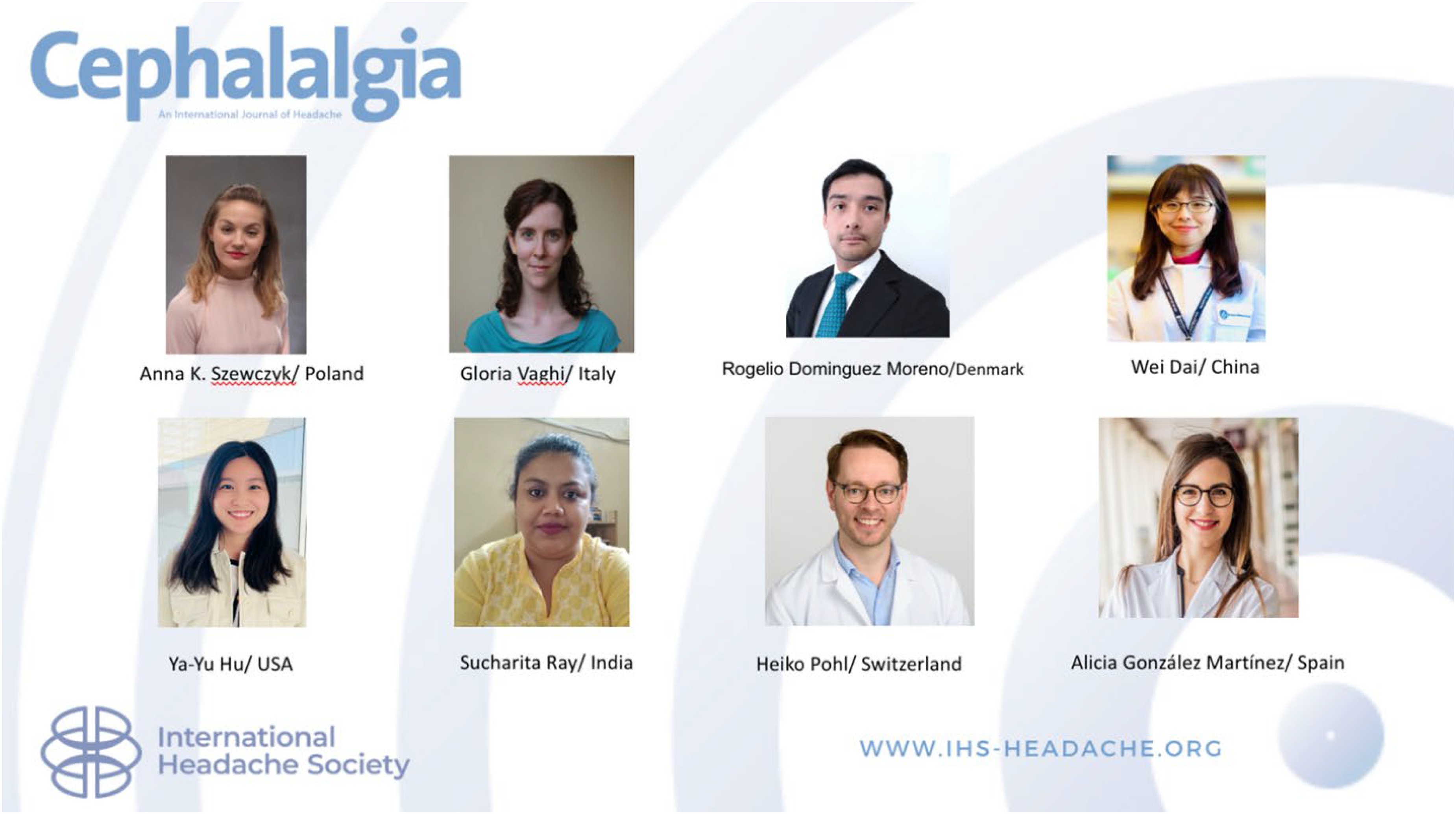
Participants in the 2024–2025 Cephalalgia Reviewer Academy.
Each trainee was paired with an experienced senior mentor. We acknowledge Anna Andreou, Gianluca Coppola, Teshame Monteith, Kuan-Po Peng, Simona Sacco, Cristina Tassorelli and Marcelo Valença for dedicating their time and expertise to support and guide the participants. The training combined hands-on mentorship in real-life peer reviews with a structured educational module covering topics such as peer review ethics, assessment of methodology and statistical rigor, editorial decision-making, and effective feedback techniques.
Throughout the program, all participants demonstrated outstanding engagement, analytical acumen and a strong commitment to the peer review process. Feedback from mentors was overwhelmingly positive, highlighting the high standard of work and professionalism exhibited by the trainees. We are confident that they will continue to contribute meaningfully to Cephalalgia and Cephalalgia Reports and to raise overall the quality of scientific publications in the headache field. We wish to see them evolve into future editorial leaders.
Building on the success of this inaugural edition, we are pleased to announce the launch of the 2025–2026 Cephalalgia Reviewer Academy. We warmly encourage early-career researchers with a keen interest in headache science to apply. Our aim remains to cultivate a strong, global community of reviewers dedicated to scientific rigor and integrity, thereby enhancing the quality of peer review in our journals and advancing the broader field of headache research.
