




Abstract
Objectives:
To develop a questionnaire that specifically evaluates the ability of trans-tibial amputees to don and doff a prosthesis and to investigate the psychometric properties of the newly developed questionnaire.
Background:
Prosthesis should be donned and doffed few times during the day and night; thus, it is important to measure ease of donning and doffing.
Study design:
A cross-sectional study.
Methods:
The questionnaire was designed and evaluated by a group of experts. The final questionnaire was administered to 50 individuals with trans-tibial amputation. A test–retest study was also conducted on 20 amputees to assess the repeatability of questionnaire items.
Results:
The prosthesis donning and doffing questionnaire was developed and tested through a pilot study. Based on Kappa index, the questionnaire items showed correlation coefficients greater than 0.7, which indicate good reliability and repeatability. The majority of the participants had good hand dexterity (80%) and could perform all types of grasps. The mean satisfaction scores with donning and doffing were 69.9 and 81.4, respectively. Most of the respondents needed to don and doff the prosthesis 3.44 times per day. Based on a 7-point score, the total scores ranged between 3 and 7.
Conclusion:
The prosthesis donning and doffing questionnaire items showed good psychometric properties. A scoring method was suggested based on the pilot sample, which requires further evaluation to be able to differentiate between more suspension types. A larger international multicenter evaluation is required in the future to measure the responsiveness of the scales. This questionnaire will be useful in the evaluation of the ability of amputees to don and doff a trans-tibial limb prosthesis.
Clinical relevance
Donning and doffing of prostheses are challenging tasks for many lower limb amputees. The prosthesis donning and doffing questionnaire, on its own or combined with other prosthetic evaluation questionnaires, has the potential to help manufacturers, clinicians, and researchers gain knowledge and improve the donning and doffing qualities of prostheses.
Background
Prosthetic use is the topic of interest among the clinicians and researchers. No matter how advanced the prosthesis, if the user is not satisfied with aspects such as ease of use and level of comfort, he or she may discontinue using the device.
Provision of a good prosthetic suspension system is one of the key elements in the rehabilitation process of persons with lower limb amputation.1,2–7 Excessive translation, rotation, and vertical movements between residual limb and socket should be prevented through the suspension system.2,4,8–11 As amputees’ statements and research findings suggest, suspension and prosthetic fit are strongly related to the functional efficiency and comfort levels.4,12 Walking pattern, residual limb soft tissue and skin, and comfort can be jeopardized by poor suspension.2,4,10,13,14
Knowing that a socket and suspension system should be donned and doffed few times during the day and night, it is important to measure ease of donning and doffing. Effortless donning and doffing does appear to have a positive effect on satisfaction with a prosthesis. 5 The socket and suspension systems require different methods of don and doff, some of which are time-consuming and necessitate more hand strength and cognitive effort than others. The pin/lock suspension needs few re-adjustments of residual limb within the socket so that the pin is fully locked distally. The seal-in system, for example, needs a longer period as first the amputee needs to spray either the inner socket or the seals, and then remove the socket valve and push the limb into the socket and put back the valve. 15
Instruments are available to evaluate socket comfort such as the socket comfort score, 16 yet to the authors’ knowledge no instrument has been developed that focuses on donning and doffing quality of prosthesis. The clearer the insight into suspension systems, the easier will be the selection for prosthetist.1–3,17
In the last decades, a multitude of surveys were carried out to investigate broadly different fields associated with prosthesis acceptance, reasons for non-use, or user preferences. A questionnaire is the most commonly used method of gathering information, because it is a less costly way to reach more people, including people at some distance. Depending on the method of distribution, it can be swiftly done and data analysis can begin right away. The questionnaire keeps away from interviewer bias, guiding and cues that can impact the legitimacy and reliability of the data collection. There are different questionnaires in the fields of prosthetics and orthotics such as Prosthetic Evaluation Questionnaire (PEQ), Trinity Amputation and Prosthesis Experience Scales (TAPES), Orthotic Prosthetic User’s Survey (OPUS), Houghton scale of prosthetic use, and Amputee Body Image Scale (ABIS). 18 However, few of these instruments address donning and doffing of prosthesis.
Based on the literature, there is no questionnaire available to evaluate the donning and doffing procedures of suspension systems. Thus, we developed and evaluated a new questionnaire for donning and doffing for transtibial amputees.
Methods
Development of the instrument
In the development process of the questionnaire, to ensure validity and reliability, first of all, the researchers reviewed the relevant literature and examined the questionnaires designed for similar purposes.1–4,16 The first draft of the instrument was developed based on interviews with eight experts as well as prosthetic users. 2 The interviews aimed to identify a list of important items in donning and doffing of lower limb prostheses. During the interview, we asked the respondents to suggest any items concerning donning and doffing that were not included in the list.
Then, a form was designed to measure both content and face validities of instrument. The content validation required the experts to rate each item of the questionnaire based on two criteria of the appropriateness of the item in representing the topic and the clarity of the meaning of the item. The face validation questions required the experts to judge about the components of visual appeal, quality of instructions to respondents, scoring format, number of sections, number of items, wording of items, relevance of items to donning and doffing, and length of time needed to complete the questionnaire. Then, the first draft of the questionnaire and validation form was sent to experts to be reviewed to ensure the content validity and face validity of the questionnaire. A list of expert prosthetists as well as researchers and academics in the field of prosthetics and orthotics was prepared. The questionnaire together with a cover letter was emailed to them. A reminder email was sent to the experts after 2 weeks to increase the rate of response. In qualitative content validity, content validity index (CVI) and also Kappa coefficients are two indicators for measuring the validity of items in different aspects, such as relevance and clarity. These two indexes were calculated for the obtained results. To calculate modified Kappa statistic, the probability of chance agreement was first calculated based on ranks by experts. Kappa was computed by entering the numerical values of probability of chance agreement and CVI of each item. Evaluation criteria for Kappa are so that the values above 0.74, between 0.60 and 0.74, and the ones between 0.40 and 0.59 are considered as excellent, good, and fair, respectively. The results of expert evaluation are presented in Table 1. Based on the Kappa values, items No. 3 and 6 needed to be modified.
The results of content validation for the first draft of the questionnaire.
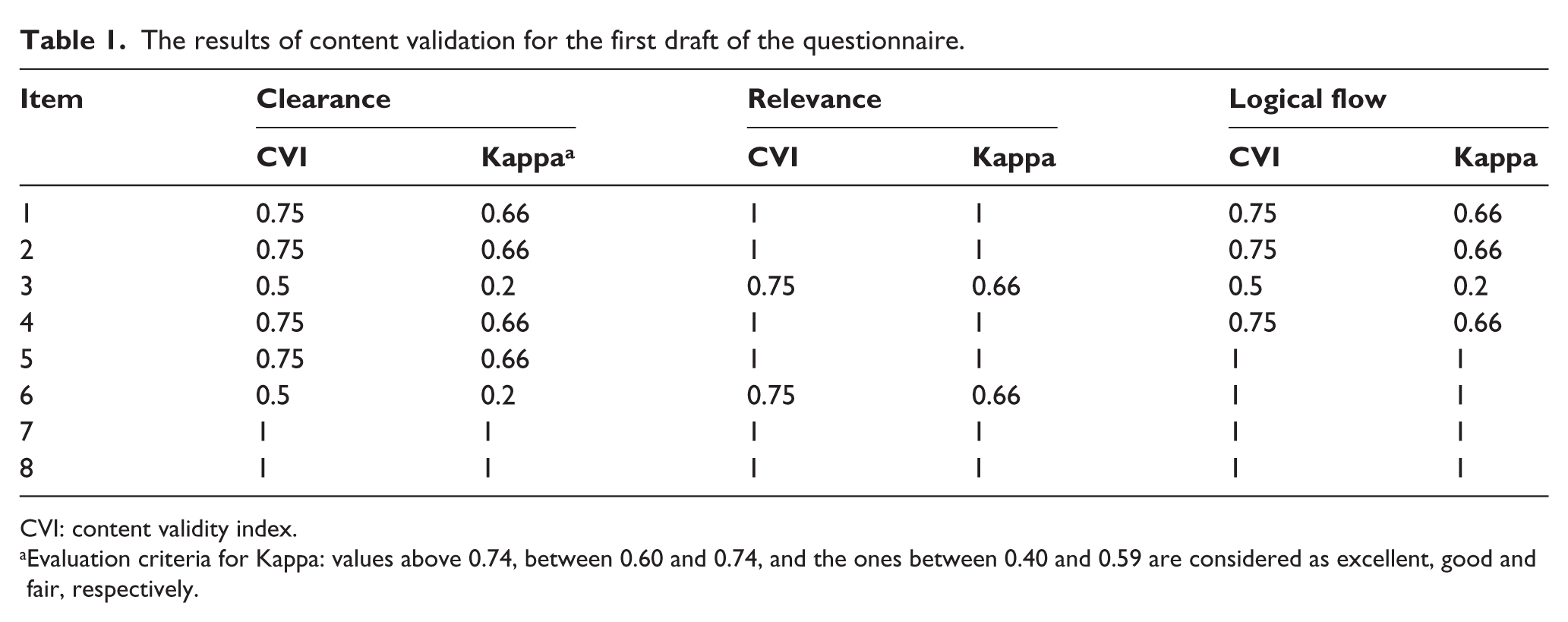
CVI: content validity index.
Evaluation criteria for Kappa: values above 0.74, between 0.60 and 0.74, and the ones between 0.40 and 0.59 are considered as excellent, good and fair, respectively.
Pilot study
Following the suggestions from the experts, the first draft of the questionnaire was revised and necessary changes were made in the second draft. The second draft of the questionnaire was piloted on 50 prosthetic users. The main reasons of piloting the second draft of the questionnaire were as follows: (1) to test the internal reliability of the instrument and (2) to foresee the possible problems that can be encountered in the administration process due to the wording of the items.
Once there was consensus among the experts and the researchers on the content of the questionnaire survey, the next phase was to administer the questionnaire to lower limb prosthesis users. The ethics approval was granted by the Medical Ethics Committee, University of Malaya Medical Centre (UMMC; no. 20143-65). The sampling was done in Malaysia. A sample population of 50 amputees was chosen to ensure sound results for the pilot study. Several hospitals and amputee rehab clinics were approached. All the participants were required to provide a written consent for the participation. The prosthetists and clinicians attended a knowledge session to become familiar with the process of data collection, inclusion and exclusion criteria, and the questionnaire content. The mode of administration was face-to-face interview, and the inclusion and exclusion criteria required the participants to be transtibial amputee, who used prosthesis for at least 1 year and had no cognitive disorders. The period of data collection was from 15 November 2014 to 6 February 2015.
Questionnaire
The final version of the questionnaire consists of two sections: a demographic section and a section for donning and doffing issues (Appendix 1). Seven questions were designed for donning and doffing, including time for donning the prosthesis (soft liner and socket), time for doffing the prosthesis (socket and soft liner), can the amputee don/doff in the dark, does the amputee need any device to facilitate donning the prosthesis, how many times the amputee needs to don and doff the prosthesis per day, amputee’s satisfaction with donning process, and amputee’s satisfaction with doffing process. The demographics asked about the hand dexterity level, absence or presence and amount of contracture, as well as activity level, which were evaluated and logged by the prosthetist who filled the form. Prosthetists measured the time to don and doff a prosthesis by a standard stopwatch. Satisfaction was measured in two questions through a continuous visual analog scale (0–100).
In addition, to determine degree of reliability for related items and questions, a test–retest study was conducted among 20 respondents, who agreed to participate.
Data analysis
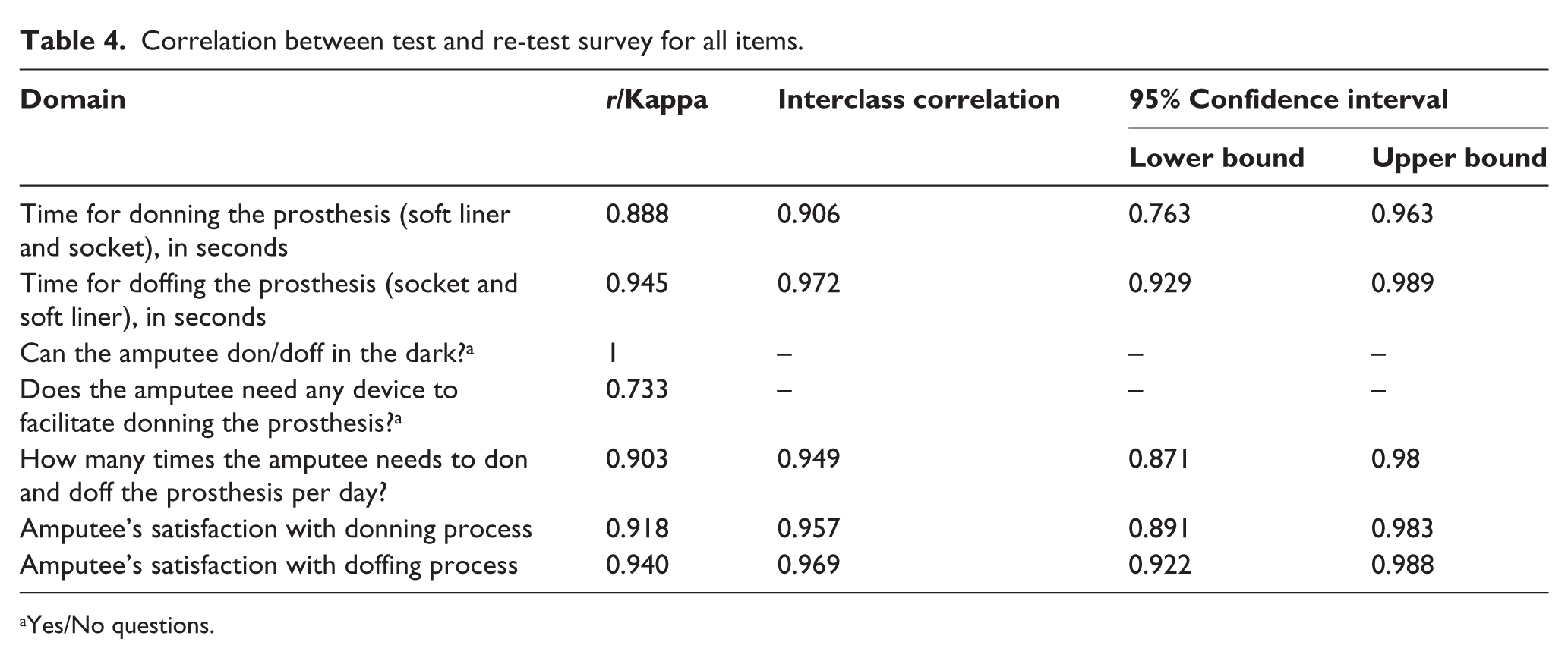
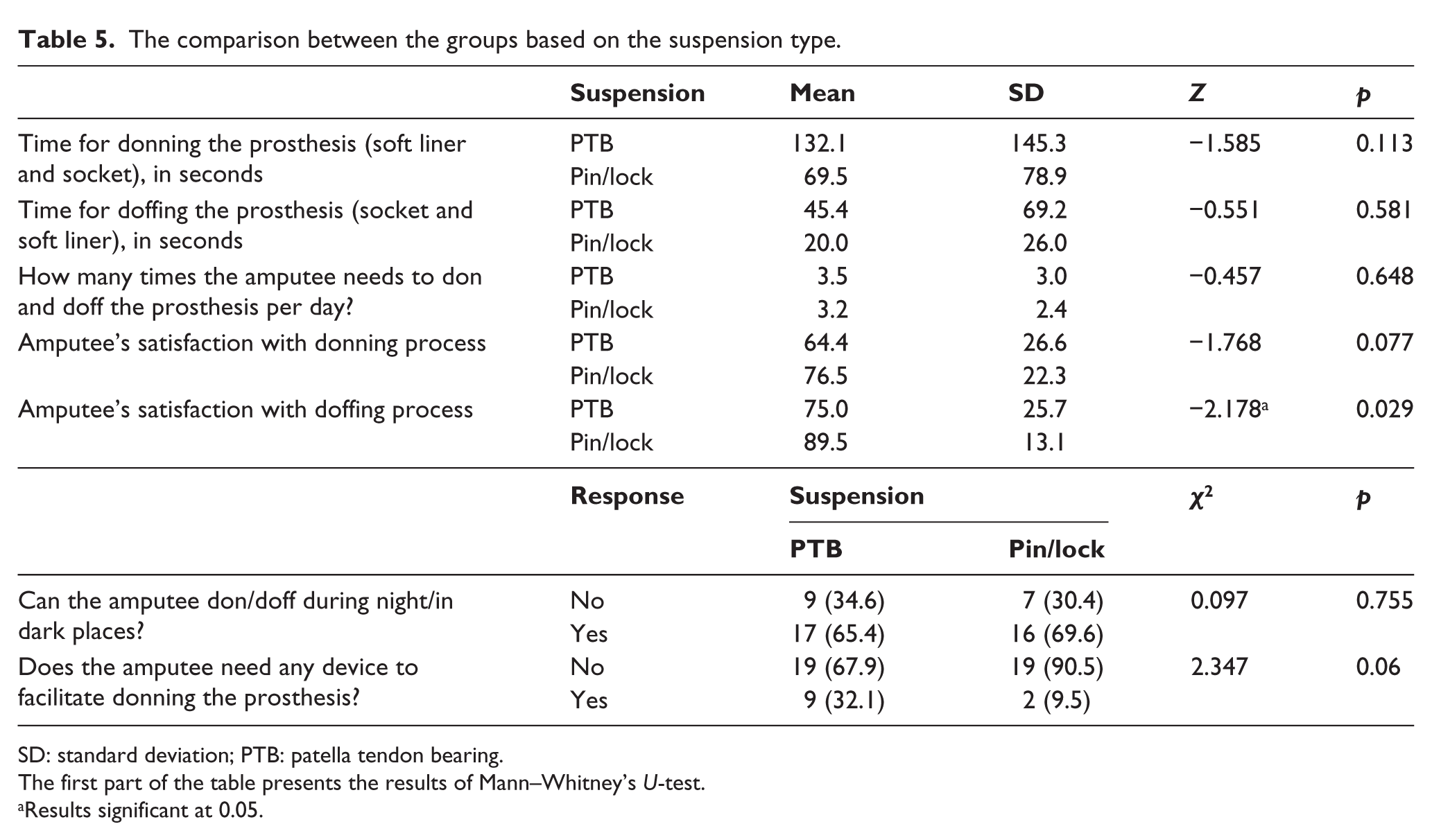
Spearman’s correlation coefficient and interclass correlation methods were applied to test the reliability of all the questionnaire items. Except for questions “Can the amputee don/doff in the dark” and “Does the amputee need any device to facilitate donning the prosthesis” that were categorical (yes/no), Spearman’s correlation coefficient was used for analysis of the test–retest reliability, and further assessment was performed by a single-measure intraclass correlation coefficient (ICC; one-way random effects model), while for the yes/no questions, Cohen’s κ coefficient was used. Descriptive statistics, including frequency, mean, and standard deviation (SD), were employed for the statistical analyses. Descriptive statistics were used to describe the demographics of the respondents. The main suspension types in this study were compared in terms of responses to the questionnaire items using Mann–Whitney U-test for continuous variables due to abnormal distribution of variables. The groups for categorical variables were compared using the chi-square test. Data were analyzed using the Statistical Package for Social Science (SPSS, version 22.0).
Prosthesis donning and doffing questionnaire scoring
To come to a single score for the instrument, the following approach was adopted, which is suggested for the current version of questionnaire. As the questions had different scales, first they were made consistent. In Step 1, for the domains D1 (time needed for donning the prosthesis), D2 (time needed for doffing the prosthesis), and D5 (number of times that the amputee needed to don and doff the prosthesis per day), the median was used as a cutoff point to generate new dichotomous variables. Respondents with a value less than the “median” were recoded as “1,” and respondents with a value more than the “median” were recoded as “0.” According to our pilot study, among 50 respondents, the median for domains 1, 2, and 5 was 60 s, 10 s, and two times, respectively.
In Step 2, for domains D6 (amputee’s satisfaction with donning process) and D7 (amputee’s satisfaction with doffing process), “50” was used as the median of scale as the cutoff point to generate a dichotomous variable. Respondents with a value less than “50” were recoded as “0,” and respondents with a value more than “50” were considered as “1.”
In Step 3, the total score of the questionnaire was calculated as follows
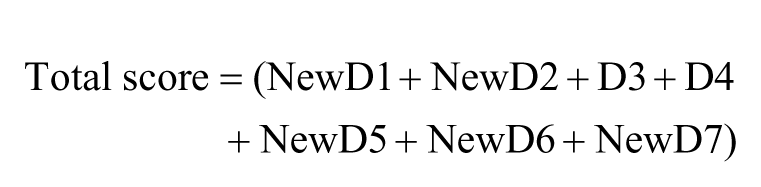
The total score may be categorized into “low, moderate, and high” as follows—total score ⩽ 2: low; total score = 3 and 4: moderate; and total score ⩾ 5: high. The higher score may be interpreted as higher quality and satisfaction with the donning and doffing.
Results
The demographic information of 50 subjects who participated in the first phase of study are presented in Table 2. The majority of participants had good hand dexterity and were able to perform all types of grasp. Only 2% of the respondents were not able to do the grasps.
Descriptive statistic for the respondents’ demographics.
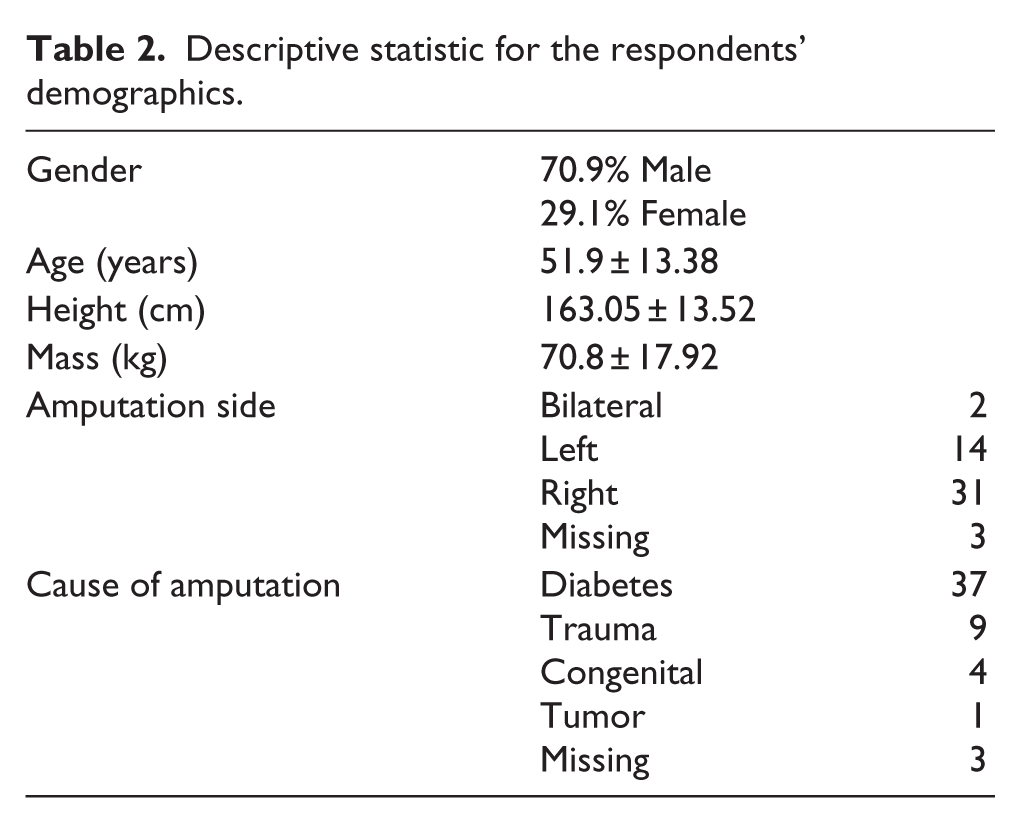
The mobility grade of the participants was mainly K2 (49.1%), followed by K1 (23.6%) and K3 (16.4%). Overall, 50.9% of the respondents used the patella tendon bearing (PTB) prosthesis, while 41.8% had a pin/lock. The majority of respondents (80%) did not have contracture. Only 7.3% had 5° of contracture, followed by 3.6% with 25° and 1.8% with 10° of contracture.
The responses to the main section of the questionnaire are presented in Table 3. According to the results, all correlation coefficients were above 0.7, which indicates that all the items are reliable (Table 4).
Statistical results for the questions with a numerical scale and yes/no questions.
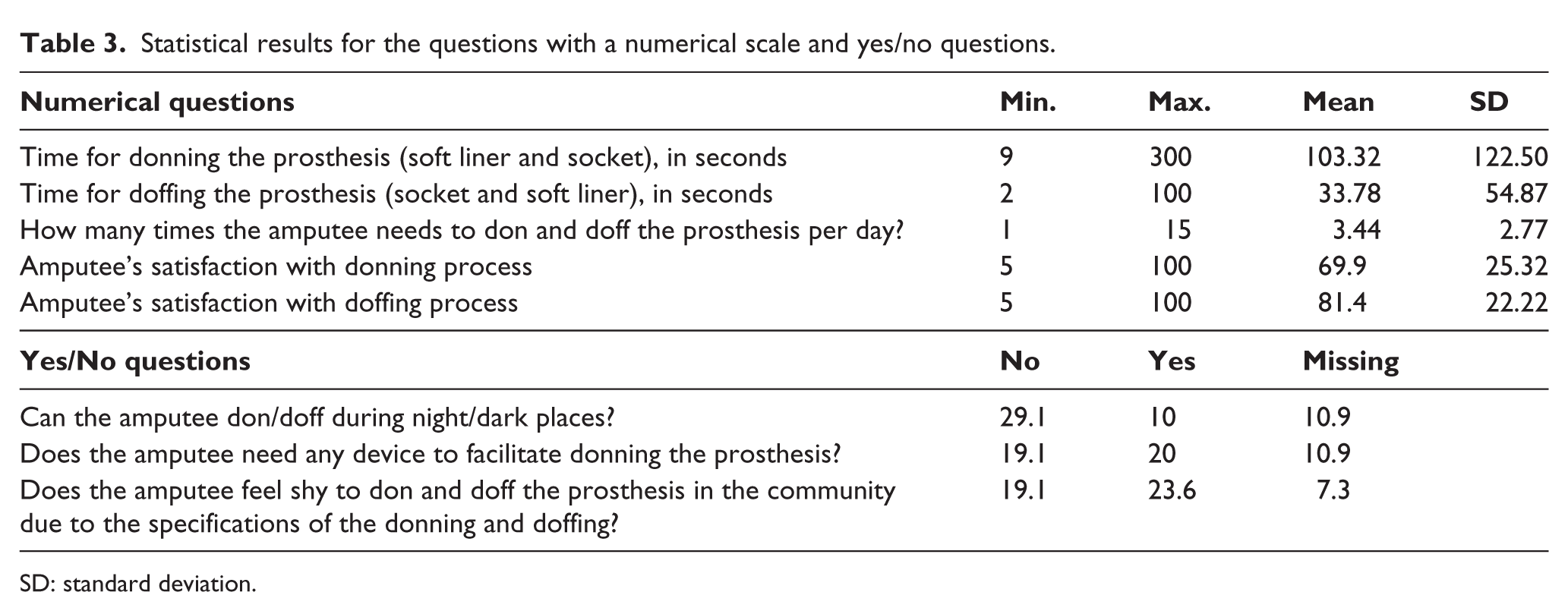
SD: standard deviation.
Correlation between test and re-test survey for all items.
Yes/No questions.
The main suspension types in this study were compared in terms of responses to the questionnaire items. Mann–Whitney U-test indicated significant difference between the groups only for “Amputee’s satisfaction with doffing process” (Table 5). Comparison between the groups for categorical variables using the chi-square test showed that there was no significant difference between the groups (Table 5).
The comparison between the groups based on the suspension type.
SD: standard deviation; PTB: patella tendon bearing.
The first part of the table presents the results of Mann–Whitney’s U-test.
Results significant at 0.05.
The total score of prosthesis donning and doffing questionnaire (PDDQ) for this pilot sample ranged between 3 and 7 with a mean of 5.68 (SD = 1.14). The total cases in this study are categorized as moderate (18.4%) and high (81.6%) based on the proposed scoring.
Discussion
The rehabilitation of a person with amputation is a challenge as it requires team work and necessitates a person’s willingness to accomplish the time-consuming and costly prosthetic training. Prosthesis satisfaction is a multi-factorial issue. Some of these factors are dependent on the level of amputation, prosthetic components, prosthetists’ skills, and especially the prosthetic suspension system. 18 Providing a proper prosthetic suspension system is a vital element of the rehabilitation process for transtibial amputees. In this study, the PDDQ was developed to specifically evaluate donning and doffing of prosthesis in individuals with trans-tibial amputation. A test–retest study was performed to assess the repeatability of the questionnaire items.
There is minimal study on the relationship between the suspension system and satisfaction. In a retrospective study, Dillingham et al. 19 examined the satisfaction of persons with lower limb traumatic amputation, which included persons with amputation at trans-femoral level. 19 The trans-femoral subjects had used either a strap or suction suspension. About 57% of the participants were not satisfied with their prostheses; however, the correlation between the suspension system and patients’ satisfaction was not investigated. 19
While a number of prosthesis evaluation measures are available, none has addressed specifically conditions related to donning and doffing. A validated measure, such as the PDDQ, may allow detailed assessment of the challenges pertaining to donning and doffing lower extremity prosthetic devices. This information could then be used for improvement of prosthetic systems, especially the suspension method. The effect of variables, such as hand dexterity, level of education, stump length, environmental conditions, and suspension type, on donning and doffing is unknown at the moment. Once validity of the instrument is established with other levels of amputation, these effects can start to be evaluated. It is hoped that future research and clinical use of the questionnaire will contribute to decision-making for prosthetic prescription and intervention for individuals with unilateral lower limb loss.
From the test–retest perspective, all the items showed very good consistency, but the greatest rating consistency was with “time for doffing the prosthesis (socket and soft liner),” while the lowest was for the “time for donning the prosthesis (soft liner and socket).” Based on the results of this questionnaire, the mean time (s) for donning the PTB prosthesis and pin/lock system was 132.1s (SD, 145.3) and 69.5s (SD, 78.9), respectively. Moreover, satisfaction for donning/doffing process was higher with the pin/lock than the PTB prosthesis (Table 5).
The literature shows that ease of donning and doffing may affect the prosthesis use tremendously and could have a positive effect on satisfaction. 5 Currently, the silicone liner is the most popular among the lower limb prosthetic users, because it offers enhanced suspension and fit within the socket as well as improved function.2,6,7,11 Previous research on silicone liners has found that patient comfort and satisfaction are particularly high in contrast to other suspension systems, such as the PTB belt.2,7,11 Gholizadeh et al. 4 mentioned that suction suspension appears to solve the “milking” problem (distal tissue stretch due to the use of pin and lock system), but donning and doffing the suction system necessitates more time and hand dexterity. 4
The total scoring of the questionnaire was moderate to high. Higher scores (closer to 7) may be interpreted as better quality of donning and doffing procedures and higher satisfaction. However, this study mainly aimed at evaluating the questionnaire items, and relating the scores to the suspension types necessitates further studies involving more suspension types.
Study limitations
The small sample of convenience used in this study may not be representative of all lower limb prosthesis users. Moreover, the amputees in this study mostly used pin/lock and PTB suspension systems; thus, inferences may not be made about other types of suspension. This study could not include bilateral prosthesis users. As bilateral amputees may face different problems with donning and doffing, the results may not be generalized to them. Moreover, measurement of time to don and doff the prosthesis may have caused bias in the results.
Conclusion
Donning and doffing a prosthesis is one of the factors affecting the satisfaction with prosthesis use. This article proposes the first instrument of its type to measure quality of donning and doffing the lower limb prosthesis. The PDDQ items showed good psychometric properties. A larger international multicenter evaluation will be required in future to measure responsiveness of the scales.
Footnotes
Appendix 1
Subject number: .……….
Date: .………………….
Appendix 2
Author contribution
All authors contributed equally in the preparation of this manuscript.
Declaration of conflicting interests
The author(s) declared no potential conflicts of interest with respect to the research, authorship, and/or publication of this article.
Ethical approval
The ethical approval was obtained from the University of Malaya Medical Centre, Medical Ethics Committee (no. 20143-65).
Funding
The author(s) disclosed receipt of the following financial support for the research, authorship, and/or publication of this article: This study was funded by the University of Malaya UM/MOHE/HIR grant (grant no.D000014-16001) and Ossur ehf.