




Abstract
Background:
Curriculum documents identify key concepts within learning prosthetics. Threshold concepts provide an alternative way of viewing the curriculum, focussing on the ways of thinking and practicing within prosthetics. Threshold concepts can be described as an opening to a different way of viewing a concept. This article forms part of a larger study exploring what students and staff experience as difficult in learning about prosthetics.
Objectives:
To explore possible threshold concepts within prosthetics.
Study design:
Qualitative, interpretative phenomenological analysis.
Methods:
Data from 18 students and 8 staff at two universities with undergraduate prosthetics and orthotics programmes were generated through interviews and questionnaires. The data were analysed using an interpretative phenomenological analysis approach.
Results:
Three possible threshold concepts arose from the data: ‘how we walk’, ‘learning to talk’ and ‘considering the person’.
Conclusion:
Three potential threshold concepts in prosthetics are suggested with possible implications for prosthetics education. These possible threshold concepts involve changes in both conceptual and ontological knowledge, integrating into the persona of the individual. This integration occurs through the development of memories associated with procedural concepts that combine with disciplinary concepts. Considering the prosthetics curriculum through the lens of threshold concepts enables a focus on how students learn to become prosthetists.
Clinical relevance
This study provides new insights into how prosthetists learn. This has implications for curriculum design in prosthetics education.
Keywords
Background
Much of the published literature on prosthetics and orthotics education focuses on descriptions of courses and syllabi requirements or revisions.1 –7 Published literature also describes learning and teaching approaches8,9 and the development of open and distance learning programmes.10–13 There are also articles discussing the creation of an accessible curriculum 14 or describing the inclusion of specific concepts and skills within a programme.15–17 In addition, there are articles on the history of prosthetics and orthotics education18,19 and prosthetics and orthotics education in the developing world.20–23 More recent work has explored international views on programme outcomes 24 and teaching methods 25 through the use of Delphi studies. Compared to other health care professional education, there is little literature on the experience of learning to be a prosthetist/orthotist. This article aims to explore potential concepts that are central to understanding prosthetics and becoming a prosthetist/orthotist using the theory of threshold concepts.
Key topics have already been identified for prosthetics and orthotics in national and international documents. For example, the Quality Assurance Agency for Higher Education subject benchmark for prosthetics and orthotics 26 in the United Kingdom provides information on what a graduate is expected to know, do and understand upon graduation. Internationally, the International Society for Prosthetics and Orthotics Category I Information Package 27 provides information on the role of the prosthetist/orthotist, guidelines for final exams and the process for recognition as a category 1 programme. These documents, through information on learning outcomes and syllabi, provide information on key topics in prosthetics and orthotics education.
Threshold concepts differ from key topics. They are described as being ‘akin to a portal, opening up a new and previously inaccessible way of thinking about something’. 28 A threshold concept changes the way you think about the concept. It acts as a gateway providing access to an alternative viewpoint, which moves thinking and understanding forward. Passage through a threshold concept may not be easy with students oscillating between not understanding, misunderstanding and understanding. However, this does not mean that all difficult concepts are threshold concepts.
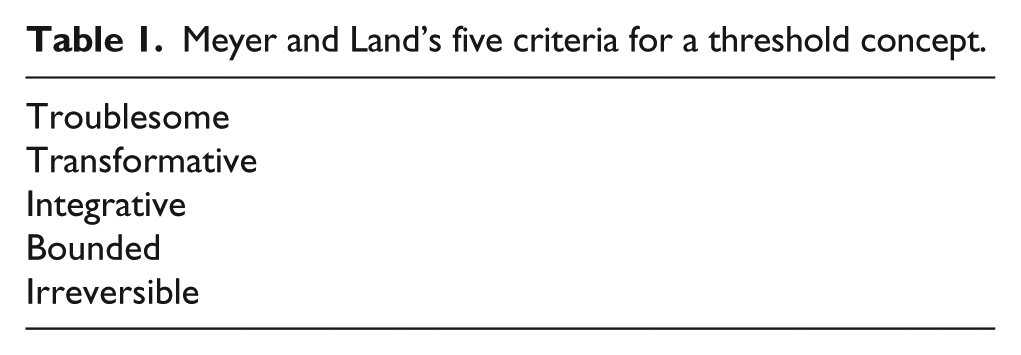
Meyer and Land 28 describe a threshold concept as meeting five possible criteria (Table 1). The concept may be troublesome, transformative, integrative, bounded and irreversible. The idea of a concept being troublesome comes from Perkins’ 29 idea of troublesome knowledge where different types of knowledge are suggested as being difficult for students. Knowledge may be troublesome because it is inert in that it remains in the person’s memory but is only used in situations such as pub quizzes, for example, historical dates. Some troublesome knowledge is alien because it is different to what the person believes or understands. Other knowledge is difficult because it is ritualised in that we follow the rule but fail to understand the ideas behind the rule, for example, the invert and multiply rule when dividing fractions. Complexity also creates troublesomeness, where several different pieces of information are combined. Meyer and Land 28 added tacit knowledge to the types of troublesome knowledge, where knowledge is internalised by the expert and difficult to make explicit to the learner. The second possible criterion of a threshold concept is its potentially transformative nature. This transformation could be a change in conceptual knowledge or a change in ontological knowledge. Integration, the third criterion, involves linking and/or combining several different pieces of knowledge together or that the knowledge integrates into personal beliefs and understanding. The fourth criterion of boundedness suggests that the concept is surrounded by other concepts but it may also be bounded by the view of the discipline, with other disciplines having an alternative view of the same concept. Finally, the irreversible nature of a threshold concept is considered to be due to the portal closing after you have passed through it; you can no longer see the concept from the perspective of a learner and it is something that you never unlearn. Which and how many of these criteria are central to a concept being considered threshold is subject to debate.
Meyer and Land’s five criteria for a threshold concept.
Davies and Mangan30–32 in their work on threshold concepts suggest an alternative model for identifying whether a concept is threshold or not. Their model involves three different types of concepts: basic concepts, procedural concepts and disciplinary concepts. Basic concepts are described as concepts that act in a supporting role, acting as stepping stones towards a more complicated way of understanding. 32 They will often be key topics that have previously been identified. Disciplinary concepts are the ways of thinking in a discipline, with the integration of several basic concepts together in a wider, disciplinary context. Procedural concepts are the ways of practicing in a discipline. These involve the use, and not just understanding, of basic and disciplinary concepts, enabling transformation and organisation of thinking. Together procedural and disciplinary concepts form a threshold concept framework, with procedural concepts acting as enablers of disciplinary concepts. Without development of this framework, students may have only a shallow understanding of basic concepts. 32 Practice in a discipline requires that you can think like an expert in that discipline. 33
These two models suggest different ways of differentiating threshold concepts from other concepts. If a threshold concept is more than just a key topic and changes the person in some way, then we need to consider how knowledge is used by the discipline. Meyer and Land’s model helps to explain what the concept looks like in terms of their criteria, and Davies and Mangan’s model explores how the concept is used. Using them together provides a fuller picture of what a threshold concept may look like.
Methods
The study analysed the experience of learning prosthetics using the two models of threshold concepts as a theoretical framework. There is no agreement on how best to identify potential threshold concepts within a discipline, and several different approaches have been used.34,35 Data generation and discussion have involved lecturers, students and educational developers, and many different data generation methods are used.34,35 In this study, both lecturers and students were invited to participate with interviews and questionnaires used as data generation methods.
Ethical approval was granted by the ethics committee at the Department of Educational Research, Lancaster University. The ethics committee at the University of Strathclyde requested the paperwork for Lancaster University and gave approval based on this. The University of Salford stated that they did not need to give further approval since Lancaster University had granted approval. Data were generated during the academic year 2008–2009. All participants gave written informed consent.
Students across 4 years of two undergraduate programmes in prosthetics and orthotics were invited to participate. Those interested were asked to complete a short demographic questionnaire. Students from University B were then purposively selected to ensure a broad range of backgrounds. A smaller number of students from University A volunteered, so all were selected as participants, but they also came from a range of backgrounds. The selected students in first to third year attended a semi-structured interview. Students in fourth year were on placement and participated through an emailed questionnaire. This consisted of the same questions as the interview plus some prompting questions. A total of 18 students participated: 7 from university A and 11 from university B. Students are identified by a number and are listed according to the academic year they had recently completed. Academic staff involved in teaching prosthetics were also invited to participate. Eight lecturers (five from university A and three from university B) participated in semi-structured interviews using similar questions to those asked of the students. The questions in the interview schedule and the questionnaire asked participants to describe their experience of what was difficult, challenging and easy to learn in prosthetics and why. A prosthetic prescription question was also included. All interviews occurred in the participants’ place of study or work. Interviews were digitally recorded and transcribed verbatim. Questionnaire responses were saved as text documents.
The transcripts were analysed using an interpretative phenomenological approach described by Smith and Osborn. 36 This method of analysis involves detailed reading of the transcripts. Initial readings are to familiarise the researcher with the data and notation of initial areas of significance or interest, moving on to noting initial emerging themes. Transcripts were analysed individually, then emergent themes across the transcripts were refined, compared and connections explored. Emergent themes were also considered according to the frequency that these themes appeared in the data and the range of responses within these themes. The emergent themes were then organised into a framework. The final themes were then considered in light of which criteria from Meyer and Land’s 28 model they met and whether they included professional and disciplinary concepts from Davies and Mangan’s30,31 model. Through this comparison with the two models, concepts that were potential threshold concepts were identified.
Results
Three potential threshold concepts in prosthetics were identified from the data: ‘how we walk’, ‘learning to talk’ and ‘considering the person’. It is outside the scope of this study to ascertain whether there is a hierarchy across these concepts. Each possible threshold concept is considered in light of the two models of threshold concepts. However, it has not been within the scope of this research to ascertain if these possible threshold concepts are irreversible. Extracts from participants’ transcripts have been selected to represent the range of views and potential levels of understanding for each potential threshold concept. The selection aims to give a picture of what the threshold concept looks like based on the two models. However, since this article draws on a larger study, 34 not all participants are represented in the extracts presented here.
How we walk
Prosthetists need to have an understanding of both normal and abnormal gait. Observation of gait and identification of variations in gait pattern are everyday tasks. This is assisted through an understanding of the effect of forces on the body. This disciplinary understanding of gait integrates into prosthetists’ daily life, causing an ontological transformation in the person. Here, Student 2 explains that she finds herself observing and analysing peoples’ gait in her daily life:
… you end up trying to see what sort of amputation they’ve got and what socket they’re wearing and what sort of shoe they’ve got on or, oh that’s slightly too long they’ve got a bit of a. You end up gait analysing people and like, ‘stop it’, you have to tell yourself. But that’s what’s become, being blasé about, there isn’t that many amputees in the world but you just see a lot of them all the time. (Student 2, year 3, University B)
However, understanding and internalising the effect of invisible forces on the body during gait can be difficult. It requires students to integrate the knowledge of gait variations, forces and changes to the alignment of the prosthesis making the concept complex. This lecturer suggests that this takes time:
… they can understand how an alignment unit can change the limb set up and what gait deviations that will cause. And that’s really latterly after they’ve really studied, they’ve had some alignment experiences, then they’ve gone back to the books. And they get to grips with that and then you say ‘well ok so, for instance, the patient has a lateral thrust of the knee so where are the excessive stump socket interface forces going to be?’ and then they, that’s another bolt on that they hadn’t actually considered. So it’s making those links to what they’re changing with the patient, on the patient, with their prosthesis and how that then links to what they’ve learned in biomechanics. (Lecturer 6)
Observation, analysis and adjustment of gait is a procedural concept that is difficult for students until they form some memories connected to the procedure. These memories can be connected to forming mental images through experiencing some variations in gait themselves as this lecturer explains:
I really started [to] learn those [gait deviations] when I started to be able to visualise them, to really understand them to actually try and carry those out, so have a walk round the living room with one shoe on and one shoe off or sticking your leg out to the side. And I think once you, you can then start to really, kind of, internalise them rather than being a list. (Lecturer 2)
Other memories connect to prosthetic users they have seen and the issues experienced by them as described by Student 11:
… and trans-femoral helps because my patient had [pressure] in their groin and you couldn’t have it up there, so that meant that it was pushing that way, so you had to make sure that that pressure wasn’t high and that just made it, you know, it made sense that way ’cause it, it was going round that way. (Student 11, year 1, University A)
The integration of disciplinary concepts and procedural concepts helps students grasp why they are learning certain concepts in biomechanics connected to gait as Student 18 explores here:
It [forces in gait] was well explained in [bio]mechanics classes and then again in P&O science classes so when it came to having to put the theory into practise it was easy enough as we had thought about it a few times before … Aligning sockets is definitely much easier when you understand what is happening and why. (Student 18, year 4, University A)
‘How we walk’ involves a change in both ontological and conceptual knowledge acquiring the disciplinary concept, integrating into the student’s understanding of both gait and their way of viewing the world. This is achieved through the procedural concepts of gait analysis and alignment with their associated memories. The disciplinary and procedural concepts form a boundary between prosthetists and other professions but also a boundary with other possible threshold concepts. The concept is difficult because it is complex and requires integration of many different pieces of disciplinary and procedural knowledge.
Learning to talk
There are two important elements in communication within the field of prosthetics. One is to learn the disciplinary jargon and develop understanding of the concepts behind it and the other is how to communicate with different people and what language is appropriate to use. Understanding and skills in communication appear to develop gradually through the programmes.
The disciplinary language is a challenge for many students. This may be linked to where they first encounter it. For Student 10, some disciplinary words were introduced in a module on human biology, and she could not initially see their relevance to prosthetics:
… but like at first when we were taught it, we were actually taught it in biology, and I was like why do I need to know all this? But yeah, it’s, you understand it now … (Student 10, year 1, University A)
The terminology used, especially in relation to anatomy, physiology and pathology, can seem like a foreign language because of its Latin and Greek origins:
… it’s terminology that you’re not used to. Brachioradialis, what the hell does that mean? [laughs] (Lecturer 5)
Students commented on how they remembered what different words or phrases actually meant. For some it was when they had to apply this knowledge that they actually understood the meaning behind the words:
… and then trying to remember abduction and adduction. It’s when you have to apply it to real life you think ahh, but I suppose when you get the hang of it, it is a light bulb moment. (Student 6, year 1, University B)
That they have understood the concepts behind the disciplinary jargon is not always recognised by student. Student 2 explains here that it was only when talking to her mother that she realised that she had understood something:
I go home and I’ll have a really good chat with my mum and she’ll be like ‘oh what have you been doing?’ and I’ll say about it and it’s, I’m suddenly more enthusiastic about the subject because I can talk about it, because I know about it and I’m kind of, I surprise myself, I’m like ‘Oh, that must have gone in then!’ (Student 2, year 3, University B)
Eventually, the reason behind using disciplinary terminology becomes clear, and students realise that it helps them to communicate and interact with others within health care as Student 1 describes:
… being around other medical professions or being at lectures and conferences and obviously they are using all these terminologies. (Student 1, year 3, University B)
However, this understanding of why disciplinary language is used is not always linked to students’ ability to use it or their understanding of the concepts behind it. This lecturer felt that disciplinary communication rather than communication with a person with an amputation was lacking in students:
I’ve got to say with talking to the patients they’re usually pretty reasonable but when we ask them to speak to, for example, myself as a fellow prosthetist/orthotist and to use appropriate terminology they then sink badly. Their understanding of the terminology is poor, their ability to actually interlace it in conversation is exceedingly difficult. (Lecturer 1)
Other lecturers commented on the students’ ability to gather information from people with an amputation in a logical but friendly manner. They also noted that students failed to understand the reasoning behind the questions they were asking:
I think that they don’t grasp the importance of getting information from someone in the right way. So they can all sit … I mean, with a sheet of paper, lives, type of house, adaptations. All those elements of a patient history written down and they get all the answers but it’s, there’s been no rapport, there’s been, it’s been very regimental, there’s been no really digging deep, they’ve asked what’s on the sheet. They don’t know the importance of asking someone if they smoke and how many cigarettes do they smoke … they’re just asking that question because it’s on the sheet. (Lecturer 6)
While some communication involves disciplinary understanding, other elements of communication evolve around small talk with people requiring prosthetic management. Students are initially nervous when communicating with people requiring prosthetic management but this, and the way they communicate, changes as they progress as Student 3 describes:
… from the first year you, you’re sort of nervous with patients, whereas you come to the 3rd year and you’re just talking to them all as if they’re just one of your mates almost. (Student 3, year 3, University B)
Students commented that they had to learn to have these everyday conversations with people and that there was a difference between the specially selected prosthesis users they saw in the university setting and those they saw on clinical placement:
I feel the most important thing learnt on placement was how to interact with real patients, as this is something that is not possible at university. It is important as you have to learn to communicate and possibly deal with incompliant patients, which prepares you for the real world. (Student 15, year 4, University B)
‘Learning to talk’ involves two elements: the development of disciplinary language and the ability to communicate with other people. The disciplinary language involves not just jargon but also the way of thinking within prosthetics: memories of the ideas and concepts behind the words. It forms a boundary with everyday language separating prosthetists from prosthesis users, but integrates prosthetists with each other and other health care professionals in a joint language and understanding. The language integrates into the development of a professional persona transforming the student conceptually and ontologically. The procedural concept of communicating with prosthesis users involves the development of what, how and why they need to ask questions to prosthesis users. Together the communication with prosthesis users and the development of disciplinary language creates a way of thinking unique to prosthetists.
Considering the person
How the disciplinary concept of prosthetic management is perceived showed progression through the years of study. Students appear to progress from a focus on prosthetic components, through a focus on the person, to a wider, holistic view of prosthetic management. A change in conceptual knowledge occurs as prosthetists need to know about different prosthetic components, but there is also an ontological change in how the person views a person with an amputation, leading to a disciplinary concept. This is demonstrated through the procedural concept of prosthetic prescription, but memories of prosthesis users are drawn upon in order to achieve shortcuts in the procedure.
Advantages and disadvantages of components with no link to the person they were prescribing for were the focus for most students in the early years of their studies. However, this was also demonstrated by two lecturers. This lecturer did not refer to the prosthesis user’s individual needs when prescribing a prosthetic foot:
… a fairly simple and reliable foot like a dynamic foot. (Lecturer 6)
Some students showed progression moving to consider how the component met the needs of the person:
… because it said he is, it seems that he is an active prosthetic user and if he wants to work in his garden and he wants to go to church, so that [the foot] adapts quite good to uneven terrain, uneven ground. (Student 8, year 1, University B)
Six lecturers focussed their prosthetic prescription on the individual’s needs:
He’s a carpenter so you’re talking about somebody who has upper limb dexterity and therefore wouldn’t have any real problems with managing the prosthesis in terms of rolling liners on or donning or doffing. (Lecturer 7)
Some lecturers and students also suggested a more holistic perspective considering the involvement of other health care professionals and the perspective of the person with an amputation themselves:
I would assume that the physiotherapist would be involved in working hard to get that flexion contracture out. (Lecturer 6) He lost his arm
The procedural concept of deciding on a prescription for prosthetic management involved memories of people, not necessarily prosthesis users that the participant had previously seen. This was demonstrated by participants from first year through to experienced lecturer:
… [laughs] sounds like our old gardener actually, that’s really funny … (Student 7, year 2, University B) … do you know what I think I’m a bit naughty because I looked at this, I looked at what he’d done and I then I started to drift off, into previous experience … I started thinking about who I’d seen who was anything like this bloke and I remember someone who was not exactly the same but similar and I thought [laughs] that’s what I did. (Lecturer 3)
In ‘considering the person’, there are clear conceptual changes in that students acquire knowledge about prosthetic components and who they may be suitable for. There is also, for some, a change in the way they view users and their management, moving towards a holistic view integrating other aspects of rehabilitation creating a disciplinary way of thinking. This is bounded by knowledge of prosthetic componentry. The integration and ontological transformation is assisted by memories of patients associated with procedural clinical concepts.
Discussion
Three possible threshold concepts for prosthetics arose from the data: ‘how we walk’, ‘learning to talk’ and ‘considering the person’. All of these concepts involved both conceptual and ontological transformations. Conceptual transformations involved a change in knowledge, for example, knowing the stages of gait. Ontological transformation requires a change in the person’s nature of being, their attitudes or beliefs, for example, a change in the way walking is viewed. Requires the integration of Knowledge of different areas is combined and integrated into the person’s way of viewing prosthetics and the wider world. Threshold concepts in prosthetics develop through procedural concepts and associated memories that combine with the disciplinary way of thinking: one does not happen without the other. These three possible threshold concepts are possibly bounded by each other but are also bounded by the professional ways of thinking and practicing within prosthetics.
Essentially, prosthetists view gait differently from members of the public there is a boundary that separates disciplinary understanding from everyday understanding. Understanding gait is not easy, and students struggle with both the visual observation of gait variations and with the invisible forces and their effect. Developing the disciplinary understanding involves a change in conceptual understanding of walking, but also an ontological change, integrating into the student’s being, with observation of gait becoming normal and something that happens automatically. To get to this point, however, students appear to require memories of gait variations and the effect of these variations or causes of the variations on the users of prostheses that they have seen connected to the procedural concepts of gait observation, analysis and adjustment.
Disciplinary language requires not only integration into the students’ vocabulary but also transformation, both conceptually in terms of understanding of the concepts, and ontologically as transformation into a prosthetist. Both the conceptual and ontological changes create a professional boundary, although there are terminology links to other professions. The terminology is not easily acquired and some words and phrases prove difficult for students due to their origins and similarities. Appropriate use of the disciplinary terminology and the ability to question people with an amputation can be considered as procedural concepts with understanding of the concepts behind the terminology and the rationale behind the questions asked in clinic, as disciplinary concepts.
Putting the service user at the centre of prosthetic management is identified as an important aspect of becoming a prosthetist, but this can take time and it appears to happen in stages. The conceptual knowledge about componentry forms a professional boundary. The ontological change happens more slowly and integrates the conceptual knowledge of components with the requirements of the individual and other areas of rehabilitation. The memories associated with the procedural concepts act as a professional ‘short-cut’ and also enable the development of the disciplinary way of thinking about the individual.
This study clearly has some limitations. The research focussed only on the learning of prosthetics, with orthotics being excluded. Exploration of the difficulties experienced in learning orthotics may identify both similar and different potential threshold concepts. Two concepts that were considered to be not potential threshold concepts were identified within the larger study. 34 Due to space limitations, these have not been considered in this article. Due to fewer student participants volunteering from University A, purposive sampling was not possible, but a range of backgrounds was represented although this could have been broader. This study collected data during one academic year, with students at different points in their degree. A longitudinal study following student participants over the period of their degree may produce different results. The influence of the lecturer on the students’ learning is outside the scope of this article. Davies and Mangan 31 argue that lecturers should design learning activities to expose the student’s level of understanding within the threshold concept. Others have explored lecturers’ approaches to and conceptions of learning and teaching, for example, Prosser et al. 37 and Kember and Kwan. 38 However, research on threshold concepts has not yet explored the influence of conceptions of and approaches to learning and teaching on the learner’s journey through a threshold concept.
Conclusion
Three possible threshold concepts in prosthetics are suggested. ‘How we walk’, ‘learning to talk’ and ‘considering the person’ provide a disciplinary way of viewing gait, communication and prosthetic management. The journey through these threshold concepts involve the learning of various basic concepts, together with the way that prosthetists think and practice. The possible threshold concepts integrate into and transform the student of prosthetics on their journey to becoming a prosthetist.
Key topics, the building blocks of the curriculum, have already been identified both nationally and internationally, but research is lacking on how these are combined and used in practice and how someone starts to think and practice, ‘becoming’ a prosthetist/orthotist. Threshold concepts are more sophisticated than key topics, and through focussing on the identification of possible threshold concepts, an alternative way of considering the curriculum is suggested. The three possible threshold concepts combine some previously identified key topics, such as the stages of gait or the ability to prescribe a prosthesis, into more complex threshold concepts allowing connections within and across modules and years. It also provides a focus on how theory is used, combined and explored during practical, clinically based, learning by both students and lecturers. Moving the focus away from key topics to threshold concepts allows prosthetic educators to explore tacit knowledge and connections between basic, procedural and disciplinary concepts and progress through the threshold concepts. It also allows a focus on the development of beliefs and attitudes held by prosthetists by considering ontological change, a change in identity and not only a change in knowledge.
This article seeks to begin to address the imbalance in empirical research in the education of prosthetists and orthotists. Furthermore, research is needed to explore possible threshold concepts within orthotics and thus obtain a fuller picture or framework of threshold concepts within the discipline. In addition, further research on how the suggested threshold concepts are developed, what are the basic, procedural and disciplinary concepts that enable students to journey across the threshold needs to be conducted. How we as educators facilitate and hinder this journey, through our beliefs and attitudes to teaching and learning, is also an area that requires further investigation.
By viewing learning about prosthetics through the lens of threshold concepts, a focus on how theory and practice combine is encouraged, enabling a more explicit way of viewing how prosthetists think and practice and how students make their way along this journey.
Footnotes
Acknowledgements

Author contribution
All authors contributed equally in the preparation of this manuscript.
Declaration of conflicting interests
The author(s) declared no potential conflicts of interest with respect to the research, authorship and/or publication of this article.
Funding
The author(s) received no financial support for the research, authorship and/or publication of this article.