




Abstract
Background:
Cycling with any form of limb amputation has progressed from an activity of leisure or rehabilitation to elite level competition as part of the Paralympic Games programme.
Objective:
While it is often proposed that research into sport with an amputation can be extremely limited, this study intended to identify the volume, type and historical strategy in this area.
Study design:
This study comprises a documented systematic literature review of cycling undertaken with any form of limb amputation.
Method:
This study used four online search engines to identify relevant peer-reviewed literature. These included SPORTDiscus, CINAHL, Scopus and MEDLINE. Google Scholar was also used as a secondary source. The initial results were then subjected to a set of pre-defined inclusion criteria. The resulting publications were then analysed for content and thematic commonality.
Results:
The review identified 20 articles which met pre-defined inclusion criteria. The identified peer-reviewed publications were dated from the period 2004 to 2014.
Conclusions:
Three clear themes emerged from the historical research. There was both a paucity of peer-reviewed literature with respect to cycling with an amputation and the design of adaptive or assistive technology to replace limb loss. However, publications have been rising substantially over the last 5 years.
Clinical relevance
This review study established the historical strategy and content of cycling with an amputation and identified the existing research themes. This will assist in summarising the current level of knowledge and help signpost such work in the future.
Keywords
Background
While the interest in recreational activity such as running has developed extensively since the 1980s and seen extensive interest of late, 1 the attention to other forms of exercise such as cycling has been far less visible. Cycling offers many advantages to those with limb amputation. These include the physiological benefits associated with cardiovascular forms of exercise. It also provides psychological benefits such as positive wellbeing 2 and sociological benefits such as opportunities to re-engage with family and friends. 3
The expectations of individuals with an amputated limb using cycling as a medium for physical activity have developed over time from one of purely recreation 4 and have led into more extreme pursuits such as competitive cycling 5 or triathlon. 3 At the London 2012 Paralympic Games, there were five different competitive classifications, spread across two sexes. Para-cycling is governed by the Union Cycliste Internationale (UCI) which defines classifications based upon the cyclist’s functionality. These classifications are defined C1, C2, C3, C4 or C5 (http://www.paralympic.org/sites/default/files/document/120716152047682_classificationguide_2.pdf). However, to undertake cycling while possessing any level of limb amputation will likely require some form of modification to the bicycle 6 or specialised prosthetic equipment developed by the clinician. 7 As a result, the ability to facilitate and optimise the performance of individuals with amputation(s) undertaking cycling is of increasing importance and relevance internationally within the sports science sector. As a result, a systematic review was undertaken to assist in this process for clinicians, athletes or other stakeholders.
Methods
A review of peer-reviewed literature was conducted in late 2014 by the author. Four relevant bibliographic databases were used for this purpose. These included the SPORTDiscus, CINAHL, Scopus and MEDLINE bibliographic databases. Furthermore, Google Scholar (GS) was also used as a secondary source to identify any missing articles and to follow up on any citations made by the resulting identified literature.
A series of keywords were used in combination for the databases. A primary keyword (keyword 1) was used in direct combination with a second keyword (keyword 2). These two keywords were combined using the ‘AND’ Boolean algebra denotation. These database search terms are presented in Table 1.
Summary of database search keywords.
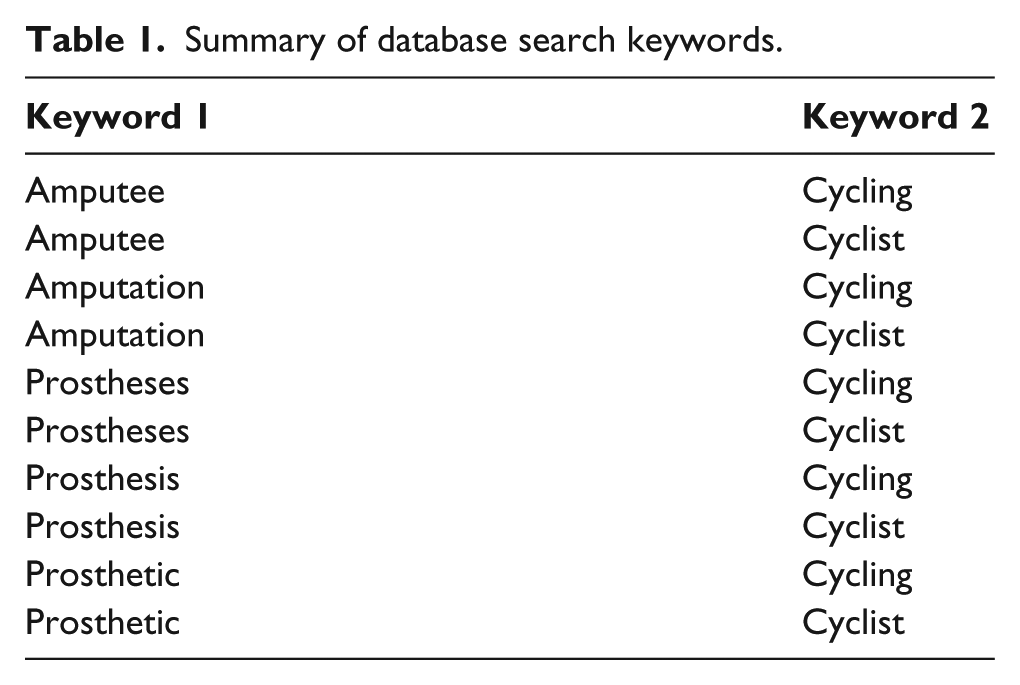
Once the literature had been identified, several inclusion criteria were established as a specification for relevance. These were defined as follows:
Must be peer-reviewed literature.
Must involve specific investigation of cycling with an amputation or cycling with the use of a prosthetic limb. Publications which merely informed that cycling with limb absence exists anecdotally (but possessed no definitive contribution to that end) were discounted.
Must involve cycling as an activity using amputated limbs to perform the activity. Articles which investigated single-sided cycling (i.e. pedalling using one sound lower limb but not actually using any amputated lower limbs) were discounted.
Results
In total, 1723 articles were identified using the four databases. One further article was identified using GS. It was speculated that this single article was only identified using GS and not using the other databases as it had just been published online ahead of its formal publication in print.
Once any duplicates had been removed, the remaining publications were scanned and sifted using the inclusion criteria. Of these, 20 publications met the criteria2–4,6,8–25 and were subsequently included in this review.
The date range of interest in the investigation into cycling with limb absence of the eligible publications ranged over a 10-year period from 2004 to the date of this review in late 2014. The time-series data of publication volume is illustrated in Figure 1.
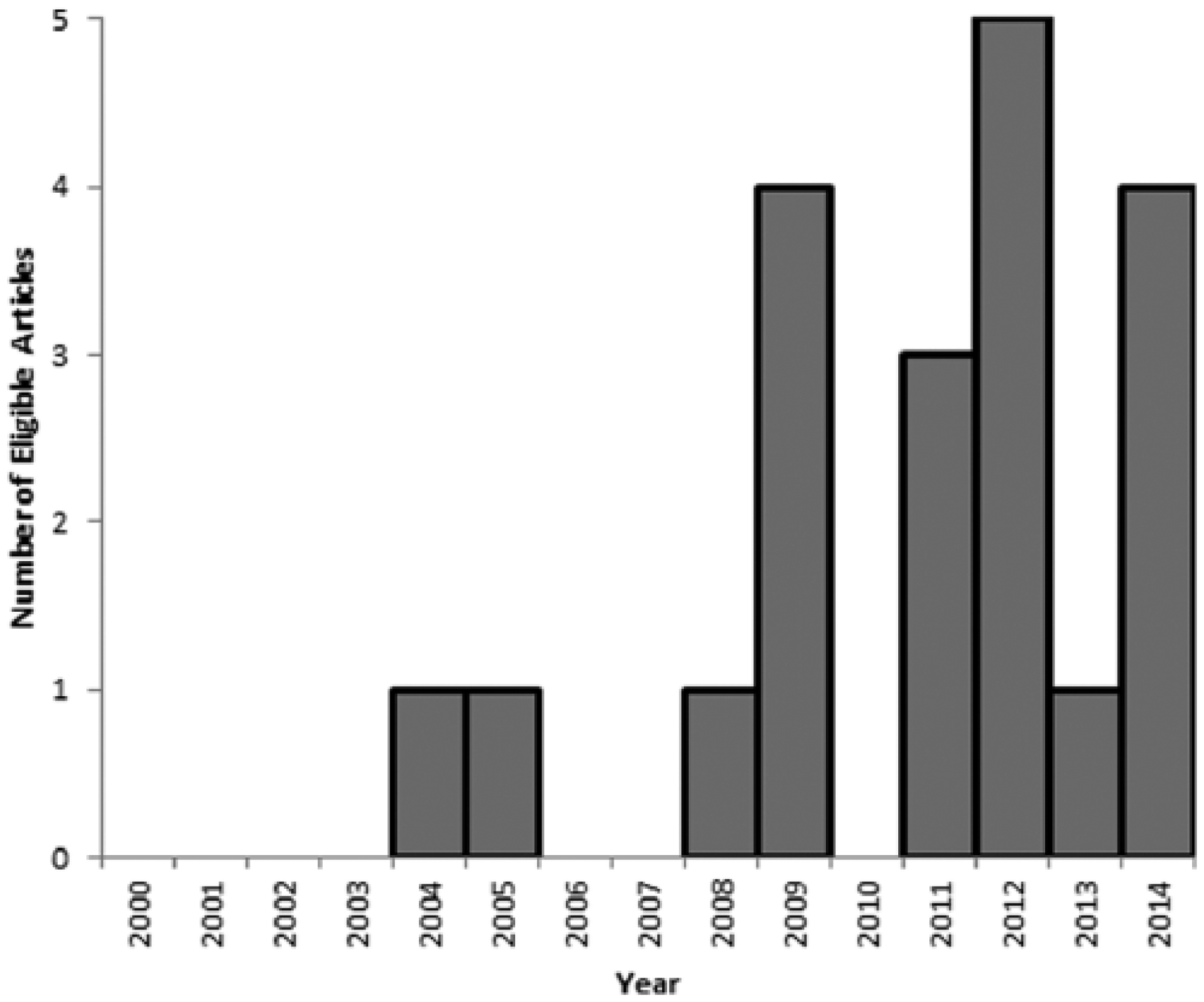
Review publication volume time-series data.
The 20 articles that were judged to have met the inclusion criteria are summarised in Table 2.
Summary of reviewed articles.
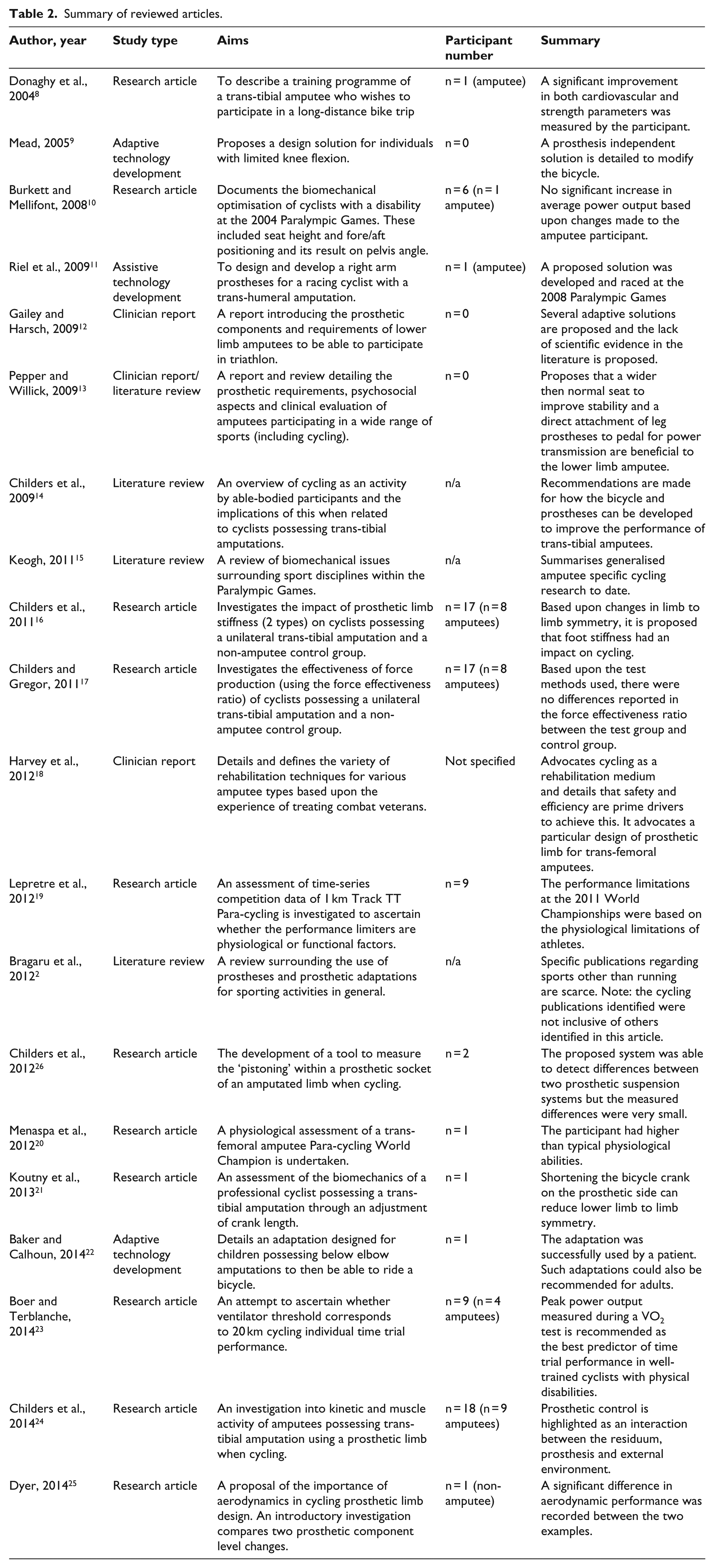
The nature of the resulting publications in Table 2 was split between literature reviews (4), research articles (11), adaptive technology development (3) and clinician experience reports (3). The article by Pepper and Willick 13 doubled as both literature review and as a clinician report.
Only four of the articles used a significant participant population of >5. Three of those were from the same first author,16,17,24 and the other utilised time-series data from a sporting event. 19 The remaining research articles typically used a case study approach using a single participant.
The types of amputees evaluated in research articles were extremely limited. Of the research articles, only two specifically concerned participants with upper extremity (UE) amputations. One of these was an adult 11 and the other a child. 22 Twelve studies specifically concerned cyclists with lower limb amputations. The remaining studies were generalised to all types of amputation or were ambiguous in their participant selection. All studies other than one used male subjects.
Of the studies that investigated lower limb amputation when cycling, only one article specifically investigated trans-femoral amputees, 20 whereas two others had photographic evidence of such candidates.12,18 The remaining articles pertained to individuals with unilateral trans-tibial amputation. Only one study had any evidence regarding cyclists with bi-lateral amputations, and this concerned photographic evidence of a cyclist riding on a static trainer indoors. 18
Discussion
Most of the selected studies in this review typically used a case study approach and/or a low number of participants. Most studies with larger sample sizes were reported by Childers and colleagues.14,16,17,24,26 However, even in these studies, the participant population number and type appears to be very similar between several of these publications so it might well be that the same population of eight or nine participants was used across several empirical studies. Such limitations can make findings extremely limited in scope if intended to be generalised to a wider population. However, running with a lower extremity amputation has seen the most attention to date, and this has also been subjected to low participant numbers. 1 As a result, it is unrealistic to expect this to change in the near future with respect to cyclists. However, it is notable that a large proportion of the included articles had focused on competitive or elite level cyclists.10,11,19,20,21,23,25 This suggests that elite sport in general is significantly driving the interest and underlying need for our understanding of cyclists with an amputation, even if the total number of publications in the field is low. Practitioners are encouraged to define and distinguish clearly between leisure and elite level cyclists as any findings may well not be applicable to both groups.
The studies typically only focused on male unilateral, trans-tibial amputees. However, the literature reviews and clinicians reports did imply considerations for all types of amputees based upon practitioners’ professional experience. If prosthetic developments or case studies of individuals with amputation have occurred within the professional environment, it is recommended that such practitioners should be encouraged to publish in peer-reviewed publications.
Despite a relative paucity of publications in this field, three consistent themes emerged. These themes were
Amputee biomechanics
Amputee physiology
Assistive technology development
Amputee biomechanics
When reviewing the literature, amputee biomechanics is the most prevalent theme. Seven of the 20 publications had significant attention in this area. The underlying philosophy for this is that it can be reasoned that any degree of lower limb amputation will reduce the total propulsive torque on the amputated side and also impose compensatory strategies upon the amputee.15,24
Lower limb amputation can create a degree of pedalling asymmetry produced by changes in motor control strategy. 14 These types of asymmetry can result in limb-to-limb imbalances in applied force and the work done. 16 To both address this and to reduce the demands upon the hip area 14 or muscle activity, 21 crank shortening on the amputated side has been advocated as a potential solution.14,21 Although the work asymmetry between the lower limbs has been shown to reduce significantly, only relatively low power outputs of 140 21 or 200 W 14 were used to assess this. This moderate level of exercise intensity likely corresponds to recreational cycling and is likely far below the exertion and/or exercise intensity produced by an athlete in a competitive event. 20 As a result, any findings from such studies may not be applicable if the test protocols used do not match the user’s actual intended activity intensity and duration.
The design of the prosthesis itself may balance the lower limb force or work asymmetries. 16 A stiffer prosthesis to pedal can narrow the lower limb asymmetry. However, this would likely be of greater relevance at the higher power outputs associated with competition. It also needs to be defined whether asymmetry as a cycling characteristic is undesirable in itself if sufficient compensation takes place elsewhere.
Power meters have been used to measure improvement in amputee biomechanics. 10 By using this tool as a performance indicator, an adjustment to an amputee of both saddle height (−19 mm reduction) and saddle fore/aft saddle position (+18 mm forward) did not significantly alter average power output. Despite this, the biomechanical recommendation for the appropriate saddle height for a cyclist possessing a lower limb amputation is to use the stronger leg as the defining value and then to maintain a level pelvis when cycling. 10
Amputee physiology
While one-legged cycling was initially recommended as a means to address issues surrounding lower limb asymmetry, 2 cycling using both limbs is now prevalent in the research that was identified in this study. For an amputee wishing to cycle (or for the practitioner recommending it), a structured and tailored training programme, containing both endurance and strength exercises, can create effective rehabilitation 18 and physiological improvements. 8
It has been proposed that different physiological parameters are evident in able-bodied cycling in terms of power output and VO2 max when compared to non-athletes. 27 This was the case with an elite level cyclist with a trans-femoral amputation who possessed both VO2 max and peak power outputs at levels seen above those of non-athletes with trans-femoral amputation. 20 In fact, the recorded levels were reported to exceed those of age-matched able-bodied candidates. With this in mind, for athletes who have a lower limb amputation, their ventilatory threshold correlates best with their potential cycling time trial performance. 23 Ultimately, the limited evidence surrounding the physiological assessment of lower limb amputees suggests that when prescribing training strategies and intensities, an appropriate solution can resemble those of their able-bodied equivalents. It has been proposed that athletes with a lower limb amputation performing in the C4-C5 classification at the Paralympic Games are differentiated predominantly by physiological factors and not their functional differences. 19
Assistive technology development
Since competitive cyclists are likely to possess physiological abilities above those riding purely for recreation, it is feasible to assume that the design of their cycling specific prostheses would also need to be tailored. 2 In addition, direct adaptation to the bicycle itself is also a solution to help amputees wishing to cycle, such as those with knee flexion issues. 9
Despite the importance of prosthetic socket fit, little attention to date has addressed this specific component. The cycling socket should allow for range of motion and encourage stability. 12 It is also worth noting that the demands of strenuous exercise may drastically affect the comfort of the socket through fluid loss 12 or residual limb ‘pistoning’. 26 This means the socket design should be tailored to the type, intensity and duration of the activity.
Ultimately, modern prosthetic limbs should now focus on being lightweight and attaching directly from socket to the cleat system of the bicycle pedal. 2 The use of energy storage and return technology, traditionally associated with walking or running, may allow greater flexibility to the user, but this in turn will result in a loss of propulsive power. 2 While this lack of stiffness is likely to be of low priority to the leisure cyclist, it would be of prime importance to the prospective athlete. 16 Also, aerodynamic drag of a cyclist can represent up to 96% of the riders’ applied power at typical racing speeds. 28 As a result, the design of the athlete’s prosthetic limbs shape and profile should also be optimised for their typical competition speeds. 25
It is worth noting that the UCI has determined that all prostheses used for para-cycling competition need to be formally approved for use beginning in 2014. 29 From this, it can be assumed that while underdeveloped in terms of empirical research, the design and subsequent impact of prosthetic limbs in competitive cycling are of further value for exploration.
Conclusion
Four databases were used to systematically identify peer-reviewed literature regarding cycling with an amputation. The application of inclusion criteria to the results produced 20 relevant articles, spread over a 10-year period from 2004 to 2014. There is therefore currently extremely limited literature to help inform the field of cycling with an amputation and the design of adaptive or assistive technology to help facilitate it. However, despite this, the main themes of research in this area currently relate to an amputee’s specific physiology and biomechanics, their socket fit and function and the technology developed to help facilitate the act of cycling.
Footnotes
Author contribution
All authors contributed equally in the preparation of this manuscript.
Declaration of conflicting interests
The author(s) declared no potential conflicts of interest with respect to the research, authorship and/or publication of this article.
Funding
The author(s) received no financial support for the research, authorship and/or publication of this article.