




Abstract
Background:
Despite the popularity of commercial games in lower limb prosthetic rehabilitation, data about their prevalence of use as well as therapists’ perspectives about these games are still lacking.
Objectives:
To learn about the prevalence of use of commercial games in lower limb prosthetic rehabilitation and therapists’ perspectives about these games.
Study design:
Cross-sectional.
Methods:
An online survey was sent to physical and occupational therapists across prosthetic rehabilitation facilities in Canada. The survey had questions about the use of commercial games and therapists’ perspectives.
Results:
Data were collected from 82 therapists. Overall, 46.3% (38/82) reported that they use commercial games; of those, 94.7% (36/38) used the Nintendo Wii Fit. The most reported perceived benefits were the Wii Fit helping to improve weight shifting (n = 76/82, 92.7%) and balance (n = 75/82, 91.5%), and being motivating and complementing traditional therapy (n = 75/82, 91.5%). The most reported perceived barriers/challenges were lack of time and familiarity with the games (n = 58/82, 70.7%).
Conclusion:
Commercial games, particularly the Wii Fit, are commonly used in lower prosthetic rehabilitation in Canada. Most of the queried therapists view the Wii Fit positively. Knowledge translation activities and developing standard treatment protocols would be helpful in minimizing the barriers identified in this study.
Clinical relevance
The Wii Fit is prevalent in lower limb prosthetic rehabilitation in Canada and it is viewed positively by therapists as having the potential to improve balance and weight bearing, making rehabilitation more motivating, and complementing traditional therapy. Future studies should investigate the efficacy of the Wii Fit in prosthetic rehabilitation.
Background
Recent technological advances have facilitated the development and use of robotic and gaming technologies, such as the Computer Assisted Rehabilitation Environment (CAREN), as augmentative therapeutic tools in rehabilitation. These devices allow for interactive therapy with a reduced reliance on therapists. Due to the high cost and limited accessibility of these devices, commercial games, such as the Nintendo Wii Fit, have gained popularity within the past few years. 1 Commercial games are attractive not only because of their low cost and wide availability but also because they provide an interactive and engaging form of exercise.
Among the commercial games available in the market, the Nintendo Wii Fit is one of the most popular and prevalent games in rehabilitation.2,3 The Wii Fit offers a variety of interactive physical activity and fitness-oriented exercises that can be used in rehabilitation. A recent scoping review on the use of commercial games in rehabilitation reported that these devices are commonly used by physical and occupational therapists across a variety of client populations. 3 At our local rehabilitation facility in Vancouver, Canada, the Wii Fit games are currently being used for prosthetic rehabilitation. Although we speculate that this is the trend in other facilities in Canada, we do not have data to support this belief. Furthermore, despite the continued growth in adoption and use of commercial games in practice, data on therapists’ experiences and attitudes about these games are currently lacking. Such data will provide knowledge on the acceptability and usability of the games and can be insightful to therapists who are considering using these games in practice. A study that surveyed the use of the Wii Fit in rehabilitation of clients with burn injuries found that the majority of physical and occupational therapists (92%) viewed the games positively and as a useful adjunct to traditional therapy. 4 In another qualitative study, physical therapists regarded the Wii Fit as a fun, self-motivating, and challenging balance training program for clients with multiple sclerosis. 5
To our knowledge, there are no published reports about the prevalence of use of commercial games in lower limb prosthetic rehabilitation or about therapists’ perspectives on the use of these games in lower limb prosthetic rehabilitation. Therefore, the overall objective of this study was to obtain an understanding about the use of commercial games, particularly the Wii Fit, in lower limb prosthetic rehabilitation. The specific objectives were to discover the prevalence of use and types of games used as well as the therapists’ perspectives about the use of these games in lower limb prosthetic rehabilitation.
Methods
Design and sample
This was a cross-sectional survey study to collect data from physical and occupational therapists across Canadian public prosthetic rehabilitation facilities. These facilities were identified from the 2011 version of the compendium of Canadian Healthcare Facilities 6 as well as the National Rehabilitation Reporting System that collects rehabilitation data from Canadian facilities. The identified facilities were included in this study if they provided lower limb prosthetic rehabilitation, had a minimum of 10 rehabilitation beds designated to any one diagnosis, and annually had a minimum of five clients with lower limb amputation (LLA).
The email addresses of potential respondents were obtained from the facilities’ physical/occupational therapy clinical practice leaders. To be eligible for inclusion in the study, the potential respondents had to be physical or occupational therapists with experience providing prosthetic lower limb rehabilitation or with knowledge of lower limb prosthetic rehabilitation services within their facility, and able to read, write and speak in English or French. We chose to include only physical and occupational therapists because the literature suggests these games are mostly utilized by these groups. 3
The potential respondents were contacted by email. Initially, we emailed the introductory study letter with the survey link. If participants opened the survey link, they were directed to the consent form, which had the option of “I agree” to indicate consent. Upon providing consent, participants were directed to the survey questions. Reminder emails were sent to all participants at 2, 4, and 6 weeks later. 7 The study was approved by the Clinical Research Ethics Board at the University of British Columbia.
Survey development and questions
The survey was first developed in English based on the existing literature and our clinical experience and was later refined through five iterations. The first iteration was reviewed by three clinical researchers: an occupational therapist/epidemiologist, a physiatrist, and a physical therapist. The second iteration was reviewed by 10 researchers with various backgrounds in physical and occupational therapy. The third iteration was piloted with two therapists (a physical and an occupational therapist) who provided LLA prosthetic rehabilitation in Canada. First author (B.I.) then met the two therapists with the goal of item refinement using a think aloud approach. 8 Based on the findings from the think aloud process, the survey items and their response categories were refined. The fourth iteration was edited for clarity and grammar by three research assistants. The final iteration was reviewed and approved by all the co-authors.
The French version evolved from the English version and was back translated for refinement. Discrepancies were reviewed and resolved.
The survey had a total of 18 close-ended questions categorized as multiple choice questions, yes/no questions, and four- or five-level Likert questions. Comment boxes were provided for questions that required elaboration (Appendix 1).
Prevalence of use and types of commercial games in clinical practice
We asked whether facilities use commercial games in practice. If the answer was yes, we asked about the types of games used, the frequency of use and the time points at which the games are used.
Therapists’ familiarity with the Wii Fit and recommendation for use as a home program
We asked how familiar the respondents are with the Wii Fit and whether they would recommend it as a home program to their clients.
Therapists’ perceived benefits about the use of the Wii Fit in practice
Respondents were asked to indicate their level of agreement related to motivation and engagement, suitability for home and group therapies, and the achievement of therapy goals. Respondents were asked to identify any other perceived benefits in the comment box provided.
Therapists’ perceived barriers/challenges about the use of the Wii Fit in practice
Respondents were asked to indicate their level of agreement about potential barriers/challenges related to the time and training requirements and lack of familiarity for the therapists with the games, the difficulty levels of the games for clients, finding a training space, inability to individualize training, lack of time in clients’ training program, cost of the games or the games not being viewed as clinically useful by therapists or clients. Respondents were asked to identify any other perceived barriers/challenges in the comment box provided.
Appropriate clients’ age for Wii Fit therapy
Therapists’ opinion about the appropriate age categories for using the Wii Fit games was collected.
Respondents’ demographic information
We asked about years of experience and expertise, frequency of working with clients with LLA, position, province, age, and sex.
Data management and statistical analyses
Summary statistics including mean, standard deviation, frequency, percentage as well as graphs were used to describe the sample and address the study objectives. Because of small cell counts, the response options “strongly agree” and “agree” were collapsed together. Similarly, the response options “strongly disagree” and “disagree” were collapsed together.
Results
Demographics
The survey link was sent to 108 physical and occupational therapists who were identified from 65 eligible facilities. Of those, 82 responded (response rate = 75.9%). The respondents were primarily physical therapists (n = 61/82, 74.4%) and had 18.2 (9.8) years of professional practice (Table 1). Of the 82 respondents, 8 (9.8%) were from Atlantic, 36 (43.9%) were from Ontario, 20 (24.4%) were from Quebec, and 18 (22%) were from Western Canada.
Demographic information and summary of descriptive variables (n = 82).

LLA: lower limb amputation.
Study objectives
Prevalence of use and types of commercial games in clinical practice
Overall, 38/82 (46.3%) reported that they use commercial games in prosthetic lower limb rehabilitation. Of all of the respondents, 36/82 (43.9%) indicated that they use the Wii Fit.
Of those who reported that they use commercial games in prosthetic rehabilitation, the majority (n = 21/38, 55.3%) indicated that their clients typically spend <1 h per week practicing these games. Seven (18.4%) reported that their clients spend between 1 and 3 h per week using these games, and the remaining respondents (n = 11/38, 28.9%) indicated that the amount of use varies considerably depending on the client. The majority (n = 29/38, 76.3%) reported that these games are used “close to discharge” (Figure 1).

Summary of the responses for time points at which commercial games are used for prosthetic rehabilitation. Respondents were asked to check all that apply.
For respondents who reported that they do not use commercial games in practice, the most selected reason (n = 15/44, 34.1%) was that “they are not familiar with the games” (Figure 2). In all, 9 of the 44 (20.4%) selected “other” as the reason for not using the games, only 1 participant elaborated on this point and explained that their clients are too young to use the games.
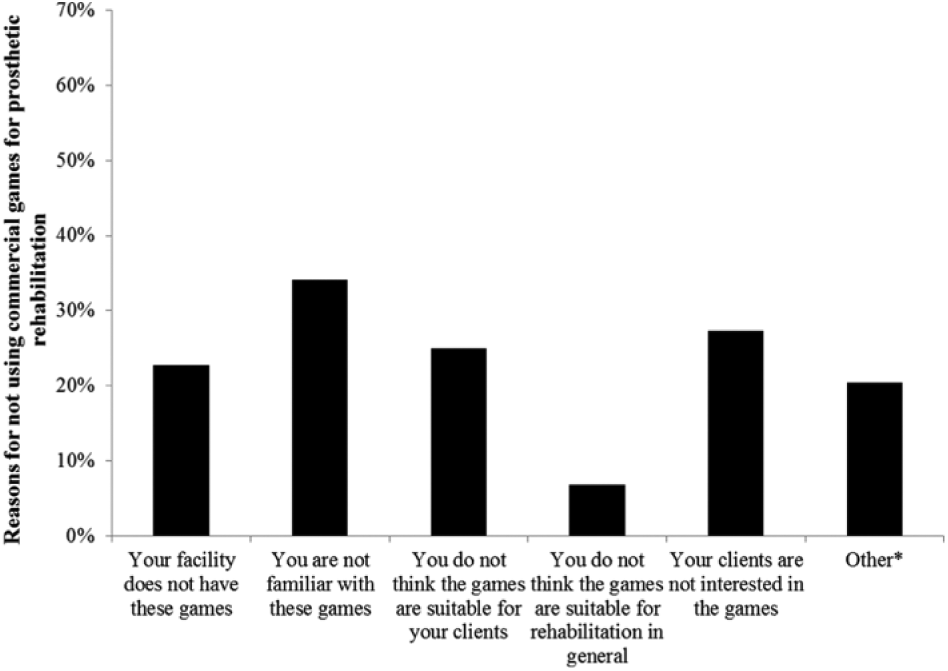
Summary of responses of reasons why respondents do not use commercial games for prosthetic rehabilitation. Respondents were asked to check all that apply.
Therapists’ familiarity with the Wii Fit and recommendation for use as a home program
When respondents were asked how familiar they were with the Wii Fit games, 41/82 (50.0%) responded that they were “somewhat familiar” or “very familiar,” while 38/82 (46.3%) were either “a little familiar” or “not familiar at all.”
Overall, 47/82 (57.3%) indicated that they “would recommend the Wii Fit games as a home program”; 12/82 (14.6%) reported that they would not; and 23/82 (28.0%) were unsure. Those who reported that they do not recommend the Wii Fit listed the following reasons: older age of clients and, thus, lack of interest and familiarity with technology and video games; uncertainty about how older clients would react to the games and safety concerns; clients’ limited resources to purchase the games; clients’ low energy state due to illness; and inability to correct posture.
Therapists’ perceived benefits about the use of the Wii Fit in practice
The most common perceived benefits (Table 2) were “helping to improve weight bearing” (n = 76/82, 92.7%), “making rehabilitation more motivating for clients” (n = 75/82, 91.5%), “complementing traditional rehabilitation” (n = 75/82, 91.5%), and “helping to improve balance” (n = 75/82, 91.5%).
Perceived benefits to using the Wii Fit in lower limb prosthetic rehabilitation (n = 82).
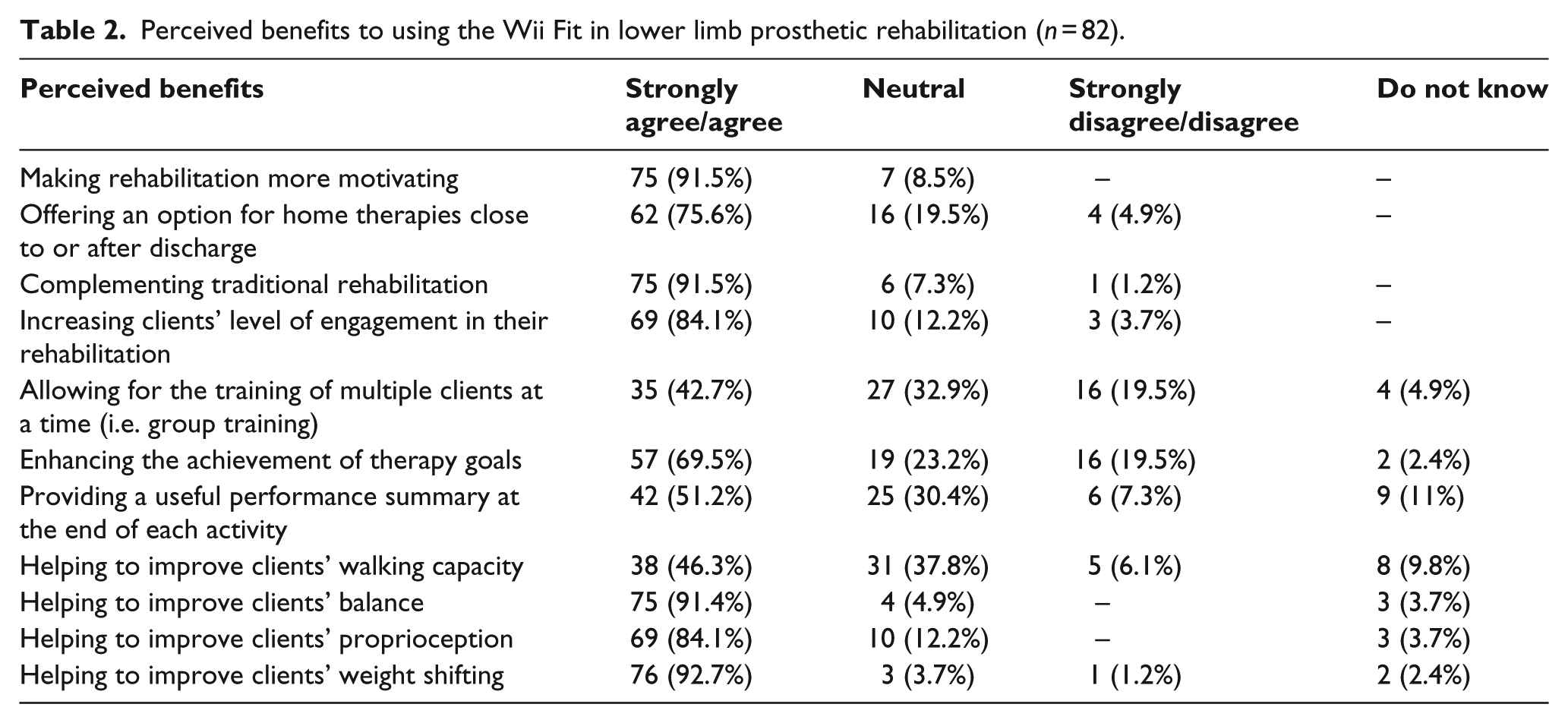
Seven respondents (8.5%) listed additional perceived benefits, such as improving self-confidence, enabling clients to participate in favored recreations (e.g. tennis), increased acceptance of sport as an activity option, distraction from disability, and enhanced social support.
Therapists’ perceived barriers/challenges about the use of the Wii Fit in practice
The most frequently reported perceived barriers/challenges (Table 3) were “lack of familiarity of therapists with the games” (n = 58/82, 70.7%) and “lack of time” (n = 58/82, 70.7%).
Perceived barriers/challenges to using the Wii Fit in lower limb prosthetic rehabilitation (n = 82).
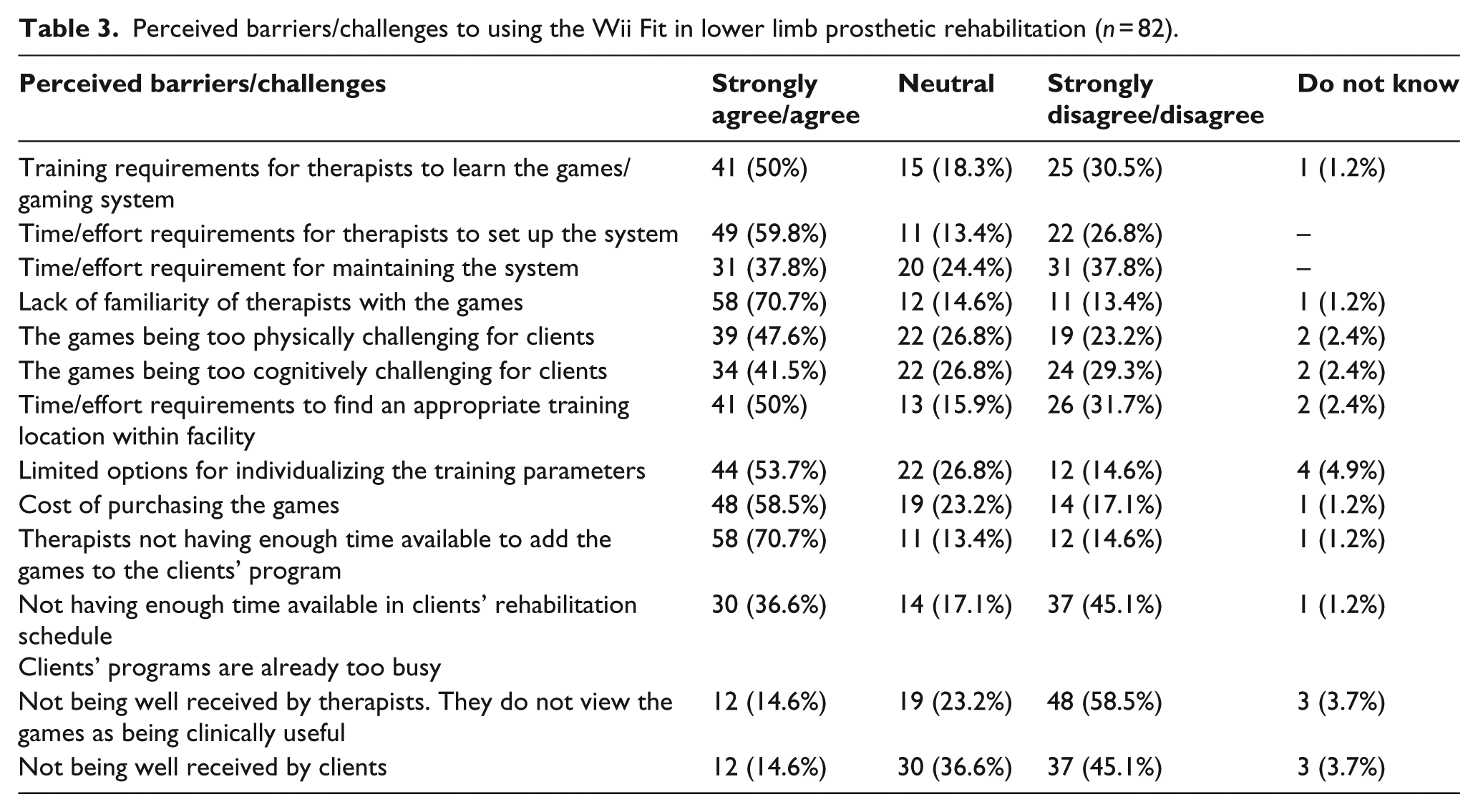
Additional perceived barriers/challenges identified by the participants were difficulty to keep up with technology and new games, and safety and risk of falls.
Appropriate clients’ age for Wii Fit training
When respondents were asked in which client age categories it would be appropriate to use the Wii Fit games for prosthetic rehabilitation, 78/82 (95.1%) reported 20–49 years of age, whereas 44/82 (53.7%) indicated 65+ years of age (Figure 3).
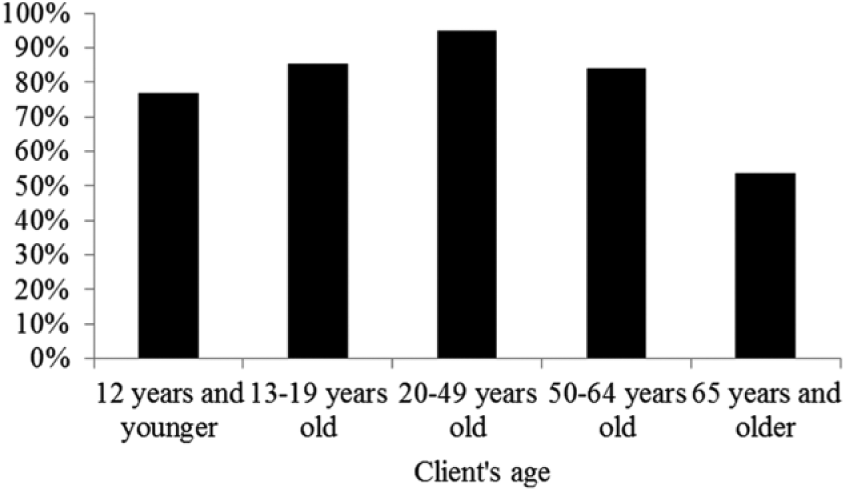
Summary of responses showing therapists’ opinion about appropriateness of using the Wii Fit games for different age categories. Respondents were asked to select all that apply.
Discussion
In this study, we showed that almost half of the respondents across Canada use commercial games in lower limb prosthetic practice. This finding provides evidence to support the claim by Ravenek et al. 3 that commercial games are rapidly becoming popular and prevalent in rehabilitation. Our results showed that among different types of commercial games used by therapists, Wii Fit was the most prevalent. Almost 95% of those who reported using commercial games in prosthetic rehabilitation indicated that they use Wii Fit games. The higher popularity and prevalence of Wii Fit use compared to other commercial games may suggest that therapists view the Wii Fit exercises as more suitable for this population. Alternatively, the higher prevalence could be related to the fact that Wii Fit has been around for a longer time and there is more research on its use, such that therapists are more familiar and comfortable with using it. When we asked about therapists’ familiarity with the Wii Fit games, half of the sample responded that they are somewhat familiar with the games, whereas the other half indicated that they are either a little familiar with the games or not familiar at all. It is challenging for busy therapists to keep up with the pace of rapidly growing technologies. The Xbox Kinect, for example, is the latest commercial gaming technology in the market and may hold greater promise for use in rehabilitation because of the advanced motion tracking technology that it uses; however, compared to the Wii Fit, it is less commonly used in rehabilitation and the research evidence for its use in rehabilitation is still limited.
When we asked whether the therapists would ever recommend the Wii Fit games as a home program, the majority (~57%) indicated that they would. Those who indicated that they would not recommend these games (~15%) stated that this was because their clients did not have these games or were older and would not like video games. It is interesting that despite the concern that clients do not have these games, the Entertainment Software Association of Canada has shown that 62% of Canadians have at least one video gaming console in their home. 9 Additionally, 54% of Canadians (mean age = 33 years; 52% males) have played video games in the past 4 weeks. Specifically, among Canadians older than 55 years old, 34% play video games. 9 Another report showed that the use of technology is growing quickly among the elderly in the United States. 10 In fact, it has been shown that older adults generally have positive attitudes toward technology, particularly toward devices that can be used at home to improve their health and independence level. 11 This suggests that in contrast to the belief that older adults are unwilling or unable to use technology, recent advancements and widespread access have resulted in older adults becoming more familiar with, and willing to use, technology. 11 In our study, the majority of the therapists (~95%) reported that the appropriate age for using the Wii Fit is 20–49 years, while about half of the therapists (~54%) indicated that the Wii Fit is appropriate to be used by the clients over the age of 65 years. Our personal observations have shown that although older participants have a steeper learning curve associated with video games, the majority enjoy and are capable of learning the games. Compared to younger adults who are usually able to engage in several other active therapies, older adults’ range of activities is often limited. These games may potentially offer an opportunity for older adults to safely engage in activities (e.g. skiing or running) that they would otherwise be unable to do in real life.
When we asked about the respondents’ perceived benefits and barriers/challenges associated with using the Wii Fit games in lower limb prosthetic rehabilitation, respondents reported more benefits than barriers/challenges (mean percent of strongly agree/agree with the perceived benefits = 74.6%; mean percent of strongly agree/agree with the perceived barriers/challenges = 46.6%). This may suggest that therapists generally have positive experiences using these games in clinical practice. The most commonly reported perceived benefits (>90%) were “making rehabilitation more motivating for clients” and “complementing traditional rehabilitation.” Numerous studies have reported similar findings associated with using Wii Fit in different patient populations.5,12,13 In a focus group that was conducted to explore physical therapists’ experiences with using the Wii Fit for balance training in individuals with multiple sclerosis, most physical therapists reported that exercising using the Wii Fit was fun and self-motivating for their clients. 5 Additionally, the physical therapists indicated that the Wii Fit games complemented traditional therapy by providing training on important components of function such as balance. 5
Other commonly reported (>90%) perceived benefits in our study were “helping to improve balance” and “helping to improve weight bearing.” The use of the Wii Fit to improve weight bearing is an important finding as weight-bearing asymmetry in gait or other functional tasks such as rising from a chair is common in people with LLA, and it relates to poorer balance and falls.14,15
Approximately 76% of the respondents in our study agreed that the Wii Fit “offers an option for home therapies close or after discharge.” This is promising and may indicate that therapists view these games as clinically useful, with the potential for use after discharge to help clients retain their functional skills. Although a valid concern of some therapists was clients’ safety, there are emerging trials that report favorably on the feasibility and safety of using the Wii Fit for home therapy.16,17
Another interesting finding was that 43% of the respondents in our study indicated that the Wii Fit “allows for training of multiple clients at a time.” Providing group training using the Wii Fit is an important application which can potentially make rehabilitation more cost-effective.
The most commonly reported barriers/challenges in our study were “lack of familiarity of therapists with the games” and “lack of time to add these games to the clients program.” This finding corroborates earlier reports that therapists’ reluctance in using video games stemmed partly from their unfamiliarity with the games and their concern about the associated training requirements. 18 Similarly, Liu et al. 19 reported that time constraints and training requirements were the main barriers to adopting new technologies by clinicians in rehabilitation. For therapists who often have heavy caseloads, it is challenging to find the time to learn about new technologies and rapidly evolving interventions. The results of this study showed that although therapists generally have positive attitudes toward using commercial games in clinical practice, they need more support in terms of reducing the time required for learning and adopting these games. Frequent knowledge translation efforts, including educational sessions, could be helpful in overcoming these barriers by familiarizing clinicians with the latest findings about these games. Furthermore, developing standardized treatment protocols that provide detailed guidelines about the use of these games could help in minimizing the time required for therapists to learn the games. 18
Limitations
We included only physical and occupational therapists because they utilize commercial games the most among rehabilitation healthcare professionals. 3 Therefore, we are missing data on other healthcare professionals, such as recreational therapists that may also use commercial games. Another limitation is that despite considerable effort to identify the physical and occupational therapists from public prosthetic facilities in Canada, we missed therapists from smaller and private amputee clinics. There is a potential for non-response bias as 24% of the identified therapists did not respond to the survey. Reporting, recall, and social desirability bias are other limitations.20,21 The phrasing of the questions and the response options may have affected the responses and lead to misinterpretation. 22 We endeavored to minimize this by operationalizing the survey questions and providing comment boxes throughout the survey. We also improved the wording, content, and formatting of the survey questions through five iterative cycles. This study reported data on clients’ experiences only from the therapists’ perspective. It is important for future studies to evaluate the clients’ perspective about these games as they may differ from the therapists’ perspective.
Conclusion
Commercial games, particularly the Wii Fit, are used commonly in prosthetic rehabilitation and viewed positively by physical and occupational therapists in Canada. The majority of the therapists queried (92%) view these games as self-motivating, with the potential to complement traditional therapy and improve balance and weight bearing. The common perceived barriers/challenges with the use of these games are lack of time and lack of familiarity with the games. Knowledge translation activities and developing standardized treatment protocols could be helpful in minimizing these barriers.
Footnotes
Authors’ Note
Bita Imam received a doctoral award throughout her PhD program (Vanier Canada Graduate Scholarships) and Janice J Eng received salary award from Michael Smith Foundation.
Author contribution
All authors contributed equally in the preparation of this manuscript.
Declaration of conflicting interests
The author(s) declared no potential conflicts of interest with respect to the research, authorship, and/or publication of this article.
Funding
The author(s) received no financial support for the research, authorship, and/or publication of this article.
References
Supplementary Material
Please find the following supplemental material available below.
For Open Access articles published under a Creative Commons License, all supplemental material carries the same license as the article it is associated with.
For non-Open Access articles published, all supplemental material carries a non-exclusive license, and permission requests for re-use of supplemental material or any part of supplemental material shall be sent directly to the copyright owner as specified in the copyright notice associated with the article.
