




Abstract
Background:
Studies on the relationship between performance and design of the throwing frame have been limited and therefore require further investigation.
Objectives:
The specific objectives were to provide benchmark information about performance and whole body positioning of male athletes in F30s classes.
Study Design:
Descriptive analysis.
Methods:
A total of 48 attempts performed by 12 stationary discus throwers in F33 and F34 classes during seated discus throwing event of 2002 International Paralympic Committee Athletics World Championships were analysed in this study. The whole body positioning included overall throwing posture (i.e. number of points of contact between the thrower and the frame, body position, throwing orientation and throwing side) and lower limb placements (i.e. seating arrangements, points of contact on the both feet, type of attachment of both legs and feet).
Results:
Three (25%), five (42%), one (8%) and three (25%) athletes used from three to six points of contact, respectively. Seven (58%) and five (42%) athletes threw from a standing or a seated position, respectively. A straddle, a stool or a chair was used by six (50%), four (33%) or two (17%) throwers, respectively.
Conclusions:
This study provides key information for a better understanding of the interaction between throwing technique of elite seated throwers and their throwing frame.
Clinical relevance
This study aimed at improving the understanding of the relationship between athletic performance and the design of the throwing frame for seated discus throwers, with a particular emphasis on the description of whole body positioning. This knowledge is particularly important in the current debate around general principles underlying the design of throwing frames and classification of athletes with a disability, including those with lower limb amputation.
Keywords
Background
Opportunities for adapted physical activities for individuals with a disability have increased steadily over the last decades.1 –3 For instance, the Beijing 2008 Paralympics Games has generated unprecedented interest in track and field events. 4 Athletes who participate in seated shot-put, discus and javelin events belong to the F30s and F50s classes, which mainly includes athletes with cerebral palsy, spina bifida, amputation, spinal cord injuries and other mobility-impaired congenital defects.5 –9
The typical throwing technique of stationary discus throwers in F30s classes starts with a few preparatory oscillations and rotations of the upper limbs and trunk from a seated or standing position prior to release of the implement standing up when the throwing upper limb is fully extended. 10 This is accomplished with the support of customised sport equipment called a throwing frame that is anchored onto a plate.11,12
The body position at the end of the throw raises some controversy about the best way to call the event. It is officially called ‘seated throwing’. Some recommend that ‘secure throwing’ or ‘stationary throwing’ might be more relevant, particularly for F30s classes. 13 Here, both terms ‘seated’ and ‘stationary’ are used interchangeably.
The performance of stationary discus throwers corresponds to the distance between the edge of the plate and the footprint left by the discus on the ground. This distance is predetermined by the parameters of the implement’s trajectory at the instant of release, namely, the position in relation to the edge of plate, the angle and the speed.11,14 This distance is also influenced by air resistance due to the flat shape of the discus.
The generation of these parameters is a function of the interaction between the athletes and their throwing frame. A change in one component within this dyad has an impact on the other as demonstrated in several studies.11,12,15,16 Attributes of the athletes encompassed in the throwing technique are determined by anthropometry, functional outcomes, strength, fitness, level of practice and so on. In principle, the confounding effect of the level of impairment should be reduced to a minimum through the classification process regrouping athletes with similar functional abilities.5 –9,17 –21
At first glance, a throwing frame is a scaffold-like seat made of metal bars and plates welded together as well as with various features, as presented in Figure 1 of Part II. 12 A rule limits the height of the seating area to no more than 75 cm from the ground (i.e. International Paralympic Committee (IPC) Athletics Rule 39). The main purpose of the throwing frame is to assist in partial or full weight bearing. Currently, the construction of each individual throwing frame is mainly driven by an empirical approach determined by the rules, feedback from coaches and athletes, apparent functionality and sensations of comfort 12 and access to local resources. 22 This approach could appear efficient and practical in principle. However, it might be only partially relevant for athletes in F30s classes with cerebral palsy as their sensations might be misleading.
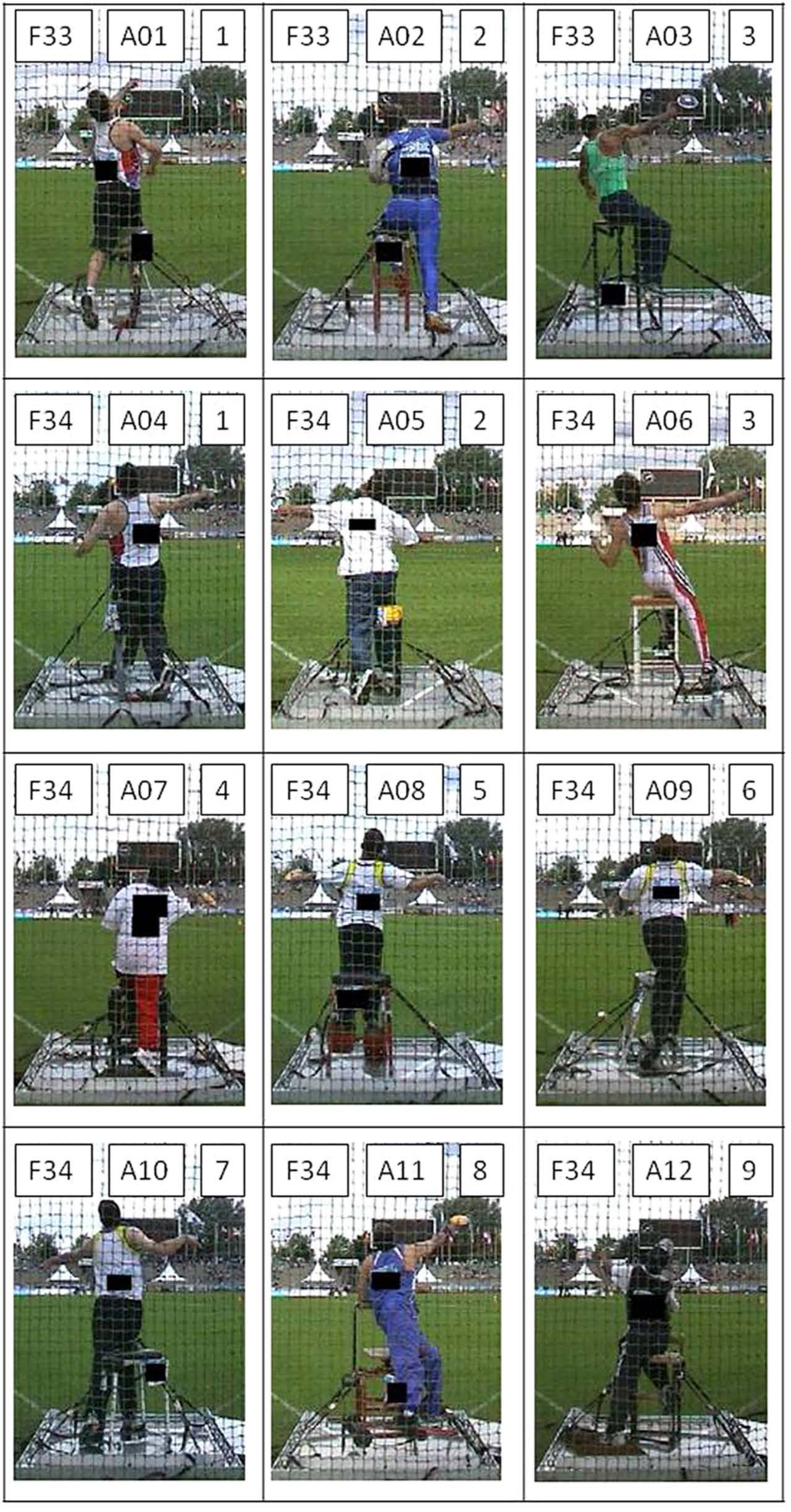
Back view of the position at release of every stationary discus thrower in F30s classes competing in the Lille 2002 IPC World Championships. The boxes in the top left, middle and right of each photograph indicate the class, the athlete’s identification number and the within-class ranking, respectively.
The relationship between performance and throwing technique has been described in several studies focusing on able-bodied23 –33 and seated throwers.14,18,19,34 –36 Some observed the sequence of actions prior to release using spatial and temporal characteristics of backward and forward body movements, range of motion, linear and angular momentum of each segment and so on. One of the most comprehensive studies of seated discus throwers was provided by Chow et al.34 This work 34 showed that
the release height of the shot, the angular speed of the upper arm at release, the range of motion of the shoulder girdle during delivery, and the average angular speeds of the trunk, shoulder girdle and upper arm during the delivery, were all significantly correlated with both the classification and measured distance. (p. 321)
Unfortunately, only some aspects of results are currently relevant. Observations were conducted during training. Therefore, they were only somewhat representative of the performance of elite athletes while competing in a world-class event. 37 For instance, the elite shot-putters participating in Chow et al.’s 34 study performed on average 15% ± 9% less than their personal best. Furthermore, data were collected on athletes regrouped according to the old classification principles. Indeed, the classification of seated throwers has been updated since the Sydney 2000 Paralympic Games.
These studies established the link between disability, performance and classification while providing a better understanding of throwing technique as well as strength and fitness requirements. All together, they contributed to improve training programs and classification of stationary throwers.
So far, the relationship between performance and characteristics of throwing frames of seated throwers has received limited attention. Frossard et al. 12 inventoried 26 characteristics of throwing frames for a group of athletes who participated in a 2006 IPC Athletics World Championships. Unfortunately, this study provided the raw characterisations of the throwing frames for seated shot-putters only.
Clearly, there is a need for more evidence about the relationship between the performance and the design of the throwing frame used by stationary discus throwers. An obvious area of interest is the contribution of the throwing frame in shaping whole body positioning and, more particularly, lower limb placement. The importance of this later relies on the concept of transfer of linear and angular momenta from one segment to the next. The movement is facilitated when the heavier segments move first followed successively by the lighter and distal ones. Typically, athletes in F30s classes have limited extension in their lower limbs. However, the lower limb placement is critical to determine how ground reaction and other contact external forces and moments are transmitted through the lower limbs to action the trunk during the course of the throw. So, it is important to find lower limb placements that create the most favourable displacements of the trunk and ultimately the release of the discus.
A phenomenological approach can help to establish the relationship between performance, whole body layout and throwing frame characteristics. Observations of a cohort of elite seated discus throwers could be obtained during a world-class event. The extraction of kinematic, dynamics or kinetic quantitative data sets is possible but limited because of the contextual constraints of the recording.12,38 –40 However, the placement of the lower limbs and throwing frame characteristics could and should be optimised for the greatest number of athletes attending each specific event.
The purpose of this work was to improve the understanding of the relationship between performance and design of the throwing frame used by male athletes in F33 and F34 classes during the seated discus event of the 2002 IPC Athletics World Championships. The specific objectives were to describe and to provide benchmark information about performance and whole body positioning with a particular emphasis on the contribution of throwing posture and the lower limb placements.
Methods
Participants
A total of 59 attempts performed by 12 stationary discus throwers were considered in this study. Only 48 attempts corresponding to all attempts officially measured were analysed. The 11 other attempts were failed attempts. All the athletes competed either in F33 or F34 classes according to the IPC Athletics Classification Rules. Both classes belong to the same group of disability, F30s, also including two other classes (i.e. F31, F32) that were not included in this competition. Three (25%) and nine (75%) athletes in F33 and F34 classes performed 13 (27%) and 35 (73%) attempts, respectively.
Typically, the functional abilities of athletes in F33 class are characterised by moderate to severe problems with lower limbs as well as fair functional strength and moderate control problems in upper limbs. Athletes in F34 class present moderate to severe problems in lower limbs and minimal control problems in upper limbs and trunk.
Interactions with athletes were not included in the research agreement made with the IPC. Consequently, no demographic or anthropometric information was recorded. This study was approved by the research organisation’s Human Research Ethics Committee.
Event
All information were recorded during the F33/34 seated discus throwing event of IPC Athletics World Championships held in 2002 in Lille, France. Athletes in both classes competed together. The official ranking was achieved through an adjustment of the performance taking into account the differences in functional levels. In this study, the raw performances in both classes were considered separately.
Raw performance data
The performance corresponds to the distance thrown measured in metres by the officials using a laser pointer with an accuracy of ±1 mm. All performances presented in this study were extracted from official result sheets provided by the IPC representatives of the organising committee of the competition.
An in-depth analysis of intra-attempt for each athlete, inter-athlete in the same class and inter-class variability was considered outside the scope of this study. Nonetheless, the intra-attempt corresponding to the attempt-to-attempt variability of the performance for each athlete was summarily described by the number of attempts analysed, the mean, one standard deviation, the minimum (worst attempt), the maximum (best attempt) and the range of the performance.
Video recording
Previous publications have already reported in depth some of the practical obstacles inherent to video recording during a world-class event (e.g. number and position of cameras, impact of disturbing factors, no interactions with participants, quality control procedure).39,40 Thus, only the key elements are presented here.
Video footages were initially recorded onto MiniDVs with two video cameras (Digital Handycam DCR-TRV15E; Sony, North Ryde, Australia) set at 25 Hz. One camera was placed on the throwing side of the athlete. The other was behind. The field of view of each camera included the athlete’s whole body during the throwing action as well as the full length (2.29 m) and full width (1.68 m) of the plate on the ground. The six attempts of the first six athletes and most of the attempts of the athletes ranked between 7th and 12th places were recorded.
The recording of each attempt started when the athlete received the discus and ended shortly after this later landed on the ground. However, only the position of the thrower at the instant of release was considered of interest in this study.
Description of whole body positioning
Whole body positioning at the instant of release included overall throwing posture and, more precisely, placement of the lower limbs. The qualitative description of whole body positioning was conducted by an experienced biomechanist and an internationally recognised coach. The video footages of every trial of each athlete were analysed following a guideline detailed in previous publications focusing on the characterisation of the throwing frame of elite male seated shot-putters. 12 The final description was achieved through a consensus between the two experts.
The athletes kept their throwing position constant although, in principle, it could be changed between attempts. Therefore, the description was athlete based (N = 12) rather than attempts based.
Overall throwing posture included the following:
Number of points of contact between the thrower and the frame ranging from one to six that could include arm rest as well as feet, front and back thighs and buttocks on both left and right sides;
The body position that could be either ‘standing’ or ‘seating’ depending on whether the athlete released the discus in the upright position or with both buttocks in contact with the frame, respectively;
The throwing orientation that could be ‘side on’ or ‘front on’ when the athlete’s hips were close to parallel or perpendicular to the direction of throw, respectively;
The throwing side – left-handed throwers were transposed and considered as right handed.
The lower limb placement refers to the following:
The seating arrangements that could involve the following: A straddle with full or partial contact between seating area and crotch or back lower thigh, and no back and/or arm rest; A stool with full or partial contact between seating platform and buttocks, and no back and/or arm rest; A chair with full contact between seating platform and buttocks, and a back and/or arm rest.
Points of contact on both the front and back feet describing the actual part of the foot in contact with the frame or the ground.
Type of attachment of the front and back legs and feet that could be the following: Free when the foot is free to move and not attached by any means; Tucked when the foot is placed behind a fixed feature of the throwing frame restricting the range of movement; Strapped when the foot is attached to the foot plate with possible separation between the heel and foot plate; Locked when the foot is attached to the foot plate without any apparent movement between the heel and foot plate; Other when none of the descriptions above could be applied.
Statistics
Statistical analyses of the relationships between the characteristics describing whole body positioning variables and performance were deemed unfeasible. Indeed, the numbers of athletes and attempts in each class were relatively low compared to the number of variables in each characteristic.
Results
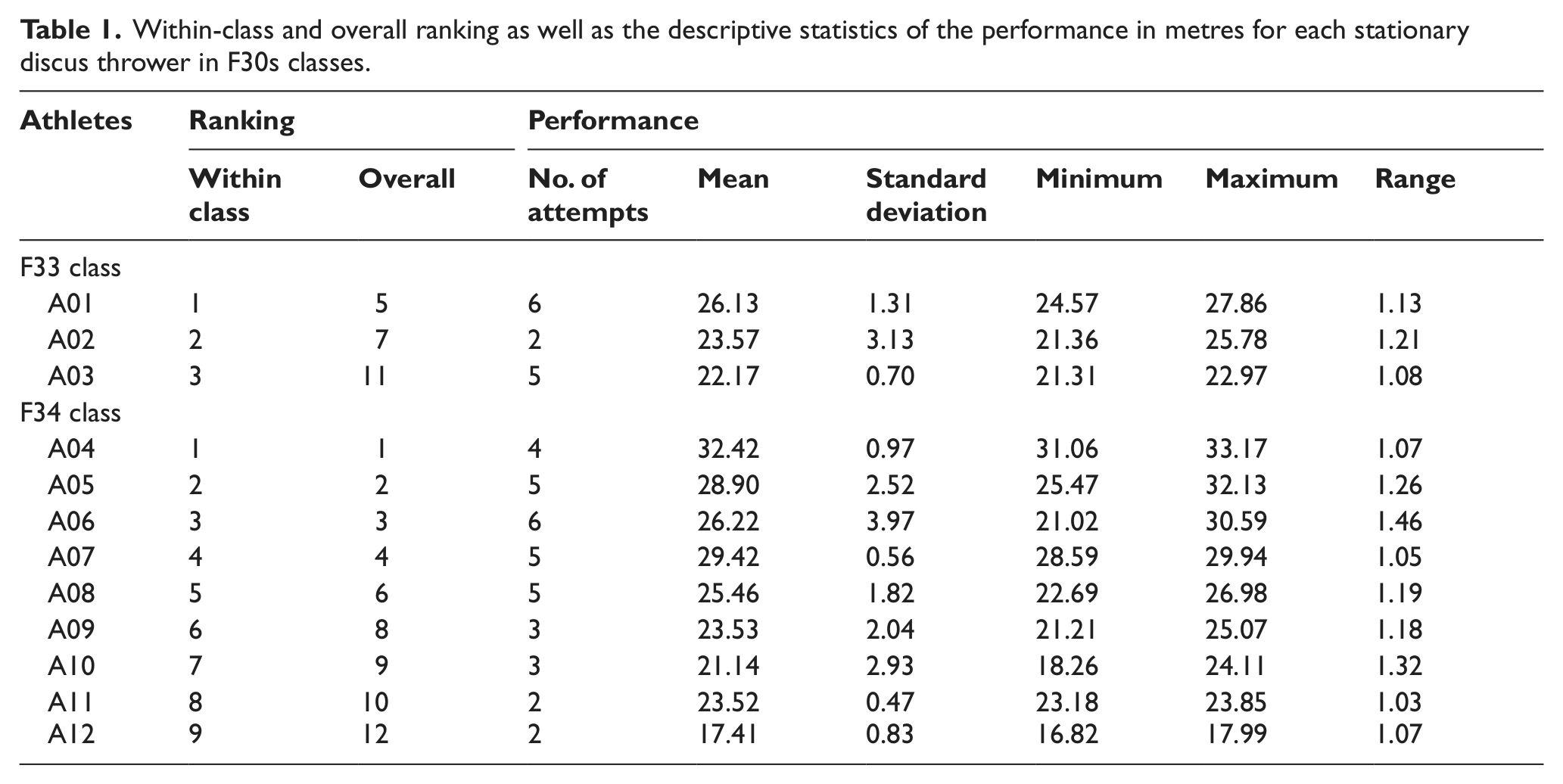
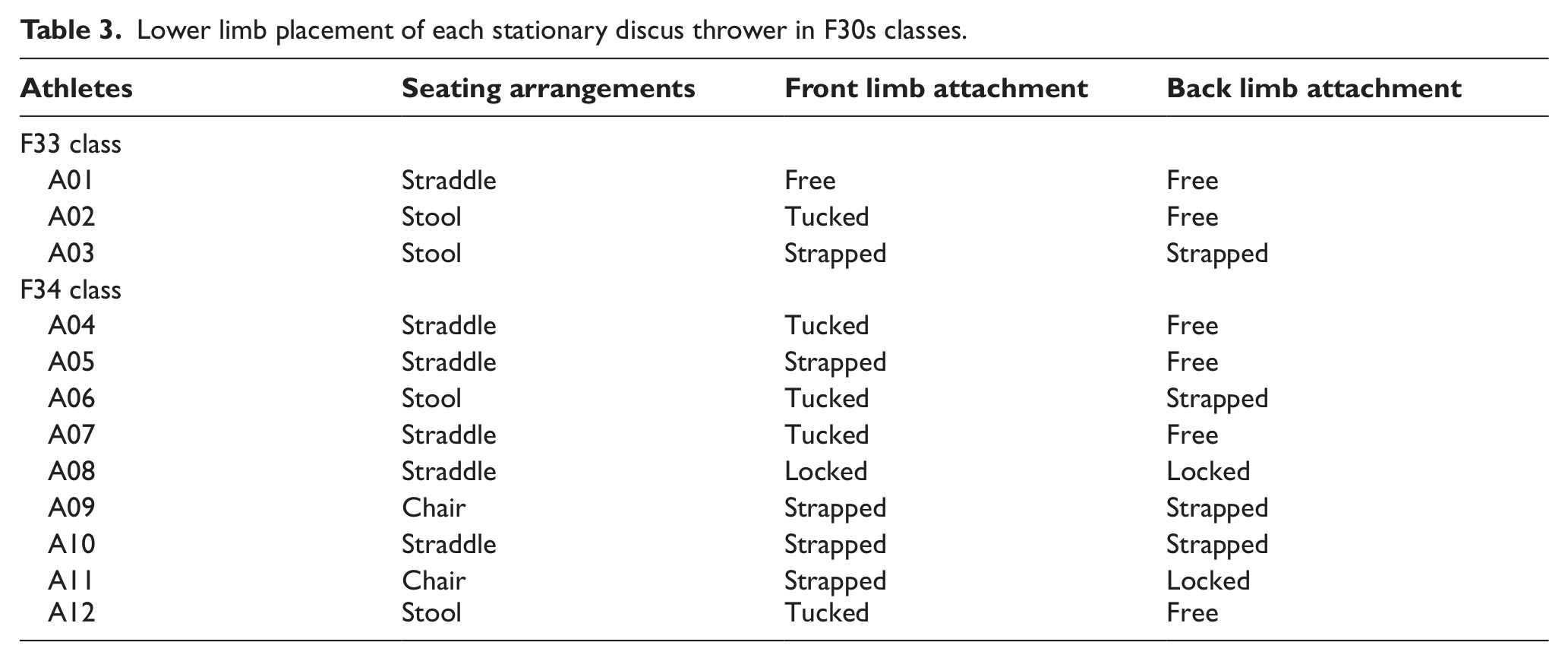
The rear view of every stationary discus throwers in F30s classes at release is showed in Figure 1. The ranking, performance, throwing posture and lower limb placements are presented in Tables 1 to 3, respectively.
Within-class and overall ranking as well as the descriptive statistics of the performance in metres for each stationary discus thrower in F30s classes.
Throwing posture of each stationary discus thrower in F30s classes.
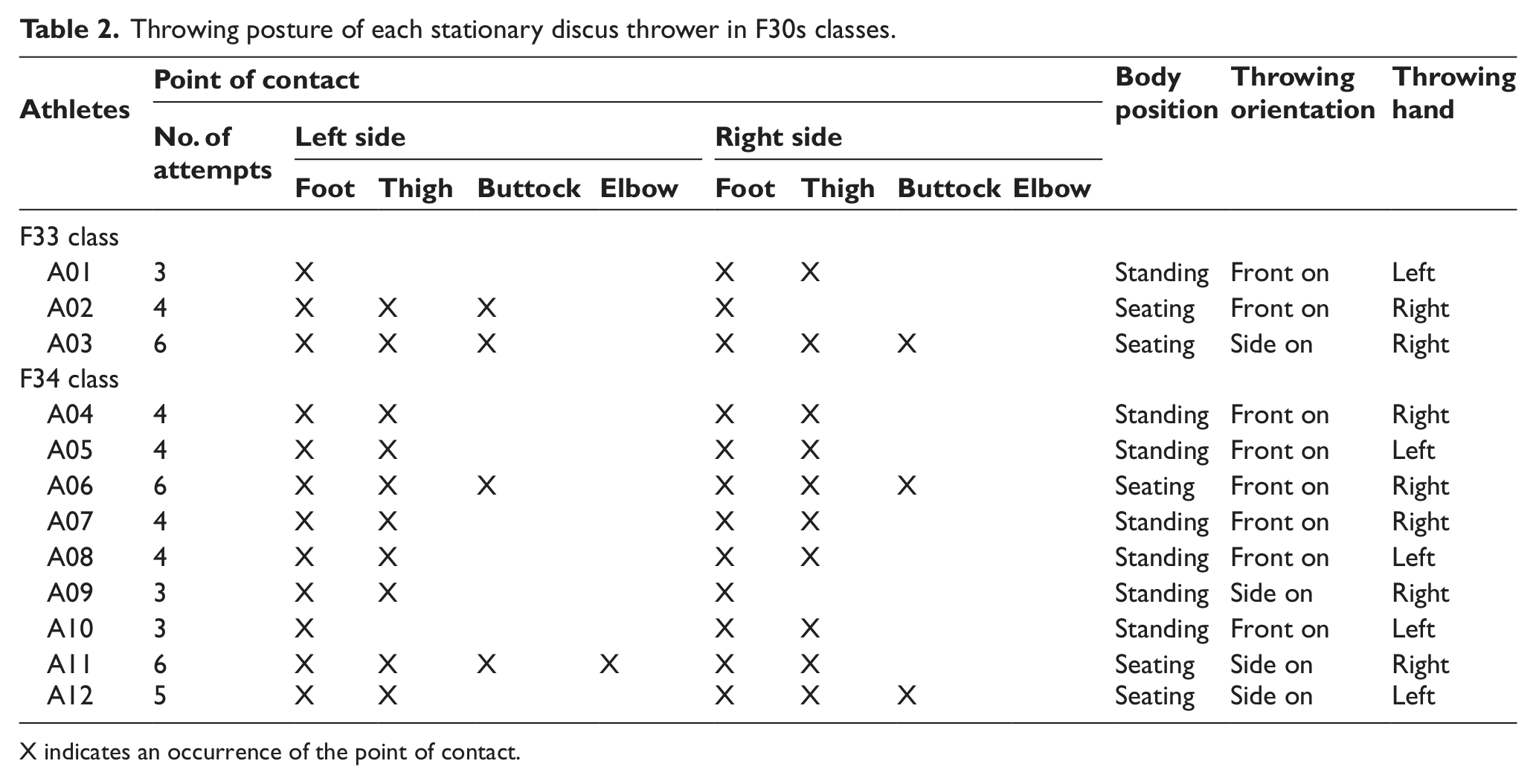
X indicates an occurrence of the point of contact.
Lower limb placement of each stationary discus thrower in F30s classes.
All athletes relied on at least three points of contacts, including the two feet. Three (25%), five (42%), one (8%) and three (25%) athletes used from three to six points of contact, respectively. Seven (58%) and five (42%) athletes threw from a standing or a seating position, respectively. Eight (67%) and four (33%) athletes released the discus facing the sector or sideway, respectively. Five (42%) and seven (58%) throwers were left handed or right handed, respectively.
A straddle, a stool or a chair was used by six (50%), four (33%) or two (17%) throwers, respectively. The point of contact of the front foot was mainly (83%) the fifth metatarsal. Only two (17%) athletes used the heel. This foot was free (8%) or locked (8%) for only one athlete and strapped (42%) or tucked (42%) for five athletes. The point of contact of the back foot was also mainly (92%) the fifth metatarsal. Only one (8%) athlete used the heel. This foot was free, locked or strapped for six (50%), two (17%) and four (33%) athletes, respectively.
Discussion
One of the most significant contributions of this study was to provide benchmark information to athletes, coaches, classifiers, biomechanists, officials and other participants who develop evidence-based training programs, design of the throwing frames and rule of discus throwing event for athletes in F30s classes. This study provided a catalogue of different throwing positions and features of the throwing frame used by elite stationary throwers. This study revealed that athletes used multiple combinations of throwing postures and lower limb placements, including up to six points of contact, two body positions, two throwing orientations, three types of seating arrangements, two types of foot contact and four types of lower limb attachments.
By definition, the points of contact have the potential to contribute to the performance by enabling the generation of external forces and moments. However, the purposes of some forces generated at particular points of contact might be to make a secondary contribution to the performance by maintaining balance and/or preventing repetitive injuries, for example. In all cases, this study demonstrated that the so-called base of support of stationary discus throwers involved more than a flat surface on the floor shaped by both feet. This base must be seen as a tridimensional (3D) shape made of multiple points of contact with different surfaces. Consequently, this highlighted the role of the throwing frame.
The panel of these combinations is one of the singularities of seated throwing events. This is in contrast with the able-bodied throwers who rely solely on the ground reaction forces and moments applied on one or both feet.
Additional contribution of this work to the current debate about the design principles of throwing frames for stationary throwers15,41,42 involving individualisation and standardisation will be further discussed in Part II. Further understanding of the relationship between performance and whole body positioning was restrained by some limitations of this study. As mentioned previously, the small number of participants limited further statistical cluster analyses. Furthermore, this study relied on the information collected in 2002. Recently, some rules and the levels of participation and performance have changed. This is a major limitation as new data must be collected. Therefore, the interpretation of these results in the current context must be conducted carefully.
There is a need for further longitudinal studies replicating the description of the whole body positioning, particularly those focusing on more recent female and male events, wider level of performance (e.g. beginner, emerging, elite) and classification (e.g. F50s) and other throwing events (e.g. shot-put, javelin). The possibilities for additional cross-sectional studies are endless particularly for those to be conducted in experimental conditions where further 3D kinematic (e.g. position and orientation of each segment) and dynamics (i.e. contact external forces and moments) confounders could be collected. 43
Furthermore, future studies focusing on optimal placements of artificial legs of discus throwers with single or double amputation will be particularly interesting (Figure 2). Such information will be valuable to better understand the actual contribution of lower limb placements in the performance. Indeed, Part II will focus solely on the possible links between the performance and the actual feet positioning.
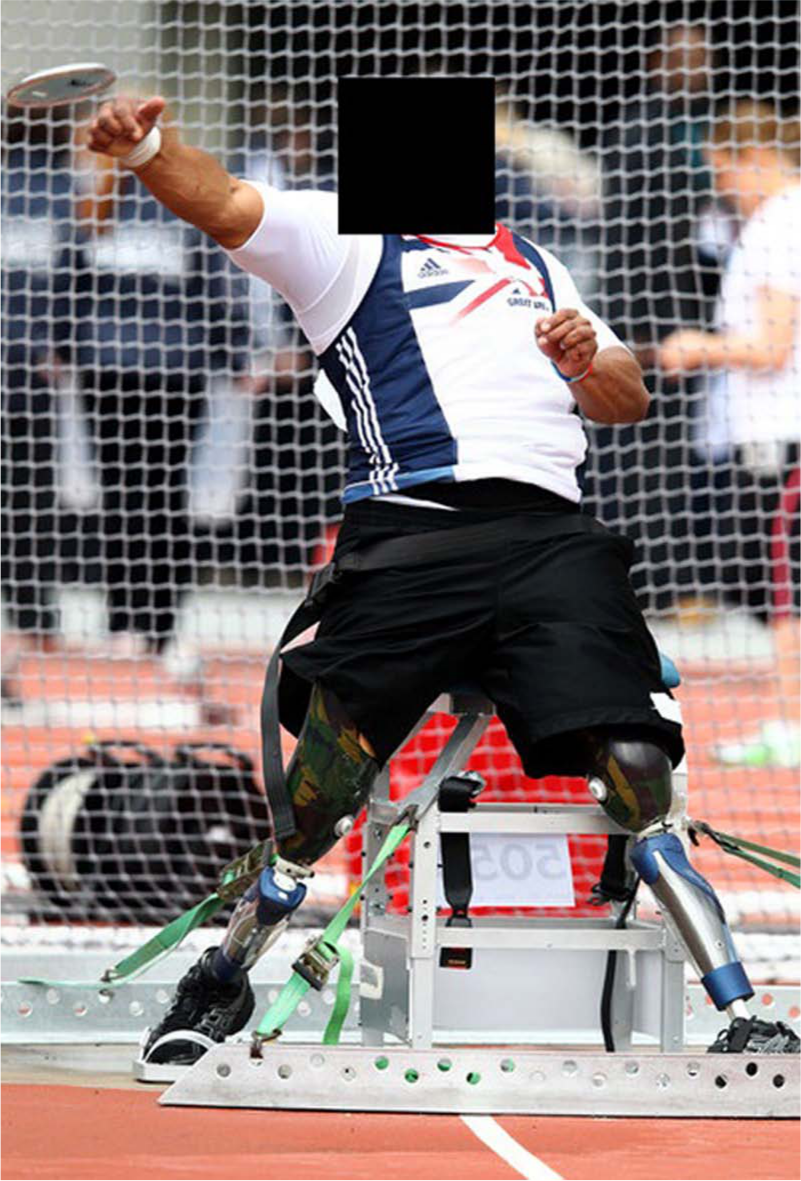
Example of a seated thrower with double lower limb amputation fitting with advanced prosthetic legs, including microprocessor-controlled knee units.
Conclusions
The whole body positioning of stationary discus throwers in F30s classes during actual world-class event has been described for the first time. It is anticipated that the results of this study will provide key information to those facing the challenge of improving the understanding of the interaction between throwing technique of elite seated throwers and their throwing frame.
Footnotes
Acknowledgements
The authors wish to acknowledge Dr Yves Vanlandewijck and Dr Walter Thompson for facilitating the access to the result sheets, Scott Goodman for his technical insight and Dr Sarah Curran for editing this manuscript.
Funding
This study was approved and supported by the IPC Sports Science Committee and partially funded by QUT ARC Linkage Project Incentive Scheme (Frossard L, Barker T, Smeathers J, Pearcy M and Goodman S. Biomechanical analysis of elite Australian athletes competing in seated throw events), QUT Strategic Link with Industry (Frossard L, Smeathers J, Barker T and Goodman S. Video analysis of seated athletes during the shot-put event at the 2002 IPC Athletics World Championships) and QUT ARC Linkage Project Incentive Scheme (Frossard L, Pearcy M, Smeathers J, Barker T and Goodman S. Novel design of a universal chair for elite Australian athletes competing in seated throw events).
Conflict of interest
None declared.