




Abstract
Background and Aim: Partial ear amputations are one of the forms of ear loss. A user-friendly design of prosthesis with safe suspension and an aesthetic appearance can be helpful to a patient who has lost part of their ear due to congenital absence or trauma. Prosthetic use has social and psychological effects on the patient and their family. The aim of this paper is to describe a technique of ear prosthesis fabrication with self suspension for these patients.
Technique: To provide a snugly fitting prosthesis, the only parts of the residual ear that were covered by the prosthesis were accurately manufactured and reduced in thickness to 0.5–1 mm and 10 mm in width, so that the silicone extended over the stumps to provide adequate suspension.
Discussion: This paper proposes the designing and constructing of a silicone ear prosthesis which had good suspension, low cost, was easy to use and was acceptable in appearance to the patient.
Clinical relevance
Residual ears are currently removed through surgery to implant placement ears in individuals who have lost part of their ear, but evidence suggests that patients do not like this method. This paper highlights the importance of providing an alternative intervention using an ear prosthesis with self-suspension for such patients.
Introduction
The face is the specification of the human body for each person, 1 and those who lose a part of their face, such as a nose, eye or ear, by illness or by accident will experience numerous difficulties. With regards to this, it has been shown that it is important for patients to return to activities of daily living as quickly as possible. 2
Ear amputation occurs in the result of trauma, congenital disease or following surgical removal of benign and malignant tumors. There are no accurate statistics of the prevalence of ear defects, but the prevalence of being born with a small congenital ear is 1 in 12,500 births. 3 The ear is located in a prominent and non-protective position; so is prone to injury. 4 Ear defects are reconstructed by surgery or conservatively treated by silicone prostheses. 5 Due to the complex structure of the ear, reconstruction surgery is one of the hardest challenges in plastic surgery. 5 Making the choice between surgery and provision of prosthesis for patients with extensive injury to the ear is very difficult and complex. This choice depends on the size, the etiology of the lesion and the patient’s wishes. When surgical reconstruction is deemed not to be optimal for improving the defects, for example due to perceived cosmetic problems, lack of physical and mental fitness of patients for surgery and the necessity of care for longer periods, plastic surgery may experience problems or failure. In such cases, provision of a prosthesis would be the best method for reconstruction of ear defects.6,7
Suspension via the face is currently the main method for attaching an ear prostheses. 8 Suspension is one of the important concepts in the ear prosthesis provision, as it is an essential feature to resist the forces that cause displacement of the prosthesis from its intended position. Maintenance of prosthesis position is mainly achieved using either adhesives,5-7,9,10 mechanical techniques, implants7,11 or anatomical procedures. 5 To use the tag as an adhesive method, patients need to be careful to put the prosthesis in its correct place. Because of vision problems in older people, and the need for healthy and non-sensitive skin, use of the tag technique is not the ideal way to suspend the prosthesis.6,9,10 Specticles (glasses) are also used as a mechanical suspension method for ear prostheses, but creating the right suspension after removal of the glasses is one of the problems associated with this technique. The use of implants is another approach but the existence of hair, oily or sweating skin in the area of the site of the prosthesis issues. The use of an implant may therefore not be appropriate in this case.3,7
Many advances have been made in prosthetic ear suspension. However, there is still a need for a suspension system that has fewer drawbacks for subjects who have only a little of the ear remaining as a residuum, as using the implant technique requires surgical removal of the remaining ear. Development of a cost-effective and simple method of suspension of a cosmetic prosthesis when compared to surgery is therefore warranted and important for these patients.
The aim of this paper was therefore to introduce a new technique in suspension of ear prostheses by fabricating silicone prostheses without associated attachments in people with partial ear loss.
Technique
The fabrication of ear prostheses is a combination of art and science. 11 The prosthesis shape, colouration and suspension must be as close as possible to the normal form. A prosthesis construction can only be successful when the subject can appear in public without attracting attention. The construction of an ear prosthesis comprises of six stages: (1) take a negative cast of the amputation and healthy side, (2) sculpture and formation of the positive casts according to the negative casts, (3) reconstruction of the amputated side on positive cast by wax, (4) providing a multi-piece format reconstruction for the amputated side, (5) processing of the prosthesis material and (6) proper suspension testing of the prosthesis. This study therefore proposes a new method of prosthetic replacement of amputated ears with a custom-made prosthesis fabricated using silicone, which has accurate fitting, suspension, is user friendly in design and which has an acceptable aesthetic appearance for the patient.
The patient’s amputated ear was lubricated with a thin layer of Vaseline to prevent adherence of impression material to the skin and hair. The negative cast was taken from the healthy and damaged ear by alginate (Zhermack, tropicalgin, Italy). A positive model of both sides was prepared by filling the negative model with plaster of Paris (Figure 1). The positive model of the damaged side was taken from the same healthy ear using wax (Covex, modelling wax, Netherlands) (Figure 2).
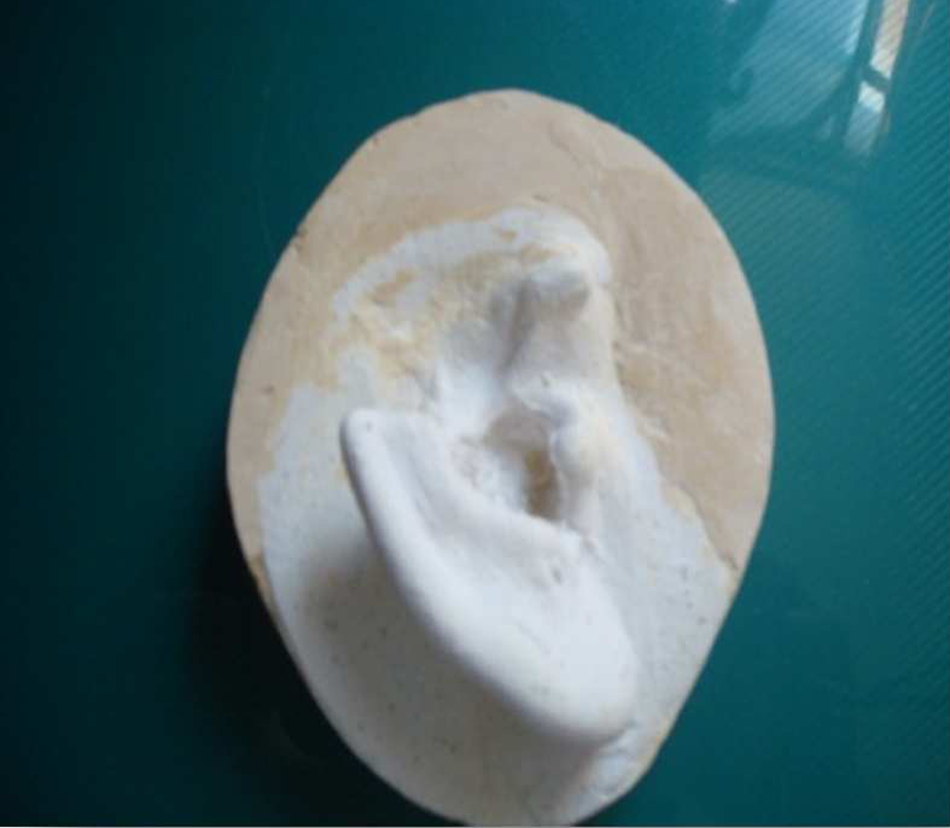
Positive model of amputated ear.
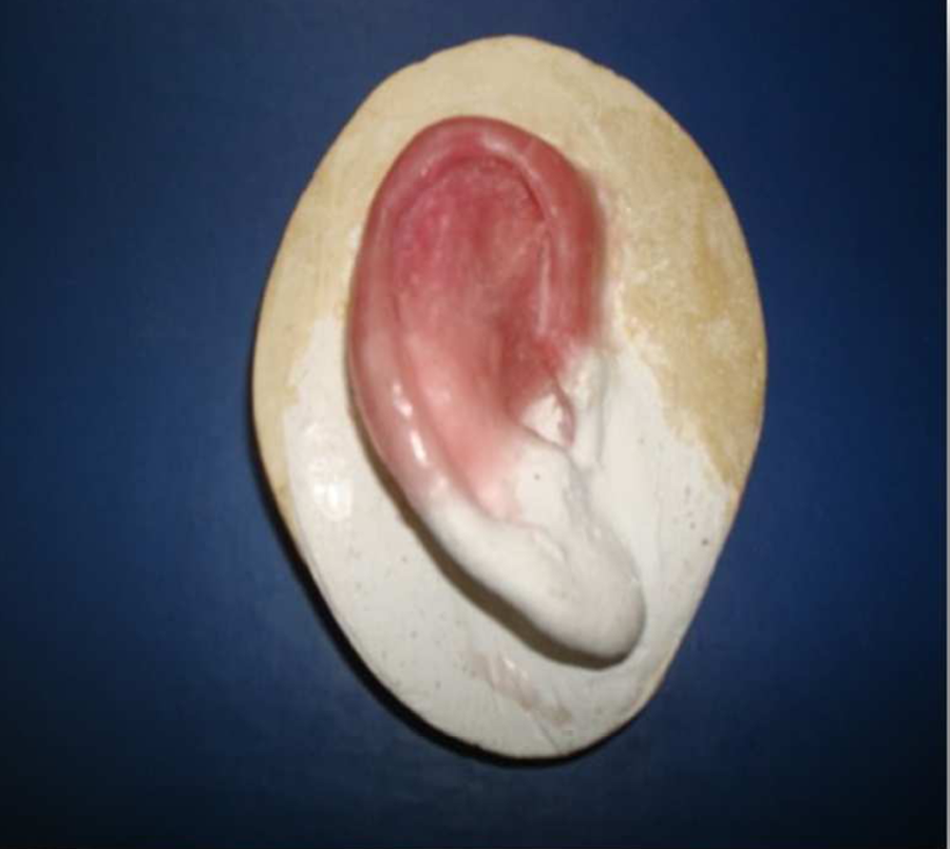
Construction of affected ear by wax.
Since the prostheses were designed to offer self- suspension, it was essential to ensure a snug fit of the silicone to the tissue of the residual ear. In order to provide a snug prosthetic fit, the only parts of the prosthesis which covered the amputated ear were reduced accurately to between 0.5–1 mm in thickness and 10 mm in width to ensure that the silicone extended over the stump with a close and cosmetic fit.
For silicone injection, and with regards to the complexity of amputated area, a multi- piece format was prepared from the corrected form (Figure 3). This is because, if a one piece format is used in fabrication of ear prosthesis, it is hard to remove from the ear – so for comfort and ease removal a two or three piece format was utilized.
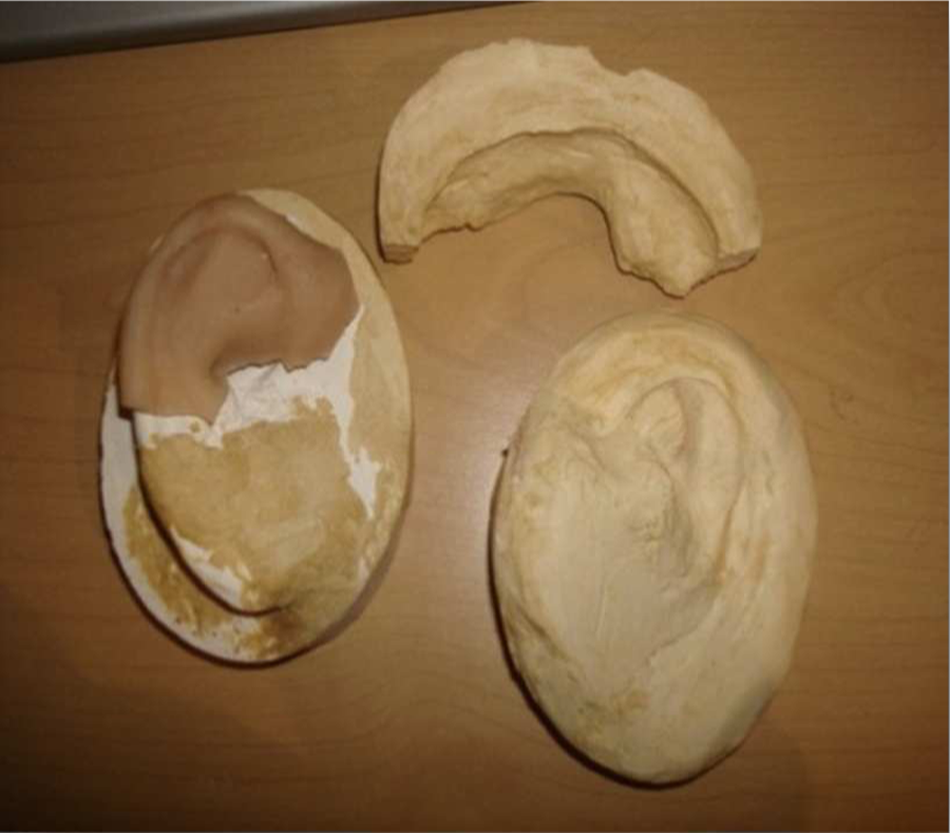
Three piece format for silicone injection.
For making a three-piece format, a positive format of the affected side that had been modified with wax, was considered as one piece. This format can be isolated with Vaseline. Negative areas behind the ear were then filled with plaster of Paris. This format was considered as the second piece. The areas on the ear were then filled with plaster of Paris and formed the third piece. All three pieces were held together with a pincer manually, and then this complex was held in boiling water for 10 minutes to melt the wax that was used in the format. This reduced the rupturing risk of the prosthesis, made it possible for accurate painting of the ear prosthesis and ensured repeated use of the multi-piece format.
According to a person’s skin colour, silicone was mixed with the desired colour (Figure 4) and then poured into the multi-piece formats and closed tightly. After 24 hours, multi-piece formats could be split apart from each other and the silicone prosthesis can be brought together (Figure 5).
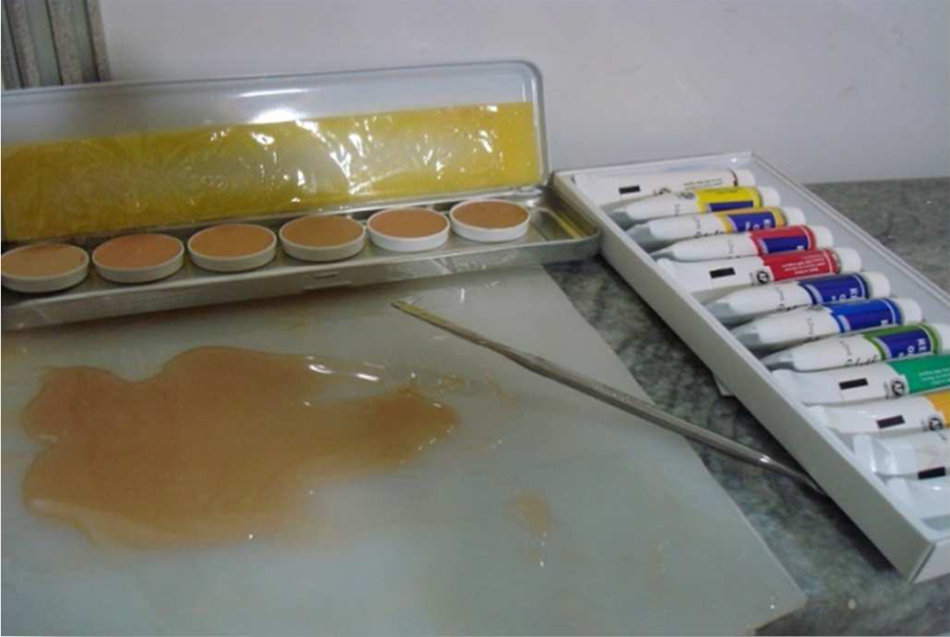
Prepared colour.
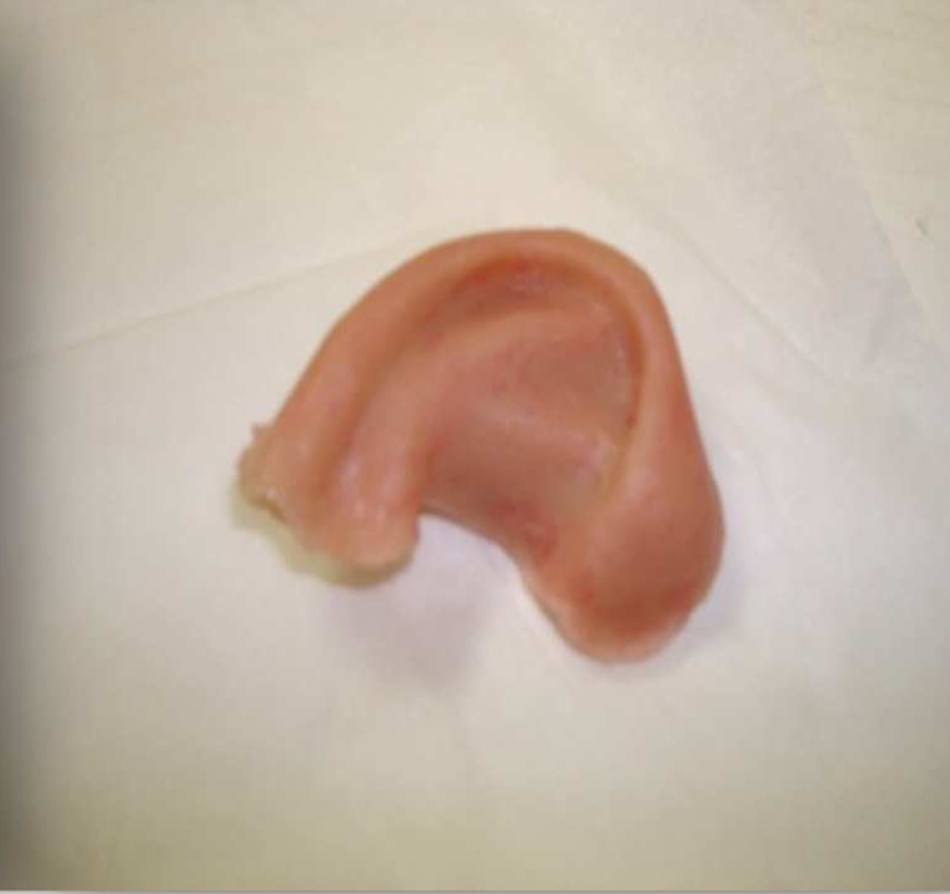
Final ear prosthesis.
The final step involved putting the constructed prosthesis on the patient’s ear in lieu of the missing part of ear (Figure 6).
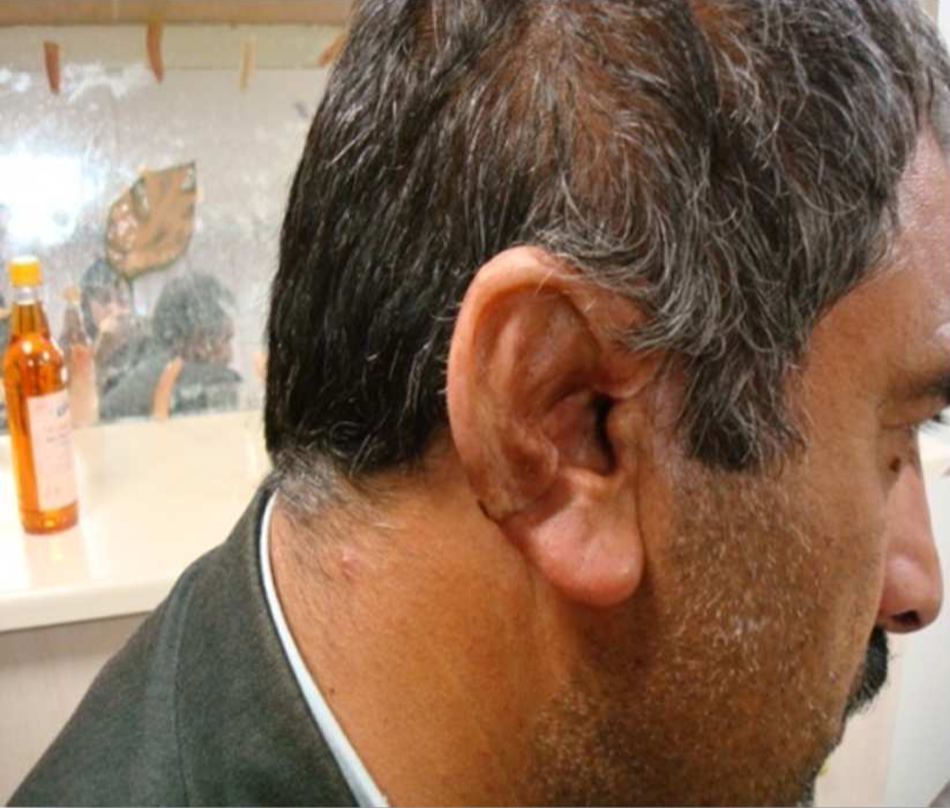
Final ear prosthesis on a patient with partial ear amputation.
Case report
A 47 year-old male patient was referred to the Department of Orthotics and Prosthetics, University of Social Welfare and Rehabilitation Science, Tehran, Iran, for the fabrication of ear prosthesis.
On general examination it was apparent that the patient had lost part of his ear due to trauma in an automobile accident. Before participation in the study, the patient read and approved a statement acknowledging informed consent. The ethics committee of the University of Social Welfare and Rehabilitation Science approved this study. Using the technique proposed in this paper, silicone ear prosthesis was prepared for the patient. The patient was trained in how to use the prosthesis. Accurate suspension, satisfaction and aesthetics were achieved with the prosthesis.
Discussion
The primary factor to achieve an ideal facial prosthesis is using the appropriate suspension approach to provide good suspension; linked to its easy application. 8 We must note that weight, size and position of the amputated surface and the materials used in its construction determine the overall weight of the prosthesis. The prosthesis needs to closely match the original weight and size of the missing part of the ear to improve the suspension achieved, or the patient may reject the prosthesis and not use it. The modelling process with wax should therefore be done with the minimum material possible to minimize weight. Suspension depends on the size of the prosthesis. The position and appearance of the prosthesis is also important.
Using adhesives, glasses and also surgical techniques to implant the replacement are the general suspension methods currently used in ear prosthesis.5-7,9,10 Our study proposed the use of the residual part of the ear as an anatomical suspension in ear prostheses. Considering previous studies published in this field, due to sweating skin, gravity and skin motion, using adhesive is not the ideal solution to hold ear prostheses in place.3,7 Using mechanical suspension, such as glasses, also presents the possibility of prosthesis displacement, 7 and therefore is not ideal for providing ear prostheses suspension. Due to the flexible tissues in and around the ear and the lack of adequate baseline bone, soft tissues in the area do not have a good-enough strength to prevent displacement of the ear prosthesis. This type of suspension is therefore not appropriate for the ear and nose, but it is the best method of suspension for eye prostheses. Although implants have more benefits than other types of suspension methods, when amputated areas have hair, excessive skin sweating or oily skin, the use of implants is not permissible. The use of implants is also very difficult to achieve successfully in people who have lost part of their ear.3,7,12 When a patient does not want to use these suspension approaches for any reason, or is unable to be offered them, a new system such as the one designed in this paper that is stable and easy to use is needed. For these reasons we therefore recruited help from the residual surfaces for suspension.
Following use of the prosthesis for a six-month period, this technique permitted a safe suspension method for the silicone ear prosthesis for the patient. Easy use of the prosthesis, a reduced risk of skin sensitivity, increasing the useful life of prosthesis, and the low cost of this approach compared to the surgical option and indeed the negation of the need for surgery were all proven benefits of using the silicone ear prosthesis by this patient.
Silicone ear prostheses may have additional advantages. Silicone, unlike other material used to fabricate prosthesis, permits fabrication of the natural ear with high definition and allows the prosthesis to be thin in the areas where it covers the amputated site so it is not obtrusive.
Prosthesis fabrication which results in replication of a natural skin surface needs both artistic and technical expertise. The ability to prepare skin colours needs an understanding of colour, and great attention to detail. Prosthesists/orthotists in this field have been playing an important role in the rehabilitation management of ear amputation patients. The use of custom-made ear prosthesis with acceptable appearance, a user-friendly design and good suspension can restore confidence and psychological improvement for patients.
Footnotes
Funding
This research received no specific grant from any funding agency in the public, commercial, or not-for-profit sectors.