



Abstract
This exchange considers the unrecognised interplay between two major political–economic trends shaping contemporary Europe, namely the upward trend in housing-induced inequalities and rising support for populist politics. Europe's housing systems have undergone dramatic transformations in recent decades that are exacerbating housing precarity, wealth inequalities and socio-spatial polarisation. At the same time, European politics has witnessed a growing acceptance of populist political rhetoric, values and policies as populists exploit citizens' economic anxieties and perceived cultural grievances. Yet, existing research overlooks the connections between housing system dynamics, housing precarity and political disaffection. In response, this exchange proposes a new approach – housing discontent – to capture how deepening housing precarity and place inequalities are influencing social attitudes, political values and preferences and resulting in a more polarised contemporary politics.
Introduction
In the decade following the financial crisis, rising economic inequality, diminishing social protections and a crisis of democratic legitimacy have thoroughly reshaped Europe's political and economic geography as an increasing share of voters have turned to populist alternatives (Dijkstra et al., 2018). In some countries, such as Spain, populists have made significant electoral gains (Lisi et al., 2019), while in others, such as Sweden and the UK, populists have transplanted their rhetoric and policy priorities into mainstream parties (Heinze, 2018; Jessop, 2018). Populism is defined as a style of politics marked by (1) a political rhetoric that instrumentalises public anxieties to challenge the political establishment, (2) a thin-centred ideology that separates society into two antagonistic groups (i.e. the people vs. the elite) and (3) a political strategy wielded by personalistic leaderships to exercise power based on direct, non-institutionalised support (Caiani and Graziano, 2019; Mudde, 2004). Populist movements are identified by three types of appeals – people-centrism, anti-elitism and demands for popular sovereignty (Bernhard and Kriesi, 2019).
Considerable diversity exists within populist movements and the drivers of populist appeal (Rama and Santana, 2020; Rooduijn, 2018). Much research has focused on right-wing populism and its exclusionary appeals to authoritarianism, ethnonationalism and cultural grievances related to globalisation's mobilisation of people, capital and culture (Inglehart and Norris, 2016). Still, a significant left populism identifies ‘the people’ in socioeconomic terms against an oligarchic elite (Ramiro and Gomez, 2017), considers how citizens' sense of exclusion is shaped by inequalities in wealth, labour, education and regional development, and displays an inclusionary logic to extend democratic participation among disregarded groups (Agnew and Shin, 2019; Los et al., 2017; Rodrik, 2018).
While a more geographically informed view of the cultural and economic drivers of populism is emerging (Cramer, 2016; Lizotte, 2019), scholarship has overlooked the importance of housing and place as more immediate and direct influences on citizens' welfare, wealth and political orientations. Housing influences individuals' everyday welfare, wealth and social mobility, as well as their ontological security, identity construction and social relations (Dewilde and Ronald, 2017). It is the foundation for societal wealth but it also structures wealth inequalities, economic and sociodemographic divides (Hochstenbach and Arundel, 2020). Indeed, in the decade since the financial crisis, rising levels of housing precarity are evident across Europe (Feantsa, 2018). Reckless financial practices have had lasting effects in terms of mortgage defaults and repossessions (Aalbers, 2012; Waldron and Redmond, 2016). The rental sector has become an asset class for corporate landlords who contribute to housing unaffordability and insecurity (Wijburg et al., 2018; Waldron, 2018). Restricted housing affordability has combined with intensifying socio-spatial segregation and gentrification (Lees et al., 2016) as housing markets shape deepening spatial divides along demographic, ethnic and class lines. Worryingly, such housing precarity is becoming a fixed feature of European housing systems (Clair et al., 2019; Waldron, 2021).
Of course, this is not to suggest an overly deterministic relationship between housing issues, populist sentiment and electoral success, and the connections between these elements are both complex and contingent. Left- and right-wing populists have capitalized on a variety of different economic and cultural issues. Some of these issues directly relate to housing, such as the widening of wealth inequalities through housing markets (André et al., 2018). For others, the connection to housing may be more indirect. For example, where racist and xenophobic attitudes towards migrants may connect to perceptions of demographic change or competition for social resources in a neighbourhood (Van Gent and Musterd, 2013). Other drivers of populist sentiment may only be weakly connected to housing grievances, while in other cases there may be no connection to housing at all.
While acknowledging such a contingency, as well as the increasing centrality of housing to political–economic debates on wealth and welfare (Aalbers and Christophers, 2014), this article also asserts that scholarship has for too long overlooked the potential role that housing might play in shaping political attitudes and preferences, both theoretically and empirically. Emerging research suggests correlations between populist voting, local housing market performance (Ansell, 2019) and financial stress (Kiss et al., 2020; Rugh, 2019), but the specific ways housing hardships shape citizens' social attitudes, political values and preferences, and their acceptance of populist rhetoric, remains underexplored. It is unclear how the ‘lived experiences’ of precarity regarding housing affordability, accessibility, security and the physical qualities of home and place might influence political disaffection. Such understanding is hampered by a lack of individual-level data on the housing grievances of populist voters, as reflected in their authentic voice and self-understanding of place. Additionally, few have considered the housing policy positions of populist movements, the discourses they construct around housing issues or how they leverage the ‘emotion of home’ in their political strategies.
In response, this exchange proposes a new focus on ‘housing discontent’, conceived here as the political expression of latent anxiety regarding housing and place-based precarity (affordability, security, quality and access) that results in more polarised political attitudes, values and preferences. Clearly, housing precarity is symptomatic of wider societal inequalities, notably those of insecure work and income, and necessitates a greater awareness of how housing issues cut across these wider disadvantages. Exposing these dynamics is vital to understand contemporary processes of political–economic change within regions, cities and neighbourhoods. The remainder of this exchange is structured as follows. Firstly, the dominant approaches to understanding the politics of housing are briefly reviewed and the key gaps in knowledge are highlighted. Thereafter, an emergent research agenda based on the ‘housing discontent’ approach is outlined. Finally, the conclusions will reflect on the importance of such a research agenda for theory and practice.
Housing and politics: Dominant approaches
While few have considered the connections between changing housing systems, housing precarity and the rise in populist politics, different kinds of literature have considered these elements separately. The comparative housing policy literature considers the institutions and policies that shape national systems of housing production, consumption and allocation and explores how variations are derived from cultural, ideological or political orientations (Stephens and Norris, 2017). Housing systems are typically typologised by the degree to which the market dictates housing supply and demand (Kemeny, 1995), ranging from liberal regimes, with a strong focus on market provision (e.g. UK) (Doling and Ronald, 2010) to more social democratic models, with a greater emphasis on regulated markets and social provision (e.g. Sweden). Comparative housing studies analyse the political, social and ideological forces that shape such regimes, the role of historical path dependencies in shaping housing policy and the stratification of society through housing (Bengtsson and Ruonavaara, 2010). Recent literature has placed greater emphasis on the outcomes arising from differing housing systems with respect to social inequality, including structural inequalities in accessing affordable housing, labour markets, income and differing welfare approaches (Dewilde and Lancee, 2013; Ronald et al., 2017).
Urban political economy emphasises the integral role of housing in the circulation and accumulation of capital and as a source of the perpetuation of capitalist-induced inequalities with regard to wealth and political power (Aalbers and Christophers, 2014). Research considers the financialisation of housing, describing the deepening penetration of financial actors, markets and instruments within the housing sphere (Aalbers, 2016) and the role of the neoliberal state in enabling the transformation of housing into an investable commodity (Gotham, 2009). Scholars have examined the inexorable expansion of household indebtedness through financial innovations (Gotham, 2009) and government stimuli in the mortgage market (Montgomerie and Büdenbender, 2015). Others have considered the transformation of rental housing into an asset class providing low-risk, high-return yields for investors (Waldron, 2018; Wijburg et al., 2018). Others look to the privatisation of public assets (Christophers, 2018) as states experiment with financial instruments to fund their activities. Such transformations have had clear socio-spatial impacts, reinforcing geographic divisions between ‘winner’ locations (Etherington and Jones, 2009) that benefit from rising property values and accumulated wealth, and ‘left behind’ locations (Gordon, 2018) that experience deeper housing busts, exclusion from housing wealth gains, poorer urban quality and a plethora of social problems relating to employment, incomes, education and crime (Rodríguez-Pose, 2018).
A distinct ‘varieties of populism’ literature considers the characteristics of populist voters, the drivers of populist appeal and tactics of populist parties. Research suggests left- and right-wing populist support comes from similar social strata (Rama and Santana, 2020), but left-wing support is more concentrated among young, highly educated urban dwellers (Ramiro and Gomez, 2017), while right-wing support is more evident among males, the unemployed and lower social classes (Dijkstra et al., 2018). Rising economic insecurity, austerity, globalisation and distrust in political elites and institutions are associated with populist voting (Kriesi and Pappas, 2015), as are issues relating to immigration, a dilution of traditional values and competition for jobs, public resources and welfare (Rydgren, 2008; Van Gent et al., 2014). More recently, the literature has emphasised the role of geography in shaping populist sentiment (Rossi, 2018; Lizotte, 2019). Right populists outperform in areas where economic and demographic change can be linked with perceptions of diminishing social status, loss of traditional values and resentments towards cosmopolitan elites (Cramer, 2016; Essletzbichler et al., 2018). In contrast, left-wing support is more concentrated in major cities, where strong anti-establishment claims are combined with more typical democratic socialist proposals (Mouffe, 2018; Tamames, 2020). This literature considers how the ‘background geography’ of local economic conditions (Los et al., 2017), investment imbalances (Iammarino et al., 2018), demographic change (Ford and Goodwin, 2017), access to welfare (Spinney and Nethery, 2013) and the urban/rural divide (Dijkstra et al., 2018) fuel populist support. Others consider how social networks, place contexts and neighbourhood composition structure opportunities for political interaction, thereby influencing political attitudes (Agnew and Shin, 2019; Van Gent et al., 2014).
Omissions and shortcomings
Each of these approaches address the politics of housing in differing ways and to differing extents. While the comparative literature valuably considers the ways in which politics shapes national housing systems and policy approaches, it has been insufficiently attentive to two issues: processes of change within housing systems and political outcomes of housing inequality. The comparative literature often conveniently places greater emphasis on policy path dependence to explain processes of stability within housing systems, but often overlooks processes of change (Aalbers, 2016). The key typologies do not offer a clear exposition for countries to transition between housing models or how hybrid models might emerge under changing economies, labour markets, demographic change or welfare models (Christophers, 2013). Much comparative research examines housing as a limited subset of social policy and has been less alive to significant political–economic transformations, such as financialisation or neoliberalisation, in driving housing system dynamics (Aalbers and Christophers, 2014). As such, new approaches must examine the political consequences of intensifying housing precarity and how such outcomes may be changing social attitudes, political values and preferences.
While urban political economy approaches examine the impacts of housing inequalities, few consider how the ‘geography of today's expanding housing crisis is creating the conditions for an “us versus them” intergroup rivalry that involves not only poor households but also an increasingly impoverished middle class that constitutes the base of support for populist political movements’ (Rossi, 2018: 1429). New-generational fractures are emerging between older, wealthier homeowners and younger renters who are pushed into an increasingly unaffordable private rental market, often marked by poor tenure security and quality (Hulse et al., 2019; Waldron, 2021). Changing homeownership dynamics contributes to increasing wealth inequalities, as stagnant markets in depressed regions undermine asset-based welfare approaches (Ronald et al., 2017), while in other contexts, such as expanding suburbs, many homeowners struggle with unsustainable mortgage debt, which can undermine their well-being (Boelhouwer, 2020; Waldron and Redmond, 2016). Restricted public housing investment and more conditional access to housing registers have prompted new resource tensions, particularly where migrants are perceived to enjoy prioritisation over taxpaying natives (Hooijer, 2020). However, it remains unclear how such inequalities might influence political participation and attitudes across socioeconomic groups, housing tenures and geographic space (André et al., 2018). Furthermore, it is unclear how specific housing grievances interact with other forms of material disadvantage relating to insecure work, income, public services and welfare in ways that might prompt protest voting.
The varieties of populism literature have largely overlooked housing as a concern, despite the fact that housing is the foundation for household wealth, economic security and welfare planning (Doling and Ronald, 2010), as well as the setting for family life (Dewilde and Ronald, 2017). Housing systems are inherently spatial, and therefore political, dividing neighbourhoods, cities and regions along demographic, class and income lines (Hochstenbach and Arundel, 2020). This social and spatial context is key, as neighbourhood composition and location (Van Gent et al., 2014), access to social and economic resources (Guiso et al., 2017), perceived crime levels (Dinas and Van Spanje, 2011) and the demographic composition of a community (Rydgren, 2008) are likely to influence political attitudes at the neighbourhood scale. The housing market influences the distribution of winners and losers across capitalist economies. Affluent cities experience housing booms and wealth concentration, which are entangled in the dynamics of uneven development and socio-spatial segregation (Lees et al., 2016; Musterd et al., 2017). Less dynamic regions experience deeper housing busts, alongside economic and demographic change, and are often excluded from the housing wealth gains (McCann, 2018). Yet, it remains unclear how such spatially induced inequalities are driving contemporary patterns of political support and how populist movements, of both the right and left, have mobilised such grievances to advance their agendas.
Towards a research agenda: Housing discontent
While emerging research suggests correlations between populist voting, stagnant housing markets and financial stress (Adler and Ansell, 2020; Kiss et al., 2020; Rugh, 2019), housing discontent seeks to examine how the ‘lived experiences’ of housing hardships shape peoples' lives in local contexts and influence their political understanding. For example, it may consider new-generational fractures in the rental market and how young adults' experiences of unaffordable, lightly regulated and insecure tenancies might influence protest voting for left-populist movements, such as Barcelona en Comu in Spain, which arose out of the city's eviction protest movement (Gessen, 2018). It could explore new socio-spatial divides in homeownership, where widening housing wealth inequalities, financial stress and perceptions of diminished social and neighbourhood status have likely fuelled disaffection towards mainstream parties, as has occurred in parts of the UK (Ansell, 2019; Boswell et al., 2020). Housing discontent might examine new housing welfare tensions, where access to public housing, social resources, perceptions of neighbourhood change and immigration have prompted support for welfare nativist and anti-immigrant parties, such as the Dutch Party for Freedom (PVV) (Hooijer, 2020; Van Gent et al., 2014). The aim would not be to produce a single deterministic framework, but rather to examine the similarities, differences, intensities and mobilisations of housing discontent across differing housing issues, comparison countries and cities.
Housing discontent not only captures how shifting housing policy regimes are producing intensifying patterns of housing precarity, but crucially considers the political implications and how politics, policymaking and political participation have been transformed as a result (Figure 1). While acknowledging housing regime typologies, it emphasises the role of political–economic transformations, such as neoliberalism and financialisation (Marcuse and Madden, 2016; Rolnik, 2019), in driving intensifying patterns of precarity. It determines the nature and extent of housing precarity, examining how housing systems structure wealth and social inequalities in spatially contingent ways. However, moving beyond political economy understandings (Aalbers, 2012; Schwartz and Seabrooke, 2009), it considers how housing precarity maps onto changing political attitudes and outcomes. In so doing, it elucidates the ways housing precarity arises as a result of political–economic transformations; the manner by which this precarity is manifested on the ground; and the ways such precarity is mobilized to influence prevailing political subjectivities.
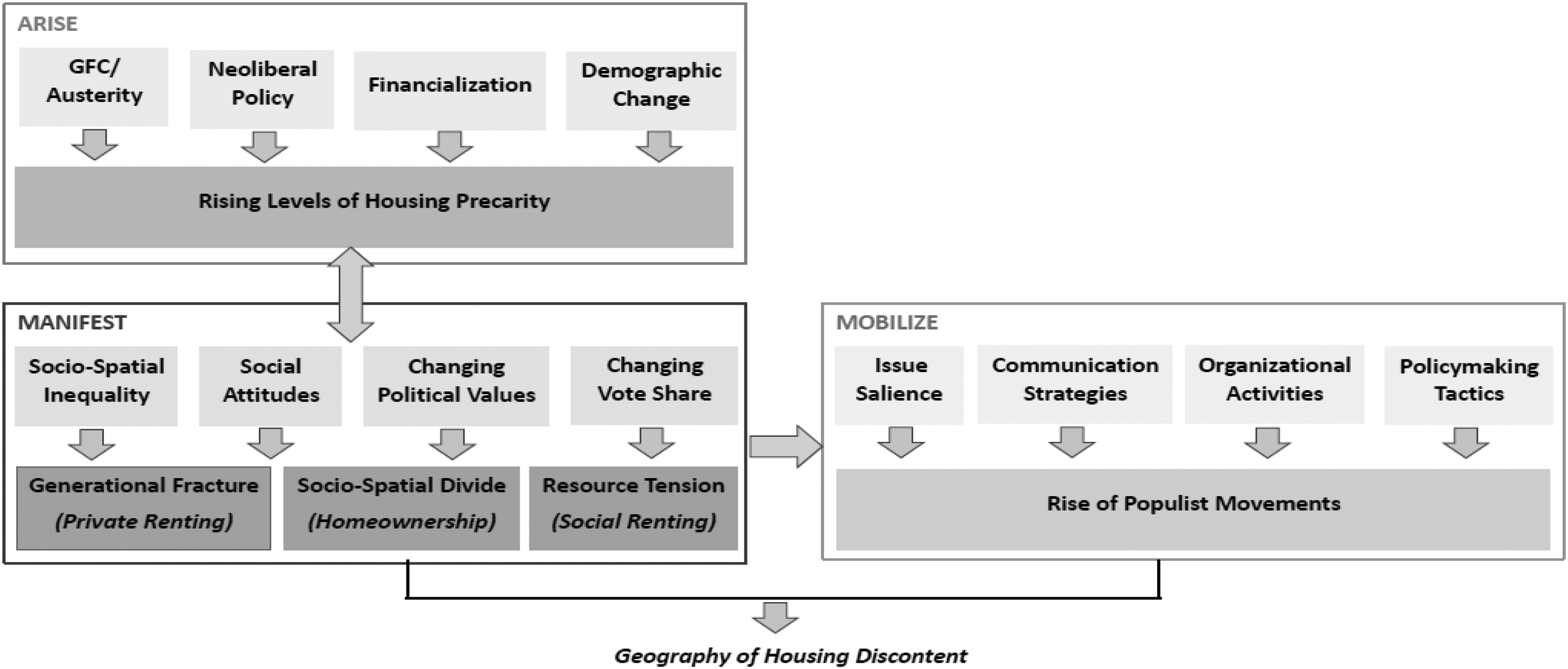
Housing discontent: a conceptual framework.
To consider how housing discontent might be operationalised, look to the case of Ireland, a country wracked by the financial crisis, a housing market collapse and austerity (Waldron and Redmond, 2014). These conditions have reshaped Irish politics as the populist, left-wing Sinn Féin party has made significant electoral gains on housing issues (Coulter and Reynolds, 2020). The country has experienced a series of housing crises, from a finance-led housing bubble in the 2000s, to a severe market collapse in the 2010s where one-fifth of all mortgages entered default (Waldron and Redmond, 2016). The Irish State nationalised €74bn of toxic property debt from the Irish banks and has resold these assets to global investors at fire sale prices, leaving taxpayers exposed for the shortfall (Waldron, 2018). Homeownership is unaffordable but to those on the highest incomes (Byrne, 2020), while younger and poorer families are displaced into a liberalised rental sector where high rents, insecure tenancies and poor quality cause severe financial, social and psychological burdens (Byrne and McArdle, 2020; Waldron, 2021). Sinn Féin has tapped such discontent as its support surged from 10% to 24% in a decade, particularly among young, urban voters (McGee, 2020) who identify housing as their most important economic and social issue, and are attracted to Sinn Féin's proposals for a national rent freeze, a cap on mortgage interest rates and a large public housing programme (Brey, 2020).
Others might look to the UK, a liberal housing regime marked by entrenched ideologies of mass homeownership, asset-based-welfare and deregulated mortgage markets (Ronald, 2008). However, evidence points to sharply rising housing inequalities (Dorling, 2014) and growing socio-spatial divides in housing wealth (Arundel and Ronald, 2021). The amplification of such inequalities displays a clear geographic pattern; London and the South East have benefited from globalisation, transnational capital and buoyant property markets, while regional towns in the North and Midlands have suffered deeper legacies of collapsed housing markets and economic change (Adler and Ansell, 2020). Such dynamics has widened wealth gaps, reinforced perceptions of regional decline and eroded support for a political mainstream that produced such differential outcomes (Ansell, 2019), best exemplified by the decisive Brexit vote in the North and Midlands (Ford and Goodwin, 2017). At a local level, resentments regarding inward migration, competition for affordable housing and services are increasingly evident (Boswell et al., 2020), while support for populist insurgents has grown and forced establishment parties to adopt more populist rhetoric and policy positions.
To explore such dynamics, housing discontent would seek to identify the policy shifts that have occurred across national housing systems and understand the macro-level political–economic transformations prompting these shifts. It would examine the emerging patterns of housing precarity across spatial scales and social groups, explore how such precarity contributes to changing social attitudes, political values and preferences and consider how populists have instrumentalised housing concerns to expand their support. Such an approach can provide the focus for policy analyses on how changing governance structures, regulations and legislations are affecting housing outcomes. It can focus on the societal or individual implications of precarious housing and inform demographic, socioeconomic and spatial analyses of changing electoral geographies, voter preferences and attitudes. It can inform political science studies of populist movements, how they frame and communicate issues regarding housing and urban politics. In short, housing discontent will elaborate on the connections between housing, place and politics and how researchers can better understand the interplay between housing inequalities and socio-political change.
Conclusions
This exchange has argued that new approaches are required to understand the interplay between intensifying housing precarity and rising support for populist politics. In the aftermath of the financial crisis, the housing systems of many advanced economies have undergone dramatic transformations that are exacerbating housing precarity, wealth inequalities and socio-spatial polarisation. Affluent cities profit from rising asset values and wealth concentration, while ‘left behind’ locations contend with deeper housing busts, economic decline and poorer urban quality. At the same time, many such countries have witnessed a growing acceptance of populist political rhetoric, values and policies as populists exploit citizens' economic and cultural anxieties for electoral gain. Many of these anxieties cut directly across key housing issues, such as the performance of local housing markets, while in other instances the connections between populist sentiment and housing grievances may be more contingent or indirect.
However, what is clear is that existing approaches have been inattentive to the connections between housing system dynamics, housing precarity and political disaffection. Comparative housing studies have been inattentive to processes of change within housing systems and the political outcomes of housing inequality (Aalbers, 2016). Urban political economy approaches have overlooked how housing inequalities have shaped resentments that fuel the base of support for populists (Rossi, 2018). Political science literature has largely disregarded the importance of housing and urban place in influencing citizens' welfare, wealth and politics (Ansell, 2019).
To address this, the paper proposes a new focus on ‘housing discontent’ to capture how deepening housing precarity and place inequalities are influencing social attitudes, political values and preferences. Such a focus would be on exploring multiplicity, differences and similarities in the experiences of housing discontent across comparison countries, cities and neighbourhoods, rather than producing a single deterministic understanding. This approach would identify the major policy transformations that are occurring across national housing systems and the political–economic transformations prompting such shifts. It would examine emergent patterns of housing precarity (affordability, security, quality, and access) among differing social groups and determine how such experiences are influencing social attitudes, political values and preferences. It would investigate how such experiences have translated into populist political support and the ways in which voters' housing grievances have been mobilised to shape political understanding.
The approach provides a foundation for future research agendas that seek to understand how socioeconomic and housing conditions are forging new forms of socio-spatial inequality, political contestation and conflict. This includes not just a distinct conceptual approach to the politics of housing, but an illustration of the potential, and challenges, of examining multiple cases of housing precarity and their political outcomes across geographic scales. While the value would most clearly be in relation to understanding the politics of contemporary housing inequalities, it will also have clear implications for debates regarding financialisation, neoliberalism, housing and welfare, as well as the literature on urban social movements and electoral geographies.
Footnotes
Declaration of conflicting interests
The author declared no potential conflicts of interest with respect to the research, authorship and/or publication of this article.
Funding
The author received no financial support for the research, authorship and/or publication of this article.