



Abstract
Orthodontic relapse remains a persistent challenge despite proper treatment and retention protocols. Fixed retainers, typically stainless steel or tri-flex nickel–titanium wires bonded to the lingual surfaces of the anterior teeth, are commonly used to maintain alignment. However, direct retainer placement techniques often require more chairside time, making it difficult to maintain proper isolation, and they are highly tech-nique-sensitive. Indirect retainer placement methods, such as thermoformed sheet tray systems and putty impression techniques, are also available but tend to be more time-consuming, costly, and require specialized equipment for fabrication. To address these challenges, we developed a new, cost-effective indirect retainer placement tray system (QuickTRAY), which is made from glue-gun material. This system reduces chairside time and laboratory procedures while maintaining efficiency.
Keywords
Introduction
Orthodontic relapse remains a significant challenge despite the implementation of appropriate treatment and retention protocols. Fixed retainers, such as stainless-steel wires/tri-flex nickel–titanium wire bonded to the lingual surfaces of anterior teeth, are commonly used to maintain alignment.1, 2
While direct retainer placement is widely practiced, indirect bonding offers improved accuracy but often requires additional laboratory time.
Additional methods for direct and indirect lingual retainer placement, such as putty impressions or thermoforming sheets, also exist but are limited by high costs, the need for specialized forming machines, and technique sensitivity. These challenges underscore the need for more efficient and cost-effective solutions in orthodontic retention.2–4
To address these limitations, we developed a unique, cost-effective glue-gun tray designed for fixed lingual retainer placement. This innovative tray utilizes a glue-gun mechanism to precisely position composite pads and retainer wires, offering improved isolation management (which is difficult in direct lingual retainer placement) and faster curing. Compared to traditional methods, this approach reduces chair time and laboratory procedures, simplifying the indirect bonding process. This new technique represents a novel advancement in orthodontic retainer-placement system technology, offering a reliable alternative that combines effectiveness, simplicity, and patient convenience.
Materials Required
Patient working model
Alginate impression material
Retainer wire: Titanium Tri-Flex [0.010 in (w) × 0.028 in (h)]
Glue gun with glue: ApTechDeals 150W
Flowable composite: Ivoclar Vivadent Tetric N-Flow
Etchant: Frost-Etching gel, 37% phosphoric acid
Bonding agent: Ortho Solo, universal bonding primer
Light curing gun: Woodpecker iLED Plus Light Cure Unit
Fabrication
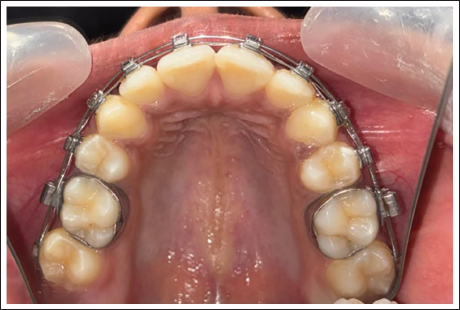
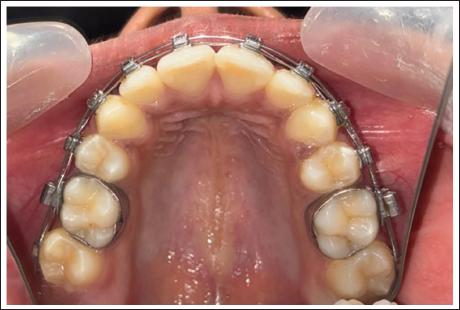
Take upper and lower arch impressions: Begin by taking accurate impressions of the patient’s upper and lower arches using alginate impression material (Figures 1 and 2).
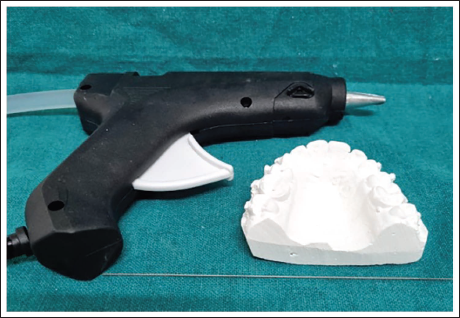
Pour cast and create working model: Pour the impressions with dental stone to create a cast. Use the cast to prepare a study model that accurately reflects the patient’s dental anatomy (Figure 2). Figure 3 illustrates a glue gun loaded with glue alongside the patient’s working model, ready for the fabrication of the retainer.
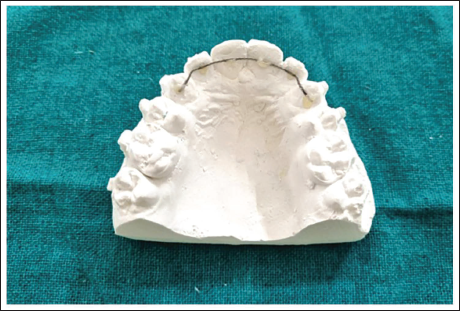
Fix retainer wire on the working model: Passively place the retainer wire (Titanium Tri-Flex—0.010 in (w) × 0.028 in (h)) onto the working model. Secure the wire in place using flowable composite (Ivoclar Vivadent Tetric N-flow) to prevent movement (Figure 4).
Make glue gun tray: Use a glue gun (ApTechDeals 150W) to apply a layer of glue over the retainer wire as well as the buccal and lingual surfaces of the tooth on the study model. Allow the glue to set and cool, forming the tray around the wire (Figure 5).
Remove the tray: Once the glue has set, carefully remove the tray from the study model. The retainer wire will be embedded in the tray, ready for further processing (Figure 6).
Polishing: The composite pads were gently polished with a brush using light pressure, and acetone was applied on the composite pad to remove residual impurities that could affect the bond strength.
Etchant: Use 37% phosphoric acid etching gel (Frost), then rinse thoroughly and dry to enhance bond strength.
Apply bonding agent: Following the etching procedure, apply a thin layer of bonding agent (Ortho Solo, a universal bonding primer) to the etched surface to ensure optimal adhesion of the flowable composite material.
Place flowable composite on exposed retainer wire: Carefully place flowable composite (light-cured nanohybrid flowable composite—Ivoclar Vivadent Tetric N-Flow) over the exposed portion of the retainer wire within the tray (Figures 7 and 8).
Ensure proper isolation: Use proper isolation techniques (e.g., rubber dam or cotton rolls) to prevent contamination during the procedure.
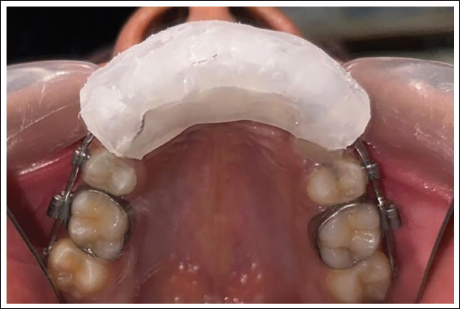
Place tray in patient’s mouth: Position the glue tray with the flowable composite and retainer wire in the patient’s mouth. Ensure that the tray fits properly and is seated well (Figure 9).
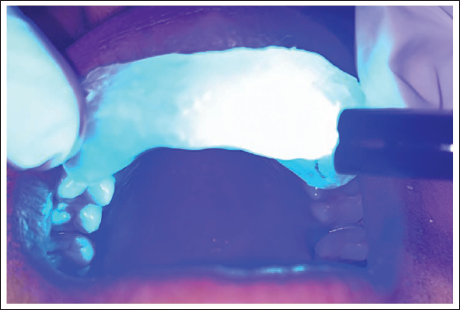
Cure the composite with a light curing gun: Use a curing light gun (Woodpecker iLED Plus Light Cure Unit) to cure the flowable composite material, ensuring proper setting and secure bonding to the retainer wire (Figure 10).
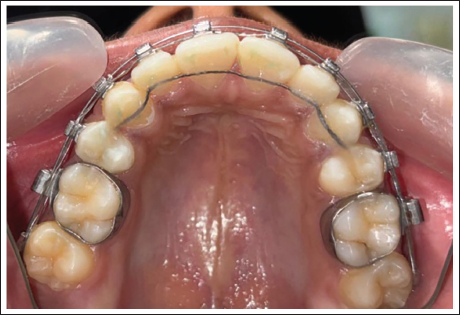
Final adjustments: After curing, we will remove the tray from the patient’s mouth and ensure that the retainer wire is securely fixed to the tooth surface with optimal bond strength (Figure 11).
Intraoral View Following Completion of Orthodontic Treatment.
Intraoral View Prior to Retainer Placement.
Glue Gun Loaded with Adhesive and the Patient’s Working Model Prepared for Retainer Fabrication.
Stabilized Retainer Wire Positioned on the Working Model with Flowable Composite.
Fabrication of the Glue Tray Over the Working Model.
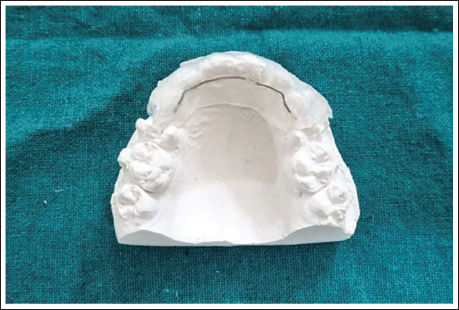
Removal of the Glue Tray from the Working Model.
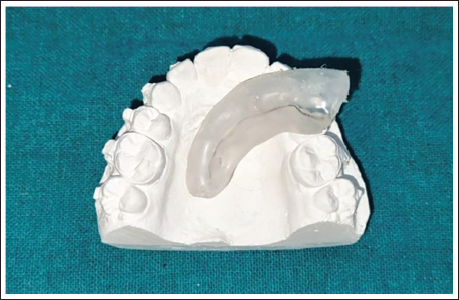
Top View of the Fabricated Glue Tray.
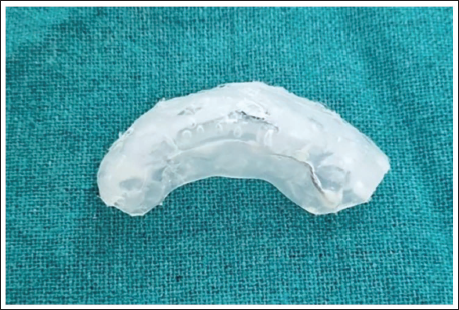
Inner View of the Glue Tray Showing the Attached Retainer Wire.
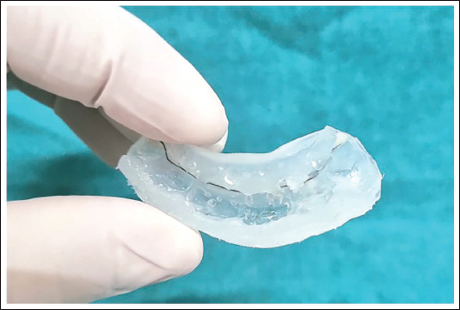
Glue Tray Positioned Intraorally in the Patient’s Mouth.
Curing of the Flowable Composite Applied Over the Retainer Wire.
Intraoral View Post Retainer Placement.
This process ensures that the retainer wire is securely embedded within the tray, providing effective retention and support after orthodontic treatment (Figures 1–11).
Advantages
Quick and efficient: Fast setup, reducing chair time for both dentist and patient.
Ease of use: Simple fabrication and placement without complex equipment.
Versatile: Suitable for various types of retainers and treatment plans.
Isolation: Better isolation control is possible because it takes less chairside time compared to the direct retainer placement technique (quick method).
Cost-effective: Affordable materials and a simple process reduce costs for both dentist and patient (compared to other indirect lingual retainer placement methods).
Overall, the QuickTRAY offers a reliable, comfortable, and efficient method for the orthodontic retainer placement tray system, enhancing both functional and aesthetic outcomes.
Discussion
This technical note describes a feasible and effective indirect bonding guide and method for fixed lingual retainer placement (QuickTRAY), which does not require vacuum thermoforming machines to construct the transfer tray. Instead, it utilizes a glue tray, a material readily available in dental practices. Additionally, it eliminates the need for putty impressions, which are costly, non-reusable, and time-consuming to manipulate. By using the glue tray, we offer a more efficient and cost-effective solution for orthodontic retention. Although the glue material used to fabricate the QuickTRAY is generally biocompatible, some patients may develop hypersensitive reactions to the thermoplastic adhesives it contains, such as ethylene-vinyl acetate (EVA), polyamide, or polyethylene-based compounds, along with additives, like stabilizers and plasticizers. Symptoms like redness, itching, burning, or swelling typically appear shortly after tray insertion and are limited to areas in contact with the tray, distinguishing them from reactions to bonding adhesives, which occur later, around bonded teeth.
To confirm an allergy, a patch test performed by a dermatologist or allergy specialist is applied with small amounts of the suspected allergens to the skin under adhesive patches for 48 h, with observations continuing up to 96 h. Additionally, a supervised small in-mouth trial may be done to detect immediate reactions. Identifying allergies beforehand is crucial to avoid complications and to select alternative biocompatible tray materials. If an allergic response is confirmed, this method should be avoided, and alternative retainer-placement techniques must be used.
Limitation
The glue tray is very flexible, which sometimes causes the retainer wire to remain attached to the patient’s study model. As a result, the retainer wire may not properly adapt to the lingual surface of the teeth, leading to bond failure.
Conclusion
The glue tray system offers enhanced retainer placement, custom fit, and improved bonding for orthodontic retainers. It is quick, cost-effective, and easy to use, reducing chair time and enhancing patient comfort. This reliable, versatile solution improves both treatment efficiency and outcomes.
Footnotes
Acknowledgments
The authors are deeply grateful to the anonymous peer reviewers for their dedicated time and expertise. Their feedback and constructive criticism have enhanced this innovation and credibility. Their meticulous review process improved content and fabrication. The authors appreciate their thorough assessment, which improved clarity and coherence, encouraging further refinement. Peer reviewers contribute significantly to scientific knowledge and academic publications, fostering excellence and integrity in innovation.
Declaration of Conflicting Interests
The authors declared no potential conflicts of interest with respect to the research, authorship, and/or publication of this article.
Ethical Approval
Not applicable.
Funding
The authors received no financial support for the research, authorship, and/or publication of this article.
Informed Consent
The informed consent has been obtained for the study.
