



Abstract
Bite registration plays a crucial role in the construction of a functional orthodontic appliance. Accurate registration is essential for achieving optimal occlusion, ensuring proper mandibular positioning, and maintaining the three-dimensional spatial relationship between the maxilla and mandible. This article explores the principles of bite registration, its significance, common challenges encountered, and clinical strategies for precise vertical-dimension control using metallic or polylactic acid (PLA) balls.
Introduction
Accurate bite registration is a fundamental aspect in the design of effective orthopedic appliances. 1 It involves capturing the three-dimensional spatial relationship between the maxilla and mandible, forming the basis for successful orthodontic intervention. 2 The construction bite plays a pivotal role, as it dictates the extent of activation required in the appliance to facilitate mandibular repositioning and optimize jaw alignment.
Over time, numerous techniques and devices have been developed to enhance the accuracy of bite registration. Despite these advancements, maintaining consistent control over vertical dimensions continues to pose a significant challenge. Addressing these complexities is essential to improving the predictability and success of orthodontic treatment outcomes.
Vertical Dimension
The amount of vertical bite opening plays a crucial role in appliance design. The bite must be opened beyond the freeway space to prevent the patient from posturing out of the appliance when the mandible is at rest. 3
Challenges in Vertical Bite Registration
Achieving the correct vertical dimension on both the right and left sides can be challenging.
Uneven vertical height may lead to occlusal disharmony, affecting both function and esthetics, as well as asymmetrical bite forces, leading to TMJ discomfort.
Overcoming Vertical Challenges
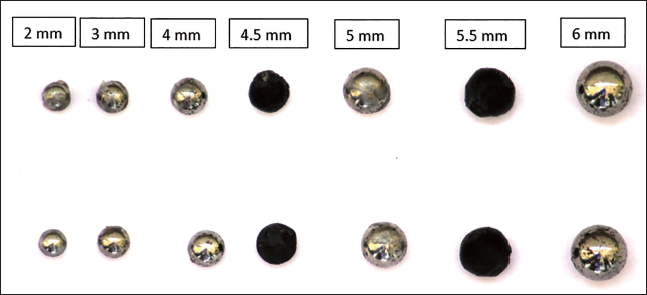
Controlling vertical dimension during bite registration is often complex. This article presents a simple yet effective method for achieving precise vertical control using metallic or polylactic acid (PLA) balls (Figure 1).
Metallic Balls of Varying Diameter.
Procedure
Train the patient to position the mandible at the desired sagittal dimension.
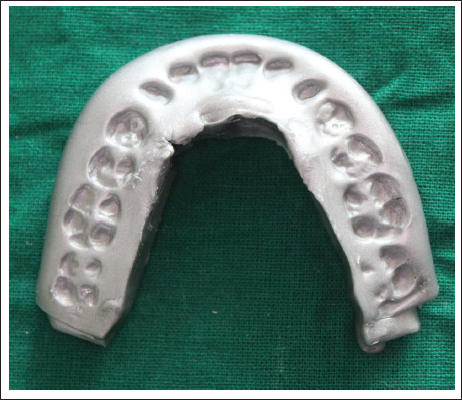
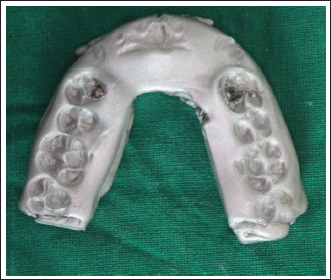
Roll the alu wax and register mandibular tooth indentations (Figure 2).
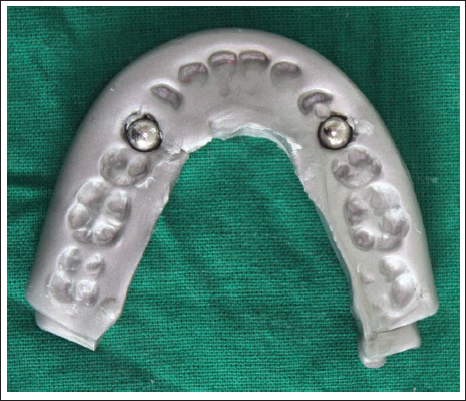
Incorporate metallic balls of the required vertical dimension at the premolar region (e.g., for a 4 mm vertical opening, use a metallic ball with a 4 mm diameter) (Figure 3).
Position the wax with the metallic ball in the patient’s mouth, instruct them to advance the mandible, and bite until resistance is met (Figures 4 and 5).
Mandibular Indentations.
Placement of Metallic Balls in Premolar Region.
Wax with Metallic Balls in Patient.
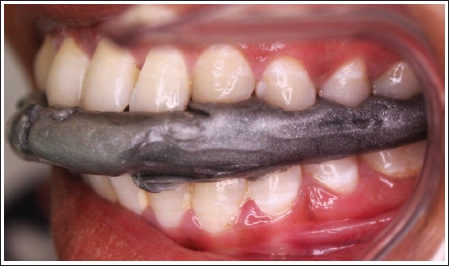
Bite Registration.
Conclusion
This technique provides a reliable method for achieving accurate vertical dimension control, thereby improving the effectiveness of functional orthopedic appliances.
Footnotes
Declaration of Competing Interests
The authors declare that there is no conflict of interest with respect to the research, authorship, and/or publication of this article.
Ethical Approval
Not applicable.
Funding
The authors received no financial support for the research, authorship, and/or publication of this article.
Informed Consent
Not applicable.
