



Abstract
Aim
This article aims to “evaluate the factors influencing patient before selecting their orthodontist in India.”
Objectives
To evaluate the orthodontists’ demographics influence patients to select their orthodontist and to know whether clinic amenities influence patients to select their orthodontist.
Material and Method
A descriptive, cross-sectional survey conducted through a web-based self-administered questionnaire with 15 questions addressing various aspects of orthodontic treatment necessity. This study included 255 patients between the ages of 12 and 30 who are undergoing orthodontic treatment or have completed their orthodontic treatment.
Results and Conclusion
A total of 255 participants were there in the study. Patients were influenced by many factors such as skillful orthodontists with updated or recent knowledge, orthodontists’ demographics, and clinic amenities.
Introduction
The last few years have been unique in the professional history of orthodontists currently operating in India. According to the 2011 issue of the Journal of Clinical Orthodontics Practice Study, the “Great Recession” has resulted in losses in mean net practice revenue for the first time in at least 30 years. Moreover, despite the fact that hundreds of new orthodontists graduate and enter practice each year, many senior practitioners remain in practice for extended periods of time, despite the fact that the number of orthodontists in practice continues to expand.
Many potential patients and their families have many orthodontic practitioners to choose from within a reasonable distance. Indeed, it appears that the practice of “shopping around” at various offices before starting treatment is becoming more common—past research has put the ratio at 30% to 41%. There is a huge need for orthodontists to understand how to best focus finite resources to maximize patient selection in their business, especially given the present practice climate. 1 Because the treatment process is a valuable dogma, it is critical to comprehend the satisfaction process at all stages of treatment from the patient’s perspective in order to provide the best possible treatment results. 2 In today’s world, patient-reported outcomes are frequently used to evaluate and compare treatment outcomes, and including patient values is a key tenet of evidence-based therapy. 3 Clinician-derived objectives or variables have been used to assess treatment outcomes in orthodontics for many years. 4 Nonetheless, there has recently been a growing body of evidence of research that includes patient-based subjective features.4, 5 Because there are so many variables to consider, determining patient satisfaction with the orthodontic treatment process can be difficult. 6
The purpose of this study is to evaluate the factors influencing patients to select their orthodontist.
Materials and Methods
The research was reviewed and approved by Institutional Ethics Committee of MIDSR Dental College, Latur, Maharashtra, India. This survey was conducted using Google Forms, an excellent tool for gathering online data with or without knowing the name of the participant. These Google Forms evaluate and provide instant statistical results to reach an inference. Participants could fill this virtual form in comfort without any hesitation or judgment from others. They can also fill out the form on their cell phones, laptops, or any other smart device, giving them complete privacy and enabling them to think freely without being swayed by previous preconceptions. The participants are also not afraid of being tracked down for their answers. A pilot survey was conducted with the help of patients to evaluate factors influencing patients before selecting their orthodontist. This study included 255 patients between the ages of 12 and 30 who are undergoing orthodontic treatment or have completed their orthodontic treatment. The data for this study was collected using Google Forms, and they were requested to complete a structured questionnaire.
The questions were prepared as follows: first 5 questions on demographics of an orthodontist, following 5 questions on clinic amenities, followed by 5 questions regarding skills of an orthodontist. Each question had answers, ranging from a positive response to a negative response. The test items determine whether an orthodontist’s personality, clinic atmosphere, and talents have an impact on the practice of an orthodontist.
Results
In total, 255 people took part in the research. The participants came from all around Maharashtra and were either undergoing or having completed orthodontic treatment. The participants ranged in age from 12 to 30 years old. The majority of the participants were between the ages of 20 and 25.
Figure 1 shows that the majority of the 255 patients considered an orthodontist’s age or experience before beginning their orthodontic treatment. A total of 85.1% of patients evaluate an orthodontist’s age and expertise, 12.9% consider an orthodontist’s personality, and only a small percentage of patients seek for an orthodontist’s Google rating before choosing their orthodontist (Figure 1).
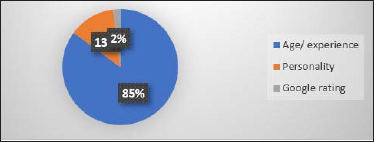
Chartcriteria Before Choosing Orthodontist.
Figure 2 demonstrates that the majority of patients choose an orthodontist with more than 5 years of expertise. A total of 44.3% of patients chose an orthodontist with more than 10 years of experience, ranging from 10 to 20 years, 40.8% chose an orthodontist with 5 to 10 years of experience, and only 14.3% chose an orthodontist with fewer than 5 years of experience. This finding indicates that an orthodontist’s experience is crucial.
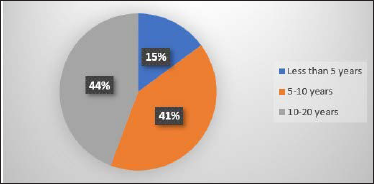
Experience of an Orthodontist.
Because we live in the 21st century, everyone, especially the younger generation, is online, the majority of the respondents had looked for orthodontists on social media sites such as Facebook, Instagram, and others. In Figure 3, 84.3% of patients have stalked their orthodontist before deciding on treatment. Only 15.7% of patients had used social media to stalk their orthodontist.
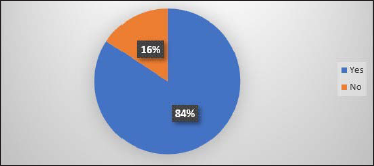
Patients Visiting Internet, Facebook or Instagram Page of an Orthodontist.
Figure 4 depicts how an orthodontist’s chairside manner should be. The majority of respondents wanted their orthodontist to be courteous to them. Patients wanted their orthodontist to be nice to them in 68.2% of cases, and 30.6% of cases wanted their orthodontist to be friendly to them in 30.6% of cases. The nature of an orthodontist is irrelevant to only 1.8% of the population.
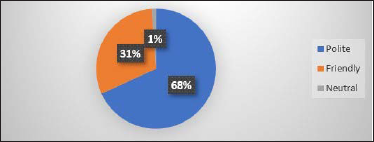
Chairside Manner of an Orthodontist.
Figure 5 depicts an orthodontist’s timeliness. Almost all patients, or 97.3%, desired to be treated at the scheduled time. Present were only a few patients there who didn’t care about being on time. As a result, while performing orthodontic treatment, punctuality toward your patient is critical.
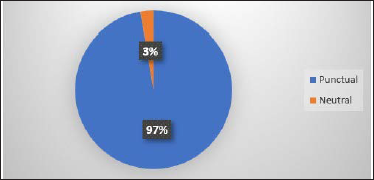
Treatment Procedure Carried Out on Time.
The distance between the clinic and the patient’s home or office is shown in Figure 6. Patients wanted a dental clinic that was close to their home or office in 45% of cases, and a clinic that was an average distance away in 45% of cases.
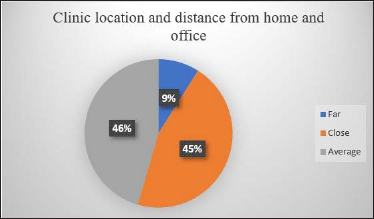
Clinic Location and Distance From Home and Office Far.
The clinical amenities are depicted in Figure 7. All of the patients want a relaxing, peaceful, and comfortable environment in the clinic. According to statistics, 97.6% of people enjoyed the clinic’s pleasant, calming, and comfortable atmosphere. Only a few patients cared about the clinic’s atmosphere.
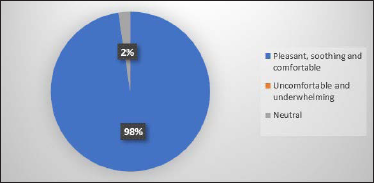
Office Ambience.
Figure 8 depicts the perspectives of patients who have access to a television in the waiting area. Ninety-three percent of patients preferred a television in the dental clinic’s waiting area. In the dental office waiting area, only 7% of customers chose not to watch television.

Television in Waiting Room.
Figure 9 demonstrates that 90% of patients prefer educated receptionists and other employees, while 9% of people don’t care whether receptionists and other personnel are educated or ignorant.
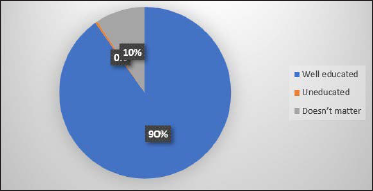
Receptionist and Other Staff in Clinic.
According to 70% of respondents, dusting, mopping, and sanitization are required for dental clinics, whereas just sanitization is required for 26% of respondents, and dusting and mopping are sufficient for only 3% of respondents (Figure 10).
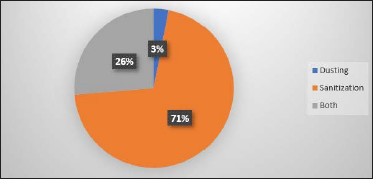
Cleaning Method Preferred in Waiting Area and Clinic Area.
Figure 11 demonstrates that 97% of patients had communicated their treatment strategy, whether extraction or nonextraction, whereas just 3% of patients were ignorant or unaware of treatment plan.
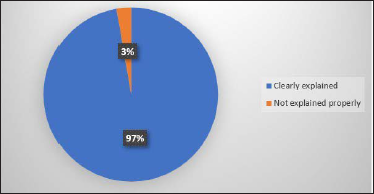
Diagnosis and Treatment Plan Explained to you.
According to 61% of respondents, orthodontists should know orthodontic treatment via traditional or conventional techniques as well as modern techniques (Figure 12). Thirty percent of patients believe orthodontists should be up to date on orthodontic treatment procedures, whereas 9% believe orthodontists should have traditional treatment abilities.
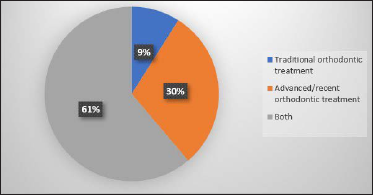
Technology and Variety of Treatment Options.
According to Figure 13, the quality of images taken before and after treatment should be highly qualified for 95% of patients, medium quality photographs are acceptable for 5% of patients, and no one wants low-quality pretreatment and posttherapy photographs.
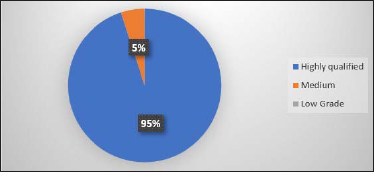
Quality of Work by the Orthodontist.
Figure 14 shows that 46% of patients learned about an orthodontist through social media, 41% through friends or family, and 12.5% through another dentist.
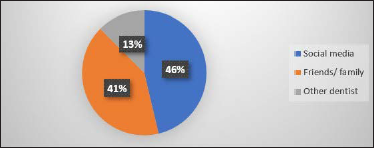
Source for Getting Information of an Orthodontist.
Discussion
For more generalization of the results, patients seeking treatment in both the public and the private sectors were included in the study. All patients included in the survey are undergoing orthodontic treatment or have completed the orthodontic treatment. In this investigation, generalization could not be assured due to the small sample size. The full saturation of themes, which was difficult to prove, was a potential weakness of this study.
Before choosing an orthodontist, inquiry about the experience and education of the provider is most common. The better the orthodontist’s service is, the longer they’ve been treating patients and the more training they’ve received. So, before receiving any form of orthodontic treatment, the age and expertise of an orthodontist are the most important aspects to consider. In our survey, 85% of patients sought for an orthodontist’s age and experience before beginning treatment. Out of these, 44% of people preferred orthodontists with more than 10 years of experience, followed by 40% who preferred orthodontists with 5 to 10 years of experience. However, knowing the expertise and education of the doctor who will be dealing with you or your child is always a good idea. This does not mean that you should avoid working in newly opened offices as not every orthodontist has the best education or years of expertise. However, the fact that an orthodontist is a trained doctor does not guarantee that they are the ideal fit for every patient.
The orthodontist’s demeanor and attitude appear to have a significant impact on patients’ perceptions of the treatment process. 7 In this study, interpersonal characteristics including politeness, friendliness, and tranquilly were favorably connected with the patient. Patient satisfaction was positively connected with the concepts of being treated as a “human being” and being treated “on the same level.” These findings were comparable to those of Sinha et al, 8 who discovered a strong positive relationship between patient satisfaction and orthodontist behavior.
As we live in the 21st century, everyone, especially the younger generation, is connected to the Internet, the majority of respondents had looked for orthodontists on social media sites such as Facebook, Instagram, and others. In our study, 84.3% of patients shopped around for an orthodontist before deciding on one. An excellent orthodontist is one who keeps his or her front office in good shape.
Patients prefer a pleasant, peaceful, and comfortable clinic environment, according to the research. The pleasant and welcoming demeanor of an orthodontist is accepted by patients. Staff should be kind, professional, and eager to help with any issues that arise. Look for a dentist that has kept the same staff members for a long time, as this suggests the team values and cares about the orthodontist with whom they collaborate. Dental assistants should be licensed and certified in their area. According to our research, 90% of patients preferred receptionists and other staff members to be educated and professional. Similar findings were found in this study, indicating that orthodontists should be aware of and provide various types of orthodontic treatment, including both traditional and more current approaches. Sixty percent of participants in our research wanted their orthodontist to be knowledgeable about both traditional and modern orthodontic treatments. Satisfaction is also influenced by perceived technical competence. In their review, Newsome and Wright 2 found comparable findings on patient satisfaction in a setting with general dentists.
The aesthetics of the environment may influence a patient’s assessment of the quality of care. Other studies, on the other hand, have found that some patients’ pleasure with the setting differed from their experiences with the orthodontist. 9 Patients’ satisfaction would be significantly impacted if appointments were delayed. Those who were negatively affected believed that additional information regarding the delays or projected waiting time should have been supplied. Similarly, practically every patient in our survey expected their treatment procedures to be completed on time.
The results of this qualitative study have revealed important information about the elements that impact patients when choosing an orthodontist. The findings of this study will be used to build a patient-centered questionnaire, rather than a clinician-centered model, to examine characteristics that influence patients when choosing an orthodontist.
Conclusion
Patients were influenced by a variety of factors, including skilled orthodontists with current or recent information, as well as orthodontist demographics.
Clinic amenities, particularly the waiting area, have a significant impact on the patient’s decision to see an orthodontist.
Patients assess an orthodontist’s experience as well as chairside manners when choosing an orthodontist.
Orthodontists must maintain up-to-date skills, knowledge, and clinic amenities.
Footnotes
Declaration of Conflicting Interests
The authors declared no potential conflicts of interest with respect to the research, authorship, and/or publication of this article.
Ethical Approval
Ethical approval has been obtained from Institutional Ethics Committee of Institutional Ethics Committee of MIDSR Dental College, Latur, Maharashtra, India.
Funding
The authors received no financial support for the research, authorship, and/or publication of this article.
