



Abstract
Aesthetics is one of the main concerns amongst most patients when approaching orthodontists for treatment, usually surpassing their functional requirements. Here we present a 24-year-old female patient who had undergone orthodontic treatment previously. However, she still had a deep bite present and desired an Aesthetic appliance to treat the same. This Modified Essix Retainer was developed with these considerations in mind.
Introduction
The Jackson’s triad describes the main objectives of Orthodontic treatment; namely, Structural Balance, Functional Efficiency and Aesthetic Harmony. With changing times, the aesthetic concerns amongst patients are also increasing, overtaking the need to correct any functional issues that the patient might be facing. The modes of retention have also changed in order to meet with the needs of today’s generation, from a removable acrylic retainer to a clear Essix retainer, without compromising on stability. 1
This article describes the fabrication of a modified Essix retainer with an incorporated anterior bite plane for deep bite correction.
Steps in Fabrication
Maxillary impression was made and a cast was poured in dental stone.
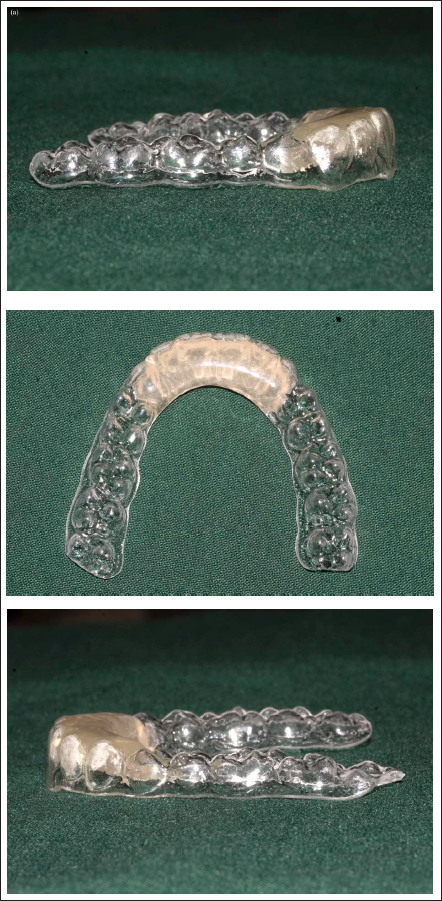
An acrylic plate was fabricated over the palatal aspect of the maxillary anterior teeth to act as a bite plane for correction of the patient’s deep bite.
The essix retainer was fabricated over this acrylic plate. A chemical bond is developed between the essix retainer and acrylic plate (Figures 1 A–C).
Patient was instructed to wear it at all times except during eating.
Occlusal and Lateral Views of the Modified Essix Retainer.
Case Report
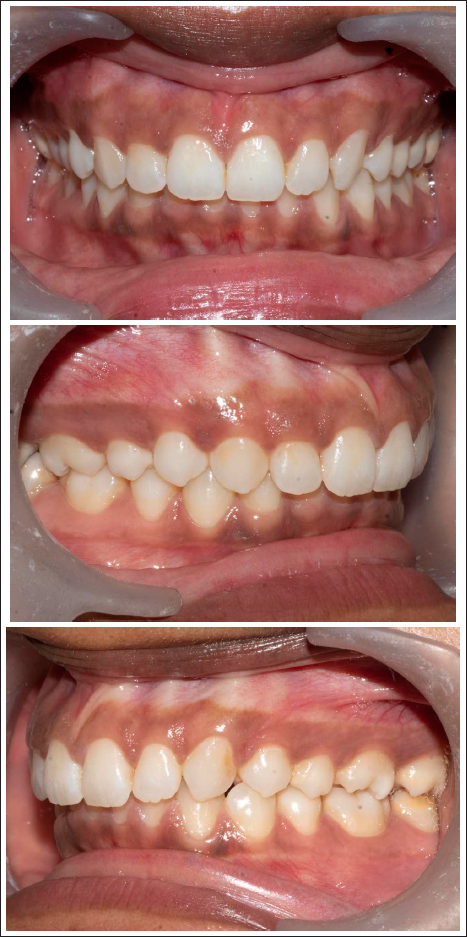
A 24-year-old female patient came with the chief complaint of a deep bite and pain behind her upper front teeth on chewing. The patient presented with a CLASS I Molar as well as Canine relation with an increased overbite. The patient had previously undergone orthodontic treatment; however, the deep bite was left untreated (Figures 2 A–C).
Intraoral Photographs Prior to Placement of Essix Retainer.
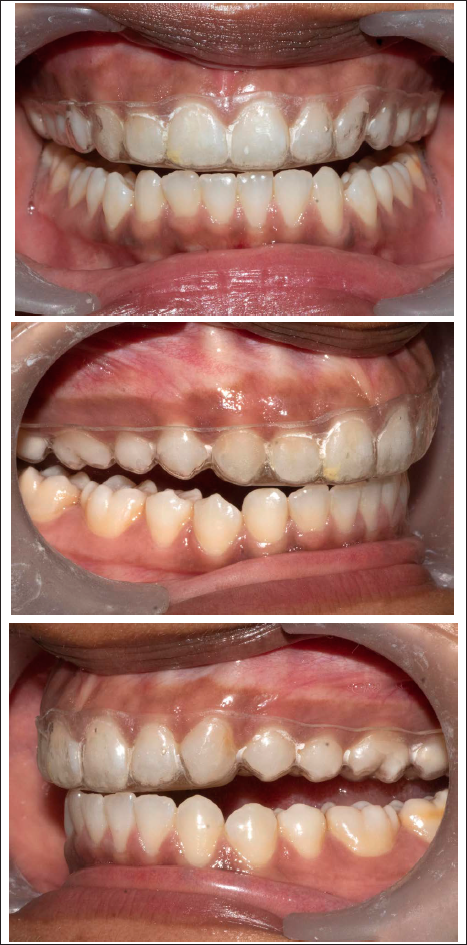
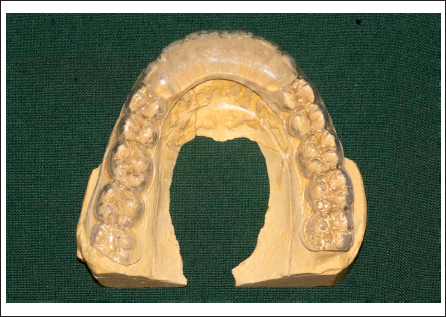
The patient showed a clear desire towards a more aesthetic appliance that would cause no interference with her speech and be easy to wear and maintain. 2 Due to these reasons, the conventional Hawley’s appliance with an incorporated anterior bite plane was rejected and an anterior bite plane was incorporated into an Essix retainer (Figures 3 A–C and 4).
Intraoral Photographs after placement of the Modified Essix Retainer.
Anterior Bite Plane Incorporated into the Essix Retainer on the Patient’s Cast.
Conclusion
The modified Essix retainer is an advantageous appliance over conventional Hawley’s appliances due to the following reasons 3 :
It is more aesthetic and comfortable for a patient;
No wire bending is required to make this appliance;
As the appliance extends only on the teeth, there is no speech problems encountered in the patient.
