




Abstract
In orthodontics, various methods of assessing sagittal jaw base relationship are formulated. Earlier, skeletal pattern was analyzed only clinically; however, after the introduction of cephalometrics by Broadbent and Hofrath in 1931, ANB and Beta angles are being used to describe skeletal discrepancies between the maxilla and mandible. YEN angle has also been used as a sagittal dysplasia indicator after its introduction in 2009. The aim of our study is to assess the predictability of ANB, Beta, and YEN angles as anteroposterior dysplasia indicators in skeletal class II malocclusion in Gulbarga population. This study is an attempt to check the variation as well as correlation existing between these 3 parameters, so that a more presumable and least variable parameter can be obtained. Total of 70 lateral cephalograms of skeletal class II patients were selected based on Down’s facial angle and tracing was carried out manually to measure ANB, Beta, and YEN angles. Statistical analysis was carried out to assess the coefficient of variation and the Pearson coefficient. Our study concluded that YEN angle is highly predictable and a homogenously distributed angular parameter used to assess sagittal discrepancy in class II patients compared to ANB and Beta angles.
Introduction
The sagittal relationship of maxilla to mandible is an important diagnostic criterion in orthodontic treatment. Although clinical observation helps determine the sagittal relationship to some extent, accurate evaluation is possible only with the help of cephalometrics. In 1931, Broadbent and Hofrath introduced cephalometrics. This method allows us to evaluate sagittal apical base relationship precisely. 1 A skeletal class II malocclusion is characterized by maxillary protrusion, mandibular retrusion, or combination of both. It affects about 20% of the population, 2 and one of the greatest challenges faced by the orthodontist is to quantify the amount of discrepancy in the maxilla or mandible in the anteroposterior plane.
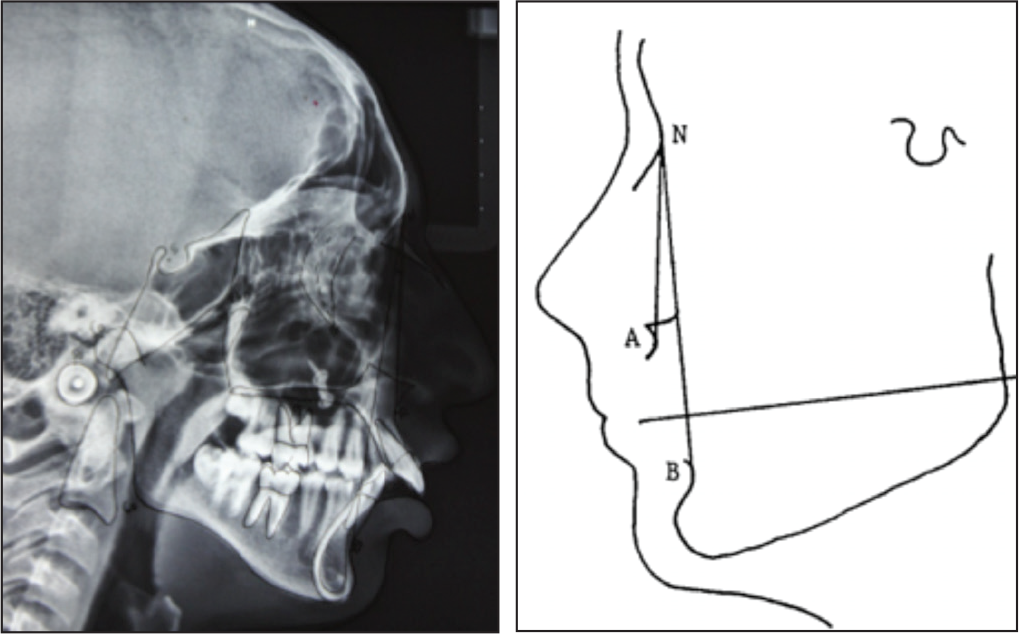
Various angular parameters have been formulated to assess jaw discrepancies in the sagittal plane. 3 Riedel’s ANB angle formed between SNA and SNB angles is widely used in evaluating anteroposterior apical base relationship (Figure 1). 4
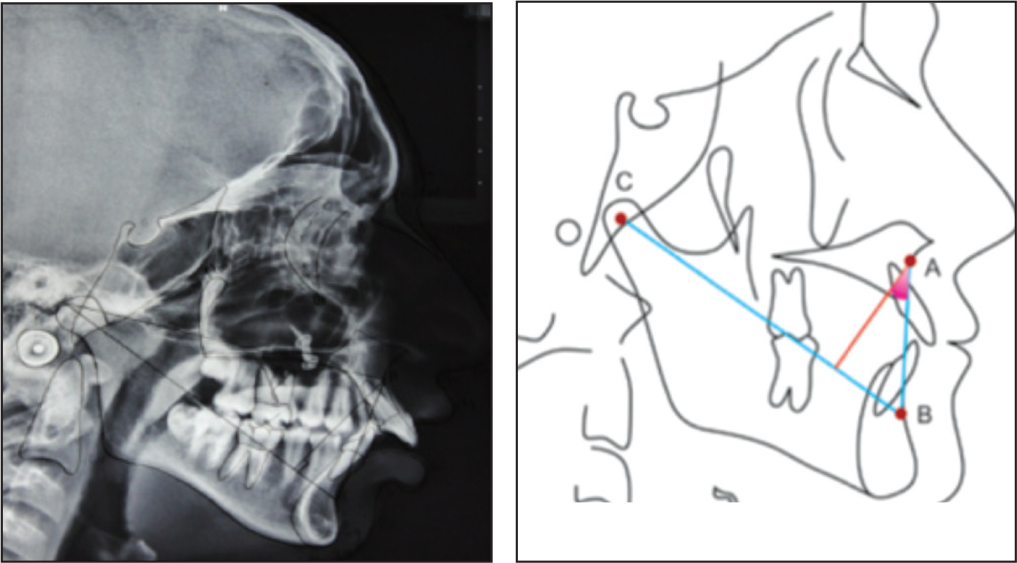
Beta angle, introduced by Baik et al, is another method used to determine the true sagittal apical base relationship without involving the cranial reference planes or functional occlusal plane. The skeletal landmarks—point A, point B, and an apparent axis of the condyle-point C—are being used and the angle formed between A–B line and a perpendicular to C–B line (Condylion-B point) is the Beta angle
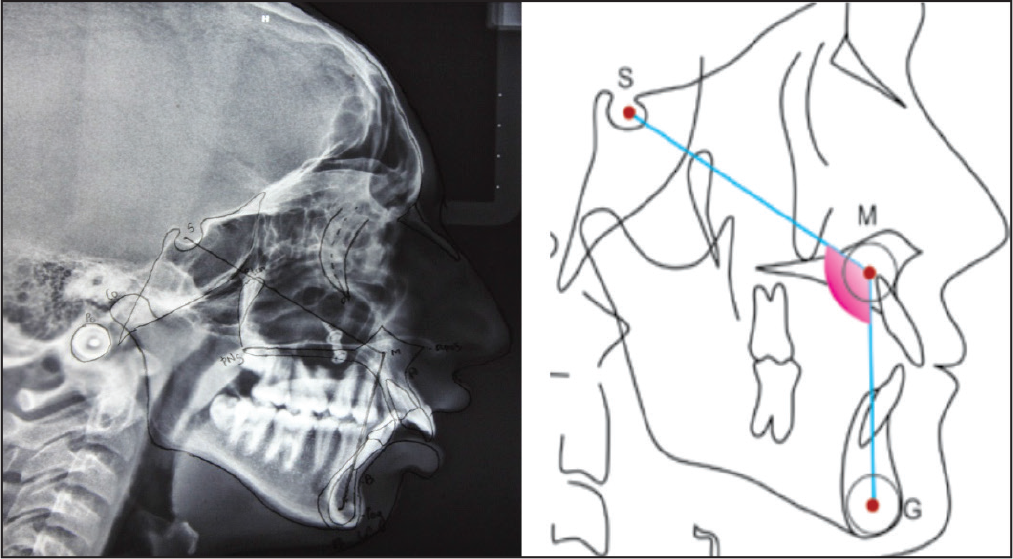
(Figure 2). 5 Later, YEN angle was developed by Neela et al, without taking any reference plane into consideration. The angle was formed by joining points S, M (midpoint of the anterior maxilla), and G (center at the bottom of symphysis) 6 (Figure 3).
ANB Angle
Beta Angle
YEN Angle
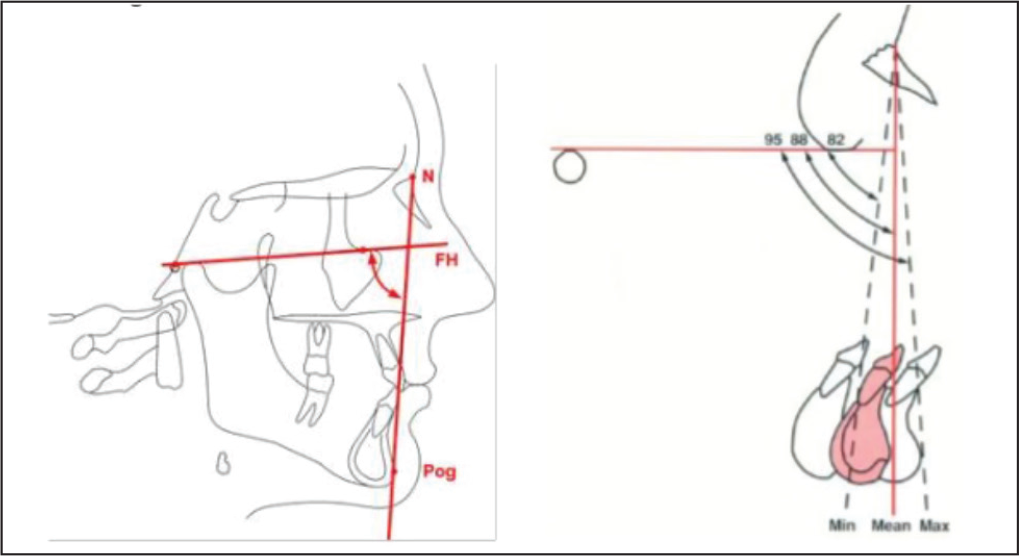
Down categorized facial type based on anteroposterior relation of the maxilla and mandible with the forehead. Facial angle is an inferior angle formed between the intersection of Frankfort horizontal plane and facial plane (Figure 4); it expresses the relative position of mandible with respect to the cranium. Based on this, mandible is classified as retrognathic or prognathic. A decreased facial angle denotes a class II skeletal profile, while an increased angle denotes a class III skeletal profile. 7
The aim of this study was to assess the predictability of ANB, Beta, and YEN angles as anteroposterior dysplasia indicators in cases of skeletal class II malocclusion in Gulbarga population. This study attempts to evaluate the variations as well as correlation presented between these parameters, so that a more accurate predictor can be obtained for assessing sagittal discrepancies.
Facial Angle
Materials and Methods
This retrospective study was carried out using high-definition pretreatment lateral cephalometric radiographs of 70 skeletal class II malocclusion patients from the Department of Orthodontics. Class II radiographic samples were selected on the basis of Down’s facial angle (< 82°). Subjects were selected under the following inclusion criteria:
Age group: 18 to 25 years No previous history of orthodontic treatment No history of trauma No congenital facial anomaly
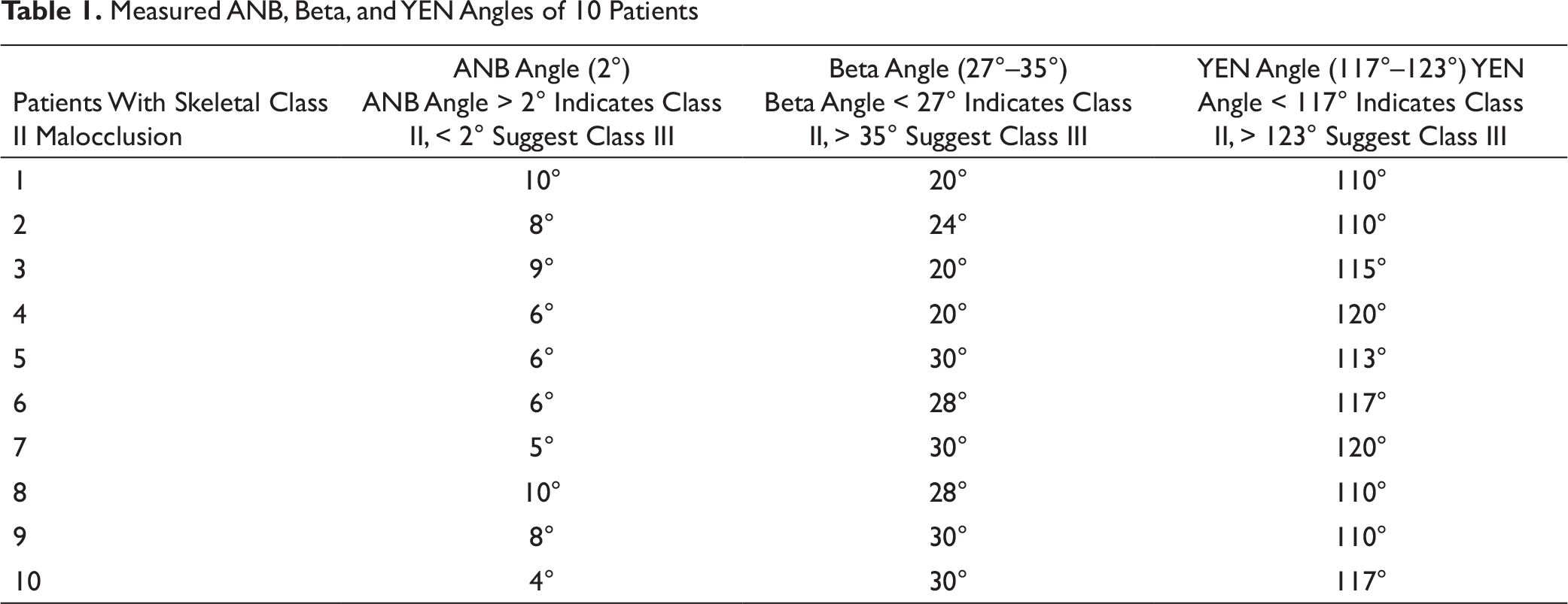
Tracings were carried out manually using a 3H pencil on acetate tracing paper with the help of an X-ray viewer. The landmarks were marked on the traced cephalograms. ANB, Beta, and YEN angles were constructed (Figures 1–3) and measurements were recorded on data recording sheets (Table 1).
Statistical Analysis
All the data were statistically evaluated with SPSS software (Shri BM Patil Medical College, Hospital and Research Center, BLDE [Deemed to be University] Vijayapura, Karnataka, India). Statistical analysis carried out included assessment of the coefficient of variation and the Pearson coefficient:
Coefficients of variability of all parameters were calculated. Correlation coefficients between the 3 parameters were calculated using Pearson correlation.
Results
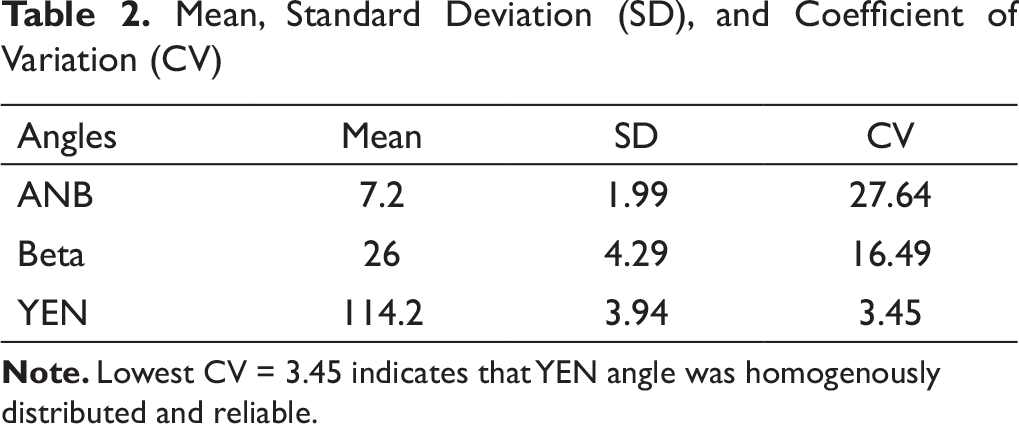
Results of our study showed that YEN angle has lowest coefficient of variation (3.45), which suggests that it is more predictable and homogenously distributed angular parameter used to assess sagittal discrepancy in class II malocclusion patients compared to ANB and Beta angles (Table 2).
Measured ANB, Beta, and YEN Angles of 10 Patients
Mean, Standard Deviation (SD), and Coefficient of Variation (CV)
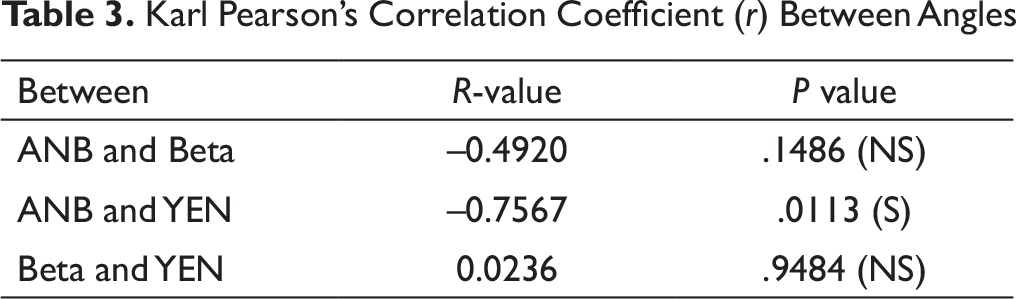
Karl Pearson’s Correlation Coefficient (r) Between Angles
Discussion
Lateral cephalometric radiograph is an extremely useful diagnostic tool in orthodontic practice which was introduced in the year 1931 by Broadbent. 1 Most of the orthodontic problems occur in sagittal plane therefore analysis of jaws in anteroposterior plane is important. 8 Wylie, in 1947, assessed maxillomandibular relationship in the sagittal plane for the first time; since then numerous analyses have been introduced to assess the same. 9
The present study was carried out to determine the predictability of ANB, Beta, and YEN angles in assessing sagittal discrepancy in class II malocclusion patients among the population in Gulbarga.
The results of this study illustrated that YEN angle was a better predictor for class II sagittal discrepancy than ANB and Beta angles. YEN angle expressed least variation and was found to be homogenously distributed as compared to the other two predictors.
In this research, YEN angle presented a higher predictability in diagnosing skeletal class II categories (P < .05). This statement could be corroborated by Venkata et al and Doshi who also found YEN angle to be one of the most effective predictor for class II subjects.10, 3 This could be because unlike Beta and ANB angle, hard tissue landmarks used in YEN angle do not undergo remodeling changes and hence represent the true nature of underlying skeletal pattern. Since YEN angle involves sella as its landmark, it is believed to be least affected by variations in facial height and jaw rotations. 6
Since Beta angle does not depend on cranial landmarks, it is believed to be least affected by change in cranial base and jaw rotation. In our study, the values of Beta angle were found to be more presumable than ANB angle in diagnosing skeletal class II malocclusion. This result is in concordance with the findings of Baik et al and Fida et al who reported less variability in Beta angle.5, 8 Though our study corresponds with these results,5, 8 YEN angle is found to be a better anteroposterior discrepancy predictor than Beta angle.
On the contrary, Doshi et al reported a positive correlation between Beta angle and Frankfort-mandibular plane angle indicating the variation that could occur in the angle during jaw rotations. 3 This statement was in close association with Sundereshwaran et al, where the author mentioned that clockwise rotation of the mandible affected the reliability of Beta angle as a sagittal discrepancy assessment tool. Hence, Beta angle may not be an ideal parameter for assessment of sagittal jaw discrepancy in patients exhibiting vertical growth patterns with skeletal class I and class II malocclusions. 11
ANB angle was considered to be the most popular parameter used to analyze sagittal skeletal discrepancies. 5 In our study, ANB value showed least efficacy in predicting sagittal dysplasia in class II patients when compared to other two parameters; this is similar to the studies carried out by Brown, Chang, and Rotberg et al. It was reported that the reliability of ANB angle is affected by changes in sella–nasion plane mainly due to anterosuperior movement of the nasion with growth.12, 13, 14 Reliability of ANB angle as a true predictor of sagittal jaw relationship has been questioned.
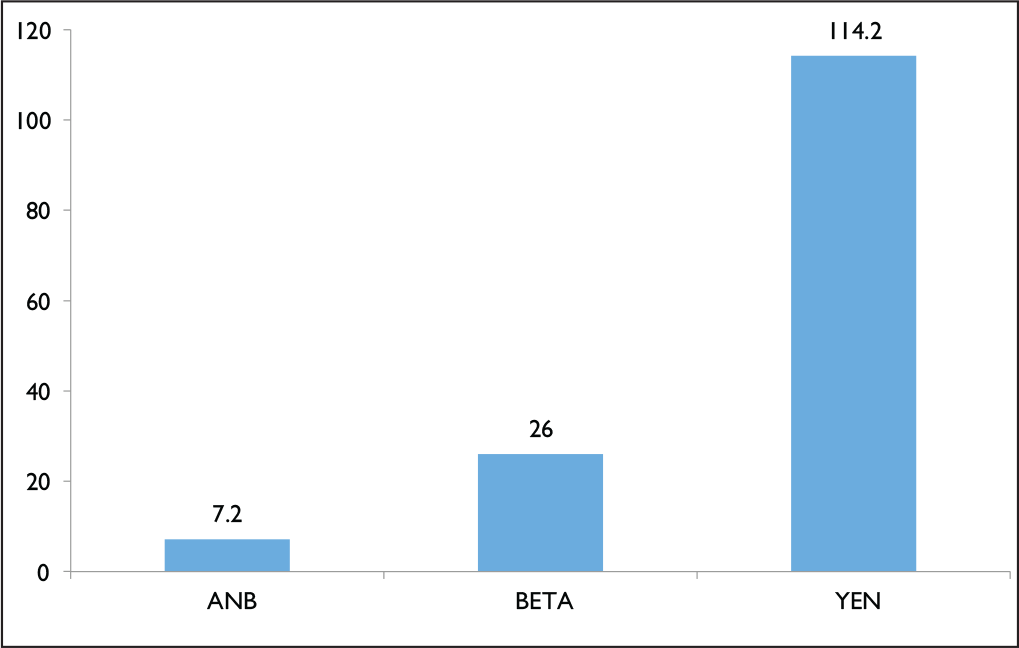
Means of ANB, Beta, and Yen Angle
ANB angle may vary in following cases:
Growth rotation of the jaws; Vertical growth reflected in the distance between points A and B; Vertical growth reflected in the distance between points N and B; and Length of the anterior cranial base and the anteroposterior position of point N.
5
Vertical displacement of N in the downward or upward direction will increase or decrease the ANB angle, respectively.15, 16, 17
Different ethnic groups present variations, so there was a need to establish the cephalometric norms for Gulbarga population and it was also necessary to find out if they were comparable with the previously established norms. The values for skeletal class II relation among Gulbarga population fall within the range of norms (Figure 5).
Our study concluded that YEN angle is the most promising cephalometrical sagittal dysplasia predictor; collaborating this with patient’s clinical findings helps in appropriate diagnosis of a case.
Conclusion
YEN angle is found to be a highly predictable parameter in assessing sagittal discrepancies in Gulbarga population.
Footnotes
Declaration of Conflicting Interests
The authors declared no potential conflicts of interest with respect to the research, authorship, and/or publication of this article.
Funding
The authors received no financial support for the research, authorship, and/or publication of this article.
