



Abstract
Background
Evaluating the need and assessing the severity of the problem help in concluding the actual need for orthodontic treatment. Many indices had been developed over the years for this purpose, and one of the most used indices is IOTN. This study was carried out for assessment of the grade of treatment difficulty utilizing the IOTN index for patients seeking orthodontic treatment at King Abdulaziz Dental Center, in Riyadh, Saudi Arabia. Random casts and digital photos of residents’ patients were collected, and statistical analysis afterward was performed for concluding the research results.
Methods
Fifty random samples were collected from seven residents who are attending King Abdulaziz Dental Center. Casts and photos were utilized for the IOTN components. The IOTN score and the incidence of each variable were calculated statistically by SPSS and Python’s libraries (Pandas, NumPy, and Matplotlib). AC and DHC categories were compared to assess the correlation by using the Chi-Square and Spearman’s correlation tests.
Results
Among 50 participants, 24% do not need or have a slight need for the treatment, 42% expresses a moderate need for the treatment, and 34% actually need the treatment in regard to esthetic component. As for the dental component, 10% do not need or have a slight need for the treatment, 26% express a moderate need for the treatment, and 64% need the treatment. Spearman’s correlation test proved a correlation (r = 0.861) between the two components. AC and DHC comparison showed significant differences (p < .001).
Conclusion
IOTN index is a valid index for screening the patients’ need for orthodontic treatment. The application of IOTN index concluded that moderate to severe need for orthodontic treatment is required for patients attending King Abdulaziz Dental Center. Adapting such a simple way through applying this index by utilizing the casts, X-rays, and digital photographs can save time and effort. However, more trials are needed to evaluation of this technique’s accuracy.
Keywords
Introduction
Orthodontics is a branch of dentistry that focuses on the diagnosis, prevention, and correction of malocclusions. The desired treatment outcome mainly depends on the orthodontist and the patient’s expectations. In Saudi Arabia, most of the patients are treated in the governmental sector; therefore, the waiting list along with the time expected for the treatment can be very long. 1 Furthermore, the actual orthodontic treatment will mainly depend on certain factors. For instance, the socio-demographic and psychosocial factors of the patients play a huge part in the treatment. Moreover, the perception of the orthodontist toward the urge for the need for treatment and referrals from other departments may significantly impact the treatment decisions.1, 2 However, many studies have shown the patients’ and professionals’ perceptions of orthodontic treatment needs have not been met.3–5 Therefore, and based on the advancement of information technology, many indices have been developed over the years to assess that issue. For example, IOTN (Index of Orthodontic Treatment Need), ICON (Index of Complexity, outcome, and need), and PAR (Peer Assessment Rating Index) were the most accepted ones worldwide.3–6 The IOTN is a screening system that was developed by Brook and Shaw. 3 It mainly consists of two components: the dental health component (DHC) and the esthetic component (AC). 7 The DHC is composed of five grades that record the need for orthodontic treatment whereas the AC mainly consists of ten grades scale of colored digital photographs with different levels of attractiveness for the esthetic need of orthodontic treatment. 3 IOTN is extensively utilized in the middle east region due to its simplicity and various application to different ethnicity.8–18 In Saudi Arabia’s western region, only one study has been conducted regarding treatment needs among regular orthodontic patients. 1 The main aim of this study is to investigate further the applicability and usefulness of IOTN to evaluate the actual treatment needs for orthodontic patients among the dental patient population seen by the residents at King Abdulaziz Dental Center (KADC) in King Abdulaziz Medical City in Riyadh city, Saudi Arabia. KADC provides tertiary dental care for out-patients and medical city in-patients, and to Medically Compromised Patients (MCP) as well.
Methods, Results, Discussion and Analysis
In what follows, we present the study method, finding, and analysis of the study results.
Methods
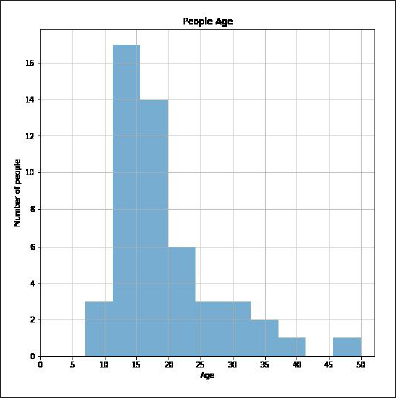
Fifty random sample subjects aged between 7 and 50 years who are treated orthodontically by the resident in KADC based in Riyadh city were used for this study. Each resident was assigned 15 patients so as a total of 105 patients was collected. Therefore, after random sampling 50 patients were finalized. The sample was collected in April and May 2019. All the participants are Arabs, and they never underwent any previous orthodontic treatment. Among this current study, there was an equivalent number patients from both sex (50% each). Figure 1 shows patients’ age group distribution. The treatment was free of charge since it was sponsored by a governmental sector. A consent form was obtained from all the participants before any impression, radiographs, or photos. IOTN components were utilized to assess the need for orthodontic treatment and to evaluate the level of attractiveness in relation to the standard photographs in the esthetic component. The IOTN was used on the casts and the digital photographs obtained by residents. The examiner followed the instruction provided by the IOTN index material. The statistical calculation for IOTN score and the incident of each variable were carried out using SPSS and Python’s libraries (Pandas, NumPy, and Matplotlib). Chi-square test was used to compare between the DHC and the AC.
Patients Age Group Distribution.
Results
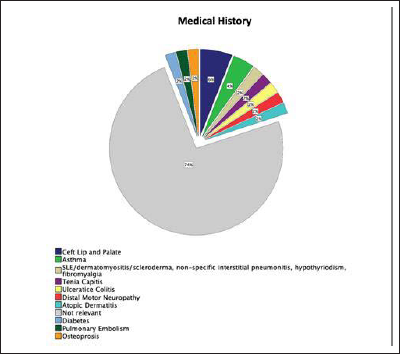
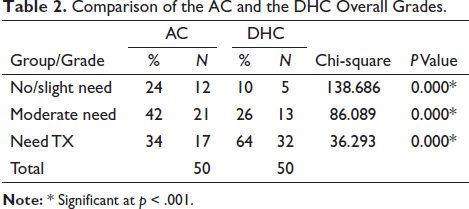
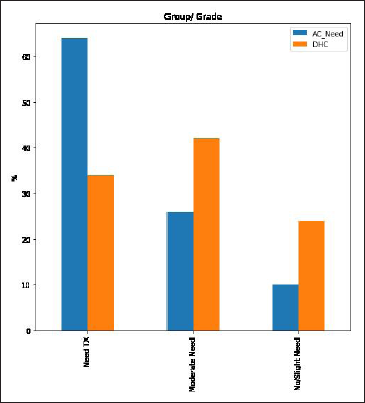
Medical history was found to be relevant in 26% of the patients as shown in Figure 2. The highest incidence of the orthodontic problem was found to be among Open bite (18%), followed by displacement, crossbite, and overjet (16%). Cleft lip and palate were found to be (8%), and for the rest, it was found to be less than 7% as shown in Table 1. The outcome from the AC component among the 50 patients studied shows that 24% do not need or have a slight need for the treatment, 42% express a moderate need for the treatment, whereas 34% need the treatment. Chi-square test was used to compare between AC and the DHC, and it was statically significant (p < .001) which indicates there is a difference between the groups.
Patient’s Medical History Cases Distribution.
The Incidence of the Orthodontic Problems as Assessed by the DHC of the IOTN.
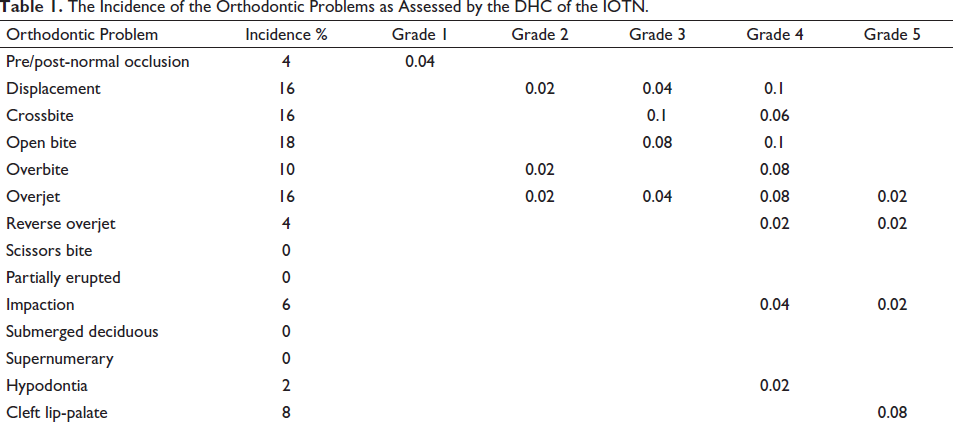
The DHC was categorized into three groups; 10% do not need or have a slight need for the treatment (grades I and II), 26% show moderate need for the treatment (grade III), 64% do need the treatment (grades IV and V) as shown in Table 2 and Figure 3. Spearman’s correlation between the AC and DHC proved, there is a correlation (r = 0.861) between the two components.
Comparison of the AC and the DHC Overall Grades.
Comparison of the AC and the DHC Overall Grades.
Discussion
The DHC reflected the types of malocclusions that can be treated in KADC, which included mainly open bite, crossbite, displacement, and increased overjet. This pattern is similarly seen in Hassan study. 1 However, due to the limited number of orthodontic residents, the sample size does not reflect an actual pattern of malocclusion in the central region. Therefore, larger scale studies should be conducted by using surveys on random samples. Furthermore, the age group in this study had a wide age range with the majority being between 13 and 23 years old in comparison with the other studies that targeted specific age groups.4, 5, 11, 19 In those studies, the targeted sample was children and adolescents who are less reliable in their perception toward their orthodontic problem. 20 Also, having a significant difference between the AC and DHC represents the poor correlation regarding the perception and need for orthodontic treatment. This is similar to the study in Ref. [1], which highlights the low awareness of the Saudi citizen, which can be related in general to the high oral health literacy and/or patients’ negligence.1, 21, 22 Moreover, other factors may play a role in the perception, such as gender, medical condition, income, and social background. In our study, income was not a factor since the patients are treated freely in a governmental sector. Therefore, they can be referred to the orthodontic residents without being aware of their orthodontic status. In our study, similar to Chew study, 23 the impact of this factor was reduced significantly by having the patients filtered in the screening clinic depending on their priority for the orthodontic treatment in the waiting list. In addition, gender was found to be irrelevant. Similar to Kerosuo study, gender, and socioeconomic factors did not significantly affect the normative treatment need. 24 However, the medical condition was found to be significantly related to the DHC and AC (p < .001). This could emphasize the idea that having multiple visits to the physicians could generate more awareness toward overall health including oral health. These factors should be considered since they can attribute toward more perception and difference in the result of the IOTN index. As Hassan study concluded, we believe that the IOTN index should be modified to fit or adapt to the Saudi population. Some problems were found to extenuate and render the DHC score, such as displacement level. As for AC, some orthodontic problems could not be noticed, such as open bite which has the highest incidence in most cases. Regarding the method that is conducted in this study by examining the photos, X-rays, and casts, this method showed a great advantage in saving time and effort for the patient. Moreover, all these tools are mandatory in evaluating the case. However, as few available studies were found conducting this method in the kingdom of Saudi Arabia, it is therefore advised that further studies are required for the evaluation of the accuracy of this technique.
Conclusion
There is a crucial need for adapting IOTN index for screening the patients’ need for the orthodontic treatment, especially in an educational governmental clinic. Moderate to severe need for orthodontic treatment was noticed in the patient who is attending King Abdulaziz Dental center. Direct application of IOTN index by visualizing the casts, X-rays, and photographs can save time and effort b and assist in relieving the patient from further examinations. However, more trials should be conducted to evaluate the reliability and accuracy of the method.
Footnotes
Declaration of Conflicting Interests
The authors declared no potential conflicts of interest with respect to the research, authorship and/or publication of this article.
Ethical Approval
The ethical approval was not needed as the patients understand and accept that their treatment is carried in an educational and research institution. Furthermore, they are not the subjects of the research and no information is collected pertaining to their own privacy.
Funding
The authors received no financial support for the research, authorship and/or publication of this article.
Informed Consent
Necessary patients’ informed consent was obtained in writing using the institution consent forms, before initiating the study from all participants.
