




Abstract
There is no single bracket gauge that can be used universally for all teeth to orient brackets in the vertical and axial planes simultaneously.
To overcome the increased armamentarium and steps involved in accurately positioning brackets, we have modified a UNC-15 probe to fabricate a multipurpose bracket positioning tool (MBP tool).
Thus, one single instrument can be used not only to position brackets (both anterior and posterior) in all planes but also for the quick verification of positioned brackets just before curing.
Keywords
Most bracket positioning gauges help orient brackets in the vertical plane (occlusogingival)only. The commonly used bracket gauges, such as height bracket position gauge (HBPG) and Boone’s gauge1have no component to assess the precise placement of brackets along the long axis of the tooth.
Though there are various modifications of gauges2-7that exist, there is no single bracket gauge that can be used universally for all teeth to orient brackets in both the vertical and axial planes simultaneously.
Accurate placement of brackets in all planes is essential for proper tip and torque expression, as well as proper alignment of teeth.
Also, most gauges are prescribed to be used in a specific manner in different areas of the mouth,8 and failure to do so results in incorrect positioning of brackets. The same bracket gauge when held differently shifts the bracket incisally, as shown in Figures 1 and 2.
Proper Bracket Positioning with a Gauge.
Change in Bracket Positioning due to Change in Orientation of Gauge.
To overcome the increased armamentarium and steps involved in accurately positioning brackets in all planes, we have modified a UNC-15 probe to fabricate a multi-purpose bracket positioning tool (MBP Tool) (Figure 3).
Multipurpose Bracket Positioning Tool (MBP Tool).
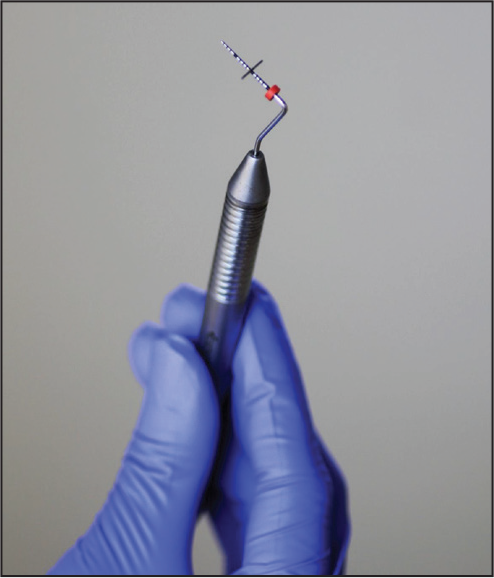
Thus, a single tool can be used universally for adjustments in all planes.
Steps in Fabrication
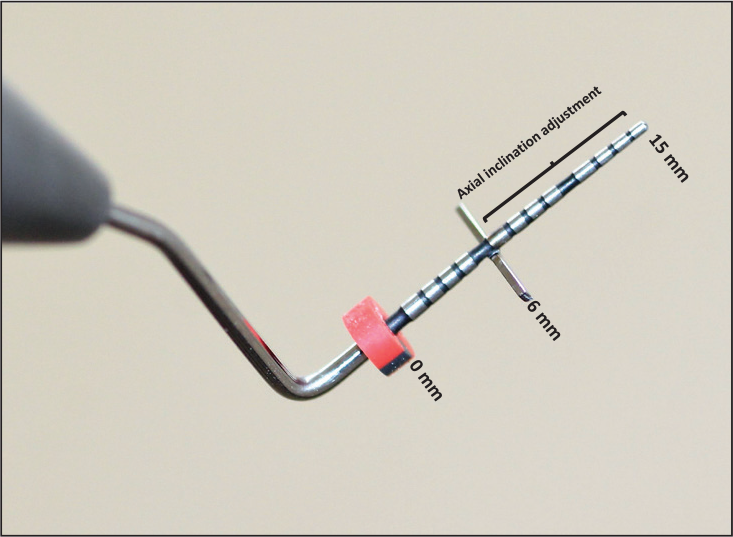
The UNC-15 probe is a 15-mm-long periodontal probe with millimeter markings. 0 mm is taken as the marking farthest away from the tip of the working end (Figure 4).
Place a rubber stopper on a UNC-15 probe at the 0-mm mark.
This can be adjusted and used for stabilization at the incisal edges and occlusal surfaces of teeth as required.
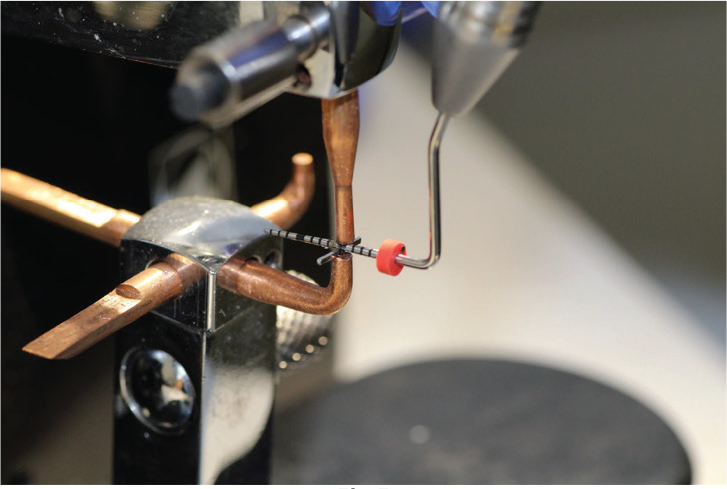
Spot weld a 0.017 × 0.025ʺ stainlesssteel wire of approximately 6 mm in length at the 6-mm mark in a horizontal fashion, as shown in Figure 5.
This horizontal wire component will enter the bracket slot.
The 6-mm mark is chosen as the welding spot, as brackets are usually positioned between 3.5mm and 6 mm.
Details of MBP Tool.
Spot Welding of Horizontal Wire onto the Probe.
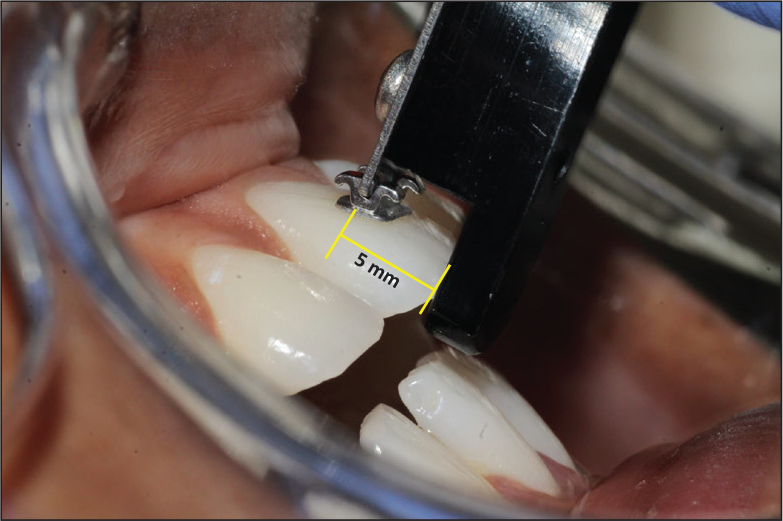
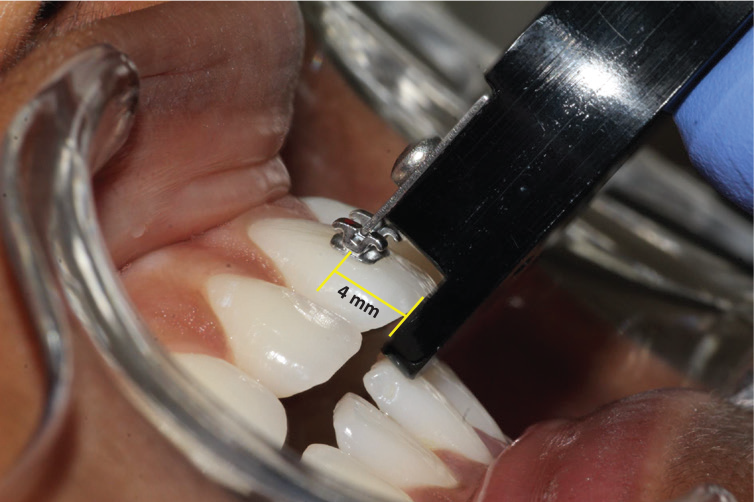
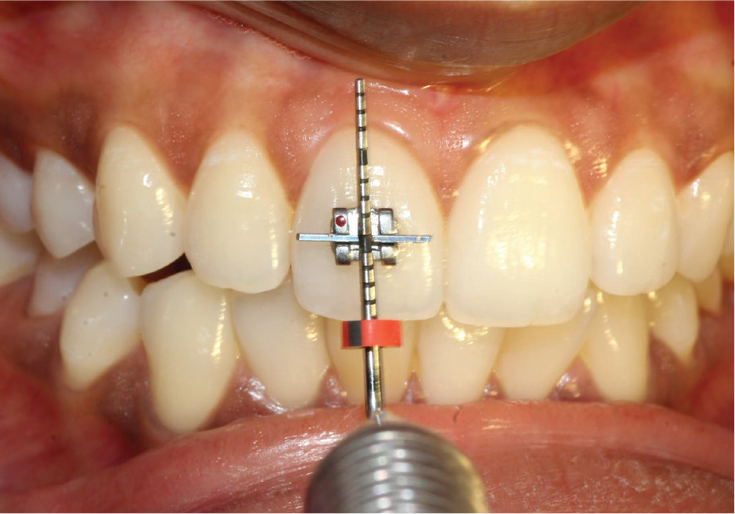
The probe can then be used to position brackets in the vertical plane, along with simultaneous orientation in the axial plane:5-mm positioned bracket on the maxillary central incisor (Figure 6) and 4-mm positioned bracket on the premolar (Figure 7).
Positioned Bracket oFnig C Fentral Incisor.
Positioned Bracket oFnig P Gre-molar.
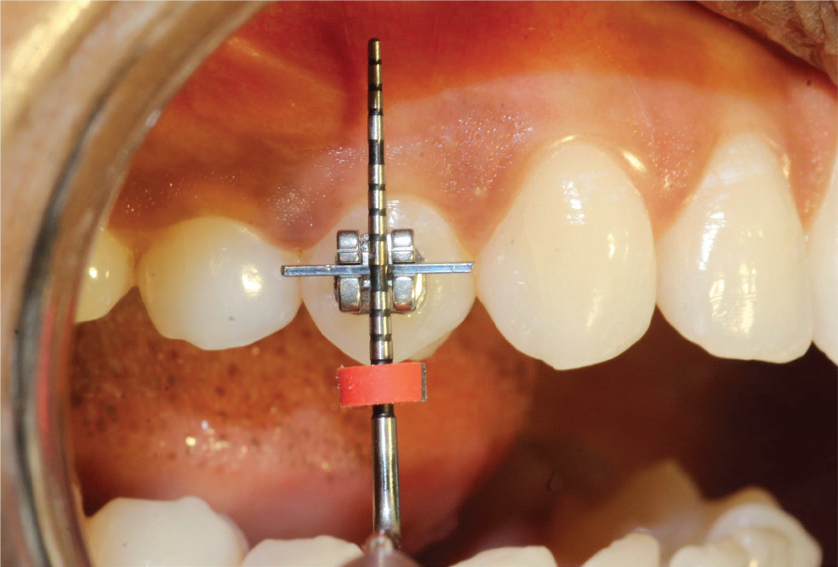
The region of the probe above the horizontal wire (Figure 4) makes the assessment of bracket position along the long axis of the tooth easier and more visible since the probe extends beyond the cervical margin of the tooth. The MBP tool also helps in making adjustments in the mesiodistal plane while maintaining the vertical and axial orientations.
Advantages
Ease of fabrication of the tool.
The calibrations on the UNC-15 probe make placement accurate and easy.
A
The instrument can be sterilized.
Footnotes
Declaration of Conflicting Interests
The authors declared no potential conflicts of interest with respect to the research, authorship, and/or publication of this article.
Funding
The authors received no financial support for the research, authorship, and/or publication of this article.
Statement of Informed Consent and Ethical Approval
Necessary ethical clearances and informed consent was received and obtained respectively before initiating the study from all participants.
