



Abstract
The NOD.Cg-Prkdcscid Il2rgtm1Wjl/SzJ strain (NOD scid gamma, NSG) is a severely immunodeficient inbred laboratory mouse used for preclinical studies because it is amenable to engraftment with human cells. Combining scid and Il2rgnull mutations results in severe immunodeficiency by impairing the maturation, survival, and functionality of interleukin 2–dependent immune cells, including T, B, and natural killer lymphocytes. While NSG mice are reportedly resistant to developing spontaneous lymphomas/leukemias, there are reports of hematopoietic cancers developing. In this study, we characterized the immunophenotype of spontaneous lymphoma/leukemia in 12 NSG mice (20 to 38 weeks old). The mice had a combination of grossly enlarged thymus, spleen, or lymph nodes and variable histologic involvement of the bone marrow and other tissues. All 12 lymphomas were diffusely CD3, TDT, and CD4 positive, and 11 of 12 were also positive for CD8, which together was consistent with precursor T-cell lymphoblastic lymphoma/leukemia (pre-T-LBL). A subset of NSG tissues from all mice and neoplastic lymphocytes from 8 of 12 cases had strong immunoreactivity for retroviral p30 core protein, suggesting an association with a viral infection. These data highlight that NSG mice may develop T-cell lymphoma at low frequency, necessitating the recognition of this spontaneously arising disease when interpreting studies.
Keywords
NSG mice have a severe immunodeficiency phenotype that is caused in part by a spontaneously arising mutation affecting V(D)J recombination, DNA double-strand break repair, and also a genetic modification resulting in loss of function of the common gamma chain of the IL2R. Prkdcscid mice with the Y4046X mutation have impaired V(D)J recombination and DNA double-strand break repair mechanisms, thereby preventing the maturation of T and B cells, resulting in the severe combined immunodeficiency phenotype. 1 The NOD/Lt congenic strain, which was crossed with the severe combined immunodeficiency (scid) mutation initially on the C.B-17 background (NOD.C.B-17-Prkdcscid, NOD-scid), also has unique immune system deficits, including increased susceptibility to some viral infections, decreases in T-cell populations, reduction in the functions of natural killer (NK) cells, altered antigen-presenting cell functions, and a lack of circulating complement. 27,63 As a result of these genetic modifications and crosses, NSG mice have marked reductions in the numbers of mature T, B, NK, and NKT cells as well as altered functions of other interleukin 2 (IL-2)–dependent immune cells. 61 NSG mice produce bone marrow progenitors that are T, B, and NK cell lineage competent and that migrate to and settle in the thymus. However, intrathymic T-cell development to maturity does not occur because of early double-negative stage 3 (DN3) arrest and apoptosis, which is attributed to the synergistic effects of the scid and Il2rg mutations. 11,43
While NSG mice are reportedly resistant to the development of lymphomas/leukemias, other strains of immunodeficient mice such as the NOD-scid mouse develop these cancers at high frequencies mainly because the thymocytes of NOD-scid mice are susceptible to spontaneous lymphomagenesis caused by a retroviral infection by Emv-30, an endogenous murine leukemia virus. 14,49,59 In contrast, lymphomagenesis occurring in Prkdcscid mice is believed to be related to the long-known phenomenon of immunocompromised mice becoming “leaky,” as evidenced by the detection of serum IgG and low numbers of mature lymphocyte populations. 6,12 This “leakiness” resulting in immune dysregulation, and in some cases either B- or T-cell lymphoma/leukemia, is largely considered due to alternative maturation mechanisms that lymphocyte populations have evolved to survive when normal physiologic processes are perturbed. 67
Mice with a severe combined immunodeficiency (SCID) phenotype have abnormal maturation of T and B cells. 1,7 Normal precursor T-cell development in the thymic cortex is divided into stages that can be differentiated by a combination of the markers CD4, CD8, CD25, and CD44. The first 4 stages are negative for both CD4 and CD8 with variable combinations of CD44 and CD25 that are defined as double-negative stages 1, 2, 3, and 4 (DN1–DN4). The fifth stage is positive for CD4 and CD8, which is classified as double positive (DP). In contrast, scid thymi are variable in their content of cells expressing these markers. Usually scid thymocytes have a maturational arrest that prevents them from transitioning from the DN3 stage, in which cells have a CD4–CD8–CD44−CD25+ immunophenotype, to the DN4 stage, in which cells have a CD4–CD8–CD25–CD44– immunophenotype. This maturation arrest results in a severe decrease in total numbers of thymocytes and a rudimentary appearance to the thymus, lymph nodes, and splenic white pulp. 42 Developing B-cell precursors in scid mice are arrested at the pro-B-cell stage. 11 Induction of aspects of the humoral and adaptive immune responses in scid mice (leakiness) correlates with the genetic background, pathogen exposures, and increasing age. The predisposition for a leaky phenotype is considered a major reason for the development of spontaneous lymphomas in scid mice, and the resulting limited life spans prohibit their use in long-term studies. 6,7,12,26 While leakiness associated with having the scid mutation is largely abated when backcrossed onto the NOD/Lt strain, the incidence of lymphomas remains even when re-derived in mice that are free of Emv-30 retrovirus. 49,59
In Il2rgtm1Wjl (Il2rg; also known as ϒc or CD132) mice, genetic engineering and removal of part of exon 3 and exons 4 to 8 of the IL-2 receptor gamma chain gene causes loss of a portion of the extracellular domain and all of the transmembrane and cytoplasmic domains of the ϒc subunit. Consequently, the Il2rg signaling functions are affected, causing a comparable phenotype as the human IL2RG deficiency. 61,64 Il2rgtm1Wjl mice have rudimentary thymi and demonstrate a block in thymocyte maturation at the CD44+CD25+CD4–CD8– (DN2) to DN3 transition, which differs from that observed in NOD-scid mice. Nevertheless, compensatory signaling pathways exist, allowing a subset of thymocytes to progress through to α/β T-cell differentiation, as evidenced by the presence of mature peripheral CD4+ and CD8+ single-positive (SP) T cells by flow cytometry. ϒ/δ T cells, which are considered IL-2 dependent, are not observed. Unlike NOD-scid mice, mature peripheral B cells are present in Il2rgtm1Wjl mice. 11,17,43
Initially, NSG mice were reported to be resistant to developing hematopoietic malignancies such as lymphoma and leukemia. 62 Therefore, as a model organism, NSG mice are considered to provide an advantage over C.B-17-scid and NOD-scid mice for both short- and long-term engraftment studies. However, there are sporadic reports of lymphoma and myeloid leukemia occurring in NSG mice. 19,58,69 Spontaneous lymphomagenesis in NSG mice is not entirely unexpected, especially since the Prkdcscid mutation was backcrossed onto the NOD/Lt strain, and both strains are well characterized regarding age-dependent susceptibility for developing these neoplasms. 13
An immunodeficient mouse closely related to the NSG is the NOG (NOD.CgPrkdcscid Il2rgtm1Sug/JicTac) mouse, which similarly carries the scid mutation on the NOD background but instead has a truncated ϒc subunit created by replacing parts of exons 7 and 8 of the ϒ-chain gene stopping its signaling functions, even though formation of the heterotrimer complex of the IL2R still occurs. 47 This method of inactivating the ϒ-chain gene differs from the genetic engineering used to create the NSG mouse, which has deletion of part of exon 3 and exons 4 to 8, resulting in loss of much of the ϒc extracellular domain and the entire transmembrane and cytoplasmic domains. 10 The NOG mouse has been reported to develop CD3+ thymic lymphomas. 28 While we and other groups have observed that lymphomas can also arise in NSG, there have been no detailed lineage characterizations of NSG lymphomas to date. 58 In this study, we have immunophenotyped 12 lymphomas arising spontaneously in NSG mice and found that select nontumor tissues of all NSG mice were positive for the retroviral p30 core protein, which has been shown to cross-react with endogenous murine leukemia viruses. 46 Most of the lymphomas were also strongly immunopositive for p30. We discuss the implications of these observations in relation to other immunocompromised mouse strains and for research studies involving NSG mice.
Materials and Methods
Mice
A review of archived tissues from 201 NOD.Cg-Prkdcscid Il2rgtm1Wjl/SzJ (NSG, JAX stock #005557) mice necropsied at St. Jude Children’s Research Hospital (SJCRH) between 2015 and 2018 revealed a subset of 12 mice with lymphoma. These 201 NSG were from a research and breeding colony of 6116 animals in the same time frame. All mice were housed at SJCRH under strict specific pathogen-free barrier practices (sterilized water, food, bedding, cages, administration of acidified water) and using aseptic handling techniques (including the use of laminar flow hoods and personal protective equipment and hair coverings) based on their increased susceptibility to opportunistic bacterial infections. 19 Mice were tested and reported as negative for the following pathogens: Helicobacter spp., Mycoplasma pulmonis, Pneumocystis carinii, Sendai virus, mouse parvovirus (MPV), mouse hepatitis virus (MHV), minute virus of mice (MVM), Theiler murine encephalomyelitis virus, epizootic diarrhea of infant mice (EDIM), pneumonia virus of mice (PVM), reovirus, K virus, polyoma virus, lymphocytic choriomeningitis virus (LCMV), mouse adenovirus (MAV), ectromelia virus, and both murine ecto- and endoparasites. Mice were assigned to animal protocols approved by the SJCRH’s Institutional Animal Care and Use Committee. Mice were euthanized in an atmosphere of 100% CO2 or died before illness was detected.
Clinical Pathology and Microbiology Data
Whole blood was collected into tubes with EDTA anticoagulant (BD Microtainer; BD Diagnostics, Franklin Lakes, NJ) for the complete blood count analysis (CBC) and peripheral blood smear using an intracardiac collection technique as a terminal procedure. Approximately 20 μl of EDTA-treated blood was used for analysis on the ForCyte Hematology Analyzer (Oxford Science, Oxford, CN). Peripheral blood smears were prepared, methanol fixed, and a Wright-Giemsa stain was applied. For the aerobic blood culture, 50 to 75 μl of blood was obtained separately and placed into an aerobic bottle using aseptic technique for testing. The available CBC analyses, peripheral blood smears, and microbiology data for all mice were reviewed and interpreted by a board-certified veterinary pathologist (H.T.).
Histopathology
Where possible, tissues from all major organs were collected and processed for histopathologic evaluation. All sampled tissues were fixed in 10% neutral buffered formalin, embedded in paraffin, sectioned at 4 μm, stained with hematoxylin and eosin, and reviewed by light microscopy and interpreted by 3 board-certified veterinary pathologists (H.T., L.J.J., J.E.R.). Mitotic counts were determined for 12 of 12 cases by a board-certified pathologist (H.T.). The count was based on the assessment of 10 random high-power fields with an area calculated as 2.37 mm2 using a Nikon Eclipse Ni microscope (Melville, NY) (400× objective/0.95, 10× ocular with field number of 22 mm). Counts were determined starting in the most proliferative area and then moving to 9 additional randomly selected areas in samples of either thymus or spleen containing lymphoma/leukemia.
Immunohistochemistry
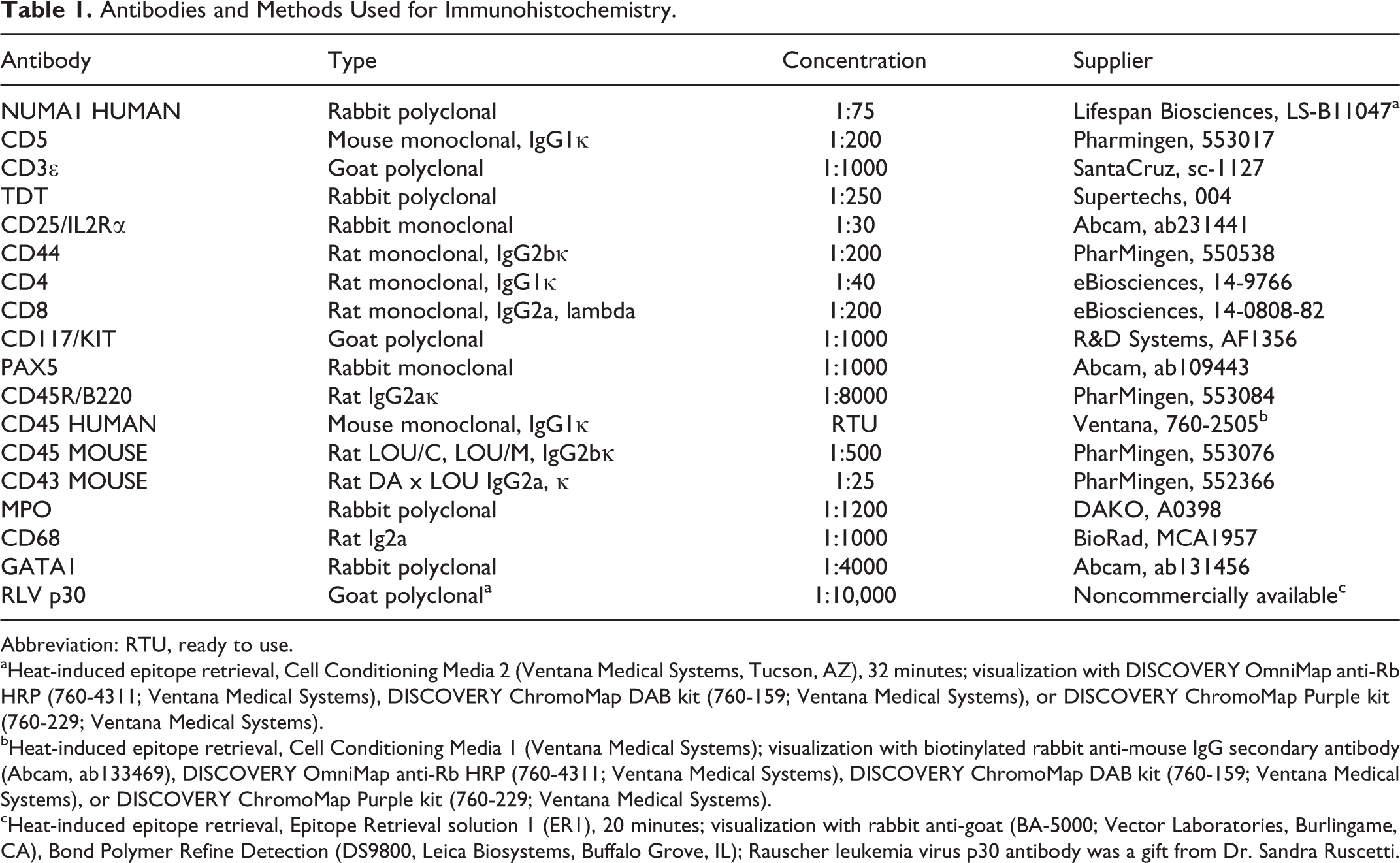
All formalin-fixed, paraffin-embedded tissues were sectioned at 4 μm, mounted on positive charged glass slides (Superfrost Plus; Thermo Fisher Scientific, Waltham, MA), and dried at 60°C for 20 minutes. The immunohistochemistry (IHC) procedures and antibodies used for mouse tissue to detect hematolymphoid antigens CD5, CD3∊, terminal deoxynucleotidyl transferase (TDT), CD25, CD44, CD4, CD8, CD117, PAX5, B220, CD45 (mouse specific), CD43, MPO, CD68, and GATA 1 were as previously described. 51 The primary antibodies used in this study and the IHC procedures for human NUMA1, human CD45, and p30, a retrovirus associated protein, are listed in Table 1. The p30 antibody has been previously published as being cross-reactive with endogenous retroviruses, specifically endogenous murine leukemia viruses. 23,46,53 CD1 mouse tissues were used as a positive control for interpreting p30 labeling. 53 C57BL/6 (B6) mouse tissues were used as negative controls for the p30 antibody since B6 mice have been reported to have undetectable ecotropic MuLV. 69 All IHCs were reviewed by light microscopy and interpreted by 2 board-certified veterinary pathologists (H.T., J.E.R.). Positive immunoreactivity for hematolymphoid antigens was defined as having at least 20% of the neoplastic cells showing appropriate labeling patterns by visual assessment. 5
Antibodies and Methods Used for Immunohistochemistry.
Abbreviation: RTU, ready to use.
aHeat-induced epitope retrieval, Cell Conditioning Media 2 (Ventana Medical Systems, Tucson, AZ), 32 minutes; visualization with DISCOVERY OmniMap anti-Rb HRP (760-4311; Ventana Medical Systems), DISCOVERY ChromoMap DAB kit (760-159; Ventana Medical Systems), or DISCOVERY ChromoMap Purple kit (760-229; Ventana Medical Systems).
bHeat-induced epitope retrieval, Cell Conditioning Media 1 (Ventana Medical Systems); visualization with biotinylated rabbit anti-mouse IgG secondary antibody (Abcam, ab133469), DISCOVERY OmniMap anti-Rb HRP (760-4311; Ventana Medical Systems), DISCOVERY ChromoMap DAB kit (760-159; Ventana Medical Systems), or DISCOVERY ChromoMap Purple kit (760-229; Ventana Medical Systems).
cHeat-induced epitope retrieval, Epitope Retrieval solution 1 (ER1), 20 minutes; visualization with rabbit anti-goat (BA-5000; Vector Laboratories, Burlingame, CA), Bond Polymer Refine Detection (DS9800, Leica Biosystems, Buffalo Grove, IL); Rauscher leukemia virus p30 antibody was a gift from Dr. Sandra Ruscetti.
Results
Clinical Data of NSG Mice With Spontaneous Lymphoma/Leukemia
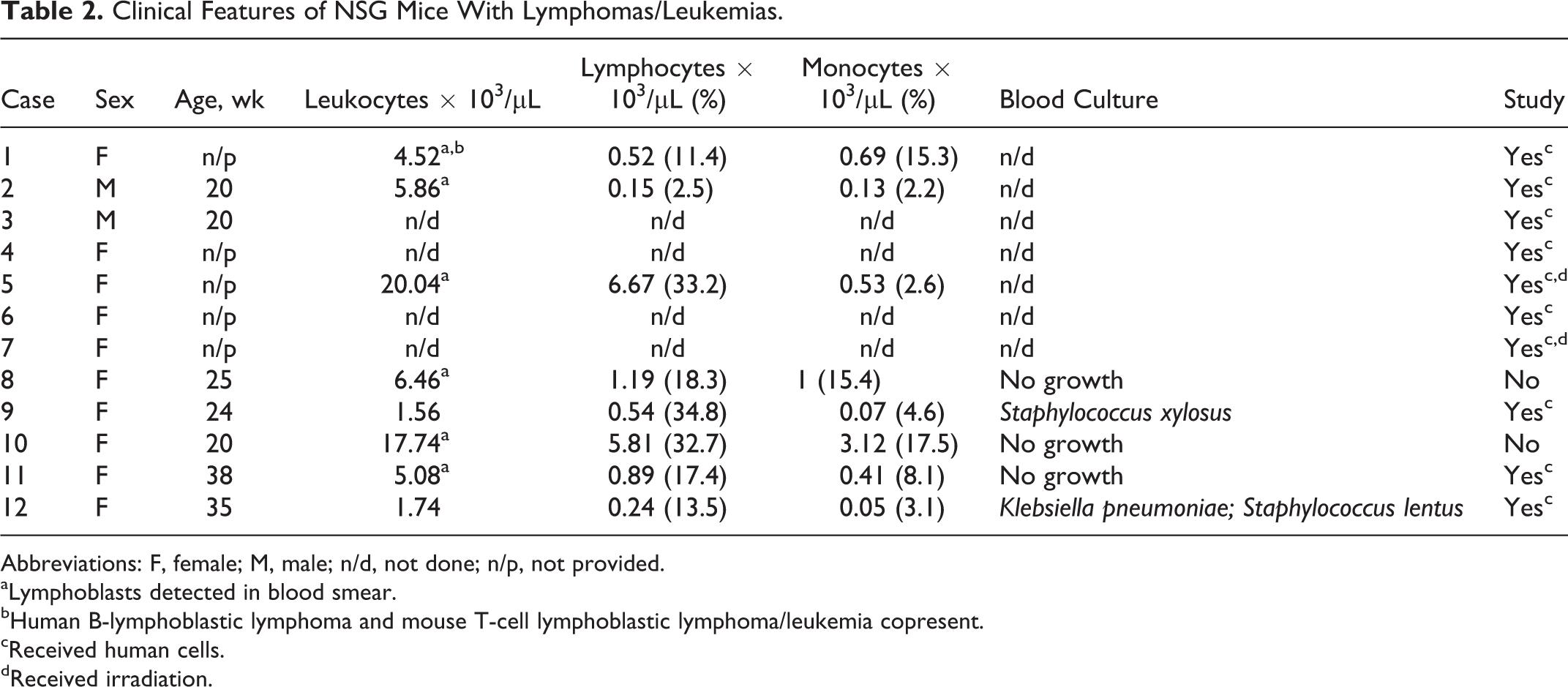
Ten female and 2 male SJCRH NSG mice between 20 and 38 weeks of age were diagnosed with lymphoma/leukemia (Table 2). In the NSG colony, the overall incidence of lymphoma was determined to be 0.2% based on an NSG population of 6116 during the 2015 to 2018 time period at our institution. Of the 201 NSG mouse necropsies during that time period, 12 (6%) had lymphoma. Therefore, the true incidence for NSG lymphomas in our institution was calculated to be between 0.2% and 6% because not all NSG mice were necropsied.
Clinical Features of NSG Mice With Lymphomas/Leukemias.
Abbreviations: F, female; M, male; n/d, not done; n/p, not provided.
aLymphoblasts detected in blood smear.
bHuman B-lymphoblastic lymphoma and mouse T-cell lymphoblastic lymphoma/leukemia copresent.
cReceived human cells.
dReceived irradiation.
NSG mice are severely immunocompromised and highly susceptible to opportunistic infections not only from commonly encountered murine pathogens but also from commensal flora and environmental organisms. 19 Furthermore, these mice may independently or concurrently have other age-related conditions such as degenerative diseases and cancer. 58 We observed that all NSG mice submitted for necropsy evaluation demonstrated clinical signs of being thin and hunched, necessitating their removal from a study or from the breeder room. Seven of the 12 mice were clinically suspected of having study-related pathologies. Five of 12 mice were suspected to have an opportunistic infection. Three of these mice had blood cultures reported as no growth, and 2 had bacteremia in addition to the diagnosis of a lymphoma/leukemia.
The peripheral blood smears of 6 of the mice diagnosed with lymphoma were available for evaluation (case Nos. 1, 2, 5, 8, 10, and 11). Five of the 6 mice had evidence of lymphoma/leukemia in the peripheral blood (Fig. 1) as well as bone marrow involvement (Table 3). Case No. 2 did not have evidence of lymphoma/leukemia in either the peripheral blood or bone marrow. Lymphoma/leukemia diagnosis on peripheral blood smear correlated with increases in leukocyte, lymphocyte, and monocyte counts based on reference controls generated in house for leukocyte, lymphocyte, and monocyte counts in naive NSG mice (Table 2). In addition, mice with lymphoma had increases in automated counts for leukocytes, lymphocytes, and/or monocytes when compared with reference intervals published for the initial characterizations of NSG mice. 62
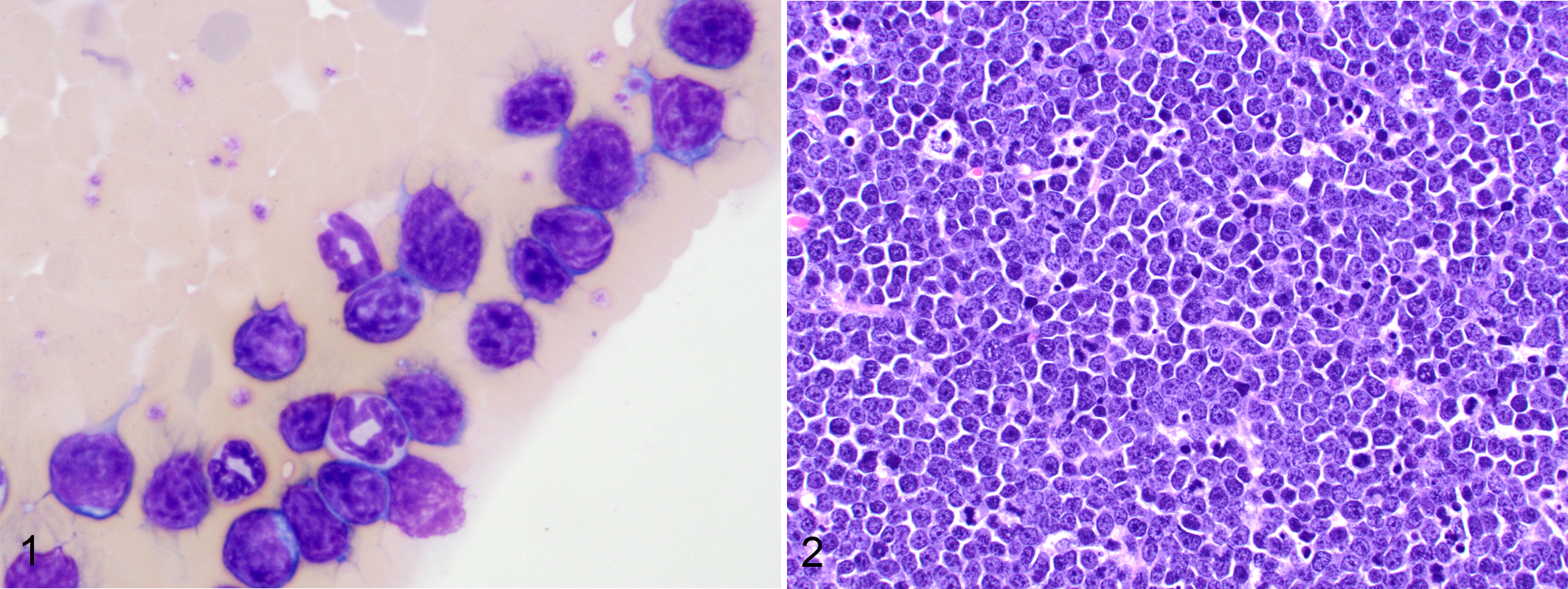
Lymphoma with leukemic phase, peripheral blood smear, NSG mouse, case 11. Medium-sized lymphoblasts are visible throughout the feathered edge of the smear and rarely within the body of the smear. Blasts have scant cytoplasm and a high nucleus to cytoplasm ratio. Nuclei are round with finely dispersed chromatin and prominent nucleoli. Modified Wright-Giemsa.
Anatomic Distribution of Lymphomas/leukemia Arising in NSG Mice.
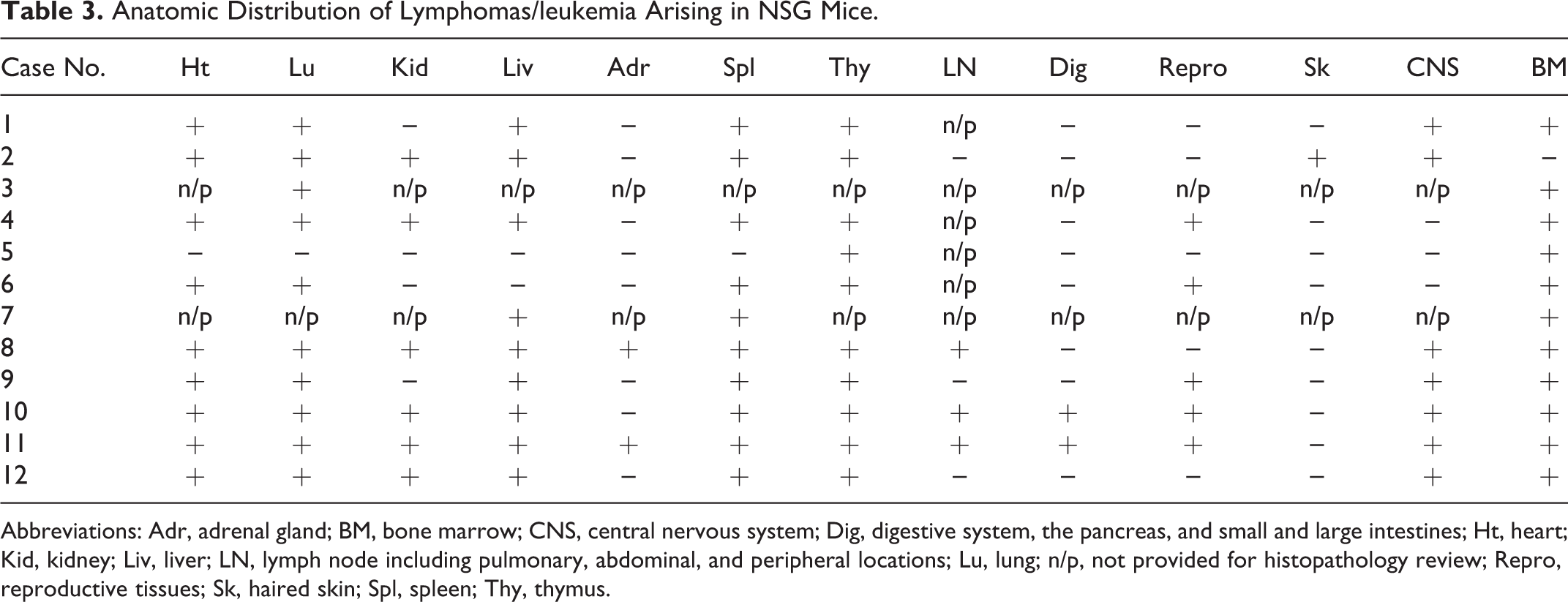
Abbreviations: Adr, adrenal gland; BM, bone marrow; CNS, central nervous system; Dig, digestive system, the pancreas, and small and large intestines; Ht, heart; Kid, kidney; Liv, liver; LN, lymph node including pulmonary, abdominal, and peripheral locations; Lu, lung; n/p, not provided for histopathology review; Repro, reproductive tissues; Sk, haired skin; Spl, spleen; Thy, thymus.
Gross and Histomorphologic Features of Lymphomas/Leukemias Arising Spontaneously in NSG Mice
The frequent gross lesions of moribund mice submitted for a full pathologic examination were enlargement of rudimentary thymic tissues, splenomegaly, and enlargement of some of the rudimentary lymph nodes. In addition, there was variable hepatomegaly and scattered nodules within the heart, lungs, kidneys, reproductive tissues, and brain and meninges. The lymphomas/leukemias involved the following tissues as viewed by light microscopy (Table 3): thymus (100%, 10 of 10), bone marrow (92%, 11 of 12), lungs (91%, 10 of 11), spleen (91%, 10 of 11), heart (90%, 9 of 10), liver (82%, 9 of 11), meninges/central nervous system (70%, 7 of 10), kidneys (60%, 6 of 10), reproductive tissues (50%, 5 of 10), lymph nodes (50%, 3 of 6), pancreas (20%, 2 of 10), adrenal glands (20%, 2 of 10), small intestine (10%, 1 of 10), and skin (10%, 1 of 10).
The 12 lymphoid neoplasms occurring in SJCRH NSG mice were classified as precursor T lymphoblastic lymphoma/leukemia (pre-T-LBL) using the characteristics of lymphoma/leukemia subtypes as outlined by the Bethesda classification of murine lymphoid neoplasms. 40 Neoplastic lymphocytes were arranged in sheets of cells expanding and effacing large regions of the rudimentary thymus (Fig. 2), spleen (Suppl. Fig. S1), and lymph nodes (Suppl. Fig. S2). Lymphoma was also observed in the kidneys (Suppl. Fig. S3) and the brain. Neoplastic cells formed periportal (Suppl. Fig. S4) and sinusoidal infiltrates in the liver, as well as perivascular and peribronchiolar aggregates in the lungs. In the 1 case that had involvement of the skin, neoplastic cells formed a distinct focus within the dermis. Epitheliotropism was not observed. Neoplastic round cells were characterized as medium-sized lymphocytes that were approximately 1.5 to 3 times larger than an erythrocyte (the erythrocytes measured approximately 5–6 μM). Neoplastic lymphocytes had a blastic appearance consisting of scant cytoplasm and round nuclei having fine chromatin with inconspicuous or 1 to 2 small centralized nucleoli. Mitotic count was determined to be 6.8/10 high-power fields (HPF) based on 12 of 12 cases.
Differentiation of Species-Specific Lymphomas With Morphologic Similarities
Ten of the 12 mice were included in preclinical studies (Table 2). Two mice were part of the SJCRH NSG breeder colony and did not receive any experimental manipulations. Three mice had been implanted with a human solid tumor in the flank region. Neither lymphovascular invasion nor metastases were observed in these xenotransplants. Seven of the NSG mice in which lymphoma of mouse origin arose had been implanted with human lymphoblastic lymphoma cells taken from different patients. Two of these mice were reported to have received irradiation prior to engraftment with human cells.
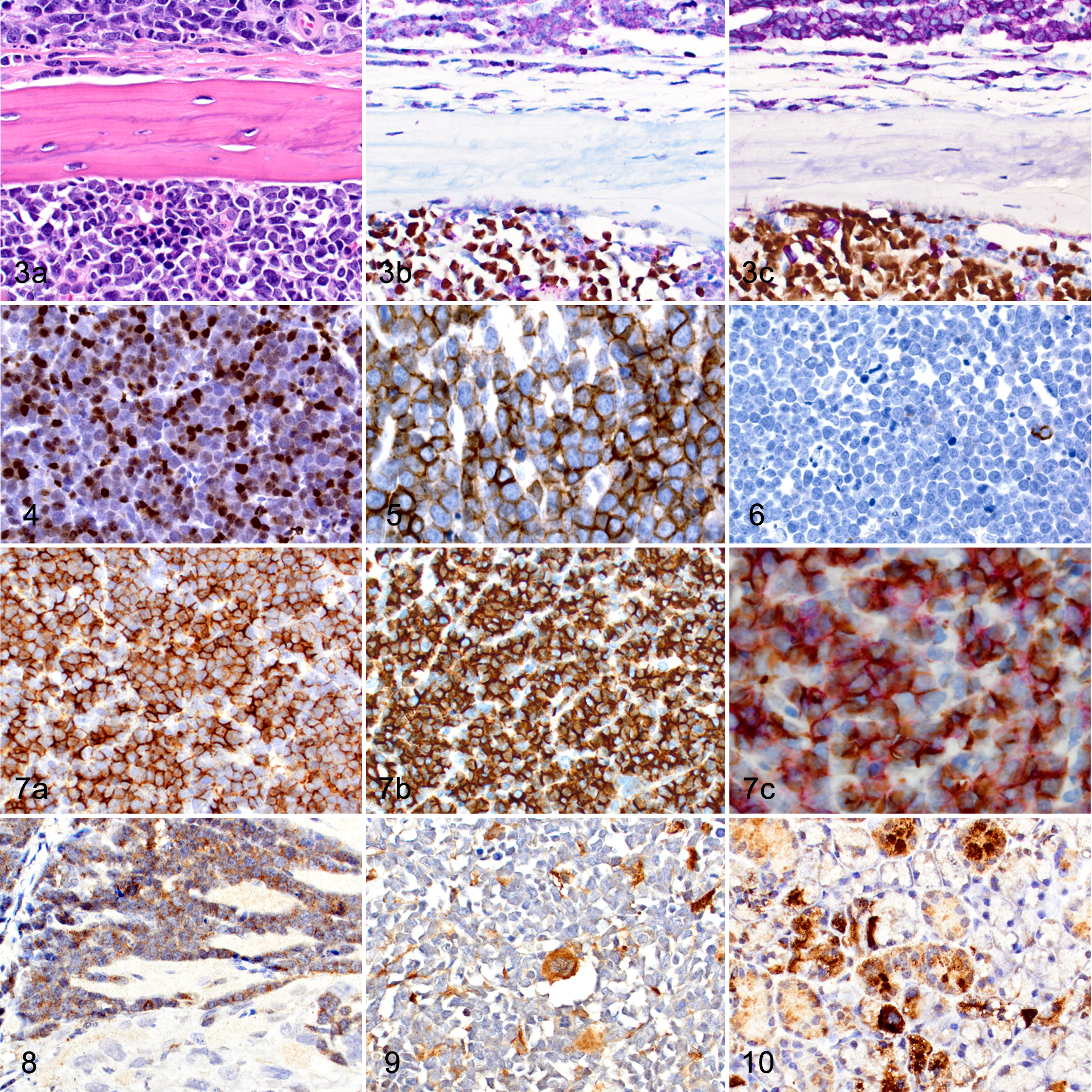
Only 1 of the 5 nonirradiated NSG mice xenotransplanted with human lymphoma also had a human B-cell lymphoblastic lymphoma. Morphologically, the 2 lymphomas in this mouse were indistinguishable (Fig. 3a), but the human and mouse origins of the 2 lymphomas were confirmed by IHC as follows. The human B-cell lymphoma in this case expressed human-specific CD45 (not shown) and an antigen expressed on the nuclear mitotic apparatus protein 1 of human cells (NUMA1, human specific, Fig. 3b); it was negative for mouse-specific CD45 (Fig. 3b) and mouse-specific CD43 (not shown). A double IHC for both PAX5 and CD3∊ did not show overlapping labeling in the same tissue section, which was useful for distinguishing between the human and murine lymphomas, respectively (Fig. 3c).
Immunophenotype of NSG Lymphomas
The classification of T-cell proliferations as either reactive or neoplastic requires the evaluation of multiple antigen markers and the anatomic pattern. 20,51,52 To determine whether the lymphoproliferations we observed were neoplastic or a reactive change, we analyzed populations within the thymus and the spleen by IHC for pan-T antigens, stage-specific developmental markers, and additional B-cell, myeloid, and erythroid antigens (Table 4). Antigen expression in all 12 of the NSG T-cell lymphomas/leukemias was consistent with an immature T-cell phenotype, with positive immunolabeling for CD3 (100%, 12 of 12; Fig. 3c, top), TDT (100%, 12 of 12; Fig. 4), and CD25 (50%, 6 of 12; Fig. 5) and lack of immunolabeling for CD44 (Fig. 6) and CD117/KIT (not shown). Lymphomas were positive for CD4 (100%, 12 of 12; Fig. 7a), CD8 (92%, 11 of 12; Fig. 7b), and coexpressed CD4 and CD8 (92%, 11 of 12; Fig. 7c). Many lymphomas/leukemias showed a loss of CD5 immunolabeling (58%, 7 of 12; not shown). Lymphomas did not appear to have aberrant antigen expression of B lymphoid antigens PAX5 (Fig. 3c, top) and B220 (not shown) or of myeloid antigens MPO (not shown), CD68 (not shown), or GATA 1 (not shown). According to the expression pattern of the panel of markers that were tested by IHC, 2 general categories of TDT+, immature T-lymphoblastic lymphoma/leukemia, could be readily identified based on the developmental expression of normal T-cell maturation stages: CD3+CD44–CD25+/–CD4+CD8+ (92%, 11 of 12 mice) or CD3+CD44–CD25+CD4+CD8– (8%, 1 of 12 mice).
Immunophenotype of Lymphomas/Leukemias Arising in NSG Mice.
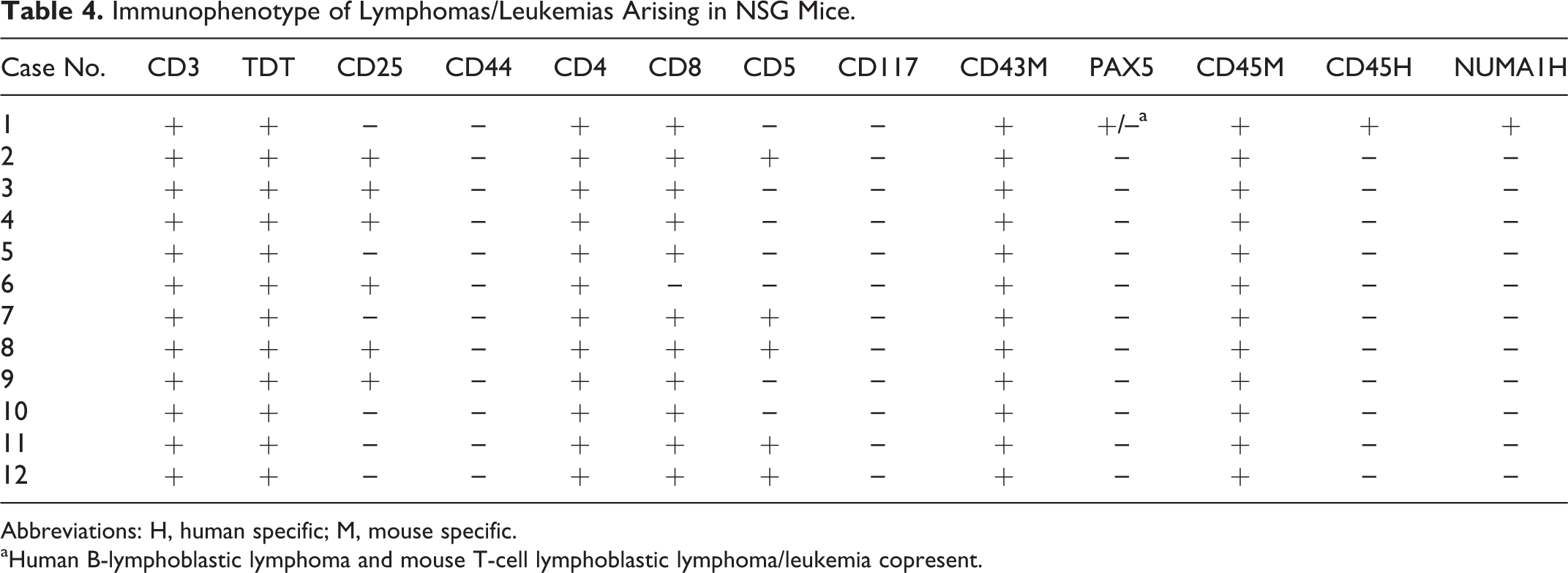
Abbreviations: H, human specific; M, mouse specific.
aHuman B-lymphoblastic lymphoma and mouse T-cell lymphoblastic lymphoma/leukemia copresent.
NSG Lymphomas Express the Retrovirus-Associated p30 Core Protein
Because retroviral infection is correlated with spontaneous lymphomagenesis in mice, we assessed sections of lymphoma within the spleen, thymus, bone marrow, liver, lung, lymph nodes, and salivary gland for immunoreactivity with retroviral p30 antibody. Strong expression of p30 antigen was detected by IHC in 8 of 12 lymphomas (67%, Fig. 8). The neoplastic lymphocytes in the other 4 of 12 mice (33%) had low intensity to equivocal labeling for p30. However, p30 was detected in normal megakaryocytes in spleen or bone marrow (Fig. 9) and in acinar and ductal epithelium of salivary glands (Fig. 10) and mammary glands (not shown) in all 12 NSG mice with lymphoma. We also confirmed that there was p30 expression in the same tissues in 2 naive NSG mice, 1 male and 1 female, which did not have either clinical or histopathologic evidence of disease.
Discussion
Our findings indicate that progenitor lymphoid cells in NSG mice have the potential to undergo neoplastic transformation and form lymphomas/leukemias that most closely identify with precursor T-cell lymphoblastic lymphoma/leukemia as described in the Bethesda classification of lymphoid neoplasms in mice. 40 The lymphomas were TDT+ and either double positive (CD4+CD8+) or single positive (CD4+ only), further supporting the diagnosis of a T-cell lymphoma arising from immature populations. Tdt is a transcriptional regulator that is responsible for generating N-diversity during the V(D)J recombination process. This lymphocyte-specific antigen is expressed in immature cells during lymphocyte development. Specifically, it is expressed in the early maturational stages, including pro-T, pre-T, and DP T cells, as well as pro-B cells in mice. 16,45 T-cell maturation stages can be assessed using IHC approaches, although overlap in marker expression exists between some stages. In addition, the development of neoplasms may not follow the normal patterns of differentiation. Therefore, it is not always possible to provide a clear distinction between pro-T- and pre-T-cell subsets, cortical thymocytes (CD4+CD8+, DP), medullary thymocytes (CD4+CD8– SP or CD8+CD4– SP), and postthymic T cells (CD4+CD8– SP or CD8+CD4– SP). Therefore, T-cell lymphomas/leukemias can sometimes only be classified broadly as either immature (TDT+) or mature (TDT–) based on whether or not they express TDT when using IHC only. 51,52
Half of the NSG lymphomas in this report were positive for CD25, which is more commonly used to identify early developmental stages of T cells in mice. Human T-cell leukemias/lymphomas universally overexpress CD25. 73 It is hypothesized that CD25 permits cell proliferation, expansion, and survival, which account for the poor outcome associated with lymphoid neoplasms expressing this marker. 18,73 CD5 is another marker used for assessing T-cell development and is expressed on most immature and mature T cells and NKT cells. Five of the 12 lymphoma/leukemias expressed CD5 while most did not appear to have detectable levels. CD5 loss is not uncommon for T-cell lymphomas/leukemias and helps to further distinguish that the lymphoproliferations observed in the 12 NSG mice were neoplastic. 51 All lymphomas were negative for CD117. Loss of CD117 suggests that lymphomas do not have an early T-cell precursor phenotype. CD117 has a role in the expansion of CD3–CD4–CD8– T-cell progenitors of bone marrow origin, which are not irreversibly committed to the T-cell lineage and may progress toward either myeloid or dendritic cell differentiation. 55,56 Indeed, the NSG lymphomas were negative for other myeloid markers. Therefore, the clinical findings, morphology, and immunophenotype are sufficient to support that the spontaneous lymphoproliferations in NSG mice are neoplastic.
When histopathology and immunophenotyping are unclear, establishing clonality can be helpful for determining whether or not a lymphoproliferation is neoplastic or a benign hyperplasia. Establishing clonality for T-cell malignancies is not always straightforward as the expansion of T-cell subclones is necessary for antigen-specific responses. Therefore, predominance of T-cell clones may occur in some reactive conditions. Because the presence of clonal T-cell populations does not prove malignancy, it cannot be relied upon as a gold standard for diagnosing such diseases alone. Molecular techniques, such as tests of clonality, are considered beneficial in a minority of human lymphoma cases and only when used in conjunction with morphology and immunophenotyping. Using formalin-fixed, paraffin-embedded samples to determine clonality also provides challenges in testing and the consistent interpretation of results. 9,29.31 In all, our interpretation that the NSG lymphoproliferations are consistent with the diagnosis of lymphomas is comparable to what is described for the immunophenotype of pediatric T-lymphoblastic leukemia/lymphoma, which is also derived from immature T cells. 8,45,48
The overall incidence of T-cell lymphoma in our NSG mice is similar to what has been reported for NOG mice, which is around 0.7%. 28 NOG and NSG mouse colonies appear to develop lymphoma at a lower frequency than what has been reported for lymphomas arising in either NOD-scid mice (67%) or C.B-17-scid mice (15-20%). 15,41,44 The differences in lymphomagenesis among these strains may be related to the functions of any residual immune cell subpopulations or from environmental exposures. While the NSG and NOG mice examined in our report and other published studies have small sample sizes, are often limited in the scope of available clinical data, and are subject to selection biases, the potential differences in tumor frequencies and growth kinetics still warrant further examination and comparison with other immunodeficient mice. Understanding the mechanisms of lymphomagenesis in NSG mice may help to better discern the role of the IL2Rϒ chain in lymphomagenesis.
One key question that our study highlights is the mechanism by which spontaneous lymphomas develop in a subpopulation of susceptible NSG mice. The disruption of the thymic niche in mice that have loss of IL2Rϒ alone or in combination with a RAG deficiency can result in thymocytes acquiring genetic alterations leading to T-cell lymphomagenesis. In 1 study, the engraftment of newborn thymic tissue into T-cell-deficient Rag−/−ϒc −/−KitW/Wv mice caused autonomous T-cell development persisting to the DP stage and transplantable atypical lymphoproliferations in multiple organs. Furthermore, progenitor cells taken from the bone marrow of either Rag2−/− ϒc−/− or ϒc −/− mice and transplanted into wild-type mice could undergo lymphomagenesis, with T-cell acute lymphoblastic leukemia (T-ALL) development recorded in 50% and 38% of the mutant mice, respectively. T-ALL did not develop in either the Rag1−/− or KitW/Wv mutant mice in which bone marrow T-cell-committed progenitors were shown to provide a continuous migration to the thymus. 35 These data suggest that thymocytes that cannot respond to essential thymus cytokines and fail to undergo canonical maturation processes, such as the thymocytes of NSG mice, can become genomically unstable.
As previously discussed, the nonneoplastic T-cell phenotype in mice with the C.B-17-scid mutation is CD44–CD25+ (DN3). 15,49,57 The NSG lymphomas are predominantly CD4+CD8+ DP and occasionally CD4+CD8– SP, similar to that reported in C.B-17-scid and NOD-scid mice. 6,12,13,26 From our data and other published reports, the phenotype of lymphomas in mice having a scid mutation alone is characteristic of a more mature DP stage than the DN3 stage. These data suggest other factors are at work in promoting the transition from DN3 to DP in DN3 thymocytes undergoing lymphomagenesis. Defective Trp53, Notch1 mutations, alterations to WNT pathway signaling, upregulation of BCL2, and irradiation all have been implicated in promoting the passage of lymphoma cells from the DN3 blockage into the DP stage of maturation. 42 71
Expression of pre-T-cell receptor (pre-TCR) is important for the survival of thymocytes and their progression to maturation. Lymphocytes with the scid phenotype arrest as DN3 thymocytes, which do not express pre-TCR and are expected to undergo cell death in the absence of any genetic changes. 57 Wnt pathway signaling, which is suppressed by p53, functions in parallel to the pre-TCR signaling. 71 Therefore, abrogation of the thymocyte arrest at DN3 via activation of the Wnt pathway or p53 inactivation may suffice for further immature T-cell development beyond the DN3 thymocyte stage. Inactivation of p53 has been shown to facilitate differentiation of arrested DN3 thymocytes to DP thymocytes. 42,71 Overexpression of BCL-2 has also been shown to promote differentiation of thymocytes from the CD4–CD8–CD25+(DN3) to CD4+CD8+ (DP) stage despite their lack of a TCR-CD3 complex in Rag-1-deficient mice. 33
NOTCH1 is required for normal T-cell development and plays an important role in regulating β-selection in CD4–CD8– DN thymocytes, but its role in the development of CD4+CD8+ DP thymocytes is not as well established. However, it has been demonstrated in Rag-deficient mice that constitutive Notch signaling can promote the progression of DN thymocytes to DP thymocytes in the absence of pre-TCR signaling. 37 Notch expression must be precisely regulated as constitutive Notch signaling leads to development of T-cell lymphoma. Chromosomal translocations and acquired gain-of-function mutations affecting NOTCH1 signaling in developing thymocytes of humans and mice cause neoplastic transformation through unlimited self-renewal and a stage-specific developmental arrest. 2,21,50 Gain-of-function mutations of Notch genes are frequently associated with mouse models of T-ALL and human T-ALL. 36,72 Alterations in Notch have been discovered in a high fraction of mouse lymphomas arising in T-cell lymphoblastic lymphoma/leukemia-prone mice, including C.B-17-scid, NOD-scid, and Rag-deficient mice. 3,25,38,70 Notch has also been shown to interact with multiple cellular pathways, and it can cooperate with other oncogenes leading to lymphoma, as occurs with Myc in mouse lymphoma/leukemia models. 36 66 72
Another mechanism of lymphomagenesis in NSG mice explored in this study was that of retroviral-induced transformation. Mouse hematopoietic neoplasms arising from viral infections have previously been reported in mice with or without irradiation, chemical exposure, or genetic manipulation. 23,39,44,53 Our data demonstrated that T-cell lymphomas arising in NSG mice can harbor murine retroviruses that can be observed in DP T lymphocytes by immunohistochemistry. The genomes of inbred laboratory mice commonly contain endogenous retroviral elements, including murine leukemia viruses. 39 While murine leukemia retrovirus antigen (MuLV) was not initially detected by immunofluorescence labeling methods in T-cell lymphomas that developed in irradiated scid mice, 32 the presence of a type D retrovirus was demonstrated in thymic lymphomas arising in 2 C.B-17-scid mice. 54 Thymic lymphomas in NOD/LtSz-scid mice have been reported to be associated with expression of an endogenous ecotropic murine leukemia provirus (Emv-30) that maps to the proximal region of chromosome 11. 49 Interestingly, Emv30null NOD-scid mice, which were developed to improve the use of this strain for adoptive transfer studies, still develop thymic lymphomas, indicating that other factors are also necessary for T leukemogenesis. 59
In humans, random retroviral integration into the host cell DNA may disrupt genes associated with T-cell development, which subsequently leads to an acute T-lymphoblastic leukemia (T-ALL). In clinical trials, the administration of the ϒc gene into CD34+ bone marrow cells using a gammaretroviral vector to treat IL2RG deficiency in human infants was correlated with the development of T-ALL in a subset of patients. These leukemias were determined to develop from T cells with α/β receptors and had the chromosomal translocation t(11;14). Through cloning and sequencing of host-viral DNA junction fragments, random insertion events at common integration sites beside proto-oncogenes were identified, most notably in association with LMO2, which is implicated in T leukemogenesis. 22,68 Thus, it is conceivable that proviral reinsertion of retrovirus near genes that influence growth and apoptosis could also be an important mutagenic event in some NSG lymphomas.
Overexpression of cMyc promotes T-cell and B-cell lymphomagenesis in mice. 34 More recently, mutated Notch1 has been shown to contribute to mouse T-cell leukemia by directly inducing the expression of cMyc, causing messenger RNA (mRNA) levels to increase in 14 primary mouse T-cell leukemias that harbored Notch1 mutations. 60 They further demonstrated that MuLV was inserted in the Notch1 or cMyc locus of these 14 leukemia lines, which likely results in expression of constitutively active Notch1 and cMyc proteins leading to leukemia. These data suggest a mechanism whereby MuLV insertion into either the Notch1 or cMyc locus may account for the occurrence of the lymphomas in the NSG mice in this study.
More recently, an endogenous MuLV that originated from the EMV 30 provirus has been confirmed to be associated with the induction of acute myeloid leukemia in NSG mice. 69 The NOD-scid mouse and the NSG mouse share 2 similar genetically altered mouse genetic backgrounds, the NOD mouse and the C.B-17-Prkdcscid mouse. The NOD mouse originates from the Swiss mouse line, and it is well recognized that lymphomas occur in a variety of mouse strains (CD-1, CFW) of the Swiss background in association with endogenous MuLV. 4,53,65 Lymphomas are reported to occur in NOD/LT mice, so it is not surprising they harbor endogenous retroviruses since they are also of the Swiss background. Therefore, our data and that of others support the idea that the NOD/LT mouse is more than likely the source of the retrovirus confirmed to be present in the NOG and NSG mouse. 49,69 However, the scid mouse cannot be definitively dismissed as being the source of the retrovirus in the NOG and NSG mice since the BALB/c mouse has also been reported to harbor an ecotropic provirus on chromosome 5, and the C.B-17-scid mouse is of the BALB/c background. 4 7 24 30 However, it has been shown that the NOD/LT, NOD-scid, and NSG strains harbor the EMV30 provirus, suggesting the NOD/LT mouse is the most probable source of the retroviral contamination of the NSG mouse. 49,69
The recognition that spontaneous lymphomas arise in NSG has implications for a correct interpretation of preclinical research studies. The occurrence and dissemination of 2 different species-specific lymphomas with morphologic similarities in the same NSG mouse transplanted with human cells highlights that both spontaneous and experimentally induced lymphomas may occur in NSG mice and can be distinguishable with IHC. We have also shown that the retroviral major core protein p30 is detectable by IHC in untransformed tissues and in lymphomas of NSG mice. Therefore, pathologists should be aware of the presence of a retrovirus in the NSG mouse and its possible association with spontaneous T lymphomagenesis.
Supplemental Material
Supplemental Material, Combined_supplemental_materials-Tillman_et_al - Morphologic and Immunohistochemical Characterization of Spontaneous Lymphoma/Leukemia in NSG Mice
Supplemental Material, Combined_supplemental_materials-Tillman_et_al for Morphologic and Immunohistochemical Characterization of Spontaneous Lymphoma/Leukemia in NSG Mice by Heather Tillman, Laura J. Janke, Amy Funk, Peter Vogel and Jerold E. Rehg in Veterinary Pathology
Footnotes
Acknowledgements
We thank Dr. Sandra Ruscetti, the National Cancer Institute, Frederick, Maryland, for providing the goat anti-RLV p30 antibody. In addition, we thank Dr. Jerrold M. Ward for his input on MuLV.
Author Contributions
Heather Tillman and Laura J. Janke Equally contributed to this work.
Declaration of Conflicting Interests
The author(s) declared no potential conflicts of interest with respect to the research, authorship, and/or publication of this article.
Funding
The author(s) disclosed receipt of the following financial support for the research, authorship, and/or publication of this article: The research in this study was partially supported by the National Cancer Institute of the National Institutes of Health under the Award Number P30CA021765. The work was also supported in part by the American Lebanese Syrian Associated Charities.

Supplemental material for this article is available online.
References
Supplementary Material
Please find the following supplemental material available below.
For Open Access articles published under a Creative Commons License, all supplemental material carries the same license as the article it is associated with.
For non-Open Access articles published, all supplemental material carries a non-exclusive license, and permission requests for re-use of supplemental material or any part of supplemental material shall be sent directly to the copyright owner as specified in the copyright notice associated with the article.
