




Abstract
Severe combined immunodeficient (SCID) mice lack functional T and B cells. This renders them useful for implantation of human cells. The absence of immune cells, however, makes severe combined immunodeficient mice highly susceptible to infections and spontaneous development of malignancies; 2 of 114 CB17/Icr-Prkdcscid/IcrIcoCrl severe combined immunodeficient mice aged 9 and 10 months developed spontaneous acute leukaemia and thymic lymphoma. The differential diagnosis of such an atypical lymphoid infiltrate includes ‘leaky’ severe combined immunodeficient mice, thymic lymphoma and acute leukaemia. Until this time, the link between the development of neoplasms in severe combined immunodeficient mice and the mutation remains unclear.
Introduction
In 1980, Bosma and colleagues noted that severe combined immunodeficient (SCID) mice possess a genetic autosomal recessive mutation termed Prkdcscid. SCID mice are homozygous CB17/Icr-Prkdcscid/ scid for the Prkdcscid allele, mapped to chromosome 16.1,2 SCID mice lack functional T and B cells resultant from impaired VDJ rearrangements. 3 This renders them useful for implantation of human cells such as in tumour or angiogenesis xenografts. The absence of immune cells, however, makes SCID mice highly susceptible to infections and spontaneous development of malignancies. 4
Although SCID mice lack T and B cells, Natural Killer cells, macrophages and granulocytes are adequate in number. 5 In 2%–23% of cases, SCID mice have turned ‘leaky’ or have few detectable clones of functional T and B cells, producing detectable levels of serum IgG and IgM. 6
Spontaneous tumours arising in SCID mice have been described in the literature and include the more common thymic lymphomas and carcinomas,4,7 and rare non-thymic malignancies, including acute leukaemias, myoepitheliomas, osteosarcomas, rhabdomyosarcomas and fibrosarcomas.8,9
Materials and methods
A total of 114 CB17/Icr-Prkdcscid/IcrIcoCrl SCID mice were generated from two breeding pairs obtained from the Charles River laboratories, following approval of the Institutional Review Board, and Animal Ethics Committee, of the Christian Medical College, Vellore. All mice were housed in individual ventilated cages with strict attention given to sterility as required for housing immunodeficient mice:
SCID mouse #1: An adult male mouse aged 9 months was found bleeding from his tail resulting from fighting with a male housed in the same cage. The mice were hence separated. While the bleeding subsided, the injured SCID mouse subsequently died. Health monitoring for pathogens report had been performed a couple of days prior to the death and was reported as being negative.
SCID mouse #2: An adult male mouse aged 10 months developed respiratory distress. The mouse was sacrificed on humane grounds.
Perfusion of the organs of both mice was done via infusion of 4% paraformaldehyde to the heart. Tissue samples were fixed in 10% buffered formalin (or decalcification solution for bone samples), embedded in paraffin, cut at 4-micron thickness and stained routinely for haematoxylin and eosin.
Results and discussion
Autopsy done on SCID mouse #1 revealed that the liver and spleen were enlarged. The thymus was normal in size. Histopathological evaluation revealed a diffuse infiltrate comprising small blasts with scant cytoplasm, indented nuclear membranes, condensed chromatin and inconspicuous nucleoli resembling acute lymphoblastic leukaemic cells. The infiltrate was present in several organs including bone marrow, lymph nodes (Figure 1(a)), lungs (Figure 1(b)), liver (Figure 1(c)) and kidney (Figure 1(d)).

Acute leukaemia, SCID mouse #1. Diffuse leukaemic infiltrate involving (a) lymph nodes, (b) lungs, (c) liver and (d) kidneys.
SCID mouse #2 had a 1.5 cm × 1.5 cm × 1 cm mediastinal mass (Figure 2(a)) with a tan coloured soft cut surface and foci of haemorrhage (Figure 2(b)). Histological evidence of non-involved thymic tissue was not present on multiple sections examined. The mediastinal tumour showed a diffuse infiltrate resembling a thymic lymphoma comprising medium-sized blasts with scant cytoplasm, indented nuclear membranes, condensed chromatin and inconspicuous nucleoli (Figure 3(a)). A ‘starry-sky’ pattern was seen in foci (Figure 3(b)). Bone marrow showed diffuse neoplastic infiltrate (Figure 3(c)). Sections from lymph nodes showed necrotic mitotically active tumour (Figure 3(d)).
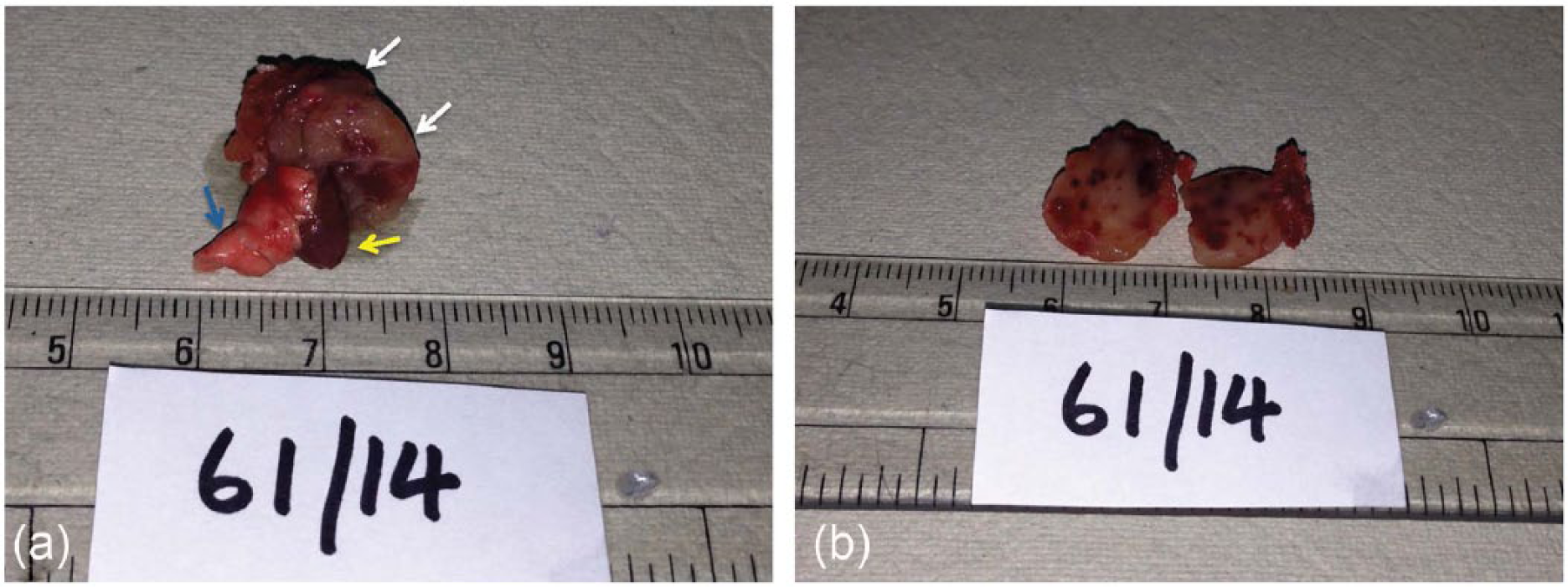
Mediastinal mass, SCID mouse #2. (a) Gross specimen. Mediastinal mass replacing entire thymus measuring 1.5 cm × 1.5 cm × 1 cm (white arrows). Blue and yellow arrows indicate lung and heart, respectively. (b) Cut section of mediastinal mass shows tan coloured soft tissue with foci of haemorrhage.

Thymic lymphoma, SCID mouse #2: (a) and (b) show a diffuse infiltrate of medium-sized blasts with scant cytoplasm, indented nuclear membranes, condensed chromatin and inconspicuous nucleoli; (b) a ‘starry-sky’ pattern is seen; (c) bone marrow shows diffuse neoplastic infiltrate; (d) sections from lymph nodes show necrotic mitotically active tumour.
A total of 2/114 (1.75%) spontaneous tumours were seen in CB17/Icr-Prkdcscid/IcrIcoCrl SCID mice. The first tumour resembled an acute leukaemia, and the second, a thymic lymphoma.
These were incidental discoveries in establishing a SCID mouse colony for the first time in a Research Animal Facility in India. The CB17/Icr-Prkdcscid/IcrIcoCrl SCID mice were procured for the purpose of implanting human cells, and daily health monitoring observed. The deterioration in health of two older mice made us suspect an infection that could compromise not only the health of the mice but also the rest of the SCID colony. While health-monitoring reports were negative, the autopsies revealed lymphoid tumours. The differential diagnosis of diffuse infiltrate of lymphoid cells in organs of SCID mice includes thymic lymphoma, acute leukaemia and ‘leaky’ SCID mice with partially functional T and B cells.4,6,7
Spontaneous tumours arising in SCID mice have been described in the literature and include the more common thymic lymphomas, and rarer non-thymic malignancies.4,7 The link between the development of spontaneous neoplasms and the SCID mutation remains unclear.
Besides the possibility of life-threatening infections as a cause of death in SCID mice, malignancies need to be excluded by thorough autopsy and histological evaluation. The development of tumours in SCID mice used for experimental human cell implantation studies must be kept in mind, particularly if there are unexpected experimental results observed. Additionally, tumours developing in SCID mice might serve as a model to study neoplasms arising in an immunodeficient background in humans.
Footnotes
Acknowledgements
Chitra Premkumar and Saranya Rajendran: Graduate Technicians, Laboratory 1; Satish Perumal and Esther Rani: Histopathology Technicians and Technical Staff, Animal Facility, at the Centre for Stem Cell Research (CSCR).
Declaration of conflicting interests
The author declares that there is no conflict of interest.
Funding
This study was supported by Department of Biotechnology BT/PR5915/MED/31/172/2012 and BT/PR7990/MED/32/282/2013 Government of India and Fast Track Grant for young scientists and Department of Science and Technology (DST), Science and Engineering Research Council (SB/FT/LS-196/2012), Government of India to Rekha Samuel.