




Abstract
The Quaker parrot has been used as a psittacine model to study clinical lipidology and lipid-related disorders. However, while Quaker parrots appear to be anecdotally susceptible to a variety of spontaneous dyslipidemic disorders and lesions caused by excess lipid accumulation, epidemiologic data are lacking. A multicenter retrospective study on 652 pathology submissions (411 necropsies and 243 biopsies) from Quaker parrots was performed by recording the final pathological diagnoses, age, and sex for each bird. The prevalence of lesions associated with lipid metabolism, such as hepatic lipidosis, atherosclerosis, xanthomas, adipose tumors, coelomic steatitis/steatonecrosis, endogenous lipid pneumonia, and acute pancreatic necrosis/pancreatitis, was reported. Multiple logistic regression models were used to characterize the effects of sex and age on these lesions, and the prevalence of hepatic lipidosis and atherosclerosis was compared to those in a random sample of control psittacine birds. The raw prevalence of atherosclerosis and hepatic lipidosis was 5.6% (95% confidence interval [CI], 3.4%–7.8%) and 21.2% (95% CI, 17.2%–25.1%), respectively. While the prevalence of atherosclerosis was similar to other psittacine species, hepatic lipidosis was more common in Quaker parrots. Quaker parrots also showed a unique susceptibility to acute pancreatic necrosis with a prevalence of 12.9% (95% CI, 9.7%–16.1%). Male parrots were found to be more susceptible than females to lipid accumulation lesions (P = .0024), including atherosclerosis (P = .018) and hepatic lipidosis (P < .001). This retrospective study confirms the high susceptibility of Quaker parrots to lipid-related disorders and presents epidemiological data that may be useful to avian clinicians, pathologists, and researchers using Quaker parrots.
The Quaker parrot (Myiopsitta monachus) is a small South American parrot (about 100–110 g) that is commonly kept as a companion bird. This species also seems particularly prone to lipid-related disorders, and the authors have commonly diagnosed hepatic lipidosis and dyslipidemia in this species. However, despite anecdotal evidence of increased prevalence of lipid-related disorders in this species, epidemiological data documenting the spontaneous occurrence of these diseases are not available.
The Quaker parrot has been shown to be highly susceptible to experimental development of atherosclerosis and dyslipidemia. A study reported that, upon being fed for 4 months a 1% cholesterol diet (controlling for caloric intake), young Quaker parrots (<2 years) developed advanced atherosclerotic lesions in all major arteries (aorta, brachiocephalic trunks, pulmonary arteries, coronary arteries) and experienced a sharp increase in the plasma levels of total and low-density lipoprotein (LDL) cholesterol. 5 The severity of atherosclerotic lesions and arterial cholesterol content increased over time, and both were correlated to plasma cholesterol levels. Induced advanced atherosclerotic lesions were of similar histopathologic appearance as spontaneous lesions in the same species, leading to the conclusion that the Quaker parrot is a good model species to study spontaneous psittacine atherosclerosis. 5 During the same experiment, a significant increase in hepatic cholesterol content was also induced over a 4- to 8-month period, and 2 of 6 Quaker parrots in the 6- to 8-month treatment groups developed severe hepatic lipidosis. 5 Quaker parrots have also been used to study the effects of nutrition on lipid metabolism and have been shown, in multiple studies, to have much higher basal total and LDL cholesterol levels than other parrot species. 4,7,18,19 In the author’s practice (H.B.), Quaker parrots seem to present with high frequency of lipid-related disorders and dyslipidemia not associated with female vitellogenesis (unlike other psittacine species), 2 which prompted this retrospective study of pathology submissions.
In Psittaciformes, lesions that are commonly reported to be associated with lipid metabolic disorders (here referred as to “lipid-related lesions”) include atherosclerosis, lipoma, liposarcoma, xanthoma, steatitis and steatonecrosis, hepatic lipidosis, renal lipidosis, splenic lipidosis, atherosclerosis, endogenous lipid pneumonia, egg yolk coelomitis and emboli, corneal lipid deposition, and congenital lipid storage disorders (eg, lysosomal storage disease). 3,8,9,16,17,20,22,24 Among these lipid-related lesions, only atherosclerosis has been studied epidemiologically to the authors’ knowledge. In a large epidemiological study including 5 common genera of captive Psittaciformes (Ara, Amazona, Psittacus, Nymphicus, and Cacatua), but not Quaker parrots, advanced atherosclerotic lesions have been shown to be more prevalent in female psittacine birds, especially with comorbid reproductive diseases. 3 This is an opposite trend compared to mammals and especially humans, where male sex is associated with higher risks of developing atherosclerotic diseases. 25 Age was also shown to be an important risk factor in the same study. 3 Acute pancreatic necrosis is considered rare in most Psittaciformes species but seems more prevalent in Quaker parrots. 13,21 While not a primary lipid disorder per se, acute pancreatic necrosis is strongly associated with lipid dysmetabolism risk factors or causes such as obesity, increased abdominal adiposity, hypertriglyceridemia, and dietary and metabolic factors in humans and domestic carnivores. 12,23
The Quaker parrot is a small species that adapts well to captivity such as indoor aviaries and laboratory settings, which, in combination with the high susceptibility to lipid-related disorders, makes it an ideal laboratory species to study atherosclerosis, lipid metabolism, and its dysregulation. To better characterize the Quaker parrot as a model for the study of lipid metabolism, it is important to assess the prevalence and epidemiological characteristics of spontaneous lipid-mediated disorders in this species. The objective of this retrospective study was to report the prevalence and the basic epidemiological risk factors associated with lesions commonly related to lipid dysmetabolism in a cohort of Quaker parrots submitted for postmortem and biopsy to 3 veterinary institutions. Our main hypothesis was that this species would have a high prevalence of lipid-related lesions, in particular hepatic lipidosis, compared to other psittacine species.
Materials and Methods
Case Selection and Study Design
The available databases of 3 diagnostic laboratories/institutions were reviewed for biopsy and necropsy submissions of Quaker parrots. Databases included the Ontario Veterinary College/Animal Health Laboratory at the University of Guelph, Guelph, Ontario, Canada (2007 through 2016); the Zoo/Exotic Pathology Service, Sacramento, California (1998 through 2017); and the Schubot Center at Texas A&M University, College Station, Texas (1988 through 1998).
For each submission, age and sex of each bird, histopathological diagnoses, and type of submission (postmortem or biopsy) were recorded when available. The variables of age and sex had a significant number of missing data (considering that the Quaker parrot is not sexually dimorphic), which were dealt with through multiple imputation procedures (see statistical analysis). Only specific histopathological diagnoses commonly related to lipid dysmetabolism, defined here as “lipid-related lesions,” were included in this study and coded as separate binary variables (ie, present or absent) for statistical analysis. Binary variables included the following: hepatic lipidosis, atherosclerosis, xanthoma, lipoma or liposarcoma, steatitis or steatonecrosis, endogenous lipid pneumonia, egg yolk coelomitis or emboli, pancreatic necrosis or pancreatitis, splenic lipidosis, renal lipidosis, corneal lipid deposition, and congenital lipid storage disease (eg, lysosomal storage disease). Individual parrots could be diagnosed with more than one of the lipid-related lesions, such as inflamed or necrotic lipomas, or pancreatic necrosis with peripancreatic steatitis. A subset of the “lipid-related lesions” variable, defined as “lipid accumulation lesions,” was included to specifically record the presence of lesions characterized histologically by excess lipid accumulation within a certain tissue. The “lipid accumulation lesions” variable included all previously listed lesions, with the exception of egg yolk coelomitis/emboli, acute pancreatic necrosis/pancreatitis, and steatonecrosis/steatitis. In addition, any histopathological diagnosis related to the reproductive tract was also recorded (“reproductive lesion” variable), as diseases involving the reproductive system have been shown to be risk factors for atherosclerosis in parrots. Egg yolk coelomitis and emboli were further classified in the “reproductive lesions” variable.
To compare the prevalence of hepatic lipidosis and atherosclerosis controlling for sex and age with other psittacine species, data from 562 non-Quaker psittacine controls selected at random (using a statistical software) from a previously published study that used the same diagnostic laboratories/institutions were used. 3 For the entire data set, the control/case ratio was 1.4.
Statistical Analysis
The prevalence of selected disorders was calculated from necropsy cases and biopsy submissions with their respective 95% binomial confidence intervals (asymptotic method). For risk factors, only necropsy cases were included into the statistical models.
Data for age, sex, or both were missing in 31.4%, 30.2%, and 10.5% of cases, respectively (unknown or unreported on submission sheets) and were assumed to be missing at random. To limit selection bias and loss of information associated with listwise deletion (default for statistical software), the missing values were dealt with via a multiple imputation procedure. A bootstrap-based expectation-maximization-Bayesian algorithm was used to perform 5 multiple imputations by missing value, creating 5 data sets. 15 Age was log-transformed to achieve normality prior to imputation (Shapiro-Wilk test). 15 Imputation diagnostics were performed by comparing the distribution of the imputed data to the complete data.
Multiple logistic models were performed using the lipid-related lesions variables (separate variables and the combined “lipid accumulation lesions” variable) as outcome variables (in different models) and age, sex, and age × sex interaction as explanatory variables. For atherosclerosis, reproductive lesion and hepatic lipidosis categories were also included as additional explanatory variables to the model. For steatitis/steatonecrosis, the lipoma and pancreatic necrosis/pancreatitis variables were also added to the model as additional explanatory variables. Residual plots were used to screen for outliers. All logistic regression models were fitted with the 5 data sets (resulting from multiple imputations) simultaneously with model parameters being automatically combined using Rubin’s rules by the statistical software. 15
The difference in prevalence of hepatic lipidosis and atherosclerosis between Quaker parrots and other control psittacine birds (genera Amazona, Cacatua, Nymphicus, Psittacus, and Ara) was assessed using a logistic regression model controlling for age and sex. Such analysis could not be performed with other lipid-related disorders, given that no previous studies had reported the prevalence for these disorders in psittacine birds.
Associations between outcome and explanatory variables were reported as odds ratio (OR) with 95% confidence intervals (CIs).
For all tests, an α of 0.05 was used for statistical significance, and statistical analysis was performed using R software (R Development Core Team; R Foundation for Statistical Computing, Vienna, Austria) and related programming packages for multiple imputations and combinatory logistic models. 15
Results
A total of 652 Quaker parrot cases (Zoo/Exotic Pathology Service: 531, University of Guelph–Animal Health Laboratory: 22, Texas A&M University–Schubot Center: 101) were retrieved, including 411 necropsies and 243 biopsies. The raw prevalence of the lipid-related lesions present in the database is reported in Table 1. Some of the most commonly observed lipid-related lesions are shown in Figs. 1–6. Most biopsy cases were from the integument, including the skin, beak, uropygial gland, and cutaneous masses (201/243, 82.7%). A single case of splenic lipidosis was recorded, which was concurrent to severe hepatic lipidosis. No cases of congenital lipid storage diseases, renal lipidosis, or corneal lipidosis were recorded. Only necropsy cases were used to investigate further associations.
Raw Prevalence of Lipid-Related Lesions in Quaker Parrots From Necropsy and Biopsy Submissions.
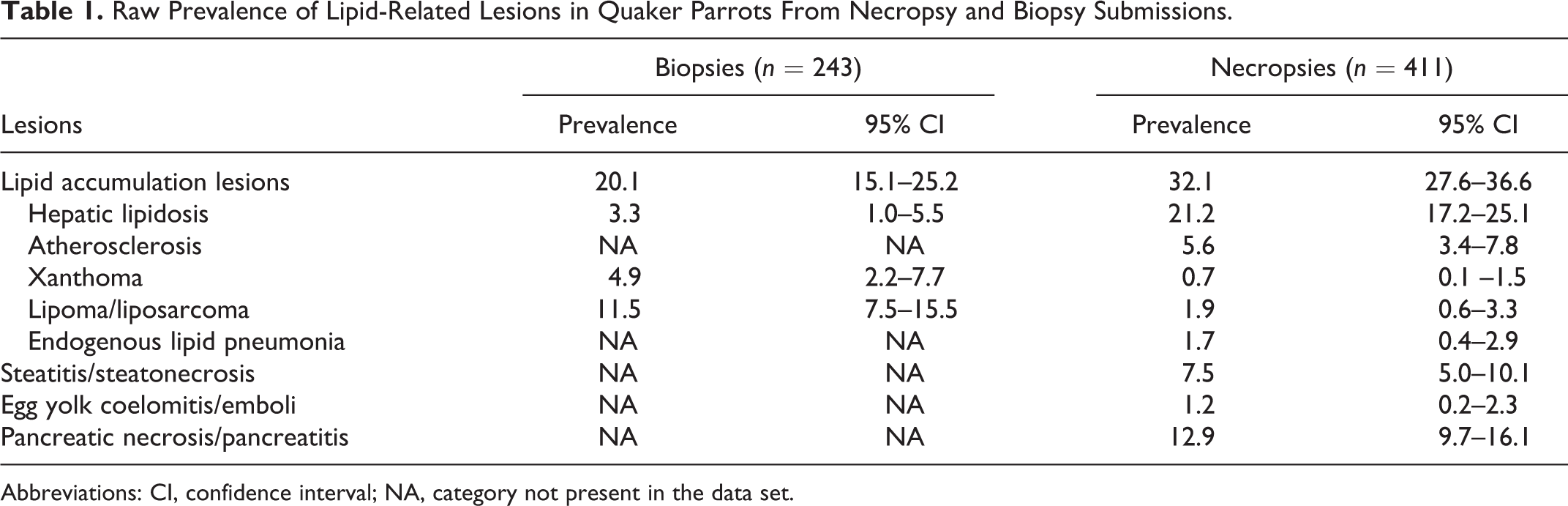
Abbreviations: CI, confidence interval; NA, category not present in the data set.
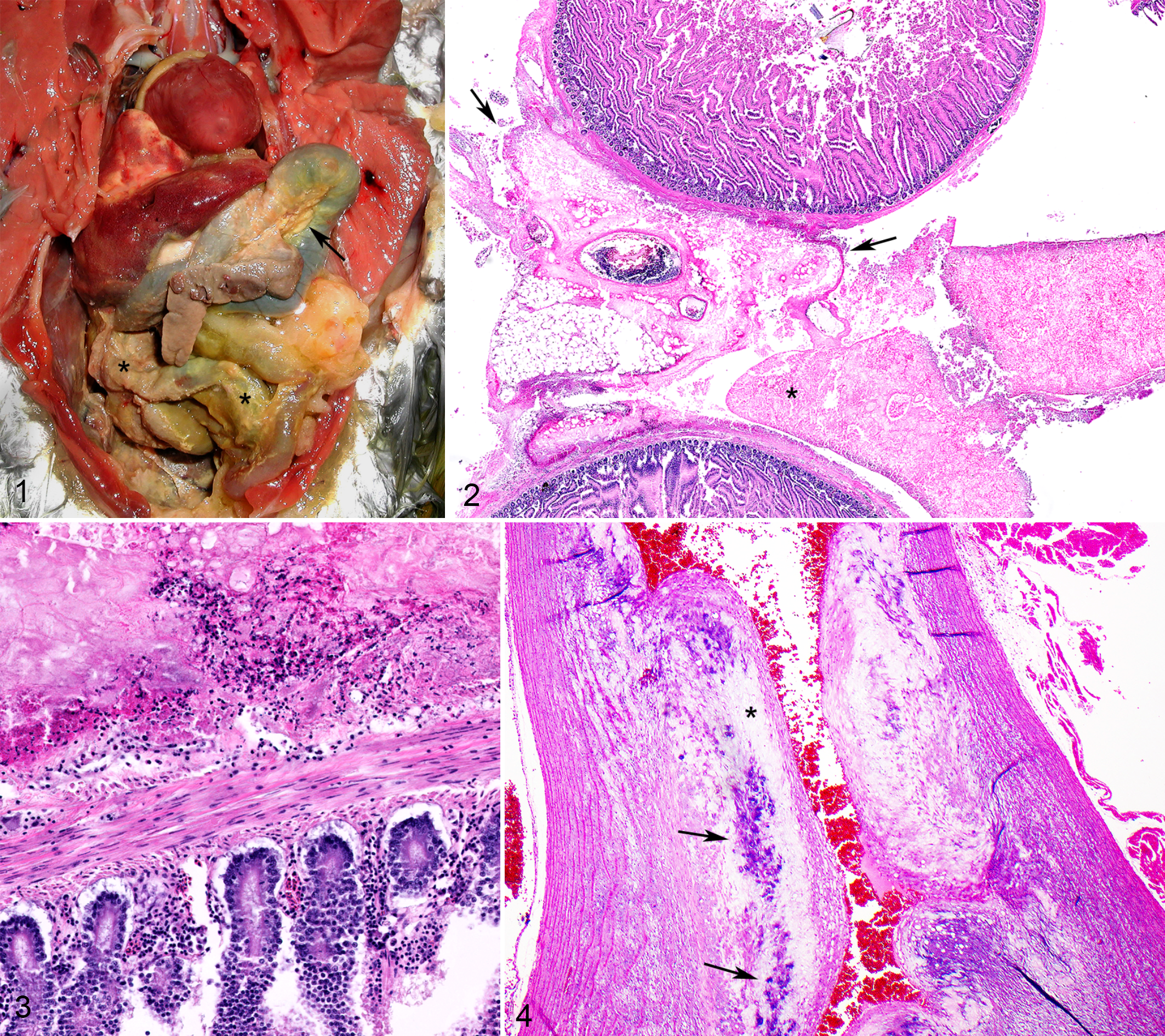
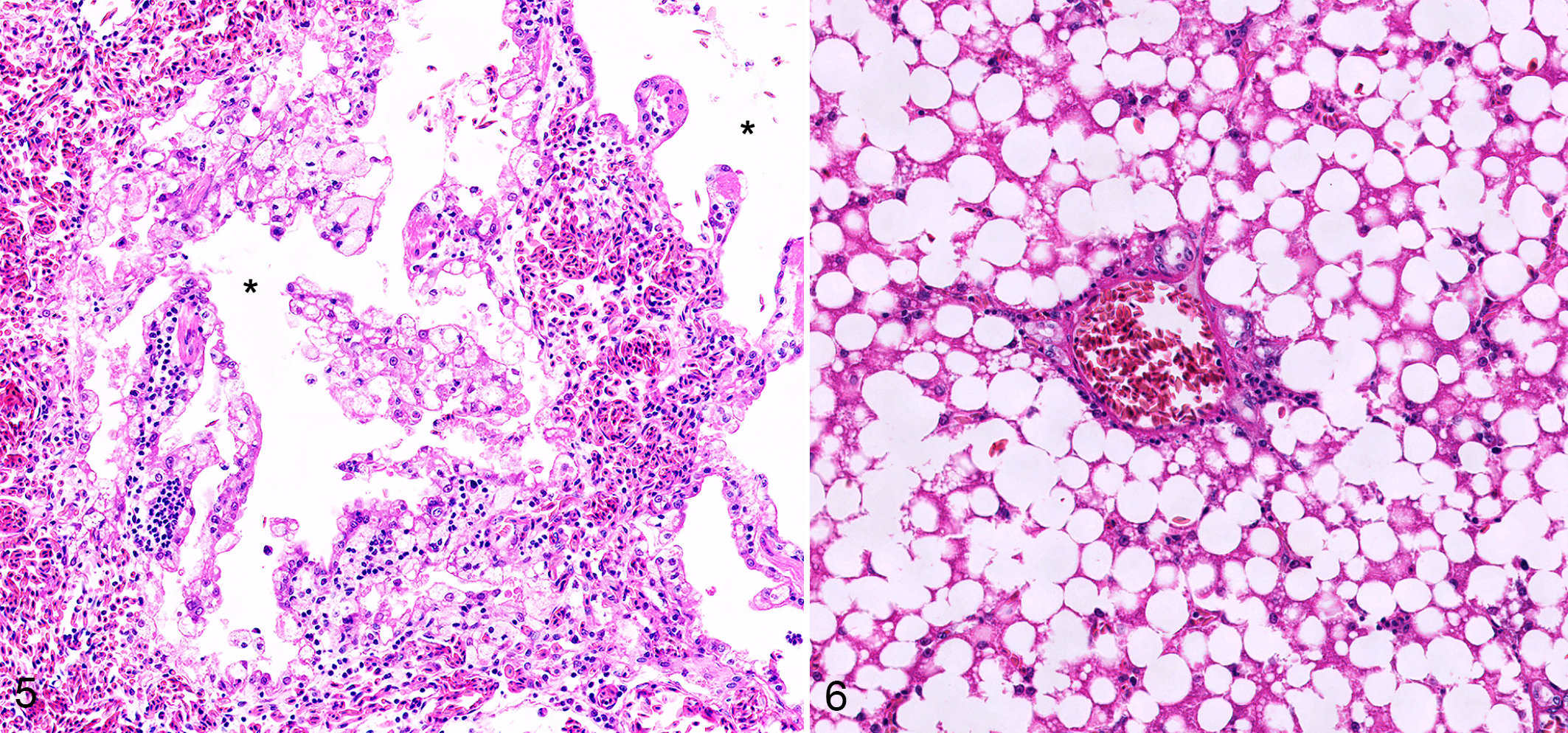
Lipid pneumonia, Quaker parrot. Foamy macrophages with cytoplasmic lipid vacuoles accumulate within parabronchial spaces (asterisks). Hematoxylin and eosin (HE).
Age (OR, 3.9/10 years; 95% CI, 3.7–4.2; P < .001) and male sex (OR, 4.1; 95% CI, 1.3–12.8; P = .018) were found to significantly increase the odds for atherosclerotic lesions, while no significant association was observed between atherosclerosis and reproductive diseases (P = .72) or between atherosclerosis and hepatic lipidosis (P = .23). Controlling for sex and age, Quaker parrots were found to have a similar prevalence of atherosclerosis as other psittacine species (P = .11). For hepatic lipidosis, only male sex was associated with significantly increased odds (OR, 2.4; 95% CI, 1.5–4.1; P < .001). Controlling for sex and age, Quaker parrots were found to have a significantly higher prevalence of hepatic lipidosis than other psittacine species (OR, 4.0; 95% CI, 2.6–6.0; P < .001).
The raw prevalence of hepatic lipidosis was about 3.5 times higher in Quaker parrots (Table 1) than in control psittacine birds, which was 6.0% (95% CI, 4.1%–8.0%). The control birds were shown not to have a sex predisposition for the development of hepatic lipidosis (OR, 0.77; 95% CI, 0.37–1.6; P = .5).
For lipid pneumonia, only age was associated with increased odds (OR, 1.9/10 years; 95% CI, 1.8–2.0; P = .032). There was no effect of age or sex on the odds of xanthomatous lesions, lipomas, or steatitis/steatonecrosis (all P > .05). However, the odds of steatitis/steatonecrosis significantly increased with the concurrent diagnosis of pancreatic necrosis/pancreatitis (OR, 19.8; 95% CI, 8.5–45.8; P < .001) and lipoma (OR, 9.8; 95% CI, 1.6–59.9; P = .013). Half of the adipose tissue tumors (total, 1 liposarcoma and 7 lipomas) had steatitis or steatonecrosis within the neoplastic tissue (4/8, 50.0%; 95% CI, 15.3%–84.7%). Adipose tumors represented 18.2% (6/33; 95% CI, 5.0%–31.3%) of neoplasia diagnosed on necropsy and 30.8% (20/65; 95% CI, 19.5%–42.0%) of neoplasia diagnosed on biopsy submissions.
Most of the pancreatic diseases were diagnosed as acute pancreatic necrosis (48/53, 90.6%; 95% CI, 82.7%–98.4%). Extensive or peripancreatic steatitis was associated with acute pancreatic necrosis in most cases (31/43, 72.1%; 95% CI, 58.7%–85.5%).
Overall, the “lipid accumulation lesions” taken as a group had significantly increased odds of occurring with age (OR, 2.3/10 years; 95% CI, 2.2–2.5; P < .001) and male sex (OR, 2.2; 95% CI, 1.3–3.7; P = .0024).
Discussion
This multicenter retrospective study confirms, using a large sample size, that lipid-related disorders have a high prevalence in Quaker parrots, in particular hepatic lipidosis and steatitis/steatonecrosis. It also reports for the first time a psittacine species in which acute pancreatic necrosis/pancreatitis is common. Interestingly, sex-based risk factors for atherosclerosis and overall lipid accumulation lesions seem to be reversed in Quaker parrots compared to other psittacine species. In other studied species, clinically significant atherosclerotic lesions were strongly associated with female sex. 3 This study strongly suggests that broad generalization of risk factors should not be made, even among closely related avian species, as marked differences may occur and can only be identified with species-specific epidemiological data.
While Quaker parrots are highly susceptible to experimental atherosclerosis and develop extensive lesions after only a few months of feeding a 1% cholesterol diet, 5 the prevalence of spontaneous atherosclerosis lesions was similar to other psittacine species. Within Psittaciformes, the genera Psittacus, Amazona, and Nymphicus have a higher susceptibility to atherosclerosis than average and the genera Ara and Cacatua show an opposite trend. 3 In light of our results, Quaker parrots (genus Myiopsitta) seem to have an intermediate susceptibility to atherosclerosis between these 2 groups of Psittaciformes. Another prominent risk factor for atherosclerosis in Psittaciformes is the presence of reproductive diseases. Quaker parrots were found to have a low prevalence of reproductive disorders, and most reproductive lesions were neoplastic (data not shown). Consequently, this risk factor could not be fully evaluated in Quaker parrots but is suggested to be of low importance compared to other species. The age effect (OR, 3.9/10 years) had a somewhat higher magnitude than in other parrots as the OR of a previous study was 2.22 of 10 years. 3 One limitation to this study as it relates to atherosclerosis is that the histopathological slides with atherosclerotic lesions were not reviewed, and the lesions could not be ranked according to the classification system developed for atherosclerotic lesions in Psittaciformes. 6 In this study, characterization of atherosclerosis relied on the accurate classification of these lesions by each pathologist, and in diagnostic settings, only “clinically significant” lesions (types 4–6) were likely considered and therefore included into the data set. Further epidemiological characterization of spontaneous atherosclerosis considering the severity and types of lesions is warranted in Quaker parrots before drawing definitive conclusions.
Quaker parrots appear to have a very high prevalence of hepatic lipidosis, with about one-fifth of cases showing evidence of hepatic lipidosis on postmortem examination. This prevalence is significantly higher than reported in any other Psittaciformes species and suggests a unique predisposition in Quaker parrots. The pathophysiology of hepatic lipidosis is poorly understood in avian species, but diet seems to be a major risk factor across species. 10,22 In egg-laying chickens, hepatic lipidosis is also strongly associated with vitellogenesis, intensive egg production, and blood estradiol concentration as estrogens drastically enhance hepatic lipogenesis in hens. 1,10 This mechanism is also suspected to occur in other female birds, including in Psittaciformes. 2 However, male sex and not female sex was significantly associated with hepatic lipidosis in Quaker parrots in this retrospective study. A similar trend was found for atherosclerosis and other lipid accumulation lesions, where male sex was a significant risk factor in this species. Therefore, female lipid physiology and its dysregulation are unlikely to be a significant factor in the development of hepatic lipidosis in Quaker parrots, and other causes or risk factors that explain such a high prevalence in this species should be investigated. Effects associated with male hormones are prominent in mammals and should be explored further in parrots. Since this study was retrospective in nature, major risk factors that could be associated with hepatic lipidosis such as diet and concurrent dyslipidemia could not be explored.
The prevalence of acute pancreatic necrosis was uniquely high in our cohort, with 12.9% of birds diagnosed with this lesion on necropsy. These data suggest that acute pancreatic necrosis is much more prevalent in Quaker parrots than in other psittacine species, where it is considered rare. 21 A review of lesions in parrot species other than Quaker parrots from the databases of the 3 pathology centers used in this study only found a handful of cases in several thousand parrots. It is unknown why Quaker parrots are the only psittacine species in which acute pancreatic necrosis is common. This species has higher cholesterol than other psittacine species and is frequently hypertriglyceridemic, and these may be risk factors for acute pancreatic necrosis as is the case in some mammals. 12,23 However, this association will have to be confirmed in further studies. Causes for pancreatitis and pancreatic necrosis in parrots also include zinc toxicosis and various infectious diseases. 21 However, they are unlikely to explain the high prevalence of acute pancreatic necrosis seen in Quaker parrots, as zinc toxicosis and infectious diseases tend to have different histopathological features and usually present less severe lesions (ie, multifocal necrosis and degeneration as opposed to extensive areas of coagulative necrosis). 21
Adipose tumors were fairly common in Quaker parrots, especially on biopsy submissions. Since data from biopsy submissions are heavily biased, a true prevalence cannot be inferred from biopsy data sets. Nevertheless, on necropsy cases, lipomas and liposarcomas represented about 18% of all diagnosed neoplasia. This prevalence is likely similar to other psittacine species, in which lipomas are very common tumors. 8,20 Half of the adipose tumors had evidence of inflammation and necrosis. This is not surprising considering that these tumors are frequently traumatized by the bird or are rubbed or traumatized by perching and cage surfaces.
While this retrospective study reports interesting and unique findings in Quaker parrots, one should interpret them in light of the many biases common in such studies. Most limitations are related to data collection, quality of databases, and missing information. In particular, age and sex were missing at a high frequency, and multiple imputation procedures had to be implemented to prevent deletion bias and loss of information. Multiple imputation procedures may appear counterintuitive to most veterinarians compared to the more generally accepted strategy of excluding incomplete patient data altogether. However, it has been shown to reduce bias and increase efficiency of statistical analysis. 11,14,15 In addition, key risk factors such as diet, lifestyle, and clinical pathologic analytes could not be investigated in this study and may provide more explanations to the reasons for the reported high prevalence of lipid-related disorders in Quaker parrots.
In conclusion, this study documents the high prevalence of acute pancreatic necrosis and lipid-related disorders in Quaker parrots, in particular hepatic lipidosis, for which male Quaker parrots showed increased odds. This study is also a reminder that the epidemiology of common noninfectious disorders is unlikely to be homogeneous in different psittacine species, and species-specific information should be reported because aggregating data may obscure species-specific trends. With this report, clinicians and diagnosticians may now have an increased awareness that Quaker parrots are more susceptible to a wide range of diseases related to lipid dysmetabolism than other psittacine species. Considering the high susceptibility of Quaker parrots to lipid-related disorders, this work also provides further support for the use of Quaker parrots as animal models for the study of atherosclerosis, hepatic lipidosis, dyslipidemia, and other lipid-related disorders.
Footnotes
Acknowledgements
We thank Animal Reference Pathology and Dr. David Gardiner for assistance with microscopic images.
Declaration of Conflicting Interests
The author(s) declared no potential conflicts of interest with respect to the research, authorship, and/or publication of this article.
Funding
The author(s) disclosed receipt of the following financial support for the research, authorship, and/or publication of this article: Part of this research was supported by the OVC Pet Trust.
