




Abstract
The CD44+/CD24– phenotype identifies cancer stem cell (CSC) properties in canine mammary carcinoma (MC); however, the histopathological features associated with this phenotype remain to be elucidated. Here, we determined whether the CD44+/CD24– phenotype was associated with hormonal receptor (HR; estrogen receptor [ER] and/or progesterone receptor [PR]) status and/or triple (ER, PR, and human epithelial growth factor receptor 2)–negative (TN) subtype; conventional histological evaluation was also performed. We found that, as single markers, both CD44+ and CD24+ were associated with less aggressive histological types, low grade, and a non-TN subtype; both markers were associated with HR positivity. On the other hand, a CD44+/CD24– phenotype was associated with higher grade of carcinoma. Therefore, our results suggest that immunohistochemical phenotyping for CD44/CD24 is useful for the evaluation of tumor behavior as well as CSC-like properties in canine MCs.
Cancer stem cells (CSCs) are capable of self-renewal and asymmetric differentiation, a type of plasticity that directly contributes to tumorigenesis, tumor maintenance, and resistance to therapeutics. 13 CSCs in human breast cancer with a CD44+/CD24– phenotype are associated with poor prognosis. 8 Efforts to identify canine CSCs have also revealed a CD44+/CD24– phenotype in mammary carcinomas (MCs). Specifically, spheroids derived from canine MC cell lines in an in vitro CSC model have high CD44 expression but are negative or low for CD24 expression. 3 A previous study reported that the CD44+/CD24– phenotype was detectable in archival tissues; 10 however, the molecular and histopathological features associated with those markers remain to be elucidated. It is suggested that hormone receptor (HR) status (specifically, the estrogen receptor [ER] and/or progesterone receptor [PR]) and the triple-negative (TN) subtype (ER, PR, and human epidermal growth factor receptor 2 [HER2] negative) are associated with aggressive tumor types in canine MCs. 6,7 We hypothesized that immunohistochemical analysis of the 2 markers, CD44 and CD24, would be a useful tool for predicting tumor behavior. The aims of this study were to examine CD44 and CD24 expression, either alone or in combination, with regard to canine MCs. Specifically, we determined the relationship of these markers with histological findings, HR status, and the TN subtype.
Materials and Methods
We investigated 88 cases of canine MCs from the histopathology database of the Department of Veterinary Pathology, Konkuk University Animal Teaching Hospital, Seoul, Korea. Routine hematoxylin and eosin staining and immunohistochemistry (IHC) were performed as previously described. 6 Classification of histological type and grade was achieved as previously described. 4 Double immunostaining for CD44 and CD24 was performed consecutively using immunoperoxidase with DAB for CD44 and immunoalkaline phosphatase with Vector Red substrate for CD24 (Vector Laboratories, Burlingame, CA). Membranous CD44 and cytoplasmic CD24 expression and double-immunostained CD44+/CD24– were deemed positive when more than 10% of tumor cells were labeled. ER, PR, and HER2 immunoreactivity were measured across the whole tumor area as previously described. 6,12 The statistical difference between groups was evaluated using Fisher’s exact test, with P < .05 indicating statistical significance (SPSS for Windows, version 17; SPSS, Inc, an IBM Company, Chicago, IL). Continuous variables were expressed as the mean ± standard deviation and categorical data as frequencies and percentages.
Results
The mean age of the dogs with MCs was 9.84 ± 2.98 years (n = 88). Thirteen cases were from mixed breeds. Seventy-one cases were from 11 purebred dogs and 4 cases were of uncategorized origin. Samples were histologically classified as tubulopapillary (n = 28), complex (n = 30), solid (n = 23), or anaplastic carcinoma (n = 7). Moreover, these samples were classified according to histological grade 1 (n = 43), grade 2 (n = 27), and grade 3 (n = 18). Microscopic lymphatic invasion was detected in 16 cases. Fifty-five of 88 cases were HR positive. The TN subtype was defined in 31 cases.
First, we evaluated immunostains of CD44 and CD24 individually compared with histological findings and molecular biomarkers. CD44+ expression was observed in 65 of 88 cases (73.9%; Fig. 1). Of CD44+ samples, 49 (75.4%) were tubulopapillary or complex types, and 16 (24.6%) were solid or anaplastic types (P = .004). Thirty-seven (56.9%) CD44+ cases were classified as grade 1 tumors and 28 (43.1%; P = .03) as grade 2 or 3 tumors. There was no association between CD44 status and lymphatic invasion. Of the 65 CD44+ samples, 47 (72.3%) were HR+, and 18 (27.7%) were HR– (P = .002). TN subtypes were found in 17 cases (26.2%) of CD44+ samples, with non-TN types comprising the remaining 48 cases (73.8%; P = .005).
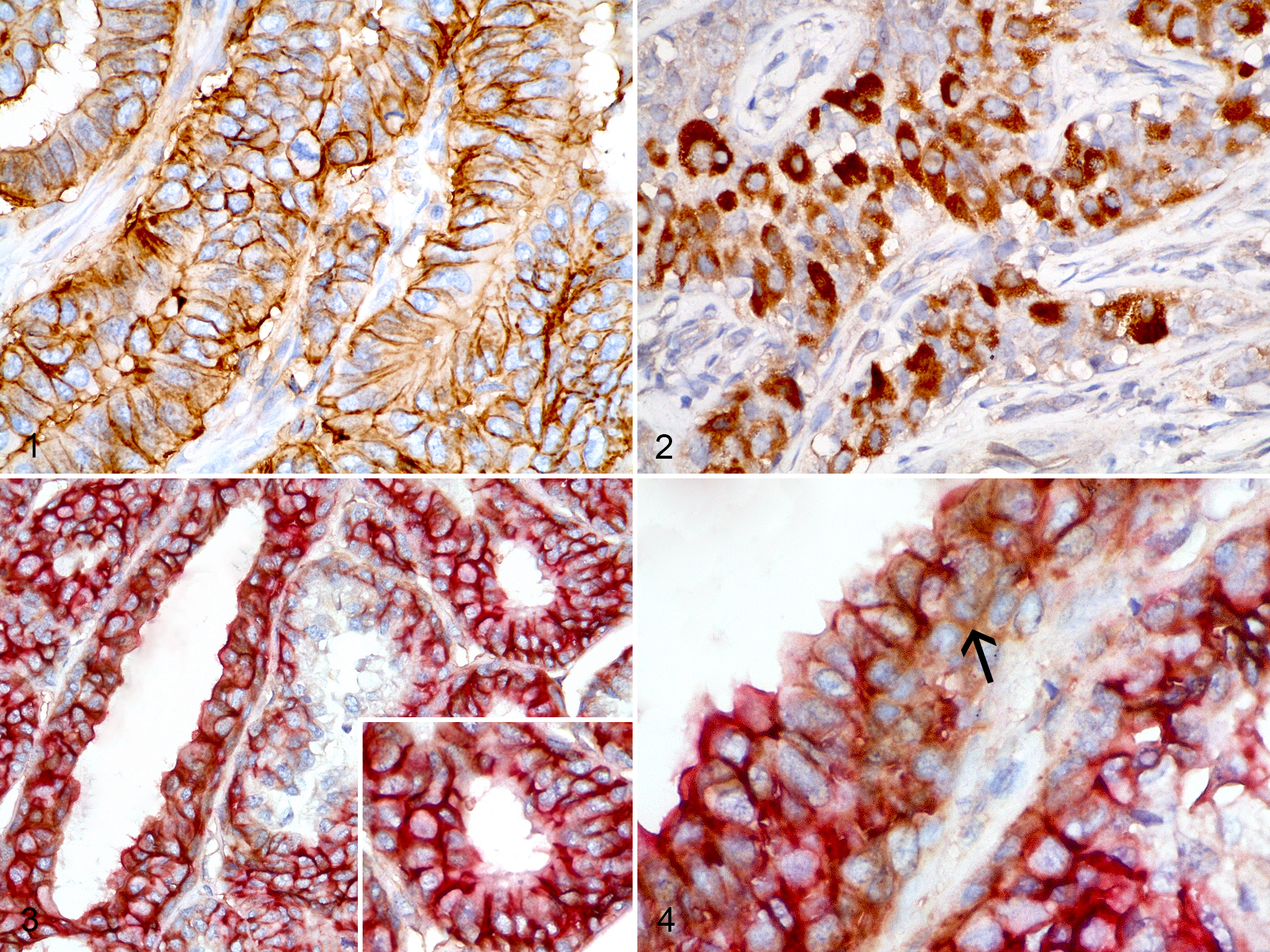
Mammary gland; dog. Immunohistochemistry.
Cytoplasmic expression of CD24 was observed in 58 (65.9%) of the cases (Fig. 2). Among CD24+ samples, 47 cases (81.0%) were tubulopapillary or complex types, and 11 cases (19.0%) were solid or anaplastic types (P < .0001). Thirty-five cases (60.3%) were grade 1 tumors, and 23 cases (39.7%) were grade 2 or 3 (P < .0001). Lymphatic invasion of tumor cells was evident in 6 cases (10.3%), but was not evident in the remaining 52 cases (89.7%) (P = .017). Furthermore, 42 (72.4%) and 16 cases (27.6%) were HR+ and HR–, respectively (P = .011). TN subtypes were found in 14 cases (24.1%) of CD24+ samples; non-TN subtypes accounted for the other 44 cases (75.9%; P = .004). Overall, the results from these histological and immunohistochemical analysis indicate that positivity for either CD44 or CD24 is associated with well-differentiated carcinomas that have less aggressive characteristics.
Next, we characterized the CD44+/CD24– immunohistochemical phenotype to determine whether this CSC-associated type correlated with tumor aggressiveness. The CD44+/CD24– phenotype was detected in 26 tumors (29.5%; Figs. 3, 4). Histological grade 1 tumors were detected in 10 cases (38.5%) of the CD44+/CD24– phenotype, while 16 cases (61.5%) were grade 2 or 3 tumors (P = .037). Notably, 23.3% (10/43) of grade 1 tumors were observed in CD44+/CD24– samples, while 55.6% (10/18) of grade 3 tumors were found in CD44+/CD24– samples. None of the other tested features were significantly associated with the CD44+/CD24– phenotypes. Statistical evaluation of the associations of CD44, CD24, and CD44+/CD24– phenotypes with histological and immunohistochemical features in canine MCs are summarized in Table 1.
Immunohistochemical Expression of CD44, CD24, and CD44+/CD24– Phenotype According to Histological and Immunohistochemical Features (n = 88).
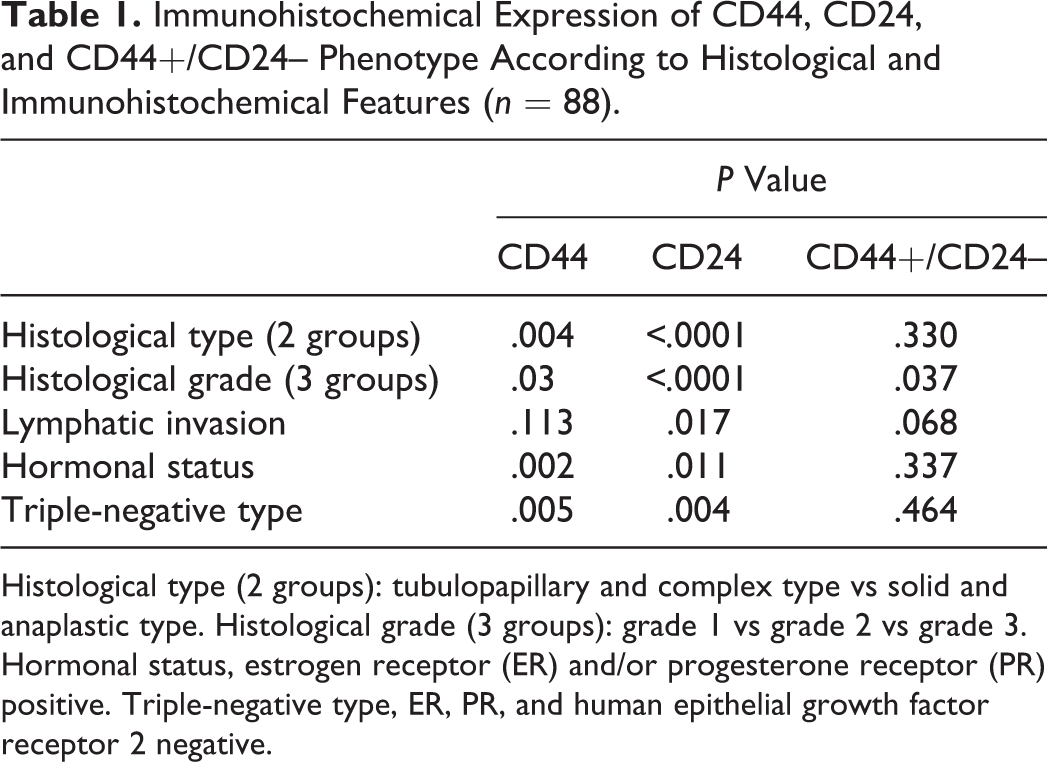
Histological type (2 groups): tubulopapillary and complex type vs solid and anaplastic type. Histological grade (3 groups): grade 1 vs grade 2 vs grade 3. Hormonal status, estrogen receptor (ER) and/or progesterone receptor (PR) positive. Triple-negative type, ER, PR, and human epithelial growth factor receptor 2 negative.
Discussion
In the present study, we demonstrate that both CD44+ and CD24+ are associated with less aggressive tumors, HR positivity, and a non-TN subtype in canine MCs. In contrast, our data showed that the CD44+/CD24– phenotype is associated with higher grade carcinoma. The significance of CD44 as an individual marker has been examined previously in canine mammary tumors; its expression was associated with benign biological behavior and a noninfiltrative subtype in some studies, while others showed that CD44 expression correlated with aggressive histological features and tumor progression. 9 –11 These discrepancies might be due to the different sample cohorts studied, as well as to the usage of different immunohistochemical scoring methods; thus, large sample sizes must be reanalyzed to draw firm conclusions. A recent in vitro study using cultured canine MC cells indicated that CD44 is related more to proliferation rather than as a CSC marker per se. 2 The steroid hormone-related signaling pathways associated with HRs are not only involved in cell proliferation and differentiation but also regulate CD44 transcription during the development of mammary tumors. 5 Our data support the finding that CD44 expression is associated with well-differentiated tumors in an HR status-dependent manner in canine MCs. However, further studies are required to determine the underlying molecular mechanisms that engender this association.
The relationship of CD24 expression to the histopathology of canine MCs is poorly understood. In this study, we revealed that CD24 was associated with well-differentiated histological features and HR positivity in canine MCs. This is consistent with the findings of a previous human breast cancer study in which expression of CD24 was found in HR+ tumors. 1 Thus, future studies are required to evaluate the utility of CD24 expression as a favorable prognostic indicator in canine MCs. The TN subtype has been studied in canine MCs that present a correlation with unfavorable prognostic features. 7 Here, we show that the TN subtype of canine MC was negatively correlated with individual expression of CD44 and CD24, suggesting that the 2 CD markers may be better prognostic indicators.
In addition to evaluation of CD44 and CD24 as individual markers, our study of immunohistochemical double staining strongly supports previous findings that CD44+/CD24– tumor cells show “CSC-like” properties in canine MCs. In a previous study, the CD44+/CD24– phenotype was found in 30% of cases, including grade 2 and 3 carcinomas and metastases. 10 Our results revealed a very similar frequency (29.5%) among the carcinoma samples we studied, which were associated with higher grade. In addition, anaplastic carcinomas were observed more frequently in samples with a CD44+/CD24– phenotype, although this did not reach statistical significance. Together, these data indicate that the CD44+/CD24– phenotype is connected to aggressive tumor behavior. In other words, the CD44+/CD24– phenotype can be reproducibly predicted to be a poor prognostic feature; this is particularly compelling, since the studies not only analyzed disparate sample cohorts that include inconsistent histological types and sample distribution from 2 different geologic regions (South Korea and Brazil) but also used different immunohistochemical methods and analysis. In addition, our current study provides information regarding the relationship of both HR status and TN subtype with CD44+/CD24– expression that will be informative for future studies. We note that, in the absence of functional validation using in vitro and in vivo models of self-renewal, differentiation, and tumor propagation, we cannot categorically state that the immunostaining results confirm that the tumor cells have CSC characteristics. However, identifying the CD44+/CD24– phenotype in a larger sample size could lead to a better understanding of CSC properties that could affect tumor behavior and prognosis in canine MCs.
In conclusion, we show that CD44 and CD24 are associated with well-differentiated cancers as they are HR+, with less aggressive histological features and of a non-TN subtype, whereas CD44+/CD24– is associated with high-grade carcinoma. Thus, we suggest that these markers are appropriate for predicting tumor behaviors and that they strengthen the hypothesis that canine MCs have CSC properties. However, further work is required to determine whether the CD44/CD24 expression is related to clinical outcome in dogs with mammary tumors.
Footnotes
Acknowledgements
We thank Ms R. H. Jang for her excellent technical assistance. This report represents a part of the PhD thesis of Y. G. Jang.
Declaration of Conflicting Interests
The author(s) declared no potential conflicts of interest with respect to the research, authorship, and/or publication of this article.
Funding
The author(s) disclosed receipt of the following financial support for the research, authorship, and/or publication of this article: This study was supported by Konkuk University in 2015.