



Abstract
Mycobacterium avium subsp paratuberculosis (Map) is assumed to infect young ruminants; however, little is known concerning the possibility of adult animals becoming infected. An experimental infection was conducted to establish the effect of age and doses of Map on susceptibility to paratuberculosis in sheep. Sixteen of twenty-four 1.5-month-old Churra lambs and 23 of 30 adult ewes (from 2–11 years old) were orally challenged with an ovine field strain of Map. Thirteen ewes and 8 lambs were infected with a high dose (HD) and 10 adult sheep and 8 lambs with a low dose (LD) of Map. The remaining animals were unchallenged controls. Animals were euthanized at 110 to 120 and 210 to 220 days postinfection. Histological, bacteriological, and nested polymerase chain reaction (PCR) studies were conducted in samples of intestine and related lymphoid tissue (Peyer patches, lymph nodes). Animals were classified according to their lesions. The number of granulomas was counted in 3 tissue sections from each sample. Only the HD groups showed lesions associated with paratuberculosis (92.3% of ewes and 100% of lambs). Adults had lesions characterized by few small demarcated focal granulomas restricted to the lymphoid tissue, whereas granulomas were more numerous and larger, appearing in the lamina propria unrelated to lymphoid tissue, in the lambs. Only HD-infected lambs were positive to culture, whereas nested PCR also detected positive HD ewes and some LD animals. These results suggest that adult sheep can become infected by Map, as seen by the development of lesions, but they are focal and restricted to the lymphoid tissue.
Paratuberculosis or Johne disease is a chronic granulomatous inflammation of the intestine and related lymph nodes caused by Mycobacterium avium subsp paratuberculosis (Map) that affects both domestic and wild ruminants. It occurs worldwide and is responsible for heavy economic losses to domestic livestock industries. This infectious disease is characterized by a long incubation period, which leads to weight loss with or without diarrhea and eventual death. 6
The pathological response of the infected animals varies widely, and different lesional classifications have been established in ovine, caprine, and bovine species depending on the presence, intensity, and distribution of granulomatous lesions as well as the number of bacteria. 10,19,33 Briefly, these pathological forms are divided into focal forms, characterized by small granulomas restricted to the lymphoid tissue of the Peyer patches; multifocal forms, where the granulomas spread into the lamina propria related or not to the lymphoid tissue; and diffuse forms, related to clinical signs, where wide areas of the mucosa are severely affected. It has been proposed that these different pathological responses represent different stages of the disease, where the immunological status of the animal plays an important role. 10,19,33
In flocks with endemic paratuberculosis, it is common to find animals showing focal lesions, similar to those observed in the initial stages of experimental Map infection. 21,31 This observation raised the hypothesis that they could be considered latent lesions of adult animals infected earlier in life or as initial lesions of recently infected adult individuals. 10,19,33
The concept of “age-related” resistance to paratuberculosis has been proposed in bovine 25,32,43 and in red deer, 28 but it has not yet been deeply investigated in other species such as ovine. Several studies carried out in cattle have confirmed that animals become more resistant to the infection as they get older, 20,34,40 but bacteriological and/or histological evidence of infection in adult cattle has also been reported. 15,25,32,34
These findings would be of great importance, as one of the main hygienic measures in paratuberculosis remains the removal of the young animals from their dams within the first months of life to prevent the transmission of Map within them, and these recommendations were based on the assumption that animals become less susceptible to infection as they age. 6,43
Several doses of Map inoculum have already been used in experimental infections, leading to disparate results. Reddacliff and Whittington 36 could not induce any detectable infection in Merino sheep challenged with doses lower than 104 colony-forming units (CFU) of Map, whereas 6 of 12 lambs infected with 103 CFU of Map developed detectable lesions in another study. 31
An experiment was designed to study the role of the age of infection on the pathogenesis of paratuberculosis, where young and adult sheep were experimentally challenged. The first part of the experiment, focusing on the differences in the peripheral immune response, already has been reported. 13 Both the humoral and specific cell-mediated immune responses appeared earlier and more intensely in the adult sheep than in the lambs, probably due to previous contact with Map or other mycobacteria, whereas the Map-challenged lambs showed a more immature immune response, unable to control the progression of the infection. 13
The main objective of the present work is to study and characterize the pathological response of Map infection in the same experiment, by comparing the differences observed in the pathological evolution of these experimentally infected lambs and ewes and evaluating the severity of the lesions with a detailed count of the granulomas formed. The effect of the challenge inoculum dose in the establishment and developmental stage of the lesions in these animals is also assessed.
Materials and Methods
Experimental Animals
Thirty adult ewes 2 to 11 years old (73.3% of them 6–9 years old) as well as 24 one-month-old lambs of the Churra breed were used in this study. All of them were randomly selected from a flock without clinical cases of paratuberculosis in the past 5 years and in which no vaccination against paratuberculosis was practiced before. 13
After a period of adaptation once in the experimental facilities of the University of León, the animals were housed in separate barns to prevent direct contact between the groups. Both adult and young ovine were randomly divided into 3 groups: one infected with the high dose of Map inoculum (HD group; n = 13 ewes and 8 lambs), the second one with the low dose (LD group; n = 10 ewes and 8 lambs), and a third group of uninfected control animals, challenged with saline solution (n = 7 ewes and 8 lambs). None of the sheep was bred during the experiment. Animals followed a diet based on commercial feed appropriate for each age.
Map Inoculum
The strain of Map used in this study was isolated from intestinal (ileal) mucosa scrapings of 3 sheep from the same flock, all clinically affected with paratuberculosis and shedding large number of bacilli, using the Ratnamohan and Spencer 35 technique with slight modifications consisting of the elimination of deoxyribonuclease and lysozyme treatments. Briefly, samples of ileum were rinsed with phosphate-buffered saline (PBS), and the mucosal surface was removed from the submucosa by scraping. Then, 20 g of tissue was mixed with 2 ml of a solution containing 150 mg/ml ampicillin (Sigma-Aldrich, Madrid, Spain) per 5 g of mucosa and homogenized using a tissue grinder. The suspension was digested with a solution with 1% trypsin (Sigma-Aldrich) in PBS (pH 7.5–8) at 23°C for 30 minutes. Finally, and after centrifugation, the sediment was resuspended in 10 ml PBS.
The field strain of Map was then determined to be IS900 positive by polymerase chain reaction (PCR) 18 and typed as an “ovine” strain by IS1311 PCR-restriction enzyme analysis. 38 Subsequently, the inocula were subjected to culture on 7H11 and Löwenstein-Jensen medium supplemented with mycobactin J (Allied Monitor, Fayette, MO) as described previously, 13 leading to counts of 4 × 10⁶ CFU Map/ml for the high-dose suspension and 1 × 10² CFU Map/ml for the lower dose. For ease of understanding, these 2 different doses hereafter will be referred to as the higher dose (HD) and lower dose (LD) inoculum of Map.
Each challenged animal received a 40-ml oral dose of the respective inoculum, divided into 4 doses of 10 ml administered at 3-day intervals.
Experimental Design
The experimental procedures were performed in accordance with Spanish Royal Decree 1201/2005 for the protection of animals used for experimental and other scientific purposes.
At 110 to 120 days postinfection (dpi), 6 ewes and 3 lambs from the HD group, 4 ewes and 3 lambs from the LD group, and 2 ewes and 3 lambs from the control group were humanely euthanized by intravenous injection of a veterinary euthanasia drug (T61; Intervet, S.A., Salamanca, Spain), followed by exsanguination. The remaining animals were euthanized at 210 to 220 dpi.
Pathological Studies
Complete necropsies were performed, and tissues were grossly inspected with special attention to the gut and related lymph nodes. Samples for histopathologic examination consisted of ileocecal valve (ICV), ileum (IL) (three 5-cm samples, taken 20, 40, and 60 cm from the ileocecal valve), jejunum (JJ) and jejunal Peyer patches (JPP) (at least 3 patches from each of the proximal, medium, and distal zones), the caudal mesenteric lymph node (MLN), 1 jejunal lymph node (JLN), and ileocecal lymph nodes (ICLN). All these tissues were fixed in 10% neutral buffered formalin and processed to routine histological sections that were stained with hematoxylin and eosin (HE) and by the Ziehl-Neelsen (ZN) technique for acid-fast bacilli (AFB) and examined by light microscopy for histological changes.
For the immunohistochemical study, selected sections having representative granulomatous lesions were immunolabeled using an EnVision + HRP visualization kit (Dako North America, Carpinteria, CA). The sections were incubated with specific rabbit anti-Map serum at a dilution of 1/9000. This polyclonal primary antibody was kindly gifted by Dr Balseiro, from SERIDA (Gijón, Asturias, Spain), and previously used in bovine 3 and fallow deer. 2 Technique specificity was controlled by omission of the primary antibody and substitution by a normal rabbit serum, omission of the EnVision polymer, and omission of diaminobenzidine. All these controls gave negative results. To evaluate the specificity of the anti-Map antibody, tissue samples of ileum from a sheep with clinical paratuberculosis were used as positive controls.
All the lesions observed in the digestive tract were classified following the guidelines previously proposed by Pérez et al 33 for paratuberculosis lesions in the ovine species, according to the presence and location of the granulomas in the different gut-associated lymphoid tissue compartments and the number of AFB detected by ZN. Sections were blinded and scored by the same observer into 5 categories, according to the amount of AFB and Map antigens present in the lesions: 0 (no AFB or Map antigens), +/– (doubtful presence of bacteria), + (solitary or very few bacteria), and +++ (high load of AFB or Map antigens in the cytoplasm of the macrophages).
Granuloma Count
After the conventional histopathological examination, the number of granulomas per tissue section was quantified in different areas of the intestinal tract and related lymph nodes. For this purpose, 10 different intestinal sites were studied (ie, the ICV) and 3 samples of the IL, JJ, and JPP (proximal, middle, and distal). Three different lymph nodes (MLN, JLN, and ICLN) were also analyzed. Three tissue sections were randomly selected from each intestinal site and 2 tissue sections from each lymph node, so that a total of 30 intestinal and 6 lymph node tissue sections were examined from each animal. Sections were blinded, and the mean number of granulomas per tissue section in each site was recorded by the same observer, distinguishing those granulomas located in the lymphoid tissue from those in the associated lamina propria (LP) or in the mucosa not related to lymphoid tissue.
Tissue and Fecal Culture
Fecal samples were taken at 15 and 90 dpi, as well as on the day of the scheduled postmortem examination, from each animal. They were frozen at –20°C until cultured for Map. Bacteriological studies were also carried out from tissue samples of the ICV, a 5-cm sample of the distal ileum (dIL) and of the medial jejunum Peyer patch (mJPP), and a piece of the caudal MLN. Two grams of tissues or feces was processed for culture onto tubes containing Löwenstein Jensen and Middlebrook 7H11 solid medium, supplemented with mycobactin J and previously decontaminated with hexadecylpyridinium chloride (Merck, Darmstadt, Germany), as described by Aduriz et al. 1 The procedure is explained in detail in a previous publication. 13
Nested PCR
A nested PCR method was performed from paraffin-embedded tissues. In total, 10 μm of ICV, dIL, mJPP, and MLN tissue sections adjacent to those used for the immunohistochemical study was cut twice, and the nested PCR was carried out as previously described, 13 using primers to detect the presence of Map-specific IS900 DNA.
Statistical Analysis
Data on granuloma count were subjected to analysis of variance using the general linear model procedure of the SAS statistical package (version 9.1; SAS Institute, Cary, NC) for the evaluation of age, treatment, time of killing, and location main effects and interactions. Previously, tissue section granuloma count figures were logarithmically transformed to submit them to normal distribution-based tests of significance. Thus, the mean numbers of granulomas per tissue section were compared among the groups at each time of killing using the Student t test for pairwise comparisons with the Tukey-Kramer correction for multiple comparisons, at the 95% significance level. Group PCR-positive frequencies were compared and tested for significance by χ 2 analysis.
Results
Three animals died during the course of the experiment from causes unrelated to Johne disease (1 ewe and 1 lamb from the uninfected control group and 1 ewe from the LD group) and were excluded from this study.
Pathological Findings
No clinical signs or gross lesions related to paratuberculosis were seen in any of the animals during the whole experiment.
Microscopically, lymphoid tissue was always found in all the ileum samples from the lambs, besides the ICV and JJP samples. In the ewes, no lymphoid tissue was detected in the samples taken from the ileum, at any level.
When examined histologically, granulomatous lesions typical of paratuberculosis were only found in the tissue sections from the HD groups, regardless of the age of infection (ewes and lambs). However, the type of lesion varied between adult sheep and lambs.
Among the HD-challenged lambs, all 8 animals (100%) showed histologic changes consistent with paratuberculosis. Lesions were classified in several categories, according to their location and pathological features, following the guidelines provided by Pérez et al. 33 For categorizing each animal, the final classification was based on its more severe intestinal granulomatous lesion.
Focal lesions appeared in 2 HD-infected lambs. They were composed of small, well-defined granulomas formed by homogeneous macrophages with a large pale cytoplasm, large nuclei, and scattered with a few lymphocytes within them, and they were found exclusively restricted to the interfollicular area of the Peyer patch lymphoid tissue (Figs. 1, 2). In some areas, these granulomas were coalescent and partially altered the normal structure of the Peyer patches. Lesions considered multifocal a were detected in 2 other HD-infected lambs. In this case, granulomas were more numerous and larger in size, and besides those seen in the lymphoid tissue, granulomatous lesions were also detected in the LP always related to the Peyer patch lymphoid tissue (Fig. 3). In the last 4 lambs, lesions were classified as multifocal b. In them, many granulomas were also found in the LP not related to the lymphoid tissue, invading and thickening the apex of the villi, and in the more severely affected areas, they partially disrupted the normal architecture, causing the enlargement of the villi with separation of the intestinal glands (Fig. 4). In those cases, the granulomas were not very well demarcated from the adjacent tissue.
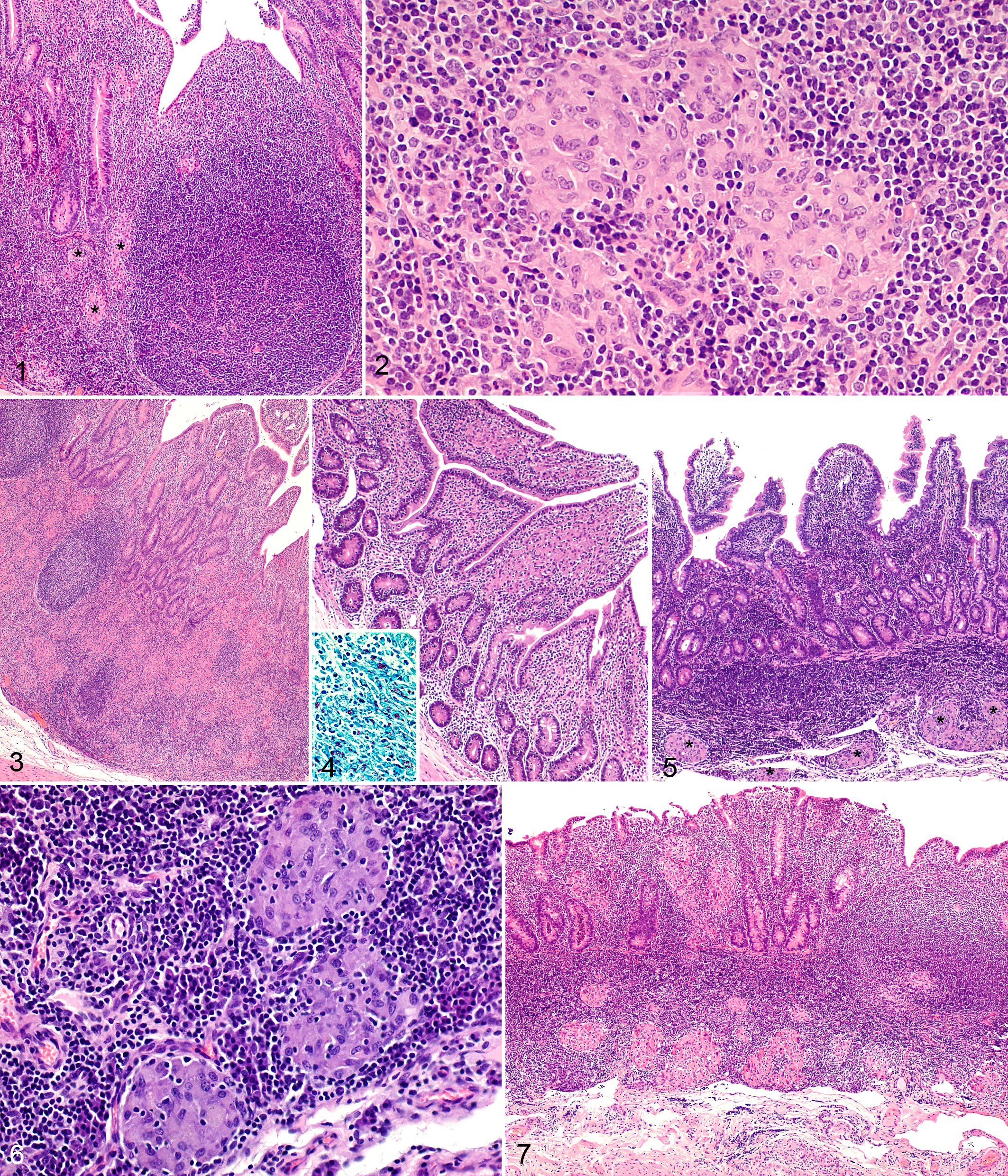
Jejunal Peyer patch, high-dose (HD)–challenged lamb. Focal lesion composed of small granulomas (*) exclusively located in the interfollicular area of the Peyer patch lymphoid tissue. Hematoxylin and eosin (HE).
Among the HD-challenged ewes, 12 of 13 animals (92.3%) showed microscopic changes consistent with paratuberculosis. Eleven of the sheep had focal lesions, with granulomas restricted to the intestinal lymphoid tissue of the ileocecal and jejunal Peyer patches, mostly in its basal area. In contrast with the lambs, the granulomas were fewer, smaller, round shaped, and well defined from the adjacent tissue (Figs. 5, 6). No differences were observed in the type and intensity of the lesions among the ewes, irrespective of their age. Only 1 sheep showed multifocal a lesions, with a few granulomas located in the mucosa adjacent to the lymphoid tissue of the ileocecal and distal jejunal Peyer patches (Fig. 7). This adult sheep also showed a mild granulomatous lymphangitis in the serosa of the ileocecal valve.
When considering the time of euthanasia, 2 of the 3 lambs examined at 110 to 120 dpi had multifocal b lesions, and the remaining one was classified as multifocal a. All the sheep showed focal forms except for 1 that had no lesion. At 210 to 220 dpi, multifocal b lesions were seen in 2 lambs, focal lesions in 2, and a multifocal a form in the remaining animal. Among the sheep, all but 1 (with a multifocal a lesion) showed focal forms.
In those 4 HD-challenged lambs with the more severe intestinal lesions (multifocal b), granulomatous lesions were also seen in the ICLN and MLN, especially spread throughout the interfollicular and paracortical areas, with a multifocal distribution. In these locations, granulomas were numerous and coalescent, formed by 20 to 100 macrophages with a large pale cytoplasm, morphologically similar to those observed in the intestine.
On the contrary, the ewes and lambs with focal intestinal lesions only occasionally showed a focal granulomatous lymphadenitis characterized by a few small granulomas composed of less than 10 macrophages, scattered within the interfollicular part of the cortical area of some MLN.
No AFB or Map antigens were detected in any of the control or LD-challenged animals or in the HD-infected ewes. However, different grades of bacterial load were demonstrated in the HD-infected lambs by ZN or IHC, varying from hardly any AFB or Map antigens in the intestinal focal lesions (grade +), to a scant positivity by both techniques in the multifocal a lesions (grade ++), and to the highest bacterial load in the multifocal b lesions (grade +++), especially in the mucosa of the ileal and jejunal Peyer patches (Fig. 4). Only occasional AFB or Map antigens were appreciated in the MLN or ICLN from 3 HD-infected lambs with multifocal b lesions.
Granuloma Counts
The mean granuloma counts corresponding to the different intestinal compartments examined in the lambs and ewes at 110 to 120 dpi and 210 to 220 dpi are shown in Fig. 8. Variability among individuals of the same group was observed. The statistical analysis showed that the total mean number of granulomas was significantly higher in the lambs (85.55) than in the ewes (19.37) at 110 to 120 dpi (P < .01) and also at 210 to 220 dpi (42.05 vs 24.03, respectively) (P < .05). It is worth highlighting that granulomatous lesions in the LP were only detected in the lambs, whereas in the ewes, granulomas were only observed in the lymphoid tissue (except for 1 adult sheep). In the lambs, a significant decrease was noted in the number of granulomas located in the lymphoid tissue from 110 to 120 dpi and the end of the experiment (P < .05), whereas those located in the LP slightly increased. However, the number of granulomas in the organized lymphoid tissue remained similar in the ewes within the same period (Fig. 8).
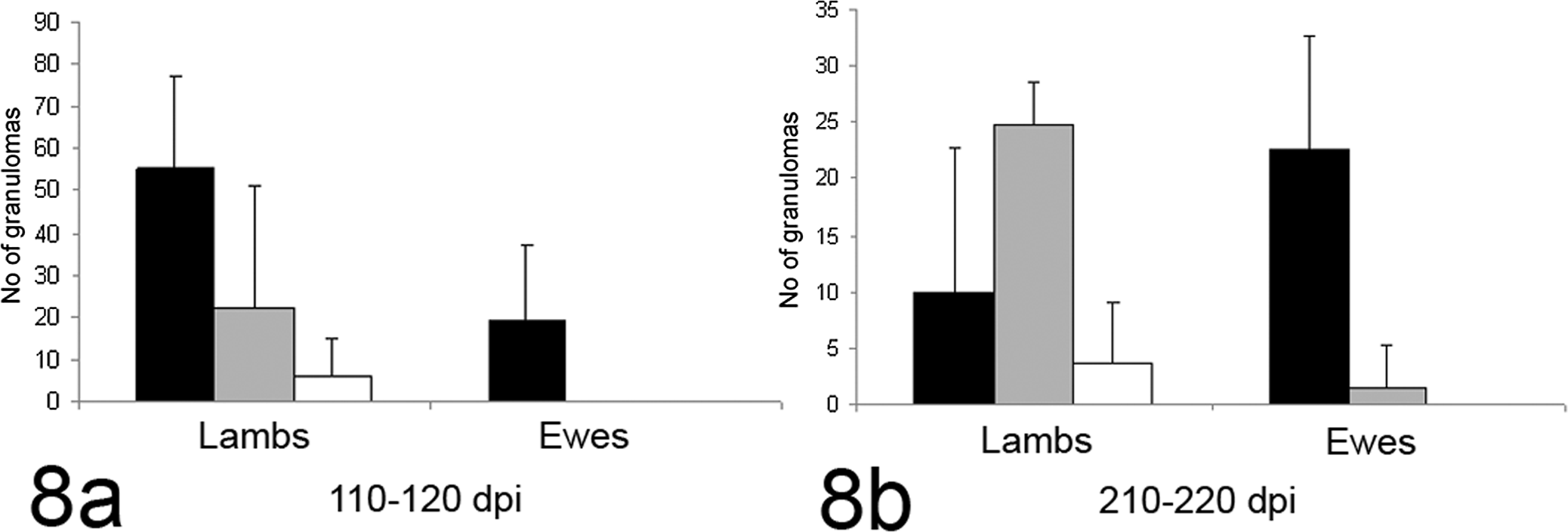
Count of granulomas from the tissues of the high-dose–infected lambs and ewes euthanized at 110 to 120 dpi (a) and 210 to 220 dpi (b). Mean number of granulomas per animal, corresponding to their location in the different intestinal compartments. dpi, days postinfection. Error bars: standard deviation. Peyer patch (PP) lymphoid tissue= black column. Lamina propria (LP) associated with PP= grey column. LP not associated with PP=white column.
When considering the lesions in each different intestinal site examined (Fig. 9), the mean number of granulomas per tissue section was always higher in the lambs compared with the ewes, especially in the mJPP and in the IL (P < .05). Although granulomas appeared to be slightly more numerous in the ICV in the ewes than in the lambs (Fig. 9), differences were not statistically significant. In both adult and young animals, most of the granulomatous lesions were associated with the lymphoid tissue in the JPP, IPP, or the ICV (Fig. 9). Specifically, in the ewes, the granulomas were significantly more numerous in the ICV than in the rest of the lymphoid tissue (P < .05). Concerning the lambs, the granuloma count was higher in the mJPP compared with the remaining JPP or IPP (P < .05), but no differences were detected with the ICV.
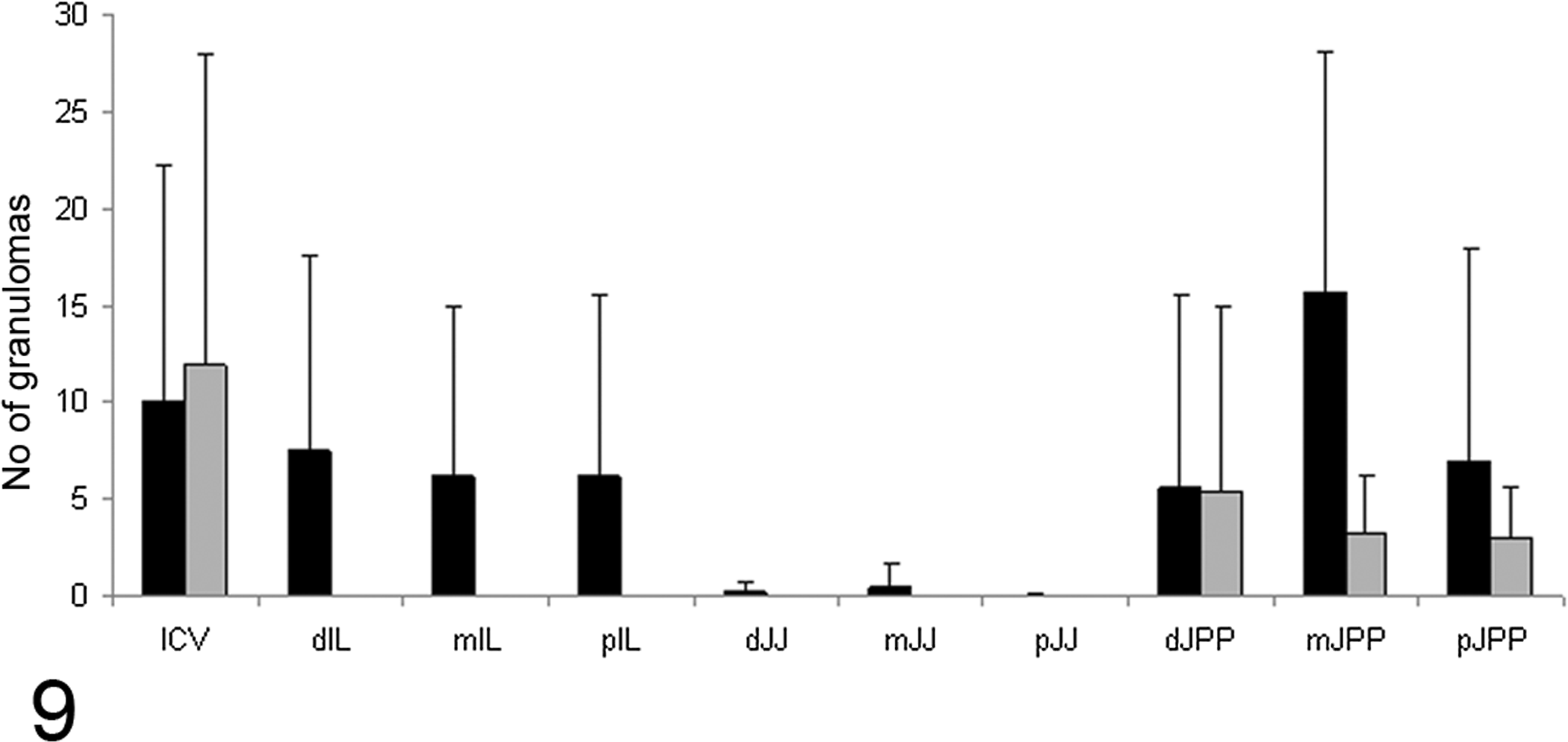
Total granuloma count from the tissues of the high-dose–infected lambs and ewes, regardless of the time of slaughter. Mean of the total number of granulomas per section and animal, according to their intestinal location. ICV, ileocecal valve; IL, ileum; JJ, jejunum; JPP, jejunal Peyer patches. d, distal; m, medium; p, proximal. Error bars: standard deviation. Lambs= black column. Ewes= white column.
In addition to the lesions in the intestine, some granulomas were also noted in the associated lymph nodes. These were more numerous in the lambs than in the ewes (P < .05) and were counted more frequently in the MLN, in both the adult and young animals.
Fecal and Tissue Culture Results
No isolations from feces were obtained at 15 or 90 dpi. The only positive feces cultures were isolated on the day of the postmortem examination from 4 of the 8 HD-infected lambs, 1 euthanized at 110 to 120 dpi and 3 at 210 to 220 dpi. Apart from 1 lamb classified as focal (euthanized at 210–220 dpi), the 3 others had multifocal b lesions, with high bacterial load in the intestine.
All the tissue samples from the control, the LD group, and the HD-infected ewes remained negative (Table 1). Instead, mycobacteria were isolated, only in 7H11 medium, from the dIL and/or ICV of 4 of the 8 HD-infected lambs: 1 multifocal b animal, euthanized at 110 to 120 dpi, and 3 euthanized at the end of the experiment, 1 with multifocal b lesions and the 2 others with focal lesions. All but 1 of these animals were also positive in the fecal samples.
Number (%) of Animals Positive to Map Detection by Culture and by Nested PCR (n-PCR)a
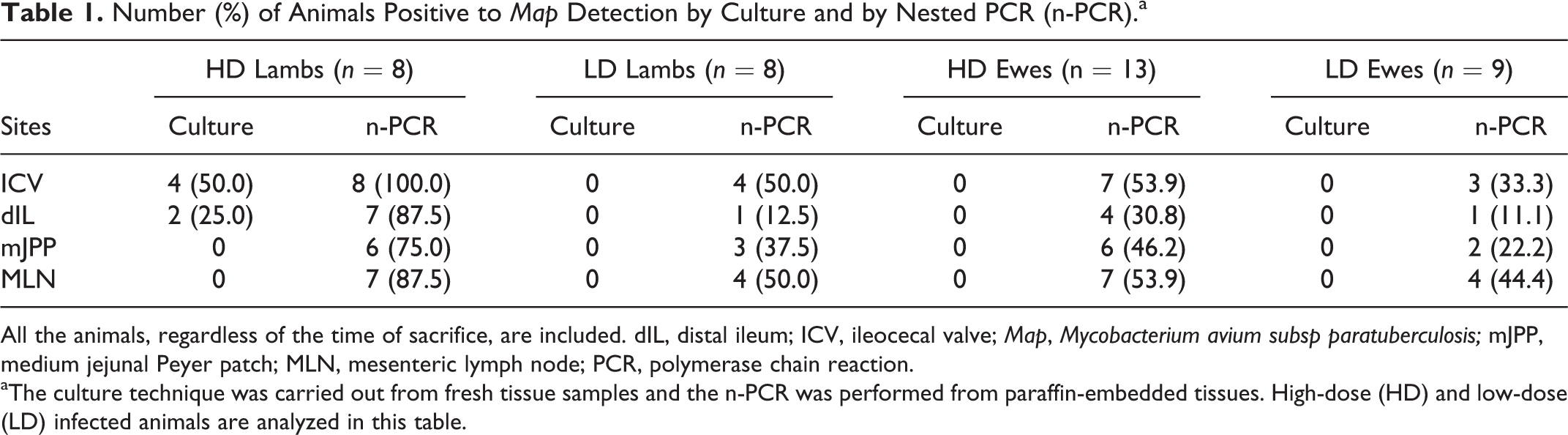
All the animals, regardless of the time of sacrifice, are included. dIL, distal ileum; ICV, ileocecal valve; Map, Mycobacterium avium subsp paratuberculosis; mJPP, medium jejunal Peyer patch; MLN, mesenteric lymph node; PCR, polymerase chain reaction.
aThe culture technique was carried out from fresh tissue samples and the n-PCR was performed from paraffin-embedded tissues. High-dose (HD) and low-dose (LD) infected animals are analyzed in this table.
Nested PCR
IS900 Map-specific sequence was demonstrated by nested PCR in all 8 HD-infected lambs (100%) from at least 2 of the 4 studied tissue sections (Table 1). The ICV was positive in all these cases. Seven of the 8 LD-challenged lambs (87.5%), in which no granulomatous lesions were detected in any of the examined tissue sections, were also positive from at least 1 tissue section. The negative lamb was euthanized at 110 to 120 dpi.
Map DNA was also detected in 12 of the 13 HD-infected adult sheep (92.3%) in at least 1 tissue section. The negative sheep was examined at 210 to 220 dpi and showed a focal lesion. ICV and MLN were the most frequent tissue sites with a positive result, although differences were not statistically significant (Table 1). Among the LD-infected ewes, in which no histological lesions were appreciated, the IS900 sequence was demonstrated in 7 of the 9 animals (77.8%) from at least 1 tissue section. Negative ewes were euthanized at 210 to 220 dpi.
All analyzed tissue sections from the uninfected lambs and ewes were negative to PCR.
Discussion
According to the results of this study, the experimental inoculation with Map was able to infect both the ewes and lambs, but detectable lesions and immune response 13 were observed only in those animals challenged with a high dose of the mycobacteria. Adult HD-infected sheep developed lesions consistent with Map infection, with clear differences in the pathological features when compared with the HD-infected lambs. Several studies have reported the presence of focal lesions in adult sheep, similar to those found in our study, considered to be latent lesional forms originating from infections that took place early in the life of the animals. 10,17,19,33 Although this possibility cannot be completely ruled out in this study, the fact that these focal lesions were not found in the LD-challenged ewes or in the controls would indicate that these granulomas would be rather the direct consequence of the dose of Map challenge or the short duration of the examination period.
Lesions consistent with paratuberculosis were found in 12 of the 13 (92.3%) adult sheep infected with a high dose of Map, associated with a specific peripheral immune response. 13 However, no similar lesions or an immune response were detected in any of the ewes from the control uninfected group, suggesting that adult sheep, older than 2 years of age, can get infected with high doses of Map. In bovine, it was shown that calves older than 4 to 6 months were more resistant to the infection with Map, 20,40 although other studies have also found that Map was able to cause lesions in cattle experimentally infected, older than 3 years 32 and even with a 9-year-old, 25 although the lesions were more restricted than in the young calves infected under the same conditions. 25,32 These findings would be in agreement with our results. In sheep, no experimental studies have been carried out to date, but in a longitudinal field study, it was shown that sheep exposed to Map as lambs had higher odds to shed Map and to develop more severe lesions than those exposed for the first time as adults. 30
The development and features of the lesions in the HD-challenged groups were different between lambs and ewes. In the latter, the lesions were, in most cases, classified as focal, always restricted to the intestinal lymphoid tissue, but small, round shaped, and well defined, even with initial fibrosis, suggesting a regressive character. Similar granulomas have also been described in vaccinated animals. 21 On the contrary, in the HD-infected lambs, the granulomas were more numerous, larger, and spread into areas of the mucosa related or not (multifocal a or b lesions) to this lymphoid tissue. This fact has been related to more advanced stages of the infection. 10,19,21,33 This is confirmed in our study by the marked decrease in the number of granulomas found in the lymphoid tissue from 110 to 120 and 210 to 220 dpi, whereas those in the LP partially increased (Fig. 8), as well as by the high mycobacterial load, evaluated by ZN and IHC, in the multifocal b lesions.
Payne and Rankin, 32 in an experimental infection of adult and young cattle, found that granulomatous lesions were fewer and better demarcated in adult animals than in calves at 4 and 6 months postinfection (mpi); however, in a previous postmortem examination carried out at 2 mpi, lesions were more severe in the adult animals. It was then hypothesized that paratuberculosis infection could have reached its higher development in the adults at 2 mpi, but their immune response could have been able to react more efficiently and control the progression of the lesions more quickly, unlike what happened in the calves. 32,34 Although in our experimental design, the animals were not examined until 4 mpi (110–120 dpi), and thus it is not possible to compare both studies, the fact that granulomatous lesions were focal and well demarcated in the adult sheep, together with the earlier and more intense peripheral cell-mediated immune response mounted by the ewes compared with the lambs, 13 would further support this hypothesis.
One feasible factor that could explain the higher resistance of the adult animals could be the previous expositions to mycobacteria in the adult sheep. Sensitization experimented by the immune system of the animals after previous and repeated contacts with the mycobacteria, its antigens, or some other environmental mycobacteria would induce a better specialization of the immunologic response. 14,32 Animals vaccinated against paratuberculosis develop granulomas similar to those seen in the adult sheep and have been shown to be more resistant to Map infection, 21 further supporting this hypothesis. In our study, the ewes came from a flock considered free of this disease, although the absolute lack of mycobacteria in the environment cannot be ensured since distribution of Map is widespread. 16 Moreover, some of the ewes used in this study were especially old (between 9 and 11 years old), increasing the probability of previous contacts with different mycobacteria, although no differences were seen in the type and intensity of the lesions in comparison with the rest of the ewes. Differences in the amount and functionality of the intestinal lymphoid tissue between lambs and adults 27,37 also could have played a role in the higher resistance of adult ewes to Map infection.
This study also emphasizes the importance of the intestinal lymphoid tissue in the establishment of paratuberculosis infection since most of the granulomatous lesions were detected in this area, as has been reported in previous studies using young animals. 21,23,24,33 Furthermore, in this study, this finding has been observed in both lambs and ewes, leading to the conclusion that the Peyer patches would be the primary portal of entry for Map infection, regardless of the age and their degree of development. The functional differences in the intestinal lymphoid tissue between young and adult sheep have not been deeply investigated, but some reports 27,37 describe that ileal lymphoid tissue suffers a marked involution as it ages, and the remaining follicles show increased numbers of T and B cells in the follicle and prominent intrafollicular T-cell areas, predominantly harboring CD4+ lymphocytes. Thus, although further investigation on this topic would be needed, it is likely that these differences in the lymphoid tissue between young animals and adults could have played a role in the different evolution of the lesions.
Regarding the location and intensity of granulomatous lesions, the granuloma count showed individual variability. The considerable between-animal variation in pathology has already been reported as a typical feature of natural and experimental paratuberculosis. 4,24,31 In our study, the ICV lymphoid tissue was more frequently affected in the ewes, whereas the lesions predominated in the medial JPP in the lambs (Fig. 9). These 2 areas have already been reported to be some of the most frequently affected in previous studies in small ruminants. 10,17,33,41 Some morphological and lymphocyte distribution similarities have been reported between ICV and JPP, compared with IPP, 11,41 suggesting that they could have had an influence on the higher presence of lesions in the ICV and the JPP than in the IPP. On the other hand, whereas the ICV is equally affected in all the animals, lesions appear more frequently in the mJPP in the lambs but not in the ewes. This could indicate a different functional pattern between both lymphoid tissues depending on the age of the animal, as it has been already seen to occur in pigs. 26 These possible functional differences between the 2 sites could explain the fact that lesions were more easily detected in the ICV than in the JPP despite the similar level of Map DNA detection by nested PCR in both locations. According to our findings, apart from the ICV, the sensitivity of the histological diagnosis of paratuberculosis would be more efficient if samples from the JPP were also taken, especially from the medial zone.
The predominance of initial lesions in the ileocecal lymph nodes or caudal mesenteric lymph node is an already known fact in bovine 19,25 or deer. 2,7 However, in our study, the lymph node involvement was less severe than in the intestinal lymphoid tissue. In the lambs, the granulomas were only found in the caudal mesenteric lymph node when granulomas were seen in the lamina propria (multifocal b lesions). These findings are in agreement with other studies in ovine, in which the initial lesions were reported to be established first in the intestinal lymphoid tissue and would not be detected in the related lymph nodes until the infection had progressed to more advanced stages. 17,21,33
Only 1 ewe (9 years old at the moment of infection) showed multifocal lesions, with some granulomas located in the LP, suggesting that the infection could have progressed to more advanced forms. Although it cannot be completely ruled out that similar lesions could have been missed in the other ewes, it is tempting to speculate that the immune response in this particular sheep, due to individual factors, could not have been able to control the progression of Map, with the subsequent formation of a higher amount of granulomas and their spread to the LP. It is worth highlighting that the peripheral immune response of this animal did not differ from its counterparts in the group.
No granulomatous lesions consistent with paratuberculosis were observed in any of the ewes and lambs infected with a low dose of Map. Nor was any Map colony isolated from the tissues or feces of these animals, although Map DNA was identified by nested PCR. Besides, the peripheral immune response, evaluated by the specific interferon (IFN)–γ production, was similar to that from the control group. 13 These results indicate that the establishment of an infection and the formation of granulomatous lesions is directly dependent on the infectious dose. This hypothesis has already been suggested by other authors, who established a correlation between the amount of the dose received and the severity of the infection induced, in ovine, 5,30,31 bovine, 39 or red deer. 29 Reddacliff and Whittington 36 reported that doses below 104 CFU were not high enough to induce a histologically and bacteriologically detectable infection in Merino sheep, although other authors have found evidence of infection using a dose of 103 CFU. 5,31 These discrepancies could be caused by the different strains of Map used in these studies, since variation on the pathogenicity depending on different Map strains has already been reported. 42
The detection of nucleic acids of Map by nested PCR in lambs and ewes from the LD-infected group was an interesting finding. Map DNA was not detected by this technique in the control animals, so it seems likely that the mycobacteria had invaded the tissue of the animals after the experimental administration of the lowest dose but were not able, at least until 210 dpi, to trigger an immune response or cause lesions detectable by the methodology used here. In our study, if the length of the experimental infection had been prolonged, the ewes and lambs from the LD-challenged group might have ended up developing a cell-mediated immune response detectable by IFN-γ production and even some lesions. Finally, the possibility cannot be ruled out that, in this group, an initial infection might have been established, but the affected animals could have been able to overcome it and recover before 110 to 120 dpi, although this alternative seems unlikely.
AFB and Map antigens were only clearly identified by ZN and IHC in the intestine from the HD-infected lambs with multifocal lesions, characterized by the presence of granulomas in the LP. The low sensitivity of both techniques in focal paratuberculosis lesions, located in the lymphoid tissue, has already been reported in previous studies and is mainly explained because of the low amount of AFB in these types of lesions. 10,17,19,22,33 It should also be remarked that the ZN technique can only stain those AFB with an intact cell wall and thus is unable to detect the bacillus present in its cell wall–deficient form or as spheroplasts. 9 However, this possibility seems unlikely as the IHC labeling, which is assumed to be able to detect degraded or previously digested forms of the bacilli, 8,12,22 did not identify any Map antigen in the focal lesions from this study.
This study has determined that adult sheep, older than 2 years, can get infected by experimental exposure of Map, as do 1-month-old lambs. In both cases, the infection leads to the establishment of lesions in the intestine. However, in the ewes, the lesions appear almost exclusively in the intestinal lymphoid tissue and are characterized to be focal and well demarcated, whereas in the lambs, they progress into more advanced forms, spreading into areas of mucosa not related to the Peyer patches and to the regional lymph nodes. Only the oral inoculation of high levels of Map was able to induce visible lesions in the tissues both in lambs and in ewes. Thus, the dose of Map inoculum administered to the animals in experimental conditions has an influence on the establishment of the infection.
Footnotes
Acknowledgements
We thank J. Reyero and G. Belver for technical assistance.
Declaration of Conflicting Interests
The author(s) declared no potential conflicts of interest with respect to the research, authorship, and/or publication of this article.
Funding
The author(s) disclosed receipt of the following financial support for the research, authorship, and/or publication of this article: This work was supported by grant AGL2008-05820-C02 of the Spanish Ministry of Science and Innovation and by grant FP6-2004-FOOD-3B from the ParaTBTools project (European Union). L. Delgado was recipient of a predoctoral fellowship from the Spanish Ministry of Education. J. Benavides is supported by CSIC through the JAE-Doc program, financed in part by the European Social Fund (ESF).