




Abstract
Background
A meta-analysis was conducted to determine whether telomerase reverse transcriptase (TERT) rs2736098 polymorphism was related to the incidence of lung cancer.
Methods
We systematically searched the following three electronic databases: PubMed, Embase, and China National Knowledge Infrastructure (CNKI), for relevant articles. Statistical analysis was performed using the odds ratio (OR) and the corresponding 95% confidence interval (CI).
Results
Seven articles involving 3836 healthy controls and 3637 patients were included in this meta-analysis. TERT rs2736098 polymorphism was significantly related to lung cancer incidence (AA vs. GG: OR=1.83, 95% CI=1.58–2.12; AG vs. GG: OR=1.21, 95% CI=1.10–1.34; Dominant model: OR=1.33, 95% CI=1.22–1.46; Recessive model: OR=1.66, 95% CI=1.44–1.90). Moreover, this polymorphism was found to be correlated with the susceptibility to lung cancer when studies were stratified based on the sample size and the Hardy–Weinberg equilibrium.
Conclusion
The present findings indicate that the TERT rs2736098 polymorphism may be a risk factor for the development of lung cancer.
Keywords
Introduction
Lung cancer is the most prevalent malignant tumor, and it is the leading cause of cancer-associated mortality world-wide, 1 with a 5-year survival rate remaining at 18% regardless of therapeutic progress. 2 Early diagnosis is crucial for reducing the present burden of lung cancer. However, most patients with lung cancer are currently diagnosed at an advanced stage, and these patients are unlikely to be cured. Additionally, the precise cause of lung cancer remains unknown, although smoking might play a predominantly etiological role in lung cancer. Notably, less than 11% of chain smokers develop lung cancer, suggesting the vital effects of genetic factors in the carcinogenesis of lung cancer. 3
Telomeres are unique structures at each end of a chromosome, and they consist of the TTAGGG repeat sequence. Functionally, telomeres are involved in maintaining chromosomal integrity via the protection of chromosome ends from end-to-end fusions and DNA damage. 4 However, telomeres with an aberrantly short length could destroy chromosomal stability, thereby causing carcinogenesis. Telomerase, or terminal transferase, is a reverse transcriptase enzyme that could catalyze the telomere synthesis reaction to extend to 3′ end of chromosomal DNA. Defective telomerase activity has been widely reported in multiple human malignancies, and telomere length is inversely related to cancer morbidity and mortality. 5 Telomerase reverse transcriptase (TERT), the catalytic subunit of telomerase, maintains telomere stability. 6
The TERT gene is localized on the short (p) arm of chromosome 5 at position 15.33 (5p15.33), and it is critically involved in maintaining telomere DNA length and tumorigenesis. TERT coding region mutations could influence telomere length and telomerase activity, further triggering severe clinical manifestations, such as substantially elevated cancer morbidity. 7 The TERT rs2736098 polymorphism, a synonymous coding single-nucleotide polymorphism (SNP) in exon 2 of TERT that is located on chromosome 5p15, has been demonstrated to be related to cancer risks. 8
The relationship of TERT rs2736098 polymorphism to the lung cancer risk has been reported in various studies, but the outcomes have been controversial. Case–control studies with a relatively limited sample size might not comprehensively illustrate the complicated relationship because of inadequate statistical power. However, a meta-analysis is a helpful method to analyze complicated data from case–control studies. This meta-analysis was performed by retrieving all the available data, and it aimed to examine the relationship between TERT rs2736098 polymorphism and the lung cancer risk.
Materials and methods
Publication search
This study was conducted in accordance with the preferred reporting items for systematic reviews and meta-analysis (PRISMA) checklist. 9 Related studies were systemically collected from three electronic databases, including China National Knowledge Infrastructure (CNKI), PubMed, and Embase, using the following keywords: “cancer” OR “tumor” combined with “telomerase reverse transcriptase” OR “TERT” OR “rs2736098” and “polymorphism” OR “variant” OR “gene”. Studies in English that were published before December 10, 2019 were enrolled in this meta-analysis. Moreover, we manually searched the related references from the retrieved studies or reviews to comprehensively acquire all eligible studies.
Inclusion and exclusion criteria
The inclusion criteria were as follows: (a) studies concentrating on the association of TERT rs2736098 polymorphism with the risk of lung cancer; (b) case–cohort or case–control studies; and (c) studies with available information for calculating genotype distribution. The exclusion criteria were as follows: studies without controls; reviews; and duplicated publications. Typically, only studies with complete data were enrolled if there were multiple overlapping or duplicated studies.
Data extraction
Two investigators independently reviewed all possible articles and subsequently performed data extraction. Discrepancies were discussed with a third investigator. The following relevant information was retrieved from each paper: first author’s surname, country, ethnicity, publication year, total numbers of cases and controls, genotype distributions in all subjects, and the Hardy–Weinberg Equilibrium (HWE) among healthy controls.
Quality evaluation
The authors assessed the methodological quality of each included article using the Newcastle–Ottawa quality assessment scale (NOS). 10 An ultimate score of six stars or more was considered to be a high-quality study.
Statistical analysis
Odds ratios (ORs) with 95% confidence intervals (CIs) were used to determine whether TERT rs2736098 polymorphism was related to the lung cancer risk via a homozygote comparison (AA vs. GG), a heterozygote comparison (AG vs. GG), a dominant model (AA+AG vs. GG), and a recessive model (AA vs. AG+GG) between groups. The I2 test was also used to determine the potential heterogeneity among these articles. An I2 of >50% was suggestive of heterogeneity among studies and the random-effects model was used; otherwise, a fixed-effects model was used. Subgroup analyses were conducted based on the sample size and HWE. Sensitivity test was conducted by sequentially eliminating one study each time to investigate its effects on the pooled outcomes. The Begg’s test was also performed to assess the underlying publication bias (p<0.05 indicated statistical difference). Finally, STATA version 12.0 (Stata Corp., College Station, TX, USA) was used for statistical analysis.
Results
Characteristics of the included studies
Initially, 478 studies were collected from the following databases: Embase, PubMed, and CNKI. The title, abstract, and full-text was reviewed and screened, and seven eligible studies were included in this meta-analysis.11–16,18 The flow diagram of study selection was shown in Figure 1. The publication years of the included studies ranged from 2009 to 2017. Overall, there were 3836 healthy controls and 3637 lung cancer patients from the seven studies that were included in this meta-analysis. When stratified by sample size, the sample size of four articles was >1000 participants each including both patients and controls. The HWE test was performed on the genotype distribution of the controls in all the included studies, and all of them were within the HWE except for Xiao et al. 18 The general features of the seven included studies are summarized in Table 1. The results of the quality assessment based on the NOS for case–control studies are shown in Table 1. The overall scores of the included studies ranged from six to seven stars. All studies were defined as high-quality.

Flow diagram of the included/excluded studies.
Included studies of the TERT rs2736098 polymorphism with lung cancer.

HWE, Hardy–Weinberg equilibrium; TERT, telomerase reverse transcriptase.
Overall and subgroup analyses
The relationship between TERT rs2736098 polymorphism and lung cancer is summarized in Figure 2 and Table 2. The TERT rs2736098 polymorphism was significantly related to lung cancer risk (AA vs GG: OR=1.83, 95%CI 1.58–2.12; AG vs. GG: OR=1.21, 95%CI 1.10–1.34; Dominant model: OR=1.33, 95%CI 1.22–1.46; Recessive model: OR=1.66, 95% CI=1.44–1.90). Subgroup analyses stratified by sample size and HWE also showed a significant correlation. The TERT rs2736098 polymorphism was correlated with the lung cancer risk in studies with a sample size of >1000 and also in studies with a sample size of ≤1000 participants (Table 2). We further performed a sensitivity analysis to reveal the effects of each single paper on pooled OR outcomes, showing that no single article actually affected the pooled ORs, which indicated the stability of the outcomes (Figure 3).

Forest plot for the association between TERT rs2736098 polymorphism and lung cancer risk.
Summary of ORs and 95%CI for the TERT rs2736098 polymorphism and lung cancer risk.
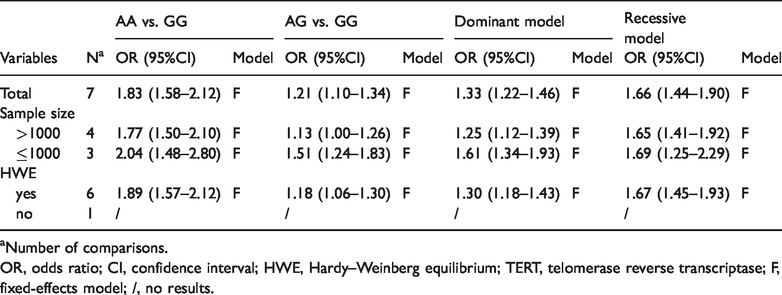
aNumber of comparisons.
OR, odds ratio; CI, confidence interval; HWE, Hardy–Weinberg equilibrium; TERT, telomerase reverse transcriptase; F, fixed-effects model; /, no results.
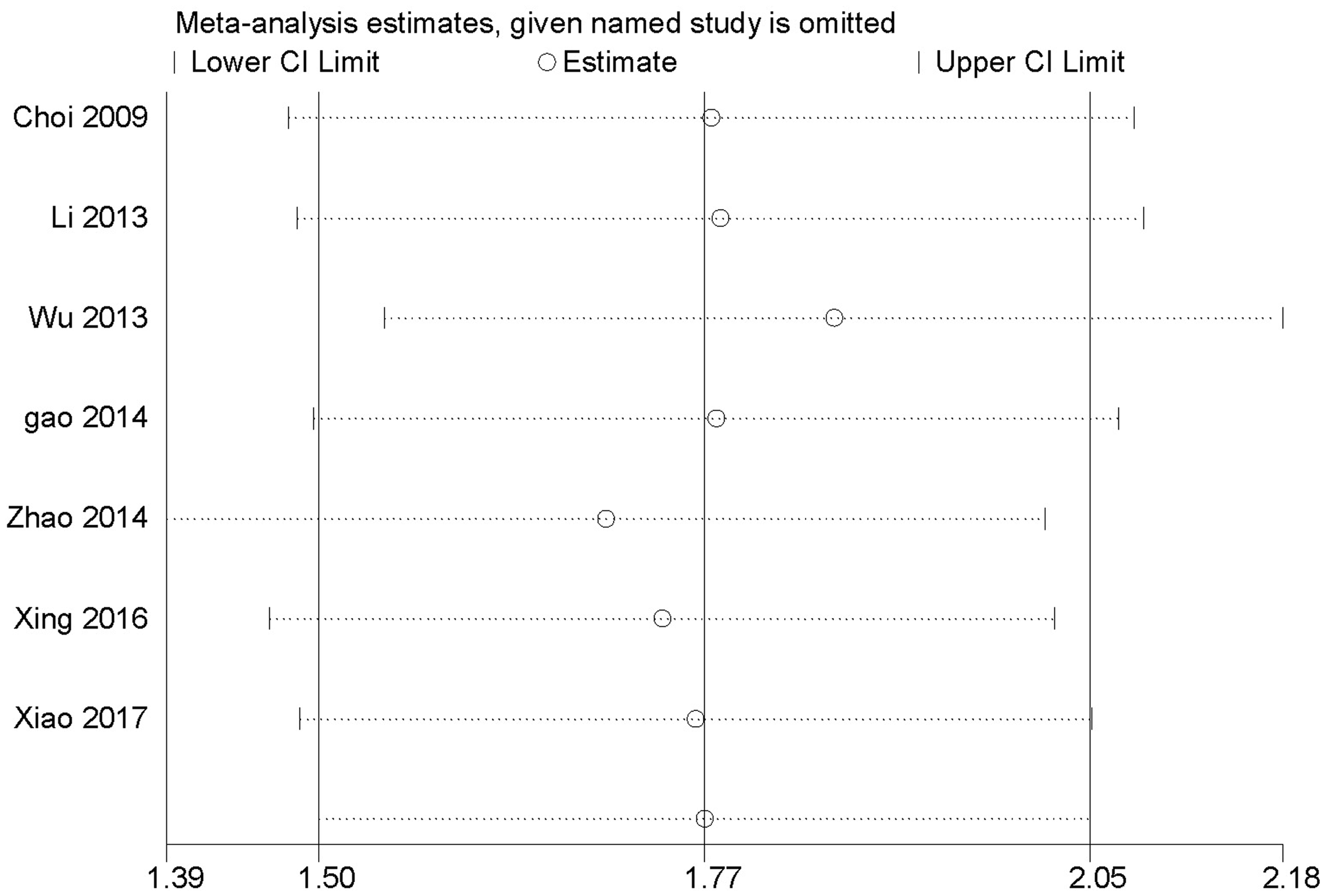
Sensitivity analysis of the association between TERT rs2736098 polymorphism and lung cancer risk.
Publication bias
The possible publication bias was examined by visualizing the funnel plot, which revealed that there was no publication bias (Figure 4), and this indicated the low publication bias in our meta-analysis in the overall population (AA vs. GG: t=0.2; AG vs. GG: t=0.2; Dominant model: t=0.2; Recessive model: t=0.2).

Begg’s funnel plot analysis to detect potential publication bias for TERT rs2736098 polymorphism.
Discussion
Global cancer statistical data indicates that lung cancer is among the most common and lethal human cancers, 19 with a complicated carcinogenesis mechanism. Air pollution and smoking are considered to be critical risk factors in lung cancer. In addition, to better understand the possible mechanism underlying lung cancer tumorigenesis, it is necessary to identify and further evaluate the relevant genetic variations. Over the past decade, several meta-analyses have revealed the relationship between TERT rs2736098 polymorphism and cancer risk, and previous studies have shown that rs2736098 leads to the occurrence and development of cancer.20–22 However, there is no specific study on lung cancer. Thus, this meta-analysis was performed by including case–control studies to examine the above possible relationship of TERT rs2736098 polymorphism with the lung cancer risk.
In this meta-analysis that included seven case–control studies involving 3836 healthy controls and 3637 lung cancer patients, we comprehensively assessed the relationship between TERT rs2736098 polymorphism and lung cancer risk. The TERT rs2736098 polymorphism was significantly related to enhanced lung cancer risk in the overall population. When the sample size of the study was investigated, the TERT rs2736098 polymorphism was correlated with the lung cancer risk in studies with a sample size of >1000 and ≤1000 participants. Moreover, in consideration of possible between-study heterogeneity that is caused by allelic distribution deviation from HWE, subgroup analysis that was conducted by restricting this meta-analysis to studies that were consistent with the HWE showed that our findings were reliable. Additionally, the publication bias was assessed as well as the robustness of our outcomes using a sensitivity analysis.
The details of the mechanism that is involved in lung cancer remains to be further elucidated. Inter-gene and genetic–environmental interactions play vital roles in tumorigenesis, while single genetic variations might present only a modest effect. Previous evidence has suggested that TERT rs2736098 and CLPTMlL rs401681 polymorphisms synergistically increase the lung cancer risk. 12 Additionally, a previous study found a synergistic effect of the TERT rs2736098 polymorphism and smoking on the lung cancer risk. 10 Interaction between other risk factors and this polymorphism in lung cancer needs to be further studied.
There are some limitations in this study. First, some of the original data on the relevant risk factors were unavailable in the enrolled studies, which restricted the assessment of gene–gene and gene–environment correlation. Second, all enrolled studies had a retrospective design, which might cause subject selection bias and further affect the reliability of the final outcomes. Finally, we only included published studies, but there are some relevant unpublished studies, which might cause a potential publication bias.
In summary, our findings indicate that the TERT rs2736098 polymorphism might be associated with the risk of developing lung cancer. Large-scale case–control studies are required to investigate the possible gene–gene and gene–environment interrelationships with the lung cancer risk.
