




Abstract
Objective
Leukocytosis is thought to be directly associated with the pathogenesis of atherosclerosis and metabolic syndrome. Increased white blood cell (WBC) count is related to cardiovascular disease in patients with type 2 diabetes mellitus; raised neutrophil lymphocyte ratio (NLR) is associated with metabolic syndrome. There is little information, however, concerning a correlation between glycosylated haemoglobin (HbA1c) and NLR. The aim of the present study was to investigate the relationship between NLR and blood glucose regulation.
Methods
This retrospective study was conducted in patients with type 2 diabetes mellitus, divided into two groups according to HbA1c levels: group 1, HbA1c levels ≤ 7%; group 2, HbA1c levels > 7%. Venous WBC, neutrophil and lymphocyte counts were determined.
Results
Of 71 patients included, fasting serum glucose, neutrophil and WBC counts were significantly higher in group 2 compared with group 1. NLR had a positive correlation with HbA1c.
Conclusion
There may be a significant relationship between NLR and blood glucose regulation. The authors propose that increased NLR may be associated with elevated HbA1c in patients with type 2 diabetes mellitus.
Introduction
Type 2 diabetes mellitus is one component of metabolic syndrome, which includes impaired glucose tolerance, hypertension, obesity and dyslipidaemia.1,2 White blood cell (WBC) count is linked to various components of metabolic syndrome, and subclinical inflammation may be associated with the increased cardiovascular risk in patients with impaired glucose tolerance. 3 Furthermore, a link has been shown between chronic subclinical inflammation and insulin resistance, metabolic syndrome and atherosclerosis. 4
Low-grade chronic inflammation is associated with increased cardiometabolic risk. 5 The process of atherosclerosis is known to involve inflammatory mechanisms, 6 and leukocytosis is directly associated with the pathogenesis of both atherosclerosis and metabolic syndrome.7,8 The prevalence of macrovascular complications has been shown to correlate positively with increased WBC count in patients with type 2 diabetes mellitus. 9
Neutrophil lymphocyte ratio (NLR) is an essential marker of systemic inflammation and an indicator of increased risk for cardiovascular events in patients with metabolic syndrome.10,11 In addition, increased NLR may be related to type 2 diabetes mellitus.10,12–14 Thus, it may be proposed that chronic inflammation plays a key role in the pathogenesis of clinical complications including cardiovascular diseases.
The purpose of the present study was to investigate the relationship between NLR and blood glucose regulation. A comparison was made between the NLR of patients with regulated diabetes mellitus (glycosylated haemoglobin [HbA1c] ≤ 7%) and patients with unregulated diabetes mellitus (HbA1c > 7%). To our knowledge, this is the first published study to evaluate the relationship between NLR and HbA1c.
Patients and methods
Study population
This retrospective study was conducted at the Medical School of Mustafa Kemal University, Hatay, Turkey, between January 2013 and April 2013. Only patients with type 2 diabetes mellitus were included. Exclusion criteria were: patients with suspected serious medical conditions; patients on any medications (except oral antidiabetic agents or insulin) that may have affected the results of the study and inflammation parameters; patients with cardiovascular disease (defined by electrocardiogram results, physical examination and patient history); patients with history of smoking or high levels of triglycerides; patients taking aspirin or statins; presence of inflammation. All participants underwent a clinical examination to establish macro- or microvascular complications and history of drug use. Participants were divided into two groups according to their HbA1c levels: group 1, HbA1c ≤ 7% (regulated diabetes); and group 2, HbA1c >7% (unregulated diabetes).12,13
The study was approved by the local Ethical Committee of Mustafa Kemal University Medical School, Hatay, Turkey, and verbal informed consent was obtained from all patients.
Inflammation and blood parameters
After an overnight fast, venous blood samples (10 ml) were collected into haemogram tubes containing di-potassium ethylenediaminetetra-acetic acid (1.5–2.2 mg/ml), and biochemistry tubes. Samples were maintained at room temperature and tested within 1 h of collection, to minimize variations due to sample ageing. Total WBC, neutrophil and lymphocyte levels were determined using an automated blood cell counter (Mindray BC-6800, Shenzhen, China), according to the manufacturer’s instructions. NLRs were quantified as total neutrophil counts divided by lymphocyte counts using the same blood samples drawn on admission. HbA1c levels were measured using automated ion-exchange high performance liquid chromatography (Variant™ II, Bio-Rad, Hercules, CA, USA) according to the manufacturer’s instructions. Serum glucose levels were measured using a hexokinase enzymatic method (Architect c8000 Chemistry Analyzer, Abbott Diagnostics, IL, USA) according to the manufacturer’s instructions.
The presence of inflammation was determined using medical history, physical examination, body temperature readings and routine laboratory tests (including WBC count). Patients found to have indications of inflammation were excluded.
Statistical analyses
Data were presented as mean ± SD or n patient incidence, and were analysed using SPSS® software, version 14.0 (SPSS Inc., Chicago, IL, USA) for Windows®. Continuous data were checked for normality, and appropriate transformation was applied to those variables with skewed distribution. Differences in continuous haematological values between groups 1 and 2 were assessed by independent Student’s t-test. To compare NLR results between regulated and unregulated patients (grouped by HbA1c levels), analysis of covariance (ANCOVA) was used with age, body mass index (BMI) and duration of diabetes as covariates. Linear regression analysis was performed to investigate any direct relationship between HbA1c and NLR, WBC count, age, sex, BMI or duration of diabetes. A P-value <0.05 was considered statistically significant.
Results
Demographic data for patients with type 2 diabetes mellitus divided into two groups according to glycosylated haemoglobin (HbA1c) levels: group 1, ≤ 7% (n = 34) and group 2, > 7% (n = 37).

Data presented as mean ± SD or n patient incidence.
There were no statistically significant between-group differences (P ≥ 0.05, between-group analysis of covariance using age, sex, body mass index [BMI] and duration of diabetes as covariates).
Haemogram data for patients with type 2 diabetes mellitus divided into 2 groups according to glycosylated haemoglobin (HbA1c) levels: group 1, ≤ 7% (n = 34) and group 2, > 7% (n = 37).
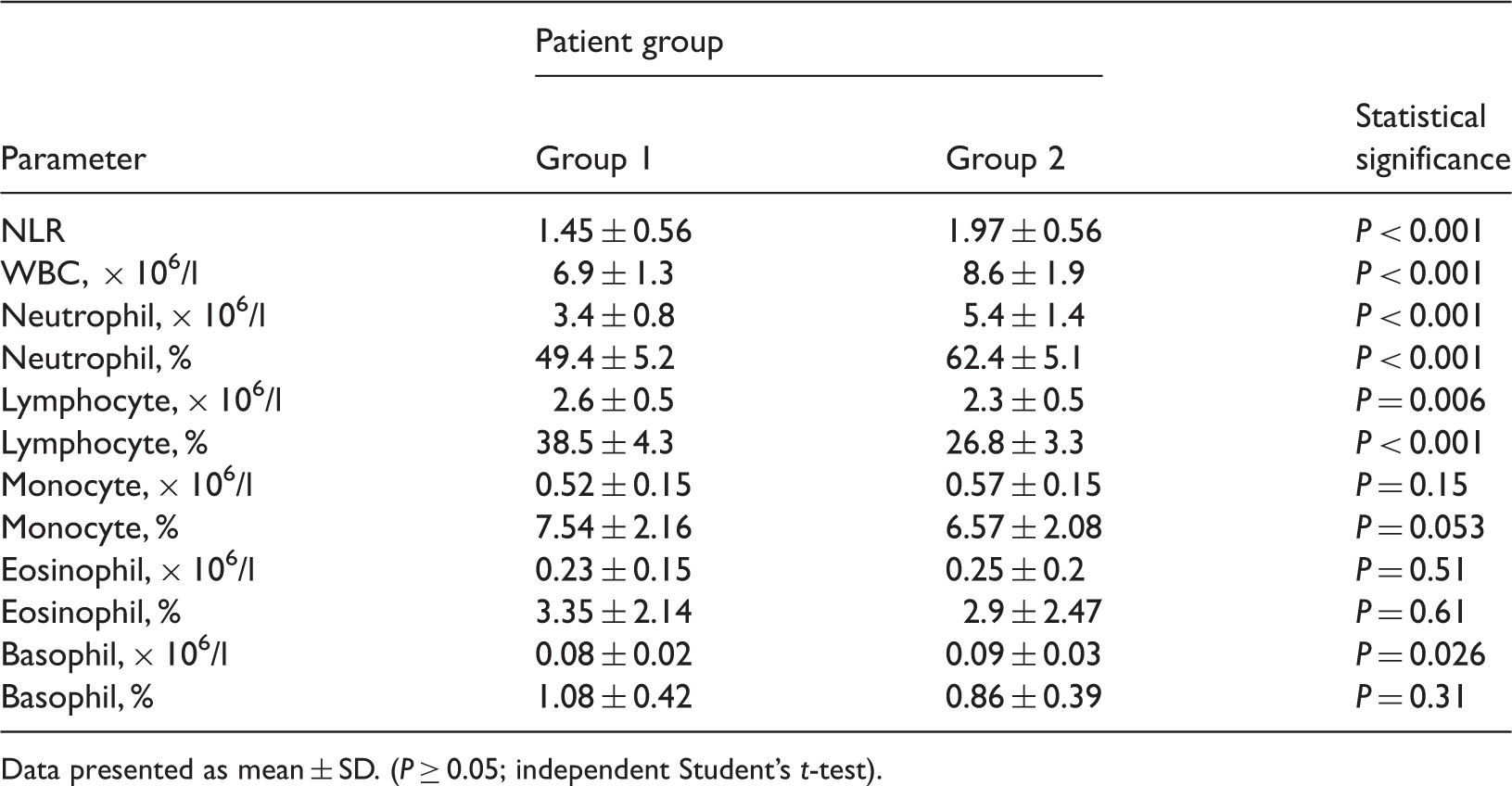
Data presented as mean ± SD. (P ≥ 0.05; independent Student’s t-test).
The NLR ratio was significantly higher in group 2 compared with group 1 (1.97 ± 0.57 versus 1.45 ± 0.56, respectively; P < 0.001). Analysis using Pearson’s correlation coefficient showed that NLR correlated positively with HbA1c levels (r = 0.577; P < 0.001; Figure 1) and showed a weak positive correlation with diabetes duration (r = 0.206; P < 0.05). There was no correlation between NLR and BMI. Linear regression analyses revealed that WBC count and NLR were independently associated with HbA1c (Table 3).
Scatter plot showing a positive correlation between neutrophil lymphocyte ratio and serum glycosylated haemoglobin (HbA1c) levels in 71 patients with type 2 diabetes mellitus (r = 0.577; P < 0.001; Pearson’s correlation coefficient). Linear regression analysis of factors related to HbA1c levels in 71 patients with type 2 diabetes mellitus. NS, no statistically significant difference (P ≥ 0.05).

Discussion
In the current study, a positive correlation was found between HbA1c levels and NLR. HbA1c levels are an indicator of blood glucose regulation, and increased HbA1c levels may be associated with increased risk of cardiovascular complications in patients with type 2 diabetes mellitus, 15 since impaired glucose tolerance is associated with coronary heart disease.6,16 Leukocytes contribute to cholesterol deposition, endothelial dysfunction and atherogenesis. 17 Moreover, there is a link between chronic subclinical inflammation and insulin resistance, metabolic syndrome and atherosclerosis.4,17,18 Vascular damage caused by endothelial cells can be influenced by hyperglycaemia, increased free fatty acids, altered lipoproteins, hypertension and diabetes mellitus. 18 Chronic hyperglycaemia also increases the release of reactive oxygen species from neutrophils. 19
Mortality from cardiovascular diseases is higher in patients with diabetes than in those without diabetes, and the morality rate rises with increasing blood glucose concentration. 20 WBC count is an essential marker of inflammation, 21 and increased WBC levels are associated with vascular complications in patients with type 2 diabetes mellitus and metabolic syndrome.3,5,9 Findings from the present study are consistent with previous publications,3,5,9 in that WBC count and NLR were found to be higher in patients with HbA1c levels >7% (unregulated diabetes), compared with those ≤7% (regulated diabetes). These data suggest that hyperglycaemia may be related to increased NLR.
Neutrophils mainly have a role in acute inflammation due to their relatively short half-life. 22 One study found no significant change in WBC count during an induced hyperglycaemic spike in patients with type 1 diabetes mellitus compared with healthy volunteers; however, lymphocyte levels were reduced as a result of hyperglycaemia in patients with type 1 diabetes mellitus and healthy subjects. 23 Low relative lymphocyte concentrations have been shown to lead independently to coronary heart disease in patients with type 2 diabetes mellitus. 24 Patients with type 2 diabetes mellitus have also been shown to have insufficient proliferation of lymphocytes due to low expression of interleukin-2 receptors. 25 The present study found decreased lymphocyte counts and increased neutrophil counts in patients with unregulated diabetes (i.e. increased NLR); these findings are consistent with a published study in which lymphocyte levels were found to be reduced due to hyperglycaemia. 23 Patients with diabetes mellitus have been suggested to have insufficient proliferation of lymphocytes. 25 The decreased lymphocyte count in patients with unregulated diabetes (group 2) compared with regulated diabetes (group 1) in the present study suggests that NLR may be further increased in patients with diabetes due to hyperglycaemia.
A positive correlation between HbA1c and WBC levels in patients with type 2 diabetes mellitus 9 was reported in a study that grouped patients according to WBC levels. Another study, in which patients were grouped based on the number of metabolic syndrome components, found a similar correlation between WBC count and HbA1c. 4 In patients with type 2 diabetes mellitus, a link between high WBC levels and impaired insulin sensitivity has been suggested. 14 In addition, leukocytes have been proposed to have a role in atherogenesis and thrombus formation, with a relationship between NLR and prognosis of cardiovascular disease being observed in patients with metabolic syndrome. 11 Another study found a relationship between NLR and diabetes mellitus in a patient group with chronic diseases. 10 None of these studies, however, directly compared HbA1c levels with WBC or NLR.
In the present study, in contrast to what may have been expected, variables such as duration of diabetes or BMI were not different between the two groups. This may have been due to the sample size, and further studies involving larger study populations are needed to clarify this issue. Another limitation of the study was the fact that ANCOVA using antidiabetic drugs or insulin as a covariate was not performed, because most of the patients routinely used oral antidiabetic agents and only five patients on insulin. Hyperglycaemia is not only influenced by duration of diabetes and severity of the disease, but also by the use of oral antidiabetic drugs and insulin. Without careful consideration of the use of antidiabetic drugs or insulin in the analysis of WBC and NLR between the two groups, the results could be confounded.
The NLR may be a more effective predictor of cardiovascular events compared with WBC or neutrophil count. 26 A positive correlation has been reported between NLR and C-reactive protein (CRP; a marker of inflammation) in patients with coronary artery disease. 27 It is suggested that the role of CRP in insulin resistance might be more significant than that of WBC. 28 The relationships between WBC levels or CRP with blood glucose regulation have been studied by a number of groups.14,28–31 To the authors’ knowledge, the present investigation is the first published study concerning the relationship between NLR and HbA1c. In the present study, patients with type 2 diabetes mellitus were grouped according to HbA1c levels and, consistent with published studies, a significant positive correlation was found between NLR and HbA1c. The authors propose that increased NLR may be independently associated with poor blood glucose regulation, in patients with type 2 diabetes mellitus.
Footnotes
Declaration of conflicting interest
The authors declare that there are no conflicts of interest.
Funding
This research received no specific grant from any funding agency in the public, commercial, or not-for-profit sectors.