



Abstract
Despite an increase in migrant entrepreneurship research in recent years, the current literature mainly focuses on the personal characteristics of migrant entrepreneurs and the influence of structural changes, often overlooking the role of the agency of migrants in overcoming marginalisation. The study addresses this gap by drawing on the identity work perspective and recategorisation theory to explore how migrant entrepreneurs use identity work as a form of agency to overcome marginalisation. Through in-depth interviews with migrant entrepreneurs in Australia, our study identifies three forms of marginalisation: structural, relational and sociocultural. We propose a typology of three forms of identity work – identity construction, mobilisation and recategorisation – which act as mechanisms through which migrant entrepreneurs navigate the complexities of their multiple identities to overcome marginalisation. Our study makes important theoretical and practical contributions by highlighting that migrant entrepreneurs are not passive subjects of marginalisation embedded within social structures but have the agency to construct and reshape their identities to overcome marginalisation in their new home country.
Introduction
Entrepreneurship offers migrants an opportunity to actively engage in the social and economic fabric of their new home country (Jones et al., 2019). However, migrant entrepreneurs, defined in our study as foreign-born individuals engaged in entrepreneurial activities in a country other than that of their birth (Brzozowski et al., 2017; Sinkovics and Reuber, 2021), often experience discrimination (Poblete et al., 2023), social isolation (Ram et al., 2017) and systemic exclusion (van Merriënboer et al., 2025; Wang and Warn, 2019), and they are frequently subject to ‘outsidership’ (Lassalle and Shaw, 2021) or othering (van Merriënboer et al., 2025). As a result, migrant entrepreneurship is frequently regarded as a marginalised activity (James et al., 2022; Villares-Varela et al., 2018). Existing research on migrant entrepreneurship tend to focus on individual-level factors, particularly the motivations driving migrants to become entrepreneurs (Salamanca and Alcaraz, 2022), and the social categories associated with migrant entrepreneurship, such as gender, ethnicity and religion (Essers et al., 2021). Other studies examining the survival and success of migrant entrepreneurs emphasise the importance of transforming institutional and social structures to support them (Jones et al., 2014; Ram et al., 2017), for example, by improving access to institutional support systems (Solano, 2023). Scholars have also applied the embeddedness approach to explore the structural connections migrant entrepreneurs have with the institutions of their new home country and social ties within their community networks (Kloosterman, 2010; Kloosterman et al., 2016). These studies essentially focus on the integration of migrant entrepreneurs into their new environments. However, while providing valuable insights, such research often implies – either explicitly or implicitly – that individual actions are largely structurally determined (Berntsen et al., 2022).
Our study, in contrast, offers a novel perspective by emphasising the agency of migrant entrepreneurs (Berntsen et al., 2022) and how it enables them to overcome marginalisation (Essers et al., 2021). The concept of agency, defined as an individual’s capacity to make choices and take action (Cederberg and Villares-Varela, 2019), is framed in the broader field of entrepreneurship in terms of a ‘reflexive actor’ who is capable of making their own choices (Stoyanov, 2018: 384) and can ‘change things’ (James et al., 2022: 438). However, there is still a lack of research exploring the agency of migrant entrepreneurs (Berntsen et al., 2022; Villares-Varela et al., 2018), especially in relation to how their identities are managed within specific social and cultural contexts (James et al., 2022). Identity, defined as one’s ‘subjective claims about oneself’ (Caza, Moss and Vough, 2018a: 707), plays a crucial role in shaping ‘how and what one values, thinks, feels and does in all social domains’ (Leitch and Harrison, 2016: 182). For migrant entrepreneurs, their experiences of marginalisation are closely linked to their identities as outsiders (Lassalle and Shaw, 2021) and ethnic minorities (Ozasir Kacar and Essers, 2019), often exposing them to distrust (Lassalle and Shaw, 2021) and stereotyping (Essers et al., 2021). Our claim is that as migrant entrepreneurs encounter social structures that create and perpetuate inequalities (Lassalle and Shaw, 2021), they develop agency to shape identities that allow them to navigate and thrive within these social structures (Ozasir Kacar and Essers, 2019).
To address the gaps in the literature, we draw on the identity work perspective (Brown 2022) to explain how migrant entrepreneurs use their agency to overcome marginalisation (Essers and Tedmanson, 2014; van Merriënboer et al., 2025). Given their intersecting identities as migrants and entrepreneurs, they have to actively negotiate these identities through their interactions with others (Essers and Benschop, 2007). The concept of identity work assumes that individuals have agency (Cross, Darcy and Garavan, 2025; Järventie-Thesleff and Tienari, 2016) and therefore, the ability to shape the perceptions of others, and in the context of migrant entrepreneurship, the capacity to build the legitimacy of their business ventures (Abd Hamid et al., 2019). Identity work is related to agency in that individuals can construct, maintain, strengthen or revise the way they perceive or present themselves in social contexts (Essers et al., 2013). In this regard, identity work reflects the interplay of individual agency and their identities in the broader social environment; as Caza, Vough and Puranik (2018b: 891) noted, ‘individuals may have some agency in the identities they choose’. In our study of migrant entrepreneurship, focusing on identity work offers an insightful perspective on the agency of migrant entrepreneurs when navigating broader social structures and overcoming marginalisation in their new home country. This also requires, first and foremost, an understanding of the systemic nature of marginalisation. In essence, our research addresses two key questions: How is marginalisation experienced by migrant entrepreneurs? and: How do migrant entrepreneurs enable their identities to overcome marginalisation?
Examining the identity work of migrant entrepreneurs is worthwhile for two reasons. First, although scholars have emphasised the critical role of identity in entrepreneurship (Mmbaga et al., 2020), studies exploring the identities of migrant entrepreneurs have largely focused on social categories such as gender (Ozasir Kacar and Essers, 2019), religion (Essers et al., 2021) or ethnicity (Stoyanov, 2018). In this study, we move beyond social categories to explore identity as a dynamic construct, comprising multiple identities (Leitch and Harrison, 2016). We take a different view from studies that consider identity as a ‘univocal (and unchanging) self’ (Leitch and Harrison, 2016: 179) or a ‘(relatively) fixed and unchanging feature’ (Stoyanov, 2018: 383); importantly, there is a ‘scarcity of multiple identity research’ (Ramarajan, 2014: 591). In the broader field of entrepreneurship, Radu-Lefebvre et al. (2021: 1564) similarly observed that ‘scant research has examined how entrepreneurs manage their multiple identities’. There is, therefore, a need to further explore multiple identities in the context of migrant entrepreneurship.
Second, most existing research on identity and migrant entrepreneurship adopts an intersectionality lens (Chitac, 2025; Lassalle and Shaw, 2021) or a postcolonial feminist perspective (van Merriënboer et al., 2025), primarily examining identity construction (Ozasir Kacar and Essers, 2019). Although these approaches offer valuable insights into migrant entrepreneur experiences, they do not ‘automatically include the subjective dimension of identity’ (Ramarajan, 2014: 610). By focusing on identity work, our study extends existing research by exploring migrant entrepreneur agency beyond mere identity construction, in relation to overcoming marginalisation. It is important to understand how entrepreneurs, particularly migrant entrepreneurs, enable and draw on their multiple identities (Shepherd and Haynie, 2009) to shape others’ perceptions of them (Leitch and Harrison, 2016). We also explore in more detail the issue of marginalisation, adopting the Diversity Council Australia’s definition of marginalisation as a manifestation of the unequal power dynamics inherent in social and economic systems (Deo, 2024). Marginalisation often stems from institutional biases and systemic constraints (Simarasl et al., 2022), where the structures of the system favour the interests of certain groups or individuals over the interests of others (Lewis and Crabbe, 2024). By this definition, migrant entrepreneurs may experience marginalisation 1 (Lewis and Crabbe, 2024) due to cultural differences or their newcomer status in the market.
Our study uses a qualitative method, which is valuable in capturing the contextual nuances of migrant entrepreneurship (Dabic et al., 2020), drawing from interviews with 39 migrant entrepreneurs in Australia. The study diverges from the prevalent trend with in migrant entrepreneurship research, which tends to focus on either Europe (Berntsen et al., 2022; Essers et al., 2021; Jones et al., 2019; Lassalle et al., 2020) or the United States (Kerr and Kerr, 2020; Salamanca and Alcaraz, 2022). Our research is based in Australia, which is ranked as one of the world’s top migration destinations and where 30.7% of the population is foreign-born (Australian Bureau of Statistics, 2024; IOM, 2023). More than one-third of small businesses in Australia are migrant-owned, representing over 620,000 businesses across the country (CGU Insurance, 2018). Research indicates that high closure rates pose a serious challenge to the long-term viability of all ventures across the country, with 20% of small businesses failing within their first year and 60% within 3 years (Abbas, 2024). Although data specific to migrant businesses is limited, it is likely that these businesses face failure rates similar to, if not greater than, businesses owned by local Australians. With its diverse ethnic enclaves and migrant communities, Australia offers a particularly relevant context for exploring how migrant entrepreneurs overcome marginalisation.
We contribute to the theoretical understanding of migrant entrepreneurship in several ways. First, despite the critical role migrant entrepreneurs play in their new home country, their entrepreneurial activities ‘do not seem to be prominent within “mainstream” entrepreneurship research’ (Ram et al., 2017: 4). In fact, research on migrant entrepreneurship remains highly fragmented (Dabic et al., 2020), and the field has yet to reach maturity (Glinka et al., 2023). While some studies on migrant entrepreneurship touch on the issue of marginalisation, they often do so in a broad or generic manner (James et al., 2022; van Merriënboer et al., 2025). Much of this work centres on structural issues, including immigration policies (Wang and Warn, 2019), regulations and labour market conditions (Ram et al., 2017), and institutional factors (Griffin-El and Olabisi, 2018). Our study expands on this by exploring three forms of marginalisation –structural, relational and sociocultural – that arise from a combination of institutional and individual factors, to provide a more comprehensive and nuanced framework for research on marginalisation.
Second, we contribute to the migrant entrepreneurship literature by drawing on the identity work perspective to enhance our understanding of how migrant entrepreneurs use identity work to overcome marginalisation. Our findings highlight a typology of three forms of identity work – construction, mobilisation and recategorisation of multiple identities – which serve as mechanisms enabling migrant entrepreneurs to overcome marginalisation. Third, we contribute to the migrant entrepreneurship literature by exploring recategorisation, thus expanding on the research on identity work. Recategorisation theory (Dovidio et al., 1997; Gaertner and Dovidio, 2000) emphasises how group members reduce biases against out-groups by seeking commonalities and recategorising their identities to become in-group members (Zhu et al., 2014). We apply this theory to examine how migrant entrepreneurs look for commonalities with others and recategorise their identities as a way to integrate into the broader community in their new home country. Our findings suggest that migrant entrepreneurs recategorise themselves by adopting a fluid identity and leveraging hybrid identities.
Finally, recognising the importance of understanding context in research (Baker and Welter, 2020; Radu-Lefebvre et al., 2021), our study, set in Australia’s multicultural economy, provides empirical evidence that migrant entrepreneurs are not passive subjects of marginalisation embedded within social structures but have the agency to engage in identity work, shaping their entrepreneurial experiences and overcoming their marginalisation.
Theoretical background
Marginalisation and the agency of migrant entrepreneurs
Studies on marginalisation describe how individual identities, associations, experiences or environments can (negatively) affect their ability to participate in society (Mehra et al., 1998). Migrants are often categorised as marginalised, as they face systemic barriers that limit their integration into the community (Bronstein, 2020). Researchers and practitioners have suggested that push and pull factors like occupational mobility and the broader economic circumstances drive migrants to pursue entrepreneurship (Shinnar and Zamantili Nayir, 2019). Nonetheless, their backgrounds or ‘otherness’ can result in their marginalisation (James et al., 2022). In their extensive review, Ram et al. (2017) identified the multifaceted barriers that can marginalise migrant entrepreneurs. They highlighted structural disadvantages, such as limited access to funding, as the main causes of such marginalisation. Research has shown that financial institutions are often reluctant to provide start-up capital or ongoing credit to migrant business owners, further restricting their opportunities (Ram et al., 2017). Moreover, migration policies can problematise migration itself and negatively shape the identity of migrant entrepreneurs, leading to marginalisation (Solano, 2023). Thus, the institutional structures of policy, regulations and financial support play an important role in either facilitating or hindering access to market resources and knowledge for migrant entrepreneurs (Kloosterman, 2010; Solano, 2023). Ram et al. (2017) also pointed out the racist exclusion that migrant entrepreneurs frequently face, describing the social structure that places them at a disadvantage.
As migrant entrepreneurs often face restrictive institutional and social structures, some scholars advocate for a ‘breakout’ strategy’ that encourages migrants to expand into mainstream business environments where the access to resources is facilitated (Wang and Warn, 2019). In many cases, migrant entrepreneurs frequently depend on their co-ethnic networks to navigate broader structural barriers (Szkudlarek and Wu, 2018), access resources (Lassalle and McElwee, 2016) or expand their social capital and professional networks (Lassalle et al., 2020). This reliance on their co-ethnic networks, combined with experiences of discrimination and racism, can limit migrant entrepreneur operations to low-value, small-scale businesses, which makes it more difficult for them to compete in the broader market (Jones et al., 2014; Ram et al., 2017). Nevertheless, other scholars point out that success for migrant entrepreneurs can be facilitated not only by co-ethnic networks but also by transnational and local networks, which can provide them with broader support and opportunities (Glinka et al., 2023; Lassalle et al., 2020).
Our study links the ability of migrant entrepreneurs to overcome marginalisation to their agency. In relation to this, Berntsen et al. (2022) emphasised the personal enablers of migrant entrepreneurs as an expression of agency, ranging from chance encounters to the development of supportive communities that facilitate entrepreneurial endeavours. The study conducted by Elo et al. (2024) explores the agency of migrant entrepreneurs by illustrating how they employ their entrepreneurial skills, diversity and range of capabilities to gain acceptance in their new home country. However, migrant entrepreneurs frequently encounter marginalisation and exclusion from the entrepreneurial ecosystem (van Merriënboer et al., 2025), which are often society’s response to certain aspects of their identity such as ethnicity or religion (Essers et al., 2021). This marginalisation not only limits their opportunities but also poses challenges to their entrepreneurial identity (van Merriënboer et al., 2025). In this article, we examine identity work as a form of agency, exploring how migrant entrepreneurs enable their own identities to overcome marginalisation.
Migrant entrepreneurs and identity work
Identity represents an individual’s response to fundamental questions like ‘Who am I?’ or ‘Who do I want to be?’ (Christensen and Newman, 2024). It shapes not only an individual’s perception of themselves but also those of others in social interactions (Ashforth and Mael, 1989). Identity work encompasses activities – which can be cognitive, discursive, physical or behavioural – undertaken by individuals to shape, repair, maintain, strengthen, revise or even discard their ‘collective, role, and personal self-meanings within the boundaries of their social contexts’ (Caza et al., 2018b: 895). It involves a ‘continual engagement in forming and reforming a coherent and distinct notion of who individuals are and how they relate to others’ (Winkler, 2018: 121). The identity work perspective draws on various identity theories (Brown, 2022), including social identity theory (Tajfel and Turner, 1979), which posits that individuals define their identity based on the characteristics common to a particular group, making them a member of either the in-group or the out-group (Hogg et al., 1995). Identity work encompasses both self-identity (or personal identity) and social identity (Winkler, 2018), or their ‘internal self identity’ and an ‘external range of social identities’ (Watson, 2009: 255). Identity work around personal identity involves self-development or self-change, while identity work around one’s social identity involves changing one’s social group associations (Caza et al., 2018b). Stoyanov and Stoyanova (2022) interpreted identity work as both an inward process of self-definition and an outward process of identity negotiation. In this way, understanding both their personal and social identities helps individuals define themselves in relation to others (Ashforth and Mael, 1989). In line with this, we consider both the personal identity and social identity aspects of identity work (Kreiner et al., 2006; Watson, 2008, 2009).
A focus on identity work (Brown, 2022; Stoyanov and Stoyanova, 2022) explores the agency of individuals (Kloosterman and Rath, 2001) to examine how migrant entrepreneurs engage with the broader societal and economic structures in their new home country. For migrant entrepreneurs facing marginalisation – whether through exclusion (van Merriënboer et al., 2025), outsidership (Lassalle and Shaw, 2021) or othering (van Merriënboer et al., 2025) – identity work can be a mechanism for overcoming marginalisation (Thompson-Whiteside et al., 2021). Existing research on the identity work of migrant entrepreneurs tends to use an intersectionality lens (Lassalle and Shaw, 2021; Ozasir Kacar and Essers, 2019; van Merriënboer, 2025), examining how structural inequalities linked to certain identities such as gender, race, ethnicity or nationality (Ramarajan, 2014) influence migrant experiences. For example, Lassalle and Shaw (2021: 1505) found that women migrant entrepreneurs in Glasgow experience ‘oppressive structures of gender (patriarchy) and migration (outsidership)’, with their entrepreneurial agency constrained by structural and systemic oppressions. James et al. (2022) similarly identified that Nigerian female migrants face disadvantages due to the intersection of their ethnic and gender identities, but that their shared entrepreneurial identity helps them to foster solidarity, allowing them to mobilise social capital and generate social support. Van Merriënboer et al. (2025) also indicated that minority entrepreneurs in the Netherlands navigate discrimination and exclusion by strategically either downplaying or embracing their marginalised racial, migrant and entrepreneurial identities. One critique of the intersectionality approach is that it mainly focuses on the objective aspects of identity, such as gender or race, while giving less attention to people’s subjective view of their social identity (Ramarajan, 2014). For instance, a female Nigerian entrepreneur may simultaneously hold multiple identities, but she can choose to identify as Nigerian in one context and as an entrepreneur in another (James et al., 2022). Recognising these multiple identities (Ramarajan, 2014), beyond those related to gender, race or ethnicity, allows for a more nuanced understanding of how individuals enable their multiple identities to overcome marginalisation in their new home country. Research on identity work frequently examines the construction of specific identities, and how they can be adapted to the broader context. For example, in their investigation of Chinese migrants in Canada, Zhang and Chun (2018) discovered a three-stage process of entrepreneurial identity work, composed of exploring possible selves, building entrepreneurial mindsets and developing identity narratives. Thompson-Whiteside et al. (2021) revealed how women in the United Arab Emirates construct their entrepreneurial identities and gain legitimacy by integrating personal identity, such as individual accomplishments, and external aspects of their lives, such as the support from family and friends.
In addition to identity construction, research on identity work has highlighted how individuals draw on their constructed identities in their interactions with others through identity mobilisation. In this regard, individuals must actively mobilise their constructed identities to influence how others perceive them. Cha and Roberts (2019) described identity mobilisation as the actions by which individuals utilise their identity, such as their minority cultural identity, as a source of advantage in certain work contexts. James et al. (2022) found that migrant women entrepreneurs mobilise their identity by fostering a sense of togetherness, which helps create a collective obligation to support each other. These migrant entrepreneurs went on to use their social resources and interactions with their co-ethnic groups as building blocks for developing their business (James et al., 2022). The concept of identity mobilisation highlights the importance of understanding how individuals draw on their constructed identities as a resource; yet this remains underexplored in the existing research (Cha and Roberts, 2019), particularly that of migrant entrepreneurship.
Another stream of the literature explores identity work through identity recategorisation. Recategorisation theory (Dovidio et al., 1997; Gaertner and Dovidio, 2000) is defined as the process of ‘reframing previously separate groups as an inclusive common ingroup’ (Kang and Lee, 2024: 163). It explores how individuals within group contexts can seek to reduce group-based stereotypes and discrimination (Gaertner et al., 1993). Out-group members may actively work to shift how the majority group perceive them by recategorising themselves to align with certain in-group qualities or characteristics. For example, they may recategorise their identity by connecting with a broader community united by a shared goal (Kang and Lee, 2024) or leveraging a shared attribute like political ideology (Chow et al., 2023). In relation to migrant entrepreneurs, recategorisation theory suggests that they may deliberately project a certain identity during social interactions to influence how others see them (Brown, 2022; Kreiner et al., 2006). For instance, a study found that North African migrant women living in France engage in identity work through selective social group association, appearance management, and resisting imposed social categorisations to combat discrimination (Killian and Johnson, 2006). Similarly, other research identified that migrant entrepreneurs may blur their ethnic identity to conform to local norms or, conversely, may highlight their ethnic identity to gain some degree of distinction and legitimacy (Abd Hamid et al., 2019). Bulgarian migrant entrepreneurs in the United Kingdom have also been observed to undertake various identity work strategies to enhance their embeddedness in the local society (Stoyanov, 2018). While social categories like gender and ethnicity have been identified as important in the recategorisation process (Zhu et al., 2014), we look beyond these categories. We emphasise that beyond identity construction, migrant entrepreneurs need to navigate their multiple identities and recategorise themselves in their social interactions with others. This serves as a mechanism to overcome the marginalisation they often face, as it allows them to challenge stereotypes and break down barriers. Despite this, the literature has yet to fully explore how migrant entrepreneurs use identity recategorisation to overcome marginalisation.
Migrant entrepreneurship in the Australian context
Australia is home to a thriving multicultural society, with migrants making up 30% of the population (Australian Bureau of Statistics, 2024; Piller et al., 2024). In 2019, Australia had one of the highest shares of migration in the OECD countries, second only to Luxembourg and more than double the OECD average of 14% (Centre for Population, 2024). This means that large numbers of migrants have played a key role in the Australian workforce, often engaging in self-employment (Rajendran et al., 2020). Migrants in Australia have long been recognised as entrepreneurial, with research identifying the push and pull factors driving this entrepreneurialism. These factors include the country’s open immigration policies for business migrants, the difficulty migrants face in finding stable employment, and their limited occupational mobility within the mainstream job market (Collins, 2003). In 2022, migrants comprised of a third of small business owners in Australia, playing an important role in creating jobs and contributing to the economy (Mann, 2021). However, the country lacks programmes tailored specifically to the needs of migrant entrepreneurs (Qu, 2023). Existing programmes, such as the ‘Incubator Support Program’, largely cater to the wider business community, often failing to address the challenges encountered by migrant entrepreneurs (Qu, 2023). In response to this gap, non-government organisations and educational institutions with incubator programmes are increasing efforts to provide the much-needed mentorship, funding and resources for migrant entrepreneurs.
Despite Australia being seen as a ‘dream’ destination and continuing to welcome significant numbers of migrants every year, reports of discrimination remain (Chamas, 2022). Many migrants still face serious difficulties in terms of integrating into Australian society; yet interestingly, the experiences of migrants settling in Australia are still not well understood (Piller et al., 2024). The media has reported on such cases of discrimination; for example, an SBS podcast series quoted one of the founders of a successful café chain stating that ‘discrimination still remains’ (SBS Arabic, 2022). Similarly, ABC News has published a Filipino couple’s experience with racism and discrimination upon moving to Australia, who nevertheless pursued their entrepreneurial dreams (Clarke, 2023). Hutchens (2024) recently drew attention to the exploitation faced by migrant entrepreneurs. These challenges are compounded by gaps in existing policy frameworks, as government policy on ‘minority immigrant enterprises in Australia is very recent and largely undeveloped’ (Collins, 2003: 137). This poses other challenges such as in terms of securing external business finance (van Hulten and Ahmed, 2013). In addition, public narratives and societal perceptions often drive migrants towards social and urban marginalisation (Solano, 2023).
This study focuses on migrant entrepreneurs in Australia, which offers a compelling context for exploring how migrant entrepreneurs exercise agency to overcome marginalisation. Australia’s diverse ethnic enclaves and migrant communities present both opportunities and systemic barriers, making the study of identity work among migrant entrepreneurs in this country particularly valuable. While existing research focuses largely on structural barriers (van Merriënboer et al., 2025), there is still an important gap in understanding how migrant entrepreneurs construct and shape their identities to overcome marginalisation (Zhang and Chun, 2018). This study explores identity work as a mechanism of agency, to provide valuable insights into ‘doing context’ in entrepreneurship research, including migrant entrepreneurship (Baker and Welter, 2020; Radu-Lefebvre et al., 2021).
Methods and analysis
To gain a deeper understanding of the identity work undertaken out by migrant entrepreneurs, we adopted a qualitative research design, involving interviews with 38 migrant entrepreneurs in Australia between October 2022 and May 2023. The participants were selected using purposive sampling (Lincoln and Guba, 1985; Patton, 2002). Our recruitment drew upon the personal networks of the authors and contacts with non-government organisations that support migrant businesses. From the initial set of interviewees, the researchers then relied on the snowballing technique (Atkinson and Flint, 2004) to recruit more participants. The selection criteria for inclusion in this study were that the migrant entrepreneur: (1) is a foreign-born individual living in Australia, (2) is the sole or co-owner of the business currently operating in Australia, and (3) has lived in Australia for more than five years. The first criterion ensured that the interviewees were migrants; the second ensured that the participants were engaged in the management of a business and the third ensured the interviewees had spent some time learning about the sociocultural and institutional environment.
Aimed at capturing maximum variation (Patton, 2002), our research included participants with a diversity of characteristics, including those related to gender, length of time residing in Australia, country of origin, educational background, location of settlement (across different states, and urban or rural areas), industry in which they operate, and business size. With regard to the selection criteria and demographic and business details, we mainly relied on self-reporting, but we also cross-checked those details with the participant’s online profiles, business websites and referred contacts (as many were recruited via snowballing and/or referred by support organisations). Using these sampling techniques, we minimised the potential for selection bias in our study.
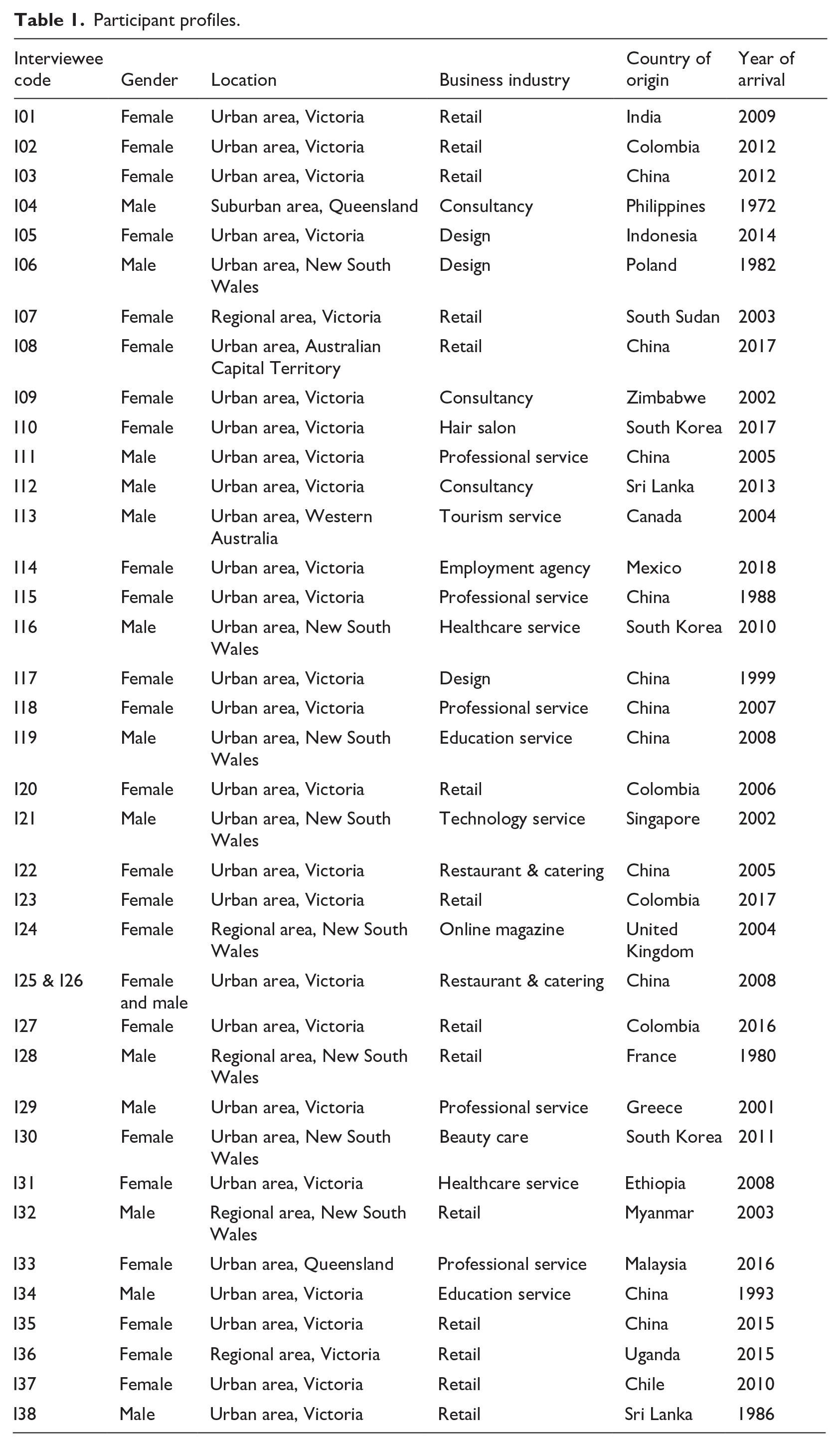
The 38 interview participants comprised of 27 females and 11 males, with most based in urban areas of Victoria (especially Melbourne), followed by New South Wales and other regional locations. Participants were born in 25 different countries, with China, Colombia, and South Korea being the most common countries of origin, they had arrived in Australia between 1972 to 2018. The most represented business industries were retail (14 participants), followed by professional services (6), consultancy (4), and design (3), with others working across education, healthcare, hospitality, and creative sectors. Table 1 provides an overview of the participant profiles.
Participant profiles.
The semi-structured interviews were conducted in person, over the phone or online, with participants choosing the location or format that was most convenient for them. The locations included their workplace, their home (for online interviews) and public places such as cafes. Whenever possible, we aimed for face-to-face interviews, but due to geographic limitations, this method was not always practical. All of the interviews were conducted in the preferred language of participants, and in most cases, this was English. Three interviews were conducted in Chinese, and one was conducted in both Chinese and English. The interviews conducted in Chinese were undertaken by a native Chinese speaker and then coded by a bilingual Chinese-English speaker using the original language. This approach ensured that the participants’ intended meanings were accurately captured and avoided any potential loss of nuance in the translation process. By maintaining the original language for analysis, we were able to preserve the richness of the responses. All the researchers took part in conducting interviews, after which the project team members shared insights and cross-checked the findings.
In each interview, the migrant entrepreneur was asked to reflect on and share the key challenges they faced when starting and running their business, as well as the actions they employed to overcome those challenges. The participants were encouraged to follow their own train of thought about their entrepreneurial journey. Using open-ended questions, the researchers also encouraged the participants to reflect on their migration experiences, social networks, sociocultural backgrounds and other contextual factors that shaped their paths as entrepreneurs. Thus, the data were the result of active interpretation of events and actions (Gioia et al., 2013). With participant permission, the interviews were audio-recorded and transcribed verbatim; on average, the interviews lasted 49 minutes each. The interview transcripts were anonymised before being compiled and coded for analysis.
Data analysis
To investigate how migrant entrepreneurs navigate their identities to overcome marginalisation, we employed a rigorous analytical framework grounded in the distinction between first-order categories, second-order themes and overarching concepts (Nag et al., 2007). To perform a systematised coding and categorisation of the data, we used Nvivo, a qualitative data analytical tool. The analysis followed an iterative process, continuously moving between the data and the emerging codes, considered alongside the literature on migrant entrepreneurship and identity work. Descriptive codes were compared across the participant accounts, enabling refinements such as renaming or collapsing categories to better reflect the emergent themes (Browning et al., 1995).
First-order categories were derived empirically from the data and then compared to existing theories on identity work and marginalisation among migrant entrepreneurs. These categories were synthesised into second-order themes while being cross-checked against the findings in the extant literature. We retained the expressions used by the participants to ensure authenticity and alignment with their experiences (Gioia et al., 2013; Nag et al., 2007). These themes were then integrated into overarching concepts, or aggregate dimensions, providing a comprehensive view of the identity work undertaken by migrant entrepreneurs. The final stage of analysis involved examining the linkages between second-order themes within the aggregate dimensions. This iterative approach enabled us to achieve theoretical saturation, to a point where further data analysis ceased to introduce new insights or categories, instead, confirming the robustness of the existing concepts, themes and codes. This data analytic strategy supported the development of deeper insights into the interplay between marginalisation and identity work (illustrated in Figure 1 in the findings section).
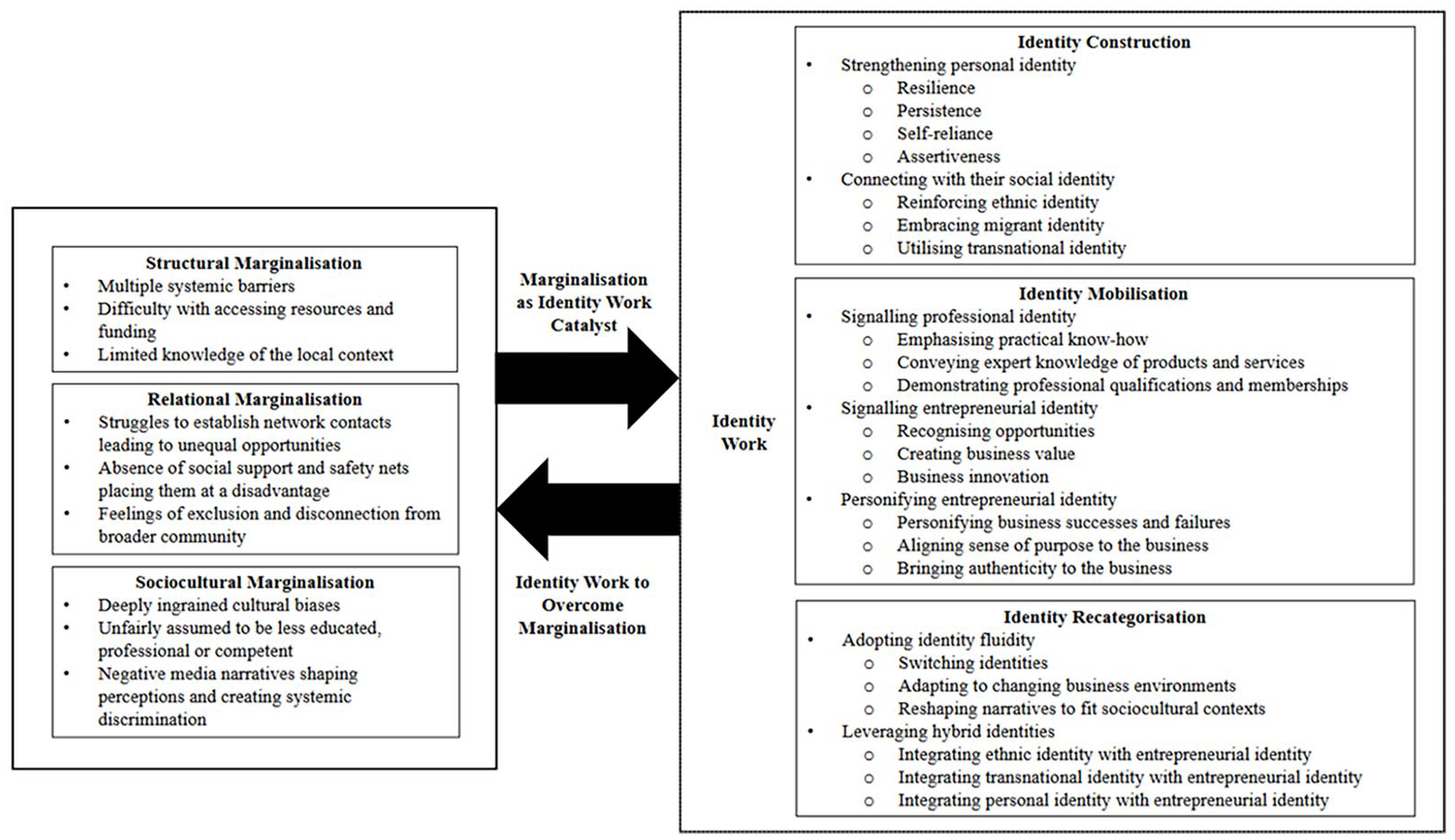
Interplay between marginalisation and identity work.
We first focused on uncovering the forms of marginalisation experienced by migrant entrepreneurs, as aggregate dimensions. Our analytical process revealed three forms of marginalisation, two of which – structural and relational – align with the existing literature (Lassalle et al., 2020). Our analysis details what constitutes or leads to such structural and relational marginalisation among migrant entrepreneurs. We also identified an emerging aggregate dimension of sociocultural marginalisation. Although prior research highlights the marginalisation of migrant entrepreneurs due to their perceived ‘otherness’, which can be viewed as sociocultural, it mainly focuses on their experiences of cultural biases and discrimination. Our findings revealed additional themes that fall under the aggregate dimension of sociocultural marginalisation. Appendix 1 presents the supporting quotes and the themes that represent the aggregate dimensions of the three forms of marginalisation.
Second, to understand the identity work undertaken by the participants to overcome their marginalisation, we explored codes derived from the data using the interviewee’s own words, and then we analysed the connections between the codes in relation to the identity work and migrant entrepreneurship literature. Via this process, we identified three types of identity work in which our participants engaged – identity construction, identity mobilisation and identity recategorisation – and we coded our data based on these themes. The coding and analysis thus involved an iterative process of comparison between the data and the literature (Strauss and Corbin, 1990). The coding process combined both theory-driven and data-driven codes, with the various first-order concepts and second-order themes confirmed by at least two researchers. Appendix 2 describes the data structure of identity work, with identity construction, mobilisation and recategorisation as the aggregate dimensions. In Appendix 2, we also present additional examples of supporting quotes and expand on the first-order concepts and second-order themes of identity work that led to our aggregate dimensions. This approach follows the Gioia coding methodology, which we used to structure our data and incorporate theoretical insights (Gioia et al., 2013).
Findings
This section begins with an overview of the different forms of marginalisation experienced by migrant entrepreneurs – structural, relational and sociocultural – which emerge from a combination of institutional and individual factors (see Appendix 1). We then illustrate how migrant entrepreneurs engage in identity work, seeking to overcome their marginalisation through identity construction, mobilisation and recategorisation, as informed by the first-order categories and second-order themes we identified (see Appendix 2). Figure 1 illustrates the interplay between identity work and marginalisation, where marginalisation can serve as a catalyst for identity work, and identity work can be a mechanism to overcome marginalisation. Figure 1 also illustrates the typology of the identity work in which migrant entrepreneurs engage to overcome their marginalisation.
Marginalisation
Structural marginalisation
The majority of migrants in our sample had started their business within the previous decade, with a smaller proportion having started over 20 years prior to the interview. In all cases, our interviewees emphasised the difficulties they face in accessing resources and funding for their business. These difficulties arise from the multiple systemic barriers that contribute to their marginalisation. These include implicit biases within financial institutions and lacking a credit history or collateral. Without a credit history, migrant entrepreneurs are unable to secure loans, but they also cannot build a credit history if they have not been residing in the country for long enough. Even if they have lived in Australia for some time, institutional barriers may still prevent them from securing a loan. These structural factors reflect the power imbalances and broader systemic inequalities that contribute to the marginalisation of migrant entrepreneurs. The following quote highlights the difficulty a migrant entrepreneur encounters when trying to start a business:
If we start our own business, we’re marginalised there. There’s nothing for us actually to step that ladder . . . I approached someone else and they asked me, ‘Do you have this much [savings]?. . . Is your yearly income this much? Are you on a health pension?’ I’m like, no, how do I reach there? I need some time to reach this level of wealth, yeah? So, they said, ‘Unfortunately, you can’t be a part of this because you don’t tick the boxes.’ (I01)
Many of our interviewees described how they are disadvantaged by institutional and societal structures. For migrant entrepreneurs, navigating bureaucratic, regulatory and legal frameworks can be a significant challenge that reinforces their marginalisation. Although many of the participants noted the various forms of assistance provided by the Australian Government, they felt excluded from accessing these resources due to their limited familiarity with the local context, including regulatory and financial processes. Their chances of success are disproportionately lower than those of local entrepreneurs, not only due to the highly competitive nature of funding opportunities but also because of their limited knowledge of the local context and language barriers. The following quote highlights the structural inequities migrants can face:
I was looking after our marketing, applying for a stall space. I was told, ‘We don’t have room for you. We’re fully booked.’ Later on, we find out they accepted another application. . . Another example, last year, the market was cancelled on the day because of the weather. They sent every stallholder an apology and to make sure they were okay. I didn’t get an email until three weeks later. . . Three months later, one stallholder said to me, ‘Oh I got my full refund back’, and I said, ‘Really? I haven’t gotten anything.’ (I07)
Relational marginalisation
The experiences of the migrant entrepreneurs in our research highlight the relational marginalisation they face, particularly in their struggles to establish network contacts. Our interviewees pointed out that their lack of connections often left them at a disadvantage, forcing them to navigate the entrepreneurial landscape without the critical support that established networks and connections provide. The difficulty in establishing networks is a form of exclusion produced by societal and institutional power inequalities, which limits their access to crucial resources, business opportunities and industry knowledge, as the quote below illustrates:
But I picked myself up, I felt like I needed to wake up for my kids. I had no one else [helping me], but yes, it’s hard. Being a migrant, it’s hard. Like no one to direct you, no one to tell you where to start from. (I36)
Many participants felt that their lack of connections contributes to a disparity in business success. Without access to a supportive network, migrant entrepreneurs can struggle to understand local business customs and regulations, making it difficult to expand their business and compete with businesses run by locals. This functions as a form of exclusion, as economic and professional opportunities are unevenly distributed between migrant and local entrepreneurs. In this regard, one participant discussed the importance of a social network:
I guess the connections that we don’t have, because our parents and our friends are on the other side of the world, so I think as a migrant that’s something that we certainly have to start from scratch . . . What I mean about connections is more like, ‘Oh, my dad’s working here,’ or, ‘My dad owns this,’ or, ‘I’m friends with this person.’ And I guess it’s more like when family has connections. (I20)
Migrant entrepreneurs also faced relational marginalisation arising from the absence of social support and safety nets, such as community connections, which could subsequently help them to weather and overcome business setbacks. Compared to local entrepreneurs who often rely on a network of family, friends and longstanding relationships built over time, migrant entrepreneurs typically lack such social support and safety nets. As one of our interviewees put it, they ‘don’t have a support system to actually push me up again’ (I33). As a result, they are more vulnerable and less inclined to take risks, which limits their full participation in the economy. Their inability to fully integrate into the social and professional structures of their new home country is a reflection of the underlying social power dynamics that place them at a disadvantage in relation to accessing support, which is more readily available to locals with established connections, as the following quote illustrates:
If I grew up with my neighbours since I was two years old, if I fail, I fail softly . . . there are networks that I’ve built up over the generations that actually can sustain me and give me time to jump back out. . . But for migrant entrepreneurs, we often do not have such a structure to absorb risks. (I21)
Many of the interviewees also shared how their identity as migrants plays a major role in shaping their feelings of exclusion and disconnection from the broader community. This lack of belonging is rooted in the systemic inequalities that prevent migrants from forming deeper, more meaningful connections with others. Even after acquiring new skills or accessing support, many of our participants still felt isolated. In this regard, relational marginalisation is evident in the profound absence of a sense of belonging among migrant entrepreneurs, as the comments below reveal:
I’ve been here for so long now . . . Ethiopia [country of origin] is very community-based, you know everyone in your surroundings, there’s always someone to talk to. Whereas Australia, it’s a little bit isolating, you have to make something of yourself. (I31)
Even when I feel like my English is more fluent than 4 or 5 years ago when I first moved to Australia, I still find it challenging and especially if I go to networking events, I just feel like I don’t belong sometimes. (I14)
Sociocultural marginalisation
Another form of marginalisation faced by migrant entrepreneurs relates to cultural norms. Local entrepreneurs and clients often share an understanding of local customs, cultures and business practices, and typically feel a sense of affinity or connection with one another. In contrast, migrant entrepreneurs are frequently perceived as different based on attributes like ethnicity or language, which can lead to stereotyping and prejudice. Our findings suggest that these cultural biases are a key factor in a migrant’s sociocultural marginalisation. These biases are deeply ingrained and reinforce the divide between local and migrant entrepreneurs; indeed, many participants recounted experiences of cultural bias where they faced distrust from investors, clients and customers. As a result, they felt they had to constantly prove their worth, as the following quote illustrates:
It seems that some potential clients wanted to appoint me [as the agent for them] but wanted to ask some personal questions that they wouldn’t ask somebody who doesn’t look like an immigrant, such as if I am a Muslim because I’ve a beard, and are you going to church this Sunday? . . . So they will ask these questions because part of the decision of whether they are going to appoint will have to do with your background or your religion. (I29)
Migrant entrepreneurs also frequently face sociocultural marginalisation in situations where they are unfairly assumed to be less educated, professional or competent, simply because they do not fit the typical expected profile of a specific role or profession. These biased and distorted perceptions are often formed based on a migrant’s appearance or language. One interviewee recounted their experience of clients doubting their ability to do well because of their appearance:
So, the biggest issue for me was that many people came and gave me a weird look. . . They say, ‘Oh, no, I’m here to see [the health professional].’ And I just said, ‘Hi, it’s me, come through.’ They gave me a weird look. They wouldn’t do that if I was white. Some people still associate people of colour, like myself, with criminal behaviours or lack of education, even though racism is not as blatant as it used to be. (I31)
Our findings further suggest that migrant entrepreneurs frequently encounter sociocultural marginalisation, which stems from societal biases and stereotypes perpetuated by negative media portrayals of people from their ethnic or racial group. Such systemic discrimination reinforces the status of migrants as ‘outsiders’ or ‘different’, which can diminish their business opportunities, as the following quote illustrates:
We face discrimination every day. People can do it directly or indirectly. . . People give us a bad look, even though you didn’t do anything bad because you are in that racial group. Sometimes, people look at you differently because of what they saw on TV. . . Even some people in the market can come and just look at us; they just pass away instead of coming and see what we are doing [as a business]. (I07)
Identity construction
Our findings indicate that migrant entrepreneurs engage in identity construction to overcome marginalisation, by strengthening their personal identity and connecting with their social identity.
Strengthening personal identity
Our data reveal certain personal qualities that allow migrant entrepreneurs to strengthen their personal identity: resilience, persistence, self-reliance and assertiveness. All of the participants affirmed the importance of adapting to the environment and cultivating a strong sense of resilience. Confronted with structural marginalisation, they must work harder to acquire new skills to remain competitive. In response to relational marginalisation, our participants told us that they are proactive about building connections and expanding their professional circle. They also commented on the importance of having emotional and psychological resilience to overcome sociocultural marginalisation, in terms of challenging and reshaping societal biases. In doing so, they strengthen their personal identity to adapt and improve despite the systemic obstacles. The following quote emphasises the resilience demonstrated by migrant entrepreneurs as they assert their agency, actively engaging in personal development to overcome marginalisation:
As a migrant business owner, you need to develop yourself. There are many challenges. That is fine. You grow stronger by solving them one by one. You should not be beaten by difficulties. I have experienced so many difficulties, and I am not scared of them. (I25)
Our participants also consistently emphasised their persistence as a defining aspect of their personal identity. This persistence, often developed in response to sociocultural marginalisation arising from biases and stereotyping, serves as a form of agency, empowering migrant entrepreneurs to not only navigate everyday business challenges but also actively find ways to challenge and reshape societal narratives that hinder their inclusion. The interviewees also demonstrated a strong resolve to overcome relational marginalisation by gradually building their networks and continuously engaging and strengthening their value in both professional and social settings, as highlighted below:
As someone who moved country, you have this mindset like you want to make something of yourself . . . there’s nothing to fall back on, it’s just: I’m going to make it work, I’m going to put my head down, I’m going to read more about this area that I don’t understand, I’m going to ask questions. So when you are faced with challenges you just put your head down and you do the work. (I30)
In addition, the participants emphasised that self-reliance is a crucial aspect of their personal identity, recognising that they will always have to work harder than others to build and maintain networks and overcome relational marginalisation, and establish financial credibility to navigate the institutional challenges associated with structural marginalisation. They often relied on their own resourcefulness to solve problems and taking initiative instead of waiting for external help or sympathy. By relying on their own capabilities, migrant entrepreneurs engage in identity work, using self-reliance to overcome obstacles and assert their identity in their new home country, as illustrated by the following quote:
I find these challenges very motivating and very intriguing. I don’t expect people to sympathise with me, and I really don’t need that sympathy at all. (I12)
Despite often experiencing marginalisation in their new home country, the participants expressed no regret about their decision to migrate. Instead, by assertively seeking opportunities – many of which may not have been available elsewhere – they challenged the limitations imposed by structural marginalisation. Rather than being passive actors, many talked about taking control of their circumstances and seeking ways to build networks and a support system to overcome structural and relational marginalisation. They proactively built and leveraged their skills, positioning themselves within the broader societal structures to overcome sociocultural marginalisation, as illustrated by the following comment:
Look, it’s like playing a game of chess, I’m not going to complain that the castle cannot turn like a horse, or a horse cannot go diagonal like a bishop. So, I am not upset. I simply see these as the pieces I have and I must learn to manoeuvre what I have. (I33)
Connecting with their social identity
Our findings indicate that migrant entrepreneurs often rely on their connection to their cultural origins. Specifically, by reinforcing their ethnic identity, they access community networks that provide support and an immediate customer base with shared language, value systems and cultural heritage, thereby reducing their relational marginalisation. This engagement also fosters a sense of belonging and legitimacy, helping them to navigate the sociocultural marginalisation they encounter in mainstream business environments. Reinforcing their ethnic identity helps migrants connect with others from similar backgrounds and better serve their community, as the following quotes illustrate:
I understand what [Chinese clients] want, and I understand the [local] community. (I11)
To be honest, the support that I receive the most is from the Latin community. (I14)
Another way in which migrant entrepreneurs connect with their social identity is by embracing their migrant identity to expand their networks beyond their ethnic group and build relationships with the wider migrant community. This helped our participants to overcome structural marginalisation by increasing their likelihood of accessing resources and opportunities. It also helped them overcome relational marginalisation by creating a shared experience that builds solidarity and trust among fellow migrants, as the following quote shows:
When I first entered the business, the only market I targeted was Chinese, but you know, this is Australia, and there are many people from different countries. So currently, the major customers I have are like from Malaysia, Thailand, and Singapore, and there are some from the USA and Europe as well. It is not difficult to connect to them. (I19)
A number of interviewees emphasised that embracing their migrant identity enabled them to make their businesses more appealing to clients with similar migrant backgrounds. This was especially evident among the participants from larger ethnic groups, where they shared familiarity and cultural understanding, or the same language. By embracing their migrant identity, they were able to overcome relational marginalisation by expanding their networks, gaining social support and creating a sense of belonging within migrant communities. The following quote illustrates a typical case in which migrant entrepreneurs found that their clients felt more comfortable dealing with them because they shared migrant experiences:
Asians prefer me a lot. Yeah, I think it was not only Koreans, it was the Vietnamese and Chinese people. They tend to come to me, I guess, more often, compared to Australians. They have no problem in accepting me. (I16)
Despite facing limited access to local resources and networks, many of our participants highlighted that utilising their transnational identity helped them to build connections to access resources in their country of origin. These links then enabled them to source innovative products, secure cheaper suppliers and offer unique products or competitive prices in their new market. Associating with their transnational identity helped them to overcome structural marginalisation, where accessing local resources would otherwise be a challenge. For instance, a Korean healthcare practitioner shared how he imported advanced medical equipment from Korea, which allowed him to overcome local resource limitations and gave him a competitive edge in the industry, as illustrated in the quote below:
I have some connections in Korea. . . Because I have the connections, I think I have a unique way of treating, compared to other health practitioners. . . The equipment is very advanced in Korea, like the frozen shoulder pad. Korean therapists have an easier way to treat some problems than Australian physiotherapists. I bought such equipment from Korea. That gives me a kind of advantage. (I16)
Identity mobilisation
In addition to identity construction, our analysis suggests that migrant entrepreneurs mobilise their existing identities to overcome marginalisation in three ways: signalling their professional identity, signalling their entrepreneurial identity and personifying their entrepreneurial identity.
Signalling professional identity
Our data highlight that migrant entrepreneurs can exercise agency by signalling their professional identity to align with the expectations of the broader community, which in turn allows them to overcome sociocultural marginalisation. One of the ways in which they signal their professional identity is by emphasising their practical know-how, using it to challenge and transform the stereotypes and narratives about migrants, including migrant entrepreneurs, in Australia. Signalling their professional identity by emphasising practical know-how allows them to create a personal brand that combines their heritage with the expectations in their industry, positioning themselves as professionals with skills and experience. This signalling enabled the participants to overcome relational and sociocultural marginalisation, as they sought to be recognised for their professional identities rather than being seen as outsiders. For instance, one interviewee highlighted his practical know-how and accomplishments to gain greater recognition, thereby fostering his integration into the professional landscape, as the following quote illustrates:
At first, they would have a doubt, like why should I choose you? You are Asian look, you are female, and this is a construction project, so why should I go with you? But then, I use my knowledge to persuade them. I fully know the procedure of the project, the details, and the solution for problems. (I17)
Our participants also described how signalling their professional identity by conveying their expert knowledge of their products or services helps them overcome marginalisation. Despite facing structural marginalisation, our interviewees recognised that proactively demonstrating their knowledge and expertise of their products or services serves as a form of agency to counter such marginalisation as well as the negative stereotypes and biases associated with sociocultural marginalisation. By demonstrating their expert knowledge, these migrant entrepreneurs also built the trust and confidence of clients and stakeholders, which is crucial for overcoming sociocultural marginalisation, as illustrated in the quote below:
Our customers trust us because we know our products. We have a lot of knowledge about our products. I can answer any questions. (I31)
Other interviewees shared how they signalled their professional identity by demonstrating their professional qualifications and memberships, to earn customer trust. Despite not conforming to the typical ‘local’ look and often having an accent, their skills, expertise, qualifications and professional memberships in industries such as accounting, finance and healthcare allowed the participants to establish themselves as credible professionals in Australia. In many cases, their proficiency even surpassed that of their local counterparts, enabling them to challenge stereotypes and shift societal perceptions of migrant entrepreneurs. Leveraging their qualifications and memberships enabled them not only to enhance their legitimacy in the market but also to counter sociocultural marginalisation, reshaping perceptions of their identity within their sector, as the following quote illustrates:
People would think a qualified accountant is professional enough to communicate with their clients on different kind of accounting issues. (I18)
Signalling entrepreneurial identity
Our findings show that migrant entrepreneurs can signal their identity as entrepreneurs to reshape how others perceive them, shifting the focus away from their migrant status. One way in which they can do so is through opportunity recognition, which then enables them to overcome structural marginalisation. This involves taking actions that demonstrate their ability to recognise and take advantage of business opportunities, to reshape how they are perceived. For example, our participants identified new opportunities after conducting market research to reposition their offerings to fit with local customer needs and preferences. One of the participants described this process:
We did a lot of market research, just like literally asking consumers what would they like and bringing samples in, just getting them into market and speaking to the consumers and it’s really important to get a bit of feedback from them . . . then, we started learning what our competitors were doing and what other companies were doing, so we could do something different. (I02)
Our findings also indicate that migrant entrepreneurs signal their entrepreneurial identity by creating business value to challenge negative stereotypes. They do so by offering affordable pricing and quality products and services. In doing so, they can shift perceptions of them as cheap providers to become recognised for offering value, thereby enhancing market acceptance and overcoming sociocultural marginalisation, as illustrated by the quote below:
My clients came to us because we provide cost-effective, value-added services. We provide many more services than local accountants at the same price. (I30)
In addition, our participants signalled their entrepreneurial identity through business innovation, by differentiating themselves from competitors in ways that challenge the norms set in the local market. In Australia’s highly competitive business environment, innovation by way of introducing particular products or services that set them apart, is key to carving out a distinct market presence. In this regard, innovation can shift customers’ perceptions and it also plays a pivotal role in overcoming sociocultural marginalisation, as the following quote indicates:
I am innovative. I provide services beyond bookkeeping and tax to clients, such as helping them apply for grants and similar opportunities. Normally, a small accounting firm wouldn’t offer that kind of service, but we do if we think the client is eligible. In that way, I believe I am innovative in terms of promoting the business through different avenues. (I18)
Personifying entrepreneurial identity
Our findings suggest that migrant entrepreneurs personify their business successes and failures, as they establish a close link between their personal identity and entrepreneurial endeavours. Migrant entrepreneurs tend to view their business as an extension of themselves, with its success reflecting personal success and its failure mirroring their personal inadequacies. This strong identification with their business underscores a sense of agency in the face of structural and relational marginalisation, where migrant entrepreneurs frequently struggle to access mainstream networks and resources. Personifying their business successes and failures helps them to advocate for their place in the broader entrepreneurial ecosystem and assert their worth in their new home country. The following quote illustrates how closely a migrant entrepreneur’s entrepreneurial identity is linked with their own personal lives, blurring the distinction between the two:
The business is you, the person. You’re presenting yourself and then the business come out of that. (I07)
Participants emphasised the importance of aligning their sense of purpose to their business as a way to overcome sociocultural marginalisation. For many, the drive to start a business stemmed from a desire to improve their lives, particularly in response to the limited job opportunities in Australia. Many in fact spoke of a deeper sense of purpose to show to themselves and others that they are capable of succeeding in a new home country. In this sense, aligning their sense of purpose to their business is a powerful tool for agency-building, as the following quote illustrates:
[My business partner] She’s very resilient lady. We’re just telling ourselves, go back to the beginning, ask why we are doing what we’re doing, and we stick to it . . . we keep going because we have a purpose, we have our reason to go for it. That’s how I remind myself every day. (I07)
Our findings also suggest that migrant entrepreneurs personify their entrepreneurial identity by bringing authenticity to the business. They do so by incorporating aspects of their cultural heritage, such as traditional practices, recipes or craftsmanship, as part of their products and services, to assert their identities within Australia’s diverse and multicultural economy. Many participants also spoke of being committed to maintaining high standards and avoiding actions that could reinforce negative stereotypes about migrants. By bringing authenticity to the business, they exercise agency to reshape perceptions of their business and of the broader migrant community in Australia, proving that they are valuable contributors to the economy. In doing so, they overcome their sociocultural marginalisation by asserting their presence and worth in the marketplace, as illustrated by the quote below:
Well, a businessperson is generally focused on making a profit, which conflicts with the craftsmanship spirit of a true artisan. If you want to maintain the original quality of your cakes in an environment where labour costs are so high, and prices are rising, but you can’t increase your prices too much, it’s almost impossible to make a profit, right? However, we have never cut corners. Regardless of how prices or rents rise, we do things the way they should be done. (I34)
Identity recategorisation
Our data indicate that migrant entrepreneurs are frequently categorised into certain social identities by the community in their new home country based on their demographic backgrounds, whether intentionally or unconsciously. This categorisation can have an impact upon how they are perceived and treated, often reinforcing biases, stereotypes and prejudices that contribute to sociocultural marginalisation. Negative stereotyping can also lead to relational marginalisation, that can hinder their ability to build relationships in the community. Additionally, categorisation creates challenges in navigating systemic barriers, further perpetuating structural marginalisation. To navigate such categorisation, our findings suggest that migrant entrepreneurs can redirect attention from their social categories such as gender or ethnicity to recategorise their identities by adopting identity fluidity and leveraging hybrid identities.
Adopting identity fluidity
Our findings reveal that migrant entrepreneurs exercise agency by adopting identity fluidity as a way to overcome multiple forms of marginalisation. This process involves switching identities, adapting their behaviour in line with either their own or the dominant culture, in response to cultural norms and expectations within the business community and broader society. While migrants cannot hide certain characteristics like skin colour, identity fluidity enables them to challenge and reshape mainstream stereotypes and assumptions about migrants, and helps them to navigate, and overcome, sociocultural marginalisation. Some participants shared that they consciously choose not to view or present themselves as ethnic or migrant individuals, instead emphasising their personal, social, professional and entrepreneurial identities. By doing so, they challenge the risk of being stereotyped based on social categories, thereby minimising their experiences of marginalisation. For instance, one interviewee stressed that although her demographic background may indicate that she is different, the way to overcome potential stereotypes is to promote her personal and professional identity, as the following quote illustrates:
As an Asian migrant entrepreneur, I need to let people know me. . . So, attending events is one way to let people know me. They know what type of person I am, what my personality and character are, and also my team and my work. (I17)
Another important aspect of identity fluidity is highlighted by having the agency to adapt to changing business environments. Many of our interviewees described how the marginalisation they face in their new home country pushes them to not only acquire new skills but also develop a deeper understanding of local practices and expectations. Some of them continued to operate in ways that were successful in their country of origin, but they also realised that they had to adapt their approach in response to local market expectations. In order to align with local norms and consumer preferences, they have to step outside their comfort zone, embracing at times unfamiliar strategies. By demonstrating their adaptability, they can overcome structural and sociocultural marginalisation, by learning and applying new approaches to business that are better suited to the local context, as illustrated in the following quote:
I think you need to be more open to change if you’re a migrant. Let me explain why: if you come here as an adult, you need to be adaptable because business is done differently in every country. In some countries, it is common for a potential client and the director of a business to sit down and discuss personal matters for 10 or 15 minutes before getting to business, and if you don’t do that, it is considered an insult. But Australians don’t do that. (I14)
Agency to reshape their narratives to fit new sociocultural contexts is another example of identity fluidity; our data indicate that migrant entrepreneurs often experience personal transformation in response to external sociocultural pressures, requiring them to redefine their sense of self in order to integrate into the broader local community. One interviewee, as illustrated in the quote below, described how migrating to Australia meant that they had to embrace a new set of values and expectations, which helped them to counter sociocultural marginalisation shaped by stereotypes and assumptions about migrants. By actively reshaping their narratives and adapting their identity to better fit the social and multicultural Australian context, they were able to increase their chances of integration and reduce the likelihood of feeling undervalued due to their differences, which is a key aspect of sociocultural marginalisation:
I like who I am now. In the past, I was very proud . . . I was polite but still carried a sense of pride. But after coming to Australia, I changed. I learned to serve others because people value equality and mutual care. So I started to genuinely do basic jobs, like cleaning. Back in China, I had never even wiped a table at home. That is one of the reasons why my café is successful. (I22)
Leveraging hybrid identities
Our findings reveal migrant entrepreneurs leveraging hybridity in their identity work as a way to overcome different forms of marginalisation. Several interviewees discussed how integrating their ethnic identity with their entrepreneurial identity has allowed them to navigate both local and cultural boundaries. By aligning their business venture with their cultural heritage, migrant entrepreneurs can not only make their products or services more appealing to a diverse range of customers, but they can also forge a stronger connection with their own community that shares their cultures. This approach helps them transcend structural and sociocultural marginalisation by catering to both the mainstream market and niche groups, creating a unique space for themselves in the market. This illustrates the agency of migrant entrepreneurs in responding to their sociocultural environment, as they leverage their hybrid identities to maximise their advantage in the Australian market. An illustrative example is that of a participant who is a Chinese restaurant owner, who identified an untapped opportunity in offering northern Chinese street food, as the local market was dominated by southern Chinese cuisine. She attributed her entrepreneurial success to the synergy between her ethnic heritage and entrepreneurial identity, emphasising how the authenticity of her culturally inspired offerings set her apart in the market:
If you can introduce the traditional foods here with authentic recipes, you know you will be successful, because you are unique. . . I want to be the first type, I want to be different. This may be my secret. (I22)
Our findings further indicate that many migrant entrepreneurs leverage hybrid identities by integrating their transnational and entrepreneurial identities. By using their connection to their country of origin, they often found effective ways to grow their businesses in their new home country. This is particularly successful when the reputation of their home country enhances the perceived authenticity or credibility of certain products or services. A clear example is the global popularity of K-pop, which has significantly boosted interest in Korean fashion, beauty and skincare. As a result, Korean products have built a strong international reputation, helping Korean migrant entrepreneurs establish a stronger foothold in the market. In Australia, where multiculturalism is embraced, this hybrid identity offers a way for migrant entrepreneurs to gain a competitive edge. One Korean hairdresser we interviewed shared that, although starting out as a new migrant entrepreneur was difficult particularly when it came to attracting clients, her identity as a Korean hairdresser actually worked in her favour. Her customers associate her Korean background with high beauty standards, which has helped her attract clients and mitigate structural marginalisation. Thus, by aligning their business with both their transnational and entrepreneurial identities, migrant entrepreneurs exercise agency to gain acceptance and also overcome the challenges of sociocultural marginalisation, as illustrated in the following quote:
Korean hairdressers are actually attractive to other Asian countries because Korean hairstyles are considered fashionable and detailed. It’s getting popular here too. This is like free marketing for me . . . But the hairdresser has to be Korean, because that’s our concept of the business. (I10)
We also found that migrant entrepreneurs often integrate their personal identity with their entrepreneurial identity to overcome marginalisation shaped by differences in backgrounds. Integrating their personal identity, which is shaped by core values such as resilience and persistence, allows them to redefine how they are perceived by others, through a focus on these core values and experiences rather than based on a particular social category, such as ethnicity. In the Australian context, where migrant entrepreneurs often face different forms of marginalisation, the focus on integrating personal identity with their entrepreneurial venture allows migrant entrepreneurs to challenge preconceived stereotypes and assumptions. Doing this would help to overcome sociocultural marginalisation. One interviewee, for example, shared how drawing on her personal journey and resilience helped her grow her business and gain recognition in her new environment:
The Australian culture is very different in that way . . . the business that we run in Sri Lanka is not run in the same way that you run here. That’s probably what I have learned so much, but as long as you’ve got that incredible work ethic, I think that’s probably what the client’s looking for. The type of business that I’m running, operations, you don’t have to be a corporate business. It’s a business that understands people to people and that’s probably something that I have learnt. (I37)
Discussion
This study draws from interviews with migrant entrepreneurs in Australia to explore the different forms of marginalisation experienced by migrant entrepreneurs, and how they overcome marginalisation through identity work. The study highlights migrant entrepreneurs’ agency in constructing and reshaping multiple identities as a response to the different forms of marginalisation experienced. In so doing, the aim of this study is to provide a more nuanced understanding of how migrant entrepreneurs enable their identities to overcome marginalisation in their new home country.
In addressing our first research question – How is marginalisation experienced by migrant entrepreneurs? – the study reveals marginalisation to be a multidimensional concept rather than a broad or generic concept (James et al., 2022; van Merriënboer et al., 2025). It highlights how marginalisation produces a compounding effect of exclusion for migrant entrepreneurs. In particular, we identified three forms of marginalisation: structural, relational and sociocultural, which stem from a combination of institutional and individual factors. Together, they create a range of compounding barriers for migrant entrepreneurs. In addition, our findings suggest that these forms of marginalisation are interconnected. For example, structural marginalisation, such as the inability of migrant entrepreneurs to break through institutional barriers to access loans or funding, can be exacerbated when migrants come from countries with significantly different cultural and economic systems. This form of marginalisation is often compounded by prejudice and stereotypes associated with their social categories, such as ethnicity or religion, which can lead to sociocultural marginalisation. Recognising how these forms of marginalisation are interconnected is crucial, as it highlights why marginalised individuals, such as migrant entrepreneurs, frequently struggle to overcome marginalisation.
In relation to our second research question – How do migrant entrepreneurs enable their identities to overcome marginalisation? – the study shifts the focus onto agency, and in particular identity work (Brown, 2022; Stoyanov and Stoyanova, 2022), to highlight how migrant entrepreneurs use it as a mechanism to overcome marginalisation. In this regard, we expand on the research around identity and migrant entrepreneurship by presenting a typology of identity work in which migrant entrepreneurs can engage – encompassing identity construction, mobilisation and recategorisation – as a means to overcome marginalisation. They construct their identity by strengthening their personal values such as resilience, persistence, self-reliance and assertiveness, while also connecting with their social identity by, for example, reinforcing their ethnic identity and embracing their migrant identity. Identity mobilisation is achieved through signalling one’s professional identity and entrepreneurial identity, and personifying one’s entrepreneurial identity by, for instance, aligning one’s sense of purpose to one’s business and bringing authenticity to the business. Finally, migrant entrepreneurs engage in identity recategorisation by adopting identity fluidity and leveraging hybrid identities, in order to bridge cultural divides and broaden business opportunities to overcome marginalisation. This typology extends beyond the typical focus on identity construction by considering how migrant entrepreneurs can mobilise and recategorise their multiple identities in response to the local context. The proposed typology thus opens new pathways for exploring migrant entrepreneurs’ agency (Berntsen et al., 2022) and lays the groundwork for future research on identity work.
Our findings demonstrate that migrant entrepreneurs have the agency to construct and reshape their identities to overcome marginalisation in their new home country. This may be influenced by the Australian context, where there are many inspiring examples of migrant entrepreneurs succeeding, partly due to the country’s multicultural economy and large ethnic communities that provide support and serve as role models. However, we also found that migrant entrepreneurs face multiple layers of marginalisation, although they remain determined to overcome this and rise above their experiences. By situating our study in Australia, we recognise the importance of context in migrant entrepreneurship (Baker and Welter, 2020), offering empirical evidence that challenges common assumptions about systemic exclusion and isolation, and suggesting that marginalisation is not insurmountable. Although much of the existing research focuses on the barriers migrant entrepreneurs face (Ram et al., 2017), our study shifts the focus to how they reshape their experiences through identity work. This aligns with recent scholarship on the fluidity of identity (Caza et al., 2018a) and the dynamic interaction between personal and social identities in entrepreneurial settings (Berntsen et al., 2022). In doing so, we offer a deeper understanding of identity work among Australia’s migrants, highlighting its key role in empowering migrant entrepreneurs to transform their experiences and overcome marginalisation.
Our research adds to both the migrant entrepreneurship and identity work literature. First, it advances the study of migrant entrepreneurship, an area that has not been extensively explored in mainstream entrepreneurship research (Ram et al., 2017) and has yet to achieve maturity (Glinka et al., 2023). While existing studies recognise the various challenges encountered by migrants, such as othering (Essers et al., 2021), exclusion (van Merriënboer et al., 2025), outsidership (Lassalle and Shaw, 2021) and structural oppression (Lassalle and Shaw, 2021), the marginalisation experienced by migrant entrepreneurs is often theorised in existing research in broad, general terms (James et al. 2022; van Merriënboer et al., 2025). In contrast, our findings show that marginalisation is a complex, multidimensional experience, emphasising the societal elements that contribute to it, which is vital to better understand the marginalisation faced by migrant entrepreneurs.
Second, our study contributes to the migrant entrepreneurship literature by incorporating the identity work perspective, thus challenging the prevailing narrative that portrays migrant entrepreneurs as passive victims of systemic exclusion (Ram et al., 2017). Instead, our findings demonstrate how migrant entrepreneurs can engage in identity work to overcome marginalisation, emphasising their agency in shaping their entrepreneurial journeys (Cross et al., 2025; Järventie-Thesleff and Tienari, 2016). Specifically, while much of the existing research has focused on a narrow range of identities, such as gender, ethnicity or country of origin (Elo et al., 2024), and often approaches these through an intersectionality lens, our findings point to a typology of identity work – construction, mobilisation and recategorisation – that incorporates the multiple identities (Ramarajan, 2014) of migrant entrepreneurs. This theoretical contribution shifts the focus from a deficit-based view to one that emphasises how migrant entrepreneurs use strategic identity-driven responses to overcome marginalisation. In doing so, our work offers a broader conceptualisation of identity work in the context of migrant entrepreneurship.
Third, this study advances identity work theory by highlighting the role of recategorisation (Dovidio et al., 1997; Gaertner and Dovidio, 2000), a concept that has been underexplored in migrant entrepreneurship research. By applying this theory, we examine how migrant entrepreneurs redefine their identities in response to marginalisation. Identity recategorisation refers to how individuals navigate multiple identities to influence how one is perceived in social contexts. Migrant entrepreneurs can do so by adopting identity fluidity and leveraging hybrid identities that reflect their diverse backgrounds and experiences. In doing so, they can challenge fixed labels and rigid categorisations, such as those based solely on gender or ethnicity. This theoretical contribution demonstrates how identity recategorisation serves as a tool for entrepreneurial agency, offering a fresh perspective on how marginalised groups can navigate their multiple identities (Caza et al., 2018b; Shepherd and Haynie, 2009) to shape the perceptions of others. Overall, the findings open new directions for further research on how marginalised groups can not only construct but also mobilise and, most importantly, recategorise their identities in response to social contexts to overcome marginalisation.
Practical implications
Our findings have several important practical implications. First, the findings offer evidence-based insights into the marginalisation experienced by migrant entrepreneurs, a topic gaining increasing attention in today’s social and economic landscape. The study is particularly relevant in multicultural countries like Australia, where discrimination against migrants remains widespread despite their important contribution to the economy. Understanding the experiences of migrant entrepreneurs is essential to shedding light on the marginalisation they encounter.
Second, this study highlights that, although completely eliminating discrimination and marginalisation may be challenging, migrant entrepreneurs can drive change by actively engaging in identity work. Specifically, our study shows that migrant entrepreneurs can actively engage in constructing, mobilising and recategorising their identities to challenge stereotypes and reshape others’ perceptions of them. They can emphasise their multiple identities, including their personal, ethnic, migrant, transnational, professional and entrepreneurial identities, as well as by adopting identity fluidity and leveraging hybrid identities. The findings highlight that migrant entrepreneurs can enable their identities as a dynamic resource to overcome marginalisation in their new home country.
Third, the study has a broad scope, addressing aspects of marginalisation and identity work, making it valuable for migrant entrepreneurs, practitioners, as well as government and non-governmental agencies. Although some governments and institutions offer general support for entrepreneurs, few offer resources specifically tailored to migrant entrepreneurs. This study emphasises the need for targeted interventions, urging governments and support organisations to tackle marginalisation in the migrant community by introducing measures that assist migrant entrepreneurs. These could include structural changes, such as re-evaluating and revising lending and funding policies, establishing formal associations, and offering educational programs on tax systems and business regulations to support a migrant entrepreneur’s engagement with the new home country. Additionally, cultural sensitivity training could be introduced to combat unconscious biases and systemic discrimination, helping reduce sociocultural marginalisation. Furthermore, policymakers and community organisations could facilitate cross-cultural networking opportunities to support migrant entrepreneurs in overcoming structural and relational marginalisation by fostering their connections with diverse stakeholders. Such initiatives would promote greater inclusivity and strengthen the support ecosystem for migrant entrepreneurs.
Limitations and future research agenda
Despite its contributions, the study also has several limitations that highlight opportunities for future research. First, while a focus on identity work provides valuable insight into how migrant entrepreneurs can overcome marginalisation, an exploration of broader structural factors (Ram et al., 2017), such as the macro-level ecosystem and network infrastructure, could deepen our understanding of how systemic changes interact with identity work to offer further insights into marginalisation of migrant entrepreneurs. Second, while we acknowledge that marginalisation spans economic, social and political domains, our research did not categorise participant experiences of marginalisation within these domains, and therefore, we do not assert that the marginalisation explored in our study is exhaustive. Future research could expand the scope to explore other dimensions of marginalisation.
Third, this study does not consider role, narrative or symbolic identities (Brown, 2022), as they fall outside the scope of our research. Future studies could explore these identities as part of the broader range of identities that shape an individual’s sense of self. Fourth, our study is limited in terms of our sampling. Most participants were Asian migrant entrepreneurs, with minimal representation from regions including the Middle East and English-speaking developed nations like the United States and the United Kingdom. The majority of our participants were also small and medium business owners. As such, their experiences may differ from those of migrants running larger businesses. Future studies could therefore examine a more diverse sample to enhance the generalisability of the findings. Such studies could also provide a more comprehensive understanding of the phenomenon and enable comparisons across different business sizes. Finally, the findings of the study are limited to a specific institutional context, with our data solely drawn from Australia. Future studies could examine a different national context to identify both distinct forms of marginalisation and identity work in other settings.
Conclusion
Our research identifies the role of identity work as a form of agency through which migrant entrepreneurs overcome marginalisation. Despite the significant contribution made by migrant entrepreneurs to their new home country, their experiences of marginalisation and how they can overcome it remain underexplored. Drawing on the identity work perspective and recategorisation theory, our study explores how identity work in the form of identity construction, mobilisation and recategorisation can help migrant entrepreneurs to overcome structural, relational and sociocultural marginalisation. Our findings have important implications for both research and practice, with a focus on how migrant entrepreneurs exercise their agency to overcome marginalisation and thrive in their new home country.
Footnotes
Appendix
Data structure of migrant entrepreneurs’ identity work.
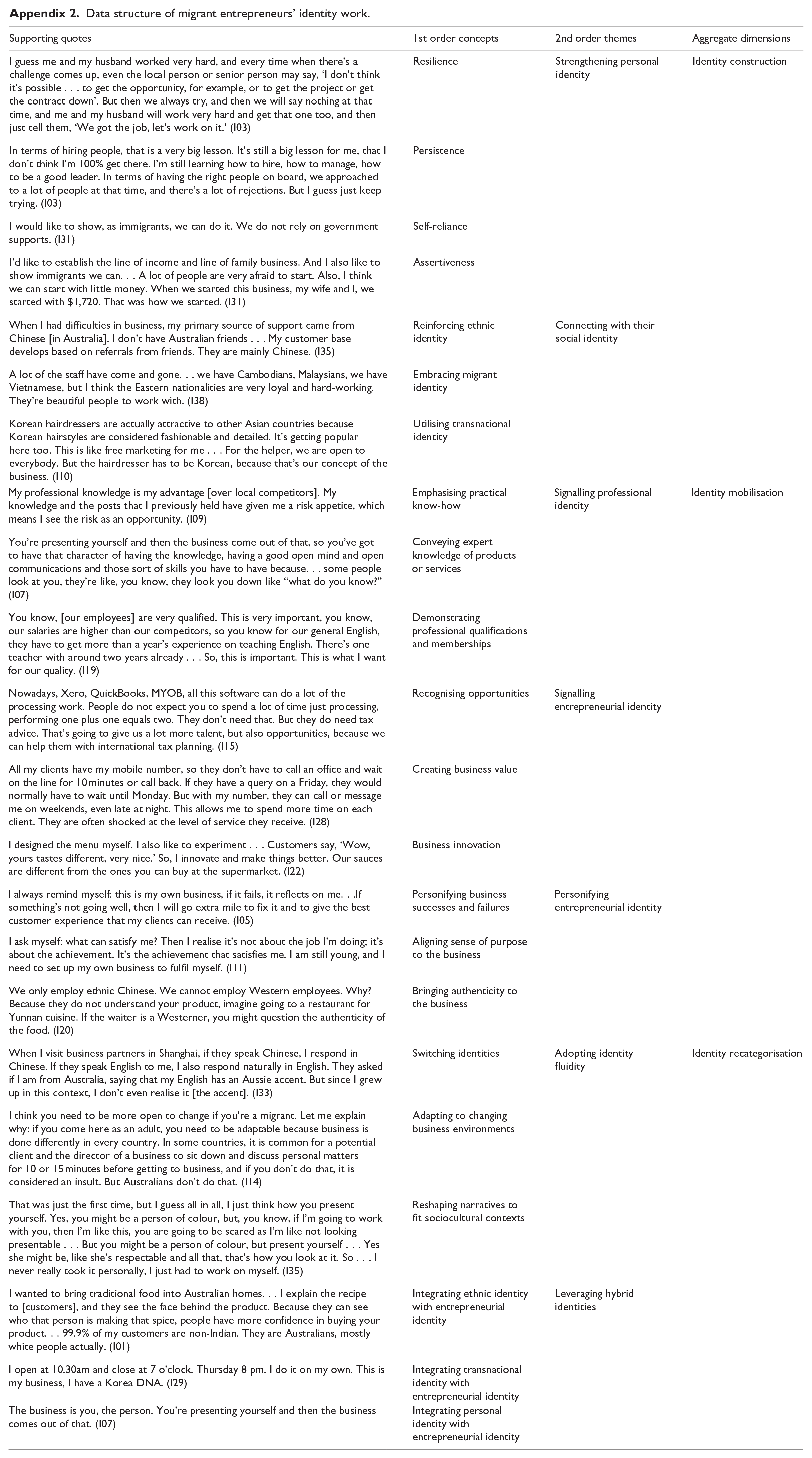
| Supporting quotes | 1st order concepts | 2nd order themes | Aggregate dimensions |
|---|---|---|---|
| I guess me and my husband worked very hard, and every time when there’s a challenge comes up, even the local person or senior person may say, ‘I don’t think it’s possible . . . to get the opportunity, for example, or to get the project or get the contract down’. But then we always try, and then we will say nothing at that time, and me and my husband will work very hard and get that one too, and then just tell them, ‘We got the job, let’s work on it.’ (I03) | Resilience | Strengthening personal identity | Identity construction |
| In terms of hiring people, that is a very big lesson. It’s still a big lesson for me, that I don’t think I’m 100% get there. I’m still learning how to hire, how to manage, how to be a good leader. In terms of having the right people on board, we approached to a lot of people at that time, and there’s a lot of rejections. But I guess just keep trying. (I03) | Persistence | ||
| I would like to show, as immigrants, we can do it. We do not rely on government supports. (I31) | Self-reliance | ||
| I’d like to establish the line of income and line of family business. And I also like to show immigrants we can. . . A lot of people are very afraid to start. Also, I think we can start with little money. When we started this business, my wife and I, we started with $1,720. That was how we started. (I31) | Assertiveness | ||
| When I had difficulties in business, my primary source of support came from Chinese [in Australia]. I don’t have Australian friends . . . My customer base develops based on referrals from friends. They are mainly Chinese. (I35) | Reinforcing ethnic identity | Connecting with their social identity | |
| A lot of the staff have come and gone. . . we have Cambodians, Malaysians, we have Vietnamese, but I think the Eastern nationalities are very loyal and hard-working. They’re beautiful people to work with. (I38) | Embracing migrant identity | ||
| Korean hairdressers are actually attractive to other Asian countries because Korean hairstyles are considered fashionable and detailed. It’s getting popular here too. This is like free marketing for me . . . For the helper, we are open to everybody. But the hairdresser has to be Korean, because that’s our concept of the business. (I10) | Utilising transnational identity | ||
| My professional knowledge is my advantage [over local competitors]. My knowledge and the posts that I previously held have given me a risk appetite, which means I see the risk as an opportunity. (I09) | Emphasising practical know-how | Signalling professional identity | Identity mobilisation |
| You’re presenting yourself and then the business come out of that, so you’ve got to have that character of having the knowledge, having a good open mind and open communications and those sort of skills you have to have because. . . some people look at you, they’re like, you know, they look you down like “what do you know?” (I07) | Conveying expert knowledge of products or services | ||
| You know, [our employees] are very qualified. This is very important, you know, our salaries are higher than our competitors, so you know for our general English, they have to get more than a year’s experience on teaching English. There’s one teacher with around two years already . . . So, this is important. This is what I want for our quality. (I19) | Demonstrating professional qualifications and memberships | ||
| Nowadays, Xero, QuickBooks, MYOB, all this software can do a lot of the processing work. People do not expect you to spend a lot of time just processing, performing one plus one equals two. They don’t need that. But they do need tax advice. That’s going to give us a lot more talent, but also opportunities, because we can help them with international tax planning. (I15) | Recognising opportunities | Signalling entrepreneurial identity | |
| All my clients have my mobile number, so they don’t have to call an office and wait on the line for 10 minutes or call back. If they have a query on a Friday, they would normally have to wait until Monday. But with my number, they can call or message me on weekends, even late at night. This allows me to spend more time on each client. They are often shocked at the level of service they receive. (I28) | Creating business value | ||
| I designed the menu myself. I also like to experiment . . . Customers say, ‘Wow, yours tastes different, very nice.’ So, I innovate and make things better. Our sauces are different from the ones you can buy at the supermarket. (I22) | Business innovation | ||
| I always remind myself: this is my own business, if it fails, it reflects on me. . .If something’s not going well, then I will go extra mile to fix it and to give the best customer experience that my clients can receive. (I05) | Personifying business successes and failures | Personifying entrepreneurial identity | |
| I ask myself: what can satisfy me? Then I realise it’s not about the job I’m doing; it’s about the achievement. It’s the achievement that satisfies me. I am still young, and I need to set up my own business to fulfil myself. (I11) | Aligning sense of purpose to the business | ||
| We only employ ethnic Chinese. We cannot employ Western employees. Why? Because they do not understand your product, imagine going to a restaurant for Yunnan cuisine. If the waiter is a Westerner, you might question the authenticity of the food. (I20) | Bringing authenticity to the business | ||
| When I visit business partners in Shanghai, if they speak Chinese, I respond in Chinese. If they speak English to me, I also respond naturally in English. They asked if I am from Australia, saying that my English has an Aussie accent. But since I grew up in this context, I don’t even realise it [the accent]. (I33) | Switching identities | Adopting identity fluidity | Identity recategorisation |
| I think you need to be more open to change if you’re a migrant. Let me explain why: if you come here as an adult, you need to be adaptable because business is done differently in every country. In some countries, it is common for a potential client and the director of a business to sit down and discuss personal matters for 10 or 15 minutes before getting to business, and if you don’t do that, it is considered an insult. But Australians don’t do that. (I14) | Adapting to changing business environments | ||
| That was just the first time, but I guess all in all, I just think how you present yourself. Yes, you might be a person of colour, but, you know, if I’m going to work with you, then I’m like this, you are going to be scared as I’m like not looking presentable . . . But you might be a person of colour, but present yourself . . . Yes she might be, like she’s respectable and all that, that’s how you look at it. So . . . I never really took it personally, I just had to work on myself. (I35) | Reshaping narratives to fit sociocultural contexts | ||
| I wanted to bring traditional food into Australian homes. . . I explain the recipe to [customers], and they see the face behind the product. Because they can see who that person is making that spice, people have more confidence in buying your product. . . 99.9% of my customers are non-Indian. They are Australians, mostly white people actually. (I01) | Integrating ethnic identity with entrepreneurial identity | Leveraging hybrid identities | |
| I open at 10.30am and close at 7 o’clock. Thursday 8 pm. I do it on my own. This is my business, I have a Korea DNA. (I29) | Integrating transnational identity with entrepreneurial identity | ||
| The business is you, the person. You’re presenting yourself and then the business comes out of that. (I07) | Integrating personal identity with entrepreneurial identity |
Funding
The author(s) received no financial support for the research, authorship, and/or publication of this article.
