




Abstract
Building on an in-depth study of 12 Bulgarian migrant entrepreneurial company cases in London, we illustrate how migrant entrepreneurs (MEs) interact with, and learn from, their exposure to a diaspora network. We demonstrate that learning processes need to be studied within the context where they occur as MEs adapt their modes of learning to contextual changes. We use social learning theory to offer a situated process model of learning, which shows why and how learning evolves over time, the learning modes MEs undergo (i.e. observational, participative, and exploratory learning), as well as the process configuration within which these learning modes are rooted. This article adds to the growing body of work showing the boundary conditions and the mechanisms through which MEs learn from networks when operating in a foreign market.
Introduction
Prior studies on entrepreneurial learning have theorised actor learning strategies and modes before market entry (Choi et al., 2008; Lévesque et al., 2009). Nevertheless, while entrepreneurial learning is largely recognised as a socially constructed process, many studies have largely overlooked the role of context (Shapero and Sokol, 1982; Toutain et al., 2017; Welter, 2011; Welter and Gartner, 2017). What makes the entrepreneurial learning process different in migrant ventures from native or local entrepreneurial ventures is the role of embeddedness and mixed embeddedness (Elo, 2016; Elo et al., 2018; Jones et al., 2014; Kloosterman, 2010; Ram et al., 2008, 2017). As such, analyses have highlighted the complex influence of network contexts, for example, diaspora contexts, on migrant entrepreneurial activities (Elo et al., 2018).
Research on the impact of context on entrepreneurial learning remains scarce (Welter, 2011; Welter et al., 2016). The scholarly focus has been on examining individual-level differences; exploring why the activities of migrant and diaspora entrepreneurs differ from other entrepreneur types and how these differences influence the process of entrepreneurial development (Baycan-Levent and Nijkamp, 2009; Elo et al., 2018; Jones et al. 2014). The extant evidence highlights the complexity of networks such as that within the context of diasporas on migrant entrepreneurial activities but more research is required in this domain (Elo et al., 2018).
To contribute to this debate, this study positions entrepreneurial learning within the context where it occurs. This article explores the learning of Bulgarian migrant entrepreneurs (MEs) in the natural setting of the diaspora networks where they reside. By exploring how entrepreneurial actors interact with, and learn from, their diaspora network we develop a situated process model of learning and show how it develops over time. Migrant entrepreneurship has been studied across different branches in social sciences informing a variety of different conceptualisations (Aliaga-Isla and Rialp, 2013; Högberg et al., 2016; Ram et al., 2017). In this study, we utilise Smallbone’s (2005: 2) definition: va[e]thnic minority entrepreneurs have been understood to be immigrants in the countries concerned [. . .]. Immigrants are defined as persons who have been born abroad. Irrespective of their nationality and irrespective of whether they are considered to be ethnic minorities in the countries concerned [. . .].
Migrant entrepreneurs are rarely fully familiar with the host country’s market environment and the challenges it presents before the creation of their businesses. Furthermore, because migrants were previously embedded within the environment of their home countries, there are limits to the utility of prior knowledge and experience (Muehlfeld et al., 2012). Hence, investigating the learning process of migrant entrepreneurs is significant for entrepreneurship scholarship as it can serve as the key to understanding how migrants overcome the economic risks encountered in host countries.
Previous studies have proposed that harnessing early experience and learning from others are important factors for entering entrepreneurship (Engel et al., 2014; Zhao et al., 2005). Yet, ‘the entrepreneurial learning literature remains underdeveloped and lacks a clear understanding of the learning process’ (Markowska and Wiklund, 2020: 1). Little is known about how small businesses actively utilise networks to facilitate their learning and operations abroad (Hilmersson and Jansson, 2012). This gap extends when we dig deeper into the learning process and ask how they synchronise the different modes of learning that occur in social networks. Madsen and Desai (2010) highlight this gap in their call for ‘more research into the mechanisms by which organizations [. . .] learn’ (p. 472). Looking at migrant entrepreneurial ventures and their intangible resources within the diaspora context such as relationships and knowledge, as well as the way those knowledge resources are utilised, makes it possible to highlight the role and the process of entrepreneurial learning for achieving foreign market integration. To advance this topic, we draw from social learning theory (Bandura, 1977b); the focus here on social networks allows us to develop a situated process model. This reflects the reliance migrant entrepreneurs place upon social networks for the acquisition of various knowledge resources and the development of context-relevant capabilities (Korsgaard et al., 2015). Learning from social networks is a core element of social learning theory making this theory as appropriate for the development of an entrepreneurial learning process model (Markowska and Wiklund, 2020).
The article makes three contributions. First, we provide an integrated framework that reveals entrepreneurial learning modes (i.e. observational, participative, and exploratory learning) that migrant entrepreneurs undergo when operating within an ethnic diaspora network in a host-country environment, as well as the contextual configuration of these learning modes. Thus, we address current calls for more research on the entrepreneurial learning process of migrant and ethnic entrepreneurs in specific ethnic contexts such as diaspora networks (Dabić et al., 2020). Second, we note that the entrepreneurial learning processes (i.e. acquiring, enriching, accumulating, stabilising, divesting, and pioneering knowledge) occurs over three learning modes. These learning modes are sequential in nature; thus, we can refer to them as phases, and coincide with the gradually increasing interrelation between the diaspora businesses and the ability of new coming actors to engage in the active management of the knowledge repositories of the diaspora network. Third, we highlight the importance of operating within a diaspora network for realising effective learning via the accumulation of knowledge, bundling of knowledge for competency building, and competency leveraging. The diaspora network is a natural conduit of collective knowledge which enables different modes of entrepreneurial learning.
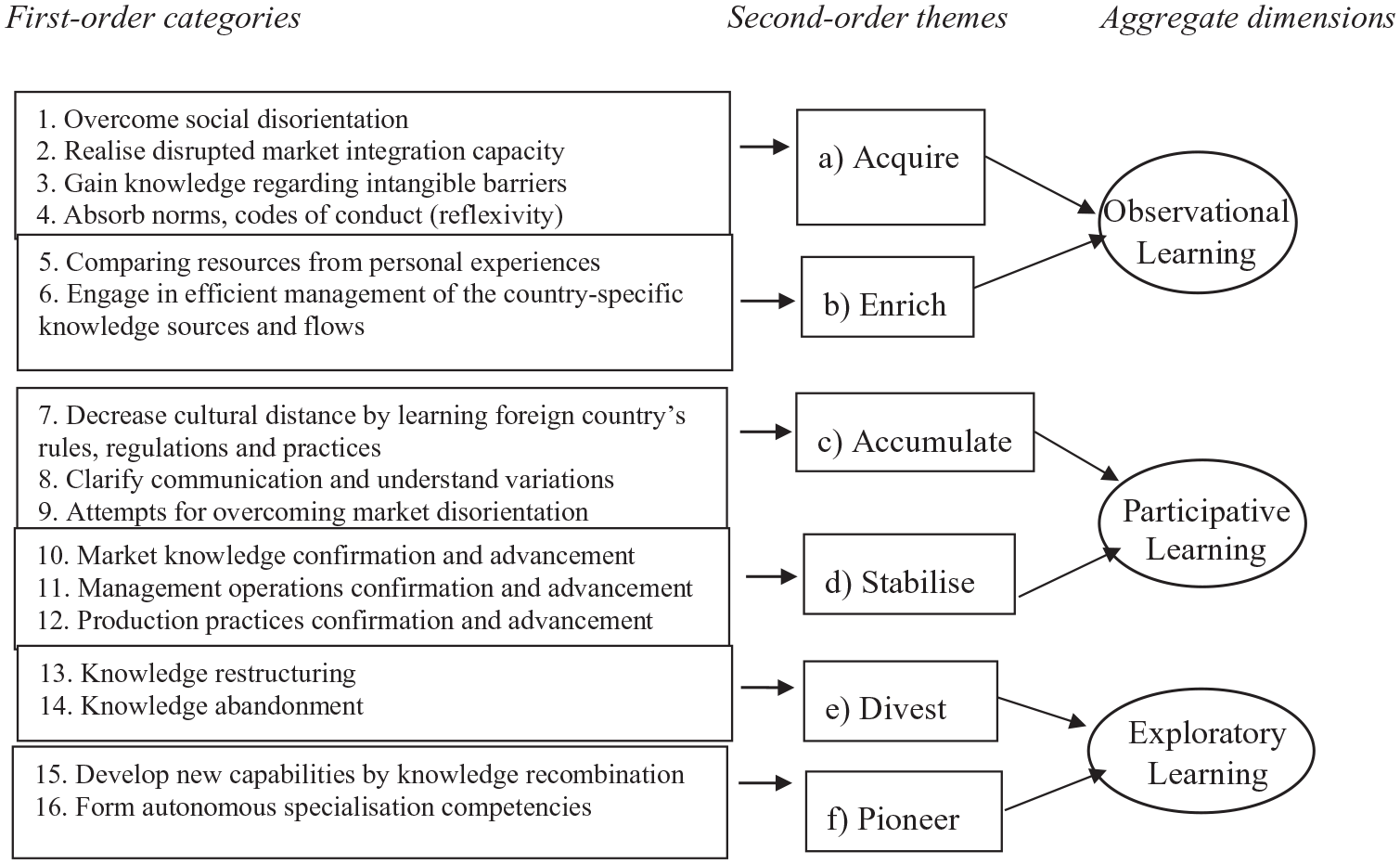
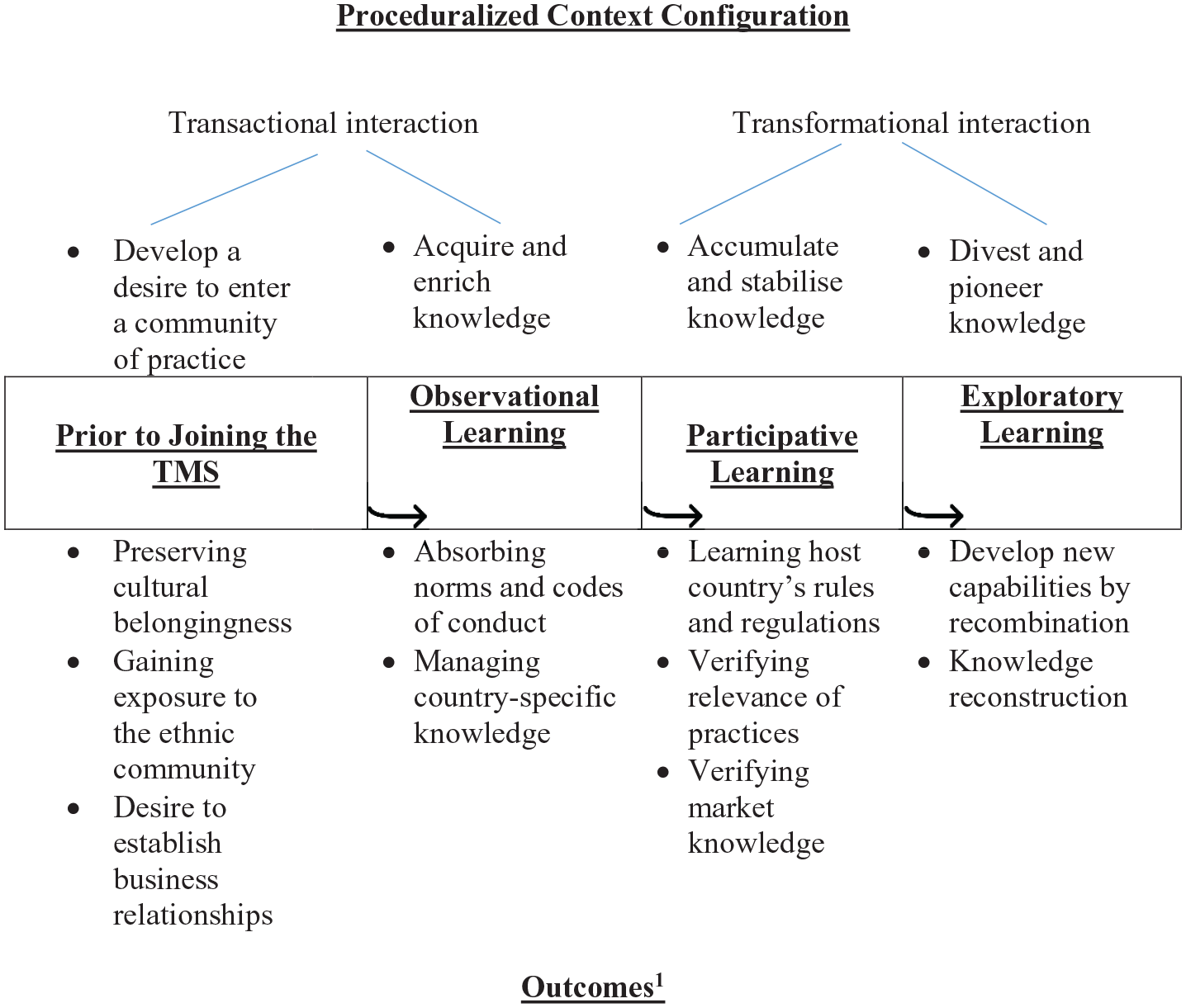
This article addresses calls for studies on learning in the context of opportunity exploration and exploitation (Wang and Chugh, 2014). We do so by illustrating how preferences for entrepreneurial learning modes evolve; that is, from observational, to participative to exploratory. Prior studies have recognised the existence of observational (learning from others), participative (experiential) and exploratory learning (Choi et al., 2008; Lévesque et al., 2009); yet, they have largely assumed learning modes remain fixed over time irrespective of the accumulated knowledge in the host country, or their changing social position of the firm. We counter such assumptions to show their oversimplification. This article demonstrates the contextual circumstances upon which learning modes, observational, participative, and exploratory, occur (see Figure 1, first-order categories). Those learning models, previously suitable and useful, evolve to become more effective; changes in entrepreneurial learning modes correspond to the changing needs of migrant entrepreneurial ventures. We highlight the various contextual elements relevant to the learning modes of migrant entrepreneurs as they transition, and the entrepreneurial actions that each learning mode entails (see Figure 1, second-order themes). Contrary to former beliefs (Markowska and Wiklund, 2020), we show that exploratory learning among migrant entrepreneurs is not the starting point of the learning journey. Instead, exploratory learning is often preceded by observational and participative learning. These findings contribute to research on the contextualisation of entrepreneurial learning (Toutain et al., 2017). The model we propose provides insights into the stages of learning of migrant entrepreneurs (see Figure 2). Moreover, the transition of learning modes corresponds to the enhancement of the value that migrant entrepreneurs generate for the diaspora network in which they operate. Hence, this article responds to calls to analyse contextual factors associated with the transition from exploitation to exploration (Wang and Chugh, 2014). Our article proceeds as follows. We discuss the literature on networks and the memory they hold, as well as the interplay between context and modes of learning. We then present our methods and findings. The final section contains a discussion of the findings and conclusions.
Data structure and reduction.
Proceduralised context configuration.
Research background
The learning and challenges of migrant entrepreneurs operating abroad
Foreign business actors entering a host-country market often face difficulty in learning how to engage in the efficient management of country-specific knowledge sources and flows (Stinchcombe, 1965). Some significant obstacles to learning are imposed by difficulties in communication and understanding (Schmidt and Sofka, 2009). Such obstacles lead to risks, business mistakes and poorer productivity (Lord and Ranft, 2000), but most notably, a struggle for synchronising and configuring knowledge relevant to the local environment (Stinchcombe, 1965). Foreign firms need to overcome these issues and establish coherence in inter-firm and intra-firm learning, a crucial path for the legitimisation of business actor actions.
The literature on learning processes has shown the importance of social and network capital for the knowledge development of entrepreneurial firms (Birley, 1985; Nahapiet and Ghoshal, 1998). Social networks serve as hubs of information and knowledge, which can stimulate the alignment of applicable knowledge or practices (Podolny, 2001). Research by Schmidt and Sofka (2009) and Johanson and Vahlne (2009) indicate that one of the core challenges MEs need to address is the inadequacy of their knowledge networks (Ostgaard and Birley, 1994). In the context of this pressing issue, novice MEs often capitalise on the opportunity to utilise their legitimacy, based on cultural and social commonalities, by entering a diaspora network. Doing so helps MEs to enhance their learning prospects, as well as their overall market integration (Zaheer, 1995). The role of ethnic networks in promoting entrepreneurial learning efforts has already been stressed (Drori et al., 2009).
Diaspora networks and their memory
The integration of knowledge by new, and incumbent actors, promotes ethnic diaspora networks as centres for creative and collaborative problem-solving. The diaspora settings are sources of collective knowledge and memory that shape, as well as are shaped by, the individual entrepreneurial learning experiences of MEs. Thus, existing transactive memory represents distributed organisational memory, which, as we will show, embodies the collective memory of the entrepreneurial community. The notion denotes the mechanisms through which ‘networks, ideas, information and practices [. . .] within dual social fields’ are used to create ‘a collective system for encoding, storing, and retrieving information’, in which knowledge disseminated to a group of individuals turn into a mutual resource (Argote, 2015: 198; Lewis and Herndon, 2011). The network’s knowledge repository is a product of the experiences of network members; this enables members to connect to a desired knowledge resource – a capability that considerably improves collective performance via vicarious means (Ren and Argote, 2011).
Knowledge in a transactive memory system has an explicit and tacit nature; the latter makes transferability a challenge (Nonaka and von Krogh, 2009). The difficulty transferring this type of knowledge arises as ME knowledge may reside in the experiences of other entrepreneurs; as such, it is vicarious (Levitt and March, 1988). Learning from difficult to transmit tacit knowledge is most effectively realised within the context of a social network (Nonaka and Takeuchi, 1995). Owing to the relational links between members, social networks are a central contextual factor for realising business efficiencies via learning (Skyrme, 2000). Thus, earlier studies suggest that such networks help entrepreneurs achieve a higher competitive advantage than networks without transactive memory (Austin, 2003; Lewis, 2004; Rulke et al., 2000). Transactive systems are so effective due to the tendency by members to improve the knowledge and the abilities of other incumbents (Argote, 2015). Thus, entrepreneurial learning is only supported by the promise of new learners to enrich existing knowledge; this promise supports the learning process of new members and activates mentoring processes. As we demonstrate, diaspora networks integrate knowledge from both the home and the host environment, facilitated by their bridging function. The knowledge system in the diaspora gives members prospects not only for enhancing their entrepreneurial learning but also provides them with the know-how required to adapt to, and operate in, the foreign environment and offers awareness of the fields in which members operate.
The role of diaspora networks for supporting migrant entrepreneurial activities in the host country is well rehearsed in the migrant entrepreneurship literature (Elo, 2016; Elo and Freiling, 2015; Elo and Volovelsky, 2017; Kloosterman et al., 1999; Waldinger, 1995). Previous research argues that social diaspora networks assist migrant entrepreneurs not only in accessing financial resources but also in providing specific market knowledge for attracting customers and knowledgeable workforce (Barnard and Pendock, 2013; Dabić et al., 2020). Moreover, ethnic diaspora networks are centres for creative and collaborative problem-solving as they provide various ways of organising that convert resources into outputs. For example, Degbey and Ellis (2019) find that diaspora networks influence cross-border M&As in Africa; in addition, the diasporic ties of the actors influence outcomes. Apart from analyses of how ethnic networks may influence migrant entrepreneurial activities and outcomes, there is a limited research effort in unveiling the specific learning processes and dynamics that occur in specific ethnic contexts, such as diaspora networks (Dabić et al., 2020; Elo et al., 2018). In addition, it has been suggested (Elo et al., 2018; Hedaa and Törnroos, 2002) that the diaspora impact is not yet well understood in its temporal setting. Most studies on the impact of the ethnic diaspora context on migrant entrepreneurial activities tend to have historic settings in terms of time and timing. In this study, we shed light on the role of diaspora networks on ME learning processes, while mapping the temporal element.
Social learning theory
Entrepreneurship research highlights the importance of actor experiences in the opportunity identification process (Politis, 2005). Entrepreneurs are known to extract useful knowledge from their experience when acting on an opportunity (Corbett, 2005; Pittaway and Thorpe, 2012). Yet, the transformative effect of prior experience assumes that entrepreneurial actors have agency and can recognise the novel application of their knowledge (Markowska and Wiklund, 2020). Nevertheless, MEs face significant risks arising from constraints upon their abilities to apply prior knowledge to opportunity development in a host-country environment. Thus, they cannot be certain that their knowledge is relevant and can facilitate the opportunity development process. Due to these complexities, ME actions will be steered by the confidence they have in their knowledge, rather than the knowledge repositories per se (Krueger, 2007). The dynamics of entrepreneurial learning make social learning theory relevant to how MEs act on opportunities in the host country.
The focus of social learning theory on social networks allows us to develop a situated process model reflecting the reliance of migrant entrepreneurs on social networks for the acquisition of various knowledge resources and the development of context-relevant capabilities (Korsgaard et al., 2015). Theoretically, learning from social networks is a core element of social learning theory (Bandura, 1977b); this enables us to explore learning processes in the context of social networks such as diaspora networks (Markowska and Wiklund, 2020). Social learning theory views MEs as agents guided by considerations of their self-efficacy; hence, these considerations shape their behaviour (Bandura, 2001). MEs self-efficacy ‘includes beliefs about capabilities of achieving desired outcomes as well as beliefs about one’s capabilities to complete tasks’ (Drnovšek et al., 2010: 335). As a result, ME beliefs in their capacity to develop an opportunity in the host country will influence learning patterns. In line with previous research (Bandura, 1977a, 1997), we expect ME self-efficacy to determine openness to adopting social examples from the diaspora community. Thus, social learning theory holds considerable explanatory potential for shedding light on the evolution of ME learning modes, observational, participative, and exploratory, shaped by the changing perception of their efficacy.
By operating in the social environment of the diaspora, MEs can benefit from utilising the knowledge of other actors in the host country during their learning process, which reduces the risks of operating in a new market (Baum et al., 2000; Holcomb et al., 2009). Yet, MEs also need to follow the social norms present in this environment to be recognised as genuine collaborators, rather than rent-seekers (Lefebvre et al., 2015; Zozimo et al., 2017). The interplay between entrepreneurial learning arising from the social environment, while creating a new wealth of knowledge for the community, is an interesting duality. This reaffirms the view that learning within a social network is part of a reciprocal process influenced by behavioural, cognitive, and environmental factors (Bandura, 1977b; Jack and Anderson, 2002). The notion that entrepreneurs manage risks by influencing their knowledge repositories, as well as shaping the environment, is prominent (Hjorth, 2004; McKeever et al., 2014). Therefore, entrepreneurial learning should be recognised as a process dependent on personal factors (previous knowledge), psychological factors (self-efficacy), and environmental (social) factors (Krueger, 2007; Toutain et al., 2017). Social learning theory can shed light on these grounds; we use it to build a model that outlines the reciprocal relationships between MEs and their diaspora environment. These relationships guide ME learning processes and hence, make this model rich in context. Positioning entrepreneurial learning within the context where it occurs answers calls for focusing on the largely overlooked role of context in entrepreneurial learning (Toutain et al., 2017).
Theorising context
In the migrant entrepreneurship literature, research interest in the role of entrepreneurial context has been a subject of scholarly debates and calls for further contributions that are beyond empirical advancement but rather suggest, novel theorisations (Welter, 2011; Welter et al., 2016). Previous research on migrant entrepreneurship has highlighted the role of embeddedness and mixed embeddedness as a key differentiation factor between migrant and local entrepreneurs, who do not possess additional layers of contextual embeddedness (Edwards et al., 2016; Elo, 2016; Jones et al., 2014; Kloosterman, 2010; Ram et al., 2008, 2017; Rath and Kloosterman, 2000). In addition, recent studies have highlighted the complexity of network contexts, such as diaspora contexts and their impact on migrant entrepreneurial activities, calling for more research work in this domain (Elo et al., 2018; Zahra et al., 2014). We respond to this call by shedding light on the dynamics in this type of ethnic network when exploring how migrant entrepreneurial learning develops and evolves by focusing on the role of specific contextual factors.
The diaspora network assists in the development of contextual learning through the formation of ‘proceduralised context’ (Brézillon and Pomerol, 1999); this generates contextual learning which is invoked, assembled, structured, and situated according to the specific personal contextual knowledge of those in the diaspora network. In diaspora networks, a large part of the personal contextual knowledge of its participants is rationalised and thus, procedularised which influences entrepreneur learning and decision-making and responses to external risks (McCarthy, 1993). By operating within the diaspora social environment, MEs get exposed to new knowledge and insights, as well as learn new skills, which may alter their learning processes. MEs are likely to acquire knowledge and enrich existing repositories so potentially, change attitudes and behaviour towards the learning processes utilised so far. This understanding is aligned with prior research, which suggests that acquiring new entrepreneurial tools influences actor responses to dealing with risks. MEs gradual embeddedness in the diaspora network is likely to have an influence on the parts of the procedularised context to which they are exposed, and under which they operate. Hence, the learning modes MEs undergo, as well as their respective outcomes, are likely to change with an increased association with the diaspora network. However, there is a scarcity of research on the dynamics of entrepreneurial learning and how it is shaped by the procedularised context within the diaspora.
Methodological approach
Data context and collection
As shown in Table 1, we draw upon 12 in-depth case studies of Bulgarian migrant owned entrepreneurial firms. All are located and operate within the city of London, presently home to 46% of all self-employed foreign-born workers in the United Kingdom according to the 2011 labour force report of the UK Office for National Statistics. Moreover, more than 51.5% (4237) of the total number of 8798 Bulgarian entrepreneurs not only reside in London, but also manage successful business operations (Centre for Entrepreneurs and DueDil, 2014). A central event in this growing economic and migratory exchange and entrepreneurial activities between the UK and Bulgaria is the accession of Bulgaria to the European Union in 2007. All of the studied firms were founded during or following Bulgaria’s accession to the European Union.
A coded list of business cases.
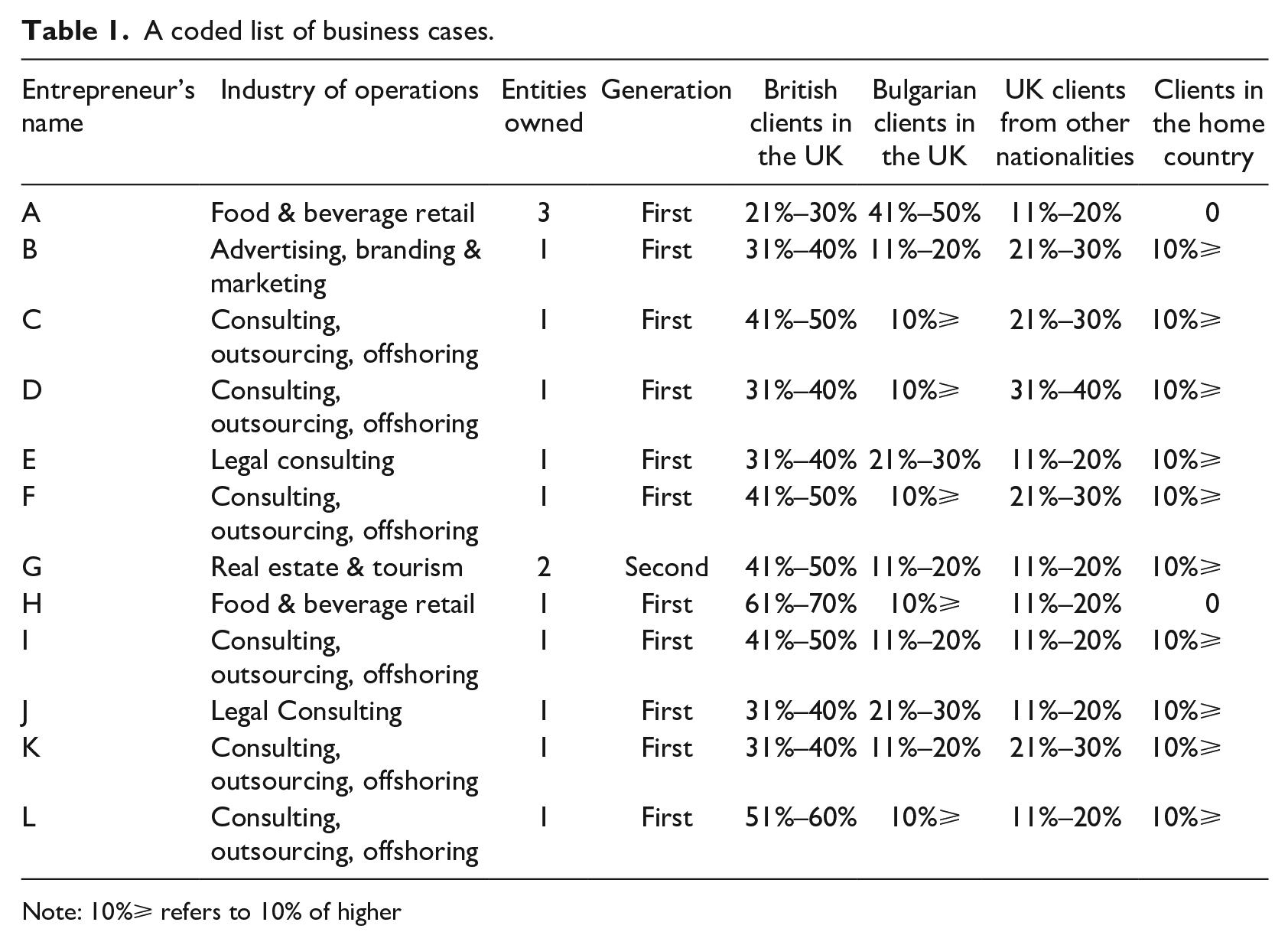
Note: 10%⩾ refers to 10% of higher
The 12 cases were selected through a purposeful sampling from a list of more than 130 operating in the United Kingdom. The British-Bulgarian Chamber of Commerce provided the list to one of the authors of the article. Initially, all the firms were selected by a survey to distinguish migrant entrepreneurs, from other types, as well as to ensure that the nominated cases satisfy other criteria. As part of the selection process, we follow Smallbone’s (2005) definition of ethnic minority migrant entrepreneurs. However, we focus only on first-generation entrepreneurs in line with our aim to understand the learning journey from the stage of entering the diaspora network. Furthermore, the selection criteria were the following: all firms need to be small businesses, employing less than 50 employees in total (EU Commission, 2016). In addition, we focused on firms situated in Greater London, and self-declared as a consulting services provider.
We focused on the cases of consulting service firms with high knowledge intensity rather than firms whose competitive advantage is based on tangible assets. The strategies of such firms focus upon offsetting liabilities by developing a superior competitive advantage based on factors other than the culture of the home country; for example, access to a low-cost workforce. By focusing on the cases of consulting service providers, we respond to calls for advancing knowledge on migrant entrepreneurship development in the knowledge-based and consulting industries (Grimaldi et al., 2020). The respondent firms ranged between two and 10 years of age and had between five and 27 employees. All, except two, provide high value-added services including business consulting, outsourcing, business law consulting, procurement, and search engine optimisation. The others were food and beverage retailers engaging in logistics consulting such as specialised consulting on distribution for improving relationships with customers and suppliers. In the data collection stage, we conducted a total of 63 semi-structured interviews with managers, employees, and external stakeholders. In each of the 12 cases, the interviews were conducted with the owners, all of whom were males, of the firms and at least three employees and external stakeholders. The interviews lasted between 60 and 90 minutes. All interviews were transcribed immediately after the end of each interview, coded, and analysed. The interviews were conducted in Bulgarian by one of the authors of the article, which facilitated the data collection process and encouraged information sharing and respondent honesty. Moreover, in each of the 12 firms where we conducted interviews with the migrant entrepreneurs and at least three employees and external stakeholders, a total of 52 interviews, providing insights about day-to-day practices and business operations. Also, 11 interviews were conducted with independent informants such as professionals; for example, the consul of the Bulgarian Embassy in London, consultants, business owners, and other members of the Bulgarian City Club in London.
The interview data were enriched by additional research observations conducted during several social and business events organised by the British-Bulgarian Chamber of Commerce, the Embassy of the Republic of Bulgaria, and shadowing the business meetings of individual actors. Such observation enabled us to gain a better understanding of the positioning, aligning strategies and tactics which entrepreneurs use for embedding themselves in the diaspora context. The social events took place in the period August–September 2011. The majority of interviews were conducted or organised during the period of social events between August and September 2011. We gained insights and recruited informants also thanks to the monthly meetings for business professionals organised by the Bulgarian City Club, which has a well-established relationship with the Bulgarian Embassy and the Chamber of Commerce. The opportunity to attend a number of these social events resulted also in additional 11 impromptu interviews with other stakeholders and experts in the entrepreneurial context. These interviewees included officials from the Bulgarian Embassy, the director of the British-Bulgarian Chamber of Commerce, Bulgarian business experts working for British and multinational firms, consultants based in Bulgaria, and other members of the Bulgarian diaspora in London.
Research approach and data reduction
We adopt a narrative approach to analyse the social reality explored by researchers (Schutz, 1962); thus, we explored the narratives produced by MEs allowing us to gain an in-depth understanding of the learning model in the context under study. Furthermore, we followed Rogoff’s (1995) recommendation to study the learning environment by focusing on three layers located in the discourse and examined – personal (micro: the entrepreneur’s experience), interpersonal (meso: one-on-one communication and exchange) and community (macro: the diaspora interactions). This approach allowed us to get a full grasp of the emerging dependencies. Narrative analysis was applied to all of the collected and transcribed data. Adopting Corley and Gioia’s (2004) approach to the data structure, the analysis was divided into three coding stages: delineating first-order concepts, second-order themes, and aggregate dimensions (see Figure 1).
In the first stage, through the use of open coding, we created first-order categories based on direct quotes from the interview data. In this initial stage of coding, we identified the commonalities in the entrepreneur narratives based on the collected interviews, described events, actions, and perceptions in the evolution of their businesses. In the second stage – axial coding – we integrated the first-order categories into second-order themes by identifying patterns in the data. This allowed us to isolate the processes made up by the different events and actions occurring in the development of the ME businesses. The final stage included selective coding, where the aggregated theoretical dimensions in this study emerged. The adopted data coding approach is in line with the abductive research process that informed our study. It allowed us to engage in a continuous data comparison moving back and forth between data and relevant aspects of theory, continuously reinterpreting the data in the light of theory (Blaikie, 2000). This approach helped us to develop scientific accounts out of the social accounts of the engagement of entrepreneurs in the environment unveiling the importance of the transactive memory and organisational learning constructs, which were not adopted at the beginning of the fieldwork.
Findings
Here, we look at the business development processes of the entrepreneurs in London. We highlight how the diaspora community facilitates their business development by helping them gain an understanding of the host-country market environment. This inevitably goes through a process of matching MEs prior business experience and knowledge to expectations of the host-country market.
The diaspora network as a domain for learning
The MEs relied on their membership within the diaspora network to address undeveloped competencies and unsatisfactory knowledge reserves. The evidence suggests that knowledge transfer and development within the diaspora provides focused market information, which enables the MEs to decrease the cost of their foreignness. This occurs in connection with problem-solving processes regarded as a mechanism for transporting knowledge from multiple and experienced parties. The flow of knowledge allows MEs to learn and thus, increase the efficiency of their businesses when operating abroad. Recurring testimony by the entrepreneurs suggests that being active in the diaspora community has strong business implications. Entrepreneur J sheds light on this by highlighting the knowledge integration benefits stemming from collaboration.
We work closely with some Bulgarian business organisations that we have met here. [. . .] That collaboration also allows us to benefit from each other’s knowledge without needing to hire more personnel. Hiring people is good when productivity increases, but increasing productivity without hiring extra people is even better as it increases our success rate. (Entrepreneur J)
The quote highlights how participation in diaspora organisations builds social ties that assist MEs in the process of business formation, growth and product/service realisation. The particular forms of assistance that have been observed include the provision of information regarding prospects for sponsorship, a wide range of institutional and legal support functions in the host country such as import/export procedures, as well as other forms of knowledge transfer. The symbiosis that occurs through the exchange of market-favoured competencies evolves into a resource interdependency in which two or more firms share knowledge, technology, or a service pool that allows for greater specialisation within the individual firm and the achievement of long-term benefits. A long-term orientation seems prevalent and may be necessary for cooperation to take place. Phrases that suggest the reliance on relatedness include variations of cooperation, frequently (indicated a repeated incidence of cooperation) and future, which indicate a desire for the continuation of the interdependence.
The communication that we have in the community is the reason to cooperate frequently. In the long term, this brings positives for both sides. (Entrepreneur C)
The data suggest that the development of network relations embracing a wide range of business partners – both similar and different – is possible when founded on shared cultural belongingness, embodied in the diaspora organisations in whose orbit the MEs find themselves. This strong network-centred orientation accelerates the externalisation of internal knowledge competencies and capabilities and their transfer to other diaspora learners.
Observational learning
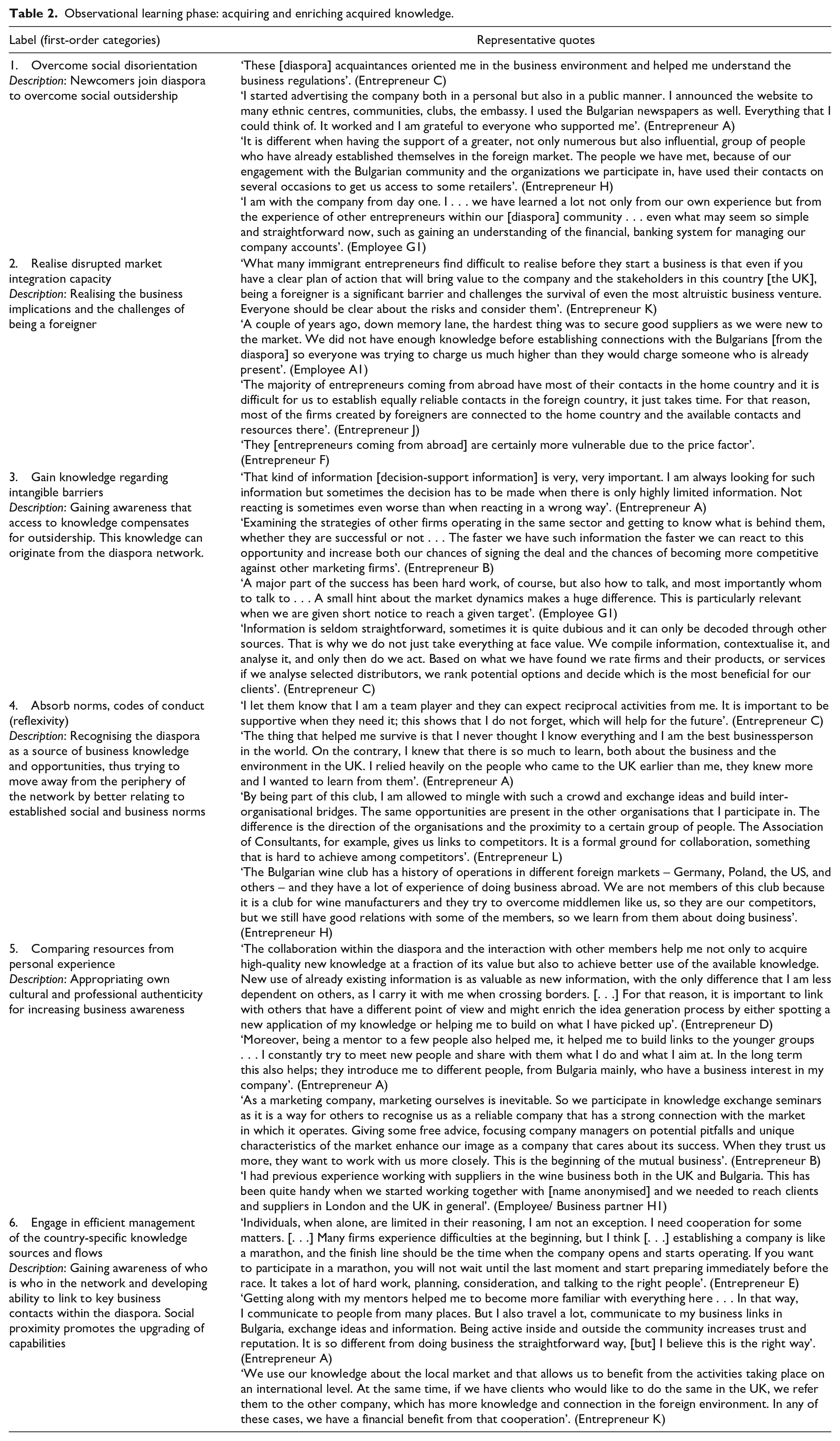
The interviews indicated that the processes via which MEs engage in learning within the diaspora network follow a particular order. The learning journey of new MEs joining the diaspora network starts with knowledge acquisition activities, namely acquiring and enriching knowledge, both elements of the observational learning phase in the model (see Figure 1). Acquiring is indicative of ME efforts to arrange a portfolio of knowledge resources relevant to the host-country environment. This learning process refers not only to obtaining a knowledge resource from the diaspora members, but also to understanding that a knowledge resource can be informed by the entrepreneur’s own experiences and exposure to the dual social environment. Enriching signifies the use of the newly acquired or extracted knowledge to further existing competencies and increase relevance to the host-country business environment. Both learning processes (acquiring and enriching) are sequential and promoted by gradual bonding between network members. While both processes encompass securing and internalising knowledge from outside the firm, both are driven by an inner perception of what constitutes an opportunity and how to pursue it. Representative quotes can be found in Table 2.
Observational learning phase: acquiring and enriching acquired knowledge.
Participative learning
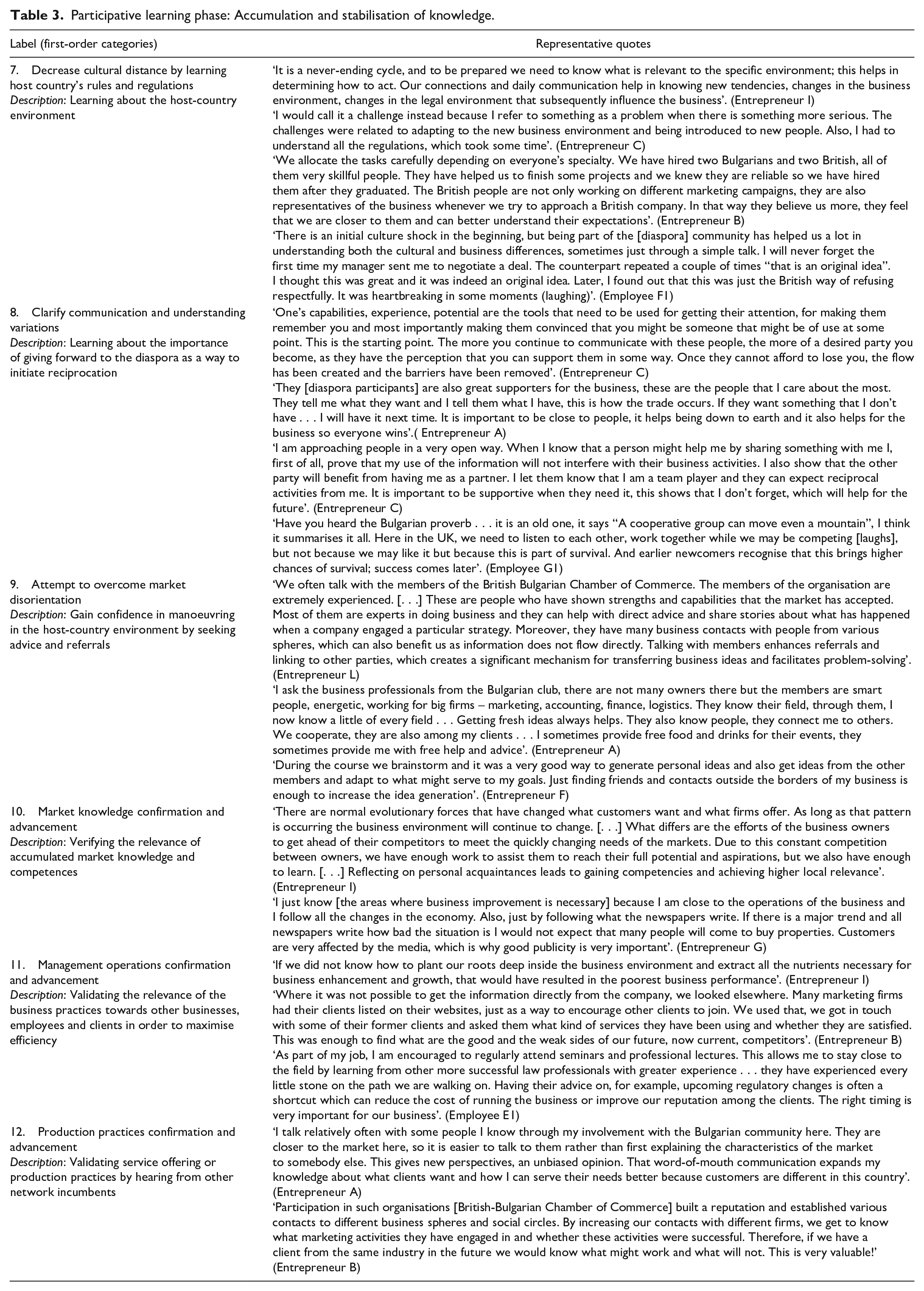
The attempt to create knowledge and synchronise it with the expectations of the host country requires the internal accumulation of that knowledge and its successive cumulative improvement – which we refer to as stabilisation – in collaboration with experienced members of the diaspora. This accumulation of knowledge assists MEs in gaining a business perspective while developing the organisational design of the firm in addition to other structural processes. Accumulation facilitates entrepreneurial firms in creating a portfolio of resources that are context-specific. Representative quotes can be found in Table 3.
Participative learning phase: Accumulation and stabilisation of knowledge.
Exploratory learning
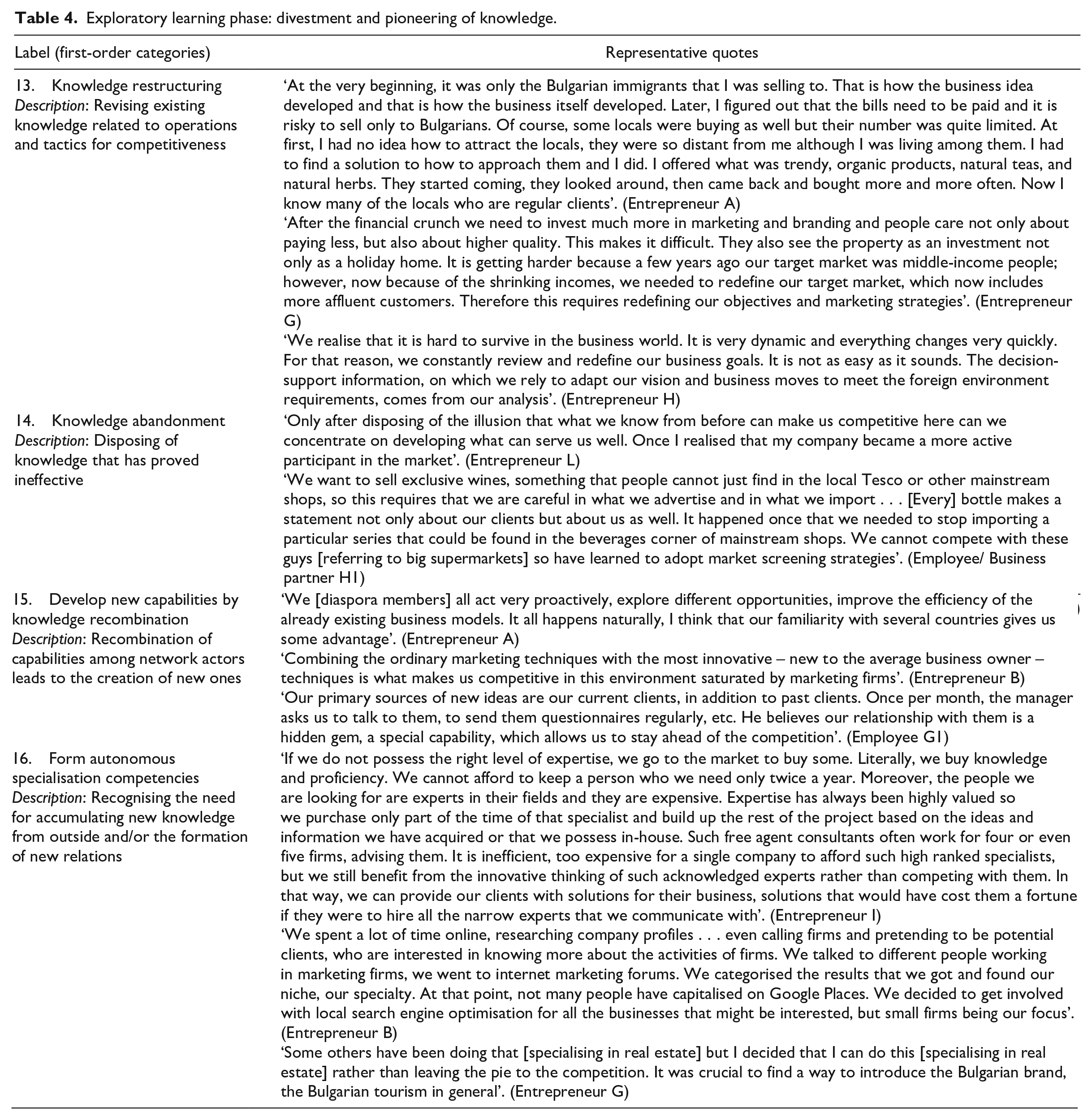
The last observed learning phase encompasses two additional processes. First, in the case when the diaspora network enriched and stabilised knowledge that does not perform as expected, then the knowledge is divested. Second, divesting knowledge may open gaps to be filled by creating knowledge, often collaboratively, that delivers desired performance. This act is associated with the process of knowledge pioneering. In this stage, the knowledge acquisition orientation (observed in the observational learning and participative learning phases) is replaced by a knowledge creation orientation due to the increased self-efficacy perceptions of MEs. The link between the divesting and pioneering processes, and how they relate to the observational learning and the participative learning phases, is shown by quote 13.1 in Table 3. The quote illustrates the entrepreneur’s realisation that although they has gone through the diaspora-facilitated observational and participative learning phases, sometimes what you have is not enough or it cannot work here although you have been told it should. This statement indicates that the network-assisted apparatuses for learning the host-country business do not always cover the expectations of the MEs. Thus, the observational and participative learning phases will sometimes fail to provide the expected degree of integration knowledge or inform adequate market integration practices. This can occur for two reasons. Either the expectant entrapment operates a business that is too different from the pool of other businesses within the diaspora, or, the available knowledge within the diaspora is of limited scope. The increased self-efficacy perception and mindfulness of the entrepreneurs regarding the limitations of the diaspora-facilitated learning stimulates them to proceed with a more rapid pace of executing business activities, following the divestment of knowledge that does not live up to expectations and pioneering alternative knowledge. Representative quotes can be found in Table 4.
Exploratory learning phase: divestment and pioneering of knowledge.
Discussion
This article’s development is led by the notion that regardless of the extant attention afforded to the entrepreneurial learning of MEs, the sequential and process dimensions remain underresearched (Wang and Chugh, 2014). Prior research on market entry has highlighted the necessity to integrate learning from opportunity exploration with that from opportunity exploitation while investigating the approach to learning within a collective social context (Wang and Chugh, 2014). In this article, we unpack the contextual nature of entrepreneurial learning by analysing the learning journey of MEs within a diaspora network. Consequently, we shed light on the role of diaspora networks in the learning process, while mapping the temporal element of ME learning within this context.
The study highlights the temporal element of the learning process. MEs were seen to benefit from observational learning upon their entry to the diaspora network. Observational learning offers an effective and less risky learning approach to exploiting opportunities (Holcomb et al., 2009; Zozimo et al., 2017). Nevertheless, following the early period of observational learning, MEs realise that they are capable of internally developing some of their newly gained knowledge (i.e. accumulating), as well as making minor additional improvements to existing capabilities (i.e. stabilising). Both ‘accumulating’ and ‘stabilising’ characterise participative learning of MEs – that is, they participate in the diaspora knowledge development and are no longer just passive recipients of knowledge. The third learning mode that MEs were found to initiate was exploratory learning. This learning mode was desirable for experienced MEs who were strongly embedded in the social context of the diaspora. Such network actors realise that conducting exploratory learning, characterised by divesting rooted knowledge inefficiencies and pioneering novel knowledge, is likely to make them distinctive in their entrepreneurial practice, may help them gain the recognition of peer diaspora members, gain higher standing for the network in the host country, and may result in market development. Although potentially valuable, this mode of learning appears to be only available to experienced MEs, who have previously gained higher degrees of self-efficacy during earlier learning modes. Such MEs have gained confidence to leverage off their strong relationships within the diaspora and actively engage in the social construction of knowledge. The sequential nature of ME learning suggests they intensify their exploratory efforts in the host environment over time. The exploratory mode of learning enables MEs to explore new avenues and challenge the accepted norms and knowledge of the social environment where they reside. It appears that MEs initiate this learning mode only after their business operations in the host country have stabilised and generated some success. In other words, learning preferences change over time, shifting from observation to participation, to exploration, upon conditions whereby MEs are becoming more embedded in the diaspora and so, enhancing perceptions of self-efficacy. Stagnation in either may limit MEs from reaching the next learning mode.
We note that MEs are given easy access to the ethnic diaspora network due to the presence of homophily allowing them to gradually gain an understanding of the norms and operations of the diaspora network as they engage with them. Through the course of increased interaction with the network members, the migrants gain new knowledge and skills that can facilitate their business development in the new market environment. This sheds light on the role of homophilous ties in underpinning business-specific knowledge development contributing to calls for research into analysing positive elements stemming from homophily (Phillips et al., 2013). This deviates from traditional views regarding homophily as an impairment to knowledge diversity (McPherson et al., 2001; Ruef et al., 2003). We have seen that diaspora networks encourage migrant entrepreneurship by providing a specific milieu for learning and developing strategies for managing, combining, and employing knowledge resources. Our study suggests that various learning dynamics emerge and co-exist in the context of the diaspora community which provides MEs with access to a collective resource we refer to (following Argote, 2013) as transactive memory. The network-level knowledge processing that characterises operating within a transactive memory system (e.g. the diaspora) enables MEs to connect to a desired knowledge resource, a capability that considerably improves collective performance via vicarious means (Ren and Argote, 2011). Transactive memory as a distributed body of collective knowledge is indicated in the quotes by entrepreneurs J and C (see ‘The diaspora network as a domain for learning’ section) about the knowledge they gain from other MEs within the diaspora, referring to ‘collaboration’ in which they ‘benefit from each other’s knowledge’ (Entrepreneur J), as well as to ‘communication’ within a ‘community’ and cooperation that occurs ‘frequently’ (Entrepreneur C). All transactive memory systems (TMS) depend on socio-cognitive processes (i.e. the combination of the cognitive and social properties of the system) (Ellis, 2006; Wegner, 1995). Learning from, and contributing to, the transactive memory of the diaspora network causes a transformative change in MEs and the social systems in which they reside (Bass, 1985; Bono and Judge, 2004), as well as promoting collective learning (Kahai et al., 2003). This strengthens shared understanding and social coordination within the TMS (Day et al., 2004; Hammedi et al., 2013), promotes shared vision and cooperation (Day et al., 2004). Ultimately, the learning that occurs within the diaspora network is transformational in nature as it changes the way MEs use critical self-reflection to explore the knowledge made available to them (Clark, 1993; Kegan, 2000; Mezirow, 1991).
Transformational learning is characterised by far-reaching changes. These can also be observed in this study which explores the transformational benefits MEs reap by utilising the diaspora network’s transactive memory. Nevertheless, the transformational learning processes within the network also transform the network itself. This is because as MEs are brought closer to the network, they move from observational to participative learning, and finally to exploratory learning, which holds the potential for transforming the network’s transactive memory. To use Cope’s (2005: 379) words, ‘From a dynamic learning perspective, there remains a pressing need to understand how entrepreneurs learn . . . [to transform to] effective managers of people and resources’. In line with Cope (2005), we consider the learning journey of MEs as dynamic, contextual and cumulative. To accurately understand the relationships between learning and context, we need to be specific about what we regard as context. Context is the group of relevant surrounding influences and conditions that make a situation comprehensible; as such, it includes interacting factors about which MEs may remain unaware and so, creating the need for exploring the characteristics of the learning event to better understand entrepreneurial learning.
In this study, we explored views about the acquisition of contextual data/knowledge and a learning framework deemed appropriate for the needs of the observed MEs. Learning is seen as a rationalised construction of action, within a broader set of subjective contextual influences, such as moderating network characteristics and antecedent variables. The contextual influences on the rationalised construction of action have led to the creation of learning process proceduralisation within the observed diaspora network. The proceduralised context is formed by the part of the transactive memory that governs learning within the network. That is, tacit knowledge commonly known by the network actors, which is directly, but tacitly, used for the rational construction of learning action. The proceduralised context emerges as an important factor for entrepreneurial learning and shapes the course of learning. Hence, to understand ME entrepreneurial learning, we shed light on the proceduralised context within the diaspora. It should be noted that in the selection and the arrangement of the contextual elements such as acquisition, enrichment, and so on, for the proceduralised context, consisting of observational learning, participative learning, and exploratory learning, there are different networks that position the contextual elements in different ways. As a result, one proceduralised learning context can be superior to another. MEs try to obtain and organise the knowledge in such a way that the proceduralised context can be utilised for their own business purposes. The challenge for MEs is then to construct some rationality for the observed facts and, to foresee the results of possible actions; the resolution of this learning challenge is observed at a later stage (see Figure 2), when MEs start to play an active role in the redefinition of the network’s transactive memory.
The introduction of the three sequential learning modes, and their belonging configuration of context element, extends previous research in entrepreneurial learning. First, we extend the view that typical ways of gaining experience involve engaging in experimentation or simply imitating the behaviour of others (Bandura, 1977b; Holcomb et al., 2009). We develop this view by showing that both exist within a learning continuum (see Figure 1). This need is in line with the notion that the adoption of new beliefs, practices and behaviours influence how entrepreneurs see their environment (Erikson, 2003; Zhao et al., 2005), as well as how they ‘transform acquired experience into knowledge’ (Bandura, 1977b; Markowska and Wiklund, 2020: 3). In this article, we find that what influences an ME’s course of learning goes beyond the new knowledge they acquire. Learning is observed as a contextual task; this study describes the contextual influences upon ME learning.
Future research directions
Future studies might explore different settings, including diasporic and non-diasporic business circles, to test the conclusions of the current article and cross-validate the identified learning phases and the processes that belong to them. Currently, replicability is constrained by the limited sample and the nature of the employed qualitative methodology. The natural setting in which fieldwork occurs impedes control over external factors, which may further hinder replication. Future research may address this limitation by testing the theories proposed here in different geographic and social settings, using larger, more representative samples and quantitative methods. Particularly, it is worth exploring what other factors, apart from gradual embeddedness, may influence the proceduralised context and hence, the shift from one learning mode to another.
In addition, future research may consider the likelihood that the scope for the diaspora to facilitate learning may vary depending on the specific socio-cultural characteristics of the observed communities within that space. Differences in attitudes, ethnic identities, and values, kinship structures, rituals and reputation may lead to variances across communities in terms of the abilities of members to integrate knowledge from narratives representing success and failure, making the mapping of cross-cultural differences and investigating how they influence the conversion of liabilities within a diaspora network an interesting research avenue. Figure 3 sheds light on the cultural characteristics of the diaspora network and its participants. Highlighting these characteristics adds to clarifying the context where the respondent MEs undertook their learning. Moreover, these characteristics may have a moderating effect on the manner in which actors operate within the studied diaspora network, the learning phases they go through, as well as the learning outcomes they achieve. We encourage future research to further investigate the influence of context (proceduralised and broader) on ME learning. Thus, it is possible that comparative studies are designed with a focus on the role of, and the variances, in context. To facilitate the emergence of such studies, we outline a limited number of antecedents that need to be considered when comparing the learning processes of different migrant/minority entrepreneur groups. Future research can assess how the association between proceduralised context and learning outcomes may vary, depending on the cultural context in which migrant groups operate and the antecedents to their operation. Initiating a meta-analysis to explore the links between context, transactional memory and learning has the promise to provide further insight. Yet, the body of relevant literature is still slim; thus, it is an area that future research can investigate.
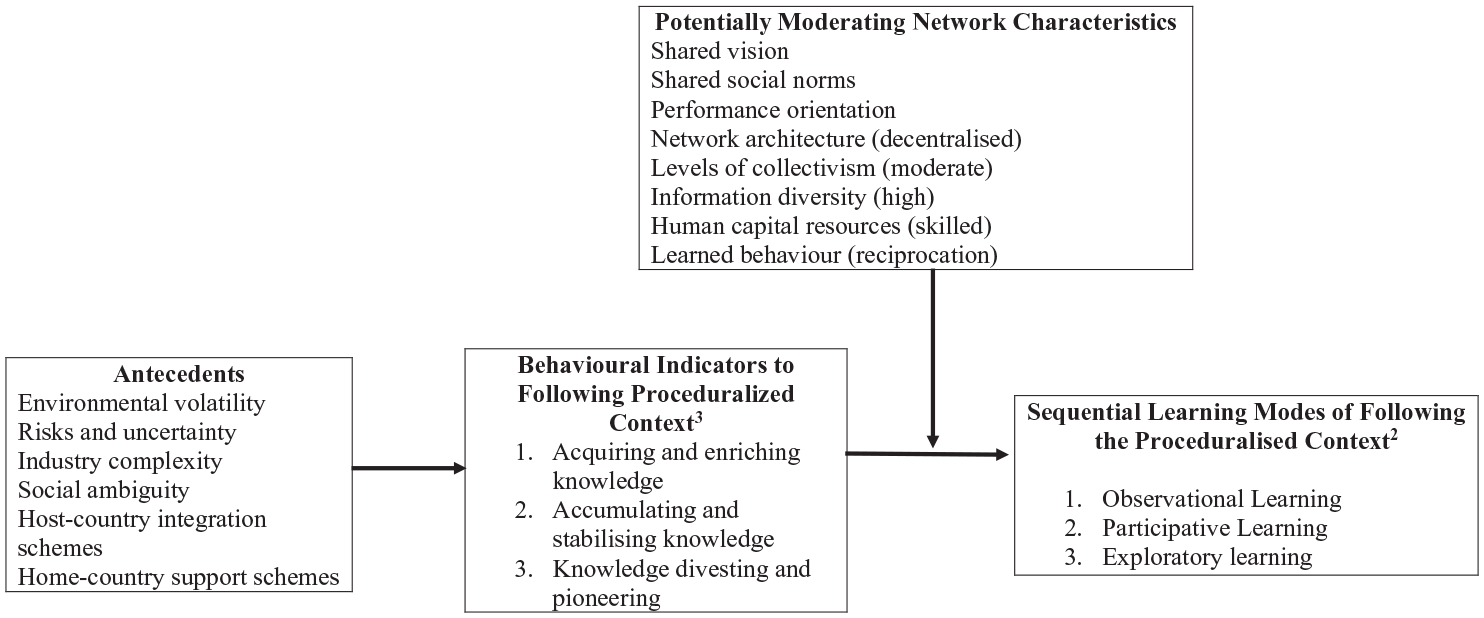
Associations between proceduralised context and learning.
Concluding with key contributions
A key contribution this article offers is the development of an integrated framework that reveals the learning configuration that MEs underwent when operating within an ethnic diaspora network in a host-country environment. The learning configuration was seen to occur over three modes; first, observational learning; second, participative learning; and third, exploratory learning. These modes were sequential in nature and coincided with the gradually increasing interrelations between the diaspora businesses and the ability of new actors to engage in the active management of the knowledge repositories of the diaspora network. The increasing interrelation (as demonstrated by the observational, the participative and finally, the exploratory affiliation of MEs in the diaspora network) altered their perceptions of self-efficacy and caused the shift to modes of learning.
Another key element of this article highlights the importance of the diaspora network context to act as an effective configuration of knowledge resources for competency building and leveraging. The social characteristics of the network facilitated the transfer of tacit knowledge. By nurturing social, as opposed to solitary learning, the diaspora network allowed MEs to enter unpredictable and unintentional situations in an authentic social context, supporting improvisation upon the best diaspora entrepreneurial practices and so, informed new knowledge creation. Moreover, the social learning mechanism motivated the exchange of narratives that illustrated stories about previous successes and failures complementing the learning processes and knowledge development. As part of this contribution, we also define the boundary conditions for learning within a diaspora network; these are the continuous development and co-development of knowledge occurring during the processes of enriching, accumulating, and stabilising, divesting and pioneering knowledge. Newly joined entrepreneurs can engage in observational learning, but it can be argued that the real value for their businesses is achieved during the later learning phases; this has a transformational effect upon ME businesses and also, the network’s transactive memory. It is during participative and exploratory learning that MEs can tailor the diaspora knowledge to their own business and thus, reap its full competitive potential. Nevertheless, to reach the higher levels of learning, they needed to reciprocate to network incumbents by showing readiness to actively engage in the continuous development and co-development of knowledge.
Finally this study, and the model it offers, addresses calls for illuminating the learning dynamics that entrepreneurs undergo and the role of context in the learning process. The proceduralised context available within the diaspora influences how knowledge is invoked, assembled and structured during the learning process. We demonstrate the intertwining of learning and context by shedding light on the proceduralised context configuration within which MEs learn. Moreover, we note that learning needs to be studied within the context where it occurs and that MEs adapt modes of learning to the changes in the proceduralised context. This arises as ME entrepreneurial learning is collaborative, and that diaspora embeddedness enables this process (Cope, 2011; Korsgaard, 2011; Korsgaard et al., 2015; Lechner and Dowling, 2003; Taylor and Thorpe, 2004). It can be argued that at each phase of embeddedness, MEs are facing a different proceduralised context that motivates adaptations to modes of learning.
Footnotes
Funding
The author(s) received no financial support for the research, authorship, and/or publication of this article.

Author biographies
Stoyan’s research focuses on entrepreneurs’ business development in the home and host country context. His research explores how entrepreneurs access, acquire, and adapt knowledge and capabilities. He explores the business assets entrepreneurs obtain from their membership in various organizations and how it influences their knowledge management processes. Stoyan has previously carried out projects on examining the business activities of entrepreneurs in the UK, Chile, Brazil and China.