




Abstract
It is becoming increasingly popular for musicians to study Body Mapping, a method of body movement education, to improve both body movement and musical quality. In Body Mapping workshops, observers frequently claim that they can both see and hear improvements in the performance, yet previous research does not support this anecdotal evidence. In the present study, pianists received a full day Body Mapping workshop and a panel of judges, blind to condition, evaluated audio and silent video clips of performances recorded the day before and the day after the workshop. In Experiment 1, judges were able to identify the post-test recordings by silent video at a rate significantly better than chance, but not with audio alone. In Experiment 2, ratings of quality of body movement were significantly higher for post-test silent video recordings, but no such effect was observed with audio alone. The present findings suggest that there are visible but not audible changes to the pianists’ performance. We discuss visual dominance as a possible explanation for these findings.
Background
In recent years, Body Mapping has grown in popularity as a somatic 1 method that can improve music performance and prevent injuries. In this method, educators coach students to inquire into their perceptions of their own body, the body map, and identify differences between their body map and their actual anatomical structures (Johnson, 2009). Educators and students work together to help the student build a greater awareness of their own body, integrating their bodily awareness into the music performance (Woodard, 2009). Body Mapping pedagogy considers the sensing, awareness, and quality of body movement to be fundamental aspects of music performance (Bindel, 2013). As the student corrects and refines their body map, the quality of body movement is said to visibly improve (Malde et al., 2013) and as a result, the quality of their musical performance is said to improve (Mark, 2003).
Body Mapping shares similarities with other somatic methods but is distinct in its approach and popularity among musicians. Copeland (2007) describes Body Mapping as “the practical application of anatomy to movement.” Students of Body Mapping learn about anatomical structures using visual images, physical anatomical models, palpation activities, and movement activities, applying the learned anatomy to activities such as music-making. While Body Mapping involves learning anatomy, these sessions differ from anatomy classes in that participants are expected to gain an awareness of the anatomical structures and functions within the context of their whole body movement and self-awareness (Malde, 2009). Originally conceived in the 1970s as a support to the learning of the Alexander Technique, Body Mapping has developed into its own distinct method which may be used in conjunction with other somatic methods or on its own (Johnson, 2009). At present, it is taught in at least 22 post-secondary music institutions (Association of Body Mapping Educators, 2020) and instructional literature for many specific instrument groups has become widely available (Association of Body Mapping Educators, 2021a). Body Mapping is often considered the only somatic method to be developed specifically for musicians (Buchanan & Hays, 2014; Rennie-Salonen & Villiers, 2016).
While the instructional literature in Body Mapping does not tend to explicitly define the exact movement parameters which would constitute “good” movement, there is certainly a consensus in this literature that instruction in Body Mapping can improve the way a musician moves during performance. Some descriptions of such improvements include greater coordination of movements in the body (Mark, 2003), a reduction in excessive force used to produce musical sound (Johnson, 2009; Mark, 2003), and an increase in the appearance and feeling of ease during music performance (Malde et al., 2013; Pearson, 2006). As movements are said to improve, playing positions are described as more dynamic, with less stiffness and holding in static postures (Johnson, 2009; Malde et al., 2013; Pearson, 2006) and the musicians spend less time in extreme ranges of motion (Conable, 2000; Mark, 2003). Changes in body movement are said to result in a myriad of audible changes. These include better dynamic control (Harscher, 2010; Murray, n.d.), greater fluidity (Pearson, 2016; Urso-Trapani, n.d.), a reduced prevalence of errors (Conable et al., 2015; Mark, 2003), and overall greater skill (Caplan, 2009). Various authors write that Body Mapping assists in playing for longer periods of time (Buchanan & Hays, 2014; Holt, 2016; Johnson, 2009) and playing at faster tempi (Harscher, 2010). Singers and instrumentalists alike are said to improve in their technical facility (Holt, 2016; Krayer-Luke, 2009) and are able to practice and perform with greater expressivity (Conable, 2000; Krayer-Luke & Breault Mulvey, 2014), and improved tone quality (Conable, 2000; Johnson, 2009).
While the popularity of Body Mapping has grown rapidly in recent years, the research on the effects of Body Mapping remains limited. Three qualitative studies have found that students learning Body Mapping in semester-long classes find the strategies useful in the context of music performance. Analysis of reflective journals in a study by Knaub (1999) found the students perceived having greater facility, less perceived tension, greater ease, stamina and breath control, as well as improved consistency of tone and increased resonance. A phenomenological study of students’ experiences by Salonen (2018) found that students became more aware of their bodily movements, which they perceived to improve their playing and singing quality. The students connected their own sense of physical ease to their musical interpretation and playing technique. Finally, Buchanan and Hays (2014) reported that during in-depth interviews, students described enhanced ability to handle fast tempi, loud dynamics, and intonation, and in many cases, an increased ease of body movement as well. Students expressed that they felt more capable of musical expressivity and focus, and improved their understanding of technical elements such as tone quality, even vibrato, breath support, and articulation (Buchanan & Hays, 2014). Students reported that sometimes their playing improved dramatically in a short period, while at other times improvements happened over the course of longer periods of study (Buchanan & Hays, 2014). This area of research has yet to illuminate whether the effects of Body Mapping tend to occur immediately following a session, over a longer period of time, or a combination of training durations.
Two studies quantitatively measured effects of Body Mapping on piano performance. In Wong’s (2015) study, pianists were given a 50-minute private lesson in a somatic method. Four of the 10 participants received an online lesson in Body Mapping, and a panel, blind to condition, evaluated audio and silent video recordings. Judges’ evaluations of musical quality were higher for post-test recordings on all factors except consistency of tempo. However, while the scores increased by a mean of 4%, none of the changes were found to be statistically significant. Evaluations of silent video showed slightly larger improvements, with statistical significance obtained in only one measure: a 5% increase in evaluated head-neck usage. Slade et al. (2020) found that MIDI data of pianists’ scales and arpeggios collected the day before and the day after a standard Body Mapping workshop were not consistently indicative of an improved piano performance. Furthermore, none of the measured changes were large enough to be audibly different. The authors posited that the reputation of Body Mapping as a method that can elicit immediately audible improvements in music performance may have its origin in a variable or variables other than audible changes.
It is interesting that the qualitative research findings and anecdotal reports indicate that there are improvements in music performance following the study of Body Mapping but the two quantitative studies do not support this. While it is possible that performance only improves after an entire semester of Body Mapping lessons, this reasoning would still not explain the anecdotal reports of improvements occurring immediately following a workshop, nor would it explain the reports in qualitative research that some improvements do occur dramatically in a short period of time. In this study, we sought to explore the perceptions of observers, blind to condition, of recordings taken before and after a single Body Mapping workshop. With these experiments, our objective is to better understand the potential origins of perceptions of short-term improvements in piano performance following such workshops.
Both experiments in this study were reviewed and approved by the Office of Research Ethics and Integrity at University of Ottawa. Participants gave consent for themselves using a written signed consent form.
Experiment 1
First, we wanted to explore what changes, if any, observers see and hear in piano performance following a Body Mapping workshop. To do so, we asked two research questions:
Here, we choose Body Mapping educators to evaluate visual aspects because they would be best trained to see such differences, and piano educators to evaluate auditory aspects because they would be best trained to hear such differences. This follows the methodology of Wong (2015) who had somatic method instructors evaluate silent video and piano instructors evaluate audio.
Method
Recordings of pianists
In all, 38 pianists (29 females, M = 26.35 years, age range = 18–56 years) were recruited among those currently studying and majoring in piano at an undergraduate or graduate level, or who had previously studied at such a level. All participants were currently active in playing, performing, and/or practicing piano. No participant had received more than one group workshop or one private lesson in Body Mapping prior to the beginning of the study. Each of the pianists participated in a typical 6-hour Body Mapping workshop. This workshop, taught by a Licensed Body Mapping Educator who was also a pianist, included an hour each on topic areas of (1) senses and awareness in movement; (2) the spine, balance in sitting and standing; (3) upper limb; (4) lower limb; and (5) breathing. The final hour of the workshop was a masterclass in which the instructor coached each participant individually. This format of workshop is considered standard within the Association of Body Mapping Educators (Association of Body Mapping Educators, 2021b) and is a central component of training to become a licensed Body Mapping Educator (Bindel, 2013). A maximum of six participants were allowed in any one workshop to control for the amount of individual attention given to each participant.
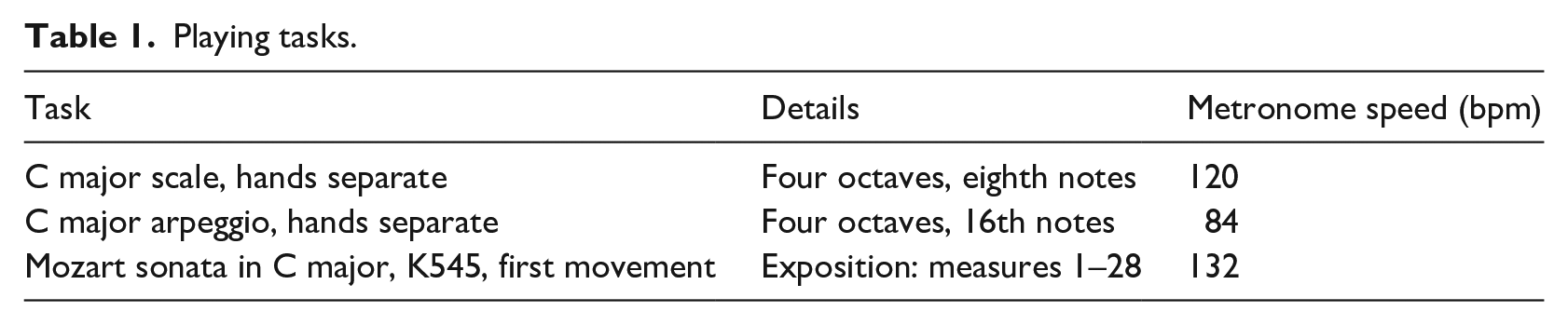
The day before and the day after the workshop, each pianist was asked to play a series of scales, arpeggios, and an excerpt of a Mozart sonata, as described in Table 1. Pianists were informed of these playing tasks prior to their participation in the study and agreed to prepare adequately for fluent performance of each task. Pianists were given a minimum of 2 minutes to become accustomed to the instrument, after which they were asked to perform each of the playing tasks. Before recording each task, the pianists performed a trial of the task which was not recorded. In both trials and recordings, metronome tempo was given for each task audibly and silenced as soon as the pianist began to play. Recordings were later separated into audio and silent video formats.
Playing tasks.
Judges of silent video
Five judges were recruited among licensed Body Mapping instructors using the Body Mapping association’s internal communication system, all of whom were professional musicians (piano [n = 1], flute [n = 1], and violin [n = 3]) and in good standing with the association. Judges were given access to a webpage which presented 38 folders, one for each pianist participant. Each folder contained ten silent video clips, five of which were from the pre-test, marked “X” or “Y,” and five which were from the post-test, marked with the remaining letter. In line with previous research, judges were asked to evaluate “X” and “Y” videos using an evaluation form which was modeled after those used by Valentine (1995) and Wong (2015). The form uses a 7-point Likert-style scale for the evaluation of body usage in factors of: head/neck, upper back/chest, lower back, shoulder region, arms, hands/wrists, legs/feet, and general impressions. Judges, blind to condition, used one form to evaluate the “X” videos and another for the “Y” videos, and were asked to identify which of the videos, “X” or “Y,” they believed to have been taken after the Body Mapping workshop. Assignment of letters “X” and “Y” to pre-test and post-test videos was randomized.
Judges of audio
Five judges were recruited among local piano instructors, all of whom had studied piano and/or piano pedagogy at the undergraduate and graduate levels and were actively teaching at the time of evaluation. None of the piano instructors were licensed Body Mapping instructors. Judges were given access to a webpage designed similarly to the one described above, with files in audio format only. “X” and “Y” videos were once again randomized. The evaluation form for this research question was designed after a similar form used by Wong (2015), which used a 7-point Likert-style scale. Judges were asked to evaluate scale and arpeggio performance in factors of consistency of tempo and technical precision, and Mozart excerpt recordings in terms of expressivity and technical precision. Finally, the judges were asked to evaluate the overall performance for the richness or weakness of tone and whether they perceived the pianist to be performing with much effort or with ease.
Statistical analyses
Data were analyzed using Statistical Package for Social Sciences (SPSS). We used Bonferroni p-value corrections to control for Type I error. Throughout this article, we consider a “family” of comparisons to be all comparisons conducted in response to a particular research question. In Experiment 1, there were four comparisons in response to each research question, leading to a corrected alpha level of .0125. Experiment 2 involved two comparisons per research question, leading to a corrected alpha level of .025. Some post-hoc comparisons are included in Supplemental Materials to provide additional insight for interested readers but are not relevant to the research question and therefore were not used in calculating Bonferroni corrections. We acknowledge that some authors consider parametric statistical tests to be inappropriate for data collected with Likert-style scales. We chose to use parametric tests in the analyses presented below to allow us to examine the possibility of interaction effects. We have replicated all of the analyses using nonparametric tests and the conclusions are the same. Thus, we are confident that the use of parametric tests with this data does not yield misleading conclusions.
Results
Silent video
We conducted a two-way repeated measures ANOVA to analyze the effects of time (two levels, pre-test and post-test) and aspect of body usage (eight levels for each aspect in the evaluation form). There was no significant interaction between time and aspect of body usage (Wilks’ Lambda = .796, F(7,31) = 1.135, p = .367, partial eta squared = .204). There was a significant main effect of both time (Wilks’ Lambda = .518, F(1,37) = 34.467, p < .001, partial eta squared = .482) and aspect (Wilks’ Lambda = .201, F(7,31) = 17.580, p < .001, partial eta squared = .799). Post-hoc analyses of the effect of aspect showed a number of comparisons that were statistically significant, even with a conservative p-value correction, though all of these effects were small. These are presented in Supplemental Materials of this article for interested readers, but since our research question is concerned with the aspect of time and there was no significant interaction between time and aspect, it is not relevant to address these findings in detail here. The mean scores for pre-test and post-test silent videos are reported in Figure 1. Cohen’s d was calculated as a measure of effect size for head/neck (d = 1.14), back/chest (d = 1.30), low back (d = 1.20), shoulder region (d = 1.30), arms (d = 1.25), hands/wrists (d = 1.22), legs (d = 1.19), and general impression (d = 1.26). Cohen (1992) writes that a coefficient d greater than 0.8 is considered a large effect, and therefore the effect of time on each aspect of body usage can be considered a large effect (Table 2).
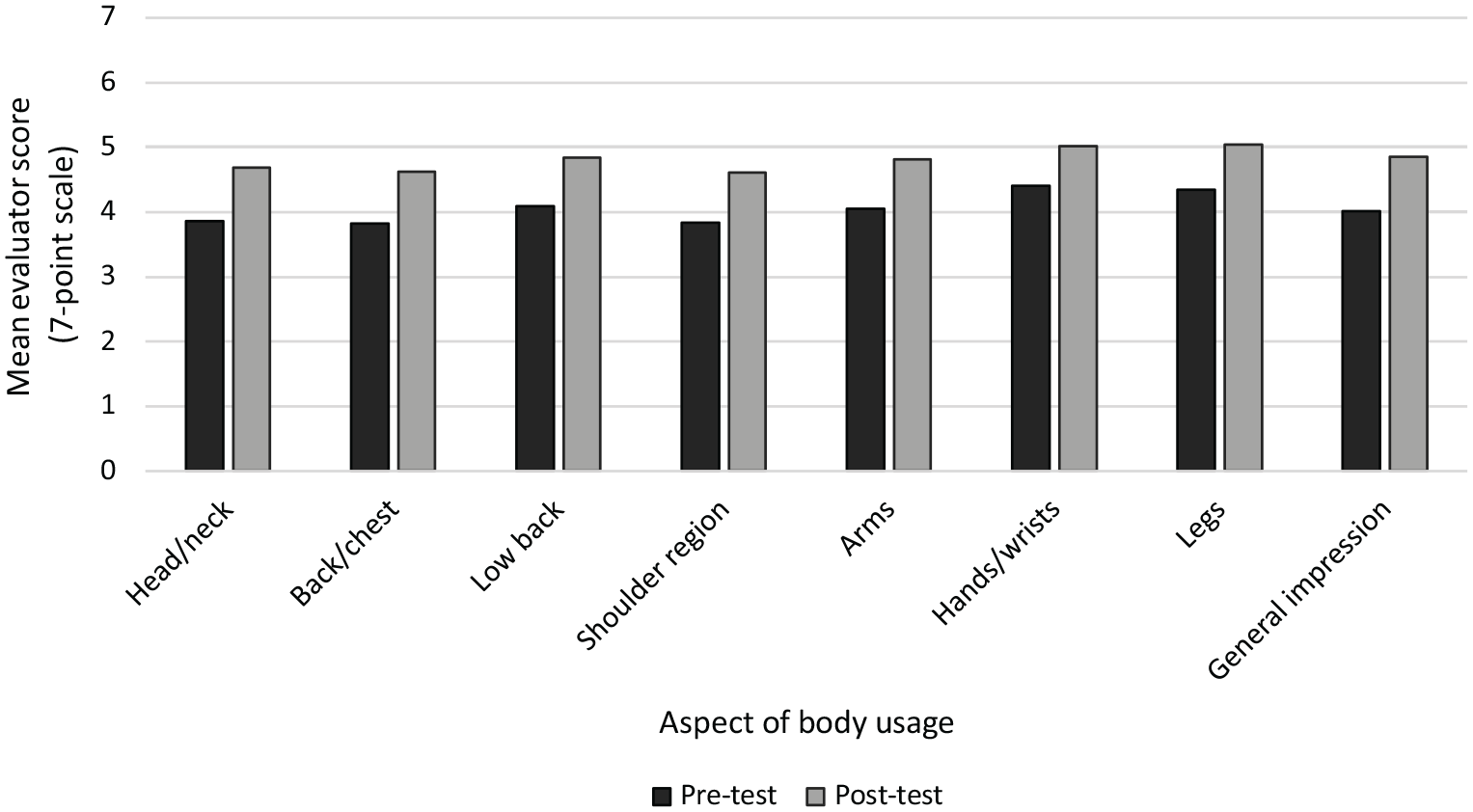
Pre-test and post-test scores assigned by panel of judges on eight factors of body use.
Difference of means in pre-test and post-test panel analysis for silent video recordings in Experiment 1.
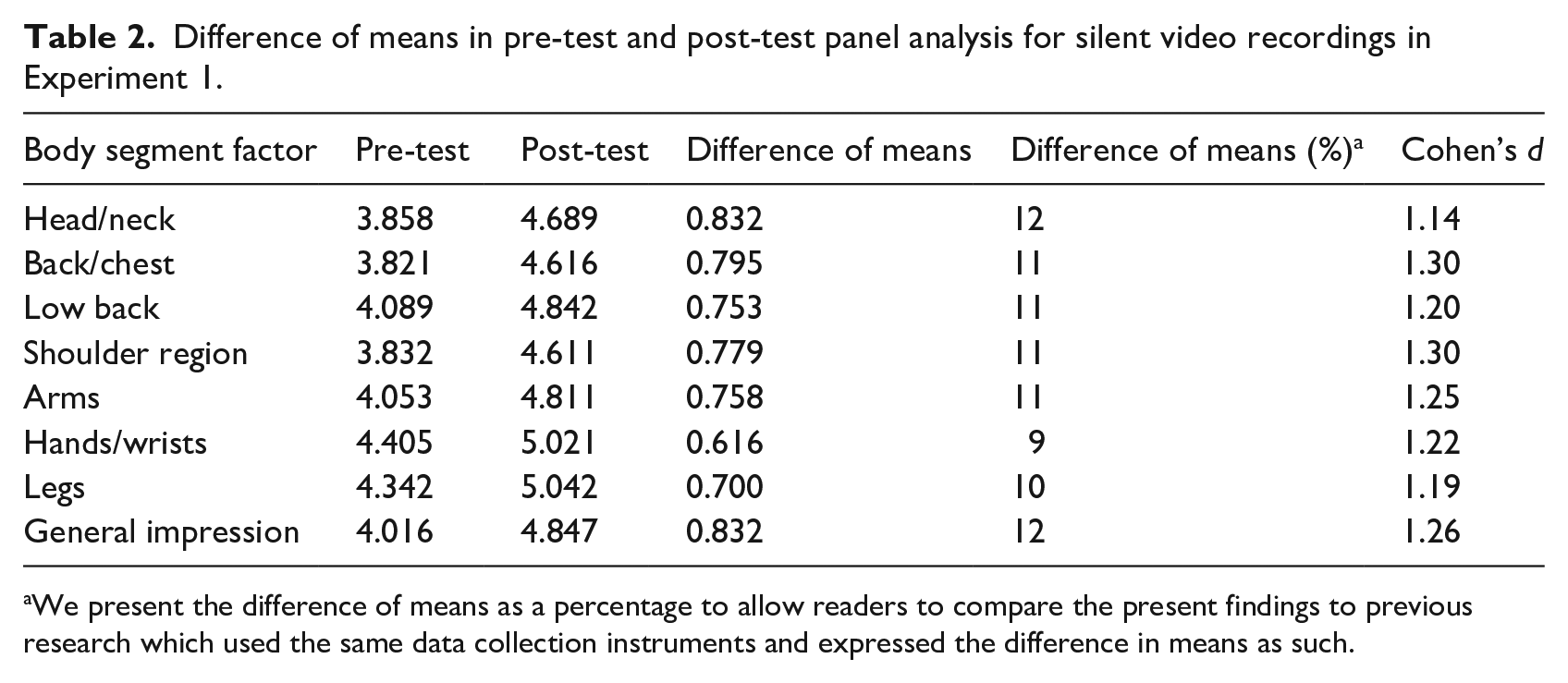
We present the difference of means as a percentage to allow readers to compare the present findings to previous research which used the same data collection instruments and expressed the difference in means as such.
The judges correctly identified the post-test recordings 75% of the time. A binomial test determined that the difference between the accuracy rate of the judges and chance level (50%) was statistically significant (N = 190, p < .001). The results indicate that the judges were able to correctly identify the post-test recordings at a rate better than chance, and that they perceived improvements in the body usage and coordination of participants. Figure 2 shows still images of pianists in the present study from pre-test and post-test recordings which provide the reader with some examples of visual aspects that were observed. Accuracy rates of individual judges were 87% for the judge whose primary instrument was piano, 71% for the judge whose primary instrument was flute, and 74%, 68%, and 76% for those whose primary instrument was violin. The judges whose primary instruments were piano and flute had accuracy rates which were within two standard deviations of the mean, suggesting that the difference of primary instruments did not skew the data.
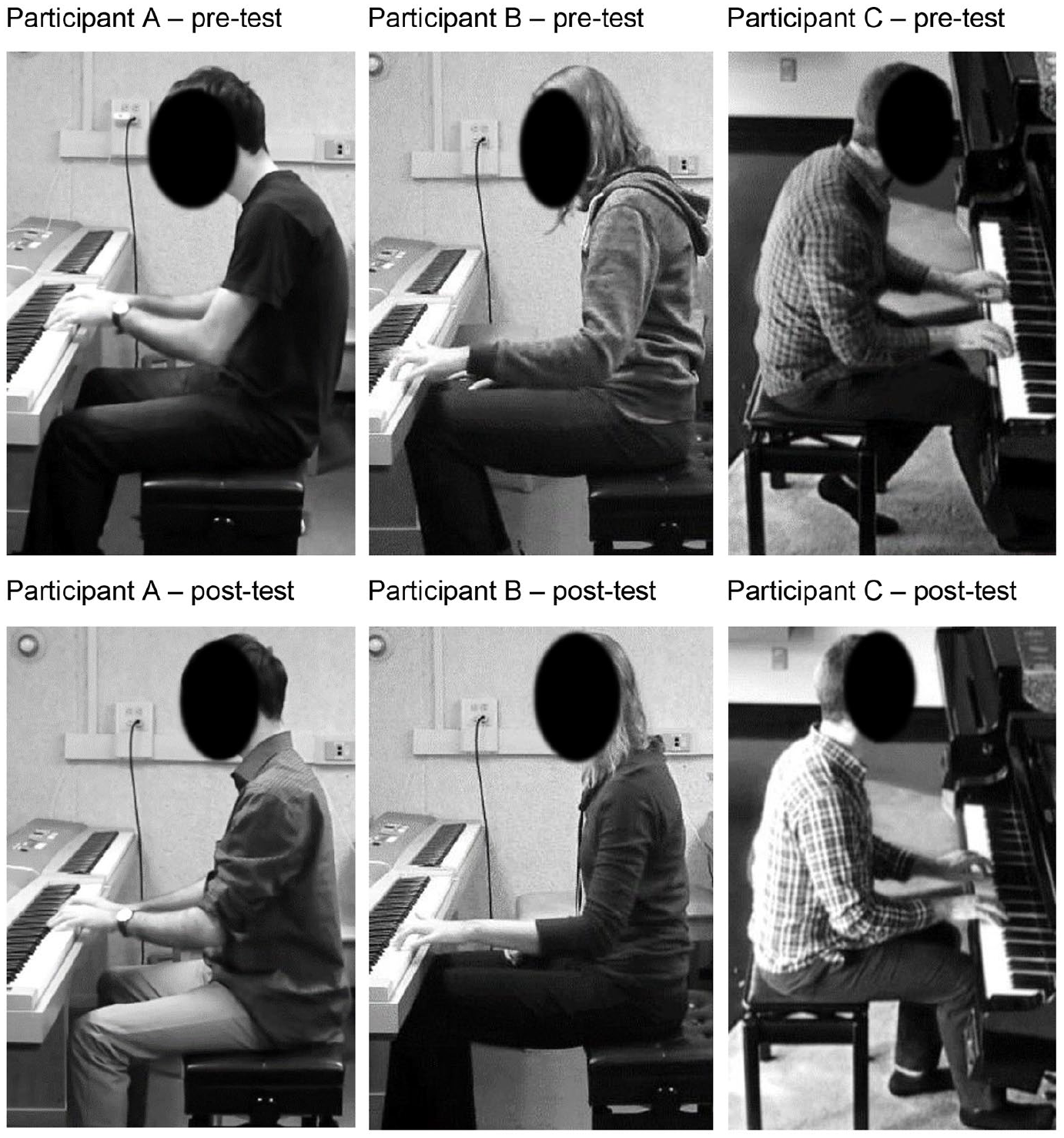
Examples of participants, still images taken from pre-test (top) and post-test (bottom) video.
Audio
We conducted a two-way repeated measures ANOVA to analyze the effects of time (two levels, pre-test and post-test) and aspect of musical performance (eight levels for each aspect of the evaluation form). There was no significant interaction between time and aspect (Wilks’ Lambda = .764, F(7,31) = 1.366, p = .254, partial eta squared = .236). There was a significant main effect of aspect (Wilks’ Lambda = .070, F(7,31) = 58.622, p < .001, partial eta squared (.930) but no significant effect of time (Wilks’ Lambda = .961, F(1,37) = 1.495, p = .229, partial eta squared = .039). Again, pairwise comparisons demonstrated that there were significant differences between certain aspects of musical performance, but as this is not directly relevant to the research question, we present this in Supplemental Materials for interested readers to consult. Figure 3 shows the judges’ pre-test and post-test scores on eight aspects of musical quality. The judges rated audio recordings of evenness of tempo in scales lower in the post-test. Judges rated technical precision of the scale similarly in both pre-test to post-test and all other factors were rated only slightly higher.
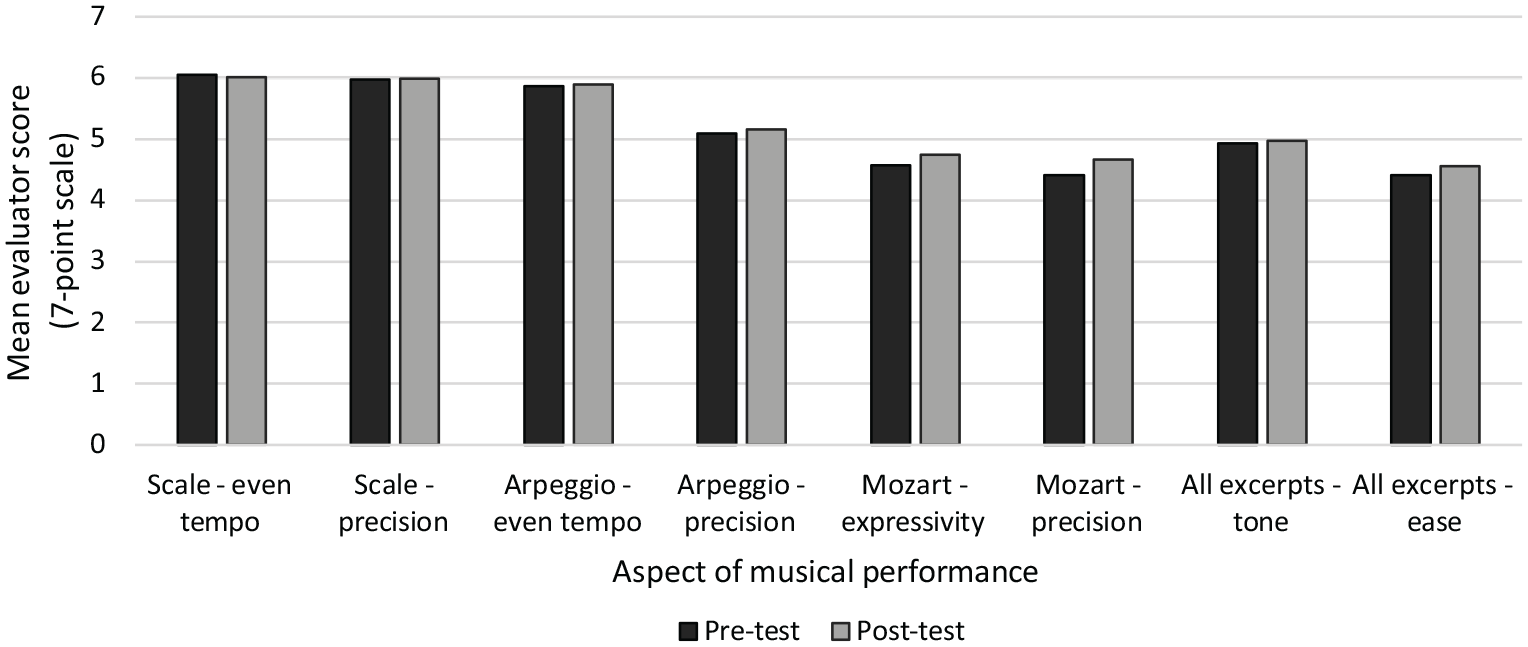
Pre-test and post-test scores assigned by panel of judges on eight factors of musical quality.
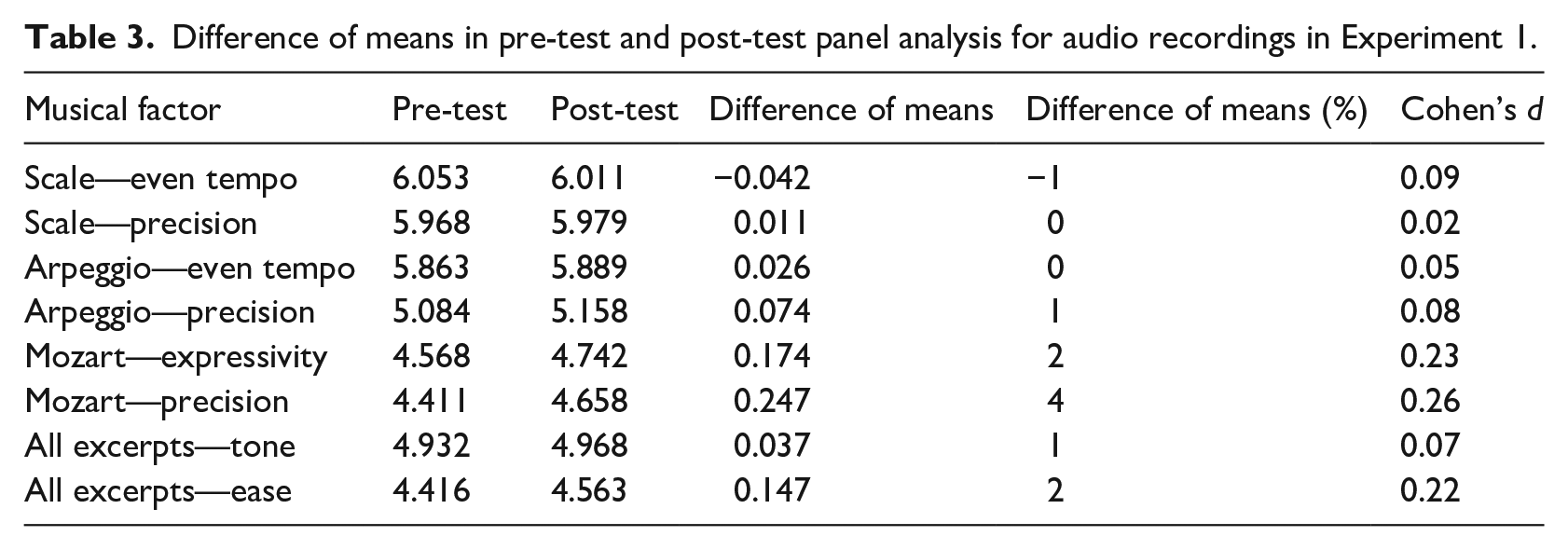
We also asked the evaluators to indicate which of the recordings they believed was taken after the Body Mapping workshop. Their accuracy rate (N = 190) was 57%, which was not statistically significant (p = 0.06) in its difference with chance level (50%), according to a binomial test. Individual judges had accuracy rates of 61%, 53%, 58%, 61%, and 53% (Table 3).
Difference of means in pre-test and post-test panel analysis for audio recordings in Experiment 1.
Discussion of Experiment 1
It is clear from the above findings that the panel of Body Mapping educators observed, with a strong trend and large effect size, improvements in body usage of pianists, whereas the panel of piano educators did not perceive improvements in piano performance with any strong trend. This raises additional questions. If it is the case that the pianists did not significantly improve in audible aspects, but they did improve in visual aspects, this raises the question of why anecdotal evidence supports differences in sound. Researchers have found that visual information is dominant in perceptual reports (Posner et al., 1976) and that evaluations of musical quality are influenced by visual aspects, such as the body movements of the performer (Siddell-strebel, 2007; Tsay, 2013). It could be that changes are observed visually, and this contributes to a perception that the sound has changed.
It is possible that the differing results of audio and silent video analysis was a product of our sample of judges. The panels were recruited from separate populations for visual and audible aspects. For this reason, and to test the theory of visual dominance, we designed Experiment 2, in which a new panel of judges, blind to condition, was asked to identify which of two recordings was taken after a Body Mapping workshop. By having the same individuals evaluate both audio and silent video, we can compare their evaluations to determine whether observers see improvements more often than they can hear them.
Experiment 2
Method
Panel evaluators
Eight judges who had not participated in Experiment 1 were recruited among licensed Body Mapping educators using the association’s internal communication system. All of the judges were professional musicians and music educators (piano [n = 6], flute [n = 1], and oboe [n = 1]), fully licensed in Body Mapping and in good standing with the association.
Procedure
For the purposes of Experiment 2, we wanted to compare the accuracy of judges identifying post-test recordings by audio and by silent video. For this experiment, we provided judges with recordings of the left hand arpeggio, demonstrating a technical task with movements across the keyboard, and the Mozart excerpt, demonstrating a repertoire task with aspects of expressivity.
The judges were provided with links to four webpages which presented audio and silent video clips. Each of the webpages presented 45 pairs of pre-test and post-test clips, featuring each of the 38 participants, plus seven duplicates. Judges were asked to indicate which clip in each pair they thought was better, and which they thought was taken after the Body Mapping workshop. Judges were presented audio and silent video clips separately such that they would be unable to compare audio and silent video clips. Since an exact definition of “better” is rarely given explicitly in Body Mapping literature, we allowed the term “better” to be defined by the implicit evaluation criteria of the Body Mapping instructors. An open text box allowed the judges to add commentary about their evaluation. Geringer and Johnson (2007) investigated the impact of excerpt duration on panel evaluations. They found that recordings of 12, 25, and 50 seconds were rated similarly by the panel, leading them to conclude that there was no main effect of excerpt duration on performance evaluations. For this reason, we used short clips of the arpeggio and Mozart recordings in this experiment. The authors decided upon arpeggio recording clips that were 10 seconds in length because that encompassed two full repetitions of the arpeggio and Mozart recording clips that were 15 seconds in length because this encompassed the initial thematic material of the sonata. The order of pairs of recordings and the order of correct responses were randomized. We analyzed the collected data for the rate of correct responses to “Which was taken after the Body Mapping workshop?” and as an exploratory analysis, compared their responses to this question and their responses to the question “Which is better?”
Results
Audio
Judges correctly identified the post-test audio arpeggio recordings 51% of the time (N = 360). A binomial test revealed that the difference between the judges’ average accuracy rate and chance level (50%) was not statistically significant (p = .87). The two evaluators who were not pianists had accuracy rates of 40% and 44%, both within two standard deviations of the mean, suggesting that their ratings did not skew the data. Judges correctly identified the post-test Mozart excerpt recording 59% of the time. A binomial test revealed that the difference between the judges’ accuracy rate and chance level (50%) was statistically significant (N = 360, p = .001). The two evaluators who were not pianists had accuracy rates of 60% and 56%, both within two standard deviations of the mean, suggesting that their ratings did not skew the data.
Better vs. after
The judges responded to the questions “Which is better?” and “Which was taken after the Body Mapping workshop?” identically in 96% of silent video recordings and 89% of audio recordings. This suggests that Body Mapping instructors perceived that pianists studying Body Mapping improved more frequently in visual aspects than in audible aspects. In the comments, several of the judges wrote that discerning which of two recordings was taken after the Body Mapping workshop was difficult by audio alone. One judge wrote the following: Freer movement may not immediately translate into ‘better’ (meaning more accurate in this case, but also more fluid, smoother, etc.) performance. A Body Mapping session can also result in a fair amount of hesitation and clumsiness at first even if the student is applying the information well. (Judge 3).
Another wrote that although the files they had selected as being the post-test recordings had issues with tempo unevenness, that, “new movement can facilitate faster tempo playing initially which takes practice to incorporate and even out” (Judge 1). These comments suggest a perception that, in Body Mapping workshops, body movement changes before the sound improves, which may contribute to the difficulty in discerning which of two audio recordings was taken immediately after a Body Mapping workshop.
Discussion of Experiment 2
In the above analyses, we found that Body Mapping instructors were more frequently able to accurately identify post-test recordings by silent video than by audio. The 64% accuracy rate among silent video recordings is similar to previous research with a similar procedure that found that evaluators were able to accurately identify 67% of post-test silent video recordings (Wong, 2015). Compare this to Experiment 1, where the accuracy rate was slightly higher. One possible explanation for this is that judges in Experiment 1 had access to all silent video recordings, including scales, arpeggios, and Mozart excerpt. Had we given this option to judges in Experiment 2, the results may have been more similar to accuracy rates in Experiment 1 and in previous research. Among audio evaluations, judges in Experiment 2 were able to identify post-test audio recordings 55% of the time, which is remarkably similar to the 56% accuracy rate in previous research (Wong, 2015), and the 57% accuracy rate from Experiment 1. As these accuracy rates were generally not statistically significant, it is likely that the same rates could have been achieved by chance.
There are a number of factors which could have contributed to the higher accuracy rate for identifying post-test Mozart excerpt audio recordings compared to arpeggio recordings. It may be that Body Mapping has an effect on an aspect of repertoire performance that is not audible in the performance of arpeggios, such as expression. It could also be that the pianists in this study had not adequately prepared the Mozart excerpt, and that practice accumulated during the pre-test contributed to improved performance in the post-test. Considering that, in Experiment 1, the only factor which yielded a statistically significant difference in audio evaluations was precision of Mozart excerpt, the latter explanation of accumulated practice seems the most likely.
The most intriguing part of the present findings is that judges were better able to identify post-test recordings by silent video than by audio. Not only that, but their commentary indicated that they struggled at times to identify the post-test recording by audio alone. These findings contrast with extant qualitative and anecdotal evidence in which individuals report a sense that their music sound improves following a Body Mapping workshop. Additionally, among audio evaluations, there were far more cases of judges choosing different recordings for which was better and which was taken after the Body Mapping workshop. These findings suggest that any changes in piano performance immediately following a Body Mapping workshop may be more easily seen than heard.
General discussion
The present findings support the theory of visual dominance in perceptual reports of Body Mapping workshops. Effects of visual dominance were most famously investigated by Colavita (1974; Colavita & Weisberg, 1979) who showed that responses to visual cues dominated the auditory ones. More recently, Tsay (2013) examined musical contexts and found that, in spite of their reports that sound is the most important factor in determining the winner of a music competition, judges were more reliably able to select the winner of a competition by silent video than by audio recordings. In the context of a Body Mapping workshop, this would mean that observers see a visual change and perceive this as a change in musical sound as well, even if no such audible change occurred. The findings of this study suggest that observers of pianists before and after a Body Mapping workshop perceive larger and more frequent visible improvements in performance than they do audible ones. This supports the theory that perceptual reports of improvements in piano performance following a Body Mapping workshop are impacted by visual dominance. It is accurate, then, to say that the pianists in our study had perceptibly better piano performance one day after the Body Mapping workshop, but these improvements were predominantly visual.
These findings have implications for Body Mapping educators and music educators. It is often understood among the Body Mapping community that, “As quality of movement improves, the playing becomes freer, more expressive, more secure. . .” (Mark, 2003, p. 5). While it is possible that in the long term, quality of movement and quality of sound are associated, in this study, such a connection was not evident one day after the Body Mapping workshop. Body Mapping educators should be aware that their perceptions of immediate changes in music performance may be predominantly influenced by the visual evidence of improvement, and instructors should not claim that a single workshop will result in immediate improvements in musical quality. At the same time, considering that judges’ perceptions of music performance are so heavily influenced by visual aspects, if a music student takes a Body Mapping workshop, the present evidence suggests that audience members will perceive a better musical sound, even if the sound itself has changed very little. Music educators should take note that audience perceptions of improvements in piano performance may be strongly affected by visual information. Addressing body movement may therefore be a relevant area of piano pedagogy, even if no changes to the sound occur. Suggesting that a student participate in a Body Mapping workshop could result in a perception of improved piano performance following the workshop, though the present evidence suggests that change to the sound itself is unlikely.
Conclusion
In this study, we investigated the perception of musical improvement in piano performance following a six-hour Body Mapping workshop by asking blind panels of judges to evaluate recordings taken the day before and the day after the workshop. We found that Body Mapping educators, blind to condition, rated body usage of pianists significantly better in post-test than pre-test silent video recordings, whereas piano instructors did not rate pre-test and post-test audio recordings consistently differently. Further investigation showed that another panel of judges was more readily able to identify the post-test recordings with silent video clips than with audio. This puts into question the common perception that Body Mapping can have an immediate positive impact on the sound of piano performance and supports the theory of visual dominance: that audience members perceive an improvement in sound because they observe improvement visually. The present findings suggest that there are observable changes, but these are predominantly visual in nature. The perception of audible change may be a product of visual dominance in music perception. Although this study provides an important contribution to this field, there are yet very few studies conducted in this area, and much more research is needed to more fully understand the effects of Body Mapping on music performance.
There were some limitations to this study which indicate possible directions for future research. Much of the anecdotal evidence around perceived improvements in musical sound of performance following a Body Mapping workshop relate to instruments other than piano. Breath control does not relate to piano and changes in tone occur much more readily among wind and string instrumentalists and vocalists. It is possible that judges would be able to perceive changes in audio alone if a different instrument or voice was used. Since the quantitative research in this area thus far has focused on pianists, future research should investigate aspects of music performance which are specific to other instruments and voice. In this study, Body Mapping educators visually evaluated body movement, but we did not measure exact movement parameters that changed. Future research could use motion capture technology to measure which movement parameters are changing and how. The present study used tools from previous research to allow better comparisons to previous findings; however, these tools have not undergone rigorous testing for psychometric properties. Future research should include validity and reliability testing of such tools to better equip researchers to analyze the effects of somatic methods.
Limitations of the external validity of our study illuminate multiple avenues for expanding this research area. Our study explored possible explanation for reports of immediate changes in piano performance, whereas the qualitative research literature has used semester long courses in Body Mapping. Future research could experimentally investigate the changes that may occur following a longer course of Body Mapping than was used in this study. Given Body Mapping’s emphasis on training the sensing, awareness, and quality of body movement, it is possible that changes in body movement precede any changes in sound. Future research could compare short term with longer term effects to illuminate what progression of changes, if any, occur during a longer period of Body Mapping training. The present study considered only the observable effects of a Body Mapping workshop and did not consider the experiences of the performers. It is possible that some participants were more motivated during the post-test recordings than others. Given that so much of the qualitative research on the effects of Body Mapping is focused on the experiences of the performers, it may be relevant to consider the relationship between externally observable effects of a Body Mapping workshop and the subjective experiences of the individual participants.
Supplemental Material
sj-docx-1-ijm-10.1177_02557614221136280 – Supplemental material for Perceptions of improvements in piano performance following a Body Mapping workshop
Supplemental material, sj-docx-1-ijm-10.1177_02557614221136280 for Perceptions of improvements in piano performance following a Body Mapping workshop by Teri Slade, Gilles Comeau and Donald Russell in International Journal of Music Education
Footnotes
Acknowledgements
We would like to thank the panel members for their time spent evaluating audio and video clips and the Association of Body Mapping Educators for distributing recruitment calls for panel members. We would additionally like to thank Yixiao Chen for technical assistance, Yuanyuan Lu for administrative assistance, and Mikael Swirp for advising on analysis. Finally, we thank Kimberley Barber, Jennifer Johnson, Ian Sutherland, and Kyoko Hashimoto for helping facilitate recruitment and data collection.
Declaration of conflicting interests
The authors declare that there is no conflict of interest.
Funding
The author(s) received no financial support for the research, authorship, and/or publication of this article.

Supplemental material
Supplemental material for this article is available online.
Notes
References
Supplementary Material
Please find the following supplemental material available below.
For Open Access articles published under a Creative Commons License, all supplemental material carries the same license as the article it is associated with.
For non-Open Access articles published, all supplemental material carries a non-exclusive license, and permission requests for re-use of supplemental material or any part of supplemental material shall be sent directly to the copyright owner as specified in the copyright notice associated with the article.
