




Abstract
Solo performance is a common experience for children learning to play an instrument, yet the research literature on these experiences is limited, with a focus on older children and adolescents. The purpose of this study was to examine younger children’s feelings about performance over the course of a year of study. Forty-one children were interviewed about their piano lessons and performance experiences at the end of two consecutive semesters of study. They also responded to a pictorial scale on their feelings about performance at each interview and again at two piano recitals. Results indicate that children are remarkably consistent in their feelings about performing in piano recitals, with few significant changes over time and context. Correlation analyses indicate changes in the relationships between feelings about performance and certain study variables over time—in particular age, liking of lessons, liking of performing, practice time, and perception of being good at piano. In the fall term, gender and age are significant predictors of feelings about performance, with younger children and boys feeling most positive. In the spring, the findings shift and the only significant predictor is children’s liking of piano lessons. Implications and directions for further research are discussed.
Keywords
The study of music provides many opportunities for children to develop not only musical skills, but also their ability to perform musical works for an audience. Typically, students will perform several times each year at recitals and examinations, and sometimes other events. These performances are generally deemed to be important components of an education in music. They allow children the opportunity to demonstrate the skills they have attained and to share a musical work with an audience. From a parent and educator standpoint, there appear to be tremendous benefits to the child musician with the development of self-esteem (Ryan et al., 2021), greater self-efficacy (Creech & Hallam, 2011), and increased social skills (Morin, 2014). However, the child’s perspective and interpretation of these events has been given little consideration in the research literature.
Findings on 12-year-old pianists indicate that they have mixed feelings about performing in recitals (Ryan, 2004). When asked open-ended questions regarding their feelings about performances, responses fell clearly within three categories—they feel nervous (24%), they like it (43%), and they like it but they also feel nervous (33%). They are afraid of making mistakes, particularly in front of an audience. This particular fear is inherent in performance anxiety, a form of social anxiety, whereby individuals do not wish to make mistakes and suffer embarrassment in social situations (Fehm & Schmidt, 2006). Unfortunately, the very nature of classical instrumental studies in the Western world places a great deal of importance on note perfection (Brandfonbrener, 1988).
Performance anxiety is one of the most commonly reported medical problems of adult performing musicians (Fernholz et al., 2019; Fishbein et al., 1988). The issue has been documented in many studies, with an overall focus on prevalence, contributing factors, and management strategies (see, e.g. Biasutti & Concina, 2014; Brodsky et al., 1994; Brotons, 1994; Cohen & Bodner, 2019; Dews & Williams, 1989; Hamann, 1982; Kendrick et al., 1982; Leglar, 1979; Lockwood, 1989; Mor et al., 1995; Salmon et al., 1995; Wesner et al., 1990). It has been suggested that experiences with performance anxiety lead some musicians to leave the profession (Nagel, 1993; Nideffer & Hessler, 1978). Preliminary examination of this issue with high school musicians suggests that this departure may occur before a professional life even gets started (Ryan & Andrews, 2021). Moreover, professional musicians who persist with their careers despite performance anxiety report its negative impact on their overall life happiness (van Kemenade et al., 1995). Clearly, this is an issue of great relevance for the music community.
Performance anxiety has recently come into focus as an issue not only for experienced musicians, but also for those in the training years (see, e.g. Diaz, 2018; Fehm & Schmidt, 2006; Kaleńska-Rodzaj, 2020; Lorenz, 2002; MacAfee & Comeau, 2020; Maroon, 2003; Osborne & Kenny, 2008; Osborne et al., 2005, 2007; Papageorgi, 2006, 2020; Rae & McCambridge, 2004; Rothlisberger, 1992; Ryan, 1998, 2004; Sinclair, 1997). Studies have shown that from very early days, children can experience intense stress surrounding music performances, even in group contexts. Preschoolers participating in group music performances were found to have high levels of the stress hormone, cortisol, in a study by Boucher and Ryan (2011). However, when performances were repeated a day later, the effect was gone, leading the researchers to speculate on the importance of pre-performance opportunities for young musicians in alleviating some of the anxiety surrounding the event.
No published studies have been found regarding the years between prekindergarten and third grade, but at least one study has indicated that by third grade, children anticipate anxiety with regard to impending school ensemble performances (Ryan, 2005). A number of studies have found gender differences to be present in young musicians, but not prior to fifth grade (LeBlanc et al., 1997; Osborne et al., 2005; Rae & McCambridge, 2004; Ryan, 2005). The limited research on children suggests that these findings be taken with caution, but certainly the entry into adolescence can bring heightened awareness of how one is perceived in social situations. Gender differences appear to persist into adulthood, as is evidenced though a number of studies (Abel & Larkin, 1990; LeBlanc et al., 1997; Nagel, 1988; Widmer et al., 1997; Wolfe, 1990).
Performance anxiety has traditionally been a subject that musicians did not talk much about. However, studies of late indicate that young musicians, in particular, want to bring it out into the open and to find better ways of coping. In a study by Fehm and Schmidt (2006), gifted adolescent musicians indicated that they want to be able to talk openly with their teachers about performance anxiety, to have more practice-performance opportunities, and to have classes in anxiety management. The voices of these young musicians are particularly resonant when you consider that memories of negative experiences with performance anxiety can stay with musicians for a long time after the fact and impact upon subsequent performances (Osborne & Kenny, 2008). These findings seem to indicate that it is not simply a matter of “shaking it off” and “putting it behind you,” but that intervention may be required in order for some musicians to bounce back from a bad performance.
Teachers may play a role in perpetuating some of the perfectionism and anxiety surrounding the performance experience. In studies by Ryan (2004) and Ryan et al. (2021), it was evident that most young musicians are encouraged to perform but are not really taught how to do it. Practice performances are rare and most studio work focuses on perfecting the repertoire selections, with very limited instruction as to how to transfer playing skills into performing skills. Indeed, teachers seem ill-equipped, though well-meaning, when faced with anxiety concerns of their students. Young musicians report being offered such advice as “Don’t worry,” “You’ll do fine,” and “Just breathe”—all positive comments, but which do little to actually support a student who is feeling anxious about an impending performance (Ryan et al., 2021). More often than not, students are simply told to “Practice More”—certainly important if not enough practice has been done to bring the piece to a high level of achievement; however, practice alone will not help a student to manage their feelings of anxiety. Indeed, the very definition of performance anxiety that is used throughout the literature precludes practice from the equation (Salmon, 1990). Additionally, students might not fulfill expectations in terms of progress, even though they practiced significantly. This might then affect their perceived sense of self-efficacy and negatively impact their self-esteem. These two factors have been associated with performance anxiety (Chan, 2011; González et al., 2018).
Most professional musicians begin their formal training early in life—according to one study (Nagel, 1987) 46% before the age of 7 and 90% before the age of 12. As previous studies have considered the solo performance experiences of children 11 and up, it was decided to take a closer look in the current study at younger children’s feelings about performance—specifically those in the under-10 age group. Research questions were:
Is there a relationship between age, practice, liking of lessons, liking of performing, self-perception of being good at piano, and feelings about performance?
Do children’s (a) enjoyment of lessons and (b) feelings about performing change over the course of a year?
Does the context in which children’s feelings about performance are measured (interview or recital) impact upon their responses?
Are age, gender, length of study, weekly practice, performing experience, self-perception of being good at piano, and liking of piano lessons significant predictors of children’s feelings about performing?
Method
Measures
Child interview
Each child was interviewed twice over the course of a school year. The school year in Canada starts at beginning of September and finishes at the end of June. Families usually register children for piano lessons for two semesters: the fall semester (from early September until mid-December) and the winter semester (from January until the end of May). Interviews were held once in late fall (November) and once in late spring (May). Interview items were designed specifically for this study, based on items and findings from previous studies. They comprised a variety of open- and closed-ended questions pertaining to the child’s experience of piano lessons and piano performances, as well as their participation in and response to other activities with performance-evaluative components. Only the items pertaining to piano performance were examined in this article. The specific questions are detailed in the Appendix.
Parent questionnaire
One parent of each child was asked to complete a questionnaire twice over the course of the study—once in late fall and once in late spring. The questionnaire was designed to gather information about the child’s piano studies, practice habits, feelings about lessons, and response to performances. Only information about practice habits and performance history was examined in this article.
Pictorial scale of reported feelings about performing
The Pictorial Scale of Reported Feelings About Performing (PSRFP) was originally designed as a subsection of the Pictorial Scale of Perceived Musical Competence, Reported Liking, and Reported Feeling Toward Performing for use in a study on the performance experiences of very young children by Boucher and Ryan (2011). It was modeled after the Pictorial Scale of Perceived Competence and Social Acceptance by Harter and Pike (1984), which has been used in a variety of studies on preschoolers and has demonstrated reliability with children as young as 3 years (Cramer & Skidd, 1992; Harter & Pike, 1984; Paguio & Hollett, 1991; Stansbury & Harris, 2000).
The items used in the PSRFP were derived from questions on the state form of the State-Trait Anxiety Inventory for Children (Spielberger et al., 1973) and the Music Performance Anxiety Inventory for Adolescents (Osborne & Kenny, 2005; Kenny & Osborne, 2006), which have been used in a variety of music performance anxiety studies. Since only one published study has been conducted on the performance experiences of young children (Boucher & Ryan, 2011), and none of the other performance anxiety measures typically used are appropriate for children as young as six, it was decided to use a subsection of the pictorial scale for this study—examining only the Reported Feeling Toward Performing.
The scale is designed as two series (one male and one female) of dichotomous pictures of a child participating in various aspects of a music performance. The pictures with the same gender protagonist as the child were shown and accompanied statements were read aloud to the child pertaining to each pair of photos. There are six items, as follows:
(1) This girl (boy) is happy/not happy that her (his) parents will be listening to the concert.
(2) This girl (boy) is calm/not calm when she (he) thinks of the concert.
(3) If this girl (boy) makes a mistake during the concert, she (he) thinks she (he) will continue to play/stop playing the piano.
(4) This girl (boy) thinks that mom and dad will like/not like the concert.
(5) This girl (boy) is confident/not confident that she (he) will remember what to do at the concert.
(6) This girl (boy) feels well/does not feel well when she (he) thinks of the concert.
When the child had looked at both pictures and heard both statements, he/she was asked which child in the pictures he/she was most like. Upon responding, he/she was then asked to qualify the extent to which that child represents his/her feelings. In the case of the item #2 given above, the boy/girl would have been asked (a) Are you just sort of calm OR are you really calm? or (b) Are you just sort of not calm OR are you really not calm?
Responses were recorded on a 4-point scale, with 4 indicating the most positive response to the photo/statement and 1 the most negative, for a total score range between 6 and 24, with 6 indicating very negative feelings about the performance and 24 indicating highly positive feelings.
Participants
Participants were 47 children aged 10-and-under at the study outset who were studying piano at a well-regarded traditional music conservatory in a large urban center. Only 41 children (24 female; 17 male) completed all components of the study and were included in the analysis. There were sixteen 10-year-olds, eleven 9-year-olds, eight 8-year-olds, three 7-year-olds, two 6-year-olds, and one 5-year-old. These children had been studying piano for between one semester and 6 years (M = 3.3, SD = 1.5). Most had some prior performing experience (mean number of performances = 6, SD = 6.8); six children had never performed prior to this study. All children and parents spoke either English or French fluently, and many were fluent in both languages. Questionnaire and interview questions were translated into French by a professional translator and were verified by a research assistant who was fluent in both languages.
Procedure
The study took place in a large urban center in Canada. Children were recruited for participation through notices posted in a large traditional conservatory that is housed in a large university music faculty. All families with children registered at the conservatory were also mailed an invitation to participate in the study, which included detailed information about the purpose of the study and what would be required of participants. Parents were provided with a university research laboratory phone number to call if they were interested in learning more or to inquire about participation.
Interviews with the children took place before or after children’s piano lessons, or at the families’ convenience. The pictorial scale was also completed at this time, as an extension of the interview. Parents were offered the option to see the children’s questions before the interview and sit in on the interview if they wished. Either before the child was interviewed (if the parent was sitting in on the child’s interview) or during the child’s interview (if the parent was not sitting in), the parent completed the parent questionnaire. The complete process took about 30 minutes. A description of the study was provided in writing and verbally to parents and children and both were asked to provide written consent before proceeding with the interview/questionnaire. Interviews were completed in the weeks prior to the scheduled piano recitals that were part of this study.
Participants performed in traditional piano recitals, the first in late fall and the second in late spring. The recitals were given in formal concert halls at the university and a large audience of friends and family attended both performances. Upon arrival, the children were each asked to complete the pictorial scale with a research assistant. Several research assistants were on site to do the pictorial scales with children as they arrived and to keep the overall feel of the recital as typical as possible.
Results
Relationship between study variables
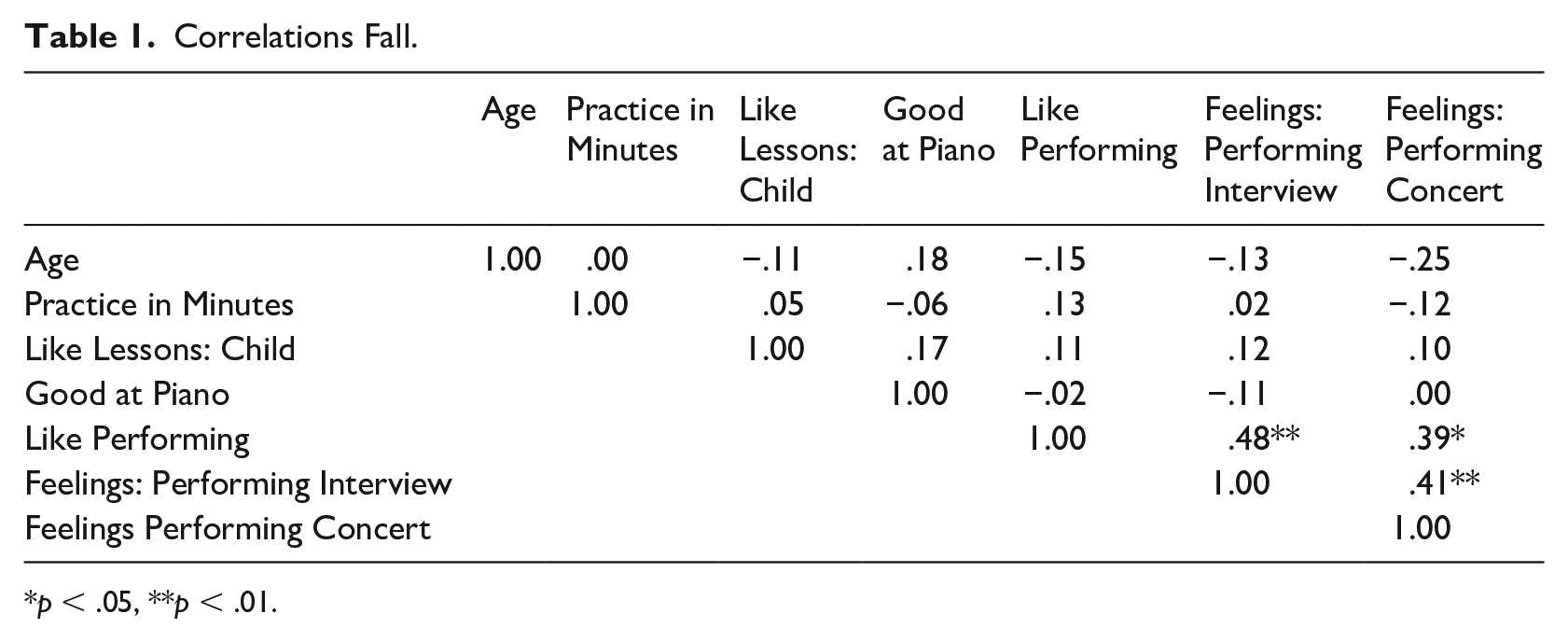
In order to examine the relationships between variables, correlations were calculated for each study period (fall and spring). Variables included children’s age, gender, liking of lessons, perceptions of being good at piano, liking of performing, and the total Feelings About Performance score for interview and performance in that semester.
Correlation analysis: Fall
Several significant correlations were found between variables in the fall (Table 1). Feelings About Performing (interview) correlated with Like Performing (r = .48, p < .01), and Feelings About Performing (concert) (r = .41, p < .01). Feelings About Performing (concert) also correlated with Like Performing (r = .39, p < .05).
Correlations Fall.
p < .05, **p < .01.
Correlation analysis: Spring
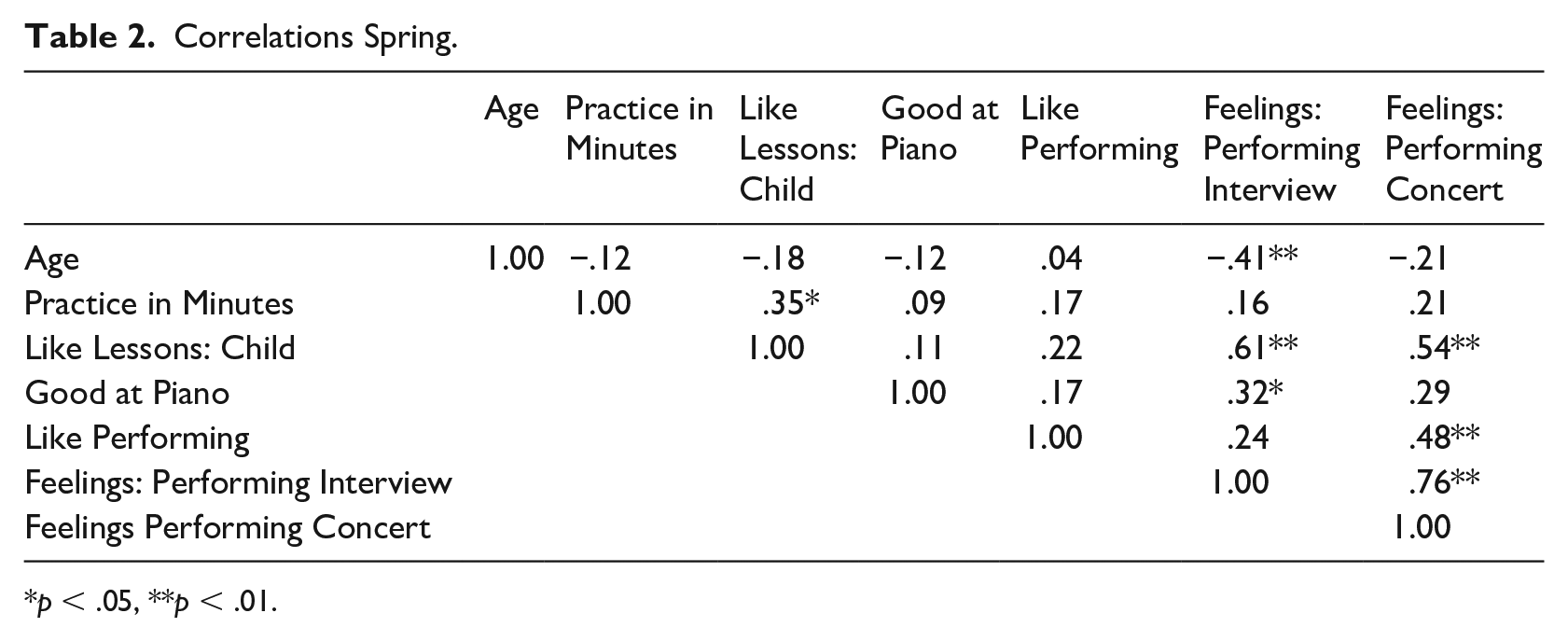
Substantially more significant correlations were found between variables in the spring study period (Table 2). Feelings About Performing (interview) correlated with Age (r = −.41, p < .01), Good at Piano (r = .32, p < .05), Like Lessons (r = .61, p < .01), and Feelings About Performing (concert) (r = .76, p < .01). Feelings About Performing (concert) also correlated with Like Lessons (r = .54, p < .01) and Like Performing (r = .483, p < .01). Like Lessons also correlated with Practice (r = .35, p = .05).
Correlations Spring.
p < .05, **p < .01.
Change in feelings about performing over time and context
To examine change in measures across the two study periods, t-tests were calculated on children’s: (1) Liking of Performing and (2) Feelings About Performing. Results indicated that neither variable changed significantly over the two semesters; however, both means were higher in the spring study period. Like Performing (t = −1.74 (39), p < .09) increased from M = 1.6 (SD = 0.7) in the fall to M = 1.8 (SD = 0.5) in the spring. Feelings about Performing (t = −1.9 (40), p < .06) increased from M = 21.3 (SD = 1.7) in the fall to M = 21.8 (SD = 2.1) in the spring.
To further parse out whether individual components of the Feelings About Performing Scale changed across time, a series of t-tests were calculated for each of the six measures between the two concerts, the two interviews, and the interview and concert in each time period. There was substantial consistency across time periods on individual components of the measure. Between Interview 1 and Concert 1 there were no significant differences. Between the two interviews, there was a significant difference for the item Feels Well (t = −2.89 (40), p < .006), with scores increasing from fall (M = 3, SD = 1) to spring (M = 3.5, SD = 0.7). From Interview 2 to Concert 2 there was a significant difference for Feels Calm (t = − 2.24 (40), p < .03) and for Will Remember (t = −3.39 (40), p < .002). Children reported calmer perceptions about performing when asked at the concert (M = 3.2, SD = 0.8) than they did at the interview (M = 2.9, SD = 0.7). They also felt more confident in their ability to remember at the concert (M = 3.8, SD = 0.4) than they did at the interview (M = 3.4, SD = 0.7). Between the two concerts, the only significant difference was found on the item Will Remember (t = −2.31 (40), p < .26). The mean score increased from Concert 1 (M = 3.4, SD = 0.8) to Concert 2 (M = 3.8, SD = 0.4).
Impact of study variables on feelings about performing at concerts
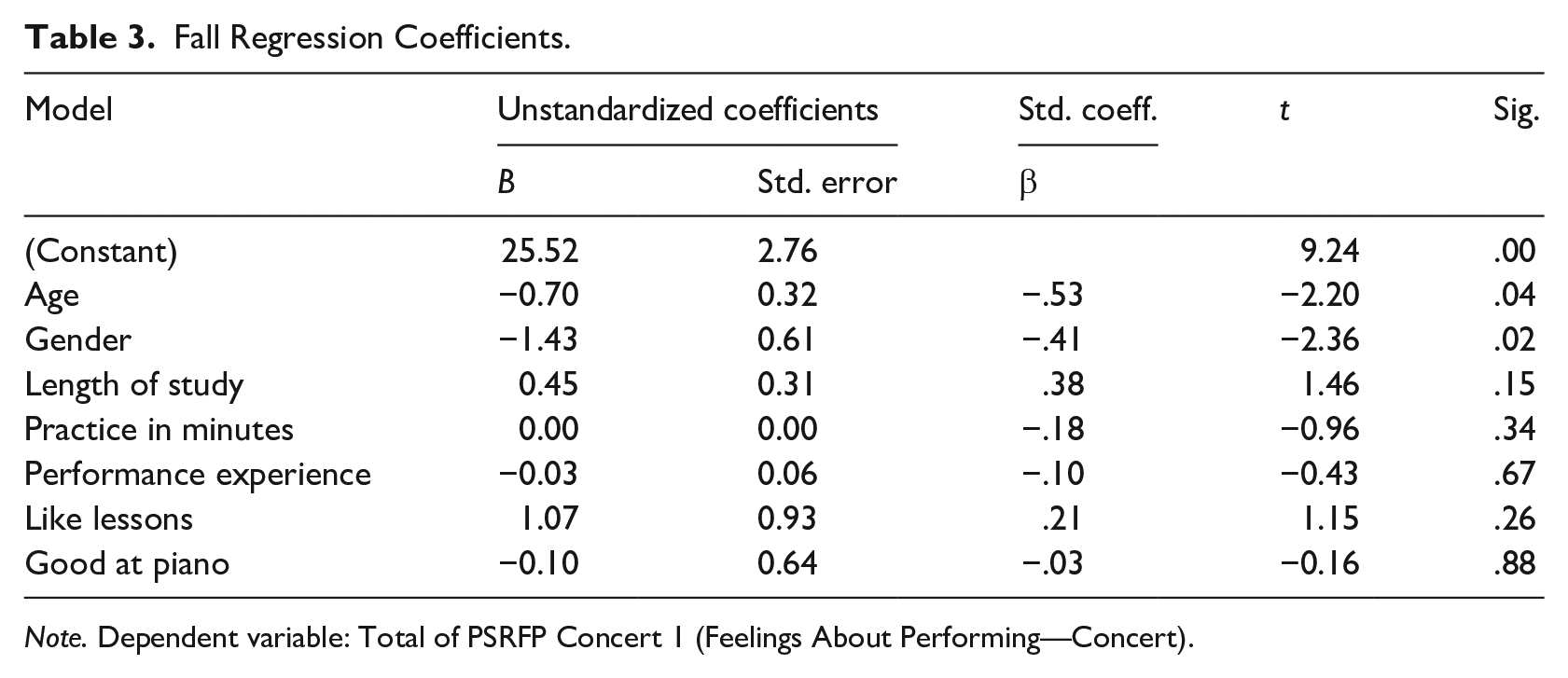
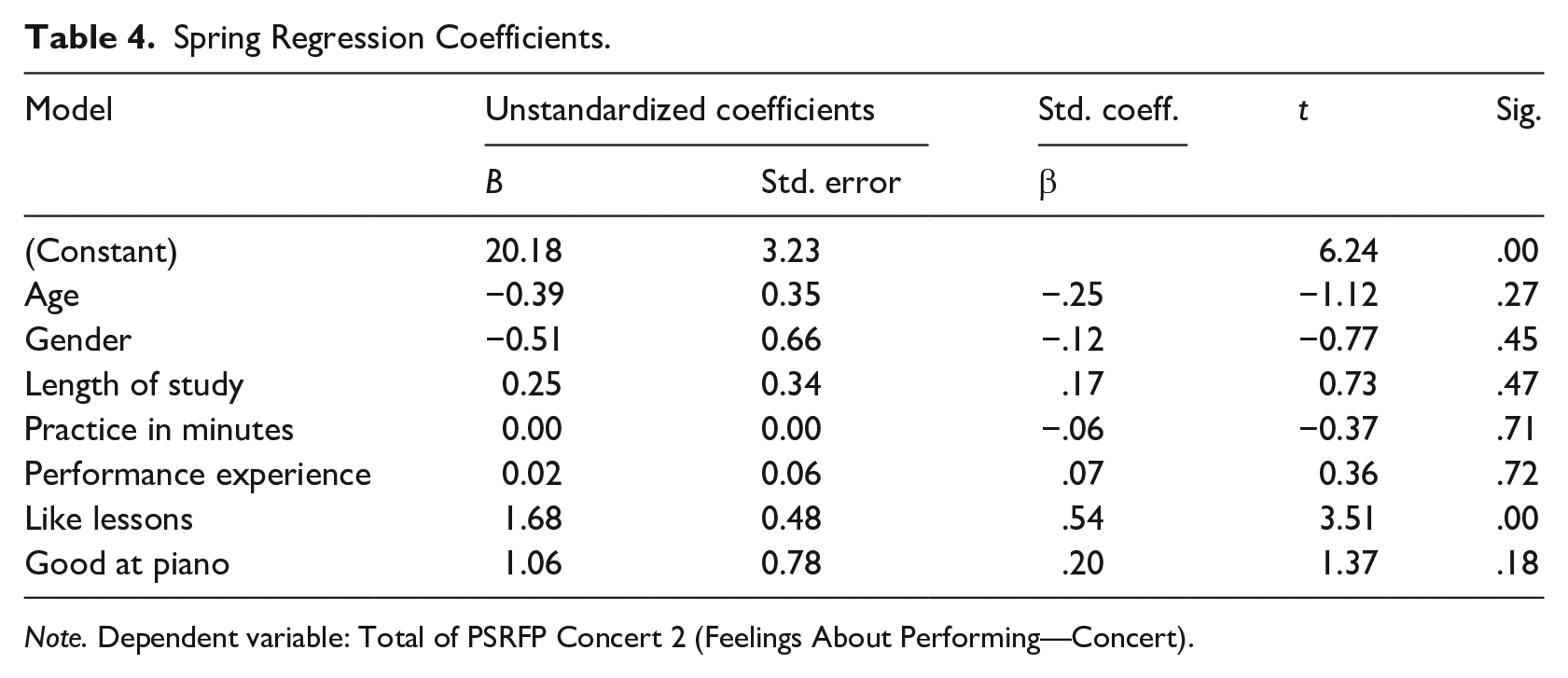
To consider potential impact of age, gender, length of study, weekly practice time, performing experience, liking of lessons, and perception of being good at piano on reported Feelings About Performing (measured at concerts), regression analyses were calculated on these variables for both study periods (Tables 3 and 4). Results indicate that both Age (B = −0.7, p < .04) and Gender (B = −1.43, p < .02) were significant predictors of Feelings About Performing in the Fall. Younger children and boys had more positive feelings about performing than older children and girls. In the spring, the only significant predictor was Likes Lessons (B = 1.68, p < .001).
Fall Regression Coefficients.
Note. Dependent variable: Total of PSRFP Concert 1 (Feelings About Performing—Concert).
Spring Regression Coefficients.
Note. Dependent variable: Total of PSRFP Concert 2 (Feelings About Performing—Concert).
Discussion
The purpose of this study was to take the first steps in examining the feelings of young pianists regarding their participation in solo recitals. Interviews with children and questionnaires completed by parents over the course of two semesters of piano instruction were examined for relationships among a variety of study variables and changes over time. Additionally, children completed the Pictorial Scale of Reported Feelings About Performing at both interviews and two subsequent concerts spaced 5 months apart. Results will be discussed in terms of the original research questions.
Relationships between study variables
Over time, the relationships between variables changed. In the first period of the study, the only significant correlations were between clearly linked items—Feelings About Performing at the interview and concert and Liking of Performing in general. In the spring, these relationships were strengthened and were joined by positive correlations between Feelings About Performing and Liking of Lessons, as well as the perception of being Good at Piano, a negative relationship between Feelings About Performance and Age, and a positive correlation between Practice and Liking of Lessons.
Liking of Lessons and perceptions of being Good at the Piano as correlates of positive feelings about performance are important findings for teachers to note. Ultimately, most music teachers aim not for their students to become professional performing musicians—rather, we want our students to enjoy learning to make music, to feel competent in their ability to do so, and to have positive experiences sharing music with others. At times when it seems as though students are not working at their potential or their interest is waning, it is worth noting the importance of positive experiences in each of these interrelated aspects of the music learning experience. Additionally, self-perception of competence has been shown to be a significant predictor of students’ plans to pursue a career in music (Ryan & Andrews, 2021).
Interestingly, there was no correlation between practice and feelings about performance in either study period, and only a moderately-low correlation between practice and liking of lessons in the spring study period. Intuitively, it would seem that practice would be highly linked with success and comfort in both lessons and practice. However, using practice quantity as indicative of practice success may be a flawed premise (Duke et al., 2009; McPherson & Renwick, 2001; Williamon & Valentine, 2000). One wonders whether a measure of practice quality, which might also be associated with the self-perception of competence, might yield more information on this front. Future studies might seek to provide clear guidelines and/or training for children as to effective practice strategies, or to periodically record and analyze samples of practice sessions, to better understand the interrelationships among practice, lesson satisfaction, and positive feelings about performance.
The negative relationship between age and feelings about performance is interesting, in that the children in this study are still quite young and no significant relationship was noted in the fall study period. It is notable, however, that the relationship between age and feelings about performance is negative in each time and context—that is, at both interviews and both concerts—though it only attained significance at the spring interview. There are too few children in the study and, in particular, at the younger ages, to compare children by age. With the majority of participants in the 9 to 10 age range at the outset of the study, by spring they would all have been in the 10 to 11 age range, getting ready to enter grades 5 and 6 in school. This preadolescent stage may be a critical point in studies of performance anxiety and overall feelings about musical performance. Certainly, age has been linked with performance anxiety in previous studies, although the results have been inconsistent (Salmon & et. al, 1989; Steptoe & Fiddler, 1987; van Kemenade et al., 1995; Wolfe, 1989) and previous studies have linked adolescence to a heighted experience of anxiety (Ryan, 2005; Ryan et al., 2021). It may be that the early stage of adolescence is also reflected in children’s feelings about performance.
Change in feelings about performance over time and context
It is noteworthy that the correlation between Feelings About Performing, as measured at the interview and at the concert, was much higher in the spring (r = .76) than in the fall (r = .41). This is suggestive that children were more in tune with their feelings about performing, even when removed from the performance context, as the year progressed. Whether this had to do with age, experience, or simply awareness brought on by initial experiences with the measure is unknown. The fact that the spring correlation is quite high is encouraging, given that many times study contexts do require us to take subjective measures in advance of an actual performance, and there is always a degree of concern that the finding might not be truly representative of participants’ in-the-moment feeling. While the correlation is not perfect, it is significantly high, which suggests that we might be able to trust advance measures, possibly even more so if participants have had time to consider the measure components in advance.
Comparison of means did not reveal significant differences between fall and winter concerts on the measures of liking and feeling about concerts, although the .06 probability level in the latter suggests that, with a larger participant pool this measure might have presented with significant differences over time. When individual components of the Feelings About Performing scale were compared over the four testing times, the items that significantly improved over the year focused on children’s confidence in their memory and their feelings of wellness and calm in performance. Each of these items pertain directly to the experience of anxiety in performance, so it is encouraging to see that the children felt more positive about them over time and experience. It would be interesting to further explore this finding in a larger study with distinct age groups to see if the experience factor could mediate the diminishing feelings regarding performance that children express as they get older.
Impact of study variables on feelings about performance at concerts
In the first semester of study, regression analysis indicated that only age and gender impacted upon children’s feelings about performance. The performance measure was taken upon arrival at a formal piano recital in which the children were performing. Older children had less positive feelings about the performance, as did female participants. This gender difference is consistent with other studies indicating that young females report greater performance anxiety than males (LeBlanc et al., 1997; Osborne et al., 2005; Rae & McCambridge, 2004; Ryan, 2004, 2005).
It is interesting that one semester later, both of these predictors had disappeared. The only significant predictor of feelings about performance in the spring semester was the child’s feelings about their piano lessons. Children who liked their lessons had more positive feelings about their impending performance. How did the results change so quickly, with approximately 5 months between the two performances?
This was a study that targeted children taking piano lessons at a well-regarded traditional conservatory, and children/parents had to take the step of contacting researchers if they were interested in participating. The first child interview/parent questionnaire, where data about age, gender, and liking of lessons was collected, was the very first component of this study—the first time the child would have met the researcher assistants and provided any information relevant to the study. As such, it is conceivable that children felt compelled to say that they did, indeed, like their piano lessons, whether or not this was actually the case. Five months later, when the second interviews took place, the children would have already gone through the first round of interviews and the first performance at which additional measures were taken. They would also have been at the end of another year of piano instruction, at which point they may have been much more inclined to speak truthfully about their feelings regarding performance. The end of a school year is also a critical time for many students to reflect upon whether or not they enjoy their lessons and wish to continue with them—something they may not have been prepared to discuss in their fall interviews.
The question of why the age and gender variables are significant for the fall but not the spring is more difficult to interpret. It is possible that there is an age plateau that children reach in this regard, whereby differences were noted in the fall, but as children aged over the course of the year, the plateau was reached and no longer showed a difference. This explanation, however, is confounded by the fact that a significant negative correlation was found between age and Feelings about Performing when measured at the interview, but not when measured at the actual recital. As this is the first study to examine children in this age range, it is worth exploring the performance experience of preadolescent children further to gain a better understanding about the role of age and gender at this time.
Limitations of the study
Results of this study should be taken with caution given the uneven number of participants across the studied age-span. As noted previously, future work with comparable groupings of children at each year between 6 and 10 would be better positioned to answer questions pertaining to differences and changes across the elementary years. The lack of an age-appropriate standardized measure with which to examine children’s performance experience is unfortunate. However, given that the pictorial scale used in this study yielded fairly consistent results over time, the potential for the measure is encouraging. An adaptation and norming of one of the current standardized scales for performance anxiety for use with younger children would nevertheless be a welcome addition to the performance anxiety literature and resources. Finally, the potential for inaccurate estimation of responses to questionnaire items such as the number of prior performances and amount of practice time (especially for older children) calls into question findings on these measures. Future studies might consider asking participants to record their practice times and performances in a log rather than responding to questions about them without evidence.
Future directions and implications for music education
While this study provided an initial glimpse into the piano performance experiences of children 10-and-under, much remains to be explored and understood—in particular with regard to the relationships between practice, gender, and age in children’s feelings about performing in public. In the meantime, teachers can take heart in the knowledge that positive feelings about lessons and confidence about instrumental skills may go a long way toward creating a happy performance experience for their students.
