



Abstract
Background:
Death by suicide is a global health concern and is one of the top three causes of death among people aged between 15 and 29 years. Teachers are the key professionals in educational institutes to identify symptoms of suicide among students. The present article aimed to develop, validate, and implement a workshop module on the suicide prevention program (SPP).
Methods:
The workshop module was developed using the “curriculum development for medical education framework”. Subject experts from the psychiatric field validated the module. A total of 72 Pre-University College (PUC) teachers participated in the workshop. A self-structured feedback questionnaire was used to evaluate the participants’ satisfaction.
Results:
The workshop content areas were identified with a thorough literature review. The workshop module (content, case scenarios for role play, topics for group activities, and diary) was developed in the English language and validated with a content validity index of one. Participants reported high satisfaction with the workshop module. Feedback reported a positive attitude toward suicide prevention.
Conclusion:
The “Suicide Prevention Program” was developed and validated based on various experts’ suggestions for PUC teachers. It can be implemented in educational institutes.
Registration:
CTRI registration is done (CTRI/2022/09/045819).
Keywords
The “suicide prevention program” can be implemented in educational settings for teachers, students, and parents to create awareness and boost their knowledge in identifying suicidal symptoms, which will help in reducing the suicide rate among students.Key Message:
Worldwide, suicide is a growing issue irrespective of age. 1 Every year 46,000 young people (10–19 years) die by suicide globally, 2 and suicide is marked as the third major cause of death among people aged between 15 and 29 years. 3 Many suicides are unrecorded due to social stigma and cultural beliefs. 4 An Indian e-newspaper highlighted that in the last two decades, the student suicide rate has increased by 4% of the annual suicide rate, and many cases are underreported. 5 Although according to the Mental Health Care Act 2017, 6 suicide is decriminalized in India as in other countries, 7 the reporting of suicide cases is still impacted by the longstanding practice of criminalization, stigma, etc. 5
Academicians act as key stakeholders in implementing the goal of reducing the rate of suicidal mortality by 10% by 2030 in India. 8 The United Nations Sustainable Development Goal (SDG 3.4.2) discusses the suicide mortality rate. 9 Students spend a good amount of time with teachers. Identification of at-risk students is a key component of a suicide prevention strategy. 10 Early identification and providing therapeutic intervention is a crucial task in suicide prevention. 11 A supportive environment in the educational organization plays a role in the prevention of suicide among students.12,13 Teachers are the most supportive source in understanding suicidal symptoms 12 and can identify suicidal symptoms among students at an early stage. 14 Counseling given by teachers helps reduce the suicidal rate among students. 15 Evidence found that teachers had limited 16 or moderate knowledge17,18 in identifying suicidal symptoms, and it can improve through gatekeeper training.19–21 Though most of the teachers are aware of their responsibility to talk to students regarding mental health issues, they have limited knowledge of suicide, and very few teachers are confident in asking about suicidal plans. 16
Therefore, existing studies16–17,20,22 were recommended to train teachers on suicide prevention so that teachers can identify suicidal behavior among students at the initial phase. A meta-analysis reported that, though school-based suicide prevention programs (SPP) are effective in suicide prevention, it was difficult to generalize the results due to the availability of limited studies. 23 To address this gap, the researchers intended to develop, validate, and implement a structured “suicide prevention program (SPP)” among Pre-University College (PUC) teachers to improve their knowledge, attitude, and gatekeeper behavior toward suicide prevention. To the researchers’ knowledge, this will be the first study in which PUC teachers are considered as gatekeepers on suicide prevention.
Methods
This SPP workshop module is part of a single-center, randomized trial among PUC teachers. Ethical clearance was obtained from the Institutional Ethics Committee, and the trial is also registered in the Clinical Trial Registry of India. The study protocol is published elsewhere. 14 The PUC teachers of the intervention arm received a one-day workshop (8 hours) on suicide prevention through lecture method, videos, group discussion, role-play, and case vignette discussion; participants were provided a handout that included major topics of the workshop and a diary. The diary will be followed up for six months.
Application and Adoption of the Framework
The curriculum development for medical education: A six-step approach framework developed by Thomas et al. 24 was followed as a blueprint to develop the SPP. The following are the steps followed:
Step 1: Problem Identification and General Need Assessment
The extensive literature on knowledge, attitude, and gatekeeper behavior toward suicide prevention in the overall population was reviewed to find the necessity of educational intervention and to comprehend the present approaches to address the need.
Step 2: Targeted Need Assessment
The literature on teachers’ knowledge, attitudes, and gatekeeper behavior toward suicide prevention was reviewed to identify the need for the present workshop.
Step 3: Goals and Objectives
The intervention’s ultimate goal was to improve teachers’ knowledge, positive attitude, and gatekeeper behavior toward suicide prevention. A further goal was to determine PUC teachers’ perceptions about the educational intervention.
Step 4: Educational Strategies
The “suicide prevention program” was prepared and validated using experts’ opinions. The content and educational techniques, including case-based discussions, interactive lectures, and short videos, were developed based on the intervention’s feasibility.
Step 5: Implementation
Permission was obtained from the Deputy Director, Department of Pre-University Education, Udupi, India, and the principals of selected PUCs for the educational intervention. A pilot study was conducted among PUC teachers to determine the feasibility of the intervention.
Step 6: Evaluation and Feedback
Following the workshop, feedback was collected from all the participants regarding the workshop module.
Development of the Educational Module
The personal experience of the authors of the present article, who are working as mental health professionals, and a thorough search of the literature served as the basis for the need assessment to develop SPP. To identify the need for SPP, a preliminary assessment was done among 50 PUC teachers, and the result showed a high necessity for SPP among PUC teachers. An extensive literature search provided recommendations from numerous studies that though some teachers had average knowledge17–18 of suicide prevention, many teachers are not confident in assessing the suicidal symptoms among students. 16 It was also found that most of the teachers do not feel comfortable talking with students about suicide, and they believe that talking about suicide can give a clue to attempt suicide. 16 Educational interventions previously conducted to improve knowledge and change attitudes and behavior toward suicide prevention were reviewed. Evidence found that teaching is a good source to strengthen the knowledge and positive attitude of teachers on the assessment of suicidal symptoms among students. The investigator also explored the existing practices and efforts done by teachers to enhance skills in suicide prevention.
After exploring the needs and expectations of teachers, the goals and objectives of the workshop were established. The content of the module was intended for PUC teachers who have never attended any training/workshop on suicide prevention. The primary objective of the module was to improve the knowledge, attitude, and gatekeeper behavior of teachers toward suicide prevention so that early recognition and prevention of student suicide can be done.
The investigator developed the module with workshop content, including case vignette discussion, scenarios for role play, topics for group activities, and a diary in the English language after a thorough search of existing literature. The participant’s capacity to understand the information was considered, and the content was made comprehensive, simple, and clear. The module consists of sessions focusing on building the skills in suicide risk assessment of students in terms of preparedness, self-efficacy, and the likelihood of identifying students for counseling and referral to the appropriate health agency. A lesson plan was prepared with details of the contents to be covered during the workshop, objectives of the included topic, the approximate time required to complete each topic, and activities the participants will do with expected learning outcomes.
Validation of the Workshop Module
A criteria checklist was prepared for validation of the SPP module, which included a selection of the content, organization of content, AV aids used, and language. The checklist, along with the study protocol and SPP module, was sent for validation to nine National and international experts from the field of psychiatry, psychiatric/mental health nursing, and psychiatric social work. The content was validated in terms of adequacy/accuracy/appropriateness/easy to follow/attractive/relevancy. The validator had to strongly agree/agree/strongly disagree/disagree with the items and give remarks and suggestions. The suggestions given by validators were analyzed, and necessary modifications were incorporated after discussion with the research team, and the draft was finalized.
Pilot Testing of the Content
The SPP was pilot-tested among 33 PUC teachers to determine the feasibility of the workshop administration and estimate the time required to deliver the module. Feedback was collected verbally and through Google Forms.
Opinions of PUC Teachers Regarding the Workshop Module
The SPP was delivered in a one-day workshop mode to 72 PUC teachers of Udupi District at Dr. A.V. Baliga Memorial Hospital, Udupi, Karnataka, India, in June 2024. Psychiatrists and psychiatric nurses delivered the sessions. Written informed consent was collected from each participant before the workshop, and learning outcomes were explained to the participants. At the end of the workshop, a feedback form was given to all the participants, and it included a total of 17 questions. Eight binary questions must be replied to with a “Yes” or “No,” seven Likert scale questions (ranging from very satisfied to not satisfied, very useful to not useful, very helpful to not helpful), and two open-ended questions for future improvement and related to an advance workshop on the same topic. The participants also verbally reported their overall feedback on the workshop. Only level 1 (reaction) of Kirkpatrick’s model of learning evaluation was assessed in this workshop; three other levels (level 2 to level 4, i.e., learning, behavior, and result) 25 will be evaluated in the RCT.
Results
Following the “curriculum development for medical education,” the needs of the teachers were identified through a preliminary study and literature search. Then, the module was prepared.
Needs of the Teachers Based on the Preliminary Study Findings and Literature Review
From the thorough search of existing studies, several areas were identified in the teachers’ knowledge, attitude, and gatekeeper behavior to include in the module. These studies informed the development of the following areas: (a) Death by suicide overview; (b) Warning signs; (c) Risk factors and protective factors; (d) Identification of suicidal symptoms; (e) Intervention for suicidal attempt; and (f) Prevention of suicide. These were the major areas for improving teachers’ knowledge, attitude, and gatekeeper behavior. As per experts’ suggestions, minor modifications were incorporated in consultation with research team members.
Workshop Module
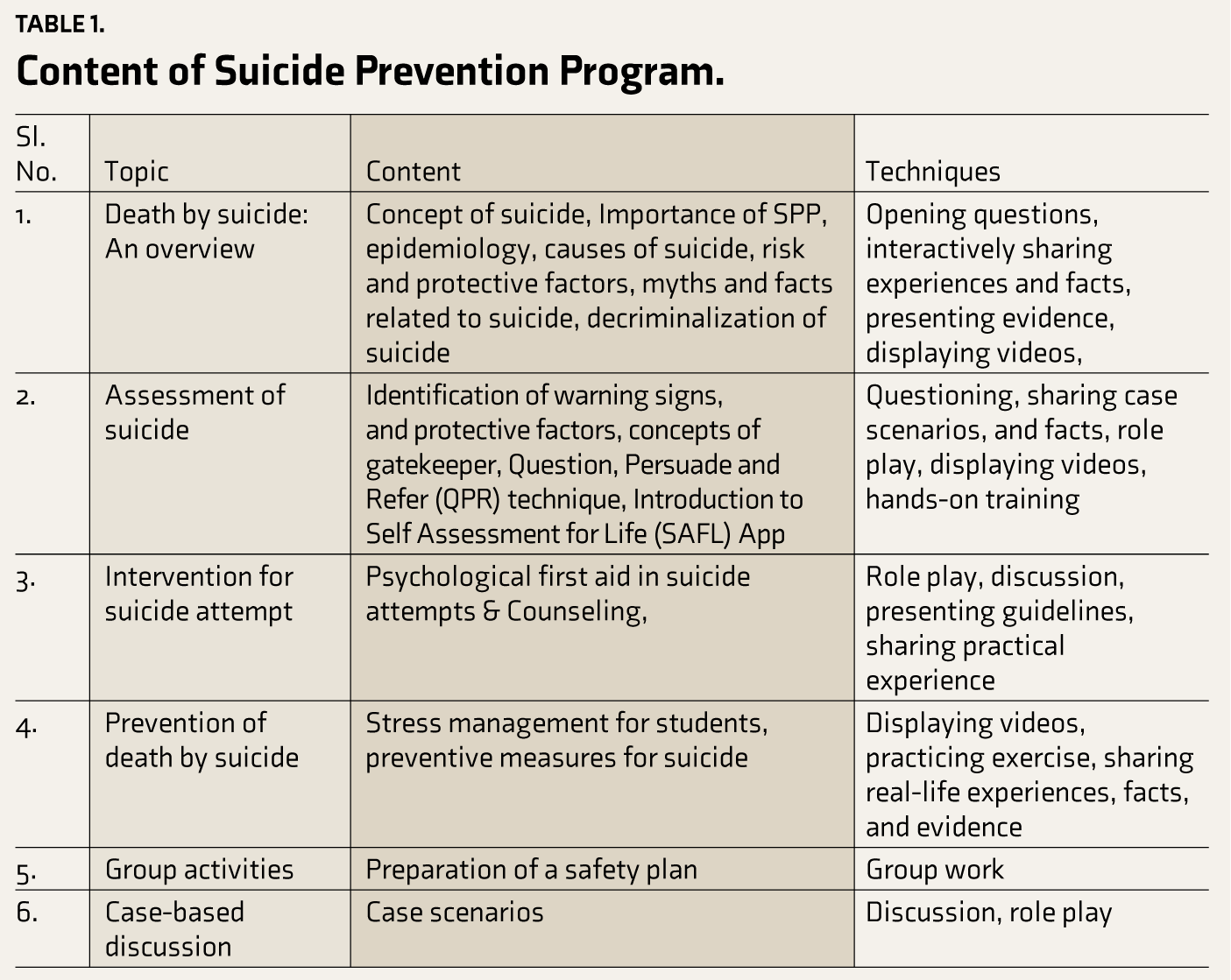
Based on the outcome of the literature search, an SPP module was prepared (Table 1). Initially, the module was prepared for 10 hours, but it was modified to 8 hours after the pilot testing. The content was deliberated through interactive lectures. The learning objectives included identifying the risk of suicide among students, reducing the number of suicides among students, helping the students to overcome stress, interacting with mental health professionals, and creating a healthy environment in the educational institute as well as in the community. A total of five YouTube videos related to suicide prevention with a mean time of 15.54 minutes, four case-based scenarios for role play, a safety plan preparation, and hands-on training on the Self Assessment for Life (SAFL) app were included in this content. A diary was given to the participants to document the details of the communication they had with their students during suicide assessments.
Content of Suicide Prevention Program.
Validation of SPP
Content validity was established through feedback from nine experts, including mental health professionals from National and international levels. The calculated CVI score was one, which is considered good content validity.
Pilot Testing of SPP
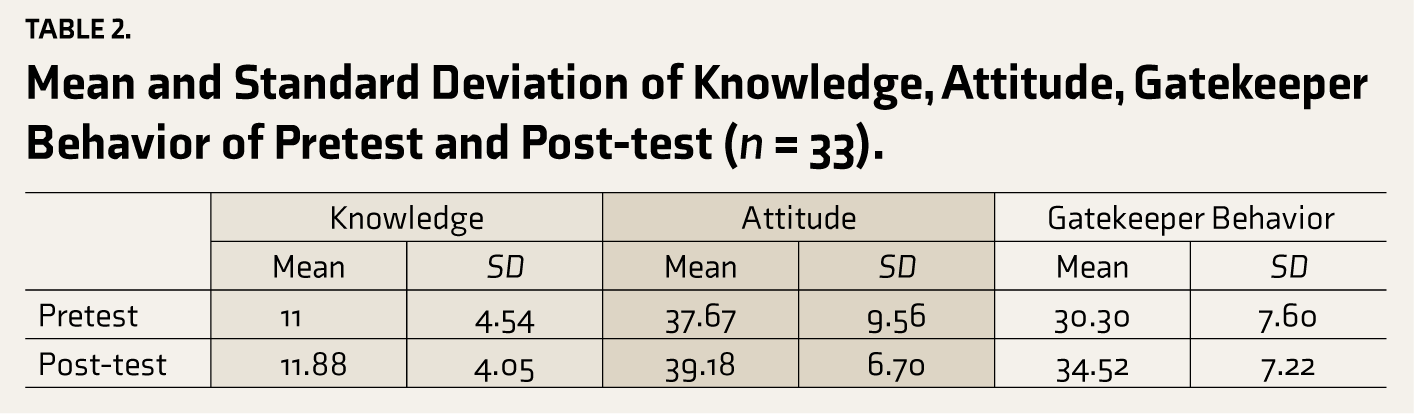
Pilot testing of SPP was done among 33 PUC teachers of Udupi. A separate taluk was selected for the pilot study as well as for the main study to reduce the contamination. Before the pilot testing (Pretest), and after 7 days of the workshop (Post-test), all the participants were assessed with the Literacy of Suicide Scale (LOSS), 26 Attitude Toward Suicide Prevention (ATSP), 27 and Gatekeeper Behavior Scale (GBS). 28 The SPP was accepted by the participants and found to be feasible to administer in the concerned population. The researcher planned for 10 hours (or 2 consecutive days) of the session. Due to time constraints, it was given for 7–8 hours (1–1.5 hours per day for one week). The materials of the SPP were found comprehensive to the participants. After attending the SPP, teachers’ knowledge was improved, and they developed a positive attitude and a positive gatekeeper behavior toward suicide prevention, which was found during the post-test (Table 2). The analysis was done using IBM SPSS (version 24). 29 Participants reported that the content of the workshop was relevant and insightful. All the participants were satisfied with the teaching-learning methods but reported that it should not be for 10 hours. Following these, the duration was reduced in the final implementation stage.
Mean and Standard Deviation of Knowledge, Attitude, Gatekeeper Behavior of Pretest and Post-test (n = 33).
Opinions of PUC Teachers Regarding the Workshop Module
A total of 72 PUC teachers from Udupi, India, were included in the implementation of SPP. All the participants were regular employees, mentally healthy, and had not ever attended any workshop/teaching program related to suicide. Most of the participants reported that the workshop was well organized, the deliberation of the session was systematic and understandable, and informatics. Six of the participants reported that more group activities need to be included. The majority of them said that the duration of the workshop should be half a day and should be conducted for all teachers, parents, students, and community people so that everyone will be aware of such alarming mental health issues. Table 3 reported the feedback received from the participants after the workshop.
Feedback from Study Participants (n = 72).
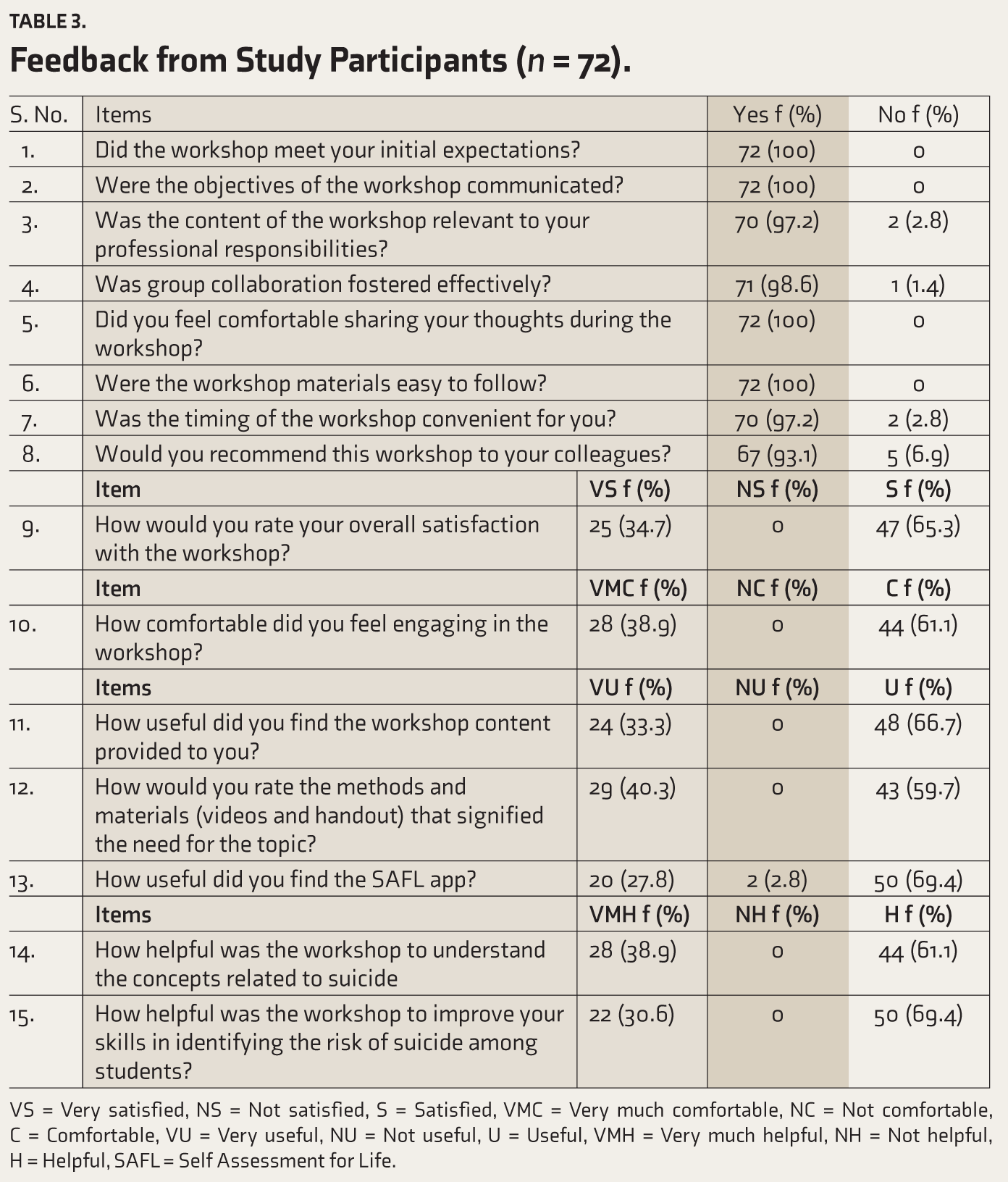
VS = Very satisfied, NS = Not satisfied, S = Satisfied, VMC = Very much comfortable, NC = Not comfortable, C = Comfortable, VU = Very useful, NU = Not useful, U = Useful, VMH = Very much helpful, NH = Not helpful, H = Helpful, SAFL = Self Assessment for Life.
Discussion
In this article, the authors demonstrated that the education module of a capacity-building program (i.e., SPP) can be developed through a stepwise approach. In this study, SPP was prepared based on the curriculum development for medical education: a six-step approach by Thomas et al. 24 which includes identifying the problem and need assessment, setting goals, developing content through experts’ opinions and validation, appropriate teaching-learning strategies, pilot testing, implementing and evaluating feedback. It was noted that the workshop was effective in the pilot testing in improving PUC teachers’ knowledge, attitude, and behavior toward suicide prevention, and the content, AV aids, and diary were acceptable. The participants appreciated the workshop well. It identified a changeable attitude toward suicide prevention among teachers before and after the workshop (Kirkpratrick’s level 1). 25
The authors of the present article also followed social cognitive theory 30 to develop the material to improve the self-efficacy, likelihood, and preparedness of the PUC teachers. Though our intervention was prepared in English, for easy understandability, we used bilanguage [English and Kannada (the local language of the study setting)] while deliberating the sessions. The evidence from the 2011 census reported that 43.7 million people of Karnataka, India, speak Kannada as a native language, 31 thus increasing the likelihood of generalizability and the efficacy of the study outcome.
The previous studies showed that educational intervention was effective in boosting teachers’ knowledge and changes in attitude toward suicide prevention.19–21 The teaching-learning techniques used in this workshop involved interactions leading to the active participation of the participants. Discussions during interactive lectures provided opportunities for participation, active and cooperative learning, and develop analytical thinking. Including common myths related to suicide helped engage the participants in the discussion and offered more opportunities for clarifying their concepts, attitudes, and behavior toward suicide prevention. Challenging popular beliefs with scientific evidence can be an effective method to alter their negative attitude. A single-arm study reported that among schoolteachers, a full-day, interactive, video-based train-the-trainer approach to a gatekeeper training program for adolescent suicide prevention was effective in the improvement of suicide literacy, decreased stigma, and exhibited gatekeeper behavior. 32
Implications of the Study
The SPP can be integrated into educational organizations after incorporating teachers’ feedback to reframe the module and recommendations from the higher school administrative authority. The major suggestions include shortening the duration of the workshop and adding more real-life situations. It can be suitably modified and implemented in educational settings for teachers, students, parents, and staff to create greater awareness and boost their knowledge and skill in identifying suicidal symptoms, which will likely help reduce the suicide rate among students.
Limitations
The opinions of the participants were collected through a self-structured questionnaire. Measuring with a self-structured questionnaire may hinder the in-depth understanding of the concepts. The authors prepared the module in English. Future studies can include multiple languages and qualitative assessments with focus group discussions. Further research should be conducted on the module for generalizability.
Conclusion
The SPP was developed and validated using experts’ opinions. The PUC teachers received the workshop well, and it could be implemented in educational institutes with suitable modifications. Future studies are needed and can also be implemented in diverse settings and populations to create more awareness. This article is part of one RCT, and the long-term effectiveness will be measured in a later phase.
Supplemental Material
Supplemental material for this article is available online.
Footnotes
Acknowledgements
This article is part of an intervention study for a Ph.D. study and received the Dr. TMA Pai Scholarship from the Manipal Academy of Higher Education, Manipal. The authors of this article express their gratitude to all the subject experts for their insightful suggestions in preparation for the SPP. We acknowledge all the members of Dr. A.V. Baliga Memorial Hospital, Udupi for their support in conducting the workshop. The authors are thankful to all the speakers for taking the sessions and grateful to the participants for their active participation.
Consent for Publication
The investigators informed all the participants before data collection that the data would be published as per the study objectives without participant details.
Data Availability
Deidentified individual participant data will not be made available.
Declaration of Conflicting Interests
The authors declared no potential conflicts of interest with respect to the research, authorship and/or publication of this article.
Declaration Regarding the Use of Generative AI
None used.
Ethical Approval and Consent to Participate
Ethical clearance was obtained from the Institutional Ethics Committee of Kasturba Hospital and Kasturba Medical College, Manipal (approval number 132/2022). Clinical Trial Registry of India (CTRI) registration was completed (CTRI/2022/09/045819).
Funding
The study received a grant from “Minds United for Health Sciences and Humanity Trust, Mysuru,” Karnataka, India.
Patient Consent
The participant information sheet was provided, and written informed consent was obtained prior to the workshop. Formal administrative permission was also granted by the Department of Education, Udupi, and the Principal of Pre-University Colleges. This manuscript has not been published, submitted, or accepted for publication elsewhere.
References
Supplementary Material
Please find the following supplemental material available below.
For Open Access articles published under a Creative Commons License, all supplemental material carries the same license as the article it is associated with.
For non-Open Access articles published, all supplemental material carries a non-exclusive license, and permission requests for re-use of supplemental material or any part of supplemental material shall be sent directly to the copyright owner as specified in the copyright notice associated with the article.
