




Abstract
Background:
Various assessment tools that explore and assess mindfulness are available. Keeping in view both the origin of and the literature surrounding mindfulness assessment tools, this study aimed to evaluate the workability of one widely researched tool, the Five Facet Mindfulness Questionnaire (FFMQ), for establishing cross-cultural generalizability and utility in the Indian context.
Methods:
We recruited 303 adults over 18 with proficiency in the Tamil language and no history of significant neurological trauma and/or psychiatric history. They completed a version of the 39-item FFMQ, which we had translated into Tamil (FFMQ-T). The psychometric properties of this scale were tested using the Partial-Credit model of Rasch analysis.
Results:
Iterative Rasch analysis could not resolve consistent misfit of the Observe facet items. Using a subtest approach, a higher-order fit of the FFMQ-T could be achieved after the deletion of additional items from each of the remaining four facets. The resulting final model for the FFMQ-T questionnaire was a four-factor solution with 22 items.
Conclusions:
This study concluded the usability of the new 22-item FFMQ-T. These results are not dissimilar to the other versions in similar populations, such as the Hindi version of the FFMQ. The ordinal-to-interval conversion tables provided here ensure that the FFMQ-T can be used with enhanced precision and parametric statistics.
The Five Facet Mindfulness Questionnaire has been widely used in assessing mindfulness in varied contexts in the West and other locations. However, research is lacking within the Indian subcontinent. Given that India is a diverse country, the investigations of mindfulness to Indian contexts need to be expanded, connecting it to broader international research by translating and validating questionnaires in Indian languages.Key Messages:
Kabat-Zinn developed the Mindfulness-Based Stress Reduction (MBSR) program in the late 1970s in the United States of America. 1 Gradually, mindfulness-based interventions, including MBSR and Mindfulness-Based Cognitive Therapy (MBCT), gained momentum worldwide. 2 A lot of research has documented the utility of mindfulness as a therapeutic intervention. 3 In this context, the most commonly used definition of mindfulness is ‘…paying attention in a particular way: on purpose, in the present moment, and non-judgmentally’. 4
Research in mindfulness needs adequate scales to assess mindfulness. Many such tools have been developed, and the most widely researched tool is the Five Facet Mindfulness Questionnaire (FFMQ).5,6 The FFMQ was derived from the pooling of items that were examined with factor analyses from five self-report mindfulness assessment tools, namely, the Kentucky Inventory of Mindfulness Skills (KIMS), 7 Mindfulness Attention and Awareness Scale (MAAS), 8 the Mindfulness Questionnaire, 9 the Cognitive Affective Mindfulness Scale (CAMS), 10 and the Freiburg Mindfulness Inventory (FMI). 11 The FFMQ assesses the higher-order construct of mindfulness by assessing five facets, namely, Observe (noticing internal and external stimuli), Describe (put words to experiences/label with words), Act with awareness (attention, awareness without distraction in the present), Nonjudge (attitude of non-evaluation towards own experiences, thoughts, and feelings), and Non-React (not getting entangled into thoughts and feelings but letting them just come and go).
A pertinent reason for the high number of citations FFMQ has been that it has been translated into many languages to establish cross-cultural validity. However, the five-factor model has been confirmed in a few studies but not others.12–15 Studies that demonstrated different fit models for the FFMQ English version include those confirming a four-factor model without the Observe facet.16–18
Much of the mindfulness research has been done in the Western context. Recently, there has been a small increase in publications related to this topic in India. More research is needed about India, particularly because of its historical connection to meditative practices and because its philosophy inspired modern mindfulness research in the first place.5,19
To enable systematic research in Indian contexts, the validity of suitable questionnaires needs to be established first. The English version of FFMQ was explored for its psychometric properties in India. 20 It was found that a modified five-factor model with three items (Items 12, 16, and 22) from the Describe facet deleted can be utilized with the general population in India. The authors acknowledged that to explore and understand the relevance and generalizability of a questionnaire in a cross-cultural and geographical setting, the need arises for translation and assessment in commonly spoken languages. To date, the following versions have been validated in Indian languages: The Hindi version of the FFMQ confirmed the utility of a 28-item FFMQ-H with a four-factor solution (with the Observe facet deleted). 21 A Gujarati version has also been examined for its utility with the Gujarati-speaking population. 22 These two studies cater to most of the population located in the North and Western regions of India.21,22
Tamil is a major language in the Southern regions of India. It is the official language in the Tamil Nadu state and Puducherry, where more than 72 million people reside. 23 Tamil is also spoken widely and recognized as an official language in Singapore and Sri Lanka. Countries like Malaysia, Fiji, Trinidad, Mauritius, and East Africa also have Tamil-speaking populations. 24 Thus, given the widespread use of Tamil across various locations of the world and specifically in the Indian context, this study translated the FFMQ to a Tamil version and assessed its utility by testing its psychometric properties.
Many studies have demonstrated the advantage of Rasch analysis in improving an instrument’s precision, especially in the context of mindfulness assessment tools such as MAAS, KIMS, FFMQ, and the Comprehensive Inventory of Mindfulness Experiences (CHIME).25–28 Hence, this study utilized Rasch analysis to determine the psychometric properties of the Tamil language version of the FFMQ (FFMQ-T). Thus, the objective of this study was to translate the FFMQ-English version to the FFMQ-Tamil version and calibrate it using Rasch analysis. This will hopefully help broaden the range of available assessment tools suitable for assessing mindfulness in the Indian context.
Method
Participants
The study recruited 303 participants from the general population of Tamil Nadu. To ensure that the participants were able to comprehend the questions, the entry criteria required the participants to be proficient in Tamil (reading, writing, and speaking) and to be above the age of 18 years, which is considered the legal age. Participants with any significant past history or present condition of neurological trauma, mental illness, intellectual impairment, and/or substance abuse were excluded.
Procedure
The participants were recruited using snowball sampling through the researchers’ networks of clinicians and colleagues who were requested to provide or involve more participants from their own networks living in Tamil Nadu. The people from the network were emailed the information sheet outlining the purpose of the study, inclusion and exclusion criteria, a link to access the questionnaire (using Google Forms), questionnaire instructions, and the approximate time taken to complete the questionnaire (20 minutes). Participants were asked to self-identify based on the inclusion and exclusion criteria, as no screening tests were conducted for the same. The information sheet also explained aspects related to anonymity, consent, data storage, and ethics approval. This study was approved by the author’s Institutional Ethics Review Board.
Anonymity was maintained such that the participants could not be identified by their responses. Completion of the questionnaire was considered as consent to participate. Participation in the study was voluntary, and at any given time, the participants could withdraw from the participation. No participants were provided with any incentive to complete the questionnaire or participate.
Measures
The FFMQ, in its original English version, consists of 39 items marked on a 5-point Likert scale ranging from 1 (never or very rarely true) to 5 (always or very often true). 6 The five subscales/facets of the questionnaire (Observe, Describe, Act with Awareness, Nonjudge, and Non-react) have eight items each, except for Non-react, which has seven items. In total, 19 items are negatively worded and thus need to be reverse-coded so that a higher score represents a higher level of mindfulness. The negatively worded items are three items from the Describe facet (Items 12, 16, and 22) and all items of the Act with awareness, Nonjudge, and Non-react facets.
This study used the method of translation-back translation to develop FFMQ-T, which was also used in developing the FFMQ-H. 21 For this, initially, two independent translators proficient in both English and Tamil, having a professional degree/diploma in translation studies and a university degree in another subject, were requested to translate the original FFMQ English version into Tamil. Further, two independent clinicians/clinical psychologists thoroughly familiar with the subject matter were requested to check for nuances in terms of grammar and meaning of the translated FFMQ-T. Then, the FFMQ-T was back-translated into English by another clinician. This back-translated version was scrutinized for any minor errors by two further independent professionals proficient in both Tamil and English. Considering the similarities between the item content of the original English version and the back-translated version, the final Tamil language questionnaire was found to be appropriate. The direction of the wording of the items (positive and negative wording) was maintained in the FFMQ-T to mirror the structure of the English version.
Data Analyses
Descriptive statistics were conducted using SPSS version 28.0. All negatively worded items of the FFMQ-T were reverse scored so that, for every item, a higher score indicates a higher level of mindfulness.
Rasch analysis was conducted using the software RUMM2030. 29 Rasch analysis includes conceptual criteria such as interpretability of the solution as well as consideration of previous findings from research. The steps to conduct Rasch analysis were as follows 30 : First, the likelihood-ratio test was completed, confirming the use of the unrestricted Partial Credit model for all the items (39 items) of the FFMQ-T. An initial analysis with all the items included served as a reference point (baseline), followed by an iterative exploration of those items with disordered thresholds and/or misfit (i.e., item fit residual is ±2.50). Misfitting items can be considered candidates for deletion, after which analysis can be re-run to scan for any further individual item misfit. Differential item functioning (DIF) was also checked for the person factors and confirmed by graphical inspection. DIF assesses the extent to which the items contribute to mindfulness differently based on different demographic variables or personal factors, which in this study was based on gender, level of education, income, occupation, and meditation practice. In order to confirm an adequate fit, the chi-square (item-trait interaction) should be non-significant, with no evidence of disordered thresholds, no significant DIF by personal factors, and sufficiently high internal scale reliability (>0.70) expressed as Person Separation Index (PSI), the mean of item location should approximate 0.00, and the fit residuals (person and item fit) should approach 0.00 with standard deviation (SD) of 1.00. After every overall model and individual item analysis, a test of unidimensionality was also conducted to confirm unidimensionality. 31
Unidimensionality is determined when a ‘confidence interval for a binomial test of proportions is calculated for the observed number of significant tests, and this value should overlap the 5% expected value for the scale’. 32 Rasch analysis is iterative because there are a series of analysis steps where each step is separately evaluated based on the criteria mentioned above. In this study, a subtest analysis approach 33 was also used, wherein the facet items are combined into subtests (super-item, testlet) to deal with concerns arising with shared item content, thus addressing local dependency. Subtest analysis helps to explore sources of local dependency and whether there is local response dependency (method effect) or local trait dependency (multidimensionality). If the fit with the facets subtests by facet is non-significant, then there is evidence of a higher-order construct of mindfulness. 27 Once an adequate model has been identified, ordinal-to-interval conversion tables were generated, following recommendations for the final analysis step of Rasch analysis. 34 The use of such scores has been demonstrated to increase measurement precision. 35
Results
During the process of data screening, three participant entries were deleted from the main analysis due to undifferentiated responding across questionnaire items, namely scores that were identical across or differed only by a score of 1 across the entire 39-item questionnaire. Thus, the total participants for analysis were 300, including 155 females (51.7%) and 145 males (48.3%). Their mean age was 40.40 years (SD = 13.29). As per the projected trend, the median age of the Tamil Nadu population a decade from now is expected to be around 40 years. 36 The majority were salaried employees (51.7%) and had an annual average income of more than 500,000 Rupees (39.7%). Most (73.3%) of participants had no prior experience with any form or type of meditation practice. These demographic variables were suitable for DIF analyses, except for age, which had to be transformed into approximately equal-sized categories first: 18–32 years (34.0%), 33–46 years (33.7%), and 47–81 years (32.0%).
The baseline analysis included all 39 items without any pre-supposed higher-order factor structure. Item locations are shown in Table 1. This model did not show an acceptable fit, as indicated by the significant chi-square (Table 2, A1). Of the eight items that are typically assigned to the Observe facet, seven were found to have significantly elevated misfit: Items 1 (3.91), 6 (3.39), 11 (6.01), 15 (5.50), 20 (4.57), 26 (6.89), and 31 (5.21). Two items of the Nonjudge facet, Items 17 (3.23) and 35 (4.29), Item 7 (–2.66) from the Describe facet, and Item 13 (–2.87) of the Act with Awareness facet also showed elevated fit residuals. Smith’s (2002) test indicated significant deviation from unidimensionality. No DIF was evident based on any socio-demographic factors.
Given the misfit of seven of the eight observe items, as well as frequent previous reports of misfit of the Observe facet, including in samples from India, in further iterations in this present study, all eight items pertaining to the Observe facet were deleted.15–17,21 Thus, a new model without the Observe facet (Table 2, B1) was tested. Although this model showed a better fit (χ2 (248) = 1302.63, p < .01), it was still significant. Additionally, the unidimensionality test revealed evidence against unidimensionality. 31 Item 33 of Non-react exhibited severely disordered item thresholds. There were several items with both misfit and disordered thresholds: Items 17 (7.22) and 35 (9.30) of the Nonjudge facet; Items 19 (3.73), 24 (3.99), and 29 (2.77) of Non-react; Item 32 (2.66) of Describe, and Item 13 (–4.24) of Act with awareness. Even after deleting these items, the resulting 23-item questionnaire exhibited significant overall misfit and multidimensionality (Table 2, B2). While there were still five misfitting items (Items 12, 14, 30, 37, and 39), the misfit was minor as it did not exceed 3.00. Instead of deleting items further and reducing the diversity of item content even further, the subsequent analyses explored to what extent the misfit may have been due to local response dependency.
Item Number, Wording of the Items, Item Location, Standard Error (SE), Item Fit Residual, and Chi-square for the FFMQ 39-item Baseline Model.
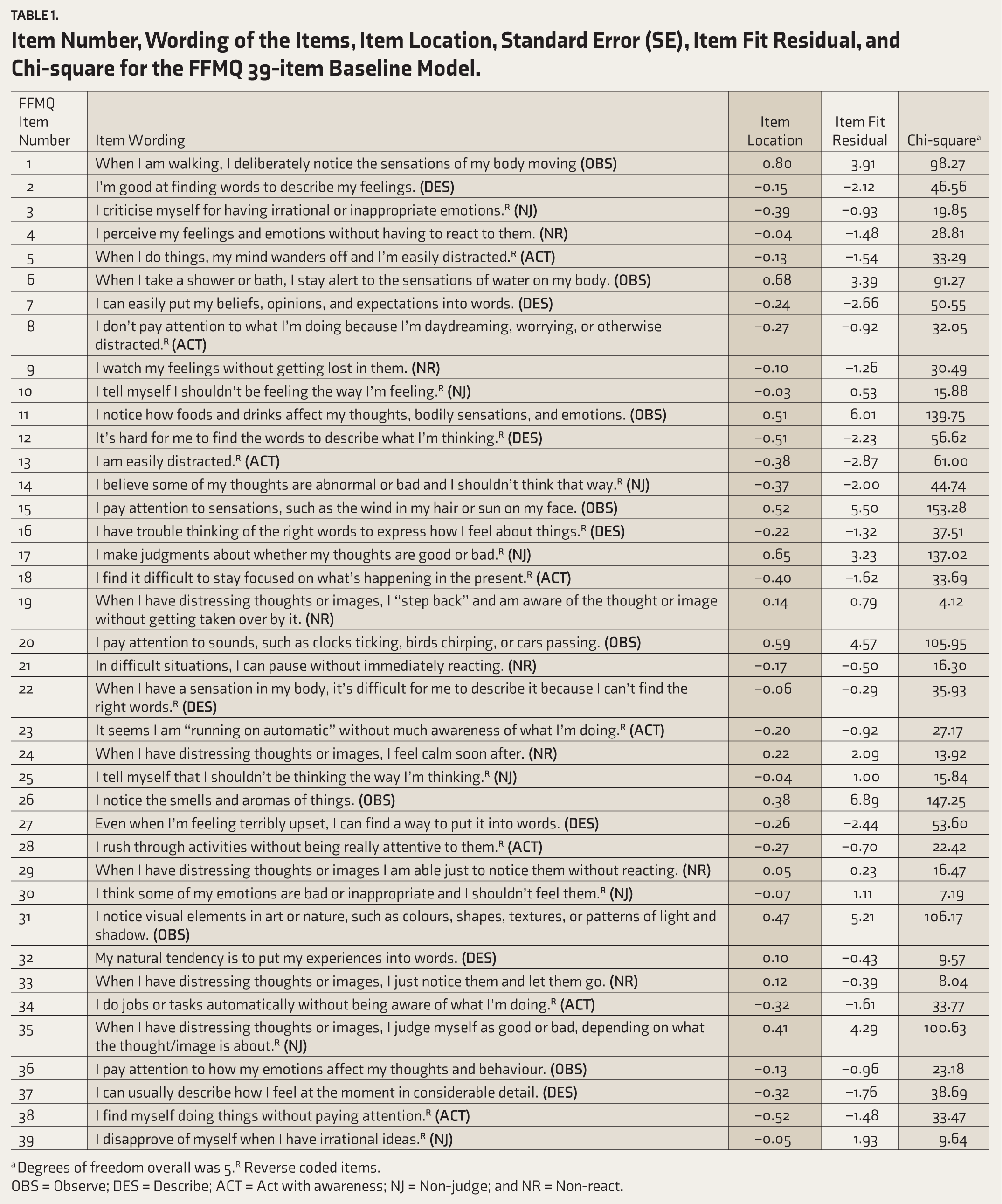
a Degrees of freedom overall was 5.R Reverse coded items.
OBS = Observe; DES = Describe; ACT = Act with awareness; NJ = Non-judge; and NR = Non-react.
Model B2s combined the remaining 23 items as subtests within their respective facet: Describe (without Item 32), Act with awareness (without Item 13), Nonjudge (without Items 17 and 35), and Non-react (without Items 19, 24, 29, and 33). The resulting model (Table 2, B2s) showed a good fit (χ 2 (32) = 44.57, p > .05), with no subtest exhibiting misfit. There was no DIF in any of the socio-demographic factors and no evidence of deviation from unidimensionality.
Before concluding that a final version of the FFMQ-T had been reached, the suitability of the remaining 23 items as stand-alone subscales needed to be confirmed first. This was also necessary to be able to generate final ordinal-to-interval conversion tables for both the total scale as well as individual subscales. The subsequent analyses thus explored the psychometric properties of the remaining four subscales using the same Rasch analysis approach outlined above.
Individual Subscale Analysis
The fit was non-significant for three of the subscales: Act with awareness (seven items) with Items 5, 8, 18, 23, 28, 34, and 38; Nonjudge (six items) with Items 3, 10, 14, 25, 30, and 39; and Non-react (three items) with Items 4, 9, and 21. However, for the Describe subscale (with Items 2, 7, 12, 16, 22, 27, and 37), the chi-square was significant (Table 2, DES1), which appeared to have been due to a misfit of Item 22. When Item 22 was thus deleted in a subsequent iteration, the model was still significant (Table 2, DES2). Thus, using a subtest analysis approach (Item 2+12; Item 16+37) showed adequate fit and confirmed unidimensionality (Table 2, DES3).
Summary of Fit Statistics for Initial, Intermediate, and Final Rasch Analyses of the FFMQ-T.
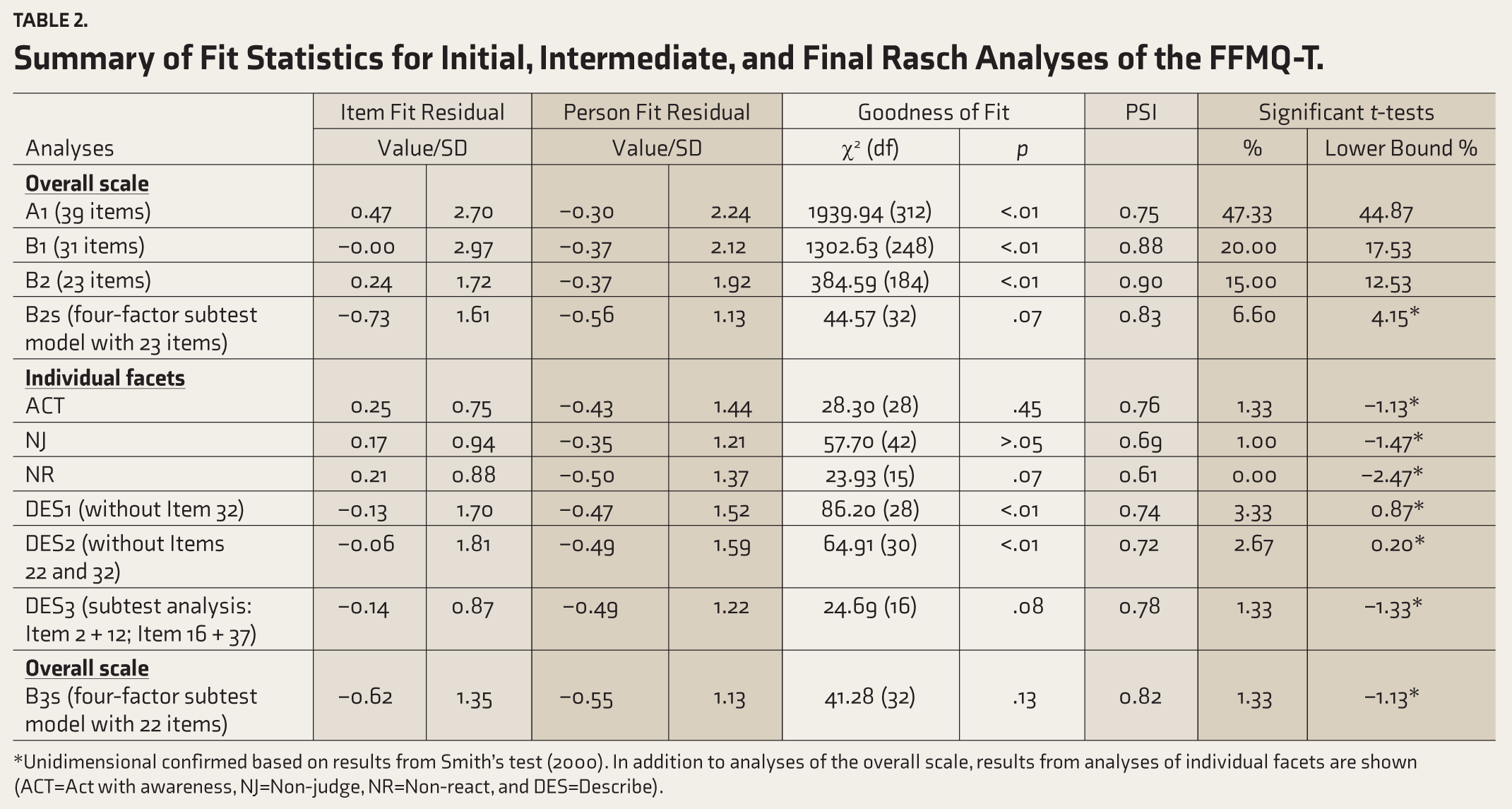
*Unidimensional confirmed based on results from Smith’s test (2000). In addition to analyses of the overall scale, results from analyses of individual facets are shown (ACT=Act with awareness, NJ=Non-judge, NR=Non-react, and DES=Describe).
Deletion of Item 22 in the individual subscale only would have resulted in a mismatch in the final set of items compared to the overall scale (c.f. B2s where Item 22 was included). To avoid such a mismatch, the subsequent analyses explored to what extent a higher order with Item 22 is also tenable. Model B3s was identical to B2s except for the fact that Item 22 was excluded (Table 2, B3s). This analysis showed adequate fit (χ2 (32) = 41.28, p > 0.05) and confirmed unidimensionality for the remaining 22 items belonging to four facets, namely, describe without Item 22 and 32, Act with awareness without Item 13, Nonjudge without Item 17 and 35, and Non-react without Item 19, 24, 29, and 33. No DIF was found, but the person-item distribution plots illustrated that a substantial proportion of participants were not covered by the items (Figure 1). Particularly for the Non-react subscale, a very large proportion of the participants (top bars in pink) were outside the range of trait levels suitably covered by the items (blue bars facing down). With a PSI of 0.61, this subscale also had inadequate reliability (Table 2). PSI for Nonjudge could be considered adequate as it is just below the cut-off value of 0.70 for group assessment. For Act and Describe, PSI values were 0.76 and 0.78, respectively, and thus also acceptable.
Person-item Threshold Distribution for Individual Facets: Panel 1 (ACT) for the Act with Awareness Facet, Panel 2 (DES3) for the Describe Facet, Panel 3 (NJ) for Non-judge Facet, and Panel 4 (NR) for Non-react Facet.
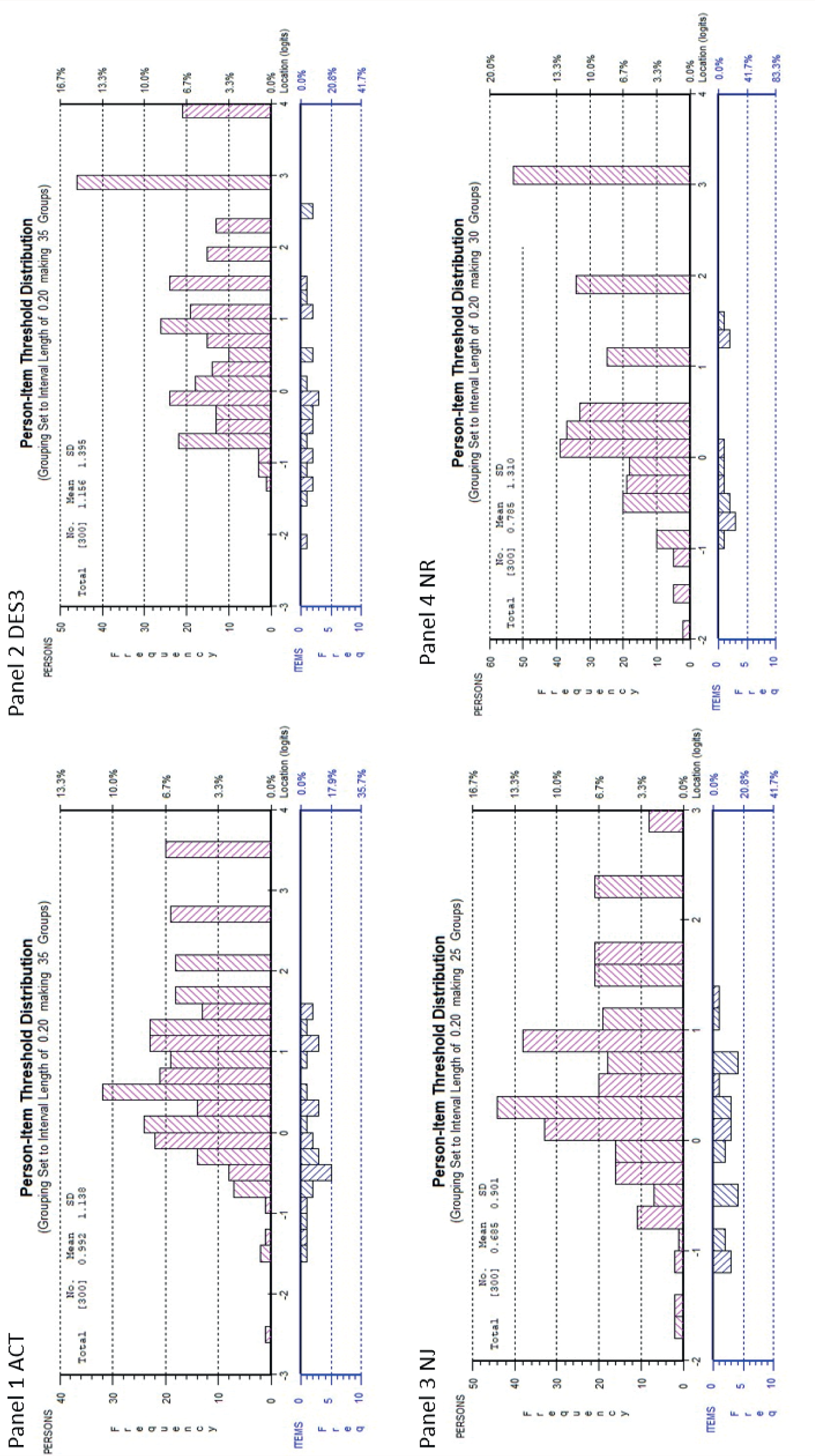
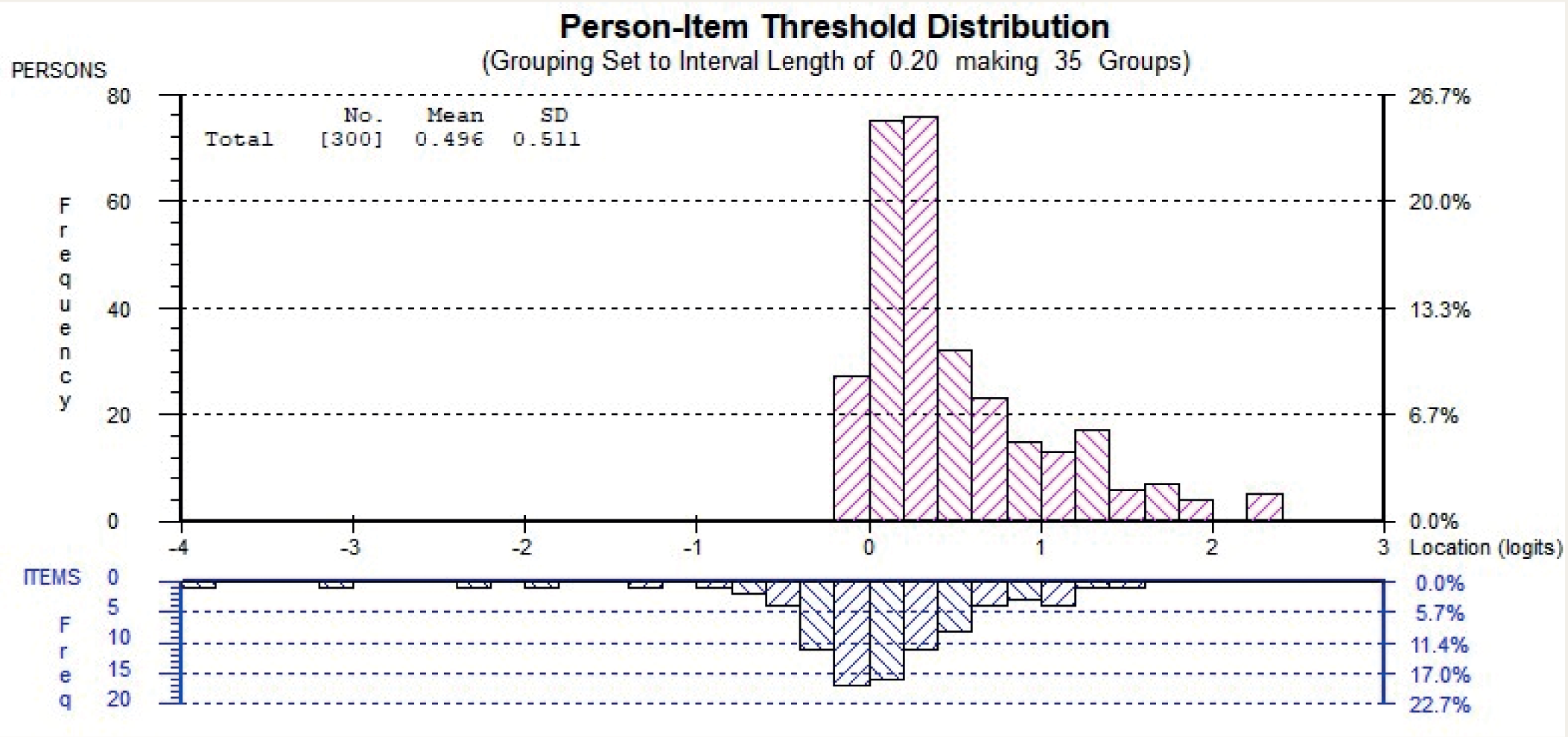
Figure 2 shows the person-item threshold plot for the total score of the 22-item FFMQ-T. Unlike for the individual subscales, the coverage provided by the items was acceptable, as only the participants with the top 3% of mindfulness scores were not covered. With a PSI of 0.82, reliability is sufficient for group comparisons but falls short of the 0.85 mark for individual pre- versus post-test assessments. 32
Person-item Threshold Distribution of 22 Items FFMQ-T.
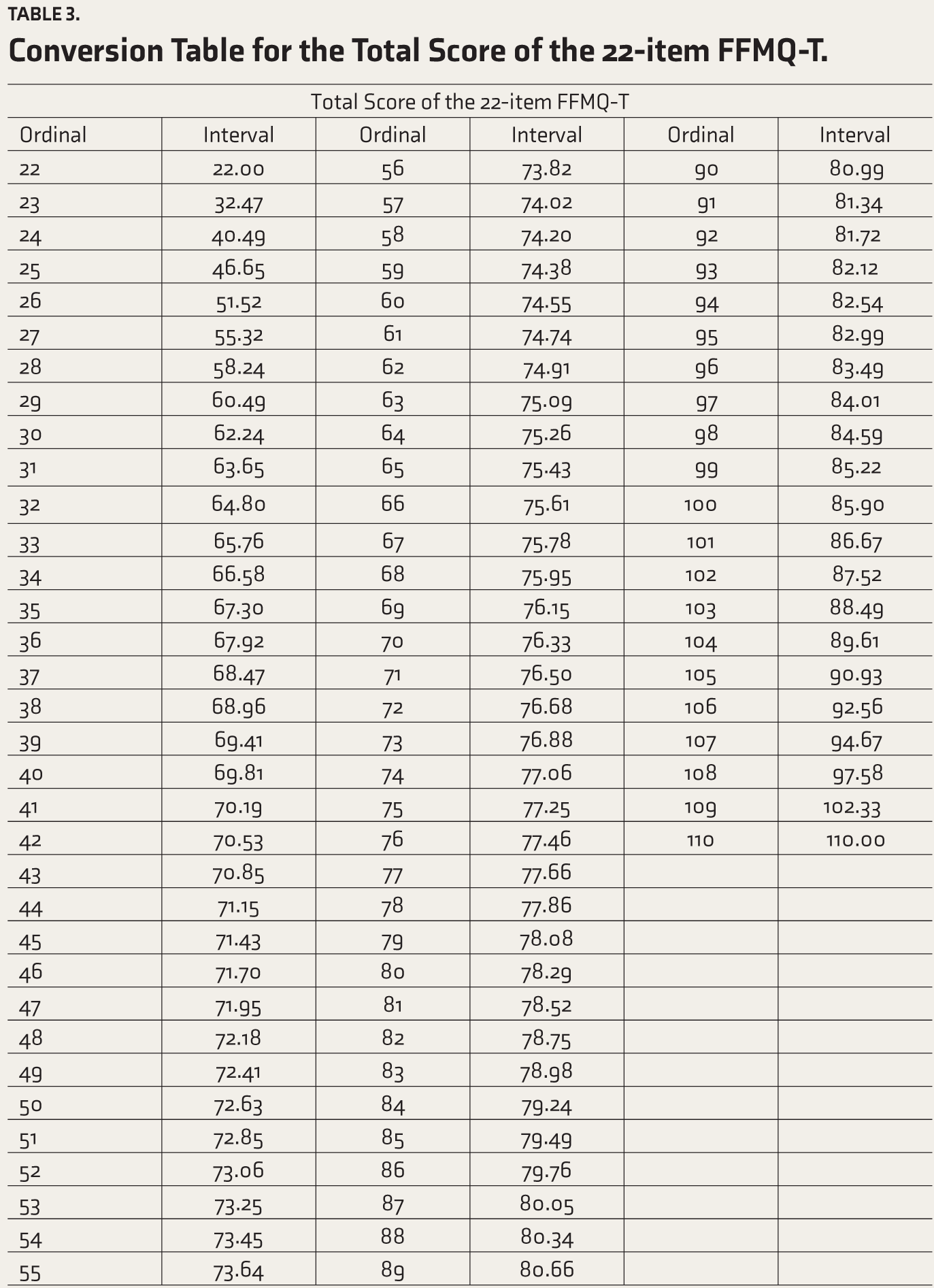
After achieving adequate fit on the Rasch model, a conversion table (from ordinal to interval scale) was also created (Table 3) for the overall four-factor model with 22 items as well as for individual facets (Table 4) using the estimates derived from the Rasch analysis. Conversion tables can only be reported for data with no missing data, which was fulfilled in this study as no participants had any missing data. Conversion tables help improve the precision of the assessment tool. The authors may be contacted for assistance when converting the scores.
Conversion Table for the Total Score of the 22-item FFMQ-T.
Conversion Table for Individual Facets.
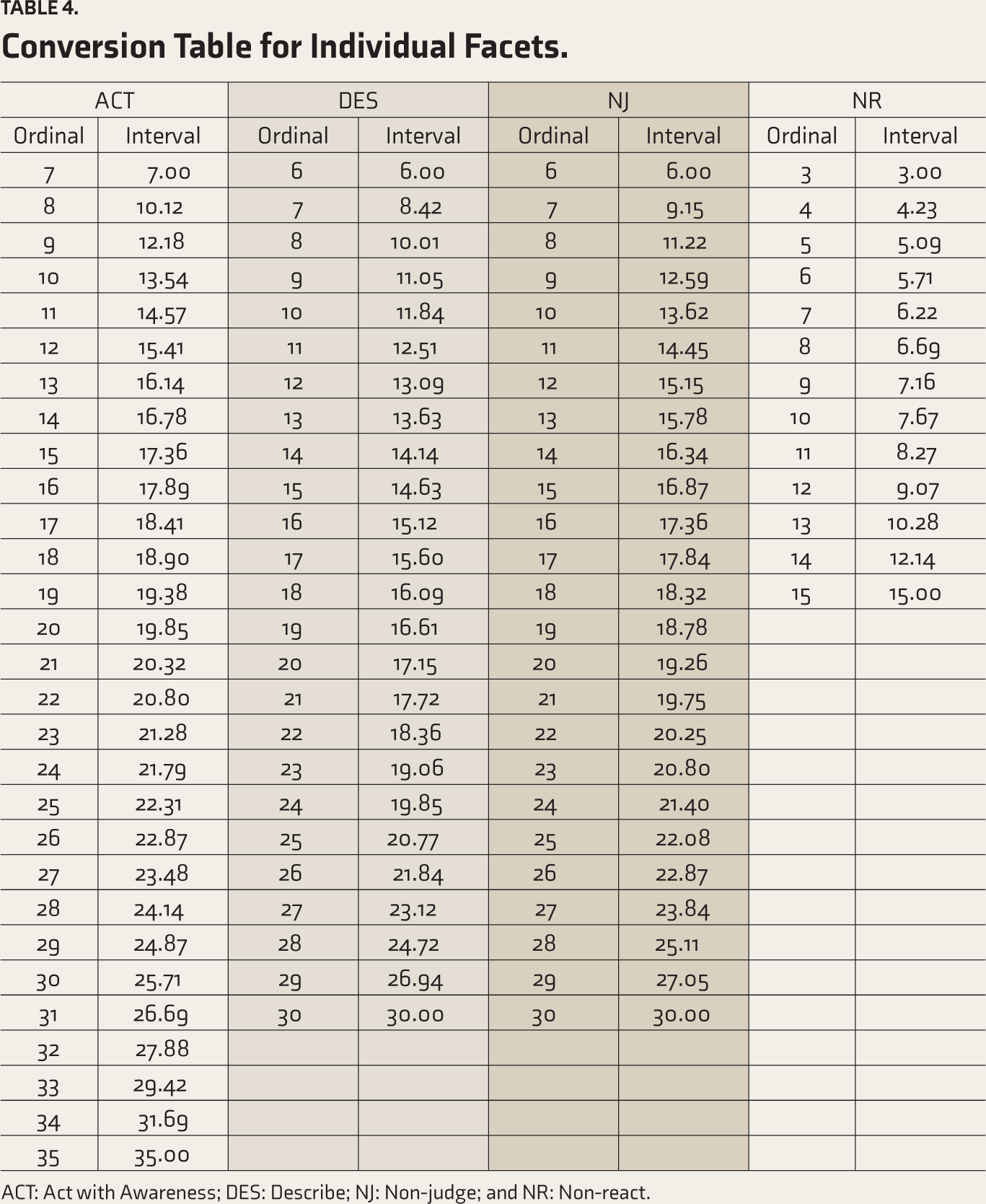
ACT: Act with Awareness; DES: Describe; NJ: Non-judge; and NR: Non-react.
Discussion
This study translated the FFMQ English version to a new Tamil language version and attempted to assess the workability of the Tamil version in a sample of Tamil speakers in India. Consistent with other work on investigating the psychometric properties of the FFMQ in India, 20 the present study utilized Rasch analysis, which has unique advantages over classical test theory approaches such as confirmatory factor analysis. 37 Rasch analysis of the FFMQ-T revealed that the Observe facet caused a substantial significant misfit and thus had to be excluded. After excluding the Observe facet, 31 items remained in the analysis. In subsequent analysis steps, other items from each of the four facets were excluded: Items 22 and 32 from the Describe facet, Item 13 from Act with awareness, Items 17 and 35 from Nonjudge, and Items 19, 24, 29, and 33 from Non-react, resulting in the 22-item FFMQ-T. Subtest analysis confirmed that this four-factor, 22-item questionnaire has a higher-order factor structure and may thus be interpreted as a single score in addition to individual facet scores. After the Rasch analysis confirmed a 22-item questionnaire with a four-factor solution, using the Rasch estimates, conversion tables were also created. It is recommended to create conversion tables to report Rasch results, 34 and it is also common practice in other Rasch analysis studies, including those conducted with the FFMQ.27,38 In the past, conversion tables have been provided for KIMS, FFMQ, and CHIME.25,27–28,39 Conversion tables improve the precision of the assessment tool, in this case, FFMQ-T.
The initial analysis in the original validation study noted low correlations for the Observe facet with the other four facets but still retained it. 6 While some other work with the English- version also concluded that the Observe facet could be presented within a five-factor model,14,40–43 other studies showed that the Observe facet did not fit the factor structure well.16–18,44–45 Similar issues with the Observe facet were reported in studies on various translation versions of the FFMQ, such as the Polish, 46 French, 47 Dutch, 48 Mexican Spanish, 49 and Hindi versions. 21 The Hindi version, FFMQ-H, confirmed a four-factor model with 28 items wherein the three items (Items 4, 10, and 33) and the Observe facet were excluded from the final questionnaire. While the Observe facet was retained in the validation of the English version of the FFMQ for use in India, 20 our results with the Tamil version were thus similar to that of the Hindi version.
A systematic exploration of the FFMQ Observe facet revealed some reasons for the frequently occurring issues with this subscale. 50 One of the critical complexities of the Observe facet is that it taps into a variety of observing aspects, including both internal and external stimuli. This wide spectrum of observation may cause misinterpretation or generalization of responses, as it is challenging to gauge these two very different types of stimuli precisely. In developing the CHIME, researchers recognized a clear distinction between these aspects of observation. 51 This recognition implies that a more detailed or separate measurement of these observation aspects may provide a more accurate portrayal of an individual’s mindfulness. Given these issues with the FFMQ’s Observe facet, future research could explore the functioning of the CHIME in diverse cultural contexts, including India. It might be beneficial to assess whether the questionnaire works better in its subscale version 28 or as a unidimensional measure, considering the unique cultural and societal factors. 52 Apart from the Observe facet, several items of each of the other facets had to be removed from the FFMQ-T due to significant misfit. This includes two items from the Describe facet: Item 22 (‘When I have a sensation in my body, it’s difficult for me to describe it because I can’t find the right words’) which was also found to be misfitting in the previous study using the original English translation in India, 20 and Item 32 (‘My natural tendency is to put my experiences into words’) which was found to be misfitting in another study using the English-language version of the FFMQ. 53 This could be attributed to the high context of communication followed in collectivist cultures such as Southeast Asia and India. The high context of communications reflects those cultures wherein individuals tend to adopt a non-verbal language of quietness and introversion. In these cultures, describing and expressing emotion in words becomes difficult or not seen as socially desirable.54–56
Further to the two significant misfitting items in the Describe facet, Item 13 from Act with Awareness was also discarded in validating FFMQ-T. The item wording was ambiguous as it seemed to categorize distraction in levels, that is, it might be difficult for participants to express or mark the levels of distraction in scaling terms such as easily. A study utilizing the English version of the FFMQ concluded that some items of the Act with awareness facet may be affected by method factors related to the item valence (similarity in wording). 57 Examples are Items 13 (‘I am easily distracted’) and 5 (‘When I do things, my mind wanders off and I’m easily distracted’). These two items have similar wording, showing duplication of items that could potentially affect the ‘stability of the facets’. 58 It was also mentioned that this duplication of items could potentially ‘compromise unidimensionality’ which has been found in the present study, because ‘reliability coefficients will be artificially inflated’ as well as ‘…the loadings will no longer reflect the true relations of the items to the construct’. 57
Two items from the Nonjudge facet, Items 17 (‘I make judgments about whether my thoughts are good or bad’) and 35 (‘When I have distressing thoughts or images, I judge myself as good or bad, depending what the thought/image is about’), require participants to categorize their emotions and feelings into exclusive and extreme binaries that involve subjective interpretation of what constitutes or classifies as good or bad, possibly making it hard for the participants to mark responses. 59 Cross-cultural research on the classification of emotions argues that there is often an element of both positive and negative within an emotion, such as ‘pursuit of happiness is not always positive’. 60 Another study argued that an individual can experience contrasting emotions at the same time, and there are differences in how each culture experiences and expresses emotions. 61 In this regard, it has been reported that in collectivist cultures, such as East Asia and India, individuals prefer and place a lot of importance on peace and calmness compared to more individualistic cultures such as North America. 62 Classifying one’s own thoughts, feelings, and emotions could create conflict within the individual, which might not be preferred by individuals belonging to a more collectivist culture as they prefer peace and calmness instead of upheaval and conflict. This could be a potential hindrance in marking the responses to the two Non-react items (Items 17 and 35), requiring participants to classify thoughts, feelings, and emotions in strict categories of good or bad. More such examples of preferred emotions and feelings have been outlined in research aimed at exploring emotional experience, expression, and regulation. 59 These studies confirm that it is difficult to categorize emotions and feelings into exclusive binaries as each society or culture has a different lens of perception, and there are times when dichotomous emotions and feelings are experienced simultaneously, making it hard to classify them as good or bad.
In our validation of the FFMQ-T, four items were discarded from the Non-react facet (Items 19, 24, 29, and 33). In past research involving translations of the original English version also, issues with items from this facet have been noted. The FFMQ-Chinese version found low-reliability coefficients for this facet compared to the other four facets. 63 Similarly, the FFMQ-Portuguese version 64 discarded the Non-react facet from the overall factor structure. Two items of the Non-react facet (Items 4 and 33) were also dropped from the overall factor structure in the study using the FFMQ-H. 21 Similar results were found in studies using German, 65 Spanish, 66 and Polish versions. 46 The present study found a 22-item version of FFMQ-T valid for the use of Tamil-speaking population. This study is an extension of the previous study utilizing the FFMQ-English version in an Indian sample from Delhi, which identified future direction to translate the English version to other languages spoken in India considering its diversity and assessing the extent of replication of the five-factor structure. 20 This study confirmed the four-factor model without the observe facet and a few items each from the other four facets, making it a 22-item questionnaire to measure mindfulness.
Although adequate fit to the Rasch model was achieved for the higher-order four-factor model as well as each of the four subscales individually, in all cases, PSI values fell short of the 0.85 cut-off for individual assessment. 32 For the Nonjudge facet, reliability may be considered marginally acceptable as it was only just below the cut-off value for group assessment. On the other hand, the Non-react subscale scores for the FFMQ-T need to be considered unreliable. Together with the evidence from the person-item distributions of the subscale scores, which indicated that available items did not cover a large proportion of participants, one needs to conclude that it is not advisable to use the subscale scores of the FFMQ-T if robust assessment is required. As a discussion tool or preliminary analysis, subscale scores may have some value. However, for group comparisons of mindfulness scores, the total score of the FFMQ-T needs to be used. Future research needs to explore whether the low reliability of the subscale scores of the FFMQ-T is related to cultural factors. For the English version, PSI values were found to range between 0.76 and 0.89. 27 The previous English version validated in India did not conduct Rasch analysis at the item level but reported an identical PSI value (i.e., 0.81) for the overall scale when using the English FFMQ (with three items discarded) in India. 20
Limitations
This study has to acknowledge some limitations relating to the diversity of the sample and the sampling technique (snowball), which was necessitated due to ongoing limitations in collecting data during the COVID-19 pandemic. The sample recruited was specifically localized in the Tamil Nadu region. Given the limited demographic characteristics available, it is difficult to ascertain to what extent our sample may have been biased. Our sample had to identify themselves according to the inclusion and exclusion criteria, which is also a potential limitation of the study. Thus, the sample might not be entirely representative of the general population of Tamil Nadu. In terms of average age, it appears that the sample was similar to the average age predicted for the Tamil Nadu population. Nevertheless, more diverse samples speaking the Tamil language should be recruited, using random sampling, from various countries (Singapore, Malaysia, and Sri Lanka) to be able to generalize the results. Further, while the FFMQ has often been used as a measure of dispositional mindfulness in general populations, 67 it has also been used frequently to evaluate the effects of interventions. 12 The effects of familiarization with meditation on the comprehensibility of FFMQ items (including the FFMQ-T) should thus be explored specifically, including the potential for response shift. 68
Lastly, it is worth noting that our exploration of the FFMQ-T varied from the psychometric investigation of the English version used in India. 20 While the latter incorporated both confirmatory factor analysis and Rasch analysis, our assessment of the Tamil version solely employed Rasch analysis. Although this methodological difference does raise the question of whether our findings could be influenced by the specific analytical tools employed, it is unlikely that our results varied dramatically due to the sole use of Rasch analysis. In the case of the English version employed in India, 20 Rasch analysis did not necessitate a substantial deletion of items. Only three items were removed to enable a suitable fit. Likewise, a Rasch analysis study of the English version used in New Zealand required the removal of two items only. 27 From these precedents, it is clear that Rasch analysis does not generally lead to extensive item deletion. Consequently, our results about FFMQ-T can be considered a revealing insight into the instrument’s factor structure rather than a product of the analysis method. Nevertheless, additional research is warranted to further investigate the extent to which these results can be replicated and how well the factor structure translates to Indian contexts. Future studies should ideally incorporate diverse psychometric analysis methods to validate these findings. This approach will provide a comprehensive understanding of the applicability and functionality of the FFMQ in different linguistic and cultural settings. As an example of the issues/limitations that may result from applying the Rasch analysis to an existing tool, the failure of the present study to support the popular ‘five-factor’ structure of the original ‘Five Facet Mindfulness Questionnaire’ itself may be noted. In the present study, the Rasch analysis has shown that while four of the five facets of mindfulness, viz., Describe, Act with awareness, Nonjudge, and Non-react were identified as capable of yielding a composite measure of ‘Mindfulness’, the fifth facet, viz., Observe, failed to show that it is an additive component of mindfulness.
This study confirmed the usability of a 22-item FFMQ-T questionnaire to measure mindfulness. The 22-item FFMQ-T consists of a four-factor model without the Observe facet and a few items from the other four facets.
Footnotes
Acknowledgements
The author would like to thank all the participants and the Psychosocial Aspects in Robotics Lab (PAIR), Bharath Institute of Higher Education and Research, Tamil Nadu, India, for all the requisite resources, infrastructure and support related to data collection in India as a Visiting Researcher.
Consent to Participate
The Participant Information Sheet clearly stated that completion of the questionnaire constituted informed consent.
Data Availability
The SPSS data file has been provided as a supplemental file.
Declaration of Conflicting Interests
The authors declared no potential conflicts of interest with respect to the research, authorship and/or publication of this article.
Ethics Approval
Ethics approval was sought from Bharath Institute of Higher Education and Research, Tamil Nadu, India, and Auckland University of Technology Ethics Committee (AUTEC).
Funding
The authors received no financial support for the research, authorship and/or publication of this article.