




Abstract
Background:
The current study was carried out owing to the projected increase in the fantasy sports market in India, the popularity of fantasy sports in the age group of 18–25 years, the gambling-related implications of engaging in fantasy sports, and the dearth of published data on the extent and pattern of engagement in fantasy sports among college students in India. We aimed to assess the attributes of engagement in fantasy sports among college students and explore their perceptions and attitudes toward fantasy sports.
Methods:
This was a cross-sectional observational study among students enrolled in undergraduate courses in an autonomous college in central India. The study questionnaire included a semi-structured proforma that asked for information on the sociodemographic details, questions to assess the gaming (both online and offline) pattern and participation in fantasy sports by the study participants, and a modified Motives for Online Gaming Questionnaire (MOGQ). The participants were also asked to express, on a 10-point scale, their agreement that fantasy sports are similar to gambling.
Results:
Around one-fifth of the participants had engaged in a fantasy sport at least once. Around 18% had gambled at least once. The participants who reported losing money from fantasy sports also engaged in a significantly greater number of fantasy sports (p = .002). Those who engaged in fantasy sports with the main goal of making money agreed more with the statement that fantasy sports are similar to online gambling compared to those who did not (p = .01).
Conclusions:
Those who engaged in fantasy sports to make money agreed more with the statement that fantasy sports are similar to gambling. The study helps understand the associations between various psychosocial motives, monetary motivations, and involvement in fantasy sports.
Around one-fifth of the participants had engaged in a fantasy sport at least once. Around 18% had gambled at least once. The mean age of playing a video game was significantly higher among those who engaged in a fantasy sport at least once. The participants who reported losing money from fantasy sports also engaged in significantly more fantasy sports. Those who engaged in fantasy sports to make money agreed more with the statement that fantasy sports are similar to gambling.Key Messages:
Fantasy sports are games in which one chooses a team of real sports players from different teams and wins points according to how well the players play each week. 1 Another conceptualization of fantasy sports describes these as “playing a game in which linked participants take on the roles of team ‘managers’ or ‘general managers’ and manipulate an aggregated ‘team’ of players whose real-world performances generate point values that determine the outcome of head-to-head matchups.” 2
Despite being common, the labeling of fantasy sports as “games” has been challenged.3, 4 Various publications have commented on the presence of elements of gambling in fantasy sports, such as the pooling of money from players, the calculation and distribution of rewards based on amounts proposed and received, and the outcome of winning and losing. One of the key dimensions of this debate is centered on the role of skill and elements of chance involved in fantasy sports.5, 6
Studies on the attributes of gambling in fantasy sports have been few, and their findings have been inconsistent. 7 While some reported that players of fantasy sports were characterized by high gambling frequency, problem severity, and comorbid psychological issues (including suicidal ideation),8, 9 others have highlighted that fantasy sports involve skills rather than only chance. 5 These research reports are from Western settings, and there are limited publications on this theme from the Asian region.
The global fantasy sports market grew from $25.44 billion in 2022 to $28.96 billion in 2023 at a compound annual growth rate (CAGR) of 13.9%. 10 While North America was the largest region in the fantasy sports market in 2022, countries like India are expected to have an increasing share driven by a host of factors, including a large proportion of young people in their population and an increase in penetration of smartphones and the internet, among others. India is estimated to have around 180 million users of fantasy sports platforms and has been projected to witness the fastest growth of online fantasy sports in the Asia Pacific in the coming years.11, 12
College students have been identified as being at higher risk for problem gambling. 13 Betting on sports has been described as a well-received gambling activity among college students in the USA. 13 Since attitudes influence human behavior, understanding college students’ attitudes toward fantasy sports shall offer insight into their engagement with these. Attitude is a key factor determining engagement in gambling behavior. 14 Studying the perceptions and attitudes of college students toward fantasy sports in the context of gaming and gambling will pave the way to understanding their behavioral engagement better.
Owing to the projected increase in the fantasy sports market in India, the popularity of fantasy sports in the age group of 18–25 years, 15 the gambling-related implications of engaging in fantasy sports, and the dearth of published data on the extent and pattern of engagement in fantasy sports among college students in India, the current study aimed to assess the attributes of engagement in fantasy sports among college students. It also aimed to explore their perceptions and attitudes toward fantasy sports.
Methods
Data Collection
The study was carried out among the students enrolled in undergraduate courses (in commerce, computer, and management disciplines) in a college in the central part of India. It was a cross-sectional observational study. The data were gathered from December 2022 to February 2023. Those over 18 years of age were eligible for inclusion. Those who refused to provide written, informed consent were excluded. The students were given the questionnaire in their lecture rooms.
Tools
The study questionnaire included a semi-structured proforma that asked for information on sociodemographic details like age, gender, and current living arrangement. The proforma also included questions to assess the participants’ gaming patterns and participation in fantasy sports. These included the number of fantasy sports ever engaged in, the frequency of engagement over the past 12 months, engagement in fantasy sports to make money, engagement in fantasy sports with the main aim of making money, experience with money (gained or lost, or no gain, no loss), and engagement with gambling.
A modified Motives for Online Gaming Questionnaire (MOGQ) was used to assess the participants’ motives for engaging in fantasy sports. The MOGQ measures seven dimensions of gaming motives, including escape (escaping from reality), coping (coping with stress and distress), fantasy (in-game identities and experience), skill development (such as attention and coordination), recreation (entertainment and enjoyment), competition (challenging and competing with others), and social (building and maintaining social relationships). 16
The participants were also asked to express their agreement with the statement that fantasy sports are similar to gambling, on a 10-point scale (where 1 meant “do not agree at all” and 10 meant “completely agree”).
Ethical Considerations
The Institutional Ethics Committee approved the study. To avoid social desirability from affecting the responses, the participants were ensured that their responses would remain strictly confidential. In addition, the data were collected in anonymized form. Data forms were accessible to the authors only.
Statistical Analysis
The data were analyzed using IBM SPSS Statistics for Windows, version 21 (IBM Corp., Armonk, NY, USA). No imputation was done for missing data. Descriptive statistics, including frequency, percentage, and mean (standard deviation), were used to describe the sample characteristics and various behaviors, motives, and experiences associated with fantasy sports. Independent sample t-tests were used to find statistically significant differences in the number of fantasy sports played and motives for engaging in fantasy sports concerning various money-related motives and behaviors associated with engagement. An analysis of variance (ANOVA) was conducted to examine the associations between the number of fantasy sports and experiences with money while engaging in them. Additionally, independent sample t-tests were used to find statistically significant differences between different groups, including those who engaged in gambling and did not engage in gambling; participated in fantasy sports to make money and did not do so; participated in fantasy sports with the main goal of making money and did not do so, in terms of the extent of agreement that fantasy sports were similar to gambling. The level of statistical significance was set at p < .05 for all the tests.
Results
Three hundred students were given the questionnaire, and 297 filled it (response rate 99%). Of these, 49.8% were females. Males were more likelier to engage in fantasy sports than females (p < .001).
Around one-fifth had engaged in a fantasy sport at least once in their lifetime. Seventy percent of these had engaged in a fantasy sport at least once in the past 12 months. Thirty percent of the participants who engaged in fantasy sports did so many times or regularly over the past 12 months. A majority (56.67%) engaged in fantasy sports to make money, which was the main reason for engaging for 28.33% of the participants. Only 5% reported losing money in fantasy sports (Table 1).
Socio Demographic and Fantasy Sport Engagement Related Study Variables (n = 297).
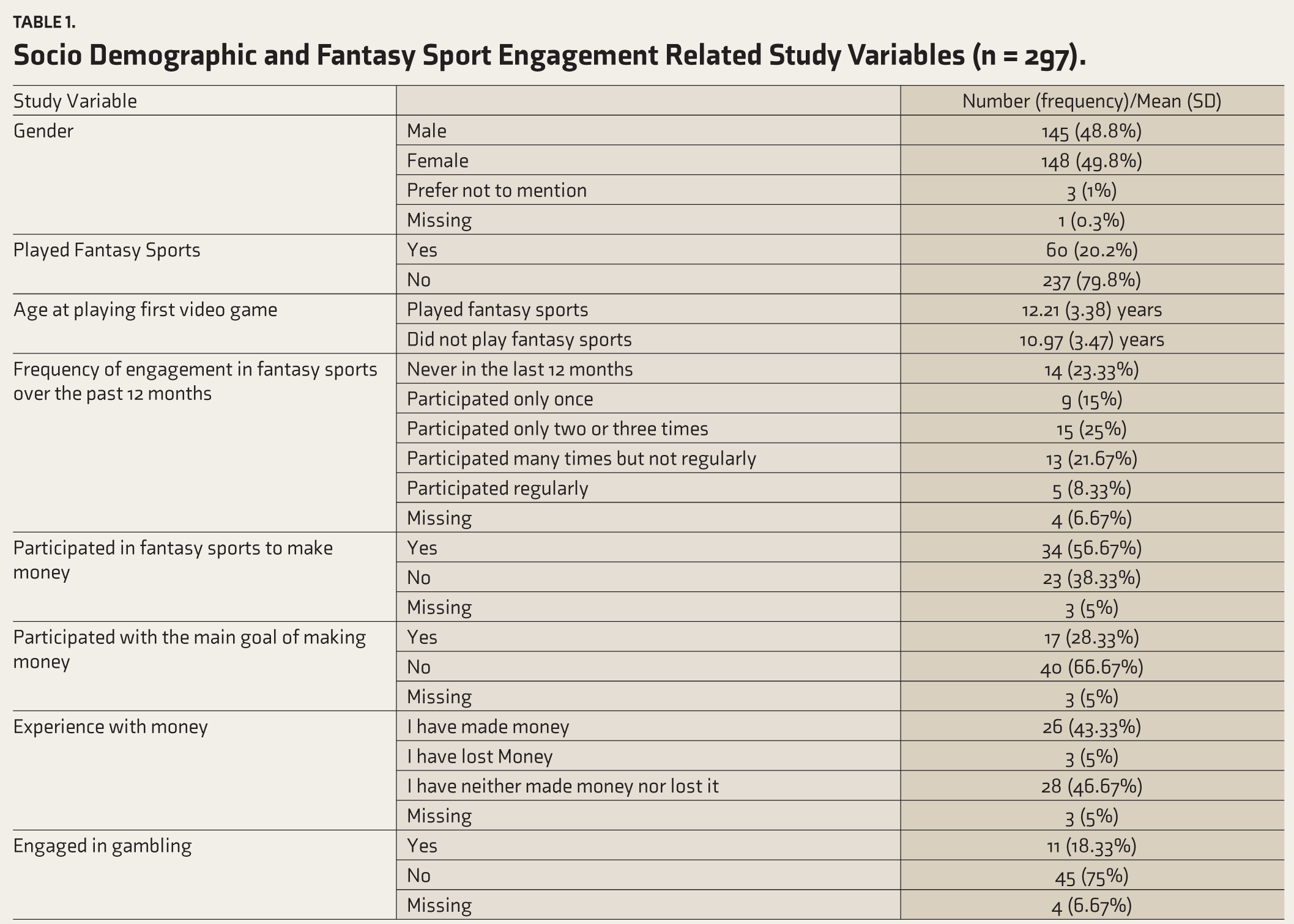
Around 18% reported that they had gambled at least once in their lifetime.
The mean age of playing a video game was significantly higher (t = 2.386, p = .018) among those who engaged in a fantasy sport at least once (mean 12.21 years, SD 3.38) as compared to those who did not engage in fantasy sports (mean 10.97 years, SD 3.47).
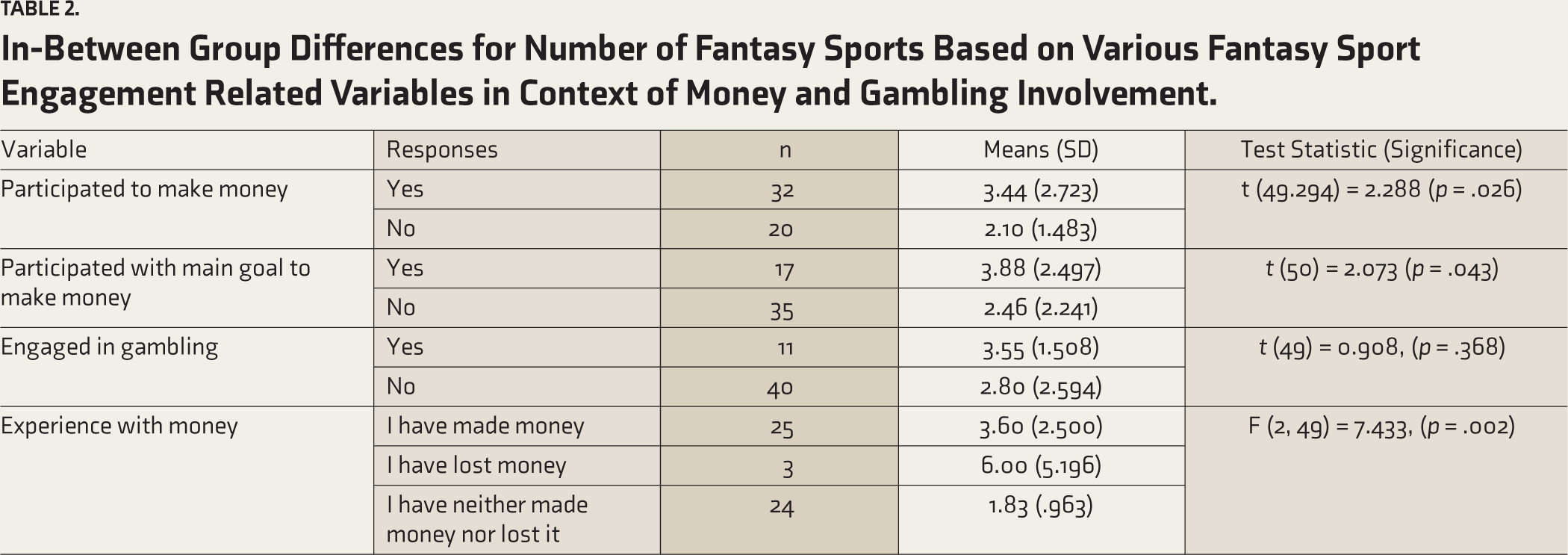
Those who reported engaging in fantasy sports to make money and for whom the main goal was to make money, engaged in a significantly greater number of fantasy sports (p = .02 and p = .04, respectively). Also, those who reported losing money from fantasy sports also engaged in a significantly greater number of fantasy sports (p = .002) (Table 2).
In-Between Group Differences for Number of Fantasy Sports Based on Various Fantasy Sport Engagement Related Variables in Context of Money and Gambling Involvement.
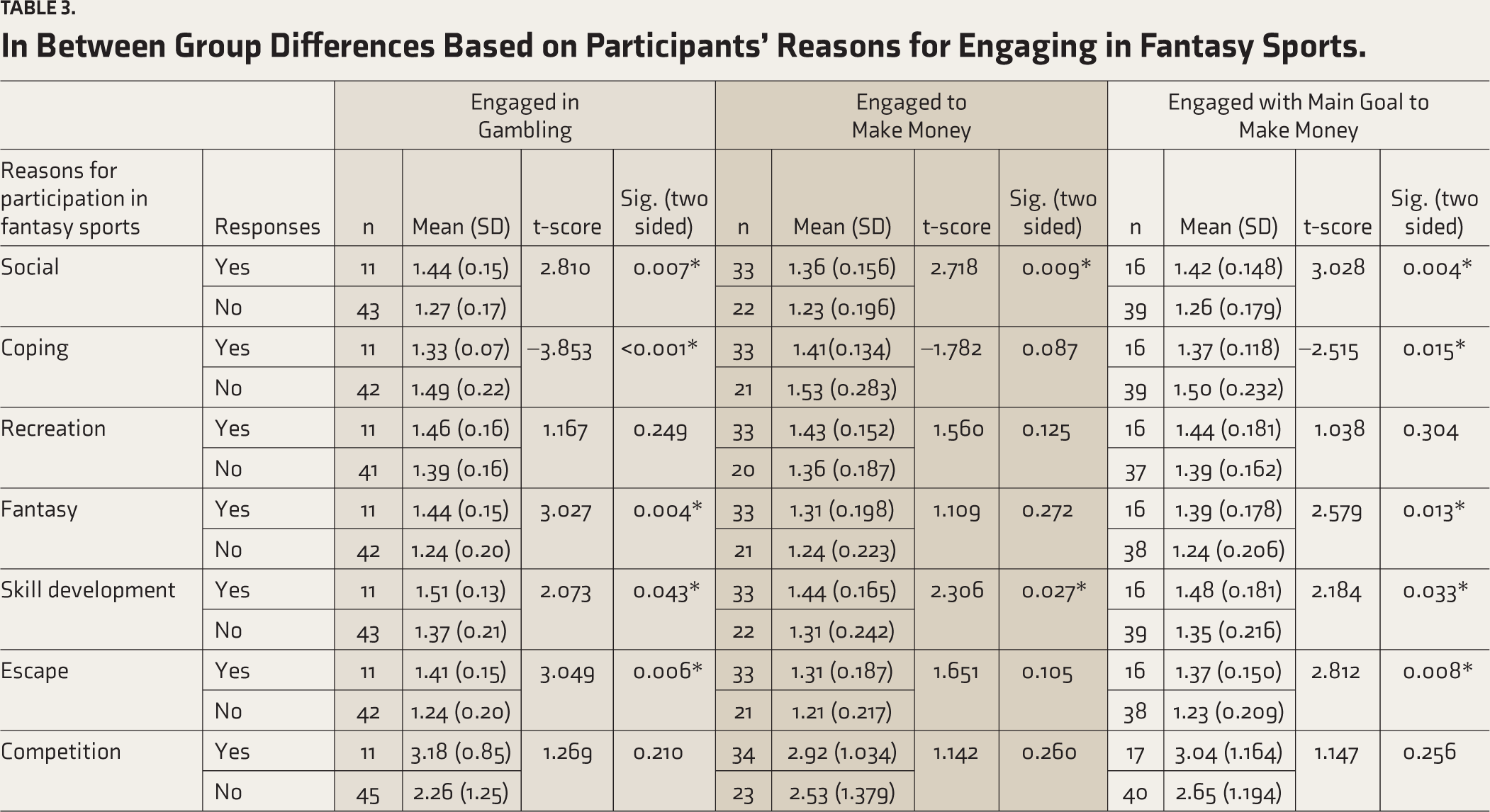
The motives for engaging in fantasy sports varied. Those who engaged in some kind of gambling were statistically more likely to engage in fantasy sports for social (p = .007), fantasy (p = .004), skill development (p = .04), and escape motives (p = .006). Those who did not engage in any gambling behavior engaged in fantasy sports significantly more for coping motives (p < .001) (Table 3).
The participants who engaged in fantasy sports to make money did so significantly more for social (p = .009) and skill development (p = .02) motives. Similarly, participants who engaged in fantasy sports with the main goal of making money did so significantly more for social (p = .004), fantasy (p = .01), skill development (p = .03), and escape (p = .008) motives. Those who did not engage in fantasy sports with the main goal of making money did so significantly more for coping motives (p = .01) (Table 3).
In Between Group Differences Based on Participants’ Reasons for Engaging in Fantasy Sports.
The extent of agreement with the statement that fantasy sports are similar to gambling did not differ significantly between those who engaged in gambling and those who did not (t = -1.281, p = .10) and between those who engaged in fantasy sports to make money and those who did not (t = -0.842, p = .20). However, those who engaged in fantasy sports with the main goal of making money had a higher degree of agreement with the statement that fantasy sports are similar to gambling as compared to those who did not engage in fantasy sports with the main goal of making money (t = -2.19, p = .01).
Discussion
Around one-fifth of our participants had engaged in a fantasy sport at least once, and around 18% had engaged in gambling at least once. The mean age of playing a video game was significantly higher among those who engaged in a fantasy sport at least once. The participants who reported losing money from fantasy sports also engaged in significantly more fantasy sports. Those who engaged in fantasy sports to make money agreed more with the statement that fantasy sports are similar to gambling.
Our findings offer some valuable insights. College students who engaged in fantasy sports differed significantly from those who did not on various variables—around one-fifth had engaged in a fantasy sport at least once. Seventy percent of these had engaged in a fantasy sport at least once in the past 12 months. This number was higher than the 11.5% reported from the US in an online survey. 9 Males were more likely to engage in fantasy sports. This finding is similar to a previous study, which revealed that most participants were males, in line with observations in the USA and Canada as well.17, 18
More than half of the respondents engaged in fantasy sports to make money, which was the main reason for around 28% of them. Bhattacharya et al. (2020) reported money and price as significant drivers for engagement in fantasy sports in only 11.8% of their participants. 15 A systematic review of motivations for fantasy sports participation did not list rewards and prizes as some of the strongest motivations for participation in season-long fantasy sports leagues. 19
In addition to the monetary purposes, previous research has listed entertainment, competition, surveillance, arousal, entertainment, escape, social interaction, friends, sense of community, utilization of knowledge in sports, love of sports, vicarious involvement as a manager/general manager, and achievement/self-esteem as the motives for participation in fantasy sports.19–22 Previous studies have revealed a love for sports, game interests, a feeling of control, and entertainment and fun-seeking to be motives for engagement in fantasy sports.15, 18 Gambling motives among fantasy sports participants remain largely unexplored. 23 The current study examined the various motives for engagement with fantasy sports. Those who engaged in fantasy sports to make money were found to have social, skill development, fantasy-based, and escape motives. In contrast, fantasy sports as a coping mode were found to be a motive among those who did not engage to make money. These findings can be interpreted in the light of existing studies that indicate that confidence in success (skill development motives) can lead to addiction and increased monetary involvement.24, 25 Further, Wilkins et al. (2023) identified the ability to maintain a healthy emotional balance as a mediating factor for experiences in fantasy sports. 26 A lack of awareness and understanding of one’s emotional state, an inability to cope with negative emotions, and a lack of adaptive coping strategies when mediating the process of engagement in fantasy sports may exacerbate negative motives such as escapism and fantasy-related motives, increase the dependence on individuals on virtual social groups, and lead to potentially negative fantasy sports experiences such as dependence or addiction.
The perception and attitudes of the person shape their motives for participation in fantasy sports. The fantasy sports users primarily motivated by surveillance (for gathering information, working with statistics, and keeping in touch with real-world games) saw fantasy sports as “games” of skill as compared to those primarily motivated by arousal (for the thrill of victory), who saw these as “games” of chance. 27 The skill versus chance perspective is important for differentiating gaming and gambling. In the current study, the participants who engaged in fantasy sports with the (main) goal of making money did significantly more for social, fantasy, skill development, and escape motives. Also, those who did not engage in fantasy sports with the main goal of making money did so significantly more for coping motives. Previous research has supported the hypothesis that virtual communities effectively fulfill the social interaction motivation. 28
Favorable attitudes toward fantasy sports as “games” are of particular concern for the more vulnerable populations, such as students. While it will make fantasy sports more appealing to them, their engagement in fantasy sports will likely generate less opposition from their parents. While these attitudes can be shaped by the false sense of confidence that the students and their caregivers can derive from the advertisement of fantasy sports as being based on skill and not a chance in some cases, in others, the favorable attitudes shall supplement the advertising by the industry and lead to increased engagement of students in fantasy sports. The relationship between engaging in fantasy sports and higher levels of sports betting and online gambling has been reported previously. 3 A study among college students reported that engagement with fantasy sports and paying to play increased the likelihood of gambling and more frequent gambling. 4
Previous research has shown that certain features of daily fantasy sports, such as enhanced gameplay and immediate money transactions, offer an opportunity for the participants to make money. 23 The gambling competition and the opportunity for monetary reward were reported to be equally at play in drawing college students to fantasy sports. 29 In a recent study, the participants who discussed fantasy sports with respect to gambling reported it as either an alternative to gambling or gambling. 26 In the current study, the extent of agreement with the statement that fantasy sports are similar to gambling was higher for those who engaged in fantasy sports with the main goal of making money. However, it was similar for those who engaged in gambling, those who did not, those who engaged in fantasy sports to make money, and those who did not.
Money is an issue, and being afraid to get “too obsessed” with it and the presence of possible addictive elements, among others, have been reported as reasons for not participating in fantasy sports or concerns among those who participated.21, 26
Only 5% respondents in the current study reported that they had lost money in fantasy sports. While this contrasts with the previous reports that suggest that most participants lose money, it is expected to have shaped their attitudes and perspectives toward fantasy sports. This should also be interpreted because many who engaged in fantasy sports did not do so regularly. The opinions and attitudes of these less experienced participants regarding fantasy sports are expected not to be firm yet and are still taking shape. Also, nearly half of the participants reported that they neither made nor lost money. It is likely that at least a proportion of these participants did not wager their money and used the promotional offers by the fantasy sports platform while they participated.
The ease of making quick money, the anonymous nature of online gambling, and a source of entertainment were the main reasons why university students from Ghana engaged in online gambling . 30
As we continue to debate gaming versus gambling in the context of fantasy sports, it is important that approaching fantasy sports (only) as “gaming” might not be prudent. The gaming and gambling related nuances of fantasy sports are more complex. For example, a study from the USA among college students found that while those who received the gaming education intervention demonstrated significant improvement in their ability to calculate gambling odds and resist common gambling fallacies, the improved knowledge was not associated with any decreases in their gambling attitudes or time and money spent on gambling activities. 31 This highlights the need for a comprehensive, multifaceted public health approach to fantasy sports rather than assuming these as “games” and developing the strategies and planning action accordingly.
This study has certain limitations. First, we recruited participants from a single setting, limiting the results’ generalizability. We did not restrict participation in daily and traditional, season-long fantasy sports. Some previous research has documented the differences in the overall fantasy sports perception of it being a game of skill versus chance and the gambling motives between the two participants.23, 32 Also, the analysis beyond the objective that was set a priori was exploratory. Despite these limitations, the current study offers valuable insights into the perceptions, attitudes, and behavioral engagement of college students in fantasy sports. These findings take our understanding of fantasy sports from the perspective of an important stakeholder, that is, college students.
Conclusion
The study helps understand the associations between various psychosocial motives, monetary motivations, and involvement in fantasy sports. These findings take forward our limited understanding of fantasy sports from the perspective of college students. It highlights the need for a comprehensive, multifaceted public health approach to fantasy sports rather than assuming these are “games” and developing the strategies and planning action accordingly.
Footnotes
Authors’ Contribution
YPSB conceptualized the study. DDKG collected the data. AJR did the analysis. All authors contributed to drafting the manuscript and approved the final version.
Declaration of Conflicting Interests
The authors declared no potential conflicts of interest with respect to the research, authorship, and/or publication of this article.
Funding
The authors received no financial support for the research, authorship and/or publication of this article.