




Abstract
Background:
In the field of psychiatry and mental health, Internet gaming disorder (IGD) is a relatively new concept. In the past few decades, as online gaming and internet usage became increasingly prevalent, this became a topic of concern and research. Therefore, this study aims to estimate the prevalence of IGD and its association with personality traits among students.
Methods and material:
The present cross-sectional study was conducted at an Engineering college in Nunna, Andhra Pradesh. The planned duration of the study was 12 months, from March 2020 to March 2021. However, it was extended until August 2021 due to the COVID-19 pandemic lockdown, as colleges were closed indefinitely until further instructions. In the current study, a total of 170 students (first year to final year) from an engineering college, aged between 19 and 25 years, were included. Students who provided informed consent or expressed willingness to participate in the study through a self-structured questionnaire and those who had internet access or experience with online gaming in the past 12 months were included. The demographic profile, including age, sex, academic year, accommodation status, and departmental course was studied. Also, the device used for gaming was examined.
Results:
The gender distribution in the given population indicates that approximately 65.88% are males and 34.12% are females, for a total of 170 individuals studied. In that 18 participants (10.58%) were found to have IGD. Among 18 participants with IGD, 14 were males and 4 were females. The gender prevalence for male and female participants was calculated separately and found to be 12.5% for males, and 6.9% for females which is almost a ratio of 2:1. The summary explores the relation between the Big Five personality traits and IGD. The current study subjects were categorized as low, medium, or high for each trait based on their IGD status (positive or negative). Significant correlations were determined between extraversion and IGD (p = .02), conscientiousness and IGD (p = .02), and neuroticism and IGD (p = .02).
Conclusion:
The current study findings suggest that the overall prevalence of IGD among college students is 10.58% with a higher prevalence among males, IGD is positively connected with neuroticism and negatively correlated with extraversion and conscientiousness. This implies that certain characteristics, either alone or in combination, may raise the likelihood of individuals developing an IGD.
Keywords
The study involved engineering students who had experience with online gaming. 10.58% of students had Internet Gaming Disorder (IGD), and there was a significant correlation between extraversion, conscientiousness, and neuroticism and IGD. The IGD is positively linked to neuroticism and negatively correlated with extraversion and conscientiousness.Key Messages:
Online gaming has become more prevalent in recent years, especially among students. In modern times, students spend much of their time playing video games on the internet rather than focusing on their academic performance. 1 Considering the current circumstances, gaming on a mobile device and online is becoming an important part of life for the majority of individuals. According to the World Health Organization report, in the coming years, the internet gaming industry is projected to undergo substantial growth, expected to increase from a modest $43 billion in 2018 to $384.9 billion in 2023. 2
A recently published statistical survey revealed that the Indian population is more prone to mobile games as compared to computer or console games. 3 Most individuals play games in a healthy and balanced way, which can offer benefits to users. 4 On the other hand, the overuse of internet gaming and symptoms resembling substance addictions are observed in some users, leading to poor outcomes, including anxiety, poor educational performance, depression, and sleeplessness and its impact on the mental status of individuals. According to the Fifth Edition of the Diagnostic and Statistical Manual of Mental Disorders (DSM-5) in 2013, it has been noted that Internet gaming disorder (IGD) is a non-substance addiction similar to gambling disorder. Also, in 2018, the International Classification of Diseases (ICD-11) classified IGD as a disease due to addictive behaviors. 5
The prevalence of IGD varies globally, with higher rates in Asian countries such as China, India, Japan, and Korea, particularly among adolescent males aged 12–20. 6 According to the DSM-5, the point prevalence in adolescent males and females is 8.4% and 4.5%, respectively. 7 The adverse effects of online gaming have been continually studied by governments and health organizations around the world in an attempt to avoid and address IGDs. This is especially important because those who are most affected are younger individuals, who have an enormous effect on future development and general health quality. 8
According to previous reports, many countries even started clinics to treat IGD in their major cities such as Hongkong, Japan, China, Thailand, the Republic of Korea, India, North America, and some parts of Europe. 9 Among various factors that may contribute to an increased vulnerability for developing IGD, Personality traits might have an important role in predisposing certain people to developing IGD.10,11 Personality traits can be explained as a determinant of one’s behaviors or predispositions characterized by individuals’ unique adaptation to a whole new environment such as themselves, others, or objects. Addictive behavior might be the result of specific personality traits, as stated in diathesis-stress model of behavior. 12 The most popular method of categorizing personality traits is the Big Five-Factor model. The Big Five model comprises of five personality dimensions: neuroticism (emotionally unstable and short-tempered), extraversion (sociable and talkative individuals), conscientiousness (extremely organized and hardworking), agreeableness (soft-hearted and well-mannered), and openness to experience (unique and curious). 13
A meta-analysis by Kayiş et al. revealed an inverse correlation between internet addiction and extraversion, agreeableness, openness, and conscientiousness, while neuroticism showed a positive correlation. 14 Moreover, there has been a noticeable surge in the number of people experiencing addiction or excessive usage syndromes associated with mobile phones, the internet, or video games. Individuals, educators, parents, and healthcare professionals must spread awareness regarding the harmful effects of IGD. Therefore, there is a need to take steps to prevent or address the issues related to excessive usage syndrome.
Furthermore, there is a demand for quantitative information regarding the emerging condition of IGD and personality traits among Indian populations. Therefore, we investigated the prevalence of IGD and its association with personality traits in students.
Methodology
A descriptive cross-sectional study was conducted at an Engineering college in Nunna, Andhra Pradesh. The planned duration of the study was 12 months, from March 2020 to March 2021, and it was extended until August 2021 because of the lockdown (COVID-19), as colleges were closed indefinitely until further instructions. Before starting this study, ethical approval was obtained from the Institutional Ethics Committee.
In the present study, a total of 170 students (first year to final year) from an engineering college were aged between 19 and 25 years. Students who had given informed consent or expressed willingness to participate in this study through a self-structured questionnaire, and those who had internet access or experience with online gaming in the past 12 months, were included in the current study. Participants who did not provide informed consent were not included. Additionally, participants who lacked internet access or experience with online gaming in the past 12 months, as well as students who were only involved in gambling-related games, were excluded from this study.
Sample collection in the college was performed after getting permission from respective college faculties and administrators under the condition to follow COVID-19 safety regulations. The data were collected through online Google Forms to maintain social distancing as per COVID-19 safety regulations. The following demographic profiles were obtained: age, sex, academic year, accommodation status, departmental course, and device used for gaming.
The following tests were performed for the present study
Internet Gaming Disorder-20 Tests: (IGD-20 Test)
In this test, a self-administered questionnaire-based format includes a total of 20 items that reflect nine DSM-5 criteria for IGD based on the components model of addiction’s six-factor theory, including salience, mood modification, tolerance, withdrawal, conflict, and relapse. According to Pontes et al., the IGD-20 tests proved to be valid and reliable, with a specificity and sensitivity of 100% and 96%, respectively. The suggested empirical cut-off value for the IGD-20 tests is 71 points out of 100, based on the study analysis. There was no severity grading for IGD-20. The IGD-20 Test’s internal consistency as measured by Cronbach’s alpha is 0.88 (α = 0.88). These results confirm the IGD-20 test’s suitability as a reliable, gold-standard, and psychometrically sound evaluation instrument for IGD. 15
Mini-international Personality Item Pool(Mini-IPIP)
There were a total of 20 items on the self-rating scale, four of which measure each of the attributes from the five-factor model. Participants were asked to rate each item on a 5-point Likert-type scale according to how accurately it describes their behavior (e.g., “I am the life of the party”). Each of the five attributes was given a total score that was calculated by adding the scores for each item on each scale. The scoring for Mini-IPIP was examined based on patients’ behavior and the Scoring for Mini-IPIP was represented as follows: 1 = Very inaccurate; 2 = Moderately inaccurate; 3 = Neither inaccurate nor accurate; 4 = Moderately accurate, and 5 = Very accurate; for the assessment of Big Five personality traits including extraversion, agreeableness, neuroticism, conscientiousness, and openness. According to Donnellan et al., the α for each big trait is represented as follows: Extraversion: 0.81; agreeableness: 0.70; conscientiousness: 0.68; neuroticism: 0.72; openness: 0.70. Given the relatively small number of items on each scale, Cronbach’s alpha for each trait was acceptable. 16 Thus, Mini-IPIP was a psychometrically standard and practically useful short measurement of the Big Five personality traits.16,17
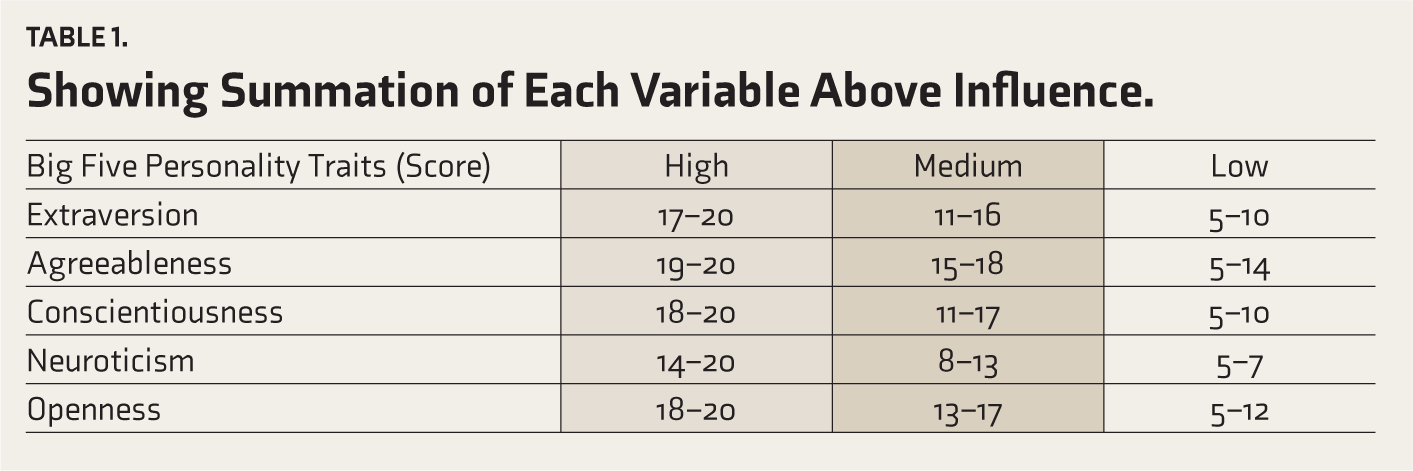
In the present study, the categorization of patients into low, medium, and high based on their Mini-IPIP scores was done based on the responses from participants ranging from 5 to 20, for each of the Big Five personality traits. The mean was taken as the center point. Then, 1 SD was used to divide it into three parts. Less than -1 SD was taken as “low”; more than +1 SD was taken as “High” and the value ranges between -1 SD and +1 SD were taken as “medium.” Similarly, The following table represents the summation of each variable of the above-mentioned influence. As shown in Table 1.
Showing Summation of Each Variable Above Influence.
Statistical Analysis
In the present study, statistical analysis was done with the help of SPSS software. The demographic profile of the study subject including age, sex, accommodation, and type of family was studied. Descriptive statistics were used to get the mean, median, and standard deviation of the following variables: scores obtained in the Mini-IPIP rating scales and scores obtained in the IGD-20 test. Similarly, Chi-square and Fisher exact tests were used for the risk factors.
Results
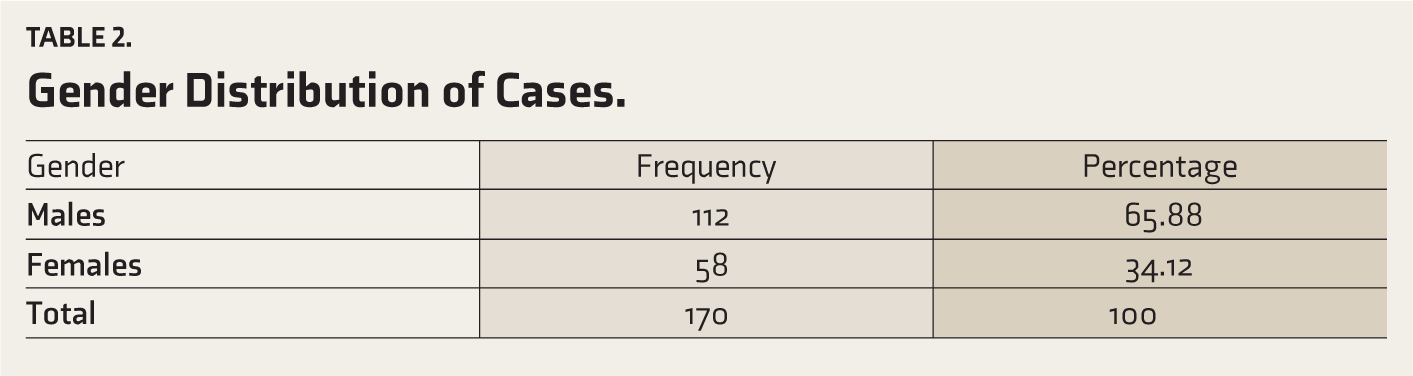
The gender distribution in the given population indicated that approximately 65.88% were males and 34.12% were females, for a total of 170 individuals studied (Table 2).
Gender Distribution of Cases.
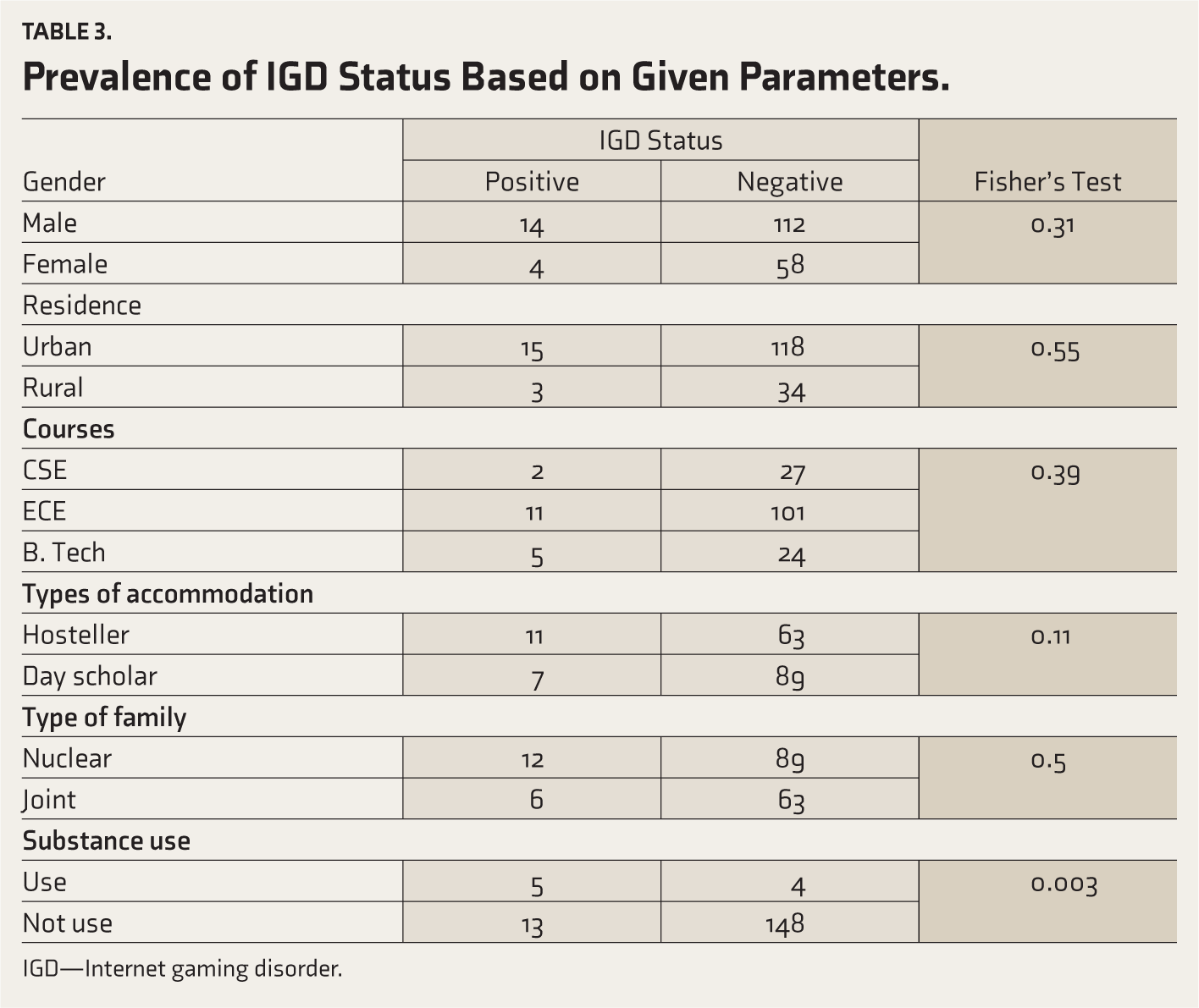
In the present study, 18 participants (10.58%) were found to have IGD. Among 18 participants with IGD, 14 were males and 4 were females. The gender prevalence for male and female participants was calculated separately and found to be 12.5% for males, and 6.9% for females.
The study included 103 participants (60.58%) aged 21, 43 participants (25.29%) aged 22, and 16 participants (9.41%) aged 20. There were 6 participants (3.5%) aged 23, and 1 participant each aged 19 and 24.
The variables such as gender, type of residence, type of courses, type of accommodation, types of family, and substance use have been arranged based on their IGD status. Significance testing was conducted utilizing Fisher’s exact test for all the above variables, a significant correlation was observed between substance use and the presence of IGD with a p value of <.003 (Table 3).
Prevalence of IGD Status Based on Given Parameters.
IGD—Internet gaming disorder.
The odds ratio analysis indicated a higher risk of IGD among individuals from urban areas, hostellers, nuclear families, and substance use with odds ratio values of 1.44, 2.22, 1.41, and 14.23, respectively.
The present study revealed that a predominant portion of participants, constituting 85.88% (146 individuals), were classified as single, while the remaining 14.12% were categorized as either married or in a relationship. Significance testing was conducted utilizing Fisher’s exact test, yielding a p value of 1, indicating no statistically significant association between relationship status and the presence of IGD in the participant group (Graph 1).
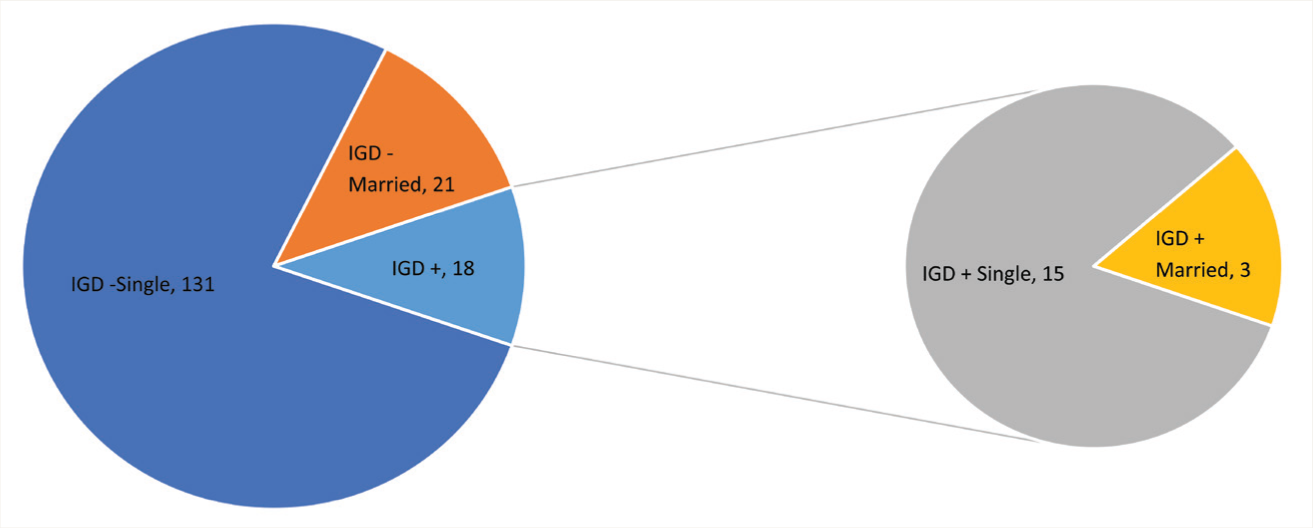
IGD − = Internet gaming disorder negative status. IGD + = Internet gaming disorder positive status.
The summary explores the relationship between the Big Five personality traits and IGD. Participants were categorized as low, medium, or high for each personality trait and their IGD status (positive or negative). Among the Big Five traits extraversion, conscientiousness, and neuroticism were observed to be significantly associated with IGD, having a p value of .02 for each trait, respectively. Conversely, agreeableness and openness to experience did not display a significant association with IGD, having a p value of .54 and .78, respectively (Table 4).
Association Between IGD and Big Five Personality Traits.
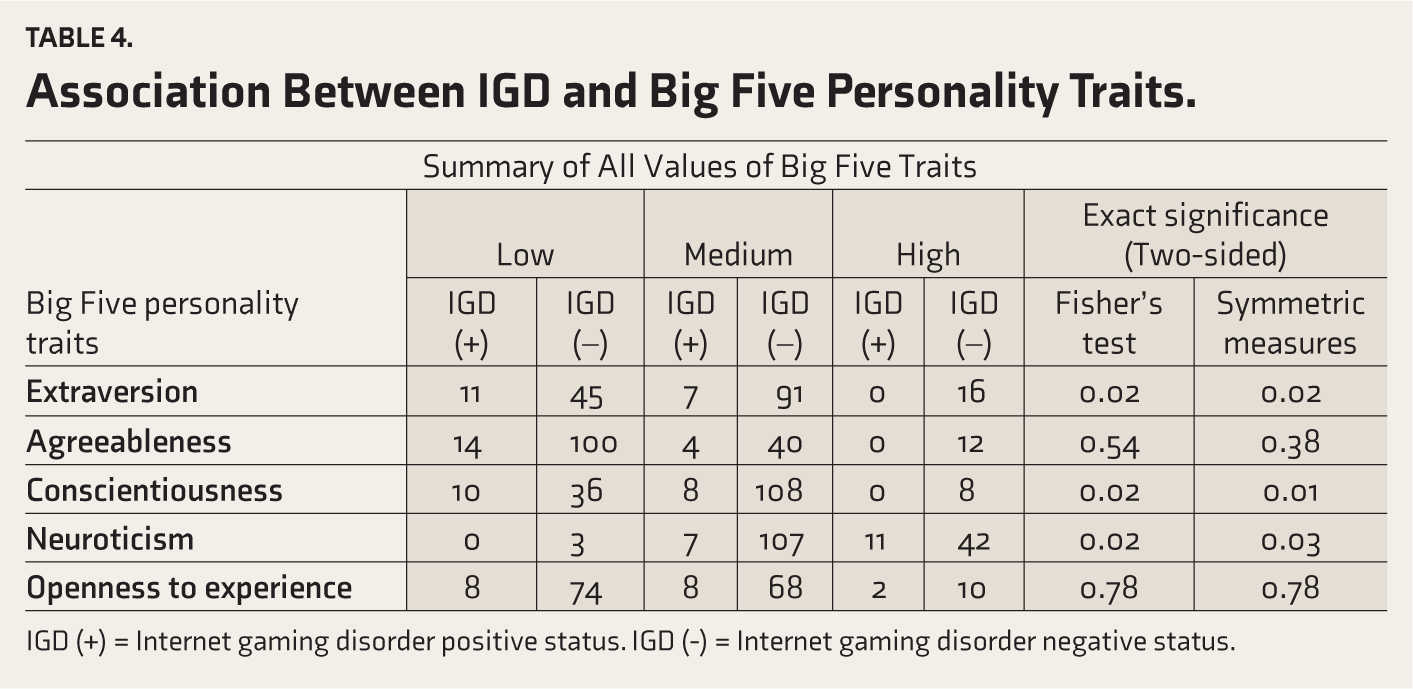
IGD (+) = Internet gaming disorder positive status. IGD (-) = Internet gaming disorder negative status.
Discussion
Internet gaming has become one of the most popular free-time activities among children and adolescents worldwide. The Internet provides entertainment, social interaction, and various opportunities for innovative skill development. Moreover, it is crucial to be aware of the potential risks associated with overuse or dysregulated gaming, as it can indeed lead to addiction-like symptoms. In the present study, the prevalence of IGD was found to be 10.58%. Similarly, Lemmens et al. 18 and Männikkö et al. 19 reported prevalence rates of 6.8% and 9.1%, respectively.
The findings of the present study indicate that 112 participants were male and 58 were female. The prevalence of IGD among each gender was revealed to be 12.5% in males and 6.9% in females, confirming that IGD is more prevalent among males than females, with an approximate ratio of 2:1. Therefore, the present study highlights that male gender is an important predictor of excessive or disordered gaming. The systematic review of IGD performed by Paulus et al. reported that IGD was observed up to five times more frequently among male students compared to female students. 20
The prevalence of IGD found in our study was within the varying range of global prevalence (1.3%–19.9%), as reported by Mihara et al. in 2017. 21 The present study has a higher prevalence when compared to the Indian prevalence of IGD reported by Undavalli et al. in 2020, 22 and Mara et al. in 2019, 23 which were 3.5% and 2.5%, respectively. The present study shows that neuroticism was positively associated with IGD, with a significant value of 0.036 (p = .03). This indicates that high neuroticism was significantly associated with the development of IGD, aligning with the findings of previous studies. 24
Thus, our study sheds light on the possibility that high neuroticism could be among the possible risk factors for mental disorders, due to the emotional instability and maladaptive coping strategies that may accompany it. Müller et al., 25 and Hoyle et al. stated that excessive gaming might be one of the maladaptive coping strategies developed by individuals with high neuroticism and can be assessed for comorbid mental disorders. 26
The present study found a negative association between IGD and extraversion, with a significant p value of .02. This indicates that individuals with low extraversion were at a higher risk of developing IGD, similar to findings in several previous studies.24,27 Additionally, the present study reveals another negative association between conscientiousness and IGD, with a significant p value of .01. This suggests that individuals with low conscientiousness were vulnerable to developing IGD due to their tendency to neglect obligations or everyday activities if they found a game particularly attractive. These results are consistent with findings in other previous studies.24,27
Furthermore, the results of the present study show that no significant association was found between IGD and agreeableness (p = .38), which is in concordance with Cole et al. 27 Openness to experience has yielded mixed findings about its association with IGD since the initial phase of research about the association between personality traits and IGD. 27 Our study found no significant association between IGD and openness to experience (p = .78), as found by Liao et al. and a few other studies.25,28 According to our study result, among the Big Five personality traits, IGD is positively associated with neuroticism, whereas it is negatively associated with extraversion and conscientiousness, and no association was found with agreeableness and openness to experience, as found by Müller et al. 25
Considering that we already know that some game aspects, like violence against women and randomly distributed reinforcement, can have strong addictive effects, further in-depth study may lead to the development of an addiction likelihood score that could be used to categorize Internet games according to their propensity to cause IGD and other psychiatric disorders.
Limitations
During this study, we faced some limitations, such as a small sample size and the samples were selected from a single college. As the college was closed indefinitely due to the COVID-19 pandemic lockdown during the study period, most of the participants in the study are attending the same academic year and comprise only two engineering departments. So, the study findings might not be representative of the general population.
Conclusion
As a result of these findings, it can be concluded that IGD has a positive correlation with neuroticism and a negative correlation with extraversion and conscientiousness. In light of this, specific traits in combination or alone might increase the risk of developing IGD. It is important to create awareness among parents, teachers, and students about IGD and possible risk factors, as the accessibility of smartphones, the internet, and mobile games is also increasing among the young population, and the prevalence of IGD is also increasing every year. Additionally, our study recommends that personality traits are one of the risk factors for developing IGD, so paying more attention to adolescents’ and young adults’ gaming use and personality traits will help in the early detection and primary as well as secondary prevention of IGD.
Footnotes
Data Availability
Data was made available by the corresponding author.
Declaration of Conflicting Interests
The authors declared no potential conflicts of interest with respect to the research, authorship, and/or publication of this article.
Declaration Regarding the Use of Generative AI
None used.
Ethical Approval and Patient Consent
Patient consent and ethical approval were taken completely from Institutional Ethics Committee, HCG Curie City Cancer Centre.
Funding
The authors received no financial support for the research, authorship, and/or publication of this article.