




Abstract
Does conflict change who desires to emigrate? Surprisingly, we still lack globally comparable empirical evidence on whether the types of individuals who want to leave their country differ between peaceful and conflict-affected locations. In this paper, we address this gap. We analyze unique survey data with global coverage to assess whether individual-level determinants of international permanent emigration aspirations differ during intrastate armed conflict compared to peaceful times and regions. We argue that armed conflict acts as an equalizer that attenuates the effect which individual economic and demographic variables have on international permanent emigration aspirations in peaceful contexts. As a result, aspirations to relocate permanently to another country increase among those demographic groups which are less inclined to move in peaceful situations. Our results indicate that variables related to a longer-term economic cost-benefit analysis, such as income or age, significantly lose importance for international permanent emigration aspirations in conflict situations. This demographic-specific effect explains an overall increase in emigration aspirations during conflicts. On average, we find no evidence that conflict increases the aspirations of all respondents to permanently move to another country. In contrast to income and age, the effects of demographic variables such as gender, household composition, or marital status are not significantly different across contexts.
Keywords
Introduction
Empirical research has established strong evidence that intrastate armed conflict 1 increases out-migration (Schmeidl 1997; Davenport, Moore and Poe 2003; Adhikari 2013; Ruhe, Martin-Shields and Groß 2021). Such conflict-related migration is frequently categorized as forced migration. However, the term “forced” suggests that individuals must flee who would ideally prefer to stay, a notion that has stirred debate over individuals’ preferences and their agency in these challenging contexts (Richmond 1993; de Haas 2011, 2021; Ottonelli and Torresi 2013; Erdal and Oeppen 2018). Given this broader debate in migration studies, it is surprising that there is no globally comparative survey research on how armed conflict affects whether, and which, individuals ideally prefer to stay or leave their country permanently.
Integrating individual preferences and aspirations 2 in migration theory has been a prominent research topic recently (Carling and Schewel 2018). However, empirical research on the link between violence and migration aspirations mainly focuses on local insecurity due to crime or interpersonal violence (cf. Aslany et al. 2021). Moreover, it does not examine how the effects of economic and demographic variables on migration aspirations differ in violent compared to more peaceful contexts. So how does armed conflict shape individual emigration aspirations compared to peaceful situations? Are individuals with different socio-economic and demographic characteristics inclined to emigrate in conflict compared to peaceful contexts?
To date, no published study has compared on a global level whether specific socio-economic or demographic groups of individuals become more or less likely to wish to leave their country permanently once armed conflict breaks out. Research on migration aspiration and intentions finds robust evidence that crime, interpersonal violence, and perceived local insecurity increase migration aspirations, on average (Wood et al. 2010; Manchin and Orazbayev 2018; Ruhe 2022). Studies of civil wars imply that violent combat affects the likelihood of local, internal, and international migration behavior (Bohra-Mishra and Massey 2011; Adhikari 2013). However, more detailed analyses of migration aspirations during armed conflict are scarce.
Hence, we know very little about what individuals ideally prefer, regardless of whether and where they eventually (have to) move. Our focus on individuals’ aspirations to move abroad permanently permits us to investigate one such preference. Moreover, as the desire to leave the country is an aspiration that individuals may hold during times of armed conflict and peace, it allows us to compare whether the effects of socio-economic or demographic variables on emigration aspirations differ between conflict and non-conflict contexts. Hence, our analysis follows recent prominent calls to jointly analyze migration processes in conflict and non-conflict contexts and investigate how large-scale violence interacts with economic and other determinants of migration aspirations (FitzGerald and Arar 2018).
We hypothesize that conflict is more than just an additional variable that increases or decreases individuals’ aspirations to leave the country permanently: It serves as an equalizer, which weakens the effect of demographic or socio-economic variables. We argue that the instability caused by conflict shifts the focus from the long-term costs and benefits to the short-term costs and benefits of staying versus leaving the country permanently. As a result, wealthier and older demographic groups, which are much less inclined to move in peacetime, increase their aspirations to emigrate disproportionately during conflict periods.
We draw on the unique global coverage of the Gallup World Poll, which contains information from over 150 countries from 2009 to 2018 and analyze whether the type of individuals who prefer to leave their country permanently changes during conflict-affected situations compared to non-conflict settings. Our vast dataset allows us to evaluate differences in emigration aspirations with alternative geographic foci. Violent combat unquestionably causes the most significant hardships in its immediate vicinity. However, intrastate armed conflicts often destabilize entire nations and generate widespread perceptions of insecurity, even when fighting is (momentarily) restricted to specific geographic areas (Gates et al. 2012). Therefore, our primary analysis relies on a global comparison of surveys conducted in countries during intrastate armed conflict and peaceful years to capture these broader implications for aspirations to leave a country permanently. To capture more localized effects of more immediate conflict exposure, we also compare survey results for newly conflict-affected subnational regions with estimates from surveys conducted in the same areas before armed conflict onset.
Global regression analyses with country-year fixed effects and regional regression estimates with region-year fixed effects underscore our theoretical expectations for those key economic and socio-demographic variables typically associated with long-term economic cost-benefit considerations. Although wealthy and older individuals generally do not prefer to move abroad permanently in non-conflict contexts, this changes in conflict contexts. Moreover, our estimates indicate that the overall surge in international migration aspirations, which we observe in conflict-affected areas, stems mainly from increasing migration desires in these demographics, not a general increase in the entire population.
The paper proceeds as follows: The following section introduces our conceptual framework and relates it to existing literature. Section 3 reviews previous research on individual variables and derives our theoretical expectations of their effects on migratory aspirations in conflict versus non-conflict settings. Subsequently, in section 4, we describe our data, research design, and additional robustness checks. Section 5 reports our empirical results. The paper concludes by discussing our findings and promising avenues for future research.
The Formation of Migration Aspirations and the Effect of Armed Conflict
Since the first push–pull theory (Lee 1966), scholars have increasingly refined migration theories. Based on the Theory of Planned Behavior from social psychology (Ajzen 1985; Armitage and Conner 2001), migration scholars conceptualize migration as the result of a two-step process, which develops from thinking about migration to actual behavior (Carling and Schewel 2018). Here, migration aspirations and intentions are a crucial precondition for subsequent behavior and serve as an appropriate analytic lens for studying migration preference formation (Gubhaju and De Jong 2009; Docquier, Peri and Ruyssen 2014; Bertoli and Ruyssen 2018; Mendola 2018; Migali and Scipioni 2019; Böhme, Gröger and Stöhr 2020).
We build upon these conceptualizations to theorize how conflict affects the formation of permanent emigration desires. According to migration research, individuals in both peaceful and conflict-prone environments tend to consider the social, emotional, and material benefits against the costs of migration (Adhikari 2013). Thus, individuals form a preference for migration by weighing the relative utility of staying versus leaving (De Jong 2000; Adhikari 2013). In intrastate armed conflict, earlier research often studies violence as the primary push factor of conflict-related migration behavior (Schmeidl 1997; Davenport, Moore and Poe 2003; Moore and Shellman 2004; Neumayer 2005; Melander and Öberg 2007). However, we have less evidence of how armed conflict shapes more permanent emigration aspirations beyond the immediate motive of (temporarily) getting out of harm's way. Economic opportunities are a prime research focus in peaceful contexts, suggesting that people prefer emigration if, for example, the economic benefits of leaving permanently outweigh those of staying (Ortega and Peri 2009; Czaika and Hobolth 2016; Neumann and Hermans 2017). Yet, many additional factors or so-called drivers of migration shape aspirations (Mendola 2018). Variables influencing the perceived benefits and costs of leaving include economic needs or incentives, personal security, social networks, information, and norms.
We can formalize an expected utility model of emigration aspirations by formulating an emigration utility equation, which consists of all these variables:

The question that remains is how armed conflict and large-scale violence affect this utility function and, hence, emigration aspirations: Is security just an additional variable
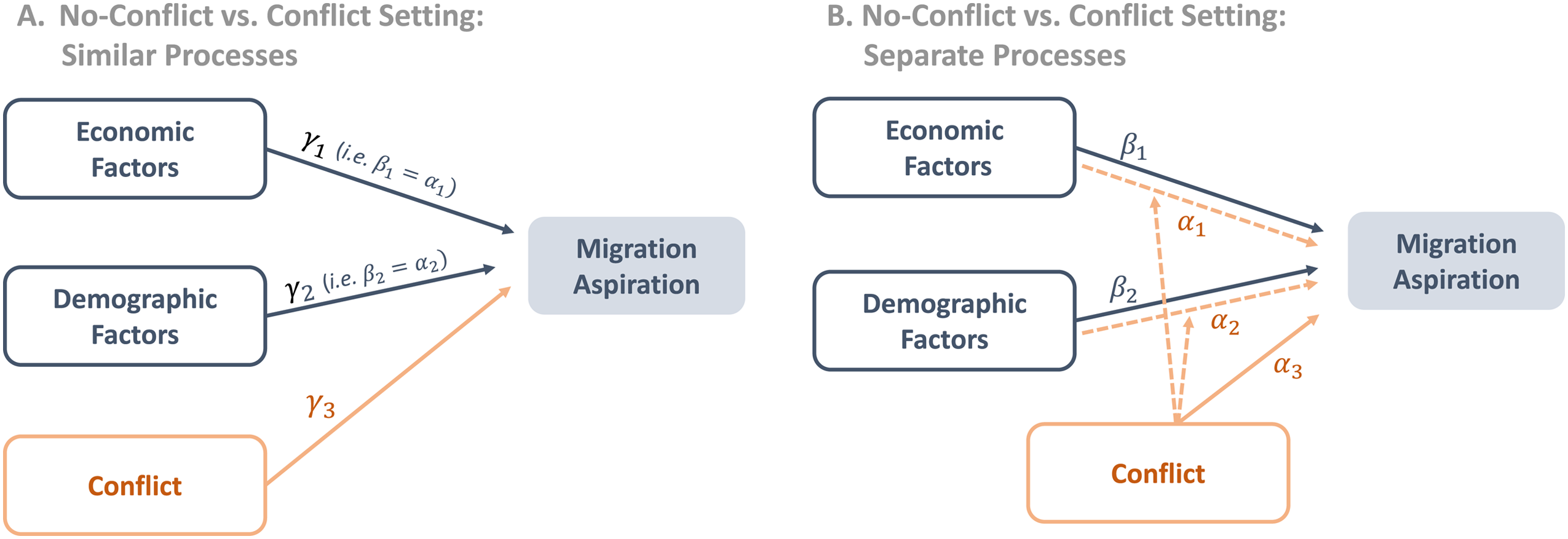
Modelling the Migration Aspiration Formation in No-Conflict Versus Conflict Settings. Source: Authors.
This perspective has one intriguing feature, which challenges the notion of an empirical difference between emigration in conflict-affected and peaceful contexts: Except for the security variable, the equation implies that the remaining migration utility calculation based on all non-security variables remains the same. This means that similar individuals wish to emigrate permanently in peaceful and violent contexts.
In contrast to this simple, largely additive utility theory,
3
a different perspective is possible (see Figure 1B): What if emigration aspiration formation in non-conflict and armed conflict contexts are different phenomena, as described by equations 2 and 3 below? After all, a security threat may alter the entire context so fundamentally that economic or demographic variables matter differently, or not at all (as depicted in Figure 1B:


Expected Effects of Individual Factors Shaping Emigration Aspirations
Potential drivers of migration have received much attention in contemporary migration studies and public debates (Migali and Scipioni 2019). These include demographic and socio-economic factors (such as gender, age, household composition, income/wealth, employment status, and educational level), other individual-level determinants (for instance, personality traits and access to information), and country/community characteristics in origin and destination (for example, governance, corruption, institutions, violence, and development level) as well as migration-related factors (such as networks and culture). All of them may affect emigration desires and behavior (see Aslany et al. (2021) for a systematic review).
We argue, however, that violence diminishes the immediate importance of most of these factors on migration aspirations. The primary motivating factor is fleeing conflict and reaching a safe place (Schmeidl 1997; Davenport, Moore and Poe 2003). While this is particularly relevant for short-term relocation (within borders), it is likely to also be true for more permanent emigration aspirations. As violence usually affects large parts of society (Gates et al. 2012), aspiring emigrants should become more diverse. In other words, insecurity creates widespread emigration desires, and other drivers of migration aspirations should lose at least part of their explanatory power. Consequently, we formulate the following general expectation:
Meta-hypothesis: Conflict attenuates the effect of demographic and socio-economic variables on permanent emigration aspirations.
In the following, we spell out the implication of this overarching meta-hypothesis for explanatory variables frequently appearing in migration research and that earlier analyses link to migration desires. To test our theoretical argument, we deduce variable-specific hypotheses about how the effect of income level, employment status, age, gender, marital status, children, and educational attainment differs between conflict and non-conflict contexts.
Income Level
Income is an ambiguous factor. Although wealthy individuals might have fewer economic incentives to leave their homes (Sharma and Zaman 2013), they have more resources to finance migration than poorer individuals (Spörlein et al. 2020). This argument follows the idea of capabilities and how poverty can prevent people from realizing their migration aspirations (de Haas 2010; Angelucci 2015). It is also in line with the inverse U-shaped relation at the macro-scale between country income levels and migration (also called migration hump theory) (de Haas 2010). However, as we study migration aspirations, financial constraints will likely play a more minor role. Migali and Scipioni (2019) show that poorer individuals are more likely to wish to emigrate from high and middle-income countries on average. Moreover, a systematic review by Aslany et al. (2021) confirms that higher socio-economic status is associated with a lower desire to migrate. Similarly, studies using subjective assessments and satisfaction measures paint a similar picture (Aslany et al. 2021). Langella and Manning (2021) suggest that this latter relationship is closely linked to individuals’ educational levels.
In conflict settings, the effect of income is less clear. Some studies show that poorer individuals have lower migration intentions (RMMS and IMI 2012; Loschmann and Siegel 2014), whereas high-status individuals quickly leave as conflict erupts (Schon 2019). In contrast, other research suggests that a higher level of wealth is associated with a lower likelihood of displacement, possibly owing to the ability to cope with conflict-related hardships or being closer to those in power (Adhikari 2013).
We argue that security threats shift the focus from the benefits of migration to the costs of staying. Armed conflicts destroy infrastructure and private assets. Even if a household is not immediately affected by violence, armed conflict deteriorates the economic prosperity of entire nations (Gates et al. 2012). Faced with such uncertainty, high-income individuals cannot be sure that they will be able to preserve their wealth in the future, shifting attention from the long-term benefits of wealth to the short-term costs of staying. Consequently, high-income individuals become more likely to wish to emigrate once conflict occurs. As a result, conflict should attenuate the difference in migratory aspirations between individuals with higher and lower income levels, which we typically observe in non-conflict settings.
Employment Status
The lack of employment opportunities (push), as well as presumably better job opportunities elsewhere (pull), are the main factors mentioned by traditional migration studies (Todaro 1969). Unemployment and expected opportunities to find a job elsewhere increase intended and realized movements (Aslany et al. 2021; Pesando et al. 2021). For those active in the labor market, the migration intention is likely to depend on the characteristics of their work and (information on) better job or payment possibilities elsewhere (Williams 2008). Casual workers are more flexible than those owning physical assets (Pivovarova and Swee 2015). In non-conflict settings, unemployed individuals tend to have a stronger desire to move than those in jobs (that fit their skill level) (Manchin and Orazbayev 2018; Migali and Scipioni 2019).
Being employed (in a job that fits the individual skill level) may matter less in conflict-affected areas if the primary aim is to reach safety. Although employment secures economic livelihood and should be associated with higher resilience, employment status does not secure life in the face of violence. Thus, even people employed in high-skilled jobs that fit their educational background might decide to move due to safety reasons, reducing the gap in migration desire relative to unemployed individuals (Burnham, Lafta and Doocy 2009). Therefore, we expect the following patterns:
Age
Most quantitative and qualitative studies report positive self-selection of working-age migrants in non-conflict settings, which seems to be non-linear and rather hump-shaped (Hatton and Williamson 2002; Van Dalen, Groenewold and Schoorl 2005; Toma and Vause 2014). This reasoning follows the traditional arguments of reaping the benefits of wage or employment differentials. The probability of paying back the often significant migration investment — particularly for international movements — is likely higher among young, flexible individuals. Studies across many countries support this association with migration aspirations (Hatton and Williamson 2002; Van Dalen, Groenewold and Schoorl 2005; Mendola 2018; Aslany et al. 2021).
There is less evidence on the role of age in migration decisions in conflict settings. Evidence comes mainly from Nepal and Colombia but does not paint a clear picture. Williams (2008) finds that people aged 21–40 are more likely to move in conflict settings. While Adhikari (2013) does not confirm this finding, other studies suggest that older respondents are less likely to migrate (Engel and Ibáñez 2007; Bohra-Mishra and Massey 2011).
Again, we argue that the mixed evidence for forced migration in contrast to labor migration may stem from a primary aim to reach safety — not to reap the benefits of a potential wage differential. Violence often affects the entire population living in the conflict-affected area — directly or indirectly — and insecurity usually threatens all age groups. Hence, aspirations for emigration should be broadly motivated to avoid conflict-induced hardships. While older age groups might still find it difficult to leave, for instance, due to decreased physical mobility, the need to reach safety is less age-group-specific. Therefore, we expect that conflict attenuates the strong effect of age observed in non-conflict migration. We hypothesize a much smaller difference in migratory aspirations across different age groups in conflict-affected countries.
Gender
Evidence for a wide range of peaceful countries indicates that men are, on average, more likely to (desire to) migrate internationally than women (Curran and Rivero-Fuentes 2003; Van Dalen, Groenewold and Schoorl 2005; Mendola 2018; Aslany et al. 2021) Some arguments suggest that men react more strongly to financial expectations, whereas networks, education, and household income influence women's intention (Cerrutti and Massey 2001; Gubhaju and De Jong 2009). Additional factors that might explain reduced female migration are the potentially higher security risk women might face during migration, and their often more limited financial means (Balaz and Williams 2011; Toma and Vause 2014). 4
It is unclear whether these dynamics change during a conflict. The movement's unplanned nature and greater urgency in conflict settings may push people to use unsafe, irregular migration routes. These are particularly dangerous for women. Very few studies consider gender as an individual-level determinant in the migration decision in conflict settings, and the evidence is mixed (Bohra-Mishra and Massey 2011; Adhikari 2013; Williams 2013).
The mixed evidence for conflict situations may result from changing life circumstances during violence. While men face a greater risk of dying due to their direct involvement in the fighting, women are particularly vulnerable in conflict-affected areas. Sexual violence against women and girls is widespread in conflict and used as a war tactic (UN Women 2014). Hence, depending on the cultural context, it is likely that women's intention to migrate increases during conflict. At the same time, traditional household management roles might become less relevant in the face of immediate danger and problematic livelihood. Quite the contrary, in conflict situations, women often find themselves in the new role of being the primary income provider for the remaining household (USAID 2007). Hence, although there may be gender differences in emigration aspirations in non-conflict settings, we expect them to diminish in violence-affected situations:
Marital Status
Generally, the narrative in non-conflict migration settings suggests that married individuals are tied to their spouse and, hence, are less flexible, leading to lower migration rates. Most studies support this argument in a systematic review of research using migration desire as an outcome (Aslany et al. 2021). The importance of marital status is possibly context-specific (Fleury 2016). Some societies do not allow single women to migrate, and married women follow their husbands. Also, in many settings, other variables such as age or gender are likely to capture part of a potential effect of marital status (Gubhaju and De Jong 2009).
In general, it is reasonable that marital status has less predictive power in the face of conflict. In contrast to non-conflict migration, a conflict will likely push the entire family to move (Engel and Ibáñez 2007). While it is likely that the intention to migrate in conflict settings is also higher for singles compared to married individuals due to less complex decision processes (Williams 2013), we expect the importance of the marital status to be less prominent than in non-conflict settings. The strong desire to move the wife and potential children to a safer environment may outweigh the greater logistical ability of singles to leave. Therefore, we suggest the following difference between conflict and non-conflict contexts:
Children
To the best of our knowledge, no studies solely focus on the effect of children in the household on migration decisions. Otrachshenko and Popova (2014) and Langella and Manning (2021) reported lower migration intentions for individuals with children. Migali and Scipioni (2019) found that individuals with children have a higher probability of wanting to migrate in middle and low-income countries but a lower probability in high-income countries. Others do not report a (coherent) statistically significant effect (Adhikari 2013; Mendola 2018).
It is unclear whether people might be more or less likely to move with children in non-conflict settings as children limit the ease of moving but at the same time might increase the wish to seek better opportunities for the sake of the children's future. Conflict might lead to increased moving of those with children to ensure their safety. As it seems likely that the urge to seek safety dominates other hindering factors, we formulate the following hypotheses:
H6b: Conflict attenuates the difference between individuals with and without children in their household.
Educational Attainment
Overall, a mismatch between employment possibilities and educational levels should drive migration in non-conflict settings. Evidence from various contexts shows that the more educated household members have higher migration intentions (Docquier, Peri and Ruyssen 2014; Aslany et al. 2021; Langella and Manning 2021). They are more likely to be those chosen by the household to move, as they usually have the highest chances of making a living and, consequently, supporting the family back home.
There is very little insight into the relevance of educational attainments on migration decisions in conflict settings. The few existing studies paint an ambiguous picture. Some studies find that individuals with higher education levels are more likely to move (Bohra-Mishra and Massey 2011; Williams 2013), while others find no such effects (Adhikari 2013). Furthermore, there is also evidence pointing in the opposite direction (Engel and Ibáñez 2007).
Hence, the unclear evidence for conflict cases again provides arguments for various effects. While education might remain relevant, the urgency of movement likely overrides the economic considerations of households when making migration decisions in conflict versus non-conflict settings. According to this, we formulate the following hypothesis:
To summarize, we expect that conflict reduces the difference in emigration aspirations across various socio-economic and demographic groups. Variables delimiting these groups should lose (part of) their explanatory power.
Research Design
We evaluate these theoretical expectations using data from the Gallup World Poll (GWP), a repeated cross-section survey of individuals in more than 150 countries worldwide. The GWP represents more than 99 percent of the adult world population (Gallup, 2018). To provide yearly nationally representative surveys for each country, the GWP randomly selects at least 1,000 respondents with a minimum age of 15 years for interviews in each country. The surveys cover both rural and urban areas. The GWP generally also covers insecure regions well, for example, Syria, however, there are sometimes local exceptions in times of heavy conflict. 5 In larger countries (such as China or Russia), sample sizes are at least 2,000 individuals, and in some countries, Gallup oversamples in major cities or areas of particular interest. The interviews are generally face-to-face.
Dependent Variable
The GWP contains various socio-economic and demographic individual and household level variables. To measure if individuals wish to emigrate permanently to another country, we use the question “Ideally, if you had the opportunity, would you like to move permanently to another country, or would you prefer to continue living in this country?”. The variable is one if individuals prefer to move permanently and zero otherwise. Relying on this variable makes our results globally comparable to several studies that either used the GWP descriptively or analyzed migration potential with a similar question wording (Carling and Schewel 2018). Focusing on the wish to migrate also reduces the sample self-selection problem with data that captures realized migration desire (Mendola 2018).
Independent Variables
As our independent variables, we describe respondents’ economic situation by coding whether respondents’ household income per capita ranges in the poorest (reference category), second, middle, fourth, or richest quintile of the national income distribution. 6 A categorical variable captures respondents’ employment status, denoting if a respondent is employed full-time (reference category), self-employed full-time, part-time employment and not seeking full-time, part-time employment seeking full-time, and whether individuals are unemployed or not part of the workforce. We code respondents’ age in 10-year intervals. Gender enters the model as a binary variable with male as the reference category. We code marital status as a categorical variable whether individuals have no partner (reference category), are married, or live with a domestic partner. A further binary variable describes if children under age 15 live with the respondent in the household. We distinguish individual educational levels into three categories as follows: 8 years of schooling or less (reference category); 9 to 12 years of schooling plus a maximum of 3 years of post-secondary education; and 4 or more years of college/university education. Lastly, we control for whether respondents live in a rural area or on a farm (reference category), in a small town or village, or in a large city or its suburbs, as these likely affect migration aspirations (Aslany et al. 2021). 7 As some variables, such as income, were not surveyed in the early waves of the GWP, we use the survey waves from 2009–2018.
To identify whether a country is affected by armed conflict, we rely on the UCDP/PRIO Armed Conflict Dataset 8 (Gleditsch et al. 2002). It is a country-year-level dataset that offers information on the start and end of a conflict, its intensity level (minor and major conflicts), and the actors involved. We generate a binary variable indicating if an (internationalized) intrastate conflict is ongoing in the country during the survey period, accounting for 98 percent of state-based armed conflicts worldwide in our sample period. We provide a complete list of conflict-affected countries and descriptive statistics for all variables in the supplementary information (section S1).
Model Specification
We model our outcome whether an individual i in country c during GWP wave w prefers to migrate abroad using a linear
9
panel estimator which accounts for country-wave fixed effects. To distinguish conflict-affected from non-conflict contexts, we estimate two separate models:
Including only countries at peace, i.e., without ongoing intrastate armed conflict: Including only countries with an ongoing intrastate armed conflict:


To assess if the individual covariates of migration aspirations differ in conflict-affected compared to non-conflict countries, we compare the coefficient estimates
Robustness Checks
Our global comparison uses country-wave fixed effects to control for any confounding influence from systematic differences across countries and years. However, one could argue that individuals in conflict-prone countries react differently than individuals in the peaceful rest of the world. A further concern might be that in long-lasting conflicts, we only capture the remaining individuals who have not yet left and that the samples might not be comparable. Lastly, conflict affects specific regions within countries. In large conflict-affected countries, we capture many respondents who live far away from actual conflict events and are possibly unaffected by them, which might affect our results.
To alleviate such concerns, we repeat the analysis with a sample that mitigates these potential issues and demonstrate that our findings remain substantively the same. First, we identified all countries which experienced their first armed conflict onset after at least 10 years of no such conflict, according to UCDP/PRIO. 11 This ensures that we do not mistake lulls in the fighting for peaceful situations. Second, we restricted our sample to only the first year of conflict and pre-conflict survey waves, which helps ensure that our conflict sample contains the most similar set of respondents. Since we include only the first conflict year, our analysis is less likely to be affected by sample selection due to conflict-related emigration. Third, we used the UCDP Georeferenced Event Dataset (Sundberg and Melander 2013) to identify all administrative level 1 areas that experienced violent events in this first conflict year. We exclude all respondents in unaffected regions from the pre-conflict and conflict samples. Finally, we analyze this refined sample using the exact model specification, that is, including country-wave fixed effects, as in our global analysis.
Furthermore, the supporting information demonstrates that our conclusions remain the same if we distinguish between minor armed conflicts and war (see Gleditsch et al. (2002) for definitions). Lastly, in addition to the separate models reported in Table 1, we also estimate a joint model for all respondents and interact each independent variable with our binary conflict indicator. We thus estimate the difference in coefficients for conflict and non-conflict contexts within the same model, which provides identical results (supplementary information section S4). Note that although our country-wave fixed effects subsume the overall effect of conflict, we can still estimate the interaction with individual-level variables, that is, how the coefficients change in conflict compared to non-conflict settings.
Estimating if Individuals Prefer to Migrate Permanently Abroad in Conflict and Non-Conflict Countries.
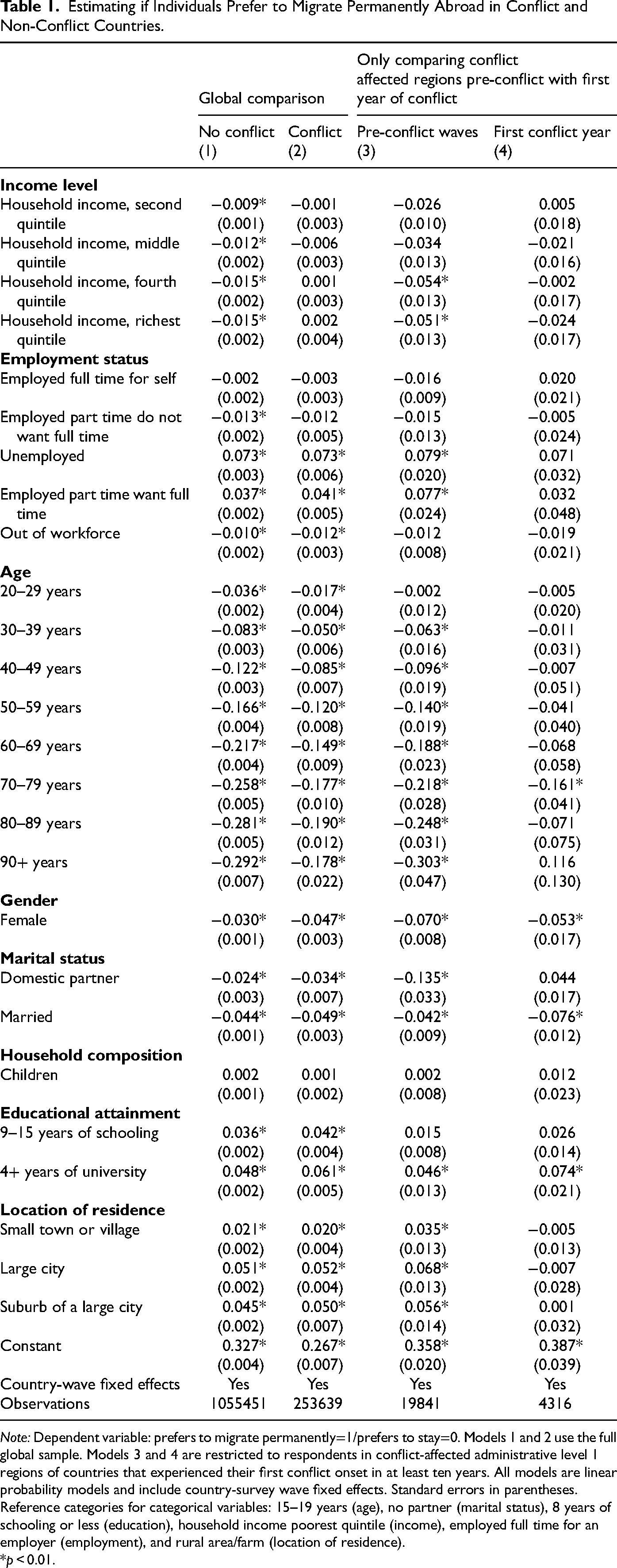
Note: Dependent variable: prefers to migrate permanently=1/prefers to stay=0. Models 1 and 2 use the full global sample. Models 3 and 4 are restricted to respondents in conflict-affected administrative level 1 regions of countries that experienced their first conflict onset in at least ten years. All models are linear probability models and include country-survey wave fixed effects. Standard errors in parentheses. Reference categories for categorical variables: 15–19 years (age), no partner (marital status), 8 years of schooling or less (education), household income poorest quintile (income), employed full time for an employer (employment), and rural area/farm (location of residence).
*p < 0.01.
Results
The first two columns of Table 1 provide the results for our primary analysis with the global sample. Column (1) presents only non-conflict cases (Model 1), and column (2) contains only those countries with an ongoing intrastate armed conflict (Model 2). The supplementary information (section S6) documents all country-years included in our global sample and which experienced an ongoing intrastate conflict (according to the UCDP/PRIO Armed Conflict Dataset). Columns (3) and (4) contain results for our analysis with only respondents in conflict-affected regions. Note, however, that the conflict-affected regions model drastically reduces the sample size, thereby increasing standard errors and p-values that do not always reach the same significance level of p < 0.01, which we report in Table 1.
The results in Table 1 suggest that generally, the direction of relationships in conflict and non-conflict contexts seems to be similar for most variables; however, magnitudes differ. Furthermore, the Chow test formally indicates that the coefficients of both models are significantly different (Chow test statistic for the global model
To facilitate the comparison of the results for conflict and non-conflict cases, we graphically describe the results of our global model and our regional analysis.
Figure 2 shows the effect of household income on the aspiration to move to another country and compares countries that experience intrastate conflict and those that do not. It indicates a substantively different effect of income quintiles on international emigration aspirations for conflict-affected contexts compared to non-conflict contexts. In peaceful settings, individuals in higher income quintiles have lower aspirations to emigrate than the poorest 20 percent of the population. In other words, the poorest have the highest migratory aspirations, and the wish to emigrate permanently decreases with income. Individuals in the two wealthiest quintiles exert the lowest aspirations to emigrate. These results confirm H1a. The results for the regional model suggest the same conclusion, whereby the effect appears even stronger, albeit with wider confidence intervals, due to the smaller sample.
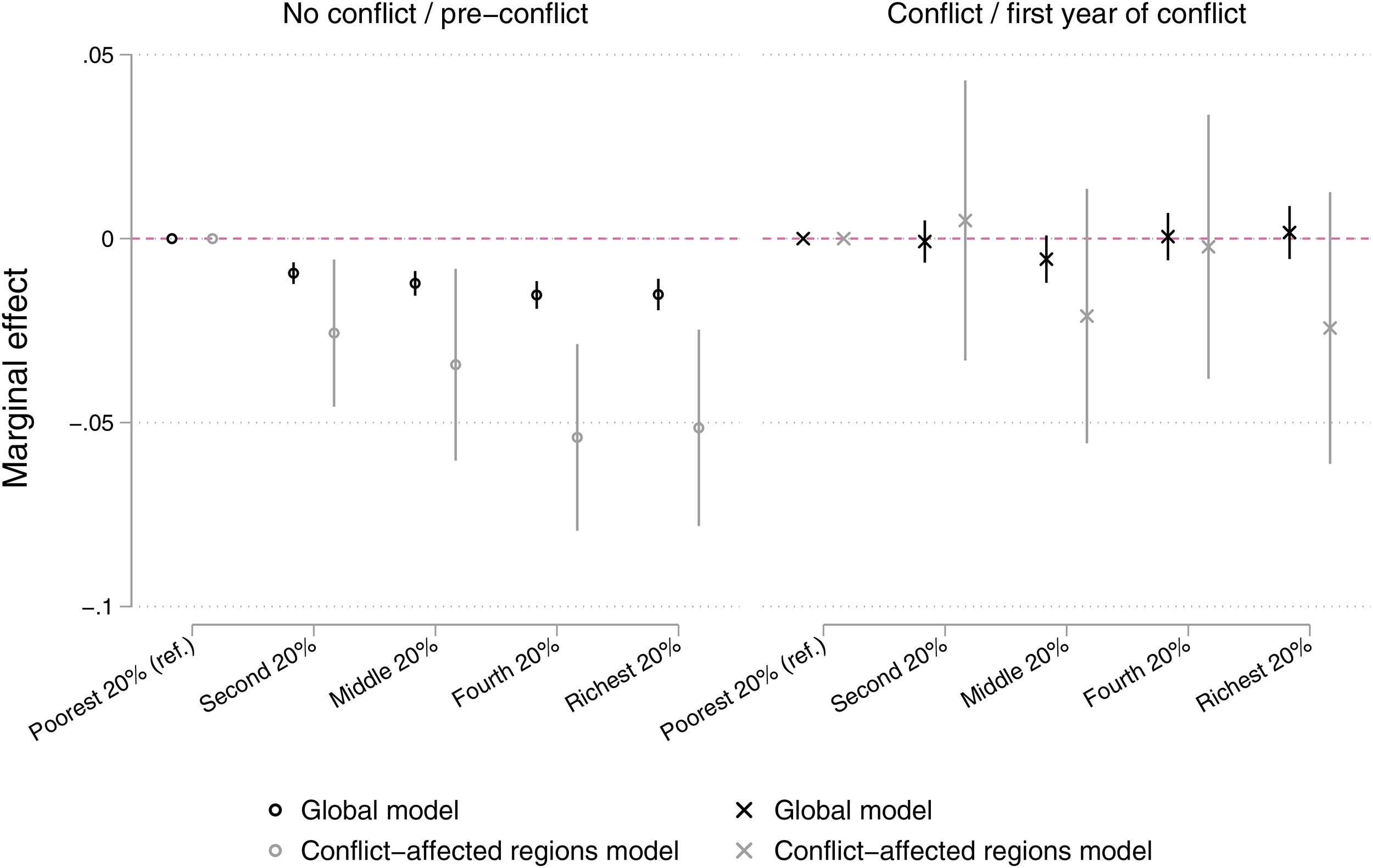
Effect of Household Income on Aspirations to Migrate Abroad. Based on Model Estimates in Table 1. Bars Denote 95% Confidence Intervals.
The results for income are strikingly different in conflict contexts, where we find no statistically significant differences across income levels. Hence, conflict not only attenuates the income effect (as hypothesized in H1b), but this effect seems to disappear altogether. Again, both the global and regional models concur and indicate that there appears to be no substantive difference in permanent emigration aspirations across income groups, once conflict occurs. The supplementary information (section S5) provides further analyses that allow the income effect to vary by country income. These confirm our previous results across all country income groups in conflict settings and for lower-middle- to higher-income countries in peaceful contexts.
This finding is consistent with our theoretical expectation that security threats shift the focus from the benefits of emigration to the costs of staying. As security deteriorates, it becomes increasingly uncertain that any status quo prevails. Thus, high-income individuals cannot be sure they will preserve their wealth in the future. Faced with such uncertainty, high-income individuals are likely to discount the future utility of individual wealth more strongly, implying that their income would be less relevant for a migration decision. Our findings match our theoretical reasoning that conflict attenuates the economic cost-benefit calculus associated with international migration.
Nevertheless, conflict does not alter all economic considerations. Figure 3 displays the results for the employment situation of individuals. Overall, individuals who are unemployed or would like to work more have significantly higher emigration aspirations, confirming H2a. However, we cannot establish significant differences between those living in countries in armed conflict and those in peaceful contexts. Furthermore, the regional models provide substantively similar point estimates, but with the expected wider confidence intervals. Both models indicate that immediate economic difficulties, such as unemployment, remain powerful determinants of permanent emigration aspirations, regardless of the security context.
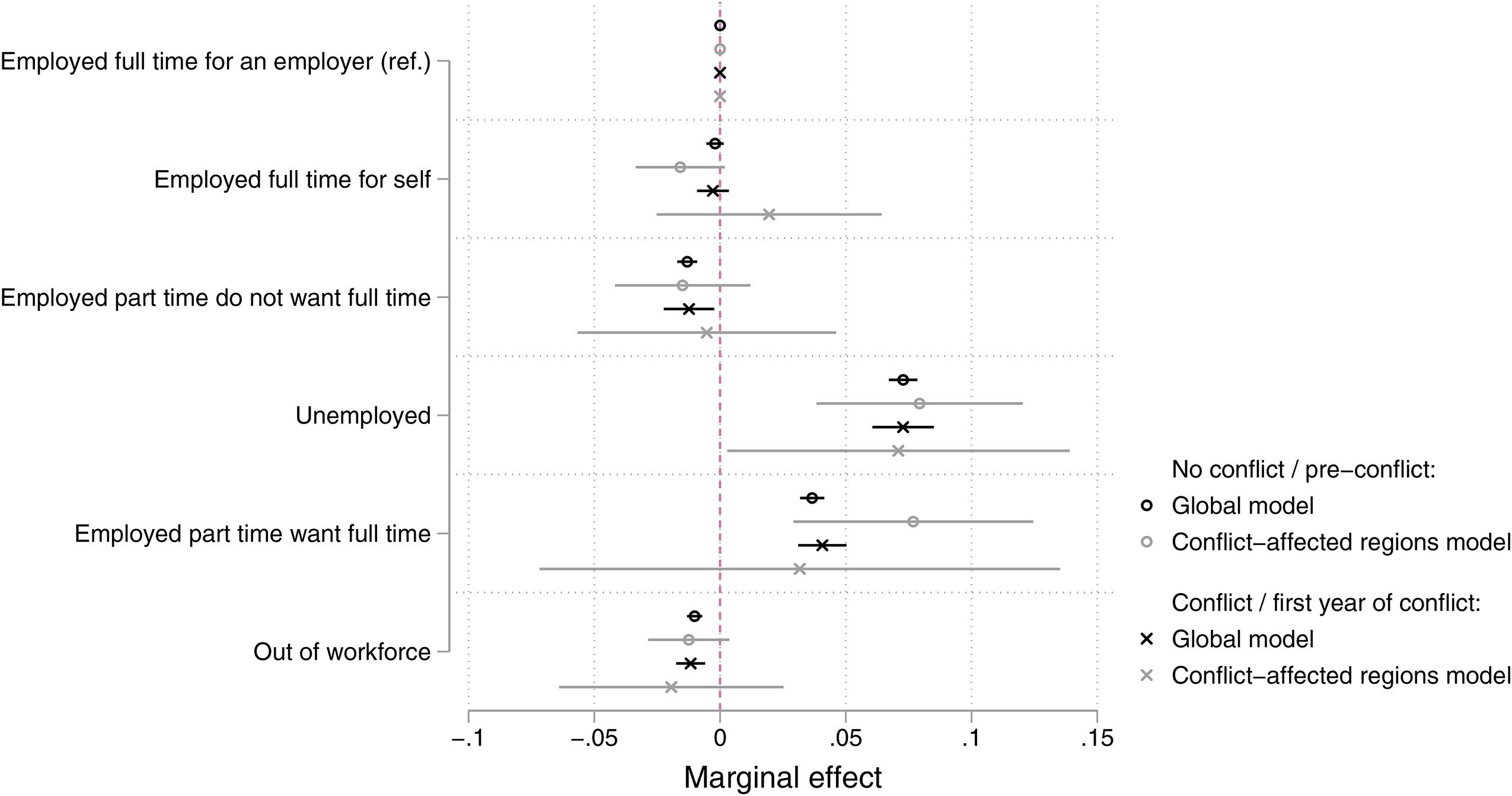
Effect of Employment Situation on Aspirations to Migrate Abroad. Based on Model Estimates in Table 1. Bars Denote 95% Confidence Intervals.
While this may seem to contradict our earlier conclusions concerning wealth, these results are consistent with the idea that conflict emphasizes the immediate costs of staying but attenuates the impact of long-term economic considerations. Unemployment or insufficient employment aggravates the immediate hardships. In line with the idea of Betts (2010) on survival migration, unemployed individuals are under immediate pressure to find work to secure their livelihoods, irrespective of whether they experience conflict. According to our results, inadequate employment maintains its “push” characteristics across conflict-affected and peaceful locations.
Figure 4 shows the effect of age on the aspiration to move to another country. Generally, emigration aspirations decrease with increasing age, which confirms H3a. However, as hypothesized, we can also clearly see that this relationship becomes weaker in conflict-affected contexts (H3b). Specifically, the effect size of age decreases between 25 percent and 50 percent for all age groups. The regional models again provide substantively very similar results. This underscores that conflict conditions substantially mitigate the importance of age. Nevertheless, age remains a powerful explanatory variable despite having a smaller effect during conflict.
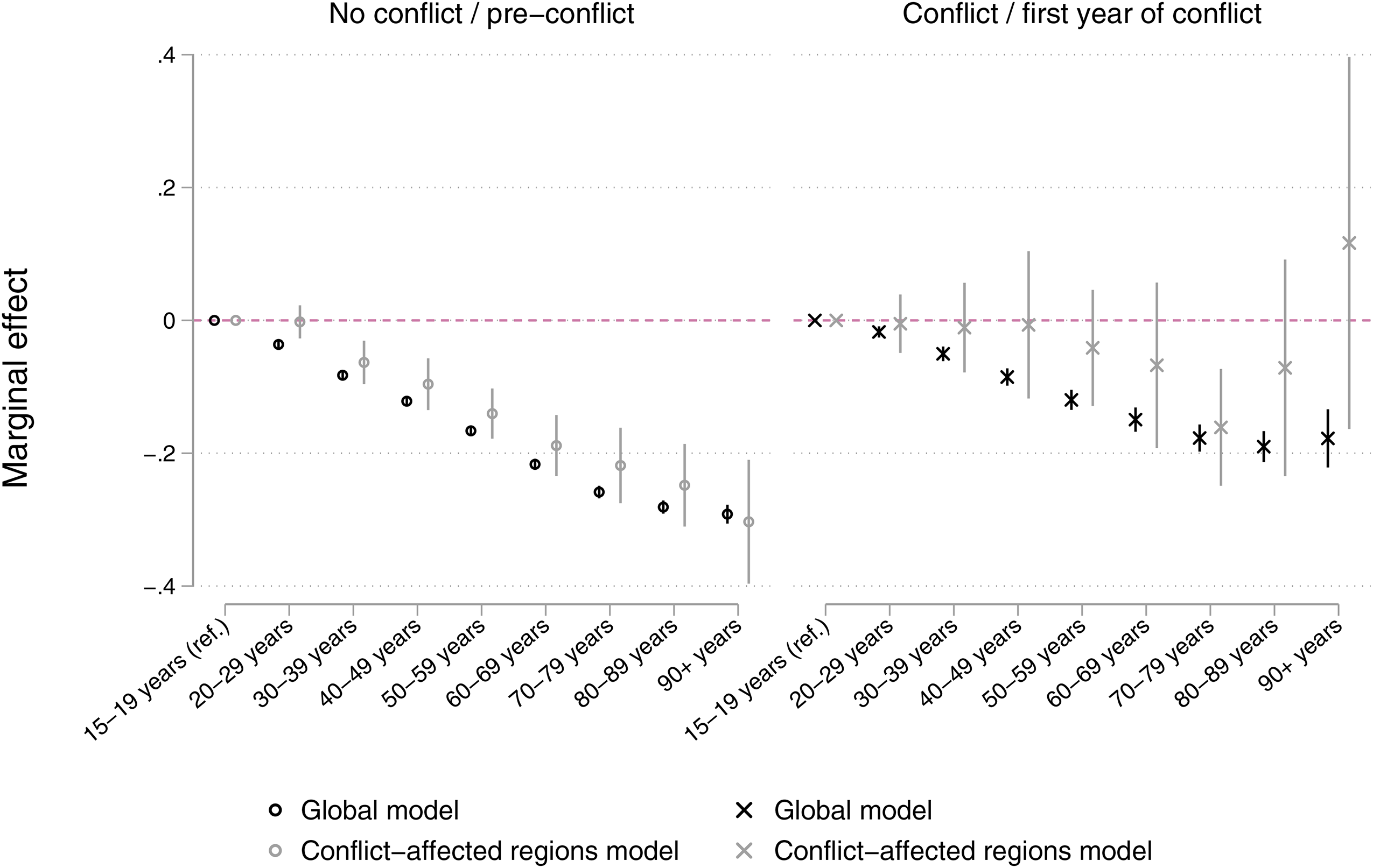
Effect of Age on Aspirations to Migrate Abroad. Based on Model Estimates in Table 1. Bars Denote 95% Confidence Intervals.
Hence, our results for age are consistent with our theoretical reasoning that conflict attenuates the economic cost-benefit calculus associated with international migration. Although older respondents are substantially less likely to want to leave, emigration aspirations are more similar across age groups in conflict-affected countries. On average, older respondents, who arguably have more established livelihoods, appear less reluctant to “make a new start” abroad once a country spirals into conflict.
We find relatively few systematic differences between conflict and non-conflict countries for our remaining socio-demographic variables. Figure 5 shows that the gender gap appears to widen in conflict contexts. However, this pattern disappears once we compare only conflict-affected countries before and during intrastate conflicts (see supplementary information sections S3.1–3.3) and once we compare only respondents in conflict-affected regions (see Models 3 and 4). Hence, while the results support our hypothesis of a negative gender gap (H4a), we cannot confirm our expectation that conflict attenuates this difference (H4b). Our findings indicate that having children in the household is not associated with emigration aspirations, contrary to our hypotheses H6a and H6b.
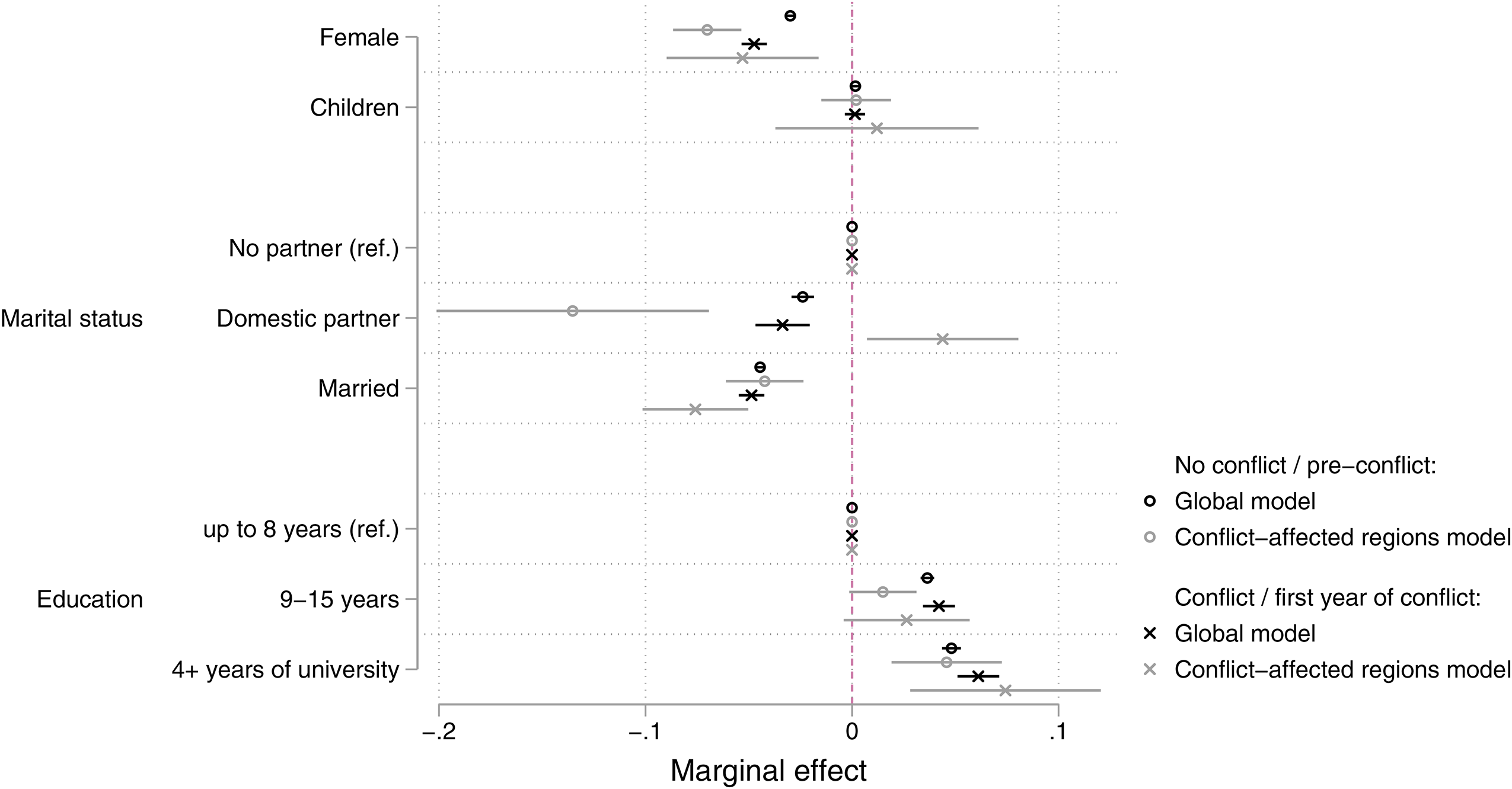
Effect of Demographic Variables on Aspirations to Migrate Abroad. Based on Model Estimates in Table 1. Bars Denote 95% Confidence Intervals.
On the other hand, married individuals or those living in a partnership are less inclined to leave, as expected (H5a). However, on a global level, neither of these associations differ substantively in conflict-affected contexts, contradicting H5b. While our global and regional analyses are very similar across variables, the domestic partner variable is an outlier. 12
The aspiration to emigrate permanently increases significantly with higher educational levels (H7a), but we cannot confirm that the effect decreases in conflict contexts (H7b). If anything, the education effect for the most educated individuals increases during conflict. Again, the results of the regional model are very similar, yet with much larger confidence intervals.
Our models also predict how the overall aspiration to emigrate permanently changes once conflict breaks out. We use the regional analysis for this calculation. Although our model is a repeated cross-section, comparing the same regions pre/post-outbreak lends itself to a cautious quasi-within-case comparison. Based on this comparison, our estimates suggest that, on average, the desire to emigrate increases by about five to seven percentage points after conflict breaks out.
Furthermore, we can compare the average migration aspiration for specific demographic groups. Figure 6 depicts the average predicted probability of two demographics with usually high and low permanent emigration aspirations: In the conflict-affected regions in our analysis, young, poor, unemployed, and single males have extremely high permanent emigration aspirations before the conflict. Remarkably, however, we find a comparable level among similar respondents after conflict begins. In stark contrast, migration aspirations are dramatically different in groups that usually do not desire to leave permanently, although they remain on a much lower level. For example, in the year that conflict breaks out, the average predicted probability of having migration aspirations is twice as high among married, wealthy women in their sixties, compared to similar respondents prior to conflict. Moreover, our results suggest that the overall increase in individuals who wish to leave permanently is due to the rise in demographic groups that have less aspiration to migrate in peaceful times and not because there is a general increase across all demographic groups.
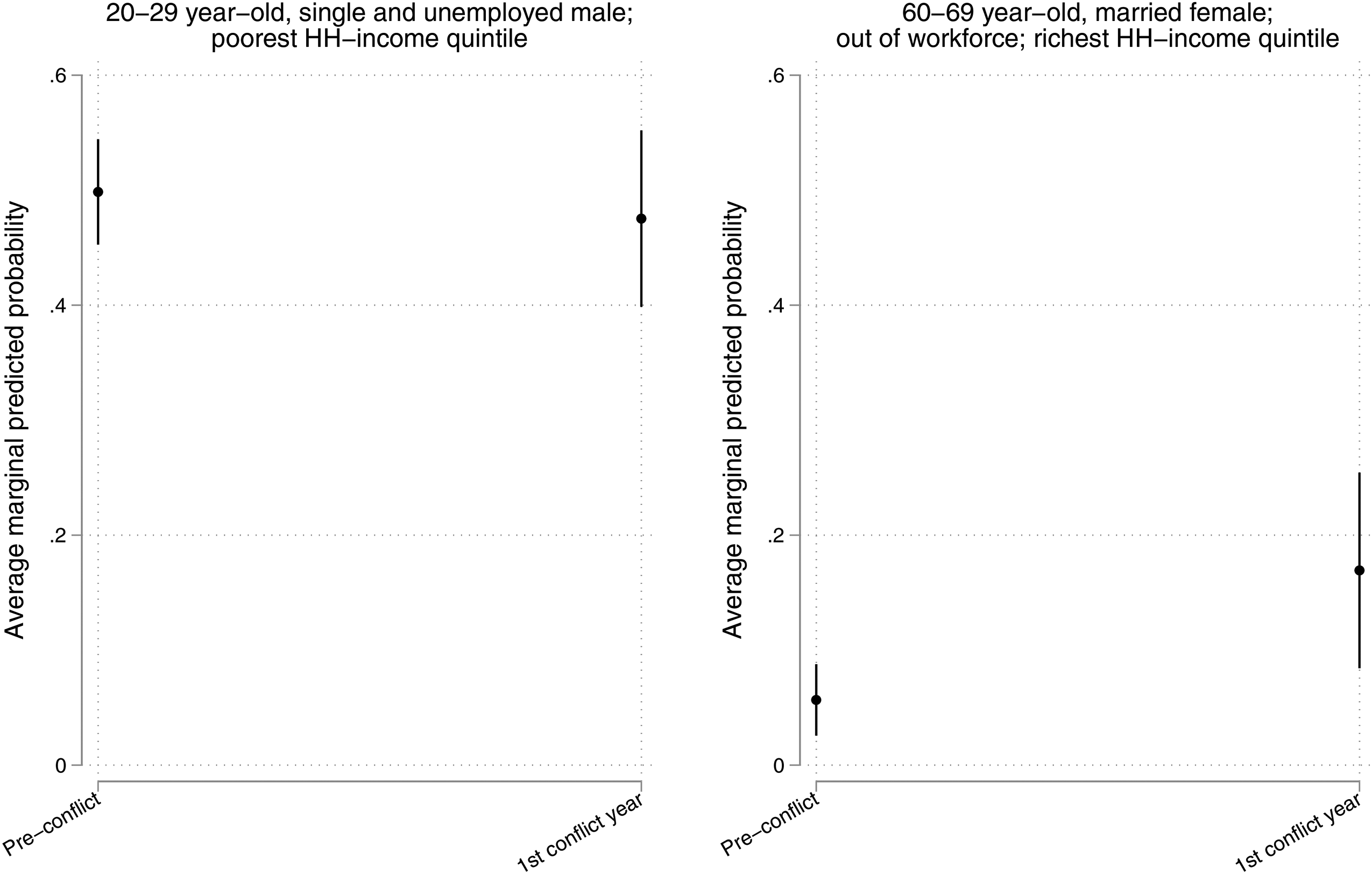
Average Predicted Probability of Aspirations to Migrate Abroad Pre-/Post-Conflict in High and Low Migration Aspiration Demographic Groups. Based on Regional Model Estimates in Table 1. Bars Denote 95% Confidence Intervals.
In the logic of Figure 1, our model and data imply that conflict increases overall aspirations to emigrate by weakening the negative effects of wealth and age in our model (as depicted in Figure 1B:
Discussion and Conclusions
This article takes a first cut at empirically connecting international migration aspirations in reaction to intrastate armed conflicts versus non-conflict situations. It explores differences across contexts using individual-level, repeated cross-section survey data with global coverage. By studying individual migration aspiration, we thus focus on what people ideally prefer to do, rather than what they (are forced to) do.
We demonstrate that individual characteristics play an important role in permanent international emigration aspirations, but that the effects of key variables differ significantly once a country experiences armed conflict. In contrast to peaceful contexts, where household income is a significant predictor of individual emigration aspiration, we find no systematic association between household income and an aspiration to emigrate in conflict-affected countries. Moreover, conflict drastically reduces the relevance of age as a predictor of emigration aspirations. In contrast to peaceful times, individuals across all age groups display a much more similar aspiration to emigrate during intrastate armed conflicts. This differential effect accounts for a general increase in emigration aspirations in conflict contexts.
Our findings are consistent with our theoretical argument that conflict is more than just an additional “push” factor. It attenuates the effect of variables related to economic motives of migration, typically described as causes of migration in non-conflict contexts. While our regional estimates indicate an increased emigration aspiration once conflict breaks out, our results indicate no direct effect of conflict on all demographic groups. Nevertheless, it is crucial to consider that we focus our analysis on permanent international migration aspirations and exclude internal (often more short-term) migratory behavior that most earlier research has studied. Hence, our study does not refute existing conflict and migration research findings. Instead, we highlight that the reason for aspiring to emigrate is a complex relationship between political, social, and economic factors — and their relative importance can change (cf. Crawley and Skleparis 2018). Moreover, our results stress the heterogeneity of the impact of conflict on migratory aspirations across different demographic groups.
As hypothesized, we see how core variables, at least partially, lose their explanatory power during conflict. Interestingly, these variables are usually associated with the long-term economic cost-benefit calculus in theories of migration decision-making, for instance, whether the income/wage gap between origin and destination is large enough and the remaining lifetime long enough to generate positive net returns from a “migration investment” (Engel and Ibáñez 2007). Therefore, the findings underscore our theoretical predictions derived from the expectation that individuals discount the future utility of wealth in the country of origin during uncertain, conflict-shaken times. The results also align with the idea that conflict puts the costs of staying at the center of the aspiration to emigrate and therefore mitigates other uncertainties and concerns.
Although the effects of economic predictors on permanent international migration aspirations differ significantly during armed conflict, our results also highlight similarities between conflict-affected and non-conflict contexts. Contrary to our theoretical expectations, we observe that the association of further socio-demographic predictors of migration differs very little or not at all across contexts. Moreover, with the notable exception of income, the coefficients of almost all variables point in the same direction in both contexts. This indicates that, at its core, the desire to relocate permanently to another country appears similar or even identical in many dimensions. Nevertheless, the very different effect of household income indicates that armed conflict can fundamentally alter the core economic drivers of international migration aspirations.
As with all empirical studies, our analysis is not without its limitations. Most importantly, we examine individuals’ migration aspirations, not actual migration behavior or concrete migratory plans. On the one hand, this protects our analysis from the selection effects channeled through the inability to migrate by parts of the population, which plague many investigations that only study realized migratory behavior (Carling and Schewel 2018). Furthermore, we are not constrained by the lack of data on less formalized types of migration (irregular migration flows), as the aspiration to emigrate include regular and irregular migration types (Van Dalen and Henkens 2008). On the other hand, future research should assess further how these aspirations translate into action. While these analyses are beyond the scope of this paper, there is increasing evidence that migratory aspirations predict migratory plans and actual behavior well in peaceful contexts (De Jong 2000; Van Dalen and Henkens 2008; Docquier, Peri and Ruyssen 2014). More recent research suggests that this might also be true in insecure settings (Ruhe 2022).
We consciously limited our analysis to preferences for permanent emigration to compare migration preferences that many individuals hold in both peaceful and conflict-affected contexts. However, this implies that we do not capture preferences for internal, temporary moves. Moreover, migration aspirations can be measured differently (Carling and Schewel 2018; Carling 2019). Arguably, internal and temporary migration aspirations differ from our permanent emigration aspirations and could be far more frequent in conflict settings. However, if such differences exist, our Chow test likely underestimates the difference in more broadly defined migration aspiration formation due to armed conflict. For example, suppose one expects the urgency to move is even stronger in security-driven, temporary migration. In that case, it is theoretically plausible that socio-demographic and economic factors become even less relevant. Nevertheless, this hypothesis would have to be tested empirically.
Lastly, while the GWP includes data on most insecure areas, a few locations are directly affected by severe conflict and could not be covered because of safety concerns (Gallup 2018). This lack of data on highly affected regions might affect our results. However, it is not apparent whether the experience of severe, immediate conflict affects international permanent migration aspirations in a way that would bias our conclusions.
This study highlights that long-term economic considerations appear to matter differently in conflict-affected environments compared to peaceful settings. Future research should investigate the role of income more intensively and examine whether these differences across conflict and peaceful locations persist in subsequent planning stages of migration decision-making. A second avenue for further research may disaggregate conflict further and explore how the duration or intensity of conflict alters these patterns. Conceivably, once a substantive number of individuals have left, in later stages of conflicts, the remaining population may consist of either less risk-averse, more resilient, or trapped populations, which might differ in their migration aspirations and their ability to act upon these intentions. Similarly, conflict may alter the destination individuals envision for themselves, which could depend on conflict-affected travel routes.
We firmly believe that global survey analyses comparing conflict and non-conflict contexts are more than an academic exercise. Our finding that income appears to be irrelevant for permanent emigration aspirations in conflict countries refute populist rhetoric that mischaracterizes increasing numbers of asylum seekers due to conflict as economic migrants motivated by the spoils of social welfare systems. Furthermore, our results stress the relevance of job opportunities and employment for international migration aspirations irrespective of conflict.
Investigating in more detail whether the heterogeneous effects of conflict on permanent migratory aspirations also manifest in long-lasting migratory movements would be an important avenue for future research. A further topic for future research may zoom in on how the effect of education changes, once conflict breaks out. Our unexpected finding that the most educated individuals are more likely to consider permanent emigration once conflict erupts highlights the potential risk of a “brain drain” from conflict-prone countries if migratory aspirations are realized.
These topics of further research notwithstanding, our analysis provides a first global analysis of differential permanent international emigration aspirations in conflict and non-conflict contexts. It indicates that the wish to emigrate permanently in conflict and non-conflict settings is related but not identical. Although many variables exert similar effects on individual migration aspirations across contexts, the insecurity generated by intrastate conflict appears to alter long-term economic cost-benefit calculus associated with emigration aspirations fundamentally.
Therefore, this study provides initial insights that mitigate some of the concerns summarized by FitzGerald and Arar (2018) that cross-national analyses of such differences between non-conflict and conflict-related migration draw tautological conclusions driven by selection on the dependent variable. On the contrary, it provides evidence for an ongoing discussion on a hierarchy of migration drivers indicating that the experience of conflict dominates economic motives even at the early stage of emigration aspirations (cf. Bohra-Mishra and Massey 2011; Kuhnt 2019). Moreover, the results suggest that international migration aspirations increase in conflicts due to an attenuated effect of income and age, that is, because individuals from demographic groups want to migrate permanently, who rarely have these aspirations in peaceful times.
Supplemental Material
sj-docx-1-mrx-10.1177_01979183231181576 - Supplemental material for Who Wants to Leave? Global Survey Evidence on How Individual Emigration Aspirations Differ Between Peaceful and Conflict-Affected Contexts
Supplemental material, sj-docx-1-mrx-10.1177_01979183231181576 for Who Wants to Leave? Global Survey Evidence on How Individual Emigration Aspirations Differ Between Peaceful and Conflict-Affected Contexts by Constantin Ruhe and Jana Kuhnt in International Migration Review
Footnotes
Acknowledgements
We gratefully acknowledge funding by the German Federal Ministry for Economic Cooperation and Development (BMZ) [9000702]. We wish to thank the editors, three anonymous reviewers, Heidrun Bohnet, Theresa Leimpek, Charles Martin-Shields, and Ramona Rischke for their valuable feedback on earlier drafts, and are thankful to the participants of the 3rd International Conference on Forced Displacement and Migration “Linking policies and people: New insights on migration and development” for their feedback as well as Alex Juan do Coutu, Katrin Klöble, Iris Volg, Maria Gerlspeck, and Andrei Botorog for the research assistance.
Declaration of Conflicting Interests
The author(s) declared no potential conflicts of interest with respect to the research, authorship, and/or publication of this article.
Funding
The author(s) disclosed receipt of the following financial support for the research, authorship, and/or publication of this article: This work was supported by the Bundesministerium für Wirtschaftliche Zusammenarbeit und Entwicklung, (grant number 9000702).

Notes
References
Supplementary Material
Please find the following supplemental material available below.
For Open Access articles published under a Creative Commons License, all supplemental material carries the same license as the article it is associated with.
For non-Open Access articles published, all supplemental material carries a non-exclusive license, and permission requests for re-use of supplemental material or any part of supplemental material shall be sent directly to the copyright owner as specified in the copyright notice associated with the article.
