




Abstract
Refugees who seek protection in neighboring countries (first safe countries of refuge) often have weak economic ties to their current place of residence. Refugees in these first safe countries also often have much to gain economically if they move on to Europe or other wealthier countries, as their refugee status opens doors that are closed to many other migrant groups. Still, far from all refugees in first safe countries aspire to move on to other locations. This article examines migration aspirations among Syrian refugees in Jordan and asks what characterizes refugees who aspire to move on to Europe. Building on theories of migration aspirations originally developed to study labor migration, it draws on a representative survey of 7,632 Syrian refugees in Jordan, conducted during the winter of 2017/2018. We show that religious and cultural preferences (preferences for living in a Muslim country and attitudes toward female labor market participation), as well as perceptions of when return to Syria will be possible, were more important in explaining variance in migration aspirations among Syrian refugees in Jordan than economic factors such as poverty or lack of jobs. These findings suggest that selection effects shape Syrian refugee migration to Europe and that refugees who go to Europe differ from those who remain in that they put less value on traditional gender roles and on living in Muslim societies. As such, the article contributes to the literature on how cultural ties and value preferences shape migration aspirations and influence the composition of migrant populations.
Introduction
An overwhelming majority of the world's refugees flee to countries neighboring the conflict zone and remain in these first safe countries 1 until return to their origin country is possible (Betts and Collier 2017; FitzGerald and Arar 2018). A minority move on to secondary locations, either shortly after arrival in first safe countries or after having lived in such locales for some time (Crawley and Skleparis 2018; Erdal and Oeppen 2018). Secondary movements in refugee populations have, until recently, received limited attention in migration studies (FitzGerald and Arar 2018), and refugee populations are rarely included in studies of migration drivers and migration aspirations. In refugee studies, on the other hand, refugees’ mobility is often conceptualized as forced, spontaneous, and unpredictable, and analyses tend to focus mainly on refugees’ limited opportunities for migration while their aspirations for migration are taken for granted (Chatty 2018). Consequently, although refugees comprise a significant share of migrants who enter Europe each year, 2 we still know little about what distinguishes refugees who remain in first safe countries from those who move on to Europe.
In more recent contributions to the study of migration aspirations, refugees’ migration decisions are increasingly discussed. These studies mainly explore variation in migration strategies among refugees who have already moved away from first safe areas, describing how refugees decide on what country to go to (e.g., Brekke and Aarset 2009; Brekke and Brochmann 2015; Havinga and Böcker 1999; Neumayer 2004), on return decisions (e.g., Carling and Pettersen 2014; De Haas and Fokkema 2011), or on remigration after return (e.g., Dustmann and Kirchkamp 2002; Kuschminder 2017). Only a few studies address refugees’ secondary migration aspirations from first safe countries—most of them drawing on qualitative data (Kvittingen et al. 2018b; Pascucci 2019; Rottmann and Kaya 2021; Tyldum 2021). To our knowledge, only one such study draws on survey data (Balcilar and Nugent 2019).
In this article, we analyze variation in migration aspirations among Syrian refugees in Jordan, using data from a representative survey of 7,632 Syrian refugees in Jordan conducted during the winter of 2017/2018. We ask what distinguishes refugees with aspirations for secondary migration from those without such aspirations, giving attention to both their reasons for wanting to remain and their reasons for wanting to move on. Specifically, we ask how the economic conditions in first safe countries, social relations at home and abroad, cultural and religious preferences, and perceptions of the availability of durable, long-term solutions 3 interact to shape these aspirations.
Our interest in migration aspirations among refugees stems from a conviction that refugee mobility constitutes a special case of migration that deserves analytical attention beyond the field of refugee studies. For refugees, economic incentives for migration are stronger overall, compared to other potential migrant groups, as refugee status opens doors that tend to be closed to other migrants (FitzGerald and Arar 2018). At the time of our study (2017–2018), Syrians who were able to reach Europe would likely have been given refugee status or subsidiary protection 4 in Europe, and with these permits, they would get access to labor markets, healthcare, and social support (Mouzourakis 2017). Like refugees everywhere, Syrians in Jordan brought few personal belongings with them, and their dwellings in Syria were often destroyed by war or taken over by others (Tiltnes, Zhang and Pedersen 2019). Few refugees have had the chance to acquire property after they arrived in Jordan, and if they have a job, it is rarely in their area of training or preference (Tiltnes, Zhang and Pedersen 2019). Consequently, Syrian refugees in Jordan have few economic ties to their current country of residence. This combination of weak economic ties to Jordan (and sometimes also to Syria after the war) and the opportunity to obtain refugee status and rights in Europe gives refugees much to gain, economically, from moving on.
However, Syrian refugees in Jordan speak the same language as their Jordanian hosts, usually adhere to the same religion, and share many culinary and cultural practices (Chatty 2018). Accordingly, Syrian refugees’ cultural ties to their host country are often stronger than their economic ties, and many Syrians feel they have more in common with their hosts in Jordan than they would if they moved to Europe (Tyldum 2021). In this article, we show that these cultural ties play an important role in shaping refugees’ migration aspirations and can constitute reasons to stay. These findings are of relevance not only for understanding secondary migration aspirations among refugees but also for understanding migration aspirations and decision-making in general.
To demonstrate how culture and economy shape Syrian refugees’ migration aspirations, the article proceeds as follows. In the first part, we describe the context in which these migration aspirations are shaped and the conditions of Syrian refugees in Jordan. In the second part, we review the literature on migration aspirations, both for migrants in general and for refugee populations specifically. In the third part, we describe our survey data and analyses. The fourth and final section presents our results, which reveal the important role of cultural ties in understanding variation in Syrian refugees’ migration aspirations. In concluding, we point to the implications of our findings for the wider study of refugee mobility and migration aspirations.
Syrian Refugees in Jordan
Following the outbreak of civil war in Syria in 2011, Syrian refugees started arriving in neighboring countries, such as Lebanon, Egypt, Turkey, Iraq, and Jordan (UNDP, ILO, & WFP 2017). The largest influx of refugees to Jordan occurred in 2012 and 2013 (Tiltnes, Zhang and Pedersen 2019), and Jordan currently hosts around 650,000 Syrian refugees, a figure that has been relatively stable since May 2017. 5 Refugees in Jordan are concentrated in the capital, Amman, and other urban areas (Tiltnes, Zhang and Pedersen 2019. Fewer than 20 percent of Syrians in Jordan live in camps (Tiltnes, Zhang and Pedersen 2019).
Syrian refugees in Jordan can register for resettlement through the UNHCR (United Nations High Commissioner for Refugees), and many do register, even though the chances of being offered resettlement are slim (UNHCR 2020). In 2018, a total of 5,005 Syrians were resettled to Europe or North America from Jordan, comprising less than 0.8 percent of the total Syrian refugee population in the country (UNHCR 2020). Beyond resettlement, there are few other opportunities for legal entry into Europe (UNHCR 2017). Some Syrian refugees apply for scholarships at international universities, or jobs available to migrants, and are able to enter Europe with work or student visas, but these opportunities are few and only available to a small minority (UNHCR 2017). As there are few alternative ways to enter Europe, Syrian refugees who are not prioritized for resettlement mainly have two options for international migration: family reunification (for those with close relatives abroad) or illegal entry. Once in Europe, Syrian refugees would, at the time when our survey was conducted (winter 2017/2018), normally be considered in need of protection and granted asylum or secondary protection (Mouzourakis 2017).
However, since the large influx of migrants in Europe in 2015, it has become more difficult and time consuming to obtain asylum in Europe (EMN 2018). Rights and benefits given to asylum-seekers have been reduced, and, in some countries, only temporary protection is granted (UNHCR 2017). Still, access to rights and benefits for those recognized as refugees is, overall, better in Europe than in Jordan, which has not yet ratified the UN Refugee Convention (Chatty 2018). 6 Although non-refoulement is guaranteed in the Jordanian constitution, refugee rights are limited, labor market access for Syrians without a work permit is largely restricted to a few economic sectors (mainly manual and unskilled work), and opportunities for post-secondary education are scarce (Small 2020).
In Jordan, UNHCR and numerous NGOs provide Syrian refugees access to basic services, including food coupons and healthcare (Kvittingen et al. 2018a; Lenner and Turner 2018). However, access to services covering basic needs such as housing, electricity, and food is generally better in refugee camps (Tiltnes, Zhang and Pedersen 2019). Camps provide assistance to avoid material poverty but offer few opportunities for employment, economic mobility, and independence (Tiltnes, Zhang and Pedersen 2019). The two largest refugee camps in Jordan are situated in desolate areas on desert terrain in northern Jordan, some 10 km (Zaatari camp) and 20 km (Azraq camp) from the nearest town (Tiltnes and Tyldum 2019).
Migration Aspirations and Secondary Migration in Refugee Populations
Until recently, refugees’ migration aspirations received scant attention in migration studies, and refugees studies and migration studies were treated as two distinct bodies of academic research (Chatty 2018). The limited attention to refugees’ migration aspirations in migration studies, we believe, can be attributed to the dominance of studies that describe migration flows from the perspective of destination countries (Schewel 2020). When migration aspirations are analyzed focusing only on those who have actually migrated, there is a risk of sampling on the dependent variable: migration appears inevitable because non-migrants and their reasons for staying and for wanting to stay are overlooked, producing what Schewel (2020) refers to as a mobility bias in migration research. This mobility bias is perhaps even stronger in refugee studies than in other areas of migration research, as the conceptualization of refugee mobility as forced leads to less interest in the aspirations and preferences of those left behind (FitzGerald and Arar 2018). Furthermore, there are strong incentives for refugees who have moved to secondary locations to frame their mobility as “having no other choice,” either due to assumptions about what kind of narratives are likely to be perceived as worthy of refugee status (Bjørkhaug 2017) or due to underlying moral evaluations condemning some motives for migration as immoral or selfish (Tyldum 2015). These factors contribute to the abovementioned understanding of refugee mobility as forced, spontaneous, and unpredictable.
We approach migration aspirations among Syrian refugees in Jordan, drawing on the aspiration-ability framework in migration studies (Carling and Schewel 2018). The aspiration-ability framework is commonly used to explain international labor migration; thus, some may find it controversial that we use this framework to analyze migration aspirations among refugees, as the notion that refugees and migrants are distinct has been strong in academic writing on migration for both historical and political reasons (FitzGerald and Arar 2018).
This article does not aim to contribute to discussions on the voluntary-forced dichotomy in migration studies around which a well-developed literature already exists (e.g., Crawley and Skleparis 2018; Erdal and Oeppen 2018). We do acknowledge that the alternatives to migration are often far from optimal in many refugee populations and that choosing migration can sometimes be choosing the lesser evil. But even people who live marginalized lives make choices. To properly understand the compositions and directions of current migration flows into Europe, we must also understand the decision-making and aspirations of more marginalized groups. Rather than assuming that the refugee status of our study population limits their choices, we make their refugee status our starting point. As we showed above, refugees often have few economic ties to their current place of residence, while, at the same time, they have more to gain from reaching weather countries that offer welfare rights and labor market access to those recognized as refugees. The ones who stay in neighboring first safe countries will often have stronger cultural ties to their current place of residence, making the study of migration aspirations among refugees a unique opportunity to investigate how cultural preferences shape migration aspirations.
As Carling and Schewel (2018) point out, the analytical distinction between desires and aspirations, on one hand, and opportunities, capabilities, or abilities, on the other, helps disentangle complex questions of why some people migrate and others do not. Migration studies have traditionally been concerned with successful migrants who have had both the opportunity and the aspiration to migrate, failing to recognize that there are people who have the opportunity to migrate but choose not to do so and, conversely, people who aspire to migrate but do not have the ability to do so (Carling 2002; Carling and Schewel 2018). Carling (2002) has been particularly concerned with the “involuntarily immobile”—persons who want to migrate but lack the ability to do so for economic, cultural, or familial reasons. As Schewel (2020) points out, however, migration studies also must better understand the choices made by the voluntarily immobile.
To better represent the perspectives of non-migrants who do not desire to migrate, Schewel (2020) makes a further distinction between those who have the ability to migrate but do not desire to do so (“voluntary immobility”) and the “acquiescent immobile” who have neither the ability to migrate nor a strong desire to do so. As Schewel (2020) underlines, to understand these groups’ migration aspirations, we cannot only look at the “push” and “pull” factors but must also include the elements that “retain” (reasons for wanting to remain) and “repel” (reasons for not wanting to migrate).
Aspirations for secondary migration are not necessarily fixed when refugees first leave their origin country. As such, secondary migration in refugee populations can be understood as a special case of stepwise migration (Schapendonk 2007). Several authors have shown how migration can take place in stages, as migrants sometimes spend months or even years before they reach their final destination (Collyer and De Haas 2012; Düvell 2012; Paul 2017; Schapendonk 2007). The stepwise nature of many migration flows is important also for an analysis of migration aspirations, as exposure to new cultural and political settings in temporary places of residence during the journey, as well as experiences of harassment, hardship, social inclusion, and success, change migrants’ preferences for return, onward mobility, and destinations (Collyer and De Haas 2012; Paul 2017; Wissink et al. 2013).
In this article, we investigate variation in aspirations for secondary migration among Syrian refugees in Jordan. The concept “secondary movements” is commonly used to refer to refugees who move within Europe or the United States, after having received protection there (e.g., Bloem and Loveridge 2017; Brekke and Brochmann 2015; Forbes 1985). Here, we use the concept of secondary migration in a similar vein to denote refugee movements that come after an initial move out of a conflict zone. For refugee mobility, we normally must apply different sets of explanations to explain first and secondary moves (FitzGerald and Arar 2018). Refugees’ first moves are made to get out of conflict zones and reach a safe first place of refuge. Some refugees literally run for their lives to escape shelling and bombs, while others experience a more gradual process through which they come to realize the need to move to another location due, for instance, to harassment, political insecurity, or material shortages that make staying increasingly difficult (Akesson and Coupland 2018). Such first movements can be within the same country or involve crossing borders into neighboring countries. Existing research on these first moves points to violence, economic hardship, and persecution as driving forces for this mobility (Adhikari 2012; Moore and Shellman 2006; Schmeidl 1997).
FitzGerald and Arar (2018) treat the first internal movement away from the conflict zone and the subsequent mobility to neighboring countries as two separate phases of refugee mobility. Thus, they refer to the next move either within or away from neighboring countries as a tertiary move. Most Syrians in Jordan come from the neighboring Dara’a province and went directly to Jordan after leaving their homes (Tiltnes, Zhang and Pedersen 2019). As such, their first movement was to a neighboring country. We, therefore, find an analytical division into two movements more helpful for our study population. In a study of migration aspirations and migration drivers among refugees, we see the main distinction as being between the movements that take place in an acute phase of a conflict and which are more spontaneous and “forced,” for instance, because of the threat of danger faced if staying (first moves), and subsequent (and later) movements where there is often less haste and where there can be more room for choice (secondary moves).
We acknowledge that distinguishing between first and secondary movements is a simplification of the processes that actually take place. The first movements out of the conflict zone can consist of several moves, as a conflict's front lines gradually make “safe areas” no longer safe (FitzGerald and Arar 2018). Secondary movements can take a variety of forms; some stay in first safe countries for years or even decades before they move on, while others move on more or less immediately (Crawley and Skleparis 2018; Erdal and Oeppen 2018). While some refugees will, from the start, have an intention to move on as soon as they have the resources to do so, others develop aspirations for secondary movements only after encountering financial difficulties or legal barriers in first safe countries (Crawley and Skleparis 2018; Düvell 2012; Wissink et al. 2013). Still, the literature on refugee mobility suggests that different mechanisms shape refugees’ motives for these first and secondary moves. While first moves can often be explained as a direct consequence of violence or fear of persecution (Adhikari 2012; Bohra-Mishra and Massey 2011), the few existing studies on secondary migration more often explain the moves with reference to an absence of long-term solutions, discrimination, or lack of opportunities (Kvittingen et al. 2018a; Rottmann and Kaya 2021; Tyldum 2021).
Below, we summarize some of the most relevant explanations offered in existing studies on aspirations for secondary migration, organized into three main categories: explanations linked to 1) Economic and human resources, 2) Networks and social relationships, and 3) Cultural preferences and protracted refugee situations.
Economic and Human Resources
Although economic theories have often had limited ability to explain real world patterns and processes of migration (De Haas 2021) it is still true that most migration flows go from poorer to wealthier countries (Massey et al. 2008), indicating that economic factors somehow shape migration aspirations and flows. In this section, we look at how access to resources has been argued to shape migration aspirations in migration studies. Here, we consider resources in a wider sense than only economic resources, addressing, on the one hand, economic resources tied to employment, poverty and wealth and, on the other, human resources associated with education and age (Bourdieu 1977).
Poverty has been argued to increase migration aspirations in refugee populations (Schmeidl 1997), as well as in other migration flows (Massey et al. 2008). The economic situation's role in shaping migration aspirations is, however, complex. As Kvittingen and colleagues (Kvittingen et al. 2018a, 2018b) demonstrate in their qualitative study among Syrians in Jordan, refugees often refer to their economic difficulties and lack of jobs when they explain why they want to move on. In their study of Syrians in Turkey, Balcilar and Nugent (2019) also find that refugees who were satisfied with access to services in Turkey were less likely to want to move on to Europe or return to Syria. These studies suggest that if basic needs are met in first safe countries, the increased economic security can reduce refugees’ aspirations to move on. However, it can also be hypothesized that access to economic resources increases aspirations, on the basis that better and, thus, more desirable migration opportunities are available to those with economic resources. People generally do not aspire to do things they believe to be impossible (Bourdieu 1977). People who have both the resources to migrate and opportunities to succeed in new destinations—for instance, because they speak a foreign language or have relevant education or networks—can be expected to have stronger aspirations to migrate, if other factors are equal.
In societies with traditional gender roles, men and women often face different expectations, and consequently poverty and economic opportunity may differently impact men's and women's migration aspirations (DeVault 1991; Zlotnik 1995). Based on a qualitative study of Syrians in Jordan and Lebanon, Tyldum (2021) show that some male refugees expressed reluctance to go to Europe out of fear of becoming aid dependent. The refugees knew that friends and relatives who had reached Europe tended to be materially better off than they were, but they also knew that many Syrian refugees in Europe struggled to enter the labor market and had to depend on aid to provide for their families. Thus, for male refugees who saw their role as provider as key to their identity, fear of difficulties entering labor markets in Europe repelled them from moving on (Tyldum 2021).
As Syrian refugees in Jordan are only allowed to work in a few economic sectors, mainly in manual and unskilled work (Tiltnes, Zhang and Pedersen 2019), refugees with higher education may have greater incentives for moving on, compared with those who seek employment in unskilled economic sectors (UNDP et al. 2017). Pascucci (2019) describes how young middle-class Syrians are conscious that opportunities for “decent” work in Jordan are scarce and how those educated in information technology see migration to Europe as their main opportunity to find relevant employment. This effect of higher education can be expected to be particularly strong for male respondents, whose opportunities to provide for their families abroad will be linked to the kind of education they have: these men may be reluctant to move on if they think moving will jeopardize their status as provider in their family.
We also expect young age to correlate positively with migration aspirations in our analysis. There are numerous reasons why those under 30 are often more mobile than other groups, including the lack of dependents and responsibilities (Crivello 2011; Gabriel 2006; Monsutti 2007). Migrants who contemplate irregular migration also point to the relevance of having young bodies and minds that are able to handle the hardships associated with illegal migration and starting a new life abroad (Pascucci 2019).
In summary, the literature on migration drivers and migration aspirations suggests that higher migration aspirations are associated with mechanisms tied to both having access to economic resources and not having access to economic resources. For male respondents, we expect access to work to have a stronger impact on migration aspirations than for females—Syrian women who do not see themselves as providers and who put less emphasis on having access to jobs will be less likely to be repelled by the difficulties of accessing jobs in Jordan and, thus, may be more likely to aspire to migrate as a consequence of poverty. The refugee population in camps often have limited access to jobs and are aid dependent in Jordan. We, thus, expect poverty to have a stronger impact on migration aspirations for the camp populations.
Networks and Social Relationships
Having social relationships with people in destination countries (access to networks) is the factor most consistently identified by migration scholars to explain mobility across populations and geographical areas (Castles 2010; De Haas 2010; Massey et al. 2008). Networks abroad can provide opportunities for migration through family reunification or through remittances sent to finance travel (Castles and Miller 2009). Networks can also increase migration aspirations by spreading ideas and creating a culture of migration (Ali 2007; Fussell and Massey 2004).
Networks at the current place of residence can also reduce migration aspirations by making people want to remain (Schewel 2020). Pascucci (2019) describes how the migration aspirations of young, educated Syrians in Jordan are embedded in familial relations of care, reciprocity, and responsibility that tend to be highly gendered. While young men can be expected by people in their community to travel to provide for their families, young women can feel obliged to remain with their family in the current place of residence to provide emotional and practical support and care. However, as Achilli (2016) points out, leaving is never easy, and for both men and women, leaving for Europe is a difficult decision. Migration often entails leaving behind family members, who may not want to migrate or who are not able to migrate for economic or practical reasons. Having many children or elderly or disabled family members can make some families more reluctant to set out on a long and hazardous journey; therefore, having dependents who need economic and practical support can reduce migration aspirations for some (Schewel 2020). For others, having children will be a reason to migrate, as refugees may aspire to move to Europe to secure their children's access to education and future employment (Tyldum 2021).
In summary, the literature review presented here suggests that having networks abroad can increase migration aspirations, while having household dependents who cannot travel, particularly elderly household members, can reduce migration aspirations. We expect the ways in which social relationships shape migration aspirations to be highly gendered, with the effect of having dependents most significant in reducing women's migration aspirations.
Cultural Preferences and Protracted Refugee Situations
Recently, several authors have asked if migrants and refugees who come to Europe self-select along cultural dimensions. A study by Docquier, Tansel and Turati (2017), for example, shows that people in Middle East and North African countries aspiring to settle in an Organization for Economic Co-operation and Development (OECD) country are less religious and, for younger age groups, express more liberal values regarding gender equality and women's rights. Similarly, Williams, Thornton and Young-DeMarco (2014) find that migrants in Nepal tend to ascribe more importance to material goods and are less committed to religion and religious values than non-migrants. Polavieja, Fernández-Reino and Ramos (2018) find that recently arrived migrants in Europe are not different from their compatriots at home when it comes to risk taking and motivation for success. However, they do find that women who have migrated to Europe tend to adhere to less traditional gender roles. Pascucci (2019) shows that many educated Syrian refugees who dream of a career in Europe, particularly young women, choose to remain in Jordan due to family responsibility and that those who adhere to traditional understandings of gender also often regard unmarried women migrating on their own as unacceptable. These studies all point to a tendency for migrants to differ from non-migrants in their value orientation and for people, particularly women, who adhere to more traditional values to be less likely to migrate.
Qualitative studies by Rottmann and Kaya (2021) in Turkey and Tyldum (2021) in Jordan and Lebanon also show that Syrian refugees often emphasize their preferences for living in a Muslim country when they talk of reasons for not going to Europe. Some talk of this preference for living in a Muslim country as a cultural preference (feeling at home in the Middle East due to familiar food and music and hearing calls to prayers from the minarets) (Rottmann and Kaya 2021); others emphasize adherence to traditional family values (fear of divorce or problems raising girls if they move to Europe) as factors making migration to Europe less tempting (Tyldum 2021). Some refugees point to limitations on women's opportunities to dress the way they want in public in some European countries (restrictions on wearing hijab or niqab) or refer to claims that Muslims are looked down upon and discriminated in Europe (Tyldum 2021). In Achilli's (2016) study of migration aspirations among Syrians in Jordan, the majority of Syrians surveyed feared cultural estrangement if they moved to Europe.
For many refugees, a major reason for wanting to remain in first safe countries is that they hope to soon return to their origin country (Stefansson 2004). Others want to remain because by remaining in the Middle East, they find it easier to stay in touch with family and friends who are still in Syria (Tyldum 2021). Syrians in Jordan often originate from border regions in Syria and engage in transnational practices where they stay in touch with family at home or check on property and land, even if they do not feel that return is yet possible (Tyldum and Durai, forthcoming). So long as return is perceived as possible in a not-too-distant future and so long as return is preferred over going to Europe, the perceived likelihood of return can be assumed to reduce migration aspirations among refugees. However, Syrian refugees in Jordan often point to the limited likelihood of getting the legal documents required to stay and work legally in Jordan as a major motive for wanting to move on (Tyldum 2021).
The literature presented in this section suggests that adhering to traditional gender roles and having preferences for living in a Muslim country will reduce refugees’ aspirations for secondary migration to Europe or other more secular or non-Muslim countries. We also expect that the perceived likelihood of return shapes refugees’ migration aspirations.
Data and Methodology
Survey and Sampling Strategy
Our analysis draws on survey data from a nationwide, representative sample of 7,632 Syrian households in Jordan and their members. Data were collected by Jordan's Department of Statistics (DoS) in collaboration with Fafo Research Foundation between November 2017 and January 2018. Households were selected though a two-stage cluster sample: 1,121 clusters were drawn in and outside camps, with probability proportional to the size of the Syrian population in the 2015 population census (plus 100 clusters where no Syrians were registered in 2015). In the selected clusters, preparatory fieldwork was completed to list all households with at least one Syrian member. In camp clusters, a random sample of 15 households was selected, while up to 18 households were interviewed in each non-camp cluster (86 percent of clusters had 18 or less households with a Syrian member). Of the sampled households, 93.4 percent were interviewed.
Choice of Respondents in Households
In each household, interviews were conducted with both the household head (or another knowledgeable adult) and with one randomly selected household member aged 15 or above. The latter was asked about subjective experiences, values, and preferences, including questions on migration aspirations. 7 In the analysis presented in this article, survey responses of both the randomly selected individual and the household head are used.
The household head answered questions on the household economy and household members’ employment. Using information provided by the household head about other household members is common practice in surveys of living standards and living conditions, such as the World Bank Living Standards Measurement Study (Grosh and Glewwe 1995) and the Scandinavian living condition surveys (Erikson and Uusitalo 1986). This use of proxy respondents is driven by a need to include all household members’ economic activities to properly assess a household's economic strategies or challenges. The effect of proxy interviewing (asking one household member about other household members labor market status or education) varies with the type of questions, but generally, questions mapping economic activity status (employment) are shown to have relatively high quality in terms of consistency between proxy responses and self-reported responses (Thomsen and Villund 2011). There is, however, a tendency for female labor market participation to be somewhat underreported when measured through proxy respondents in some parts of the world (Anker and Anker 1989).
Method and Analysis
In this article, we use a Linear Probability Model (OLS regression with binary dependent variable), which allows us to compare coefficients across models and for different populations (Mood 2010). To control for potential consequences of using a linear design, all models were analyzed with logistic regressions as well (not shown). In the logistic regression model, the same variables were significant on more or less the same levels, and the internal strength relationships between variables were consistent.
The sample of clusters was drawn with probability equal to size in census, producing a sample that is close to self-weighting (i.e., a sample where no post-stratification weights were needed). Still, weights were computed (based on the relisting of sampled clusters in the preparatory fieldwork) to adjust for non-response and changes in population size in selected clusters after the 2015 census. The frequency distributions presented here show weighted results. The regressions analysis is, however, conducted on unweighted data to avoid the added variance contributed by the weights. Cases that had missing values on one variable were excluded from the analysis, but “do not know” on attitudinal variables were not set to missing. Most variables had between 0 and 20 cases with missing data; however, the network variable, which is constructed from a battery of questions on relatives abroad, had 850 cases with missing data, bringing the total number of cases excluded in the analysis to 15% of the sample (1,155 of the 7,632 respondents). To avoid multicollinearity, we avoided inclusion of any independent variables that correlate with other independent variables above .60.
Limitations
This article addresses migration aspirations among Syrian refugees residing in Jordan in 2017/18. This population should not be understood as representative of Syrian refugees at large, as former waves of migration produced at least two selection processes, giving the Syrian population in Jordan particular characteristics that may be different from Syrian refugees elsewhere. First, a large part of the Syrian refugee population in Jordan originates from the nearby Dara’a province (Tiltnes, Zhang and Pedersen 2019). Although Dara’a's population only comprised 5 percent of the pre-war population in Syria, 48 percent of refugees in Jordan originate from this province (ibid.). Dara’a is a mainly rural region of Syria, and its population tends to adhere to a more traditional way of life, compared with Syrians more generally (Pedersen 2019).
Second, we assume that quite a few Syrians who initially came to Jordan later left and moved on to Turkey, Europe, or other destinations. We know that secondary migration among Syrian refugees in Turkey and Russia was strong in 2014 and 2015 (Parkes 2015), but there is only anecdotal evidence that widespread secondary migration also took place from Jordan. We do not know if those who left then were systematically different from those who remained.
Variables in the Analysis
To operationalize migration aspirations, we use the following survey question: “Are you – alone or with friends or family – seriously considering migrating to Europe or another country now?,” with the option of answering “Yes, to Europe,” “Yes, elsewhere,” or “No.” We estimate, based on our survey data, that 30 percent of Syrians in Jordan were considering migrating to Europe and that another 3 percent were considering moving elsewhere. The question was preceded by one asking whether the respondent had previously considered moving to Europe. Only 1.5 percent answered that they had previously considered going but had no current plans to do so.
Asking if refugees were seriously considering going to Europe gave a strict operationalization of migration aspirations and could perhaps more accurately be referred to as capturing migration intentions. However, migration intentions is a concept that is often (but not exclusively) used to explain migration in the context of European, North American, or other population groups with few constraints on their mobility (e.g., Van Dalen and Henkens 2008; Williams et al. 2018) or return migration from these countries (e.g., Carling and Pettersen 2014; De Haas and Fokkema 2011). Migration aspirations are, by contrast, more commonly used to denote migration plans in contexts where opportunities for migration are limited and where desires and hopes for migration may not result in actual migration (e.g., Alpes 2014; Carling and Åkesson 2009; Jónsson 2008). Due to Syrian refugees’ limited legal opportunities for migration and the measures taken to restrict irregular entry into Europe, we believe that only a minority of Syrians who said they were considering moving on to Europe would actually succeed in doing so and, thus, choose to refer to their plans for migration, first and foremost, as an expression of “migration aspirations.”
To explain variation in migration aspirations, we rely on 19 indicators that, in different ways, operationalize refugees’ access to resources, social relationships, cultural preferences, and the perceived protractedness of their exile. Table 1 gives an overview of these indicators, their distribution in the study population, the share of respondents with this property that expressed migration aspirations, and which respondent in the household answered the survey question.
Overview of Independent Variables in the Analysis.
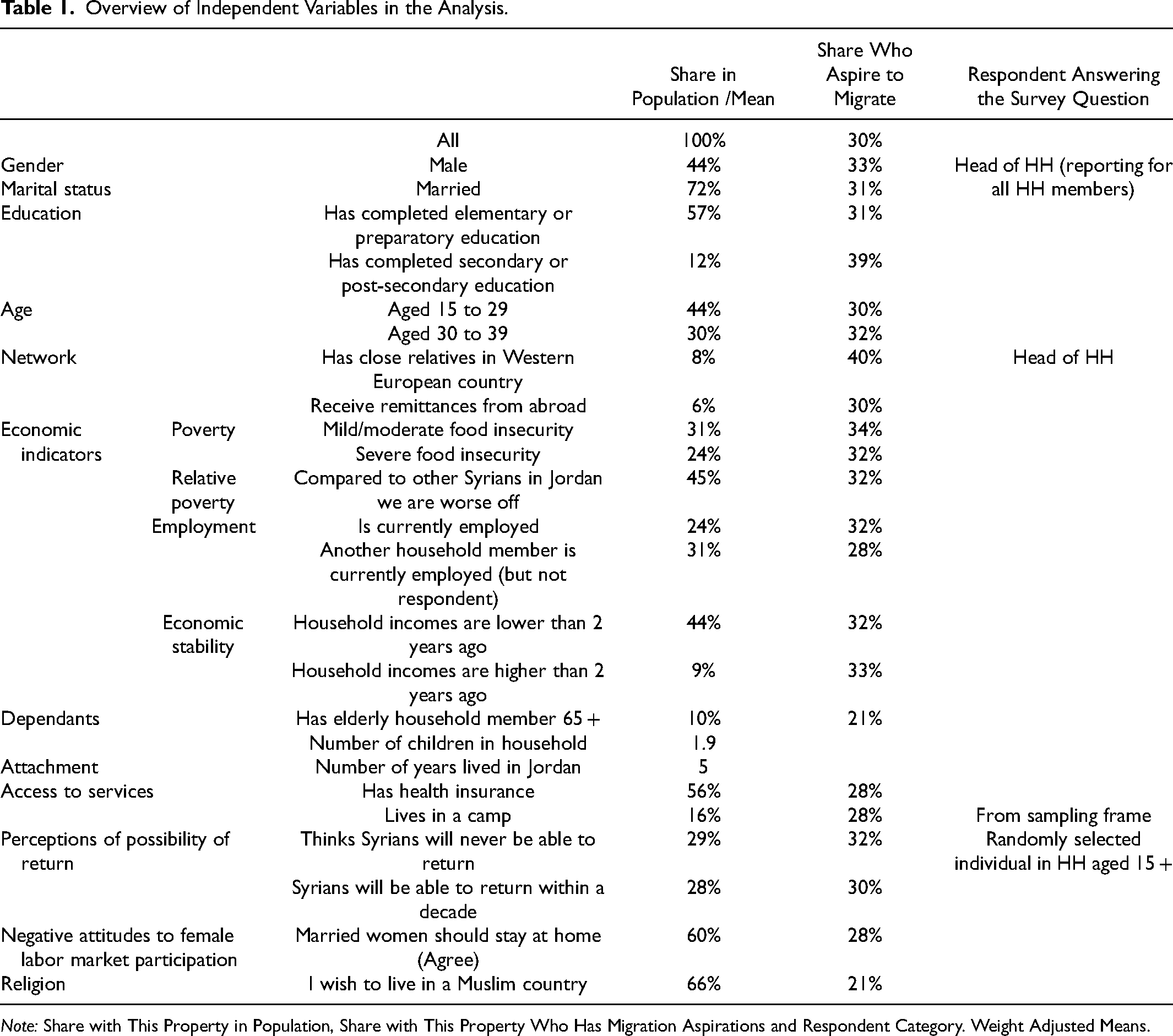
Note: Share with This Property in Population, Share with This Property Who Has Migration Aspirations and Respondent Category. Weight Adjusted Means.
Some dependent variables need a bit more detailed information. As a measure of poverty, we rely on a food security index, developed by the Food and Agriculture Organization of the United Nations (Cafiero, Viviani and Nord 2018; Tiltnes, Zhang and Pedersen 2019), which draws on a list of eight questions about food variety. Respondents with a zero score on the index were categorized as not suffering from food insecurity, those scoring between one and six had a mild or moderate level of food insecurity, and those scoring seven or eight suffered from severe food insecurity. To measure unemployment, we draw on International Labour Organization standard labor market definitions and distinguish among respondents who were employed, those who were not working but lived in households where other members were employed, and those who did not work and lived in households where nobody else was employed.
Analysis
The results of our regression analyses are presented in Table 2. Building on the above literature review, we explore four sets of variables that we hypothesize shape refugee populations’ migration aspirations: (1) access to resources; (2) social relationships; (3) cultural preferences; and (4) perceptions of long-term solutions. The analysis is run separately for camp and non-camp populations and for male and female respondents. By distinguishing between camp and non-camp populations, we aim to grasp differences in livelihood strategies, as the camp population will be more aid dependent and have fewer opportunities to find employment (Tiltnes and Tyldum 2019). By distinguishing between male and female respondents, we aim to grasp gendered differences in both livelihood strategies (the importance of being able to be a breadwinner in the family) and cultural preferences, as previous research has shown that traditional gender values can impact migration aspirations for women, but not necessarily for men (Pascucci 2019; Polavieja, Fernández-Reino and Ramos 2018).
Linear Probability Model (OLS).
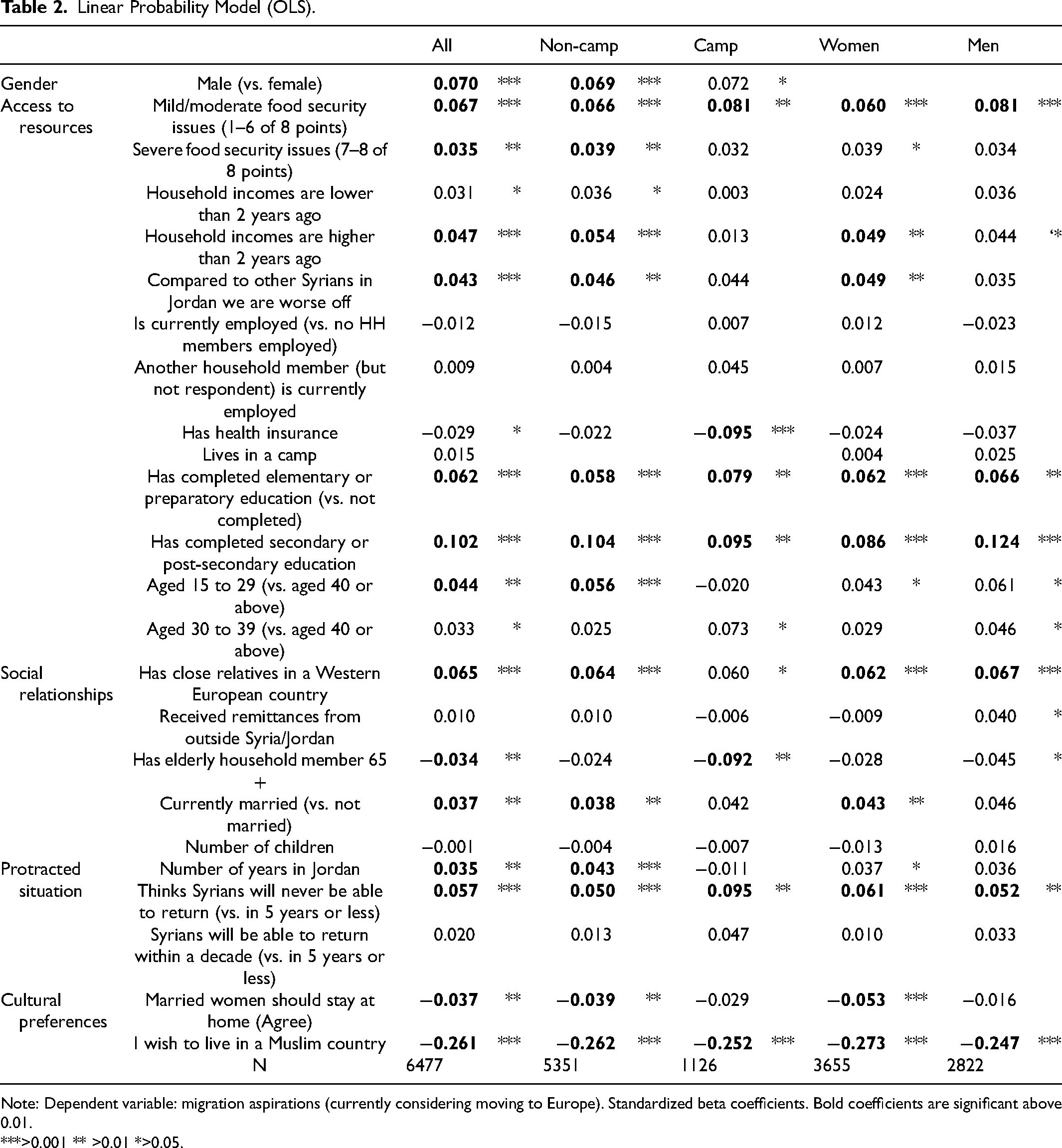
Note: Dependent variable: migration aspirations (currently considering moving to Europe). Standardized beta coefficients. Bold coefficients are significant above 0.01.
***>0.001 ** >0.01 *>0.05.
Access to Resources and Migration Aspirations
The literature review suggested a complex relationship between migration aspirations and access to economic, human, and social resources, where those with access to money, education, and networks are assumed to have better opportunities to migrate and more opportunities for success if they go abroad. As individuals with access to resources are more likely to succeed if they go abroad, the most resourceful can also be assumed to have stronger aspirations to migrate. Simultaneously, those with few resources will have less holding them back but also more to gain from migrating. From this perspective, people without jobs and without access to healthcare or welfare services can be assumed to have stronger aspirations for moving on. However, as some men are reluctant to relinquish their role as provider in the family and may fear becoming dependent on welfare if they go to Europe, we expect poverty's effect on migration aspirations to be stronger for women than for men. As the camp population is often more dependent on aid, as access to jobs is limited, we expect poverty's effect on migration to be stronger for the camp population.
The complexity of the relationship between economic conditions and migration aspirations is confirmed when we look at the regression results. First, we find no significant effect of having a job on migration aspirations when the households’ economic conditions are controlled for. This lack of correlation may be explained with reference to the lack of predictability in employment and the low quality of jobs that many Syrians end up taking in Jordan. Although unemployment among male Syrians at the time of our survey was almost at the same level as for Jordanian men (Tiltnes, Zhang and Pedersen 2019), job insecurity for refugees was much higher, work was often temporary, and pay was significantly lower than for Jordanian workers. Refugees could also mainly work in unskilled sectors (Tiltnes, Zhang and Pedersen 2019).
Persons in households with some food security problems had stronger migration aspirations than both those in households with severe food security problems and those in households without any food security problems, countering our expectation of finding the strongest migration aspirations in low- and high-income households. However, as expected, we found that for female respondents, severe food security problems were associated with higher migration aspirations, but not for men. Among female respondents, we also found that relative subjective poverty (thinking they were worse off than other Syrian households in Jordan) was associated with higher migration aspirations. We take the lack of significant coefficients for these variables for male respondents to support our expectation that worry about aid dependence in Europe reduced migration aspirations among some male respondents.
Having secondary education gave some of the strongest effects in the analysis, particularly for male respondents, consistent with our expectation that refugees with secondary education have more to gain from migration and that men's migration aspirations are more likely to be contingent on their expectations of finding ways to support their family if they move. We found age to have a surprisingly weak effect on migration aspiration, although refugees under the age of 30 were somewhat more likely to express migration aspirations.
We did not find the expected effect of severe food security problems on migration aspirations for the camp population. However, several other economic variables had different effects for the camp and non-camp populations. The only economic variable to have a significant effect on migration aspiration for the camp population (beyond moderate food security problems) was access to services, measured as having health insurance. Refugees with access to health insurance were less likely to aspire to migrate than those without. However, overall, refugees living in camps, where access to services was better, were not less likely to express migration aspirations. For the non-camp population, economic stability was associated with lower migration aspirations, while those whose incomes had increased or (to a lesser extent) decreased, compared to two years ago, were more likely to have migration aspirations. In the non-camp population, relative subjective poverty correlated significantly with migration aspirations.
In summary, we find that having higher education was associated with higher migration aspirations, that economic stability was associated with lower migration aspirations, and that unemployment did not have an effect on migration aspirations at all. For women, we find that poverty increased aspirations for secondary migration. Access to services such as health insurance seemed to counter this effect, at least for the camp population. The overall effect of economic variables was, however, limited. If we run the regression model with only those variables operationalizing economic and educational resources and age, the model's predictive ability is quite limited; these variables give an R square of only 0.034, compared with 0.112 when all variables in this analysis are included.
Social Relationships and Migration Aspirations
Numerous authors have pointed out how networks abroad can increase the likelihood of both having migration aspirations and actually migrating (Castles and Miller 2009; Cohen and Sirkeci 2011; Massey et al. 2008). Some argue that networks shape migration aspirations through the economic benefits that come from having relatives abroad who can finance travel and make migration possible (León-Ledesma and Piracha 2004; Van Dalen, Groenewold and Fokkema 2005), while others emphasize networks’ effects on aspirations through the establishment of a “culture of migration,” as reports from acquaintances abroad teach non-migrants not only how to migrate but also to desire to migrate (Ali 2007). Having close friends and family abroad can also shape migration aspirations simply through the desire to be reunited with them. In our analysis, we include both whether refugees had close networks in Europe and whether they had received remittances from abroad (from any country other than Jordan or Syria). We can, thus, isolate the economic effects of having networks abroad from other ways friends or relatives abroad can shape migration aspirations.
Those who received remittances from abroad were more likely to stay outside camps than those who did not get remittances 8 but were not more likely to have migration aspirations. In our regression model, we get only weak or non-significant effects for remittances (weak and slightly significant effects for male respondents). 9 On the other hand, having networks abroad increased migration aspirations for both men and women, but only in the non-camp population. These patterns of correlation indicate that the economic side of having networks (i.e., remittances) did not drive the network effect on migration aspirations for this population. Rather, the main mechanisms through which networks shape aspirations in this population seem to be refugees wanting to be reunited with family who had already left or relatives abroad providing information and practical assistance that drive migration aspirations. Networks, thus, seem to shape migration aspirations not mainly by making migration economically available but through the cultural mechanisms associated with “cultures of migration” (Ali 2007; Cohen 2004; Kandel and Massey 2002) and through social relations for those who wish to be reunited with family abroad.
We also expected that having dependents in Jordan would reduce migration aspirations. We find no such effect of having children but did find that having elderly household members reduced migration aspirations for the camp population. In line with expectations, we also find that unmarried women were less likely to aspire to migrate than married women.
Cultural Preferences, Absence of Long-Term Solutions, and Migration Aspirations
Although we find significant correlations for several variables operationalizing access to resources and social relationships, these relationships were not very strong. As the sample size is large, even weak correlations will give significant effects. Thus, we also must keep an eye on these variables’ explanatory power, and the variables we have discussed thus far do not explain much of the variance but give an R2 of only 0.041 combined. When we add the last four variables—length of stay in Jordan, perceptions of likelihood of return, preferences for living in a Muslim country, and views on female labor market participation, R2 increases to 0.112, indicating that these last four variables had more explanatory power in this analysis than economic resources, age, education, networks, and dependents combined.
The strongest coefficient in our analysis, by far, was having a preference for living in a Muslim country. Refugees who said they preferred to live in a Muslim country were far less likely to aspire to migrate than others. In line with expectations and previous research (e.g., Pascucci 2019; Polavieja, Fernández-Reino and Ramos 2018), we also find that women who adhered to traditional gender roles were less likely to aspire to migrate.
The UNHCR distinguishes among three types of long-term durable solutions in an area with significant refugee inflow (UNHCR 2007). The preferred solution is voluntary repatriation and return to the origin country. When return is not possible, local integration in the host country is an option; however, if refugee numbers are high, integration in host societies may not always be possible. In the UNHCR framework, secondary migration, through resettlement to third countries, is the last option, used only when return and local integration are not possible (UNHCR 2007).
Our survey responses indicate that Syrian refugees also often preferred repatriation over secondary migration. Those who believed return to Syria would one day be possible were much less likely to aspire to migrate than those who had given up on this idea. Our analysis shows that the longer refugees stayed in Jordan, the more likely they were to aspire to move on, suggesting that integration processes in Jordan were rare and/or unsuccessful. The finding that length of stay in Jordan did not reduce incentives to move on can be taken to indicate that for many, staying in Jordan without formal rights and proper access to the labor market was not perceived as a viable long-term solution.
Conclusion
This article has shown how Syrian refugees in Jordan who aspired to move on to Europe differed from those who did not. We find that variation in aspirations for secondary migration is best explained by looking at refugees’ cultural ties. Economic conditions and social networks also shaped refugees’ migration aspirations, but adherence to traditional values, religion, and opportunities for integration in the local economy seemed to be more important when refugees decided where to settle and build their lives. The most important factor, by far, in explaining variation in migration aspirations among Syrian refugees in Jordan was their preferences for living in a Muslim country. As Schewel (2020) has pointed out, to understand migration aspirations, we cannot only look at the factors that “push” or “pull” but also must take into account what potential migrants see as positive in their current country of residence (the factors that retain) and what they dislike in potential destination countries (the factors that repel). The preference for living in a Muslim country that so many Syrians in Jordan expressed can be understood as an element that retains for those who feared that migration would make them miss the sound of the minarets, food, traditions, and holidays (Rottmann and Kaya 2021). But this preference for living in a Muslim country can also contribute to refugees being repelled by the idea of moving on to Europe, as many refugees expressed skepticism toward cultural practices in Europe, fear of family dissolution and of children adapting to cultural practices they perceive as immoral, or concerns about not being able to dress according to tradition or religious practice (Tyldum 2021). Additionally, perceived absence of long-term solutions to life as a refugee seemed to be an important driver for migration aspirations; the less likely refugees thought their return to Syria and the longer they had lived in Jordan without getting formal rights, the more likely they were to aspire to move on to Europe.
Although several studies have previously shown that not all refugees in first safe countries aspire to move on to Europe (Kvittingen et al. 2018b; Pascucci 2019; Rottmann and Kaya 2021), ours is the first survey-based study to show that refugees can have a preference for remaining in countries to which they have cultural proximity. When we point out that some refugees may prefer to stay in first safe countries, rather than moving on to Europe, we recognize the ethical challenges and potential for misuse of our research. Such a finding can add fuel to the fire in migration debates where refugees who do not behave as passive victims, but demonstrate agency and vigor, are interpreted as not being “real refugees” (Crawley and Skleparis 2018). However, we believe it is equally ethically problematic to portray the world's refugee populations as groups of people without ties to their current place of residence and as desperate to reach Europe at any cost, when data indicate that more complex mechanisms shape their migration aspirations. Europe and the values and promises that it holds does constitute a dream for some (Tyldum 2021), but not every refugee in the Middle East dreams about moving to Europe. Refugees who actually reach Europe may have had this dream of Europe, but we should not assume that it is shared by all those who remain.
Through our analysis of migration aspirations in a population with limited economic ties to their current country of residence, we have demonstrated the importance of cultural ties in shaping migration aspirations—a finding that has relevance for the study of migration aspirations in general. Several studies have previously shown that migrants can differ in their value preferences from non-migrants who remain in their origin countries (e.g., Docquier, Tansel and Turati 2017; Pascucci 2019; Williams, Thornton and Young-DeMarco 2014). Compared to those who do not migrate, migrants tend to adhere more closely to values that are common in their new destination country (Borjas 1987; Polavieja, Fernández-Reino and Ramos 2018; Williams, Thornton and Young-DeMarco 2014). This article has shown that such self-selection mechanisms also seem to take place when refugees in first safe countries contemplate secondary migration; those who think it important to live in a Muslim country and who adhere to traditional gender role are less likely to aspire to move on to Europe.
Footnotes
Declaration of Conflicting Interests
The author(s) declared no potential conflicts of interest with respect to the research, authorship, and/or publication of this article.
Funding
The author(s) disclosed receipt of the following financial support for the research, authorship, and/or publication of this article: This work was supported by the Norges Forskningsråd (grant number 288372).
