




Abstract
While the study of international migration has benefited from the use of direct surveys to measure aspirations to migrate, little attention has been paid to potential sensitivity biases that could lead to measurement errors (i.e., underreporting) when eliciting irregular migration intentions. In contexts where migration through irregular pathways is clandestine, dangerous, and concealed from family members to avoid interference, prospective migrants may hesitate to disclose their true intentions. Thus, the question arises: Are direct survey estimates underreporting intentions to migrate through irregular pathways? This article presents evidence from a double-list experiment in rural Central Ethiopia in 2022. Drawing on a sample of 5,302 respondents, this study compares estimates of intentions to migrate irregularly obtained through a traditional direct question vs. a less intrusive double list experiment. While the main results indicate no significant differences between the double list experiment and the direct question in the prevalence of irregular migration intentions, further analysis reveals heterogeneous sensitivity biases with respect to respondent subgroups. Taken together, the results suggest that direct measures of irregular migration intentions can be reliable.
Introduction
Are direct survey estimates underreporting intentions to migrate through irregular pathways? 1 The study of international migration has greatly benefited from the collection and analysis of migration aspirations (Carling and Mjelva 2021). However, estimating migration intentions through irregular pathways using traditional direct survey questions may lead to underreporting bias, especially in contexts where irregular migration is not only associated with dangerous and clandestine journeys but also where disclosing such intentions could jeopardize their realization, particularly due to potential family interference. There has been little questioning of this potential bias in reporting intentions to migrate through irregular routes in the migration literature.
This study makes a methodological contribution by assessing whether direct elicitation of irregular migration intentions is subject of bias. The direct elicitation of irregular migration intentions has been used in the literature for understanding differences between the drivers of regular and irregular migration, assessing risk preferences, and evaluating effects of awareness-raising campaigns. Accurate estimation of irregular migration intentions is essential for advancing research in these areas. From a policy perspective, enhancing the measurement of irregular migration intentions can help prioritize social and development policies by identifying demographic groups that are more likely to overestimate their chances of reaching their destination irregularly while underestimating the associated risks. Furthermore, migration intentions serve as an input for predicting migration flows (Docquier, Ozden, and Peri 2014; Tjaden, Auer, and Laczko 2019; Wanner 2021). Given the link between migration aspirations and actual flows, misestimating aspirations can lead to inaccurate migration forecasts, which may be used to mislead policymakers.
In this study, I assess if the elicitation of intentions to migrate irregularly is affected by issues of sensitivity bias by comparing estimate using a double list experiment and a traditional direct question. The double list experiment is an established survey technique designed to address measurement issues related sensitivity bias. According to Blair et al. (2020), sensitivity bias is a type of measurement error that occurs when survey estimates are distorted (overreported or underreported) due to the sensitive nature of the behavior or attitude being elicited. Examples of sensitivity bias include overreported voter turnout and underreported drug use or engagement in sex buying.
This article presents evidence from a survey conducted in rural Central Ethiopia, a context where the criminalization of migration brokerage, the risks of irregular migration, and the concealment of migration intentions from families create a compelling setting for assessing sensitivity biases in estimating irregular migration intentions through direct questioning. The survey data were obtained from the evaluation of an awareness-raising campaign implemented by the International Organization for Migration (IOM) and the Ethiopian government, aimed at promoting safer migration decisions. This study surveyed a sample of 5,302 respondents to elicit their intention to use irregular migration pathways under a hypothetical scenario in which they lack the necessary papers to migrate regularly. The survey design incorporated both a traditional direct question and a less intrusive double list experiment to assess intentions to migrate irregularly. The primary outcome of interest in this study is the difference in the estimates obtained by the list experiment minus those obtained using the direct question. The larger the difference, the larger the sensitivity bias.
The remainder of this article is structured as follows. The next section provides an overview of the context of irregular migration in Ethiopia. The Theoretical Motivation section situates the study within the literature on migration aspirations and the list experiment method. It also explains the source of the potential sensitivity bias and outlines the hypotheses of the study. The Methodology and Data section introduces the sampling approach, details the empirical design of the double list experiment, and explains the analytical strategy. This is followed by the Results section. Finally, the Conclusion discusses methodological implications for eliciting irregular migration intentions and suggests directions for future research.
Context: Emigrating Irregularly from Ethiopia
Internal migration in Ethiopia over the past half-century has been shaped by political violence, famine, and development-driven rural-to-urban movements (Schewel and Asmamaw 2021). Despite the ongoing rural-urban migration, it was estimated that by 2015, almost 80 percent of Ethiopian population lived in rural areas (Schewel and Fransen 2018). According to several studies, actual internal migration in Ethiopia is relatively limited, with survey data showing that only 6 percent of Ethiopians changed their zone of residence between 1999 and 2013 (Bundervoet 2018; Schewel and Fransen 2018). Education and employment have been key drivers of internal migration, with younger and more educated individuals being particularly likely to move.
In regard to international migration, an estimated 1.68 million Ethiopians were living abroad in 1990, representing 3.5 percent of the country's population at the time, according to United Nations estimates (UN DESA 2020). 2 By 2021, survey data from the Central Statistics Agency of Ethiopia, excluding the Tigray region, determined that there are 839,000 Ethiopian migrants abroad (Central Statistics Agency Ethiopia 2021). This figure is slightly lower than the 2020 United Nations estimate of 946,000 Ethiopian migrants abroad. These migrants represent approximately 0.8 percent of the Ethiopian population.
There are four main international migration corridors in Ethiopia: movements within the Horn of Africa, the southern route, primarily to South Africa, the northern route to Libya and Europe, and the eastern route to the Arab Gulf states, particularly Saudi Arabia (Gezahegne and Bakewell 2022; IOM 2023; Mengiste 2022). Although precise figures on outward migration are unavailable, IOM data on tracked movements indicate that the eastern route, which passes through Djibouti and Somalia, is one of the most frequently used by Ethiopians (IOM 2023). Its popularity is linked to established migrant networks and geographical proximity (IOM 2021).
While there is considerable uncertainty about figures, and their estimation methods, between 60 and 70 percent of Ethiopian migrants are estimated to have left for the Arab Gulf states and the Middle East using irregular pathways, and it is estimated that 60 percent of Ethiopians present in Saudi Arabia likely entered irregularly (IOM 2022a; RMMS 2014). There is detailed documentation of the multiple vulnerabilities and human rights violations suffered by Ethiopian migrants using irregular pathways along the eastern corridor, including being killed by border guards, deportation, dying on route, and labor and sexual exploitation, lack of food and water, extortion, trafficking, harsh temperatures exceeding 40°C in the summer, among others (Human Rights Watch 2023; IOM 2021; Mengiste 2021).
The use irregular migration pathways is not only shaped by the constraints imposed by countries of destination but also at the origin. According to researchers, Ethiopian migration policies introduced since 2015 have made regular migration pathways less accessible for unskilled Ethiopian migrants (Nigusie 2022; Tufa, Deshingkar, and Mengiste 2022). These policies created a series of requirements for emigrating, including pre-departure training, awareness programs on employment rights and destination country conditions, and educational qualifications such as completing grade eight and obtaining a certificate of educational competence. However, according to studies interviewing migrants on route to the Gulf Arab states, they perceived these requirements as overly strict, complex, and costly, with some reporting bureaucratic hurdles preventing them from securing the necessary documentation even when they have obtained passports (IOM 2021).
According to researchers, Ethiopia's policy can be described as an attempt to control and end irregular mobility across international borders (Gezahegne and Bakewell 2022). Between 2013 and 2018, as a response to the heightened abuse and exploitation of Ethiopian workers abroad, the Ethiopian government issued a ban on labor migration to the Gulf countries. Since 2015, to manage migration, Ethiopia has enacted overseas work regularization laws and anti-human trafficking and smuggling laws. Those who are found guilty of human trafficking and smuggling face fines of 150,000‒500,000 Birr and 15‒25 years of imprisonment, depending on the severity of the crime. According to official reports, the Ethiopian authorities are actively prosecuting individuals involved in the trafficking of persons and smuggling. In the 2022–2023 fiscal period, the Ethiopian federal government allocated 25 million USD to anti-trafficking and migrant smuggling efforts (US Department of State 2023). While the data on human trafficking and migrant smuggling are conflated and it is difficult to disaggregate the two of them, between 2021 and 2022, 608 individuals were prosecuted for these crimes and 225 were convicted by courts (US Department of State 2023).
These efforts to control migration are not limited to the criminalization of brokers; the government has also launched nationwide awareness-raising campaigns discouraging irregular migration amongst the general population (Gezahegne and Bakewell 2022). These information campaigns, implemented in cooperation with international organizations, seek to change social norms towards irregular migration, raise awareness around risks, and disseminate information on local employment opportunities and skill-training programs.
Migration Decision Making and the Role of Families
A key motivation to migrate using the eastern route for Ethiopians is to seek better economic opportunities in the Arab Gulf countries, with the goal of supporting their families and communities through remittances (Mengiste 2022). A series of studies on Ethiopian migrants in transit through Djibouti and Somalia suggest that, on average, they expected a seven-fold increase in monthly income in Saudi Arabia compared to what they expected to earn in Ethiopia (IOM 2021).
Studies have found that most migrants had a specific destination within Saudi Arabia in mind before starting their journey (IOM 2021; Mixed Migration Centre 2024). These studies further highlight that many migrants have transnational links with family or acquaintances, which help facilitate access to information for journey planning. Additionally, about half of the respondents fund their journey with personal savings. While many rely on facilitators or broker networks to navigate irregular migration routes, they often report feeling misled by them and express a lack of trust in these intermediaries (Mengiste 2022; Mixed Migration Centre 2024).
According to studies with Ethiopian migrants in transit through irregular pathways, most of them made the decision to migrate independently, including their choice of route and destination, with few reporting influence from family or smugglers (IOM 2021; Mixed Migration Centre 2024). According to interviews with families of missing migrants, it is common that Ethiopians leave on irregular migration journeys without informing their families (Mengiste 2021, 16).
Recent qualitative studies have documented that young people often conceal their migration intentions from their families, especially their parents (IOM 2020a, 25; IOM 2022b, 21). Migrants may withhold their sharing plans to avoid family interference, especially when they perceive that their families are less optimistic about migration and may attempt to prevent their departure (Bakewell and Sturridge 2021, 191). As irregular migration carries significant risks, some parents seek to prevent their children from undertaking such perilous journeys.
When migration journeys fail, individuals may face personal costs, including financial loss, or imprisonment. These failures can have repercussions for their families as well. Researchers have documented that when migrants return with debt or fall victim to ransom or extortion, their families often bear the financial burden and experience social stigma (Fejerskov and Zeleke 2020, 50). The stigma can have gendered dimensions, as patriarchal norms in some Ethiopian communities dictate that men are expected to provide for their households. Although less common, there is also evidence of communities with more positive attitudes toward migration. In such cases, families play an active role in planning the journey and facilitating its realisation, including finding brokers and providing financial support (Tufa, Deshingkar and Mengiste 2022).
Theory: Migration Aspirations and Sensitivity Bias
Measuring Intentions to Migrate Through Irregular Pathways
The study of international migration has immensely benefitted from the aspiration/ability model. According to Carling and Schewel (2018), migration can be analysed as two separate steps. First, “aspiration” can be conceptualized as the belief that migration is preferable to non-migration. Among those who aspire to migrate, some have the “ability” to realise the actual mobility, which is the second step. Both aspirations and ability to migrate are influenced by individual-level characteristics that interact context-level factors (social, political and economic).
Regarding empirical measurement, migration aspirations have been traditionally elicited with surveys. A systematic literature review counted 276 survey items assessing aspirations to migrate from 212 surveys collected between 1960 and 2020 (Carling and Mjelva 2021). For its part, ability can be measured by directly observing if individual has actually moved. A second way to measure it is to assess the prospects of her realization of the migrations aspirations if they were to emerge regardless of the aspirations of an individuals. For example, the “Visa Restrictions Index” has been developed to assess the number of countries that holders of a given national passport can visit without a visa (Carling and Schewel 2018).
In parallel to the rich literature on the measurement of aspirations to migrate, researchers have collected direct-question survey data on intentions to migrate irregularly with three main objectives. The first is to assess the impact of policy scenarios, including variations in legality, migration risks, and social welfare benefits at the destination, on the willingness to migrate irregularly (Bah and Batista 2018; Beber, Ebert and Sievert 2024; Detlefsen, Heidland, and Schneiderheinze 2022). The second is to evaluate the impact that information and awareness-raising campaigns have on intentions to migrate irregularly (Shrestha 2019, 2020; Tjaden and Dunsch 2021; Tjaden and Gninafon 2022; Bah et al. 2023; Hebie, Sessou, and Tjaden 2023; Morgenstern 2023). Finally, another strand of research has focussed on understanding differences between the drivers of regular and irregular migration (Dennison 2022; Friebel et al. 2024; Restelli 2023; Woldemichael and Getu 2020).
Similarly, it is important to mention the efforts of international organizations and NGOs to routinely collect data on migration intentions to monitor specific migration corridors, and assess risk exposure, mainly in Africa and the Middle East, including the IOM's Displacement Tracking Matrix (IOM 2018, 2020b), the Mixed Migration Centre (Mixed Migration Platform 2017), and the International Centre for Migration Policy Development (Khoury, Mogiani, and Reis 2024).
Irregular migration, characterised by its evasion of authorities and border controls and clandestinity, presents a challenge in its estimation (Düvell 2008). Recently, there has been a surge in diverse methodological approaches to address these measurement issues, including expert judgment, self-identification surveys, digital trace data, administrative sources, and apprehensions at irregular border crossings (Tjaden 2021; Rodriguez Sanchez, and Tjaden 2023; Sohst, Acostamadiedo, and Tjaden 2023).
Addressing Sensitivity Bias in Survey Research
The quality of survey data can be weakened by a myriad of causes, including poorly administered questionnaires, respondent confusion, and enumerator errors, to name just a few. Measurement error in surveys has been defined as survey results that have deviated from “true reflections of the population” (Groves 1989). In this paper, I focus on measurement errors associated with potential sensitivity bias in eliciting intentions to migrate using irregular pathways with direct question estimates.
According to Blair et al. (2020), the list experiment is a method developed to provide respondents with greater anonymity in cases when honesty can be compromised by the direct question. The method was first introduced to estimate heroin use in the United States (Droitcour 1984). Since the mid-80s, the list experiment has been applied in a wide range of topics including illicit drug use, abortion, sexual and criminal behaviors, support for authoritarian regimes, voter turnout, vote buying, and prejudice based on race, religion, and sexual orientation (Blair et al. 2020; Li and Van den Noortgate 2019).
In its standard version, the list experiment requires the researcher to randomize the sample into two groups. The first group is presented with a list of non-sensitive items, while the second group receives the same non-sensitive list plus the sensitive item. Each respondent is asked to report the total number of items they agree with, without specifying which ones. The difference in means between the mean total item counts of the first and second groups indicates the overall sample prevalence of the sensitive attitude or behavior. The double list experiment is a modification in which every respondent receives a treatment version of one list and a control version of another list, thus everyone serves as both control and treatment within the sample. A key advantage of the double list experiment is its greater precision compared to the standard list experiment, halving the variance of estimates (Blair et al. 2020; Glynn 2013).
Applications of the double list experiment have highlighted the misreporting associated with direct questioning across various topics. For example, Pakistani women interviewed face-to-face underreported experiencing an abortion when using the direct method (Huber-Krum et al. 2020). Similarly, popular support for Putin in Russia in 2015 was underestimated using the direct estimate (Frye et al. 2017). A study in Senegal revealed underreporting of condom use among female sex workers, while another in Burkina Faso showed underreporting of intimate partner violence using the direct method (Lépine, Treibich, and d’Exelle 2020).
In some applications, researchers used the list experiment method to evaluate prevalence rates that vary according to subgroups defined by individual-level characteristics (sex, wealth, age, family status, political orientation, etc.). In this case, sensitivity bias may affect each group in different ways, and when aggregated, the biases may cancel each other out (Blair et al. 2020). For instance, a study on induced abortion in India found similar prevalence rates using both the direct method and a double list experiment in a face-to-face survey (Bell and Bishai 2019). However, underreporting of abortion was detected among divorced, separated, or widowed women using the direct method. In Colombia, a study on LGBT self-identification found no difference between the direct estimate and the list experiment for the overall sample (Ham, Guarín, and Ruiz 2024). Yet, disaggregation by age and education revealed that older respondents with tertiary education were more likely to identify as LGBT. Finally, an online survey collected in the United States revealed that men and heterosexual respondents are more likely to overreport the positive attitude towards having a transgender manager than women and homosexual respondents (Aksoy, Carpenter, and Sansone 2024).
The list experiment technique has rarely been used in migration studies. Some notable exceptions include the estimation of irregular migrant stocks by McKenzie and Siegel (2013), and Tjaden and Rodríguez-Sánchez (2025). McKenzie and Siegel (2013) employed a standard list experiment to elicit irregular migration stocks in Ethiopia, Mexico, Morocco, and the Philippines. By surveying households to identify members with irregular migratory status, they concluded that the list experiment method, although more imprecise than the direct question, provided valuable information. The estimates from the list experiments were relatively similar to the estimates from the direct questions where the data were available. In Ethiopia, they oversampled areas with a high concentration of migrants. Using the direct question, 33 percent of the households reported having a member residing irregularly abroad, and 39 percent with the list experiment. In Morocco, the estimate was 40 percent for both methods. There were no statistical differences for the estimates in Ethiopia in part due to the relatively small sample size and the wide confidence intervals in the standard list experiment. Tjaden and Rodríguez-Sánchez (2025) elicited the legal status of Mexican and Venezuelan migrants across four states in the United States, using both direct questioning and a standard list experiment method with participants recruited via social media. For Venezuelans, the estimates from both methods were nearly identical, likely due to the broader availability of protection mechanisms. In contrast, for Mexicans, the list experiment yielded an estimate 30 percentage points higher than the direct question. The authors concluded that the list experiment is effective for approximating the prevalence of irregular migration status.
There are three key differences between these approaches and that described in this paper. First, I focus on eliciting migration intentions, not stocks. Second, in the case of McKenzie and Siegel (2013), the authors surveyed families retrospectively, which may introduce inaccuracies. As noted in Section “Context: Emigrating Irregularly from Ethiopia”, it has been documented that many migrants leave without previously informing their families, meaning that respondents may have incomplete information. The strategy in this paper involves directly surveying potential migrants, offering the methodological advantage of soliciting responses from the individuals concerned rather than potentially unreliable accounts (Carling 2019). Third, I conduct a double list experiment, which tends to produce more precise estimates.
Migration Theory and Potential Sensitivity Bias
This study's analysis of the potential underreporting of irregular migration intentions is informed by network and rational choice migration models. Rather than treating these as mutually exclusive theories, scholars have argued for their integration within the aspiration/ability model (de Haas 2021). Migration aspirations emerge from a complex cognitive process shaped by perceived risks and benefits of staying versus migrating, as well as by individuals’ social networks (Riosmena 2024). Before reviewing the application of the networks and rational choice models to this study, it is important to clarify why some respondents in this Ethiopia-based study, conducted through face-to-face interviews at their homes, may underreport their intentions to migrate irregularly.
Building on frameworks from sociology, social psychology, and political science, Blair et al. (2020) theorize that a sensitivity bias occurs when respondents (1) consider a “social referent,”(2) believe this referent can infer their response, (3) think there is a preferred response by the referent, and (4) fear consequences for deviating from it. In this study, social referents likely include parents or family members who, as discussed in Section “Migration decision making and the role of families”, may oppose migration due to the dangers it involves. Given that interviews were conducted at home, where family members were at earshot, respondents who intended to migrate through irregular routes may have chosen to conceal their true intentions when asked directly to avoid jeopardizing their plans. The extent to which intentions to migrate through irregular routes may be underreported may depend on individuals’ migration networks and their assessment of potential risks and benefits of migrating.
Migration background and networks have long been recognized in the migration literature as key factors that encourage further migration (Massey et al. 1993). These interpersonal ties and experiences facilitate migration by reducing information asymmetries, lowering migration costs, and increasing expected net returns. Empirical research consistently shows that access to transnational ties and migration experience strengthens migration aspirations (Carling et al. 2023) and that migration, in some Ethiopian regions, is often socially embedded within kinship and religious networks (Tufa, Deshingkar, and Mengiste 2022). Consequently, respondents with families that have a migration background and networks abroad may be less likely to underreport irregular migration intentions compared to those without such connections.
General rational choice models are also recognized in the literature as a key factor influencing migration (Todaro and Maruszko 1987). According to this framework, individuals decide to migrate based on a cost-benefit analysis, expecting a positive net benefit, usually monetary. This assessment involves weighing the advantages and disadvantages of migration while also considering potential risks associated with the journey and conditions at the destination. Empirical research shows that awareness of irregular migration risks can reduce intentions to use irregular migration pathways, particularly among individuals with hesitant migration aspirations, but has less influence on those with resolute migration aspirations (Detlefsen, Heidland, and Schneiderheinze 2022; Tjaden 2023). Possibly, respondents who are more aware of migration risks or have hesitant migrations aspirations may be more likely to underreport intentions to use irregular pathways than those who are less aware of risks or have resolute migration aspirations.
Finally, demographic characteristics have a key influence on aspirations to migrate. The literature shows that being man, young and having higher education is consistently associated to aspiring to migrate internationally (Aslany et al. 2021; Carling et al. 2023).
Hypotheses
I propose hypotheses that aim to shed light on the potential sensitivity bias surrounding the measurement of intentions to migrate through irregular routes. I hypothesize that when prospective migrants are directly surveyed about their likelihood of using irregular migratory routes, they factor into their response the potential bias stemming from the potential opposition from the families to the use of the irregular migration route. Consequently, given this sensitivity bias, they are more likely to underreport their intention to utilize irregular routes when directly elicited.
The potential sensitivity bias in reporting irregular migration intentions through direct questioning may vary across respondent subgroups. Based on the theoretical review above, I outline the following expectations.
First, respondents with a migration background and strong networks abroad are less likely to underreport irregular migration intentions. To assess this, I included three variables in the analysis: parental encouragement to migrate, receiving remittances, and knowing a migrant abroad.
Second, higher awareness of the risks associated with irregular migration may lead to greater underreporting of such intentions. This hypothesis is tested using perceptions of the likelihood of dying on irregular routes to the Gulf countries, the probability of finding employment there after migrating irregularly, exposure to an awareness-raising campaign on the risks of irregular migration, and intended destination. The theoretical review also suggests that the impact of risk perception on migration attitudes interacts with the level of determination in migration intentions. Therefore, I expect respondents with hesitant migration aspirations to be more likely to underreport their intention to use irregular routes than those with resolute migration aspirations.
Finally, due to the theoretical ambiguity regarding the direction of sensitivity bias across demographic groups, I do not make specific claims about underreporting patterns. However, I include sex, age, and education as exploratory variables.
Methodology and Data
Population
This article aims to estimate the prevalence of intentions to migrate irregularly amongst potential migrants. The study uses data collected to evaluate the “Community Conversations Programme” (CCP), an information campaign implemented by the IOM between 2019 and 2022 in three out of nine administrative regions in Ethiopia: Amhara, Oromia, and the Southern Nations, Nationalities, and Peoples, mainly in rural settlements (Acostamadiedo and Dankenbring 2023). In these settlements there is limited access to infrastructure and public services, villages are distant from large urban areas, and most people work in agricultural activities. The campaign engaged influential community leaders, such as teachers, religious leaders, and youth and women's groups, to disseminate messages through community forums and word of mouth about irregular migration risks, local livelihood opportunities, community support of returnees, and safe migration alternatives. 3 Local experts from the IOM and the regional Ethiopian government, based on their local expertise, selected the settlements where people were showing the highest propensity to migrate irregularly, making them an ideal setting for this study.
Sampling Strategy
Survey data for this evaluation were collected between March and September 2022. The questionnaire was programmed with XLSForms and was administered face-to-face at respondents’ homes using SurveyCTO via electronic tablets. The interviews were conducted in Amharic and Oromo languages by professional enumerators of the private firm Zerihun Associates.
When implementing the oral consent form, enumerators from the private firm read an information sheet giving the objective of the data collection, contact details of survey coordinators, the possibility to withdraw from the interview at any moment, and the possibility to ask questions. Respondents were assured that all information would remain confidential, participation was totally voluntary, and the data that would be made available publicly for research would not contain any information that could reveal their identity. 4 Enumerators were instructed to explicitly mention that the objective of the survey was to evaluate the awareness-raising campaign, which operated in coordination with the Government of Ethiopia and the IOM.
A total of 195 settlements were sampled using the 2018 Ethiopian pre-census cartographic database of enumeration areas. Of these, the CCP targeted 105. These were selected randomly from a total of 1,067 settlements that the CCP had targeted for operations in the three Ethiopian regions mentioned above. The remaining 90 sampled settlements that the CCP had not targeted were also randomly selected. They are located within the same administrative Ethiopian zones in which the CCP had targeted specific settlements (see Map 1). 5 The sample size of settlements within each Ethiopian zone was proportional to the estimated population size of the enumeration area, as provided in the pre-census cartographic dataset.
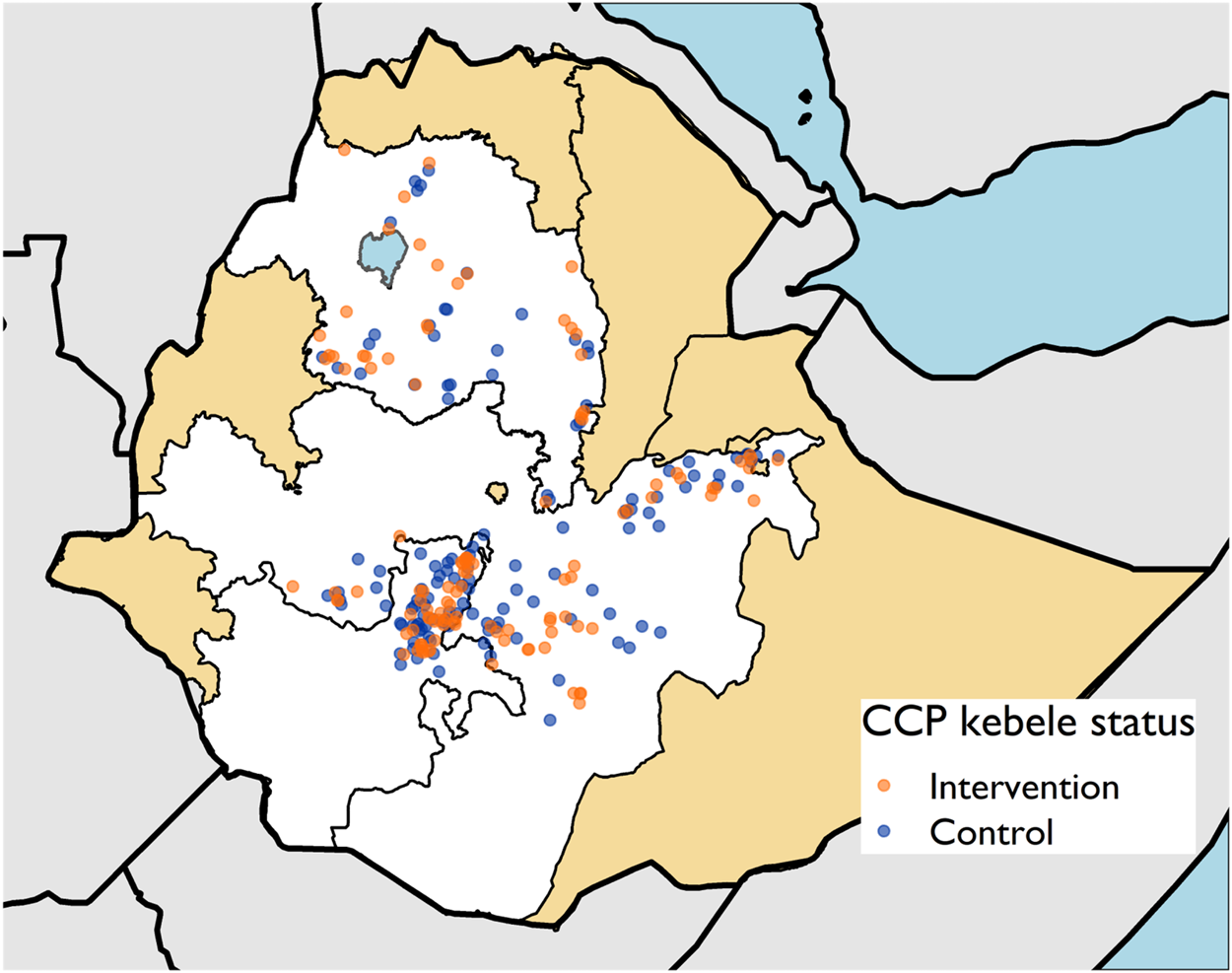
Settlements (Kebeles) Sampled for Data Collection.
The sampling of households and individuals followed the approach from Hagen-Zanker et al. (2023b). Enumerators were instructed to plan random walks following predetermined starting points and sample households at regular intervals using enumeration area maps provided by the Ethiopian Statistical Service. Enumeration areas had on average 136 households, 25 of which were sampled. The sampling of respondents was limited to households with members aged 18‒40 years old. If a household had only one member in that age bracket, that member was interviewed, and if it had more, the survey tablet randomly selected a household member. 6
In total, 5,302 individuals completed the questionnaire for the CCP impact evaluation. The response rate was 98.8 percent, which is not uncommon in Ethiopia. 7 Compared to the 2022 World Bank's socioeconomic panel (Ethiopian Statistical Service and World Bank 2023), a survey with a random selection of settlements, the CCP impact evaluation survey has a slight oversampling of respondents who reported that they were married, had obtained a primary education, and were Muslim. While these differences are expected due to the differences in sampling approaches, both surveys share similar demographic trends (see Supplemental Table B-1).
Sample Description
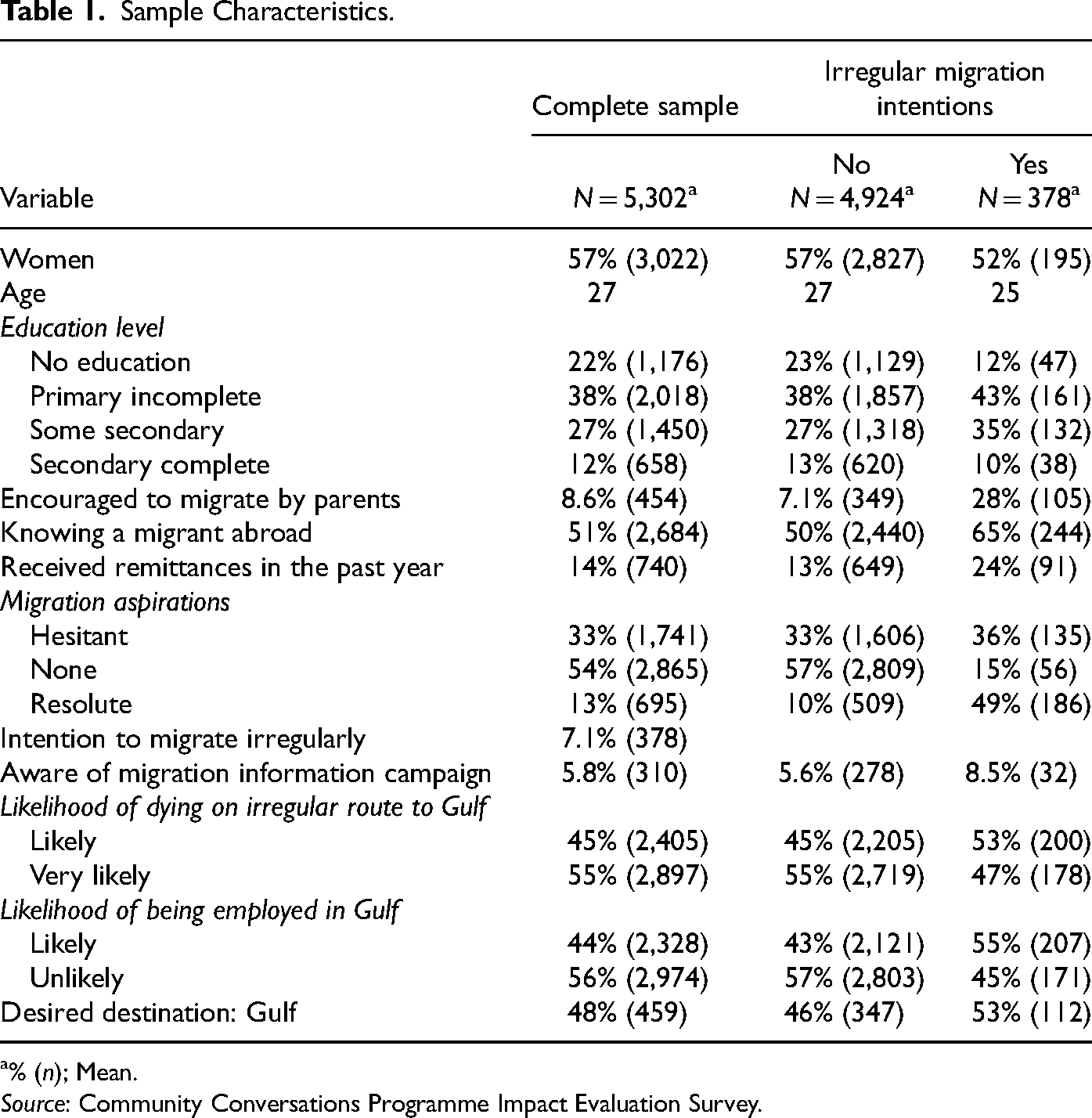
The average age of the respondents in the sample was 27 years old. Fifty-seven percent were women. Twenty-two percent reported no formal education, 38 percent did not complete their primary education, 27 percent had some secondary education, and 12 percent had completed secondary or postsecondary education. In regard to the migration background and networks, 8.6 percent were encouraged to migrate by their parents, 51 percent know a migrant abroad and 14 percent received remittances. Six percent were aware of the information campaign by the CCP.
Most of the respondents were aware of irregular migration risks to the Arab Gulf states and some overestimated their chances of finding a job abroad there. Fifty-five percent reported that it was “very likely” that they would die if they migrated irregularly to the Gulf states and 44 percent said it was “likely.” Regarding potential employment in the Gulf after irregular migration, 54 percent said it was “unlikely” that they would be employed if they were to migrate irregularly there (see Table 1).
Sample Characteristics.
% (n); Mean.
Source: Community Conversations Programme Impact Evaluation Survey.
To measure aspirations to migrate, I used an adjusted version of the three-dimensional typology of migration aspirations proposed by Carling et al. (2023). The typology makes use of three dimensions of migration to reflect the intricacy of the decision to migrate measured in three dummy questions: consideration (has seriously considered migration), preference (would prefer to migrate rather than stay), and readiness (would be ready to seize the opportunity to migrate). The combination of dimensions leads to five categories of migration aspirations: none, deferred, ambivalent, spontaneous, and resolute. 8
In this study, the three dimensions of migration resulted in 19.4 percent of respondents considered migration, 18.5 percent preferred migrating and 44.6 percent were ready to do it. When looking at the five categories of migration aspirations, 54 percent of respondents had no aspirations to migrate, 2 percent had deferred aspirations, 27 percent ambivalent aspirations, four percent spontaneous aspirations, and 13 percent resolute aspirations. This pattern of migration aspirations is consistent with other survey data collected a year earlier in various regions in Ethiopia. 9 In this paper, these five categories were recoded into three based on substantive and distributional grounds. The typology includes the two extremes, none and resolute aspirations, and a third category in the middle collapsing deferred, ambivalent, and spontaneous aspirations, defined here as “hesitant migration aspirations.” Thirteen percent had resolute migration aspirations, 33 percent hesitant aspirations, and 54 percent no aspirations to migrate. Using the direct question on intentions to migrate irregularly, which was asked of all respondents, 7 percent reported intentions to use irregular pathways.
Respondents who reported intentions migrate irregularly were younger, male, encouraged by their parents to migrate, knew someone living abroad, received remittances, had stronger migration aspirations, and were more optimistic about finding employment abroad and successfully completing the journey if they were to migrate irregularly (see Table 1).
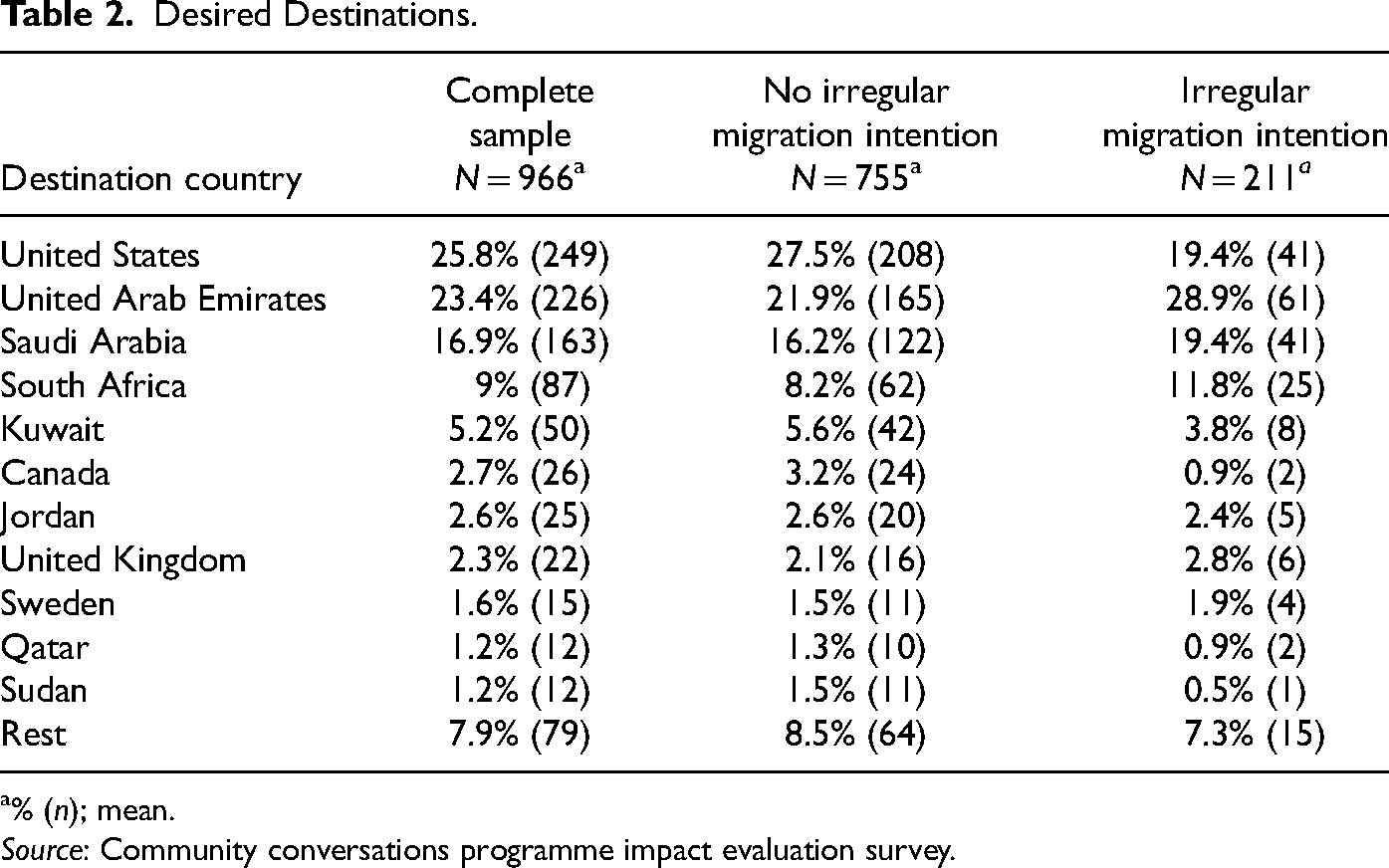
Among respondents who reported a preference to emigrate, most reported that they wanted to go to the United States (26%), the United Arab Emirates (23%) and Saudi Arabia (17%). About half of respondents wanted to go to the Arab Gulf countries (48%). Those who reported intentions to migrate irregularly were less likely to prefer the United States, and more likely to prefer the United Arab Emirates, Saudia Arabia, and South Africa (see Table 2).
Desired Destinations.
% (n); mean.
Source: Community conversations programme impact evaluation survey.
Direct Question and Double List Experiment Design
This article uses the terms “irregular migration intention” and “intention to migrate through irregular pathways” interchangeably, following common usage in recent migration research (e.g., Woldemichael and Getu 2020; Restelli 2023; Tjaden 2023; Beber, Ebert, and Sievert 2024). Irregular migration intentions were elicited with the direct question: “If you were unable to get the necessary papers, like a visa, to leave Ethiopia to live or work in another country, would you still try to do it?”
Reflecting on how this survey question relates to the migration aspiration measurement literature clarifies what is being measured. Conceptual reviews of survey items have identified distinct approaches to operationalize migration aspirations (Carling and Schewel 2018). Among these approaches, this study aligns most closely with explicit conditional willingness to migrate, that is, a respondent's preparedness to migrate under an explicit hypothetical scenario (Carling and Mjelva 2021). By introducing a concrete legal barrier, the question captures preparedness to migrate despite being unable to do so regularly. The explicit conditionality improves measurement precision by reducing interpretive ambiguity, especially when compared to implicit conditional questions that can be understood in different ways by respondents (Carling 2019).
The explicit conditionality of the survey item indicates that respondents are not expressing an unconstrained or voluntary preference. Rather, the question captures a constrained willingness to migrate that emerges within structural limitations and varying degrees of access to regular migration channels depending on the respondent. 10 Thus, the term “intention” in this study is understood as conditional preparedness shaped by structural barriers, perceived risks, and limited opportunities, rather than a preference.
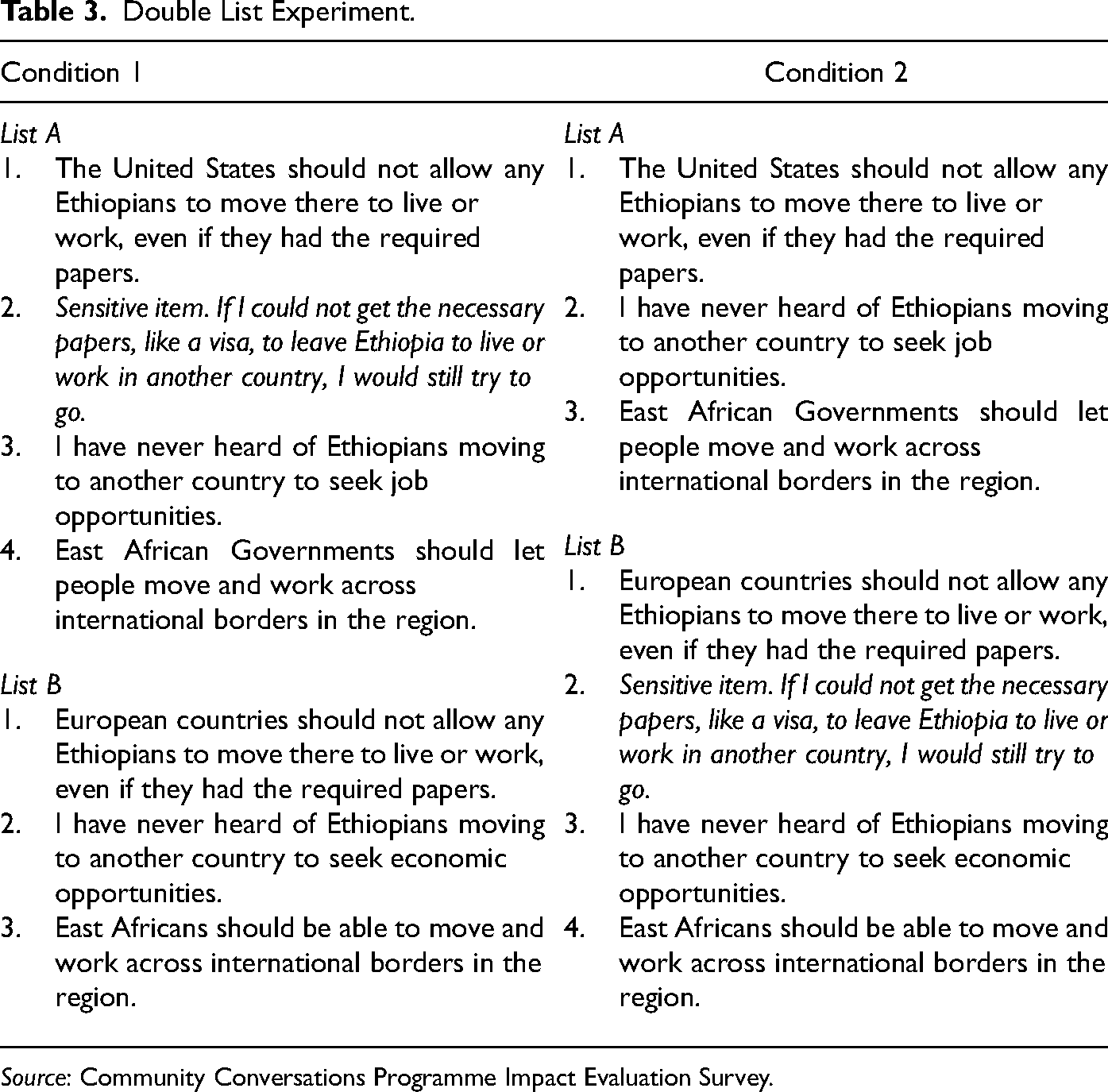
The double list experiment randomly assigned respondents to Condition One or Condition Two. In Condition One, respondents received List A with the full items (including the sensitive item) followed by List B with the baseline items (not including the sensitive item). In Condition Two, the other half of the respondents received List A with the baseline items (not including the sensitive item) followed by List B with the full list items (including the sensitive item). Note that the wording across Lists A and B are relatively similar but not the same. This was to increase statistical efficiency of the double list experiment according to Glynn's (2013) recommendations. This was the exact wording of the list experiment: I will read three/four statements. I will then ask you how many of these statements you agree with. You should not tell me which specific statements you agree with but the total number of statements that you agree with. I will show you a card with drawings of the statements now.
The sensitive item is in italics (see Table 3).
The recommendations implemented in this double list experiment study enhance its design, aiming to increase its statistical efficiency and reduce measurement errors. 11 Enumerators were instructed to show cartoons depicting the items to respondents (Kramon and Weghorst 2019). This visual aid was intended to reduce respondent error (see Supplemental Appendix C with the images).
Double List Experiment Robustness Checks
I implemented five tests to check the robustness of the double list experiment. First, the questionnaire not only randomly assigned respondents to Condition One or Two, but also randomly assigned the sequence in which the double list experiment and the direct question appeared in the questionnaire. This was done to evaluate any potential ordering effects between the double list experiment and the direct question and assess whether the ordering could prime respondents to underreport irregular migration intentions (Aronow et al. 2015). There was a battery of questions on preparations to migrate positioned between the direct question and the double list experiment. Table 4 shows the number of respondents in each randomization group (list experiment condition and questionnaire sequence), with a roughly similar number of respondents in each.
Double List Experiment.
Source: Community Conversations Programme Impact Evaluation Survey.
I compared the means in observed variables across the randomisation groups (see Supplemental Table D-1). The results show successful randomisation of the double list experiment conditions. In contrast, while the random ordering of the measurement methods was effective across characteristics, it had an effect on the estimated share of respondents with intentions to migrate irregularly using the direct question. When the direct question appeared in the questionnaire first, the prevalence of intentions to migrate irregularly was 5.4 percent, and 8.9 percent when the list experiment appeared first, meaning 3.5 percentage points higher (t-test p < .001). Thus, to avoid ordering effects, I opted for comparing the direct question and list experiment estimates when both appeared first in the questionnaire in the results section.
Second, the items within lists A and B were intended to be negatively correlated but positively correlated between them (Glynn 2013). Supplemental Figure D-2 shows evidence that this was achieved.
Third, I assessed the presence of ceiling effects in the double list experiment. These occur when respondents report the highest number of items on the treatment list, thus revealing their preference for the sensitive trait. When given List A, about 5 percent of respondents reported four items, and for List B, 4 percent. Thus, this list experiment was not affected by ceiling effects. The result did not vary by the order of appearance of the list experiment or direct question. 12
Fourth, I tested for violations of the list experiment assumptions assessing for potential design effects (Supplemental Appendix D-3). Design-effect violations take place when participants assess the control elements differently in the treatment and control conditions of the list experiment (Blair and Imai 2012). Concretely, respondents could be influenced by the number of items in a list. In the treatment group, where there is one additional item compared to the control group, respondents might alter their responses to the control items. The results suggest that there was a potential violation of the list experiment assumptions in List A. Thus, I proceeded to implement the list experiment design-effect significance test (Blair and Imai 2012). The design-effect significance test confirmed that List A suffered from design effects, while List B did not. Then, I tested for design-effect violations by respondent subgroups’ aspirations to migrate by restricting the sample when the list experiment appeared first to avoid the ordering effects. There were no design effects for respondents with hesitant or resolute migration aspirations.
Finally, I tested for carryover effects (Diaz 2023). Carryover effects occur when respondents who saw the sensitive item in the first list alter their response to both lists (Droitcour 1984). While there were carryover effects for the complete sample, there were not when the sample included only respondents with hesitant or resolute migration aspirations (See Supplemental Appendix D-4).
Number of Subjects in Each Randomisation Group.
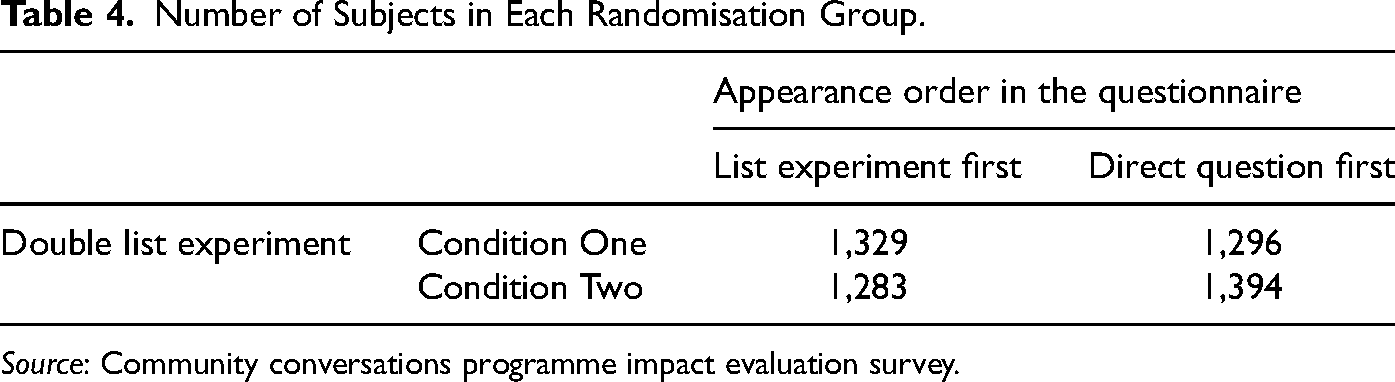
Source: Community conversations programme impact evaluation survey.
Analytical Strategy
To assess whether the hypothesized sensitivity bias led to an underreporting of intentions to migrate irregularly, I present the estimates of the direct question when it appeared first, of the experiment Lists A and B when they appeared first, and of the pooled list (mean across Lists A and B), as well as the difference between estimates of the pooled list experiment and those of the direct question. The list experiment estimates are calculated using the piecewise estimator, which is equivalent to the classic list experiment difference-in-means estimator (Glynn 2013). To test the first hypotheses in this study, I begin the analysis including respondents with hesitant or resolute migration aspirations in order to ensure a minimum level of robustness following the test results (see previous section). 13
Subsequently, the analysis delves into an examination of list experiments by subgroups analysing the complete sample, including all respondents. I disaggregate the results by demographics (age, sex, and educational level), aspirations to migrate (none, hesitant, resolute), migration background and network variables (encouragement to migrate by parents, respondent household receiving remittances, and knowing a migrant abroad), risk awareness (perceptions on dying on route and possibilities to be employed, intended destination, and aware of information campaign CCP).
When analyzing the differences between the pooled estimate and the direct question estimate, I interpret a positive difference as underreporting intentions to migrate irregularly by the direct question, while a negative difference as overreporting. To assess whether the differences are beyond chance, confidence intervals for the difference in means between the direct question and double list experiment estimates were generated using the bias-corrected and accelerated (BCa) bootstrap interval (Davison and Hinkley 1997; Efron 1987). The analysis of respondents with aspirations to migrate resamples 2,500 times and the subgroup analysis 5,000 times. 14 Given that I perform a total of 27 hypothesis tests in the subgroup analysis, I report Bonferroni-adjusted p-values in the main text and unadjusted p-values in Supplemental Appendix Table D-5.
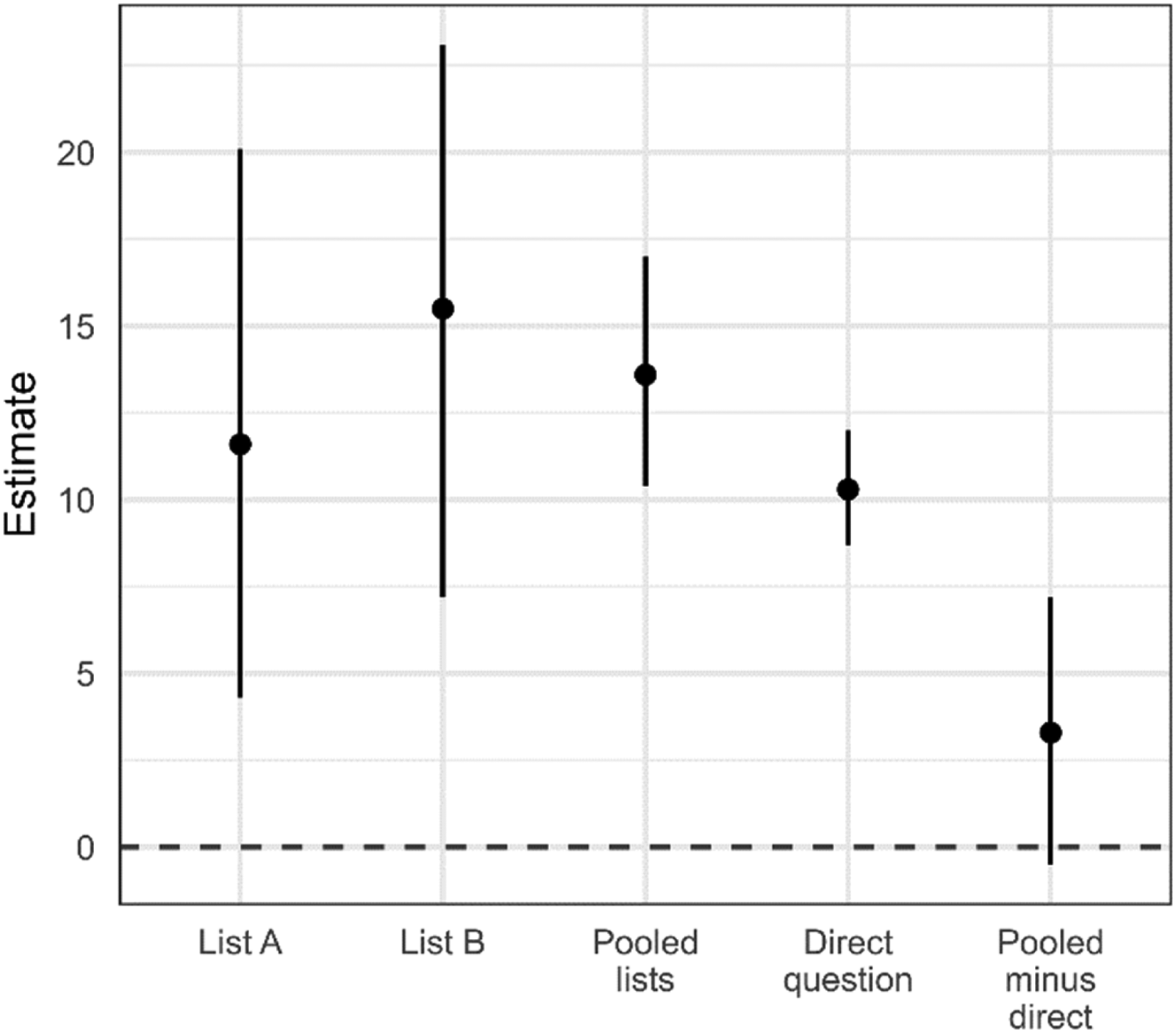
Lists A and B, Double List Experiment (Pooled), and Direct Question Estimates of Migration Intentions Through Irregular Routes.
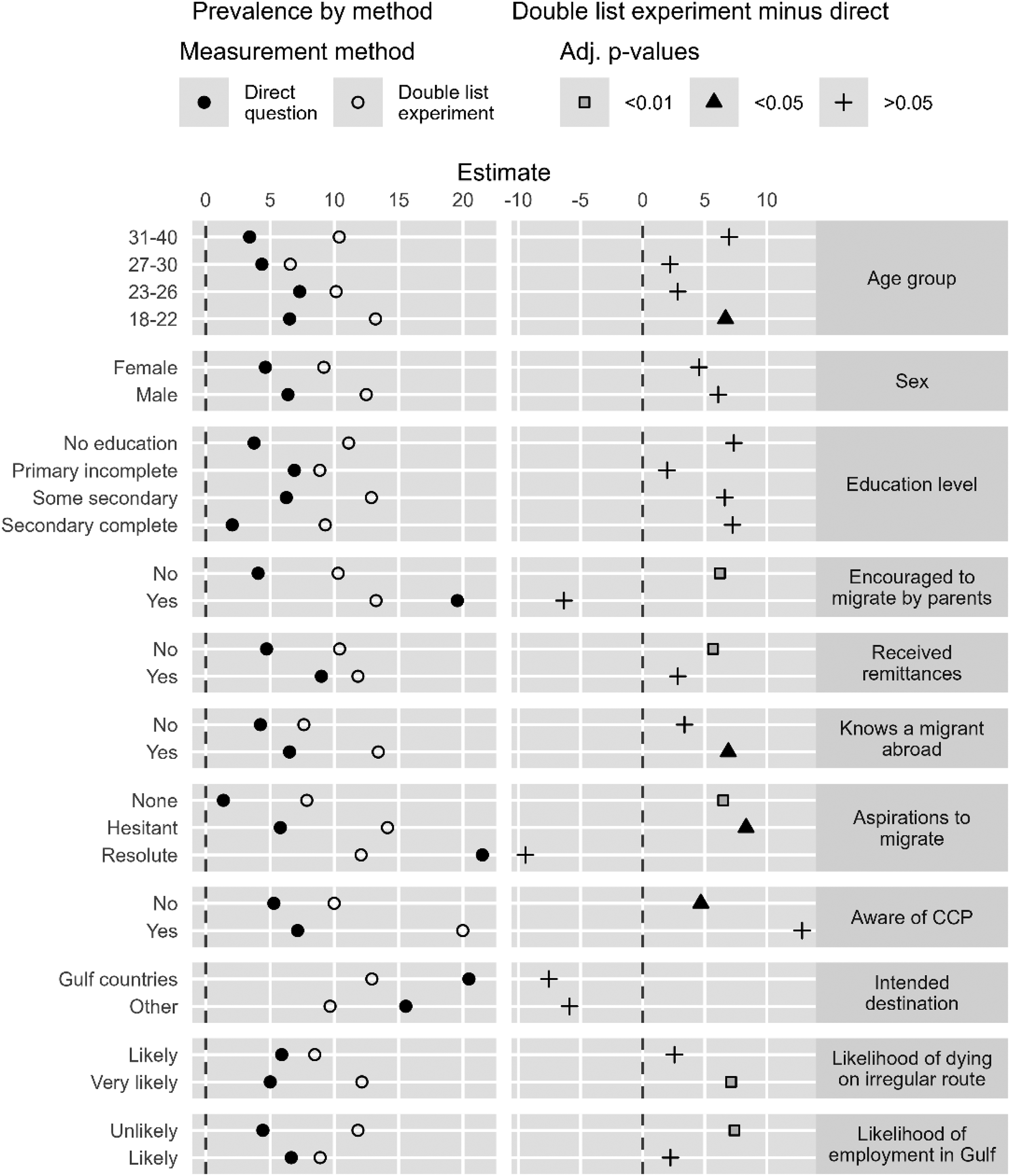
Estimates of Migration Intentions Through Irregular Routes by Subgroup.
Results
Double List Experiment and Direct Question Estimates of Migration Intentions Through Irregular Routes
The prevalence of irregular migration intentions is 11.6 percent with experiment List A, 15.5 percent with List B, and 13.6 percent with the pooled lists. The direct question estimate indicates a prevalence of 10.3 percent. In the first hypothesis I expected a higher estimate from the double list experiment than from the direct question estimate. While there is a positive difference between the pooled list experiment and direct question estimates of 3.3 percentage points, it is not statistically different from zero. Contrary to my initial expectations, the data do not suggest an underreporting of intentions to migrate irregularly when asked with the direct question for respondents with aspirations to migrate (see Figure 1).
While the list experiment produces a slightly higher estimate than the direct question, the difference is small. List experiments are known to require large samples to detect statistically significant differences, and this study is no exception (Blair et al. 2020). Although a larger sample might yield statistical significance, the estimated difference remains substantively small, meaning that the practical conclusion remains unchanged: the two methods provide similar estimates.
Measuring Intentions to Migrate Though Irregular Routes for Subgroups
Did the difference between the pooled list experiment and the direct question yield an underreporting of intentions to migrate irregularly by subgroup? Figure 2 presents the estimates disaggregated by demographic variables, migration background and networks, risk awareness, and aspirations to migrate. The left panel shows the double list experiment and direct question estimates and the right panel their difference, including the Bonferroni-adjusted p-value testing whether the estimate is different than zero. A positive difference is interpreted as underreporting irregular migration intentions using the direct question. Four results stand out.
First, individuals who were more aware of irregular migration risks tended to underreport irregular migration intentions when asked directly. Those who perceive a high likelihood of dying on route to the Arab Gulf countries and those who believe it would be unlikely to secure a job there after migrating irregularly underreported their intentions to migrate by a non-zero seven percentage points difference. In contrast, there were no differences in the prevalences across measurement methods for the intended destination. While the estimated difference for respondents aware of the CCP migration awareness campaign was not statistically significant, they tended to underreport their irregular migration intentions more than those unaware of the campaign. One interpretation of this result is that these individuals might be more aware of the costs of irregular migration than those who did not have contact with the information campaign.
Second, individuals with hesitant migration aspirations tended to underreport their intentions to migrate irregularly (non-zero difference of 8.3 percentage points). In contrast, individuals with resolute migration aspirations tended to report higher aspirations to migrate irregularly when asked directly compared to the double list experiment, although the difference was not statistically different from zero. For individuals without migration aspirations, the results indicate a non-zero difference of 6.5 percentage points. I would expect to find a smaller difference for this group. Although it is possible that respondents without an interest in migration misreported their aspirations in the list experiment due to a potential misunderstanding of the question, the robustness checks suggest that there is likely some noise in the list experiment for this specific subgroup.
Third, respondents who were not encouraged to migrate by their parents and those whose households did not receive remittances evidenced a non-zero difference of underreporting of irregular migration intentions compared to respondents who were encouraged to migrate and those whose families did receive remittances. The variable that does not follow this trend is knowing a migrant abroad. Those respondents who know a migrant abroad tend to underreport intentions to migrate irregularly. One possible explanation is that these migrants provide firsthand information about the potential risks of irregular migration, leading to a more cautious response in direct questioning.
Lastly, most of the differences across sex, age, and education are not different from zero. The exception is respondents aged 18‒22 who tended to underreport irregular migration intentions (non-zero difference of six percentage points). It is important to note that detecting differences across groups requires more statistical power than the sample size that this study was able to obtain.
Conclusion
This article contrasted direct question and double-list experiment estimates of irregular migration intentions to assess possible sensitivity biases of the direct question. Ethiopia provides a compelling setting for this investigation, given the dangers and clandestinity of irregular migration, as well as the tendency of prospective migrants to conceal their plans from their families. The experiment was part of a survey administered face-to-face to 5,302 respondents in rural Central Ethiopia to evaluate an information campaign by the IOM. The key outcome of interest is the difference in estimates of the double list experiment minus those of the direct question. Are direct question surveys on irregular migration biased?
The main findings show no significant differences in the prevalence of irregular migration intentions between the double list experiment and the direct question for the overall sample of respondents with aspirations to migrate. However, subsequent analysis reveals varying sensitivity biases among different respondent subgroups. Respondents who were more aware of irregular migration risks and those without a migration background were more likely to underreport their intentions to migrate through irregular pathways.
Respondents who were more aware of irregular migration risks or had hesitant migration aspirations were more likely to underreport their intentions than those with lower risk awareness or resolute aspirations. These findings align with rational choice models of migration (Todaro and Maruszko 1987), which suggest that individuals weigh the costs and benefits of migration, including journey risks and conditions at the destination when expressing their intentions. Similarly, individuals with hesitant aspirations are more sensitive to perceived risks and legal constraints, making their responses more susceptible to social desirability bias in direct questioning, whereas those firmly committed to migration are less influenced by concerns over its illegality (Detlefsen, Heidland and Schneiderheinze 2022).
Importantly, this study also underscores the role of migration background and networks (Massey et al. 1993). Respondents who were not encouraged to migrate by their parents and those whose households did not receive remittances tended to underreport irregular migration intentions, whereas those encouraged to migrate and those that receive remittance did not. This aligns with research showing that in Ethiopian communities, where irregular migration and brokerage are embedded in family and religious networks, migration brokers are often seen as a socially accepted resource, making respondents less sensitive to reporting intentions to use irregular migration pathways (Tufa, Deshingkar and Mengiste 2022).
Do these results imply that researchers should avoid the direct question? Not necessarily. Taken together, these results suggest that, in this particular context in rural Ethiopia, direct measures of irregular migration intentions can be reliable. Given the loss of statistical power associated with the list experiment, the stringent conditions required for its implementation, and the complexity it introduces, direct questions appear to be a viable alternative. If resources allow and sensitivity is a concern, testing sensitivity biases with a list experiment can be an alternative. It must be noted that doing so can affect the direct question estimate due to the ordering effects if both the direct question and list experiment are administered to all respondents, as shown in this study.
This study is not without its limitations. First, it focusses solely on rural Central Ethiopia. While this is an important country where many people migrate irregularly, there are others where sensitivity biases may be a cause for concern given their different material and cultural conditions (Morocco or Mexico, for example). As more countries impose more restrictions on the mobility of migrants, concerns of sensitivity biases may become more prevalent. Future research should replicate this study in diverse contexts to understand how local factors moderate biases in eliciting irregular migration intentions. Second, while this study provides insights, it also highlights the need for further research to explore these dynamics more deeply with alternative non-intrusive survey methodologies, such as the randomized response technique (Warner 1965). Alternatively, researchers may want to explore various dimensions of irregular migration, including questions on preparations, timeframes and conditionality of irregular migration. Similarly, qualitative research could provide deeper insights into how different respondent groups perceive, feel, and respond to survey questions about irregular migration in particular.
Despite its limitations, this study contributes to the migration aspirations literature. Estimates of irregular migration intentions are collected to examine differences in the drivers of regular and irregular migration, assess risk preferences, evaluate awareness-raising campaigns, and inform migration forecasts. However, these research efforts rely on the assumption that estimates of irregular migration intentions are accurate. There has been limited scrutiny of whether intentions to migrate through irregular pathways are subject to sensitivity bias in survey responses. This study addresses that gap using data from Ethiopia, specifically by comparing two survey methods: the direct question and the double list experiment.
Supplemental Material
sj-docx-1-mrx-10.1177_01979183251352443 - Supplemental material for Are Estimates of Irregular Migration Intentions Biased? Evidence from a Double List Experiment in Ethiopia
Supplemental material, sj-docx-1-mrx-10.1177_01979183251352443 for Are Estimates of Irregular Migration Intentions Biased? Evidence from a Double List Experiment in Ethiopia by Eduardo Acostamadiedo in International Migration Review
Footnotes
Acknowledgments
I am especially grateful to Jasper Tjaden for his comments, support and guidance. I also thank David McKenzie, Irene Schöfberger, and Cristina Samper for their comments on earlier versions of this work. I am also grateful to Roberta Aita for the visual aid used in the list experiment. I further thank the anonymous reviewers for their time and insightful comments. I acknowledge funding from the Netherlands Ministry of Foreign Trade and Development Cooperation for the data collection.
Declaration of Conflicting Interests
The author declared no potential conflicts of interest with respect to the research, authorship, and/or publication of this article.
Funding
The author disclosed receipt of the following financial support for the research, authorship, and/or publication of this article: Data for this study were collected as part of the impact evaluation of the awareness-raising campaign “Facilitating Informed Migration Choices – Community Conversations as a Tool for Preventing Unsafe Migration in Ethiopia,” implemented by the International Organization for Migration and funded by the Netherlands Minister for Foreign Trade and Development Cooperation.

Supplemental material
Notes
References
Supplementary Material
Please find the following supplemental material available below.
For Open Access articles published under a Creative Commons License, all supplemental material carries the same license as the article it is associated with.
For non-Open Access articles published, all supplemental material carries a non-exclusive license, and permission requests for re-use of supplemental material or any part of supplemental material shall be sent directly to the copyright owner as specified in the copyright notice associated with the article.
