




Abstract
Migration is increasingly recognized as a dynamic, often recurrent, and intergenerational process. Yet, little research has examined how childhood exposure to international migration, through one's own moves and through family history, shapes aspirations for future (im)mobility. In this article, we address this gap using a life course perspective to investigate how both direct and indirect migration experiences during childhood influence openness to international migration in adulthood. We distinguish between immobility, return migration, and onward migration aspirations, and explore underlying mechanisms such as socioeconomic status, transnational ties, multilingualism, experiences of discrimination, and identification with the country of residence. Using data from the French survey Trajectoires et Origines 2, we find that individuals with a more recent immigrant descent tend to express higher return migration aspirations but lower onward migration aspirations. Direct migration experiences in childhood are associated with greater openness toward migration overall, though differently by descent: among those with a distant immigrant background, childhood migration fosters openness to onward migration, while it increases return aspirations among those with a more recent immigrant descent. These results offer new insight into how migration and immobility aspirations are shaped early life experiences and family migration histories.
Introduction
Migration is not a one-time event but rather a dynamic, often recurrent process unfolding over the life course and across generations (Vidal and Lersch 2021). Empirical evidence shows that repeat migration is common, with over a third of worldwide migrations between 2010 and 2015 involving moves not originated in the country of birth (Azose and Raftery 2019). While returns to the country of birth remain the most prevalent form of remigration (Dustmann and Görlach 2016), scholars have increasingly distinguished them from onward migrations — i.e., those between two countries, neither of which was the birthplace (Ahrens, Kelly, and Van Liempt 2016; Bygnes and Erdal 2017; Ramos 2018). This research emphasizes how prior experiences of migration shape subsequent migration, either toward an origin country or to a new destination. Beyond direct experiences, individuals with a migration background — especially the second generation — tend to be more mobile than those without one (Caron 2019; de Jong and de Valk 2023; Levitt and Waters 2002). This suggests that migration is intergenerational, with mobility-related attitudes and resources passing down through families.
The value of research linking migration experiences to future mobility is often limited by its predominant focus on realized migration, typically examining adult populations. Less attention has been given to migration aspirations, which are interesting to study per se for a number of reasons. Positive attitudes toward migration can turn into actual migration behaviors (for a comprehensive literature review, see Aslany et al. 2021), therefore enabling us to better understand migration decisions in the making. They also offer valuable insights into potential mobility by capturing those who aspire to migrate but face structural barriers (Carling 2002; Carling and Schewel 2019). Migration aspirations are arguably more influenced by direct and indirect migration experiences than actual migration behavior, which is shaped by immediate circumstances (Kley 2011). Whether they turn into actual migration or not, “migration imaginaries” (Bolognani 2016) say something of individuals’ relationship to the country of residence and the expected destinations, and constitute as such interesting outcomes for the sociology of immigrants’ integration (Caron 2020). Therefore, studying migration aspirations provides a broader understanding of how past experiences shape future mobility intentions and/or behaviors (Huinink, Vidal, and Kley 2014). Moreover, little research has examined how childhood migration — whether combined with migrant descent or not — shapes migration aspirations later in life, despite early childhood and adolescence being critical periods for cognitive development, personality, and aspirations.
In this study, we advance the understanding of migration determinants by examining how early-life exposure to migration influences openness to migration, or the lack thereof, in adulthood. We use data from the survey Trajectories and Origins (TeO2, 2019–2020) conducted on immigrants and their descendants in France. Adopting a life course perspective, we emphasize how past experiences can reinforce, deter, or reactively shape future mobility by influencing attitudes toward both movement and immobility. We conceptualize migration as a lifelong and intergenerational process rather than a one-time event driven solely by material conditions. We distinguish between two key dimensions of early-life migration exposure: (1) indirect family experience, captured through immigrant descent, and (2) direct childhood migration experience. By integrating these dimensions, we provide a more comprehensive understanding of migration trajectories across diverse populations, including immigrants, their descendants, and individuals without an immigrant descent but with migration experience.
Additionally, we differentiate between two directions of movement: migration to a new country (onward migration), and migration to previous residence countries and/or to ancestral homelands (return migration). We explore underlying mechanisms by considering socioeconomic status, transnational ties, multilingualism, experiences of discrimination, and identification with the country of residence.
This article expands on existing research by Caron (2020) which used the first version of the TeO survey to explore the differences in (onward- versus return-) migration intentions across immigrant generations. Not only this study updates these findings using most recent data, but it goes further by investigating the migration aspirations of individuals with no migration background or with more distant immigrant ancestry, a group that is generally overlooked but still contributes to the diversity of migration and immobility aspirations; by looking at the consequences of direct migration experiences during childhood and how these vary by immigrant descent; and by attempting to formally test mechanisms identified by different theoretical perspectives on the formation of migration aspirations.
Background
Migration Aspirations
Most research on migration has focused on actual migration behaviors and their structural determinants. However, since the formulation of the aspiration-ability (Carling 2002) and later aspirations-capabilities (de Haas 2021) frameworks, increasing attention has been given to migration aspirations as key precursors of migration. These frameworks highlight the distinction between wanting and being able to migrate, showing that migration aspirations are shaped by broader social, economic and political structures, while migration capabilities (the freedom to choose where to live) depend more strongly on access to legal, financial, and social resources. Importantly, by conceptualizing aspirations as a motivational component of the migration process that interacts with capabilities, these frameworks identify them as the theoretical link through which past experiences may later translate into migration.
Studying attitudinal aspects rather than behaviors in migration research is crucial for two reasons. First, attitudes provide insight into potential mobility — that is, the segment of the population that expresses openness to migration, even if they do not ultimately migrate (Carling 2002; Docquier, Peri, and Ruyssen 2014; Carling and Schewel 2019). Second, attitudes reflect broader cognitive and social processes that shape how individuals perceive migration as an option, independent of external constraints. Attitudes toward migration are shaped by socialization into migration, learning from (positive and negative) experiences of migration, and the formation of migration imaginaries — the ways individuals envision life elsewhere and their own potential mobility (Bolognani 2016; Caron 2020; Bernard and Perales 2024). Because attitudes are less constrained by economic or legal barriers than actual behaviors, they provide a more fundamental measure of how migration is perceived and valued within different social groups. As Carling and Schewel (2019, 10) put it, “migrating, then, is not ultimately about where you are, but who you are.” Alongside transnational practices, migration aspirations — whether they turn into actual behaviors or not — can therefore provide interesting insights on integration processes for migrants and their descendants, in that they inform not only individuals’ attitudes toward migration, but also on their relationships with their current country of residence and their intended destination (Caron 2020).
We focus on the notion of openness to migration — a behavioral disposition that reflects individuals’ willingness to migrate, regardless of concrete plans. Openness to migration is shaped by perceptions of opportunity, attachment to the place of residence, and perceived constraints to mobility (Huinink, Vidal, and Kley 2014). While planning or actual migration behavior is often triggered by specific events, such as job offers or family reunification (Kley 2011; Kley and Mulder 2010), openness to migration captures a broader attitudinal foundation that underlies future migration decisions.
Three Perspectives Linking Early Migration Experiences with Migration Aspirations
In this study, we conceptualize migration as a lifelong and intergenerational process. We adopt a life course perspective that, instead of treating individuals as static “migrants” or “nonmigrants,” views migration as recurrent, cumulative, and socially embedded (Coulter, Ham, and Findlay 2016; Vidal and Huinink 2019; McCollum, Keenan, and Findlay 2020; Bernard 2022). Experiences and resources accumulated from early life shape the motivations, opportunities, and constraints surrounding migration decisions (Bernard and Vidal 2020). On the one hand, early experiences can support subsequent behavior by influencing individuals' attitudes such as the openness to migrating or intentions to leave. Early experiences influence not only whether individuals consider migration, but also the potential direction of future moves — whether they envision moving to a new destination or returning to a previous residence country or to an ancestral home (Caron 2020). On the other hand, acknowledging an increasing focus on immobility in high-emigration areas (Schewel 2020), negative migration experiences such as discrimination, legal precarity, economic struggles, or unmet expectations within an individual's network can deter future mobility. Rather than reinforcing openness to migration, such experiences can consolidate aspirations for stability in the current location.
Research on migration behavior has already emphasized return migration as a central outcome of international migration. Studies show that return migration is often linked to economic hardship, barriers to integration, or long-term migration plans related to retirement or financial accumulation (Dustmann and Görlach 2016; Constant 2020; Caron 2024). However, onward migration has received growing attention as a response to economic opportunities, skill accumulation, or experiences of marginalization in the host society (Ahrens, Kelly, and Van Liempt 2016; Ramos 2018; Monti 2020). While much of this literature focuses on migration behaviors, an emerging body of research explores how earlier migration experiences shape migration attitudes such as intentions and aspirations, even in the absence of concrete migration plans (Ivlevs and King 2012; Caron 2020; de Jong and de Valk 2023).
A key insight from this research is that family migration history or immigrant descent influence migration attitudes even among those with no direct migration experience. Second-generation individuals, for instance, often exhibit higher migration aspirations than those without an immigrant background, reflecting socialization into migration through transnational networks, multilingualism, and family narratives of migration (Ivlevs and King 2012). 1 While this indirect exposure to migration in early life is well-documented, far less attention has been given to individuals who migrated during childhood (for an exception see Bernard and Perales (2024) on international migration and Bernard and Vidal (2020) on internal migration, showing that children who migrate display higher migration rates in adulthood). These individuals occupy an in-between position — having both direct migration experience and the socialization into migration that characterizes second generations. Understanding the role of direct versus indirect migration experiences in shaping migration aspirations is therefore critical for advancing the study of migration.
In France, a major country of immigration in Europe where around 9% of the population were first-generation immigrants in 2019–2020, while another 12% belonged to the second generation (Lê, Simon, and Coulmont 2022), Caron (2020) reports that immigrants who arrived in adulthood (the first generation) tend to have stronger return migration aspirations, particularly those from Portugal, North and sub-Saharan Africa, and Turkey. In contrast, immigrants who migrated to France as children (the 1.5 generation) often align to the second generation in terms of migration intentions. Among individuals born in France, the second generation (i.e., those with two immigrant parents) tends to have higher aspirations to return to their parental homeland when they face discrimination in France. However, mixed-descent individuals (the 2.5 generation) are less likely to consider returning and instead show a greater propensity for onward migration to a third country, especially within Europe. This pattern suggests that migration aspirations evolve across generations and the diversity of parental origins, influenced by experiences of integration and identity formation in France. Notably, research has largely overlooked the fact that some second-generation individuals may have also experienced migration during childhood.
The literature on migration aspirations determinants offers various perspectives for understanding the relationship between early migration experiences and future migration or immobility aspirations. In what follows, we review three such perspectives. We view these perspectives as complementary rather than mutually exclusive.
The Migration Capital Framework: Migration as a Self-reinforcing Process
A first perspective addresses the self-reinforcing role of migration over the life course, suggesting that earlier experiences of migration build important conditions for subsequent migration. A theoretical contribution in this respect builds on the concept of “migration capital” linking personal and family migration histories to migration behaviors in adulthood (Paul 2011, 2015; Busse and Vásquez Luque 2016; Saksela−Bergholm, Toivanen, and Wahlbeck 2019; Bernard and Perales 2024). Migration capital — also referred to as “migratory knowledge” (Ramos 2018), “mobility capital” (Moret 2020) or “migration-specific capital” (de Jong and de Valk 2023) — is a loosely defined concept used to indicate the many tangible and intangible resources that shape individuals’ aspirations and capabilities toward migration. These resources include attitudes, social networks, economic resources, knowledge on migration processes (administrative procedures, migration costs, etc.) and ability to adapt to new environments.
One key contribution of Bernard and Perales (2024) is to draw a distinction between location-specific and general migration capital. Location-specific migration capital encompasses the resources that attract and/or enable individuals to move toward a specific destination, such as (but not limited to) proficiency in the place's language, cultural affinity, social networks in the location, or legal entitlement to settle. Thus, location-specific migration capital might likely enhance migration to previous countries of residence or with important social and cultural linkages. General migration capital instead includes resources that can facilitate migration to any destination, such as a general propensity and willingness to learn new languages or to adapt to new places, material resources to sustain the costs of migration, and ability to navigate immigration bureaucracy. In such way, general migration capital not only enhances migration to countries where individuals have relevant linkages, but also beyond.
Building on previous literature, Bernard and Perales (2024) recognize that individuals accumulate general and location-specific migration capital indirectly through their family migration history and the related socialization in childhood; and directly through their own migration experiences. For instance, the second generation may acquire location-specific migration capital from their parents (i.e., indirectly) via the language spoken at home, religious and cultural practices, or regular calls and visits to relatives in the country of origin. This process can also be reinforced through direct experiences, such as accompanying parents on circular migration to the origin country. Similarly, general migration capital can be transmitted indirectly, through positive attitudes toward migration or encouragement to learn additional languages, and directly, if children take part in their parents’ migration journeys, going through the process of traveling and adapting to a new country, language, and peer group.
Immobility Aspirations
The second perspective, elaborated by Schewel (2020), focuses on the factors shaping immobility preferences. While initially conceptualized to explain the immobility aspirations of nonmigrants in high emigration countries, some of these factors are generalizable to individuals with and without migration experience in high immigration countries.
The first are retain factors, which align with the idea of location-specific capital. As individuals make social and economic investments and develop emotional attachments to their place of residence over time, these factors become stronger deterrents to migration, particularly for those with longer durations of residence. The second are repel factors, referring to the perception of difficulties associated with migration itself and specific destinations. Potential moves are not only assessed in relation to opportunities elsewhere but also through prior migration narratives and experiences that can diminish migration aspirations by emphasizing economic insecurity, social exclusion, political instability, or even moral and cultural concerns about life in potential destinations (Todaro 1969; Gardner 1993; Mata−Codesal 2015). Negative feedback from one's migrant network might discourage migration by highlighting the risks and hardships of moving, such as unemployment or discrimination (Faist 2004). Last, Schewel (2020) considers internal constraints, such as risk aversion and cognitive limitations that narrow individuals’ perceived horizon of possibility and prevent them from viewing migration as a concrete option. For instance, those who have not been exposed to international migration in their formative years, whether directly or indirectly, may fail to consider it as a viable path, even when they could objectively benefit from mobility.
Migration as an “Exit” Strategy
The third perspective sees early migration experiences as potentially fostering migration aspirations as a reaction to negative experiences and unmet expectations in the residence country. A hostile context of reception can lead to reactive transnationalism (Itzigsohn and Saucedo 2002) or reactive ethnicity (Portes and Rumbaut 2001), where individuals who feel marginalized develop stronger ties to their ethnic community and an idealized view of their origin country. These mechanisms are well-documented among the second generation (Santelli 2013; Caron 2020; Shahrokni 2020) and racialized minorities such as Muslims in France (Esteves, Picard, and Talpin 2024), and may also shape return aspirations among those who moved in early childhood.
For others, relocating to a new country rather than returning to an origin one can serve as an exit strategy from marginalization. Second-generation individuals, particularly those with EU citizenship, often have greater legal motility (Kaufmann, Bergman, and Joye 2004) compared to first-generation immigrants, granting them more freedom to move across borders. While this primarily impacts actual migration behavior, differences in perceived opportunities and constraints can influence migration aspirations and destination choices (Carling 2002; de Haas 2021). Migrants socialized in Europe, especially those with one parent from a different European country, may feel a stronger European identity and thus be more likely to consider intra-European mobility. These factors highlight how early migration experiences shape not only the ability but also the desire to leave a given country, whether as a return or onward move.
Hypotheses
In the following, we build on the three perspectives outlined above to formulate our empirical expectations on the association between indirect (family) migration experience and direct migration experience in early life and openness toward migration, or the lack thereof.
Our first set of hypotheses refers to the association between indirect migration experience and openness toward migration. All three perspectives expect a more distant immigrant descent to be associated with higher immobility aspirations. This is due to the higher retain factors associated with a multigenerational rootedness in the residence country, to the higher internal constraints deriving from a lower chance of socialization into the idea of international migration as a possible life choice, and to the lower migration capital.
H1 A more distant immigrant descent is associated with lower openness to migration.
H2 A more recent immigrant descent is associated with higher openness to migration to an origin country.
H3 A more recent immigrant descent is associated with higher openness to onward migration.
H4 The further the immigrant descent, the stronger the association between childhood migration experiences and openness to onward migration.
H5 Among individuals born in France, the more recent the immigrant descent, the stronger the association between childhood migration experiences and openness to return migration.
H6 Individuals from the 1.5 generation are less open to onward migration.
H7 The 1.5 generation has similar openness to return migration as the second generation with internationally mobile childhoods.
Data, Variables, and Methods
Data
We use data from Trajectoires et Origines 2, a survey conducted in metropolitan France (henceforth, France) between 2019 and 2020 targeting migrants and children of migrants living in France, and including a group of individuals without a migration background (Beauchemin, Ichou, and Simon 2023). We exclude three groups of respondents from the sample: first, we exclude all individuals born in overseas French departments (N = 850) and all descendants of French overseas natives (N = 846), as they represent a distinct case of internal migration which would require separate attention. For a similar reason, we exclude people who are born abroad but have at least one parent or grandparent born in France (N = 454), and respondents born in France who have at least one parent born abroad but with French descent (N = 1,319), as they are an interesting case not clearly fitting any category of immigrant descent. Finally, we exclude first generation individuals who migrated to third countries as children but only moved to France as adults (N = 367), to avoid conflating this group with the much larger group of 1.5 generation individuals. After excluding these groups, respondents with missing observations on key variables (N = 108), and apatrides (N = 17), the analytical sample includes 22,534 individuals aged 17 to 60.
Variables
The main dependent variable captures openness toward migration. Respondents who answered “yes” or “maybe” to a filter question (“Do you think you will, one day, go live in a DOM, in a TOM, or abroad?”) were asked to indicate to which country they would migrate. If this corresponds to the birth country of the individual, of one of their (grand)parents, or to one of the countries where the respondent lived in their childhood, respondents are coded as intending to migrate to their origin country. If the country indicated differs from each of these countries or if the respondent replied “don’t know,” respondents are coded as intending to migrate to a new country. Respondents who did not give a valid answer to the filter question (N = 1,281) are recoded as having no migration intentions. 2
The first main explanatory variable is immigrant descent, tracking for how many generations has respondents’ family resided in metropolitan France. This proxies both how many generations separate respondents from their closest immigrant ancestor, and their rootedness in France and in their other countries of origin. Foreign-born individuals (1/1.5gen) are respondents born abroad who have two parents and four grandparents born abroad. Throughout the text, we use the term 1gen to refer to individuals born abroad (with two parents and four grandparents born abroad) who migrated to France as adults, and the term 1.5gen to indicate those who first moved to France as minors. Second generation (2gen) are respondents born in France with two parents and four grandparents born abroad; mixed-descent (2.5gen) respondents are born in France with one parent born in France and one abroad who have at least two grandparents born abroad; third generation (3gen) respondents are born in France, with two parents born in France and at least one grandparent born abroad; fourth generation (4+ gen) are individuals born in France with no parents or grandparents born abroad.
While most respondents are classified as being born in France or abroad based on their reported country of birth (99.2%), we recode as being born abroad respondents who were born in France but who left within the year (N = 9), and as born in France individuals born abroad but who moved to France within one year from their birth (N = 195). This is to avoid considering as born abroad (in France) individuals whose parents went abroad (in France) only to give birth. The fully detailed immigrant descent variable is used in the descriptive analyses; in the multivariate analyses, 4+ gen and 3gen are grouped in a single 3+ gen category. In the descriptive analyses, 1gen and 1.5gen are treated as separate categories; in the regressions, the two are treated as a single immigrant descent category and their distinction is captured through the interaction with childhood migration experience (see below). 3
Childhood migration experience identifies whether respondents experienced international migration for at least one year during childhood (between ages 0 and 17). Importantly, given that we exclude from the sample 1gen who migrated to third countries as children but only moved to France as adults, the 1/1.5gen (foreign-born) category of immigrant descent is neatly divided into 1gen and 1.5gen by the childhood migration experience variable.
In all the analyses, we control for a number of confounders: these include age (coded so that 0 corresponds to age 20), gender and information on childhood family situation (i.e., up until age 18). The latter include perceived family financial situation, experience of violence within the family, and having always lived with both parents.
Mediators
We define four groups of mediators reflecting the main theoretical expectations reviewed in the background section.
The first group relates to socioeconomic status attainment, as material resources are expected to increase migration aspirations by lowering its perceived costs and by increasing individuals' capabilities toward migration. This group includes educational level (low, medium, high), and social class (managers and professionals, intermediate occupations, skilled workers, unskilled workers, self-employed, students, inactive, unemployed).
The second group of mediators captures transnational ties, and important proxy of location-specific migration capital. This group includes: two dummy variables indicating if the respondent has a parent or a partner living abroad; a variable indicating whether the respondent is childless, whether all their children live in France, or whether they have at least a child living abroad; a variable indicating whether the respondent has a partner and, if so, if they are born abroad or in France; a variable indicating whether the respondent owns property abroad.
The third group of mediators aims at measuring respondents’ migration-relevant endowments, a set of characteristics that could be relevant for both location-specific and general migration capital. First, number of languages spoken (one, two, more than two) is calculated from two variables asking in which language respondents read books and in which languages they watch movies, videos or TV series. Multiple answers were possible, and the options given were French, English, the language spoken at home growing up, and other(s). Individuals with missing information on both variables were assigned value one if they declared having a good proficiency either in French or in their mother tongue, and two if they declared having a good proficiency in both. The second migration endowments indicator is (further) migrations in adulthood, measuring how many times (zero, once, more than once) individuals migrated as adults (age 18 or older), without counting the first migration in adulthood if directed to France, and the last return to France. Finally, we use a dummy variable to indicate whether respondents have multiple citizenships.
The fourth group of mediators aims at measuring respondents’ experience of France. First, feeling at home in France is measured through the answers to the question “[How much do you agree with the statement:] I feel at home in France?,” with answers ranging from 1 (“strongly agree”) to 4 (“strongly disagree”). The other variables in this group are homeownership (yes/no) and experience of discrimination. The latter measures whether the respondents declared having been unfairly treated or discriminated in the last five years, with possible answers “often,” “sometimes,” “never,” or no answer. These variables can indicate “retain factors” (feeling at home in France, homeownership) or reasons to aspire to migration as an “exit” strategy (not feeling at home in France, experience of discrimination)
One additional variable, origin region, is only used in the descriptive analysis. 4 This variable captures the macro-area of origin of respondents belonging to the third generation or lower, and is constructed based on the country of birth of the respondent (1/1.5gen), their foreign-born parents (2/2.5gen), or their foreign-born grandparents (3gen). We consider the mothers’ side in case of multiple origins. The categories are aimed at identifying the largest origin groups for 3gen respondents, and thus include “Southern Europe,” including Spain, Portugal and Italy, “Other EU+” including other EU/EEA countries and the United Kingdom, “Northern Africa” including Morocco, Algeria, Tunisia, Libya and Egypt, and “Other origins.”
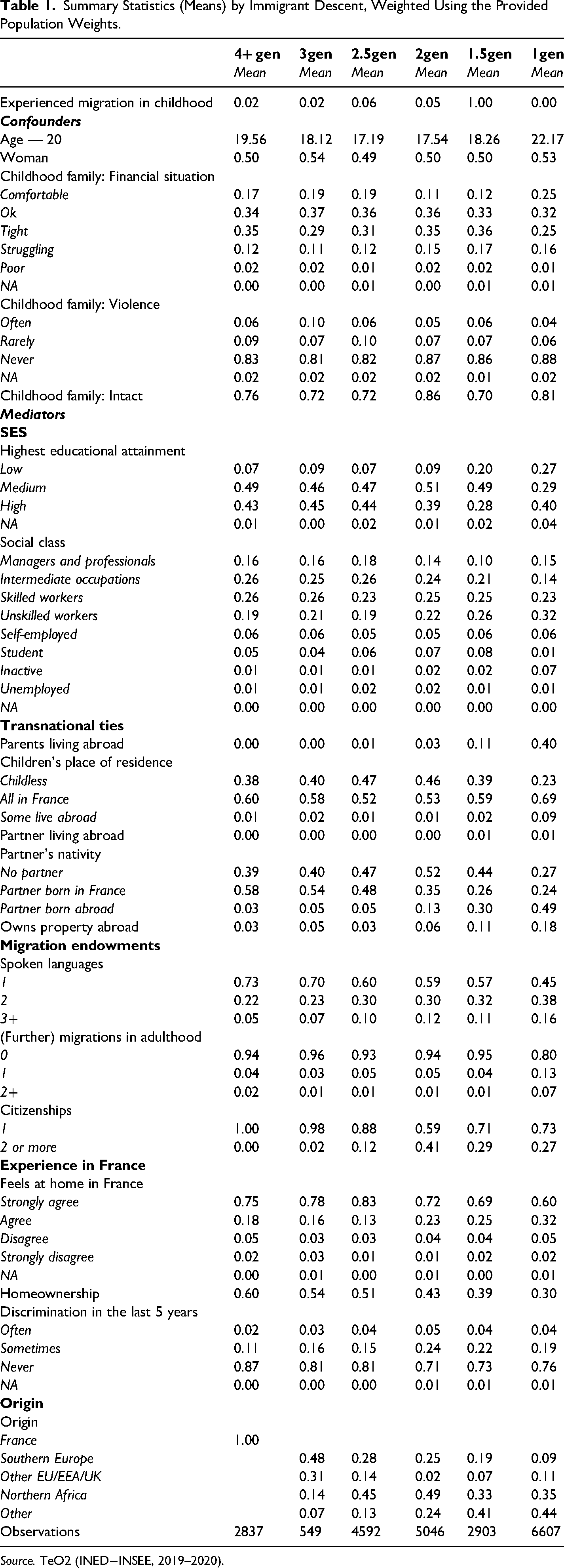
Weighted descriptive statistics stratified by immigrant descent categories are reported in Table 1.
Summary Statistics (Means) by Immigrant Descent, Weighted Using the Provided Population Weights.
Source. TeO2 (INED−INSEE, 2019–2020).
Methods
In the first and main analyses, we use multinomial logistic regression models to estimate the association between openness to migration (immobility, return migration, onward migration), and the interaction between immigrant descent and childhood migration experience, controlling for confounders. All analyses are weighted using the provided population weights.
We then use KHB decomposition (Karlson and Holm 2011; Karlson, Holm, and Breen 2012) to assess the size and statistical significance of each mediators’ group's contribution to the unmediated association between the interaction between immigrant descent and childhood migration experience and openness to migration.
Results
Figure 1 presents the predicted probabilities from the multinomial logistic regression of migration aspirations by immigrant descent and childhood migration experience, controlling for confounders. At first sight, these results support H1, as a more distant immigrant descent is associated with higher immobility aspirations, although differences between 2.5, 2 and 1/1.5 generations are not statistically significant at the 95% threshold. However, the higher openness to international migration of people with a more recent immigrant descent are largely driven by their higher return aspirations, whereas 3+ and 2.5 gen (with or without childhood migration experience) are the groups with the highest onward migration aspirations. This supports H2 but rejects H3.
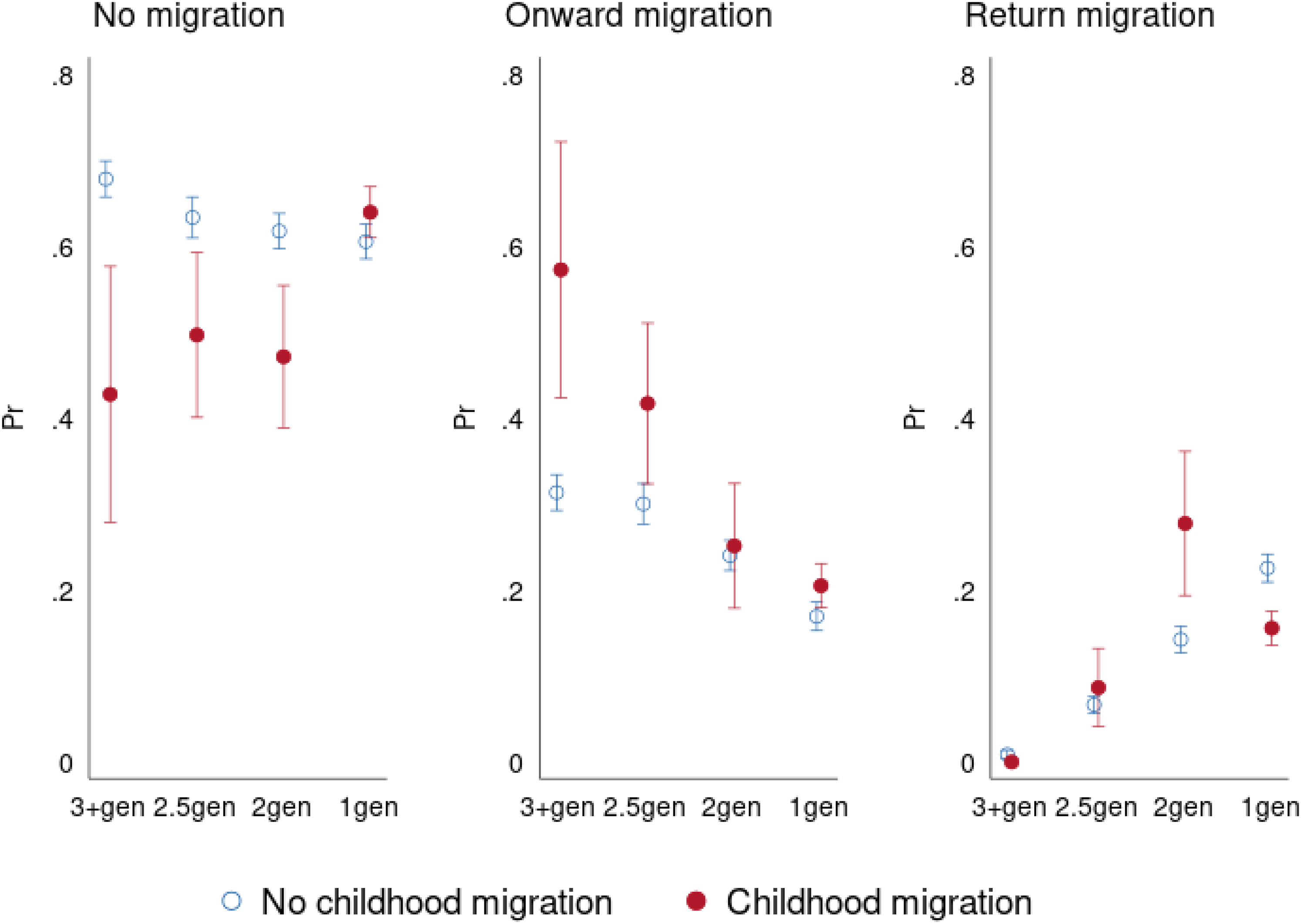
Predicted probabilities of expressing no, return or onward migration intentions by immigrant descent and childhood migration experience.
As expected, having experienced international migration during childhood is associated with lower immobility aspirations in all French-born groups, supporting H4, and the association between childhood migration and onward/return migration aspirations varies substantially by immigrant descent. Among individuals with a more distant immigrant descent (3+ and 2.5gen), childhood migration experiences are associated with higher chances of being open toward onward migration, while the association with return migration aspirations (to an ancestral homeland or to a childhood residence country) is substantially null. To the contrary, having migrated internationally during childhood is not associated with higher onward migration aspirations among the 2gen, but it is associated with much higher chances to express return migration aspirations in this group. H4 and H5 are therefore both supported.
Finally, the 1.5gen (identified in the analyses as 1gen with childhood migration experience) is confirmed as a peculiar group in terms of migration aspirations. Partially in line with H6, this group is the least likely to express onward migration aspirations among those who had internationally mobile childhoods, although the difference compared to the 2gen (with or without childhood migration experiences) is not statistically significant at the 95% threshold. However, contrasting with our H7, the 1.5gen is less likely to report openness toward return migration compared to the 2gen who experienced international migration during childhood, and have instead similar levels of return migration aspirations as the 2gen who spent their entire childhood in France.
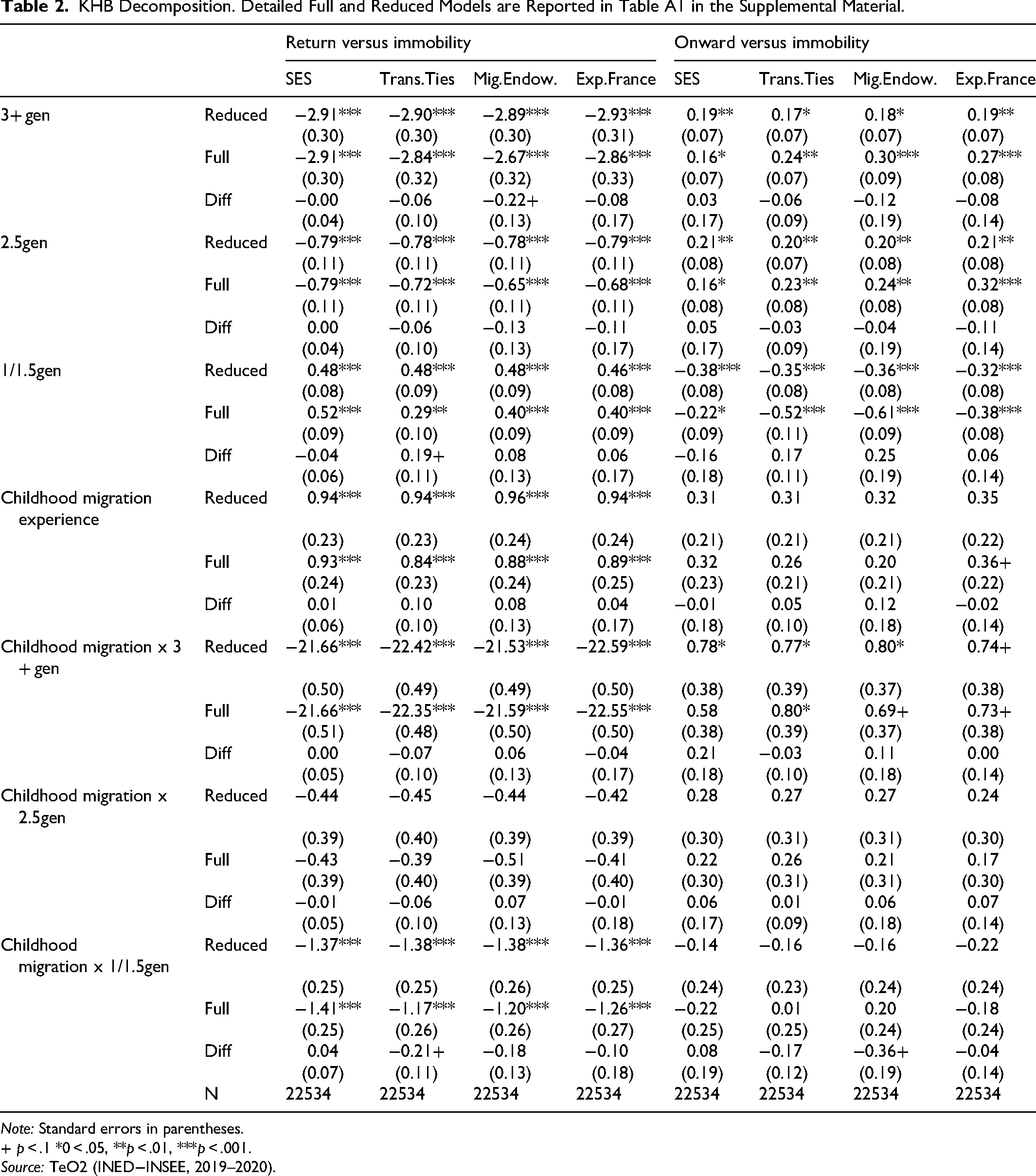
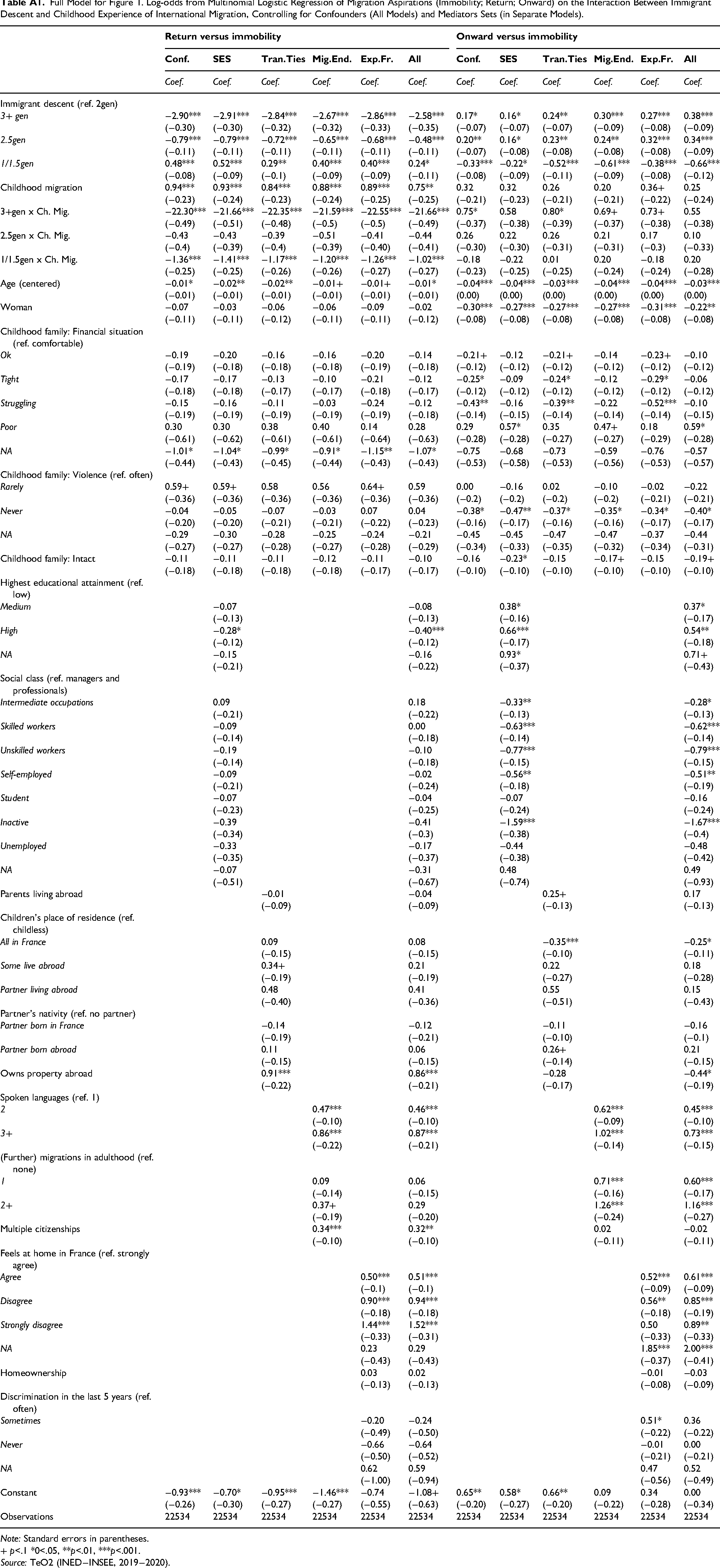
In Table 2, we report the results from the KHB decomposition estimating the contribution of each group of mediators to the unmediated association between the interaction of immigrant descent and childhood migration experience and migration aspirations. In the table, “Reduced” coefficients refer to the models controlling only for confounders, “Full” coefficients refer to the models controlling for confounders and the relevant set of mediators, and “Diff” refers to the difference between the ones and the others. Focusing on the latter, we find that neither socioeconomic attainment (highest educational attainment and social class), nor experience in France (feeling at home in France, homeownership and perceived discrimination) statistically significantly mediate the association between migration aspirations and immigrant descent, childhood migration experience, or their interaction, despite both sets of variables being independently associated with migration aspirations (ref. relevant models in Table A1 in the online appendix).
KHB Decomposition. Detailed Full and Reduced Models are Reported in Table A1 in the Supplemental Material.
Note: Standard errors in parentheses.
+ p < .1 *0 < .05, **p < .01, ***p < .001.
Source: TeO2 (INED−INSEE, 2019–2020).
Instead, transnational ties and what we labeled “migration endowments” partially explain some of the associations described above: the 1gen's stronger transnational ties (see Table 1) statistically significantly explain part of the higher return aspirations of this group compared to both the 2gen and the 1.5gen. At the same time, the difference in return aspirations between the 3+ gen and the 2gen is slightly, but statistically significantly, reduced once migration endowments such as multilingualism and multiple citizenships are controlled for, supporting the idea that the 2gen's higher return aspirations compared to individuals with a more distant immigrant descent are partially due to location-specific migration capital, rather than to negative experiences in the birth country.
Discussion
In this article, we combined three different perspectives on the drivers of migration and remigration aspirations (migration capital framework, the immobility perspective, and migration as an “exit” strategy) to formulate hypotheses on the association between immigrant descent, direct experiences of international migration in childhood, and migration aspirations in adulthood.
Our results are largely compatible, with some caveats, with the migration capital framework and with the immobility perspective, and less so with the perspective seeing migration as an “exit” strategy. We found that a more recent immigrant descent is associated with higher return aspirations and that this association is what drives the lower immobility aspirations of this group: even among those who did not migrate as children, people with a more distant immigrant descent have more onward migration aspirations. This suggests that the kind of migration capital that is transmitted across generations tends to be location-specific (e.g., attachment to the origin country and culture, proficiency in the parental native language, legal entitlement to settle) rather than general (e.g., ability and willingness to deal with immigration bureaucracy and to learn a new language). This is also supported by the mediation analysis, as we find that migration endowments significantly mediate the association between immigrant descent and return, but not onward, migration aspirations. None of the factors we considered explain, even partially, the association between immigrant descent and onward migration aspirations. The lower openness to onward migration of people with a recent immigrant descent is in line with Schewel's (2020) immobility perspective, especially if we broaden the definition of immobility aspirations to include return to the country of origin: 1, 1.5, and 2gen need to invest time and (psychological) resources to become, feel and/or be seen as part of French society, which can be a powerful retain factor to stay in France, or at least can deter them from having to go through the same process again moving to a new country.
Direct experience of international migration during childhood substantially correlates with migration aspirations in adulthood, with important differences by immigrant descent. Among those with a more distant immigrant descent, including the 2.5gen, childhood migration correlates with onward migration aspirations, whereas among the 2gen, childhood migration increases return migration aspirations. This might reflect the different experience and motivation for childhood migration across immigrant descent groups: 2gen are more likely to have migrated to their parents’ birthplace, which reinforced their connection to the country and culture. Instead, 2.5gen and 3gen are more likely to engage in intra-European migration or other North–North migration in a way that does not generate attachment to the specific destination, but rather allows them to perceive international migration as a concrete possibility in their adult life. None of the factors we considered significantly mediates the association between childhood migration experiences and onward migration versus immobility aspirations. This suggests that it is not tangible elements of migration capital such as multilingualism or transnational ties that drive this association, but rather deeper, here unmeasured factors such as what Schewel (2020) labels “internal constraints,” which include personality characteristics (e.g., risk aversion) as well as the absence of migration as a perceived life possibility.
Interestingly, two groups that are very similar in terms of immigrant descent and childhood migration experience, 2gen who migrated as children and 1.5gen, display quite different patterns regarding migration aspirations. 2gen who migrated as children have relatively low immobility aspirations, in line with the other French-born groups who experienced international migration during childhood. Instead, 1.5gen have similar immobility aspirations as the groups who spent their whole childhood in France. In addition, 1.5gen are less likely than 2gen who migrated as children to express return aspirations, despite the latter having spent on average a shorter part of their childhood abroad (6.8 years on average versus 8.7). Again, this likely reflects the more difficult characteristics of the 1.5gen's childhood migration to France compared to the 2gen's migration to their parents’ birthplace. The former generally moved to a country where their parents had little social networks, where they often became visible minorities, and where they might have had to learn a new language and adapt to a new culture. These difficulties in childhood migration might both act as “retain factors,” where the 1.5gen is less willing to move out of France to not lose the investment in adapting to the new place as children, and as “repel factors” against future migration, including to the country of birth.
This study is not without limitations. While we sought to empirically test the main mechanisms proposed in the three theoretical perspectives through mediation analysis, the available data did not allow us to capture all of them. In particular, most “retain” and “repel” factors, as well as “internal constraints,” could not be directly measured. As a result, support for the immobility aspiration perspective rests largely on the alignment between hypothesized and observed associations between immigrant descent, childhood migration, and migration aspirations. Future research should further unpack the mechanisms shaping migration aspirations, perhaps including information on personality traits (internal constraints) and qualitative insight on the individuals’ perception of the costs and benefits of migration.
Overall, our results paint a nuanced picture of the association between childhood experiences of international migration and migration aspirations in adulthood. On one side, direct and indirect childhood experiences promote migration aspirations in adulthood, as predicted by the migration capital framework. However, this article highlights that for people with a recent immigrant background, who are often visible minorities in the country under study, this intergenerationally transmitted propensity to migrate is mostly directed to an origin country, especially when the indirect transmission of migration capital is paired with direct childhood experience of migration. Having a recent immigrant background instead seems to deter onward migration aspirations, a finding that cannot easily be explained through the migration capital framework and that is more in line with Schewel's immobility perspective, under which migration, and the investments made in the process, can be a source of attachment to the destination country and a deterrent of further (onward) migration.
Supplemental Material
sj-docx-1-mrx-10.1177_01979183251409788 - Supplemental material for Where to (Next)? Family and Childhood Migration Experience and Migration Aspirations in Adulthood
Supplemental material, sj-docx-1-mrx-10.1177_01979183251409788 for Where to (Next)? Family and Childhood Migration Experience and Migration Aspirations in Adulthood by Claudia Brunori, Louise Caron, and Sergi Vidal in International Migration Review
Footnotes

Funding
The authors disclosed receipt of the following financial support for the research, authorship, and/or publication of this article: This paper is part of the LIFELONGMOVE project (DOI: 10.3030/101043981) funded by the European Research Council (ERC) under the European Union's Horizon Europe research and innovation programme (Grant Agreement No. 101043981).
Declaration of Conflicting Interests
The authors declared no potential conflicts of interest with respect to the research, authorship, and/or publication of this article.
Supplemental Material
Supplemental material for this article is available online.
Notes
Appendix — Complementary Tables and Figures
Full Model for Figure 1. Log-odds from Multinomial Logistic Regression of Migration Aspirations (Immobility; Return; Onward) on the Interaction Between Immigrant Descent and Childhood Experience of International Migration, Controlling for Confounders (All Models) and Mediators Sets (in Separate Models).
|
|
|
|||||||||||
|---|---|---|---|---|---|---|---|---|---|---|---|---|
|
|
|
|
|
|
|
|
|
|
|
|
|
|
| Coef. | Coef. | Coef. | Coef. | Coef. | Coef. | Coef. | Coef. | Coef. | Coef. | Coef. | Coef. | |
| Immigrant descent (ref. 2gen) | ||||||||||||
| 3+ gen | −2.90*** | −2.91*** | −2.84*** | −2.67*** | −2.86*** | −2.58*** | 0.17* | 0.16* | 0.24** | 0.30*** | 0.27*** | 0.38*** |
| (−0.30) | (−0.30) | (−0.32) | (−0.32) | (−0.33) | (−0.35) | (−0.07) | (−0.07) | (−0.07) | (−0.09) | (−0.08) | (−0.09) | |
| 2.5gen | −0.79*** | −0.79*** | −0.72*** | −0.65*** | −0.68*** | −0.48*** | 0.20** | 0.16* | 0.23** | 0.24** | 0.32*** | 0.34*** |
| (−0.11) | (−0.11) | (−0.11) | (−0.11) | (−0.11) | (−0.11) | (−0.07) | (−0.08) | (−0.08) | (−0.08) | (−0.08) | (−0.09) | |
| 1/1.5gen | 0.48*** | 0.52*** | 0.29** | 0.40*** | 0.40*** | 0.24* | −0.33*** | −0.22* | −0.52*** | −0.61*** | −0.38*** | −0.66*** |
| (−0.08) | (−0.09) | (−0.1) | (−0.09) | (−0.09) | (−0.11) | (−0.08) | (−0.09) | (−0.11) | (−0.09) | (−0.08) | (−0.12) | |
| Childhood migration | 0.94*** | 0.93*** | 0.84*** | 0.88*** | 0.89*** | 0.75** | 0.32 | 0.32 | 0.26 | 0.20 | 0.36+ | 0.25 |
| (−0.23) | (−0.24) | (−0.23) | (−0.24) | (−0.25) | (−0.25) | (−0.21) | (−0.23) | (−0.21) | (−0.21) | (−0.22) | (−0.24) | |
| 3+gen x Ch. Mig. | −22.30*** | −21.66*** | −22.35*** | −21.59*** | −22.55*** | −21.66*** | 0.75* | 0.58 | 0.80* | 0.69+ | 0.73+ | 0.55 |
| (−0.49) | (−0.51) | (−0.48) | (−0.5) | (−0.5) | (−0.49) | (−0.37) | (−0.38) | (−0.39) | (−0.37) | (−0.38) | (−0.38) | |
| 2.5gen x Ch. Mig. | −0.43 | −0.43 | −0.39 | −0.51 | −0.41 | −0.44 | 0.26 | 0.22 | 0.26 | 0.21 | 0.17 | 0.10 |
| (−0.4) | (−0.39) | (−0.4) | (−0.39) | (−0.40) | (−0.41) | (−0.30) | (−0.30) | (−0.31) | (−0.31) | (−0.3) | (−0.33) | |
| 1/1.5gen x Ch. Mig. | −1.36*** | −1.41*** | −1.17*** | −1.20*** | −1.26*** | −1.02*** | −0.18 | −0.22 | 0.01 | 0.20 | −0.18 | 0.20 |
| (−0.25) | (−0.25) | (−0.26) | (−0.26) | (−0.27) | (−0.27) | (−0.23) | (−0.25) | (−0.25) | (−0.24) | (−0.24) | (−0.28) | |
| Age (centered) | −0.01* | −0.02** | −0.02** | −0.01+ | −0.01+ | −0.01* | −0.04*** | −0.04*** | −0.03*** | −0.04*** | −0.04*** | −0.03*** |
| (−0.01) | (−0.01) | (−0.01) | (−0.01) | (−0.01) | (−0.01) | (0.00) | (0.00) | (0.00) | (0.00) | (0.00) | (0.00) | |
| Woman | −0.07 | −0.03 | −0.06 | −0.06 | −0.09 | −0.02 | −0.30*** | −0.27*** | −0.27*** | −0.27*** | −0.31*** | −0.22** |
| (−0.11) | (−0.11) | (−0.12) | (−0.11) | (−0.11) | (−0.12) | (−0.08) | (−0.08) | (−0.08) | (−0.08) | (−0.08) | (−0.08) | |
| Childhood family: Financial situation (ref. comfortable) | ||||||||||||
| Ok | −0.19 | −0.20 | −0.16 | −0.16 | −0.20 | −0.14 | −0.21+ | −0.12 | −0.21+ | −0.14 | −0.23+ | −0.10 |
| (−0.19) | (−0.18) | (−0.18) | (−0.18) | (−0.19) | (−0.18) | (−0.12) | (−0.12) | (−0.12) | (−0.12) | (−0.12) | (−0.12) | |
| Tight | −0.17 | −0.17 | −0.13 | −0.10 | −0.21 | −0.12 | −0.25* | −0.09 | −0.24* | −0.12 | −0.29* | −0.06 |
| (−0.18) | (−0.18) | (−0.17) | (−0.17) | (−0.18) | (−0.17) | (−0.12) | (−0.12) | (−0.12) | (−0.12) | (−0.12) | (−0.12) | |
| Struggling | −0.15 | −0.16 | −0.11 | −0.03 | −0.24 | −0.12 | −0.43** | −0.16 | −0.39** | −0.22 | −0.52*** | −0.10 |
| (−0.19) | (−0.19) | (−0.19) | (−0.19) | (−0.19) | (−0.18) | (−0.14) | (−0.15) | (−0.14) | (−0.14) | (−0.14) | (−0.15) | |
| Poor | 0.30 | 0.30 | 0.38 | 0.40 | 0.14 | 0.28 | 0.29 | 0.57* | 0.35 | 0.47+ | 0.18 | 0.59* |
| (−0.61) | (−0.62) | (−0.61) | (−0.61) | (−0.64) | (−0.63) | (−0.28) | (−0.28) | (−0.27) | (−0.27) | (−0.29) | (−0.28) | |
| NA | −1.01* | −1.04* | −0.99* | −0.91* | −1.15** | −1.07* | −0.75 | −0.68 | −0.73 | −0.59 | −0.76 | −0.57 |
| (−0.44) | (−0.43) | (−0.45) | (−0.44) | (−0.43) | (−0.43) | (−0.53) | (−0.58) | (−0.53) | (−0.56) | (−0.53) | (−0.57) | |
| Childhood family: Violence (ref. often) | ||||||||||||
| Rarely | 0.59+ | 0.59+ | 0.58 | 0.56 | 0.64+ | 0.59 | 0.00 | −0.16 | 0.02 | −0.10 | −0.02 | −0.22 |
| (−0.36) | (−0.36) | (−0.36) | (−0.36) | (−0.36) | (−0.36) | (−0.2) | (−0.2) | (−0.2) | (−0.2) | (−0.21) | (−0.21) | |
| Never | −0.04 | −0.05 | −0.07 | −0.03 | 0.07 | 0.04 | −0.38* | −0.47** | −0.37* | −0.35* | −0.34* | −0.40* |
| (−0.20) | (−0.20) | (−0.21) | (−0.21) | (−0.22) | (−0.23) | (−0.16) | (−0.17) | (−0.16) | (−0.16) | (−0.17) | (−0.17) | |
| NA | −0.29 | −0.30 | −0.28 | −0.25 | −0.24 | −0.21 | −0.45 | −0.45 | −0.47 | −0.47 | −0.37 | −0.44 |
| (−0.27) | (−0.27) | (−0.28) | (−0.27) | (−0.28) | (−0.29) | (−0.34) | (−0.33) | (−0.35) | (−0.32) | (−0.34) | (−0.31) | |
| Childhood family: Intact | −0.11 | −0.11 | −0.11 | −0.12 | −0.11 | −0.10 | −0.16 | −0.23* | −0.15 | −0.17+ | −0.15 | −0.19+ |
| (−0.18) | (−0.18) | (−0.18) | (−0.18) | (−0.17) | (−0.17) | (−0.10) | (−0.10) | (−0.10) | (−0.10) | (−0.10) | (−0.10) | |
| Highest educational attainment (ref. low) | ||||||||||||
| Medium | −0.07 | −0.08 | 0.38* | 0.37* | ||||||||
| (−0.13) | (−0.13) | (−0.16) | (−0.17) | |||||||||
| High | −0.28* | −0.40*** | 0.66*** | 0.54** | ||||||||
| (−0.12) | (−0.12) | (−0.17) | (−0.18) | |||||||||
| NA | −0.15 | −0.16 | 0.93* | 0.71+ | ||||||||
| (−0.21) | (−0.22) | (−0.37) | (−0.43) | |||||||||
| Social class (ref. managers and professionals) | ||||||||||||
| Intermediate occupations | 0.09 | 0.18 | −0.33** | −0.28* | ||||||||
| (−0.21) | (−0.22) | (−0.13) | (−0.13) | |||||||||
| Skilled workers | −0.09 | 0.00 | −0.63*** | −0.62*** | ||||||||
| (−0.14) | (−0.18) | (−0.14) | (−0.14) | |||||||||
| Unskilled workers | −0.19 | −0.10 | −0.77*** | −0.79*** | ||||||||
| (−0.14) | (−0.18) | (−0.15) | (−0.15) | |||||||||
| Self-employed | −0.09 | −0.02 | −0.56** | −0.51** | ||||||||
| (−0.21) | (−0.24) | (−0.18) | (−0.19) | |||||||||
| Student | −0.07 | −0.04 | −0.07 | −0.16 | ||||||||
| (−0.23) | (−0.25) | (−0.24) | (−0.24) | |||||||||
| Inactive | −0.39 | −0.41 | −1.59*** | −1.67*** | ||||||||
| (−0.34) | (−0.3) | (−0.38) | (−0.4) | |||||||||
| Unemployed | −0.33 | −0.17 | −0.44 | −0.48 | ||||||||
| (−0.35) | (−0.37) | (−0.38) | (−0.42) | |||||||||
| NA | −0.07 | −0.31 | 0.48 | 0.49 | ||||||||
| (−0.51) | (−0.67) | (−0.74) | (−0.93) | |||||||||
| Parents living abroad | −0.01 | −0.04 | 0.25+ | 0.17 | ||||||||
| (−0.09) | (−0.09) | (−0.13) | (−0.13) | |||||||||
| Children's place of residence (ref. childless) | ||||||||||||
| All in France | 0.09 | 0.08 | −0.35*** | −0.25* | ||||||||
| (−0.15) | (−0.15) | (−0.10) | (−0.11) | |||||||||
| Some live abroad | 0.34+ | 0.21 | 0.22 | 0.18 | ||||||||
| (−0.19) | (−0.19) | (−0.27) | (−0.28) | |||||||||
| Partner living abroad | 0.48 | 0.41 | 0.55 | 0.15 | ||||||||
| (−0.40) | (−0.36) | (−0.51) | (−0.43) | |||||||||
| Partner's nativity (ref. no partner) | ||||||||||||
| Partner born in France | −0.14 | −0.12 | −0.11 | −0.16 | ||||||||
| (−0.19) | (−0.21) | (−0.10) | (−0.1) | |||||||||
| Partner born abroad | 0.11 | 0.06 | 0.26+ | 0.21 | ||||||||
| (−0.15) | (−0.15) | (−0.14) | (−0.15) | |||||||||
| Owns property abroad | 0.91*** | 0.86*** | −0.28 | −0.44* | ||||||||
| (−0.22) | (−0.21) | (−0.17) | (−0.19) | |||||||||
| Spoken languages (ref. 1) | ||||||||||||
| 2 | 0.47*** | 0.46*** | 0.62*** | 0.45*** | ||||||||
| (−0.10) | (−0.10) | (−0.09) | (−0.10) | |||||||||
| 3+ | 0.86*** | 0.87*** | 1.02*** | 0.73*** | ||||||||
| (−0.22) | (−0.21) | (−0.14) | (−0.15) | |||||||||
| (Further) migrations in adulthood (ref. none) | ||||||||||||
| 1 | 0.09 | 0.06 | 0.71*** | 0.60*** | ||||||||
| (−0.14) | (−0.15) | (−0.16) | (−0.17) | |||||||||
| 2+ | 0.37+ | 0.29 | 1.26*** | 1.16*** | ||||||||
| (−0.19) | (−0.20) | (−0.24) | (−0.27) | |||||||||
| Multiple citizenships | 0.34*** | 0.32** | 0.02 | −0.02 | ||||||||
| (−0.10) | (−0.10) | (−0.11) | (−0.11) | |||||||||
| Feels at home in France (ref. strongly agree) | ||||||||||||
| Agree | 0.50*** | 0.51*** | 0.52*** | 0.61*** | ||||||||
| (−0.1) | (−0.1) | (−0.09) | (−0.09) | |||||||||
| Disagree | 0.90*** | 0.94*** | 0.56** | 0.85*** | ||||||||
| (−0.18) | (−0.18) | (−0.18) | (−0.19) | |||||||||
| Strongly disagree | 1.44*** | 1.52*** | 0.50 | 0.89** | ||||||||
| (−0.33) | (−0.31) | (−0.33) | (−0.33) | |||||||||
| NA | 0.23 | 0.29 | 1.85*** | 2.00*** | ||||||||
| (−0.43) | (−0.43) | (−0.37) | (−0.41) | |||||||||
| Homeownership | 0.03 | 0.02 | −0.01 | −0.03 | ||||||||
| (−0.13) | (−0.13) | (−0.08) | (−0.09) | |||||||||
| Discrimination in the last 5 years (ref. often) | ||||||||||||
| Sometimes | −0.20 | −0.24 | 0.51* | 0.36 | ||||||||
| (−0.49) | (−0.50) | (−0.22) | (−0.22) | |||||||||
| Never | −0.66 | −0.64 | −0.01 | 0.00 | ||||||||
| (−0.50) | (−0.52) | (−0.21) | (−0.21) | |||||||||
| NA | 0.62 | 0.59 | 0.47 | 0.52 | ||||||||
| (−1.00) | (−0.94) | (−0.56) | (−0.49) | |||||||||
| Constant | −0.93*** | −0.70* | −0.95*** | −1.46*** | −0.74 | −1.08+ | 0.65** | 0.58* | 0.66** | 0.09 | 0.34 | 0.00 |
| (−0.26) | (−0.30) | (−0.27) | (−0.27) | (−0.55) | (−0.63) | (−0.20) | (−0.27) | (−0.20) | (−0.22) | (−0.28) | (−0.34) | |
| Observations | 22534 | 22534 | 22534 | 22534 | 22534 | 22534 | 22534 | 22534 | 22534 | 22534 | 22534 | 22534 |
Note: Standard errors in parentheses.
+ p<.1 *0<.05, **p<.01, ***p<.001.
Source: TeO2 (INED−INSEE, 2019−2020).
References
Supplementary Material
Please find the following supplemental material available below.
For Open Access articles published under a Creative Commons License, all supplemental material carries the same license as the article it is associated with.
For non-Open Access articles published, all supplemental material carries a non-exclusive license, and permission requests for re-use of supplemental material or any part of supplemental material shall be sent directly to the copyright owner as specified in the copyright notice associated with the article.
