




Abstract
How does the viewing of social media content produced by Senegalese migrants residing in Europe correlate with migration aspirations of people in Senegal? We answer this research question by interrogating original survey data from two regions in Senegal, Dakar and the Casamance, as well as original interview data of (potential) Senegalese migrants, repatriates, migration experts, and stakeholders. Using a mixed-methods approach that combines our qualitative interview and quantitative survey data, we provide robust evidence that viewing more social media content produced by compatriots in Europe coincides with stronger migration aspirations among respondents in Dakar and the Casamance. We also shed light on potential mechanisms. Here, our findings suggest that viewers of social media content by Senegalese migrants in Europe express higher admiration for migrants, consider the migration journey to Europe to be more viable and expect life in Europe to be especially rewarding. Our findings are in line with the cognitive migration model, which posits that migration aspirations are shaped by the potential migrants’ mental time travel to an imagined future abroad. We argue that browsing social media content produced by Senegalese migrants residing in Europe creates particularly positive notions about migration and life in Europe, fueling migration aspirations by facilitating and making the cognitive migration of people in Dakar and the Casamance especially appealing.
Keywords
Introduction
The internet increasingly shapes domestic and international migration. There is substantial evidence that access to the internet fosters migration by enhancing one's migration abilities; such abilities allow one to convert their migration wish into reality (Carling and Schewel 2018, 955). For instance, the internet can reduce information and travel costs associated with the migration journey, make it easier to cultivate social ties with compatriots in transit and destination countries of migration and lower the costs of cross-border communication, which, in turn, reduces the psychological costs associated with migration (e.g., Dekker and Engbersen 2014; Dekker, Engbersen, and Faber 2016, 2018; Gillespie, Osseiran, and Cheesman 2018; Hiller and Franz 2004; Pesando et al. 2021; Vilhelmson and Thulin 2013).
However, one's actual migration is only the endpoint of a longer migration process. For instance, Kley (2011) proposes a three-stage model of this process, differentiating between the wish or consideration to migrate, the planning of migration, and its eventual realization. Similarly, in their aspiration-ability framework, Carling and Schewel (2018, 947) argue that the migration process consists of two steps: migration aspirations and actual migration. 1 Importantly, not all migration aspirations lead to actual migration, even though there tends to be a positive relationship between both stages of the migration process (e.g., Docquier, Peri, and Ruyssen 2014; Lu 1999; Tjaden, Auer, and Laczko 2019). In other words, there is a difference between the formation of migration aspirations and the translation of such aspirations into action. Consequently, in addition to its role in actual migration, research has also focused on the role of the internet in affecting migration aspirations. Here, the empirical evidence suggests that internet access and increased internet usage also correlate with higher migration aspirations (e.g., Aslany et al. 2021; Golovics 2020; Grubanov-Boskovic et al. 2021; Marrow and Klekowski von Koppenfels 2020; Pesando et al. 2021; Sadiddin et al. 2019; Thulin and Vilhelmson 2016).
In this paper, we add to the empirical literature on the role of the internet in shaping the first step of the migration process, the formation of migration aspirations, by interrogating original survey data of several thousand respondents from two regions in Senegal, Dakar and the Casamance, and original interview data of Senegalese in their country of origin and in Europe. Grubanov-Boskovic et al. (2021) have already investigated the relationship between migration aspirations and internet access in 29 African countries (including Senegal) in 2014/2015. They find that having internet access is positively associated with both the desire to move abroad and migration preparations, where internet access especially drives migration preparations.
With this study, we directly respond to the concluding remarks of Grubanov-Boskovic et al. (2021, 1819) who call for future research “to more precisely identify the causal connections between not only Internet access, but also online experiences, and intentions to move.” We add to Grubanov-Boskovic et al. (2021) and the broader literature on the role of the internet in migration aspirations in two major ways. First, rather than considering the mere effect of internet access on aspirations, we investigate the role of internet content. In detail, we study how viewing social media content by Senegalese migrants in Europe (published on Facebook, WhatsApp, Instagram, TikTok, Snapchat, and similar apps or websites) correlates with the migration aspirations of people in Dakar and the Casamance. That is, we consider a specific reason how access to the internet (i.e., variation in exposure to a specific type of social media content) could influence migration aspirations. Second, a mixed-methods approach allows us to combine the insights gained from regression analyses of our original survey data and qualitative interview data to make more well-founded statements about the linkages between social media content and migration aspirations. We also use our quantitative and qualitative data to explore mechanisms that could govern the nexus between social media exposure and migration aspirations. We can therefore provide insights into how internet access and technological progress could shape migration aspirations.
We focus on the nexus between exposure to social media content produced by Senegalese migrants in Europe and migration aspiration in two regions of Senegal, Dakar and the Casamance, because of Senegal's migration history. Senegalese migration to Europe started over a century ago with the deployment of Senegalese for the French army in World War I and the recruitment of former soldiers as well as of people in Senegal as workers by France (Maher 2017; Mourre 2018). Since the 1980s, Senegalese migration to Europe has further increased. Apart from the former colonizer France, Spain and Italy have become important destination countries (Fall 2016; Hernández-Carretero 2016; Riccio 2001). Irregular migration to Europe by Senegalese is a newer phenomenon that started after European countries implemented migration restrictions, starting with France in 1987 (Flahaux 2017; Maher 2017). That is, Europe has been a favored migration destination for Senegalese migrants, meaning that (1) migration aspirations are likely to form with Europe as a destination in mind, while (2) the Senegalese diaspora in Europe is large at the same time, making it plausible that the social media content Senegalese migrants in Europe produce is prevalent enough to shape migration aspirations back in Senegal.
To preview our main quantitative results, we find a positive association between the viewing of migrants’ social media content and individual migration aspirations in a regression analysis of our original survey data of several thousand respondents in Dakar and the Casamance. Our findings are robust to the inclusion of a variety of control variables, different operationalizations of migration aspirations, and different estimation techniques. They are also supported by our qualitative results showing that respondents, in both Senegal and Europe, often refer to the role of social media content in shaping their migration aspirations. Finally, exploring both the survey and interview data, we shed light on the mechanisms linking social media usage and migration aspirations. We find that the avid viewing of migrants’ social media content is associated with higher levels of admiration for migrants as well as higher expectations that the migration journey to Europe is viable and that life in Europe is rewarding.
Our empirical findings suggest that browsing social media content by Senegalese migrants residing in Europe creates positive notions about migration, consequently fueling migration aspirations of Senegalese people residing in Dakar and the Casamance. These findings speak to the model of cognitive migration, where migration aspirations are shaped by the mental time travel into a likely future in a different country and the construction of corresponding migration narratives (Koikkalainen and Kyle 2016). For instance, prospective migrants in Dakar and the Casamance may believe the lives of their compatriots abroad to be more worthwhile after having enjoyed predominantly positive migrants’ social media content of life in Europe. This, in turn, is expected to facilitate one's own cognitive migration, with prospective migrants constructing their own narrative of also becoming a successful migrant in the future.
The remainder of this paper is organized as follows. In Section “Theoretical Framework”, we discuss our theoretical approach. Section “Data” introduces our data, while Section “Patterns of Migration Aspirations and Exposure to Migrants’ Social Media Content” discusses migration aspirations and social media use in the two Senegalese regions we surveyed. Using both interview and survey data, in Section “Relationship between Migrants’ Social Media Content and Migration Aspirations”, we investigate the association between migrants’ social media content and the migration aspirations voiced by people living in Dakar and the Casamance. In Section “Exploration of Mechanisms”, we explore potential mechanisms underlying the nexus between the viewing of this social media content and migration aspirations. Section “Conclusion” concludes.
Theoretical Framework
Stages of the Migration Process. The migration process involves several steps (e.g., Carling and Schewel 2018; Kley 2011). It commonly starts with the formation of migration aspirations and includes the planning and preparation of the migration journey, culminating in the migration journey itself. What is more, the migration process may then even repeat itself, leading to, e.g., onward or return migration.
In this contribution, we are interested in how the social media content by Senegalese migrants in Europe affects the first stage of the migration process, i.e., the emergence of migration aspirations. While not all migration aspirations are ultimately realized, there tends to be a positive correlation between them and out-migration (e.g., Docquier, Peri, and Ruyssen 2014; Lu 1999; Tjaden, Auer, and Laczko 2019). For instance, Tjaden, Auer, and Laczko (2019) study the relationship between migration aspirations and official migration flow data for more than 160 countries, showing that there is on average a positive association between aspirations and aggregated international migration. Consequently, understanding how migrants’ social media content shapes migration aspirations is also important to assess the relationship between the viewing of social media content and the observed patterns of international migration.
Determinants of Migration Aspirations and the Role of Migrants’ Social Media Content. How are migration aspirations formed? To answer this question, we rely on the theoretical framework of cognitive migration by Koikkalainen and Kyle (2016). The cognitive migration framework is a novel approach to incorporating imagination and prospective thinking into migration studies. Koikkalainen and Kyle suggest that their framework is especially relevant to better understand “potentially risky, emotionally laden, major decisions” (Koikkalainen and Kyle 2016, 770), which includes migration decisions. In detail, Koikkalainen and Kyle (2016, 767) define cognitive migration as the phase of decision-making in which the experimental, always-on, imagination actively, though not always consciously, negotiates one's future social worlds and, hence, emotional states converging around a core destination. This mental time travel into a possible future in a different country constructs a narrative on how one's life is likely to proceed if one chooses to migrate […].
First, users of social media tend to present themselves in a positive light on social media platforms (e.g., Schreurs and Vandenbosch 2021; Sheldon and Bryant 2016; Vogel and Rose 2016). This is a consequence of the so-called positivity bias, where “social media users strategically post self-related content, which is typically highly selective, curated and unspontaneous […] [with the] goal of a positive self-presentation” (Schreurs and Vandenbosch 2021, 331). Due to this bias, pictures and videos posted by Senegalese migrants residing in Europe may highlight positive events but downplay negative experiences abroad (e.g., concerning working conditions or discrimination).
Second, pictures and videos are particularly potent in grabbing attention and eliciting an emotional response compared to text-based social media posts (as also shown by research on online marketing and advertising; see, e.g., Li and Xie 2020). This suggests that the posting of pictures and videos by Senegalese migrants in Europe ought to produce a particularly strong emotional response. Given the prevalence of positivity bias, this emotional response will likely be positive.
Third, social media content is generated by sources that users usually consider to be trustworthy, oftentimes due to personal ties (e.g., family and friends who live abroad). Even when there are no personal ties, social media personas (influencers) may also be considered trustworthy due to the development of para-social relationships (e.g., in the form of a one-sided “friendship”) with them (e.g., Liebers and Schramm 2019; Shareef et al. 2020; Sterrett et al. 2019). This trust is expected to facilitate a particularly pleasant and impactful cognitive migration.
In sum, we hypothesize that viewing migrants’ social media content is associated with higher international migration aspirations. We derive this hypothesis from the cognitive migration framework, arguing that migrants’ social media content facilitates this cognitive migration by providing individuals with eminently trustworthy and pleasant (curated) images and imaginations about the migration journey and life in Europe, ultimately inspiring individual migration aspirations.
Importantly, our main hypothesis could also be derived from other theories concerning the formation of migration aspirations. For instance, economic models of migration postulate that potential migrants weigh the benefits of migration against the benefits of staying in their home countries, developing migration aspirations when the former benefits outweigh the latter (e.g., de Aslany et al. 2021; Borjas 1989). Here, migrants’ social media content may affect this economic calculus in ways that create stronger migration aspirations, e.g., by increasing the expected benefits of migration when social media content paints a favorable picture of life in Europe. In summary, then, while we see the cognitive migration framework as most appropriate in the context of our analysis, our theoretical expectations are not contingent upon the choice of a specific analytical framework.
Data
To explore the relationship between the social media content posted by Senegalese migrants residing in Europe and migration aspirations, we collected original data from (a) a survey of approximately 4,000 respondents in two Senegalese regions, Dakar and the Casamance, and (b) semi-structured interviews with Senegalese migrants and experts in Europe as well as potential migrants, returnees and migration experts in Senegal. Our research design followed a sequential approach: we first conducted the qualitative fieldwork, which led to the development of the research question for this paper and informed the questionnaire design for the quantitative data collection. In this section, we describe our two data sources in more detail.
Interview Data
We conducted semi-structured interviews in the Dakar and Casamance regions, Italy (Turin, Rome, and Palermo), and Germany (Berlin and online due to COVID-19 regulations). The interviews were conducted between October 2019 and February 2020 in Senegal, between September 2020 and August 2021 in Germany and between September and October 2021 in Italy. The interview languages were French, Italian, Pulaar (a local Senegalese language for which an interpreter was employed), or Wolof (Senegal's lingua franca, spoken by one of the co-authors). In Senegal, 41 interviews were conducted with 57 individuals, amongst them migrants’ family members and friends (12 interviews), return migrants (24 interviews), and experts (5 interviews). In Italy, interviews were conducted with 28 individuals (26 Senegalese migrants and two migration experts). Finally, in Germany, 15 interviews were conducted with 19 individuals (5 Senegalese migrants and 14 members of Senegalese migrant associations).
At this point in time, the ethics committee of our institution does not require formal ethical clearance for qualitative research projects. Nevertheless, we discussed the interview guide with Senegalese researchers and adjusted it according to their feedback. Prior to the interview, the interview partners were informed, in written and oral form, about the scope of the research project, the anonymization procedure, and the possibility to interrupt or withdraw from the interview at any time. The interview partners gave their written or, in case of illiteracy, oral consent before the start of the interview. Inter alia, we asked interviewees about their (retrospective) migration aspirations, expectations, and experiences. During the qualitative fieldwork, social media came up frequently, so we included questions on interviewees’ exposure to and perception of social media content produced by Senegalese in Europe.
Interview partners were recruited through personal contacts and through gatekeepers such as migrant associations and a Senegalese research assistant. In some cases, interviewees also connected the interviewer with other potential interview partners (snowball sampling). In general, the sampling of interview partners in Senegal was guided by the desire for equal representation of potential migrants and return migrants, as well as of interviewees from Dakar and Casamance. Finally, we also aimed for equal representation along gender and educational lines when selecting potential interview candidates in all three countries. The interviews were transcribed and analyzed using MAXQDA, a software tool designed for computer-assisted text analysis. We coded the first five interviews inductively to develop a code tree for the analysis of the other interviews.
Survey Data
Between November 2021 and January 2022, survey data were collected in Dakar and the Casamance regions, the former being a very urban and the latter a rural region; our results are thus only representative for these parts of Senegal. Both regions have high emigration rates but differ greatly with regards to, e.g., poverty rates, education level, as well as ethnic and religious composition. The survey interviews were conducted in French or a local language (Wolof, Pulaar, Mandinka, or Diola) as computer-assisted personal interviews by local interviewers in cooperation with Senegal's National Agency of Statistics and Demography (ANSD). Respondents were randomly drawn from the population of 15- to 35-year-olds. Young respondents are expected to be especially technophilic, making it more plausible that social media shapes their migration aspirations. What is more, young respondents are most likely to migrate in the first place (e.g., Aslany et al. 2021). According to the World Bank (2024), in 2020, approximately 35 percent of the population was between 15 and 35, while only 25 percent were older than 35; approximately 40 percent were younger than 15. While our findings do not generalize to the whole adult population, especially people older than 35, 15 to 35 years old still account for approximately 71 percent of the adult population.
4,037 respondents from 4,037 households in the Dakar region (N = 997) and Casamance region (total N = 3,040, with the sub-regions Ziguinchor N = 1,629, Sédhiou N = 614 and Kolda N = 797) were surveyed. 2 Within households, respondents were selected through a simple random draw, with the selected respondent having a two-thirds probability of being male. For all surveyed regions, ANSD used auxiliary data to validate that the survey data were indeed representative of the population in the surveyed regions and in the given age bracket (after accounting for the previously mentioned gender imbalance due to our survey design). In light of oversampling of men and random stratified sampling in several Senegalese regions, for all subsequent empirical analyses with the survey data, we employ post-stratification weights to reflect the actual gender distribution in Senegal (which is approximately 1:1), while also accounting for differences in population size (per the most recent census) between the surveyed regions. For instance, this results in female respondents from the Dakar region being weighted especially strongly.
In the survey, respondents were asked about their migration aspirations and plans as well as their socio-economic and demographic characteristics (e.g., age, gender and relationship status). Further survey questions concerned, for example, the respondents’ experience with migration as well as their thoughts on life in Senegal and abroad (e.g., with respect to economic prospects at home vis-à-vis abroad).
We accounted for ethical considerations when designing our survey in several ways. For one, we received formal ethical clearance for our research project and underlying questionnaire from the ethics committee of our institution before the start of the survey. For another, we were aware of the fact that especially inquiring about migration aspirations can be sensitive in a context in which many people cannot act on their migration aspirations. Consequently, we solicited feedback from ANSD and other Senegalese researchers prior to the data collection regarding the locals’ understanding of the questionnaire. This feedback proved very helpful, allowing us to change questions that were regarded as potentially sensitive to avoid potential discomfort for the survey participants. Finally, when the survey data were collected, all survey respondents were asked for their consent before the interviews started, where anonymity was always guaranteed.
Patterns of Migration Aspirations and Exposure to Migrants’ Social Media Content
In this section, we provide background information on migration aspirations and the viewing of migrants’ social media content, using our qualitative and quantitative data. The aim of this section is to show that (1) international migration aspirations are widespread and that migrants’ social media content is viewed by many, and that (2) both our qualitative and quantitative data speak to these facts. Having established these descriptive facts, we then analyze the role of migrants’ social media content in migration aspirations in Section “Relationship between Migrants’ Social Media Content and Migration Aspirations”.
Migration Aspirations
Migration aspirations are prevalent in Dakar and the Casamance. During the qualitative fieldwork, many interview partners declared their aspiration to migrate. Returned migrants spoke about their previous migration aspirations before leaving, but also often communicated that they wanted to migrate again in the future. Furthermore, parents spoke about their children's wishes to migrate, students about their plans to study abroad and many others about their own or their friends’ aspirations to migrate. As one interview partner puts it: “It is certain, these young people want to migrate” (Abdou, potential migrant, Casamance, 5 October 2019). 3
Migration aspirations might also be an expression of the imagined possibility of traveling and potentially be a consolation to the fact that many have little chance of actually migrating to Europe. Nevertheless, these migration aspirations are sometimes strong enough to make people pursue their migration goals despite many obstacles. For instance, Khady, a young woman, explained how her peers engage in various attempts to migrate irregularly to Europe: There are many young people, they have arrived for example to the barrier of Spain or Morocco, they cannot continue, yet they return. They come back. But they try another time. They say to themselves ‘No, I have to get there, I have to get there’. They would rather die than give up. (Khady, potential migrant, Casamance, 5 October 2019)
Figure 1 provides a first look at our survey data concerning migration aspirations, where we create five bins that each correspond to a twenty-unit interval on the initial answer scale. We find that approximately 30 percent of respondents have no to little aspiration to migrate (0–40 on the initial scale), while approximately 50 percent have very strong aspirations to do so (>80). These numbers are comparable to those of the seventh wave (2016–2018) of the Afrobarometer, where Senegalese respondents were asked about their thoughts about migration to another country, with approximately 40 percent of respondents stating that they have considered moving to another country to live there. 5 Comparing Dakar and the Casamance, migration aspirations are more pronounced in Dakar (see the Supplementary Material, Appendix A).
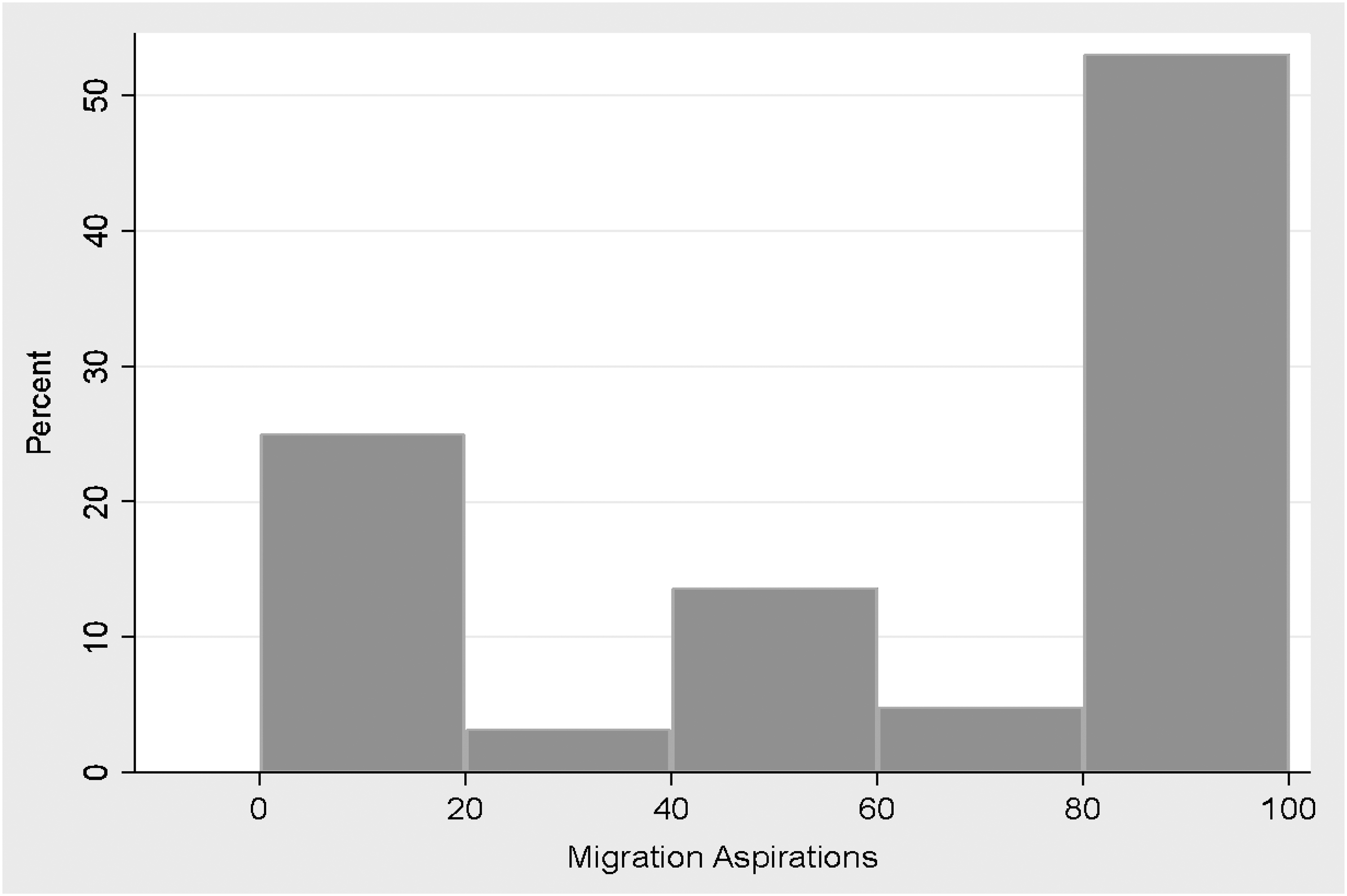
Migration Aspirations Among Survey Respondents.
Exposure to Migrants’ Social Media Content
In Dakar and the Casamance, many people use the internet and accordingly, also browse social media content. As Bineta, an interview partner in the capital Dakar, explains, social media is also accessible in rural areas such as the Casamance region, where we conducted part of the quantitative fieldwork: Because there are people even who live in a village now that are connected. They say there's a high penetration rate of internet. It's not an internet rate but it's a strong penetration rate of Facebook and WhatsApp and Instagram and Snapchat. People use that mainly to chat, to exchange, to see what everyone else is doing every day. Those who are in Europe, they spend their time doing Snapchat and posts. (Bineta, potential migrant, Dakar, 19 November 2019)
In our quantitative survey, we similarly find that exposure to social media content produced by Senegalese migrants in Europe is fairly common. We measure this exposure by respondents’ answer to the following survey question: “How often do you see photos or videos by Senegalese living in Europe on social media? With social media, we mean Facebook, WhatsApp, Instagram, TikTok, Snapchat, and similar apps or websites.” The answer ranges from 0 (“never/practically never”) to 6 (“more than once a week”). Answer options in between are 1 (“less often than a year”), 2 (“once a year”), 3 (“once every three to six months”), 4 (“once a month”), and 5 (“once a week”). As shown in Figure 2, while about 50 percent of respondents never or rarely view social media content produced by Senegalese living in Europe, about 20 percent of respondents view it at least once a week. Comparing Dakar and the Casamance, respondents in Dakar tend to view such content more often than their counterparts from the Casamance; in particular, respondents in Dakar are much less likely to have (practically) never seen social media content by Senegalese migrants living in Europe (see the Supplementary Material, Appendix A).
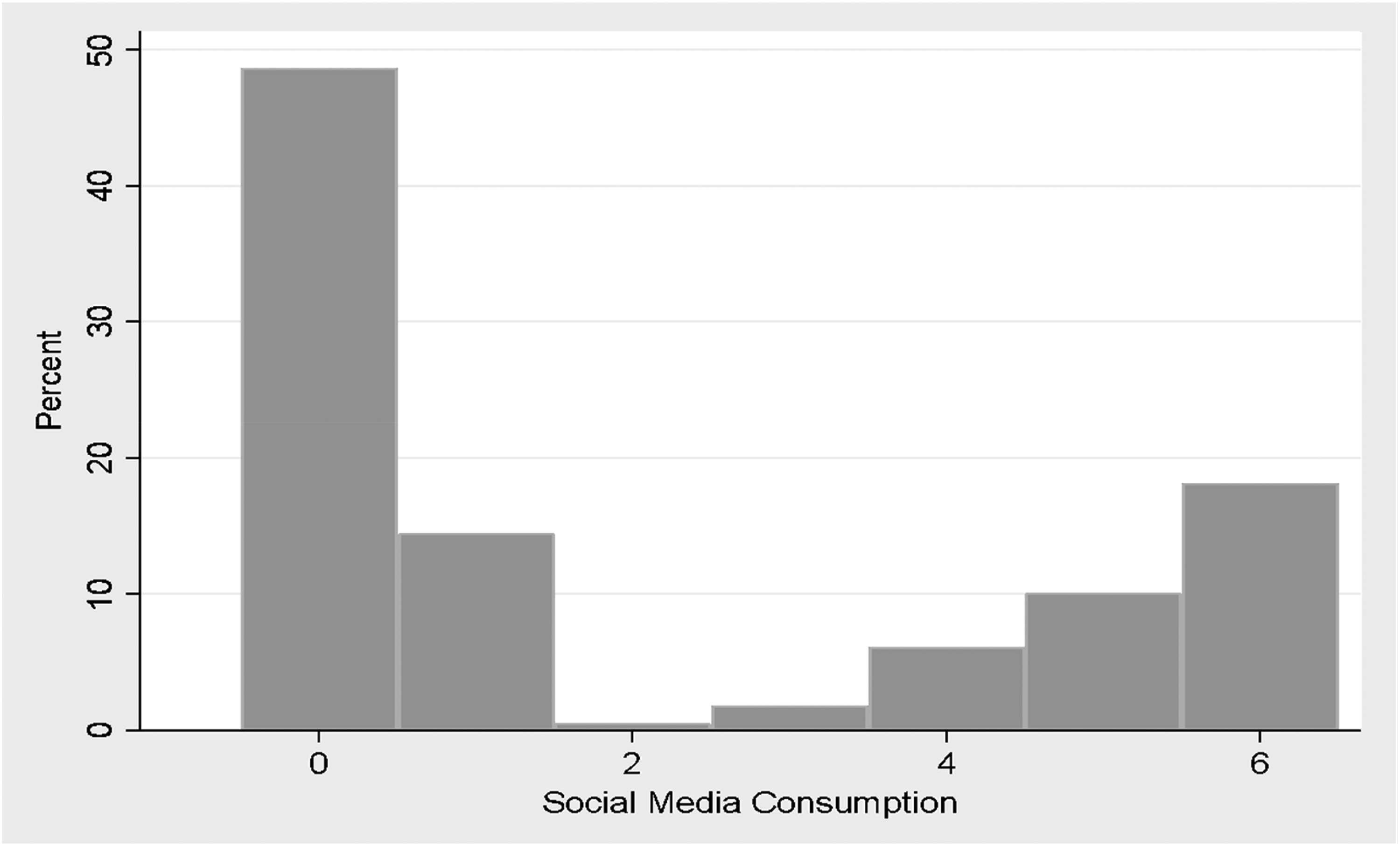
Social Media Use of Survey Respondents.
Relationship between Migrants’ Social Media Content and Migration Aspirations
Our quantitative and qualitative data show that (a) migration aspirations among respondents in Dakar and the Casamance are substantial, while (b) a fair share of these respondents also regularly view social media content produced by Senegalese living abroad. In this section, we investigate the relationship between this content and migration aspirations.
Qualitative Results
In our qualitative fieldwork, we find that both aspiring and returned migrants name social media content as an important factor fostering or having fostered their migration aspirations. For example, Seydou, the father of an aspiring migrant explains the origin of his son's motivation to migrate as follows: “They [his son's friends in Europe] would post pictures and they would impress him from those pictures, and it is by seeing those pictures that he is considering going” (Seydou, returnee, Casamance, 3 October 2019). This suggests that photos posted by the son's friends in Europe may have allowed his son to cognitively migrate and to imagine his potential life abroad, which becomes a driver for his aspirations. Similarly, Ibrahima, a returned migrant from Casamance, told us: And how does *name of contact in Germany* talk about Germany? Does he send you pictures? Yes, he would talk to me about good stuff. He would send me pictures by WhatsApp. These are pictures that are often taken in Internet cafes, in hotels, in any case, this beautiful place where he took pictures. He spoke to me of very good things that he had done. Is it these photos that motivated you to go? Yes, indeed. All I know is that life is better there than here. (Ibrahima, returnee, Casamance, 4 October 2019)
Furthermore, Senegalese migrants currently living in Europe recall that the social media content of other migrants indeed influenced their migration decision-making. For instance, Fatima, a Senegalese woman living in Italy, describes how pictures she saw on Facebook when she was still living in Senegal influenced her decision to migrate. According to her, social media content and especially photos play a key role in the formation of migration aspirations for people in Senegal: To tell you the truth when I was in Senegal sometimes a person takes beautiful pictures and puts them in Facebook which will disturb your head, you will only want to leave, that's what you will want, yes, you only want to leave. (Fatima, migrant, Rome, 22 September 2021)
Quantitative Regression Analysis
Empirical Model
Next, we analyze the survey data by means of a regression analysis to assess whether individual migration aspirations can be systematically explained by the viewing of social media content of Senegalese migrants in Europe. 6 We estimate the following model:

Here, migration refers to the respondent's answer to the question on how much they have considered moving to another country, with the answer being on a scale from zero to 100 (higher values mean stronger migration aspirations). Our main variable of interest, socialmedia, refers to the respondent's answer regarding their use of social media to view content produced by Senegalese migrants in Europe (higher values coincide with higher levels of usage).
Additionally, our empirical model includes a vector of controls, X. The choice of these variables follows from a review of the determinants of migration aspirations by Aslany et al. (2021). All control variables come from our original survey conducted in Dakar and the Casamance. We control for respondents’ age, gender, and relationship status, where we expect age, female gender, and being in a long-term relationship or marriage to correlate with lower migration aspirations (Aslany et al. 2021). We also control for education with a dummy variable that is equal to unity when a respondent has secondary education or higher. We anticipate higher education levels to correlate with stronger migration aspirations (Aslany et al. 2021). Finally, we consider the influence of respondents’ expectations about the future of the Senegalese economy, using respondents’ thoughts about the economic situation in Senegal now vis-à-vis in three to five years (higher values correspond to a more positive economic outlook). Individuals who have more optimistic expectations are expected to have lower migration aspirations (Aslany et al. 2021).
Main Regression Results
As shown in Table 1, we find that viewing social media content by Senegalese migrants in Europe correlates with higher migration aspirations of individuals surveyed in Dakar and the Casamance. Our baseline estimates reported in Model (1) imply that a one-unit increase in the social media variable is associated with an increase in individual migration aspirations by approximately 2.4 points. By comparison, a one-unit (i.e., one-year) increase in age is linked to a decrease in individual migration aspirations by about 0.9 points.
The findings regarding the controls are as expected. We find that migration aspirations are higher among young, male, and educated individuals who are not in a relationship. As a first robustness check, in the Supplementary Material (Appendix B), we show that the positive relationship between social media usage and migration aspirations is not affected by the inclusion of further controls, indicating, e.g., personal life satisfaction, employment situation, trust in the Senegalese government, department-fixed or interviewer-fixed effects. 7
Main Regression Results.
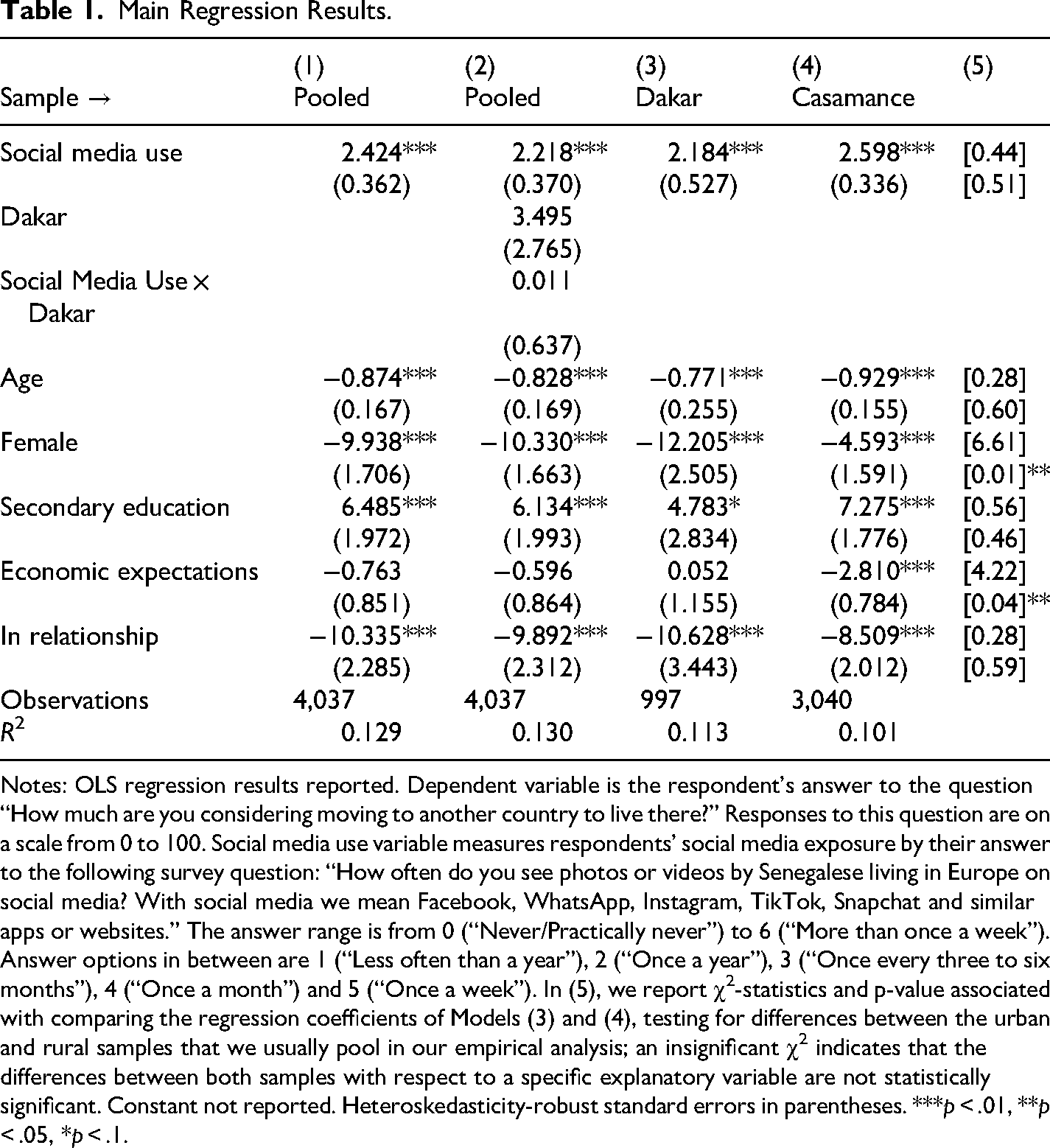
Notes: OLS regression results reported. Dependent variable is the respondent's answer to the question “How much are you considering moving to another country to live there?” Responses to this question are on a scale from 0 to 100. Social media use variable measures respondents’ social media exposure by their answer to the following survey question: “How often do you see photos or videos by Senegalese living in Europe on social media? With social media we mean Facebook, WhatsApp, Instagram, TikTok, Snapchat and similar apps or websites.” The answer range is from 0 (“Never/Practically never”) to 6 (“More than once a week”). Answer options in between are 1 (“Less often than a year”), 2 (“Once a year”), 3 (“Once every three to six months”), 4 (“Once a month”) and 5 (“Once a week”). In (5), we report χ2-statistics and p-value associated with comparing the regression coefficients of Models (3) and (4), testing for differences between the urban and rural samples that we usually pool in our empirical analysis; an insignificant χ2 indicates that the differences between both samples with respect to a specific explanatory variable are not statistically significant. Constant not reported. Heteroskedasticity-robust standard errors in parentheses. ***p < .01, **p < .05, *p < .1.
As another robustness check, we consider whether the use of different regression weights matters to our empirical results. For instance, due to relative population and sample sizes, observations by respondents from Dakar (especially women) are weighted more strongly than observations from the Casamance. This could easily yield extreme weights, potentially affecting our estimates. Reassuringly, in the Supplementary Material (Appendix B), we show that various methods of trimming extreme weights (e.g., by replacing extreme weights in the top 10 percent of observations with the trimmed maximum, i.e., the 90th percentile) produce empirical results reported almost identical to those reported in Table 1. Another way to probe the robustness of our findings is to apply weights so that observations from Dakar and Casamance each have the same weight. Here, the idea is that our estimates should be shaped equally by the urban (Dakar) and rural (Casamance) parts of our sample. 8 Again, we can show in the Supplementary Material (Appendix B) that using this weighting method produces empirical findings that are very similar to those reported in Table 1.
At the same time, our discussion about weights for the urban and rural parts of our sample also points to the issue of pooling data from Dakar and the Casamance. On statistical grounds, pooling increases sample size, which, in turn, increases the precision of our estimates (lower standard errors). However, the urban and rural regions differ—as shown above—with respect to their migration aspirations, social media use as well as other socio-economic and demographic characteristics. Consequently, pooling may come at the potential cost of masking meaningful differences between urban and rural regions with respect to the social media-migration aspiration nexus. For instance, the impact of social media use on aspirations might be smaller in Dakar, where social media use is more common and where other transnational influences might also shape migration aspirations.
One way to test this assumption is to interact with our social media use variable for Dakar. As shown in Model (2) in Table 1, there is no evidence of an interaction effect that would point to differences between the urban and rural regions with respect to social media use. Furthermore, in Models (3) and (4), we run separate regressions for the Dakar and Casamance sub-sample, comparing effect sizes between both models in a seemingly unrelated regression framework. While there are differences in effect sizes for some control variables (female gender and economic expectations), for our main explanatory variable of interest—social media use—effect sizes between both sub-samples are statistically indistinguishable from each other, while this variable also remains a statistically significant and positive predictor of migration aspirations for both sub-samples. Again, this suggests that viewing social media by Senegalese migrants in Europe is positively and in a similar manner associated with migration aspirations in Dakar and the Casamance. 9
Measurement of Social Media Use
In the following, we further probe the robustness of our findings. Here, one may not consider it appropriate to treat social media use as a linear variable, as we did in Table 1. Thus, as a robustness check, we consider alternative operationalizations of our main explanatory variable. We create a binary variable to differentiate between those who have never seen photos or videos by Senegalese living in Europe on social media and those who have. Moreover, we create a categorical variable that differentiates between individuals that view this type of media at most once a year, month or week, respectively, with the baseline being individuals that view it less than once per year. Additionally, we construct a variable that distinguishes between occasional users (Europe-specific content is at least viewed once a month, but not weekly), regular users (who browse this type of content at least once a week) and irregular users (who view social media content by Senegalese migrants in Europe at a maximum every 3–6 months or less). Finally, we compare respondents who browse social media content by Senegalese migrants residing in Europe at least once a week (heavy users) to those who do not.
In Table 2, we show that regardless of how we operationalize our explanatory variable, higher levels of use of migrants’ social media content correlate with higher migration aspirations. For instance, being a heavy user is associated with an increase in individual migration aspirations by approximately 11.5 points in comparison to the group of non-heavy users.
Viewing of Migrants’ Social Media Content and Migration Aspirations.
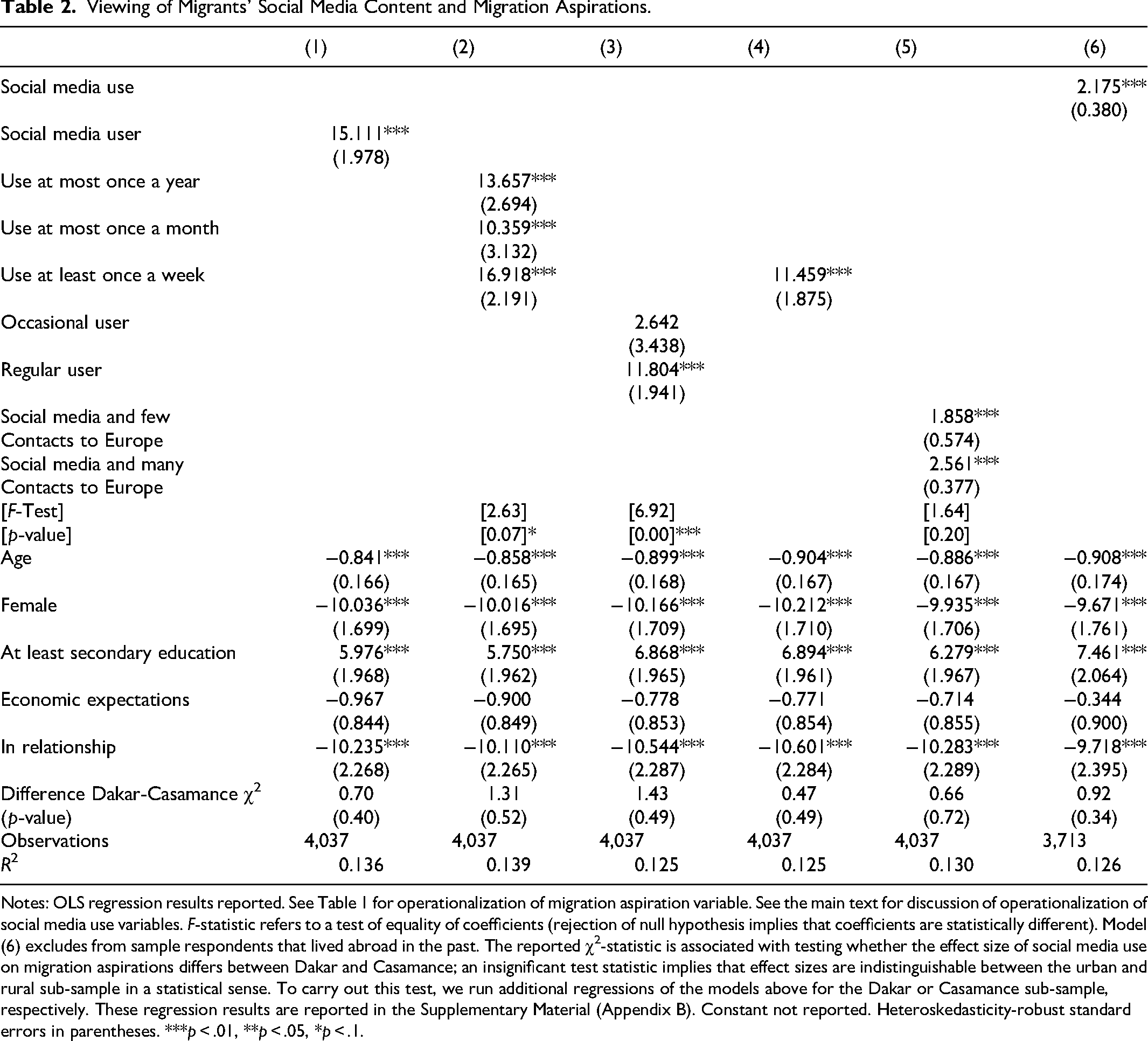
Notes: OLS regression results reported. See Table 1 for operationalization of migration aspiration variable. See the main text for discussion of operationalization of social media use variables. F-statistic refers to a test of equality of coefficients (rejection of null hypothesis implies that coefficients are statistically different). Model (6) excludes from sample respondents that lived abroad in the past. The reported χ2-statistic is associated with testing whether the effect size of social media use on migration aspirations differs between Dakar and Casamance; an insignificant test statistic implies that effect sizes are indistinguishable between the urban and rural sub-sample in a statistical sense. To carry out this test, we run additional regressions of the models above for the Dakar or Casamance sub-sample, respectively. These regression results are reported in the Supplementary Material (Appendix B). Constant not reported. Heteroskedasticity-robust standard errors in parentheses. ***p < .01, **p < .05, *p < .1.
In Table 2, we also report χ2-statistics associated with testing whether the effect size of social media use on migration aspirations differs between the Dakar and Casamance sub-samples; an insignificant test statistic implies that effect sizes are indistinguishable between the urban and rural sub-sample in a statistical sense. To conduct the tests for differences in coefficients, we run additional regressions—as in Models (3) and (4) of Table 1—for the Dakar or Casamance sub-sample. For the sake of brevity, we do not report the results for these sub-sample regressions in the main text but report them in the Supplementary Material (Appendix B). Reassuringly, the associated tests always suggest that there are no differences in effect sizes between the Dakar and Casamance sub-samples when using alternative operationalizations of social media use.
Next, one may argue that social media content has a differential effect on aspirations depending on whether respondents have direct contact with Senegalese living in Europe. To study this argument, we consider the respondents’ answer to the survey question “How often do you communicate with Senegalese living in Europe?,” categorizing those who have such communication at least once a week as having many direct contacts and those who have such communication at most once a month as having few direct contacts. In Model (5), we show that both respondents with many and few contacts with Senegalese in Europe see stronger migration aspirations due to their viewing of specific social media content produced by Senegalese in Europe, with the difference between the two groups not being statistically significant. 10 This finding also holds for sub-samples that only consider data for Dakar or the Casamance, respectively (see Appendix B in the Supplementary Material for the full regression results).
Finally, one may argue that individuals who have lived abroad in the past (return migrants) may be less susceptible to the “siren call” of social media; including them in our sample may thus affect our estimates. To examine this argument, we consider the following question: “Have you ever lived elsewhere than here?,” categorizing those who named another country as having lived abroad. In Model (6), we show that dropping those respondents with foreign experience from the sample does not affect our main empirical conclusion. 11 In addition to the pooled sample, this finding also holds for the Dakar and Casamance sub-samples (see Appendix B in the Supplementary Material for the full regression results).
Alternative Dependent Variables. Having established that different operationalizations of social media use yield similar results—using the pooled and sub-sample data—we next consider whether the positive association between the browsing of migrants’ social media content and individual migration aspirations may be due to the choice of the dependent variable. Here, we convert our original dependent variable (which measures aspirations on a scale from 0 to 100) into (1) a five-binned-variable, where each bin corresponds to a twenty-unit interval on the initial answer scale, (2) two binary variables that are equal to unity when a respondent has at least considerable migration aspirations (meaning a value of >60 on the initial answer scale) or has very strong aspirations (meaning a value of >90 on the initial answer scale), respectively, and (4) a variable that categorizes our initial dependent variable by its quartiles.
Moreover, there is a discussion in the literature on how to measure migration aspirations in the first place (see, e.g., Mjelva and Carling 2023). For instance, empirical operationalizations of migration aspirations may differ with respect to the nature of the respondent mindset, inquiring, e.g., considerations (as we do in our study), expectations, willingness, or planning (Mjelva and Carling 2023), which could lead to potentially different conclusions on the role of migrants’ social media content in individual migration aspirations. To address this concern, we employ three additional migration variables. First, we use the respondents’ answer to the following question as an alternative dependent variable: “Have you made concrete plans to move to another country within the next 12 months?” The answer is a binary variable, with unity indicating that the respondent has made concrete plans, while zero indicates that they have not. Second, we consider the question “Have you made any preparations to move to another country within the next 12 months?” Here, we create a binary variable that is equal to unity when a respondent has made preparations. Planning and preparations refer to different migrant mindsets, e.g., reflecting a respondent's desire to act on their migration aspirations (e.g., Tjaden, Auer, and Laczko 2019). Furthermore, we create a binary variable that is equal to unity when a respondent has strong migration aspirations (meaning a value of >90 on the initial answer scale) and concrete migration plans. This is to combine survey information on the consideration and planning mindsets.
We report our empirical findings using our alternative outcome variables in Table 3; depending on the nature of the dependent variable, we run logistic or ordered logistic regressions. Using pooled data, we find that viewing social media content of Senegalese migrants in Europe positively correlates with individual migration aspirations regardless of operationalization. We also find that respondents who browse social media by Senegalese in Europe are more likely to have made concrete plans or migration preparations to move to another country within the next 12 months. Finally, these respondents are also more likely to report both strong migration aspirations and concrete travel plans at the same time. As above, we report χ2-statistics associated with testing whether effect sizes of social media use on migration aspirations differ between the Dakar and Casamance sub-samples, finding that this is never the case (see Appendix B in the Supplementary Material for the full regression results for the two sub-samples). In summary, these findings suggest that our main empirical conclusion from Table 1 is robust to alternative operationalizations of the outcome variable.
Different Operationalizations of Outcome Variable.
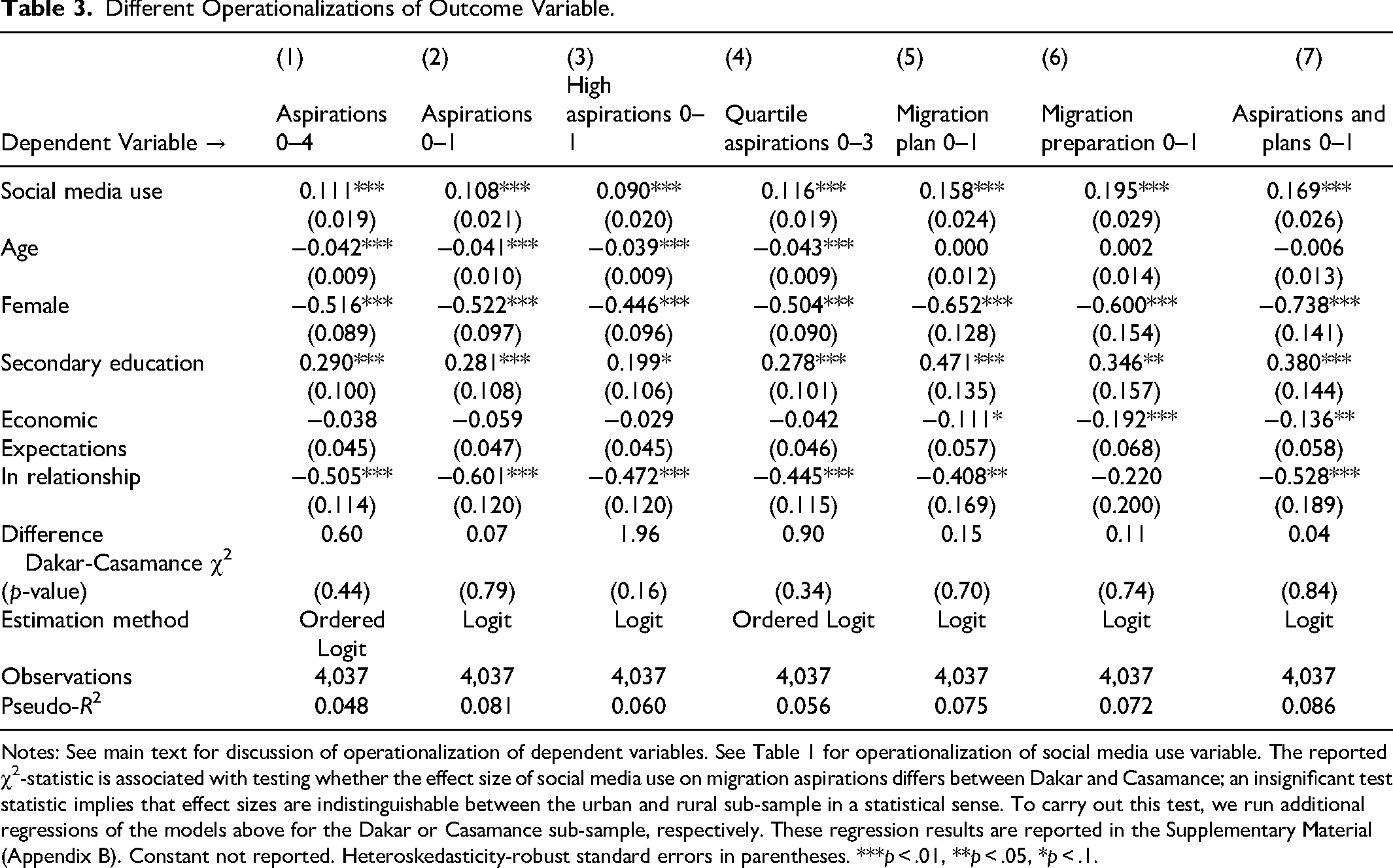
Notes: See main text for discussion of operationalization of dependent variables. See Table 1 for operationalization of social media use variable. The reported χ2-statistic is associated with testing whether the effect size of social media use on migration aspirations differs between Dakar and Casamance; an insignificant test statistic implies that effect sizes are indistinguishable between the urban and rural sub-sample in a statistical sense. To carry out this test, we run additional regressions of the models above for the Dakar or Casamance sub-sample, respectively. These regression results are reported in the Supplementary Material (Appendix B). Constant not reported. Heteroskedasticity-robust standard errors in parentheses. ***p < .01, **p < .05, *p < .1.
Instrumental-Variable Estimates
There may be concerns that our regression estimates could be biased due to endogeneity, especially with respect to reverse causation. For instance, it is possible that individuals who already have strong migration aspirations may seek to engage with emigrants online or view even more social media content by Senegalese migrants to further facilitate their cognitive migration. Consequently, in the appendix in the Supplementary Material, we also present instrumental-variable estimates of the effect of the viewing of migrants’ social media content on migration aspirations to reduce endogeneity concerns. While we discuss our empirical model in more detail in Appendix C in the Supplementary Material, in short, we instrument individual social media use by smartphone ownership. This instrument is relevant (i.e., correlated with the potentially endogenous explanatory variable) as many social media apps are developed especially for smartphones.
The empirical results discussed in Appendix C in the Supplementary Material indicate that viewing social media content by Senegalese in Europe is associated with higher migration aspirations, also in the instrumental-variable setting, with the associated instrumental-variable diagnostics being sound. In Appendix C in the Supplementary Material, we also discuss two ways to probe the exclusion restriction, that is, the assumption that smartphone ownership only affects migration aspirations via migrants’ social media content, (1) a placebo test and (2) the plausibly exogenous framework of Conley, Hansen, and Rossi (2012). As shown in Appendix C in the Supplementary Material, through these latter robustness checks we provide evidence in favor of the validity of the exclusion restriction. In sum, our instrumental-variable estimates are in line with the regression results reported in Table 1, reducing endogeneity concerns. They also speak to the qualitative findings, where interview partners consistently hint at the role of social media in fueling their migration aspirations, while never indicating that they would change their behavior concerning social media use because of changing aspirations (which would have pointed to reverse causation issues).
Exploration of Mechanisms
Our investigation of both the interview and survey data indicates that there is a positive relationship between the viewing of social media content generated by Senegalese migrants in Europe and the migration aspirations of survey respondents and interviewees in Dakar and the Casamance. In this section, we explore why this relationship emerges following a two-step approach. In the first step, we present potential mechanisms we find in the analysis of our qualitative data. In the second step, we test for these mechanisms within a regression framework using our survey data, reporting correlations between social media use, potential mediators (which are related to various transmission channels), and individual migration aspirations.
Exploration of Mechanisms from Interview Data
Pictures and videos of their journey posted by migrants in Europe on social media can help potential migrants to envision a specific (safe) travel route that others have already successfully used. As Seydou, a returned migrant, explains: In general, when I started, I took the trouble to ask [using my phone] those who have already arrived at the destination. They are the ones who tell me where to go to get there. They are the ones who give me the route to follow. (Seydou, returnee, Casamance, 3 October 2019)
Most interview partners in Dakar and the Casamance describe the photos posted by migrants in Europe as beautiful or otherwise pleasant. For instance, Bineta describes the social media behavior of migrants as follows: […] the social networks they use is Facebook, WhatsApp, is Instagram. And we know in advance that on these networks, we will show only the pretty pictures, only positive posts. (Bineta, potential migrant, Dakar, 19 November 2019) Very nice pictures! I think he was at the *city in Germany* main station. There, it's a luxury, and you are dressed with a parka like the prime minister of Germany, people look like that. The youth, if they see these pictures there, they want to come [to Germany]! (Souleymane, migrant, Berlin, 20 July 2021)
Indeed, most interviewees describe the social media content of migrants in Europe as positive. People in Dakar and the Casamance mostly only see posts, pictures, and videos that highlight positive aspects of life abroad. For instance, one interviewee remarks: In general, they [the migrants] only show what is positive. They will show the beautiful landscapes and the beautiful clothes, but they will never show what they are working on, for example. (Modou, potential migrant, Dakar, 19 November 2019) Well considering the situation we live here, you’re not going to think about that, honestly. You're going to say to yourself, here I am, I’m going to be like him, that's just what you’re going to think. (Oumar, potential migrant, Casamance, 7 October 2019) You’ll see, you can’t see that, only he can know that it's a staging, but you’ll see that he's all clean, he lives easily. (Oumar, potential migrant, Casamance, 7 October 2019) That's it, because that's what he wants you to believe. Then you can’t be here, you’re with your friend, you’re working here in Senegal harder than he is. So, he's not even leaving for six months, he starts telling you bullshit, you’re going to believe him because you’ve never been there, you’re going to believe him. (Adama, potential migrant, Casamance, 7 October 2019)
Second, respondents compare the social media posts to their own living situation, which makes the depicted reality even more desirable. For people who eventually migrate to Europe and are then experiencing a “reality check,” this often leads to great frustration. The realization that the living realities of Senegalese migrants in Europe tend to be quite different from what is depicted on social media can lead to a shock upon arrival. Idrissa, a migrant in Italy, explains his disappointment after he saw the real working conditions of Senegalese migrants with his own eyes: The majority of them [i.e., Senegalese migrants in Europe] who came to Senegal [for holidays] or whose photos you saw, or who you found there, when you come here, when you see them working you say to yourself ‘no’. I'm not going to hide it from you, I was discouraged. […] You say to yourself that ‘no, it's impossible, it can’t be true, with those photos that he showed you, with what he made you believe, you know?’. (Idrissa, migrant, Rome, 19 September 2021)
Exploration of Mechanisms with Quantitative Data
Our qualitative analysis allows us to identify three potential mechanisms explaining the effect of the viewing of migrants’ social media content on migration aspirations. 12 First, social media can facilitate one's cognitive migration (and thus, in turn, affect one's migration aspirations) by favorably shaping one's visions about the migration journey. Second, social media use correlates with an increased admiration of migrants abroad, making it more likely that one's own cognitive migration experience is positively shaped by such admiration, meaning that, e.g., interviewees may imagine themselves to be equally successful. Third, social media influences one's assessment of life in Europe through positively biased social media posts by migrants abroad. Interviewees are more likely to envision a pleasant and successful life in Europe during their cognitive migration, which can, in turn, fuel their migration aspirations.
To study whether these mechanisms also matter systematically, we use our survey data. We estimate the association between social media use (socialmedia) and various proxies for the potential mechanisms (transmission) for individual i, net of the influence of the usual vector of controls discussed above (X), using the following estimation equation:
First, we expect social media content to facilitate the cognitive migration of individuals in Dakar and the Casamance by making the migration journey appear more viable. Individual perceptions of the migration journey are captured by answers to the questions “How likely is it that a migrant from Senegal makes it to Europe?” and “How likely is it that you will make it from Senegal to Europe?” For both questions, higher values mean that respondents are more likely to expect the journey to be successful. Second, the viewing of migrants’ social media content may increase one's admiration of migrants. Admiration of migrants is measured by answers to the questions “When you see successful migrants, does that encourage you or a suitable family member to migrate?” and “Have you or other members of your close family ever admired any other person who moved abroad?” Higher values coincide with more admiration. Third, social media content may make life in Europe appear more attractive and worthwhile, leading to a more pleasant cognitive migration experience. Individual perceptions about life in Europe are measured by answers to the questions “If a person from Senegal successfully migrates to Europe, how much money is this person able to send to the family in Senegal per month?” and “How often do you expect Senegalese migrants in Europe to be discriminated against?” For the former question, respondents will provide a sum of money as their estimate of potential remittances, while for the latter question, higher values coincide with higher levels of (expected) discrimination.
We expect the viewing of migrants’ social media content to coincide with higher admiration of migrants, more favorable imaginations about the migration journey, and greater expectations of life in Europe. Furthermore, we also study whether the six variables themselves share an association with individual migration aspirations. We consider the following model using the variables already described above.
Our empirical results are reported in Table 4. They indicate that viewing more social media content by Senegalese in Europe correlates with a more favorable assessment of migration journey success and of life in Europe, as well as higher levels of admiration of migrants (Panel A). Assessing differences between Dakar and the Casamance, we find that effect sizes for social media use are similar across both sub-samples, with the exception of expected income, where social media use is only found to matter to the Casamance sub-sample (see Appendix E in the Supplementary Material for the full regression results for both sub-samples). Overall, the findings reported in Table 4 are consistent with our argument that social media use ultimately leads to stronger migration aspirations by shaping individual imaginations about migrants, migration, and life in Europe that facilitate one's cognitive migration.
Potential Mechanisms.
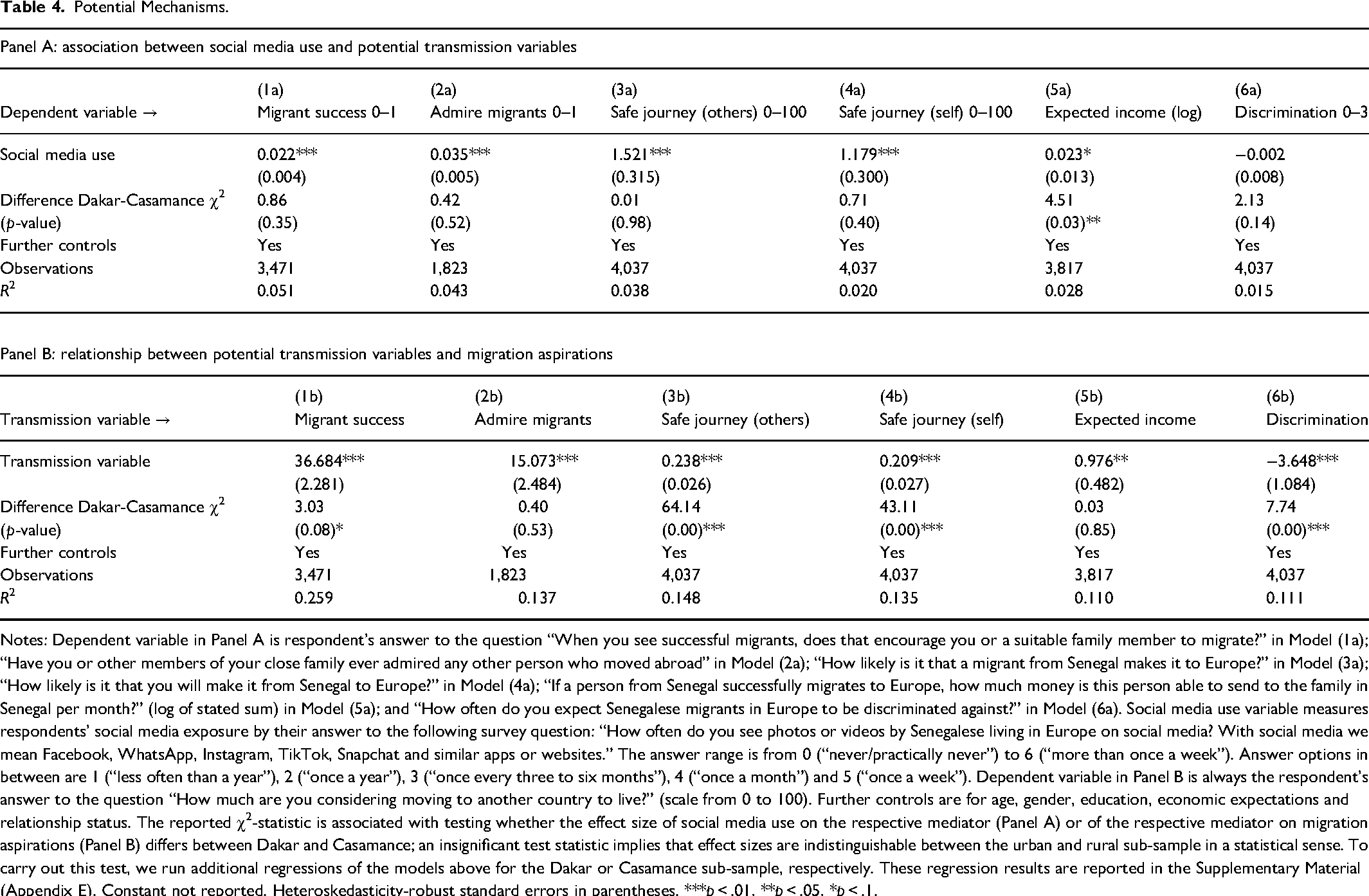
Notes: Dependent variable in Panel A is respondent's answer to the question “When you see successful migrants, does that encourage you or a suitable family member to migrate?” in Model (1a); “Have you or other members of your close family ever admired any other person who moved abroad” in Model (2a); “How likely is it that a migrant from Senegal makes it to Europe?” in Model (3a); “How likely is it that you will make it from Senegal to Europe?” in Model (4a); “If a person from Senegal successfully migrates to Europe, how much money is this person able to send to the family in Senegal per month?” (log of stated sum) in Model (5a); and “How often do you expect Senegalese migrants in Europe to be discriminated against?” in Model (6a). Social media use variable measures respondents’ social media exposure by their answer to the following survey question: “How often do you see photos or videos by Senegalese living in Europe on social media? With social media we mean Facebook, WhatsApp, Instagram, TikTok, Snapchat and similar apps or websites.” The answer range is from 0 (“never/practically never”) to 6 (“more than once a week”). Answer options in between are 1 (“less often than a year”), 2 (“once a year”), 3 (“once every three to six months”), 4 (“once a month”) and 5 (“once a week”). Dependent variable in Panel B is always the respondent's answer to the question “How much are you considering moving to another country to live?” (scale from 0 to 100). Further controls are for age, gender, education, economic expectations and relationship status. The reported χ2-statistic is associated with testing whether the effect size of social media use on the respective mediator (Panel A) or of the respective mediator on migration aspirations (Panel B) differs between Dakar and Casamance; an insignificant test statistic implies that effect sizes are indistinguishable between the urban and rural sub-sample in a statistical sense. To carry out this test, we run additional regressions of the models above for the Dakar or Casamance sub-sample, respectively. These regression results are reported in the Supplementary Material (Appendix E). Constant not reported. Heteroskedasticity-robust standard errors in parentheses. ***p < .01, **p < .05, *p < .1.
We also show that the various transmission variables correlate with migration aspirations in plausible ways (Panel B). For instance, we find that social media use increases the admiration of migrants; increased admiration, in turn, correlates with stronger migration aspirations. On closer inspection, there are some differences between Dakar and the Casamance (see Appendix E in the Supplementary Material for the full regression results for both sub-samples). Travel safety more strongly shapes migration aspirations in the Casamance, while concerns about discrimination in Europe matter more prominently for the migration aspirations of people from Dakar. Also concerning expected discrimination, while we find that this variable is negatively related to migration aspirations (especially for people from Dakar), there is no evidence that social media exposure correlates with individual discrimination expectations (Panel A). This latter result speaks to our qualitative findings that social media content produced by Senegalese in Europe is curated, i.e., biased towards positive images and imaginaries, and thus does not highlight experiences with discrimination.
As a robustness check, in the Supplementary Material (Appendix E), we also report results from a mediation analysis following Baron and Kenny (1986). Using the pooled data, according to this analysis, migrant success and migrant admiration, as well as the risk of oneself own death on the migration journey are more important mediators than expected income after migration and the migration risks for others. Using sub-sample data, we find that migrant success tends to matter more in Dakar, while concerns about the safety of the journey matter more to respondents from the Casamance. Consistent with our other findings, we again find that discrimination experiences in Europe do not mediate the effect of social media exposure on migration aspirations. Thus, the results from the mediation analysis largely conform to the other empirical results presented in this subsection.
Conclusion
Given the important role of the internet in economic, social, and political life, there has also been an increasing interest in its effect on international migration. We study how viewing social media content by Senegalese migrants residing in Europe correlates with migration aspirations in two Senegalese regions, Dakar and Casamance. Building on the model of cognitive migration by Koikkalainen and Kyle (2016), where migration aspirations are shaped by their mental time travel into a potential future abroad, we hypothesize that social media use affects this very cognitive migration in ways that amplify migration aspirations.
To test this hypothesis, we employ a mixed-methods approach. We analyze interviews with (potential) migrants, repatriates, migration experts, and stakeholders in their country of origin and in Europe, and original survey data of several thousand respondents residing in Dakar and the Casamance. We provide robust evidence that browsing more social media content by compatriots in Europe positively correlates with individual migration aspirations, where this relationship holds both for the urban and rural parts of our sample.
Further exploring the interview and survey data, we also shed light on potential mechanisms. We find evidence suggesting that the viewers of migrants’ social media content have higher levels of admiration for migrants, consider the migration journey to Europe to be more viable, and expect life in Europe to be especially rewarding. In line with our theoretical expectations, our empirical findings suggest that viewing migrants’ social media content is associated with especially positive notions about migration to and life in Europe, consequently fueling migration aspirations by facilitating and making the cognitive migration of potential Senegalese migrants especially pleasant. As an important caveat, however, these latter quantitative findings are only correlational, reflecting promising associations between social media use, various potential mediators, and migration aspirations. We consequently invite future research to study the mechanisms underlying the nexus between social media use and migration aspirations in more detail.
Our study also has additional limitations; these limitations, in turn, also point to additional avenues of future research. First, while we show that social media content influences migration aspirations, more research is necessary to evaluate which components and aspects of social media use are especially relevant. For instance, our study does not consider whether it is content by influencers or rather by friends and acquaintances residing in Europe that particularly shapes migration aspirations.
Second, we do not study heterogeneity in the relationship between social media use and other drivers of migration aspirations. For example, individuals with different socio-economic characteristics (e.g., gender, education, or tech savviness) may respond differently to migrants’ social media content with respect to their migration aspirations.
Third, while we show that social media use enhances migration aspirations in an urban (Dakar) and rural (Casamance) region of Senegal, the generalizability of our findings is limited, especially as we only consider survey respondents in a specific age bracket. Future research may study other parts of Senegal as well as the relationship between social media use and the migration aspirations of older individuals. What is more, future research focusing on other countries is necessary to further add to the generalizability of our findings.
Finally, while our interviews with actual migrants highlight the role of social media content and our survey shows a positive association between viewing such content and migration plans, our study focuses primarily on the early stage of the migration process—the formation of migration aspirations—rather than subsequent stages. However, social media content may also matter to subsequent stages. For example, Carling and Schewel (2018) posit that eventual migration is the consequence of (high) migration aspirations and the ability to convert these aspirations into reality. Social media content by migrants in Europe may also matter to the development of migration abilities, e.g., by fostering the formation of networks in destination countries or the acquisition of skills and knowledge that facilitate migration and integration abroad. Consequently, studying the relationship between social media use and the latter stages of the migration process—especially with a mixed-method approach—is clearly another important avenue of future research.
These limitations notwithstanding, our findings may ultimately inform migration policy, also considering the strong correlation between migration aspirations and eventual out-migration and the outsized relevance of social media for young people (who are also most likely to migrate internationally). For instance, given that our interview findings suggest that potential migrants in Dakar and the Casamance oftentimes do not fully appreciate the highly curated nature of many social media posts by Senegalese migrants residing in Europe, investments in digital education and literacy may attenuate such issues in the future. Such measures may, ultimately, allow migrants to have more realistic views about life in Europe, avoiding the disappointment about real living conditions upon arrival.
Supplemental Material
sj-docx-1-mrx-10.1177_01979183251376544 - Supplemental material for The Role of Social Media Content in Migration Aspirations: Mixed-Methods Evidence From Two Senegalese Regions
Supplemental material, sj-docx-1-mrx-10.1177_01979183251376544 for The Role of Social Media Content in Migration Aspirations: Mixed-Methods Evidence From Two Senegalese Regions by Daniel Meierrieks and Julia Stier in International Migration Review
Supplemental Material
sj-docx-2-mrx-10.1177_01979183251376544 - Supplemental material for The Role of Social Media Content in Migration Aspirations: Mixed-Methods Evidence From Two Senegalese Regions
Supplemental material, sj-docx-2-mrx-10.1177_01979183251376544 for The Role of Social Media Content in Migration Aspirations: Mixed-Methods Evidence From Two Senegalese Regions by Daniel Meierrieks and Julia Stier in International Migration Review
Footnotes

Acknowledgements
We thank the editorial team at International Migration Review and the anonymous reviewers for their guidance and insightful comments.
Funding
The authors disclosed receipt of the following financial support for the research, authorship, and/or publication of this article: This work was supported by the Federal Ministry for Family Affairs, Senior Citizens, Women and Youth (Germany) under Grant 3920405WZB (TRANSMIT Project). The open access publication was funded by the WZB Berlin Social Science Center.
Declaration of Conflicting Interests
The authors declared no potential conflicts of interest with respect to the research, authorship, and/or publication of this article.
Supplemental Material
Supplemental material for this article is available online.
Notes
References
Supplementary Material
Please find the following supplemental material available below.
For Open Access articles published under a Creative Commons License, all supplemental material carries the same license as the article it is associated with.
For non-Open Access articles published, all supplemental material carries a non-exclusive license, and permission requests for re-use of supplemental material or any part of supplemental material shall be sent directly to the copyright owner as specified in the copyright notice associated with the article.
