




Abstract

Introduction
Toxicologic pathologists are tasked with morphologic evaluation of tissues in animal toxicity studies to ascertain drug or chemical-related effects. These assessments are based on knowledge of the species and spectrum of morphologic changes that occur in the untreated control population. Within the rat heart, a number of morphologic changes have been observed as spontaneous events in control populations, one of the most common being myocardial degeneration or cardiomyopathy (Greaves 2000; King and Russell 2006; Kemi et al. 2000). Experience suggests this change can be observed with a highly variable incidence in very young rats and increases in severity with age; however, many classic literature descriptions identify this as a condition of aging rats. To gain better understanding of the industry’s approach to sampling the heart and terminology in common use in young rats, an informal survey was conducted in 2009 that focused on rat studies of 7 days’ to 28 days’ duration. The survey was sent to 89 individuals who represent the pharmaceutical (53), contract research organization (CRO) and consultant (35), or chemical industries (1). Responses were received from 36 contacts, for a 40.5% return rate. Respondents were asked if survey results could be published; all but one agreed. Sectors represented in the reported data include 20 pharmaceutical (13 North America, 5 Europe, 2 Japan), 9 CRO (6 Europe, 3 North America), 4 consultants (2 Europe, 2 North America), 1 chemical company (Japan), and 1 anonymous (unknown affiliation).
A graphical summary of selected survey questions is presented in Figure 1A-J. The following general trends in short-term studies (less than 28 days) were noted: Respondents primarily use CR Sprague-Dawley rats, 6 to 8 weeks of age at the start of the study, group housed and fed ad libitum. Hearts are most often sectioned longitudinally. The majority of pathologists use combinations of terms to describe the components (degeneration/necrosis, inflammatory cell infiltration, fibrosis) of the spontaneous morphologic changes in the heart. The majority of pathologists diagnose all events (all lesions, no threshold for size or severity). Regulatory concerns were identified by about one-third of pharmaceutical company respondents; when concerns were noted, resolution was generally achieved by providing historical data or modifying terms. The majority of respondents felt that the incidence of spontaneous background pathology has not increased over time.

Graphs of selected survey questions. The title above each graph refers to the question asked.
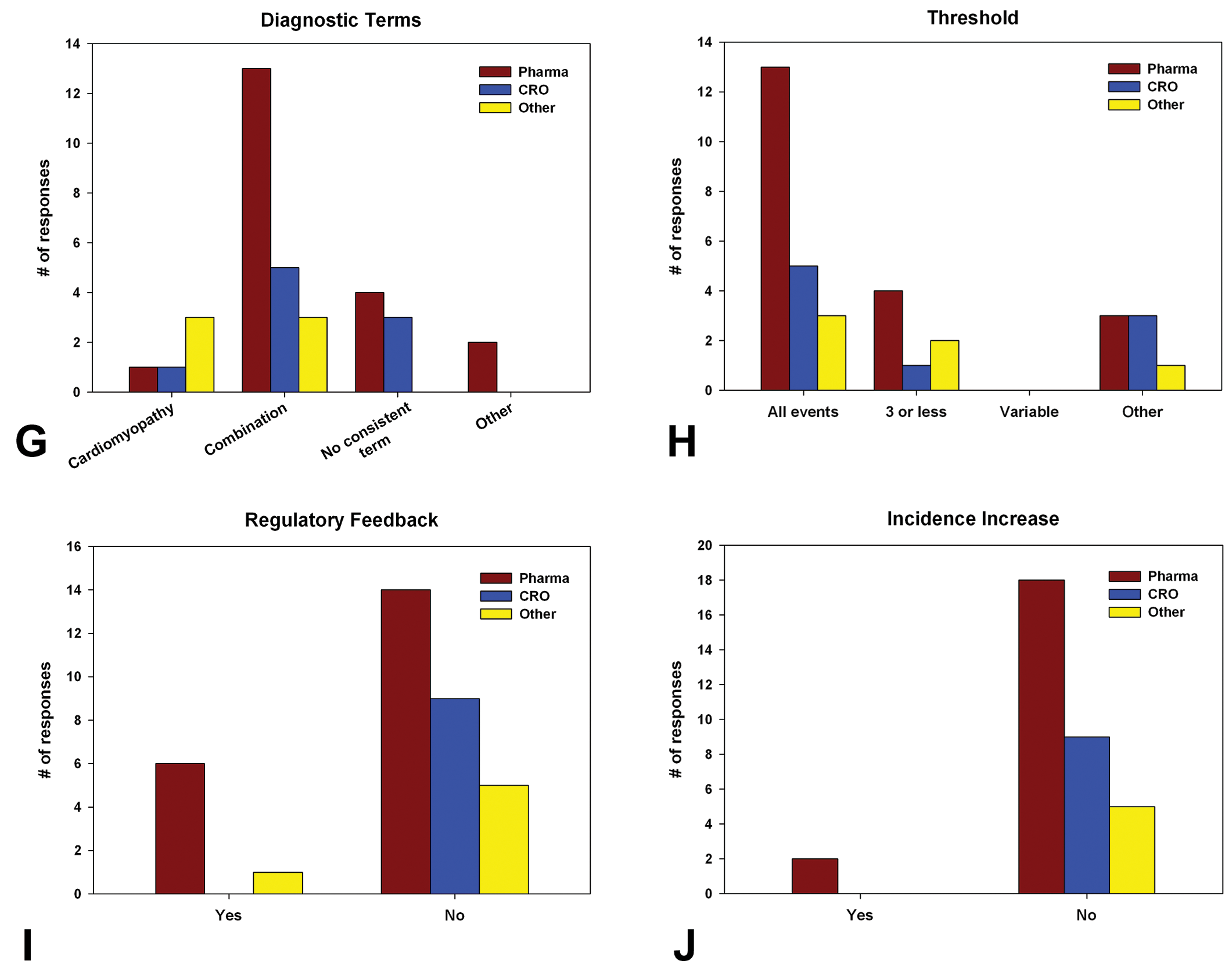
For short-term studies (i.e., studies of 28 days’ duration or less), most respondents used a combination of descriptive terms. One respondent commented that the term cardiomyopathy is used on a “case by case” basis (i.e., in the absence of cardiac changes that are considered drug-induced, cardiomyopathy is used as a summary term, making for simple and straightforward microscopic incidence summary tables). Another respondent generally reserved the use of cardiomyopathy for studies of 13 weeks’ duration or longer. In reference to threshold, the majority of respondents diagnose all events, with a number of comments indicating variability in approach. Respondents noted that the threshold may be dependent on client request or study objective (i.e., expectation of cardiac changes). Some noted that a single minimal focus would be below threshold but that multiple foci would be recorded. The majority of respondents did not experience any issues with regulatory review. However, 6 of 20 pharmaceutical company respondents and 1 “other” respondent fielded questions from regulatory agencies; 4 of these respondents used the term cardiomyopathy and 3 used combinations of terms. These respondents generally addressed the issue with detailed descriptions of the changes along with incidence in historical controls or additional clinical pathology or modification of terminology to indicate the rat-specific nature of the change.
A number of general comments were included by respondents. One respondent’s comment postulated an interesting question: The distribution of lesions, as well as their incidence and severity, is important with regard to delineating potential effects of treatment. Although cardiomyopathy is fairly distinctive in older animals, a few foci of necrosis and/or inflammatory cells cannot be attributed to cardiomyopathy in young animals with much confidence. This survey may concern a matter of principle that applies more widely than just to the heart—at what age might spontaneous lesions of senescence be diagnosed with confidence?
Footnotes
Acknowledgments
The authors wish to thank all the respondents for their time to complete the survey.
This is an opinion article submitted to the Regulatory Forum and does not constitute an official position of the Society of Toxicologic Pathology or the journal Toxicologic Pathology. The Regulatory Forum is designed to stimulate broad discussion of topics relevant to regulatory issues in toxicologic pathology. Readers of Toxicologic Pathology are encouraged to send their thoughts on these articles or ideas for new topics to regulatoryforum@toxpath.org.