




Abstract
Customer reviews are a new type of third-party evaluation that has transformed how power operates over evaluated producers, and in so doing has attracted scholarly attention. However, this literature rarely addresses the power relationships operating between platforms collecting and aggregating these reviews. We address this blind spot by relying on Pierre Bourdieu’s theory of fields, which we use to highlight that the reaction of producers to traditional third-party evaluations depend on, and reproduce, the domination of an evaluation intermediary over its competitors. Our qualitative study of the field of jobbing platforms in France reveals that producers react to customer reviews only on platforms accumulating relatively better stocks of reviews, in a self-reinforcing manner. Managers of platforms with smaller stocks of reviews resist by sheltering jobbers from reviews. Our study re-introduces field-level power dynamics between platforms to research exploring the forms of power that operate on producers subjected to reviews. It adds to studies of evaluation intermediaries by specifying that the accumulation of reviews underpins the power relationships between intermediaries in the customer review era and by identifying sheltering as a new form of resistance. Finally, it updates Bourdieu’s theory for the digital age by explaining that individuals’ accumulation of capital online relates to inter-organisational power dynamics.
Keywords
Introduction
Producers were previously subjected to evaluation intermediaries producing ratings (e.g. Michelin Guide) or rankings (e.g. university league tables). 1 They now have to deal with customer reviews collected and aggregated by online platforms like TripAdvisor (Orlikowski & Scott, 2014; Sharkey, Kovacs, & Hsu, 2022). This shift to customer reviews has changed how producers react to evaluations, i.e. their reactivity (Espeland & Sauder, 2007). Producers have moved from convergent reactivity, in which behaviour is adjusted to predefined, explicit and stable evaluation criteria (Brandtner, 2017), to experimental reactivity, in which there is continuous micro-adapting to heterogeneous customer needs (Curchod, Patriotta, Cohen, & Neysen, 2020). Prior studies explain that producers evaluated by customer reviews are therefore subjected to new forms of power (Curchod et al., 2020; Gandini, 2019; Newlands, 2021; Rahman, 2021). Existing research, however, overlooks that the shift to customer reviews also reshaped power relationships between evaluation intermediaries (Sharkey et al., 2022) despite scholars’ recent calls for studying the social dynamics emerging between organisations collecting and aggregating data (Alaimo, 2022; Kolb, Dery, Huysman, & Metiu, 2020). Hence, we ask the following: How does power operate between online platforms collecting and aggregating customer reviews?
To address this question, we rely on Pierre Bourdieu’s (1993, 2005) theory of fields and his approach to domination as the self-reproduction of asymmetrical power positions among field members. This approach enables us to integrate insights from prior studies of traditional evaluation intermediaries (Brandtner, 2017; Déjean, Gond, & Leca, 2004; Ringel, 2021) by conceptualising reactivity-based domination as a form of Bourdieusian domination operating between competing field-level evaluation intermediaries, which is driven by producer reactivity, and also reproduce it – and which can be resisted. In the context of traditional evaluations, reactivity-based domination works through mechanisms such as the perceived soundness of intermediary ranking criteria (Espeland & Sauder, 2007). While such mechanisms are inoperative in the customer review era, comparable field dynamics still seem to be at work, as competing platforms collecting and aggregating reviews often occupy asymmetrical power positions (Curchod et al., 2020; Sharkey et al., 2022). Overall, this raises the question of how reactivity-based domination operates between competing online platforms and, consequently, how managers of platforms facing this domination resist.
We explore these insights through a qualitative case study of the field of jobbing platforms operating in France. Jobbing platforms organise transactions between customers and producers of local services (like those exchanged in the United States or United Kingdom through TaskRabbit), for example, home repairs. This field is appropriate for addressing our research question for two reasons. First, jobbing service producers are incentivised to seek positive customer reviews because of their impact on jobbing service customers (Babić Rosario, Sotgiu, De Valck, & Bijmolt, 2016; European Commission, 2017). Second, several competing platforms occupying asymmetrical power positions have coexisted in France for a long time (European Commission, 2019). Hence this field is ‘autonomous’ in the Bourdieusian sense (Bourdieu, 2005) and epitomises some of the dynamics observed in other fields populated by platforms collecting and aggregating reviews (Curchod et al., 2020; Sharkey et al., 2022). Our empirical analysis builds on 36 interviews of managers from 11 platforms (both prominent and less prominent) and of field experts, which we complemented with online data.
Our results reveal that reactivity-based domination operates among competing jobbing platforms through differential accumulation of customer reviews in which the relative accumulation thereof orients customer choice between competing platforms. This mechanism explains why jobbers react to customer reviews on some platforms in ways that accentuate differential accumulation of customer reviews on these platforms. We also found that managers of platforms undergoing this reactivity-based domination actively resist by helping jobbers to remain active on their platforms without being reactive to reviews, either by downplaying the automatic use of customer reviews by their platform or by circumventing customer use of reviews through direct interaction.
Our study offers three contributions. First, we advance prior analysis of how power operates on producers subjected to customer reviews (Curchod et al., 2020; Newlands, 2021; Rahman, 2021) by accounting for the field-level, relational form of power that operates between platforms collecting and aggregating reviews. We show that the relative stock of reviews accumulated on a platform shapes the power relationships deployed through reviews between customers, producers and managers of this platform. Second, we add to research on evaluation intermediaries (Brandtner, 2017; Giamporcaro & Gond, 2016; Ringel, 2021; Sharkey et al., 2022; Slager & Gond, 2022) by introducing the concept of reactivity-based domination and by explaining that the mechanisms of this domination have changed in the customer review era – the assessment criteria of intermediaries now matter less than the capacity of intermediaries to accumulate better stocks of customer reviews than their competitors. This situation explains the emergence of sheltering – a new form of resistance used by managers of thus dominated platforms to protect producers from customer reviews. Third and finally, our study extends prior digital updates of Bourdieu’s field theory (Fourcade & Healy, 2017) by explaining that the digital capital accumulated by individual producers in digital fields populated by other individual producers (like the field formed by jobbers competing on a given jobbing platform) interfaces with the power dynamics operating at the level of digital organisational fields (Alaimo, 2022; Kolb et al., 2020) like the one populated by competing jobbing platforms. In these digital organisational fields, dominant actors seem able to maintain their power positions despite possible changes in the definition of valued capital.
The Power Implications of the Shift to Customer Reviews: A focus on producers
Customer reviews are a novel type of third-party evaluation that has recently attracted considerable attention in studies of organisations (Barbe & Hussler, 2019; Curchod et al., 2020; Galière, 2020; Kornberger, Pflueger, & Mouritsen, 2017; Orlikowski & Scott, 2014; Rahman, 2021; Sharkey et al., 2022). Traditional third-party evaluations imply that evaluation intermediaries use stable, explicit evaluation criteria to rank or rate producers publicly and update their assessments at a regular pace. For instance, Michelin Guide rates haute-cuisine restaurants with a list of well-known criteria – such as ingredient quality – and publishes an annual updated version of its ratings in a book (Karpik, 2010). In contrast, third-party evaluation in the customer review era is performed as follows. Online platforms, built and operated by platform managers, collect reviews written by customers who spontaneously develop multiple and unpredictable criteria for assessing their experience with producers. The platforms use this continuous flow of customer-generated data to feed their algorithms and also aggregate these reviews before publishing them online (Sharkey et al., 2022). For instance, TripAdvisor collects reviews of hotels from their customers and uses them to continuously update the ordering of hotels on its results pages, as well as hotels’ review scores (Orlikowski & Scott, 2014).
These distinct features of customer reviews are reflected in the reactivity (Espeland & Sauder, 2007) induced by these third-party evaluations, i.e. the pattern by which evaluated producers adapt their behaviours to obtain better assessments. Reactivity to traditional third-party evaluation is convergent (Brandtner, 2017, p. 200). Producers seek to obtain better ratings or ranking by adapting their behaviours in a timely manner to meet explicit stable evaluation criteria. This leads to increasing similarities in producer behaviours (Espeland & Sauder, 2007). In contrast, reactivity to customer reviews is experimental (Rahman, 2021, p. 957) with producers remaining adaptable and flexible and perpetually trying to anticipate and satisfy heterogeneous customer reviews (Bucher, Schou, & Waldkirch, 2021; Curchod et al., 2020; Orlikowski & Scott, 2014).
A stream of research has started documenting the power implications of the shift to customer reviews. Most of these studies approach experimental reactivity as the outcome of new power ‘configurations’ (Curchod et al., 2020, p. 644) that operate at the expense of producers and to the benefit of platform managers (Bucher et al., 2021; Gandini, 2019; Newlands, 2021; Rahman, 2021). These studies show that customer reviews enforce a ‘qualitative intensification’ of producers’ work (Gandini, 2019, p. 1040) with producers trying their best to please customers because they feel vulnerable to reviews (Curchod et al., 2020; Orlikowski & Scott, 2014) as platform managers can alter opaquely – i.e. unilaterally and unexpectedly – how platform algorithms use these data (Rahman, 2021; Rosenblat & Stark, 2016). Also, these studies point out the ‘implicit coalitions’ of platform managers and customers with regard to reviews (Curchod et al., 2020), with managers, for instance, remaining indifferent to complaints of producers about unfair reviews.
This focus on producers is surprising, given that scholars found that the digital transformation of organisations challenges our understanding of other inter-organisational dynamics (Alaimo, 2022) and scholars have called for further study of the social dynamics operating between organisations that collect and aggregate data (Kolb et al., 2020). We responded to this call by focusing our investigation on how power operates between online platforms collecting and aggregating customer reviews.
Beyond Producers: Reactivity-based domination and related resistance attempts
To account for the power relationships operating between these platforms, we build on Pierre Bourdieu’s theory of fields, which accounts for domination, defined as the reproduction of asymmetrical power positions between members of the same field. Bourdieu’s (1993) fields are defined as autonomous social spaces with ‘invariant laws of functioning’ (p. 72). Fields are autonomous and can be analysed as such when they have existed long enough for their members to share a definition of valued capital so that these members struggle to accumulate relatively more thereof. Valued capital comprises intangible field-specific resources: in markets that are fields formed by competing firms, such Bourdieusian capital comprises, for instance, customer trust or ‘brand loyalty’ (Bourdieu, 2005, p. 76).
According to Bourdieu, what constitutes a capital valued in a field is not determined in a neutral manner, but instead benefits those field members who have more of it. These field members can easily accumulate more of this capital in a self-reproducing manner, that ensures their self-reproducing domination over others (Bourdieu, 1993). Thus, firms with greater brand loyalty can sell at higher prices and thus invest more, deliver better offerings and satisfy their customers better, in a self-reproducing manner (Bourdieu, 2005). Dominated actors can nevertheless resist, either openly by developing strategies of ‘subversion’ (Bourdieu, 2005) aiming at changing the definition of valued capital, or covertly, through superficial accumulation of the valued capital. Successful subversion strategies are in fact rare, provided that the dominant members do their best to protect existing definitions of the valued capital, which benefit them.
Pioneering attempts at updating Bourdieu’s theory of fields have introduced the concept of ‘übercapital’, defined as a type of Bourdieusian capital specific to the digital society that is made up of ‘digital traces’ (Fourcade & Healy, 2017, p. 18) left by individuals online, these digital traces underpinning the competition of these individuals in online contexts. According to this definition, the reviews accumulated by individual producers on a platform (e.g. individual drivers on Uber) constitute their übercapital within the digital field populated by the other individual producers active on this platform, to the extent that these reviews underpin the competition between these individual producers on the platform in question. Yet, although Bourdieu (2005) acknowledges that fields are always embedded in one another, so that the definition of valued capital at one level interplays with power relationships operating at another level, existing studies are scant on the interplay between inter-platform power relationships and the definition of individuals’ übercapital in each platform.
Bourdieu’s theory of fields, however, offers valuable insights as it enables us to conceptualise how reproduction of the asymmetrical power positions of traditional evaluation intermediaries is driven by producer reactivity. This situation can be referred to as reactivity-based domination. In such a context, evaluation intermediaries constitute a field when they assess the same producers for the same customers (Brandtner, 2017), such as for instance Michelin Guide and Gault–Millau’s ratings of haute-cuisine restaurants for fine-food connoisseurs. Studies of such contexts found that producers do not react to ratings and rankings of all evaluation intermediaries but instead adapt their behaviours to obtain better assessments from the dominant intermediary only. An evaluation intermediary dominates its competitors when customers consider its assessments more credible (Ringel, 2021) or more predictive (Espeland & Sauder, 2007) and therefore rely on its evaluations to compare producers. Hence producers are strongly motivated to seek good evaluations from this dominant intermediary (Martins, 2005; Sauder, 2008). Accordingly, Brandtner (2017) highlights that producers engage in convergent reactivity only with evaluations produced by the most ‘prominent’ (p. 204) intermediary in a field, while Déjean et al. (2004) argue that an evaluation intermediary enforces specific ‘patterns of behaviour’ (p. 741) on producers only because it ‘stays ahead’ (p. 759) of its competitors.
As producers react only to ratings or rankings produced by a dominant intermediary, they contribute to reproduction of the dominant position of this intermediary. Indeed, when producers seek to obtain better assessments from a dominant intermediary, and therefore adapt to its evaluation criteria, they ‘increase the validity of the measure’ (Espeland & Sauder, 2007, p. 11). And as producers strive to ‘correspond to the model’ (MacKenzie, 2006, p. 19) of the dominant evaluation intermediary’s criteria, they reinforce the perceived ‘credibility’ or ‘soundness’ of these criteria in the eyes of customers. As a whole, this prior research suggests that reactivity-based domination operates in a self-reproducing manner: (a) an evaluation intermediary dominates its competitors when customers are of the opinion that its evaluation criteria are better at predicting the behaviours of producers than those of other intermediaries; hence (b) producers try their best to meet the dominant intermediary’s evaluation criteria, thereby (c) reinforcing the overall perceived soundness of these criteria.
Prior research on third-party evaluation focuses on a single dominant evaluation intermediary (Brandtner, 2017) and only a few studies suggest that dominated intermediaries can resist. However, Dubuisson-Quellier (2013) shows that a dominated evaluation intermediary seeks to make producers reactive to evaluation criteria other than the dominant ones, for instance by trying to ‘convince [them] that consumers are now evaluating products differently in relation to their environmental performances’ (p. 684). Olson and Waguespack (2020) also show that dominated evaluation intermediaries can resist by strategically using the same evaluation criteria as the dominant actors while adapting the timing of the release of their assessments. Overall, prior research suggests that dominated evaluation intermediaries can resist reactivity-based domination either openly by (a) making producers reactive to third-party evaluation relying on criteria that differ from those of the dominator (b) or covertly by benefiting from producer reactivity to the criteria used by the dominant evaluation intermediary.
In sum, prior analyses of the power implications of the shift to customer reviews have focused on producers subjected to these reviews but have overlooked the power relationships operating between online platforms that collect and aggregate reviews. A Bourdieusian analysis of traditional evaluation intermediaries offers interesting insights to capture these power relationships by suggesting that producer reactivity to the ratings or rankings of an intermediary depends on and reproduces the domination of that intermediary, through reactivity-based domination. These prior accounts of reactivity-based domination and resistance to such domination rely on mechanisms that are inoperative between competing platforms, collecting and aggregating reviews. And yet, there is no reason to assume that these platforms are exempt from field-level power dynamics. Sharkey et al. (2022) indeed noted that producers are often evaluated by reviews from competing platforms and suggest that reviews by prominent platforms have relatively more influence on producers, without specifying the underlying mechanisms. For instance, the dominant position of TripAdvisor in its field is suggested to be core to the impact of its reviews on hoteliers (Jeacle & Carter, 2011). Other such fields seem to be populated by one dominant platform and multiple dominated actors; for instance, when studying producers registered on eBay, Curchod et al. (2020) explain that these producers all acknowledge ‘the superiority of eBay’ (p. 660) over its competitors. Studying a field populated by competing platforms that collect and aggregate reviews can therefore expand our understanding of reactivity-based domination (and resistance to it) in the context of the customer review era and will also help to further update Bourdieu’s theory of fields to the digital age. Pioneering attempts along these lines have thus far theorised on the new form of Bourdieusian capital accumulated online by individual users of platforms but neglected the interplay between such individual capital and the power relationships operating between competing platforms. Therefore, in order to better understand how power operates between online platforms collecting and aggregating customer reviews, we seek to address the following sub-questions: How does reactivity to customer reviews (re)produce situations of domination among competing online platforms? And How do managers of dominated platforms resist such reactivity-based domination?
Context, Method and Data
Research setting
To address our research questions, we conducted an in-depth qualitative case study (Yin, 2009) on the field of jobbing platforms operating in France. Jobbing platforms organise exchanges between customers and producers called ‘jobbers’, who provide local services that require few qualifications (Xerfi, 2019) such as, for instance, the assembly of furniture. Jobbing platforms operate as follows. First, to access the platform, customers and jobbers must create a profile and provide required information (e.g. bank details). They can then access the platform and formulate a demand (e.g. search for someone to assemble furniture) by entering keywords in a search algorithm. The algorithm provides customers with a result page listing the jobbers available for the task. Customers choose a jobber by browsing the profiles returned by the algorithm. The jobber completes the task; the customer verifies completion and is allowed to leave a review (Xerfi, 2019).
It is interesting to explore our research questions by focusing on jobbing platforms because jobbers are highly motivated to seek good reviews on platforms where they are registered. Indeed, customer reviews have in general more impact on customer decision-making in the purchase of services (Babić Rosario et al., 2016). Customers rely even more on customer reviews when they purchase jobbing services than when they buy other services provided by individual producers – like ridesharing – because jobbers often come to their home and/or spend time with them (European Commission, 2017).
As such services require the physical presence of jobbers, jobbing platforms compete only when they operate within the same geographical space. Accordingly, we focused our data collection on jobbing platforms operating in France. Focusing on a national geographical space ensures a homogeneous business environment. Moreover, France is an interesting national context for answering our research question, since jobbing platforms emerged there early in the 2010s (Xerfi, 2019). The French population is one of the most familiar in Europe with the use of jobbing platforms, both as jobbers and as customers (European Commission, 2017). Therefore, the volumes of both supply of and demand for jobbing services are relatively higher than in many other European countries, enabling many competing jobbing platforms to coexist there, and for a long time (European Commission, 2019). These competing platforms, however, occupy asymmetrical market positions, as indicated by their respective estimated number of jobbers or their estimated revenues (Xerfi, 2019). In that sense, jobbing platforms in France – according to Bourdieu’s (2005) theory of fields – can be described as relatively autonomous. Provided that one contribution of this paper is to account for the mechanisms of reactivity-based domination in the customer review era, it is important to highlight that we did not select our case ex-ante, based on fulfilment of such criteria by one or more members of the field in France. Rather, we selected this field because it seemed interesting to explore our research question, as platforms there operate in a homogeneous business context in which producers have considerable incentive to react to customer reviews and because the field in question is autonomous and populated by competing members who seemingly occupy asymmetrical power positions, like several other fields populated by competing platforms that collect and aggregate reviews (Curchod et al., 2020; Jeacle & Carter, 2011; Sharkey et al., 2022).
Data collection
To gain a detailed understanding of the field of jobbing platforms in France, we gathered various kinds of empirical material. The Appendix to this paper provides an overview of our data sources and their uses in our analytical protocol. 2 First, we compiled reports from French and European institutional sources addressing jobbing platforms. Then we constructed a preliminary open-ended interview guide and identified five respondents working as managers in jobbing platforms with whom we conducted exploratory interviews that we recorded, transcribed and analysed. We also attended a trade show gathering managers of jobbing platforms operating in France, during which we collected additional material (e.g. a list of small-scale platforms attending the conference but rarely covered by media) and networked with key actors. We refined our interview guide as a result of this first stage of data collection.
In the second stage of data collection, we conducted additional semi-structured interviews with managers of other jobbing platforms operating in France. We identified interviewees according to a ‘theoretical sampling’ logic (Charmaz, 2006) and attempted to interview platform managers occupying a variety of power positions. In line with our field approach, we conducted interviews with several managers of a prominent jobbing platform and also with managers of much less-prominent platforms. To get a more complete picture of the field, we also interviewed individuals in organisations that we identified as important for the field, such as experts from insurance companies and employees from venture capital firms, an IT editor, and the co-founder of a (failed) project that aimed at gathering customer reviews received by producers across different jobbing platforms.
The interviews were 30 to 100 minutes in length, with an average of 50 minutes, and were all conducted in French. All but two of the interviews were transcribed; two respondents refused to be recorded and we therefore took notes manually. Following Gioia, Corley and Hamilton’s (2013) guidelines for exploratory qualitative research, we assured all the interviewees of their anonymity at all stages of data collection. While gradually analysing our data, we also performed secondary interviews with former interviewees when it appeared interesting to do so, for instance when we noted that during the first interview our interviewees stated that they altered the use of reviews in their algorithm but did not explain why. We stopped conducting interviews when no new information emerged, thereby reaching theoretical saturation (Glaser & Strauss, 1967). In total, we conducted 36 interviews within 19 organisations, including 11 competing jobbing platforms. These interviews were the main source of primary data for this study. As Bourdieu (1996) recommended interviewing members of a field to study the unfolding of power, using such data to answer our research question is consistent with our field-level focus.
To enhance the reliability of our findings, we triangulated the data obtained from our interviewees with online data from several sources. First, we browsed the online content of the platforms from which we interviewed managers, collecting each page mentioning customer reviews (such as FAQ sections). We also tested the algorithms of each platform (Christin, 2020) by running queries as if we were customers and noted whatever appeared significant regarding our focus on customer reviews. Last, to triangulate the activities and discourse of the platform managers, we analysed reviews published in app stores (Apple and Google Play) about platforms from which we had interviewed managers.
Data analysis
Our analytical approach was inductive and iterative (Charmaz, 2006; Gioia et al., 2013; Glaser & Strauss, 1967) and roughly followed three stages. We began the first stage of analysis with open coding (Miles & Huberman, 1994) and coded all sections of text related to customer reviews. For example, we crafted codes describing platform managers’ use of reviews (e.g. ‘platform manager creates fake review’). We were initially surprised to see in our data that several platform managers were complaining about jobbers not seeking positive reviews; while most studies portrayed producers as reactive to customer reviews, and while jobbers have in theory high incentives in seeking positive reviews. Hence, we progressively focused our analysis on the actual patterns in jobber reactivity, their determinants, triggers and their consequences for platform managers. Once we had adopted this analytical focus, we recoded our data iteratively and progressively stabilised a set of ‘first-order concepts’ (Gioia et al., 2013, p. 21) that captured emerging units of meaning. We created a first-order concept only when similarities appeared across data sources. At the end of this first step of analysis, our codes were descriptive and close to the words of interviewees, with labels like ‘managers decrease the weight of reviews in their search algorithm’.
We started our second step by systematically comparing and confronting these first-order codes. As we knew studies explaining that platform managers benefit from producer reactivity to customer reviews, we considered it interesting to observe that certain managers saw reviews as an impediment. We decided to go back to the literature on power and realised that although existing research examining the power implications of the shift to customer reviews focused on producers, our dataset captured forms of power operating between competing platforms and their managers. We therefore read more specifically on the field-level approach to power and decided to focus on Bourdieu’s field theory, which progressively emerged as best able to make sense of the dynamics we observed in our data. It led us to perform a round of axial coding: we sought relationships between our first-order concepts by keeping in mind that field members do not ‘own’ power but are (or are not) in a position of domination, and also that field members develop strategies to resist or enhance existing positions of domination. In so doing, we subsumed first-order concepts like ‘platform managers decrease the weight of reviews in their search algorithm’ and ‘platform managers craft indicators by adding data other than reviews to jobber profiles’ within a more abstract ‘second-order theme’ (Gioia et al., 2013) labelled ‘platform managers downplay the platform’s automatic use of customer reviews’. We determined that these two first-order codes showcased similarity, both being from platform managers not benefitting from jobber reactivity to reviews and from managers redesigning the use of reviews by their platforms. At the end of this second step, we turned to pioneering attempts to digitalise Bourdieu’s field theory (Fourcade & Healy, 2017). We found that in existing research, scholars conceptualise digital fields as those formed within a given platform, among individuals competing within this platform, with übercapital being the Bourdieusian digital capital specific to these fields. In our study, jobbers’ übercapital is the sum of the reviews they collected on a given platform, and analytically we focus on the power relationships between platforms in which jobbers accumulate such übercapital.
Moving back to the existing literature to refine our contributions, we focused on studies tackling field-level power dynamics enforced by competing evaluation intermediaries and realised that our case could identify mechanisms of domination and strategies of resistance distinct from those described in studies dealing with traditional evaluation intermediaries (Brandtner, 2017; Sharkey et al., 2022). We crafted the concept of reactivity-based domination to integrate studies on traditional evaluation intermediaries and integrated our second-order themes into aggregate theoretical dimensions. Hence, we collapsed the second-order themes pertaining to different patterns of jobber reactivity on competing platforms and their effects on platform competition into the dimension ‘reactivity-based domination operating between competing platforms’, as well as themes related to reactions by platform managers facing reactivity-based domination into the aggregate labelled ‘the strategies of resistance by managers of dominated platforms’. At this stage, we also dropped codes pertaining to the actions of managers of platforms benefiting from reactivity-based domination, as these actions were targeted to maintain the status quo, as expected by Bourdieu’s theory of fields. Table 1 provides supplementary data illustrating these two aggregates (and their second- and first-order categories) that are presented in detail in our findings section.
Supplementary empirical illustrations.
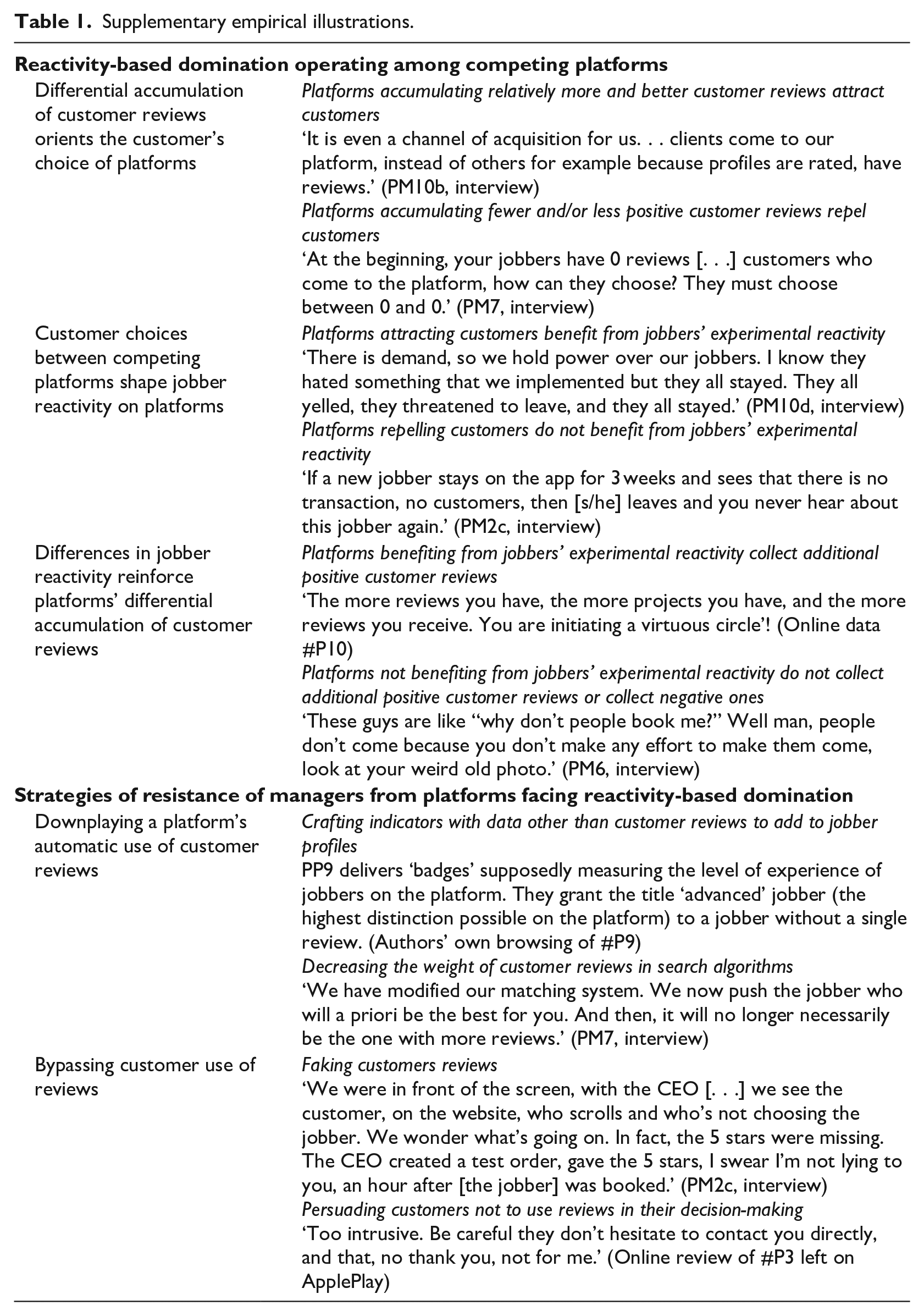
Reactivity-Based Domination and Strategies of Resistance in the Customer Review Era
Our analysis shows that reactivity-based domination in the customer review era operates through the mechanism of the differential accumulation of customer reviews. We also found that managers of platforms facing this domination resist by helping jobbers to be active on their platform without having to react to customer reviews.
Reactivity-based domination among competing jobbing platforms
Our analysis indicates that one platform (#P10) benefits from the experimental reactivity of jobbers thanks to its relative accumulation of customer reviews at the expense of all other platforms and in a self-reinforcing way.
Differential accumulation of customer reviews orients the customer’s choice of platforms
Our data indicate that differential accumulation of customer reviews on jobbing platforms shapes decision-making by customers when they seek jobbers and must choose between competing platforms. Indeed, we found that platforms accumulating relatively more and/or better customer reviews attract more customers. Customers prefer to conduct transactions on platforms accumulating relatively more customer reviews with better comments – especially when these reviews are distributed among many jobbers. Managers from several platforms explained that having many positive reviews is crucial for attracting customers; one of them stated that the number and content of accumulated customer reviews constitute ‘key success factors’ (#PM6, interview) for platforms, while another called them a ‘non-replicable asset that constitutes your intrinsic value’ (#PM10c, interview). One manager illustrates how differential accumulation of customer reviews by platforms shapes customer choices between competing platforms as follow: If [a customer] goes to platform X and sees the profile of a jobber named Roger with only one comment from a customer and then goes to another platform Y and sees Roger with 20 comments. . . [this customer] will choose platform Y. (#PM9a, interview)
Hence platform (#P10) systematically attracts customers with its stock of customer reviews. Managers of #P10 explain that the stock of customer reviews of their platform enables them to attract customers: ‘customers come to us, rather than to our competitors’ platforms, because we have lots of jobbers with lots of reviews’ (#PM10c, interview). Thus, in comments on #P10 left on appstores, customers often voiced their satisfaction with the opportunity to choose between many jobbers with many customer reviews: ‘What is better than to be able to get in touch with different [jobbers] that you can carefully choose based on previous reviews written by other people?’ (review left on an appstore about #P10).
As a corollary, we found that platforms accumulating fewer and/or less positive customer reviews repel customers; customers desert them, especially when few reviews are distributed among few jobbers. Managers of platforms other than #P10 explain that their relative accumulation of customer reviews makes the development of their business ‘uberdifficult’ and deplore the fact that their jobbers ‘lack customer reviews’ (#PM7, interview). These managers depict themselves as ‘poor’ in contrast with #P10, which is said to be ‘rich’, as it owns a ‘wealth of comments’ (#PM9a, interview). A manager in a platform in this situation told us that even though customers end up visiting her platform, most of them eventually go elsewhere due to the absence of customer reviews. She therefore explains that she ‘basically has to count on customers who can transact without reviews, which is unusual’ (#PM6, interview). To inform his sales pitch, the founder of a website aiming at aggregating reviews from different platforms also ran statistical tests on various platforms to determine the impact of customer reviews on customer decision-making. His analysis showed that customers are significantly repelled by platforms with an obvious lack of customer reviews on jobber profiles: Small platforms lack customer comments. Even if there are several jobbers ready to work and even though they propose a valuable deal, if a customer runs a search and sees that there are only empty profiles, it will not work. (#ORA1, interview)
Venture capital funds offer further evidence; they acknowledge that platforms’ accumulation of customer reviews is decisive for attracting customers and consider this aspect carefully before investing. An employee of such a fund explains that customer review stocks are a key criterion for evaluating a sales pitch by a platform manager: ‘If [the managers] are unable to communicate those figures to us we won’t listen to them for more than 5 minutes’ (#VC2, interview). Hence the stock of reviews accumulated on #P10 convinces private investors to invest, whereas those accumulated on other platforms repel them: a #P10 manager explained us that his platform’s stock of reviews ‘was actually reassuring for everyone’ and in particular for ‘investors’ (#PM10e, interview), whereas managers of platforms experience the opposite: ‘we don’t have much of the kind of data we’d need to appeal to an investor’ (#PM6, interview).
Customer choices between competing platforms shape jobber reactivity
Our data indicate that while differential accumulation of customer reviews orients customer choice between competing platforms, the relative number of customers using a platform shapes jobber reactivity to customer reviews on that platform.
Indeed, it appears that as #P10 attracts customers, it benefits from the experimental reactivity of jobbers – most jobbers registered on #P10 seek to obtain additional positive customer reviews by all means. On the one hand, jobbers who have already collected many positive reviews on #P10 still make significant efforts to collect more reviews and thereby maintain their attractiveness, even though they are already prioritised by customers: ‘even if they [already have more than 40 reviews] they still know that they really must be on time’ (#PM10c, interview). Several managers from #P10 explained that experienced jobbers are aware of the competition and fear that one negative review will compromise their chances for future transactions, i.e. they could quickly ‘lose their place on the app’ (#PM10a, interview). This is also evidenced by reviews found on an appstore about #P10, such as one from a jobber complaining that despite a good record of transactions, s/he nevertheless needs to remain ‘super alert’ to land new ones. On the other hand, jobbers on #P10 who had received no review, or only a few, seek by all means to please customers to obtain their first (few) reviews. They patiently watch the app despite a prolonged period without offers and try to remain competitive by cutting prices significantly or by applying for all sorts of jobs, even when they are located far away, thereby remaining extremely accommodating to customers. This is evidenced by the narrative used in response to new jobbers who – when customers refuse to choose them because they lack reviews – turn to #P10’s FAQ section to learn how to conduct their first transactions: ‘It’s the normal process! You have to show perseverance, continue to apply and never give up!’ (#P10, online data). This is also captured tellingly by the following quotation: When jobbers start on the platform, we know it is difficult for them to find business. That’s why we refer to it internally as ‘desert crossing’. New jobbers literally spend months applying all over the place, cutting prices [. . .] looking for their first reviews. (#PM10b, interview)
Then, it appears that platforms repelling customers do not benefit from the experimental reactivity of jobbers; when customers desert a platform, jobbers make little or no effort to collect additional positive customer reviews on that platform. On these platforms, jobbers without customer reviews do not struggle to obtain their first customer review. They do not try to please customers more than jobbers with reviews and make a rapid exit instead. A manager told us that on her platform, new jobbers often rush their profile pages – something they would never do on #P10: ‘It’s complicated for jobbers to enter the big platforms nowadays. They can’t come with an empty profile with a dark photo and everything or a description of barely three words [like they do on our platform]’ (#PM6, interview). In providing examples showing that new jobbers do not try hard to obtain a first review on his platform, a manager complained that they leave fast if they don’t obtain job offers quickly: ‘If you don’t provide any business opportunities, they’ll tell you directly that they’re fed up with your thing and they leave’ (#PM2b, interview). On these platforms, the few jobbers that have already received a few positive customer reviews also tend not to make much effort to collect additional positive reviews. A manager explains that ‘those with comments are inevitably contacted for all transactions, even if they do nothing to flesh out their profiles or make their offers particularly attractive’ (#PM5, interview) while another confirms that: they don’t need to try please customers – at all! – to obtain a transaction. We have this one jobber who has maybe 45 comments, you can be sure that if she says she’s available she’ll have at least 10 requests in one hour without doing anything, without lifting a finger. (#PM2a, interview)
Differences in jobber reactivity reinforce platforms’ differential accumulation of customer reviews
While the relative number of customers shapes jobber reactivity on these platforms, differences in reactivity on competing platforms further reinforce platforms’ differential accumulation of customer reviews.
Our data reveal that because #P10 benefits from jobbers’ experimental reactivity to customer reviews, it tends to collect additional positive customer reviews. Most #P10 managers acknowledge that ad hoc efforts by most jobbers enable their platform to accumulate additional positive customer reviews. Jobbers seek to please customers to obtain extra positive customer reviews in a self-reproducing way because satisfied customers ‘tend to use the platform more and more’ (#VC1, interview). This was confirmed by the manager of a dominated platform; when speaking about #P10 he explains that ‘because they face actual competition [on #P10], jobbers there have to be professional to obtain transactions and reviews, and so on and so on’ (#PM11, interview). This effect is also self-reinforcing because platforms benefiting from experimental jobber reactivity tend to incorporate relatively more new jobbers with reviews than their competitors, because jobbers lacking reviews on such platforms make considerable effort to obtain their first transaction and first review.
On the other hand, platforms in our sample which do not benefit from jobbers’ experimental reactivity tend not to collect any additional positive customer reviews or collect negative ones. Platforms in our sample that do not benefit from experimental jobber reactivity are stuck in a vicious circle: (a) jobbers make less effort to obtain transactions, (b) they make relatively less effort to please customers when they get work; and as a result (c) customers are relatively less likely to leave positive reviews. A manager of such a platform related a revelatory experience; a jobber active on her platform easily obtained transactions because he was one of the few with customer reviews. He considered [his position secure] and made less and less effort. As a result, he collected negative reviews: He did like 15 transactions that went well, he was happy [. . .] he totally relaxed somehow [. . .] he was feeling overconfident and he messed up a couple of transactions and of course customers complained. (#PM2b, interview)
This is also acknowledged by a manager of #P10, who explains that the lack of reviews on a platform can lead to such detrimental effect: ‘customer will choose the only jobber with good reviews and afterwards, naturally, this jobber will go down in quality, because he feels powerful on the platform’ (#PM10d, interview).
Strategies of resistance developed by managers of platforms facing reactivity-based domination
Managers of jobbing platforms enduring this reactivity-based domination develop strategies of resistance; they enable jobbers to become active on their platforms or to remain so without being reactive to customer reviews. These managers do so by downplaying their platform’s automatic use of customer reviews or by circumventing customer use of reviews.
Downplaying a platform’s automatic use of customer reviews
To downplay the automatic use of customer reviews on their platforms, managers first craft indicators with data other than customer reviews and add them to jobber profiles.
Many managers of platforms facing the reactivity-based domination designed what they call ‘trust badges’ (#P6, online data); these are data indicators added to the profiles of certain jobbers, which use non-review data to help customers differentiate these jobbers from one another. These badges are usually provided to jobbers in exchange for uploading a few items of personal information such as a certified telephone number. Not only do managers of dominated platforms craft such new indicators, but they also make them prominent on their result pages. For instance, in browsing the #PM5 platform, we found trust badges with shiny green blazons that take up nearly half of the jobbers’ profile pictures. This is also summarised by a manager from a dominated platform: We have created what we call ‘trust badges’ [. . .] These badges of trust act as credentials for our jobbers [despite the absence of reviews]. (#PM7, interview)
Managers also downplay the automatic use of customer reviews by their platforms in decreasing their weight in search algorithms. To do so, they (re)configure their search algorithm so that it uses data other than customer reviews for selecting jobbers on result pages. For instance, a manager acknowledged that he had recently changed the parameters of his search algorithm to provide customers with a result page that selects jobbers according to geolocation rather than review scores: Now it shows the two [jobbers] closest to your geolocation, [so that] the awesome guy who has 300 reviews that are all great. . . well, if he’s not located on your street, you won’t be able to priority-choose him anymore. (#PM2a, interview)
Beyond the criteria used to retain jobbers on the result pages, these managers also adjust parameter ranking jobbers on result pages, especially by increasing the weight of parameters unrelated to customer reviews. One manager chose to overweight data related to ‘the speed of the jobber’s response’ (#PM9b, interview). While reluctant to give exact details on the algorithm parameters, another manager simply acknowledged that his search algorithm does not rank jobbers based on their reviews: ‘clearly, the guy who has 10 reviews already has a greater appeal to customers. . . so, we don’t orientate in this sense with the algo’ (#PM11, interview).
Circumventing customers’ use of reviews
Managers of platforms facing reactivity-based domination also try to protect jobbers from the imperative of being reactive to customer reviews by circumventing customer use of reviews: they do so first by faking customer reviews.
We found that managers of dominated jobbing platforms ‘fake’ customer reviews, either by creating them ex nihilo for jobbers with no review or by deleting negative reviews. Managers of dominated platforms often leave quasi-automatic positive customer reviews on the profiles of jobbers who have not yet conducted any transactions. Inquiring about the possibility for a new jobber to conduct transactions, a manager admitted that s/he left fake customer reviews: ‘we push them a little; we give jobbers their first review.’ S/he confirmed this further: ‘Yes, [we provide] the first comment, the first review’ (#PM2a, interview). In exploring platform P#9, we also observed that one of our interviewees gave customer reviews to jobbers on his platform. Indeed, a customer profile with his initials, photograph and current location posted several customer reviews with a standardised pair of sentences (#PM9, online data). Managers of dominated platforms may also leave ‘fake’ customer reviews on jobber profiles when customers forget to leave reviews themselves. A manager explains the practice: ‘We decided to enter 5 stars automatically and we write “very good” or something like that. Somehow, for me, it’s like “if you’re not happy, you just have to say so”’ (#PM6, interview). In addition, our analysis indicates that managers of dominated platforms may contact customers directly to influence the content of the reviews they post or intend to post. An IT editor reported that managers of platforms which do not accumulate many positive customer reviews pay customers to delete negative reviews: Having a negative review can kill your business in the beginning. Something can be like ok, I will reimburse you, you upset me; it’s not very expensive. Take back your dough. And the counterpart is that the review disappears. (#ITE1, interview)
Similarly, a manager told us that one of the most active jobbers on his platform once received a negative review that prevented him from securing new transactions; this led the manager to remove the negative review: I called the customer that left the [negative] review and asked him for permission to delete his comment; we did so, and. . . the jobber completed a new transaction the very next day! (PM2a, interview)
Managers of dominated platforms can also persuade customers not to use reviews in their decision-making. They call them directly to assure them that they are safe even if they agree to a transaction with jobbers lacking reviews: ‘[we] call to remind [prospective customers] that X or Y have applied for the transaction and that X or Y are very good, [we] know them personally’ (PM7, interview). A manager of another dominated platform confirms use of this strategy: ‘We can also call the customers and tell them there is a certain jobber available for such a request; he is very good, we saw him in the office, don’t hesitate to take him’ (#PM11, interview). This is also apparent in reviews left on appstores. Some customers criticise this practice; one complained that ‘[he] was really surprised to be called by someone claiming to be an employee of#P3’, especially since this person ‘reminded [him] to get in touch with [certain #P3 jobbers] and even suggested [he] choose Mr. X.’
Discussion
In this paper, we asked how power operates between platforms collecting and aggregating customer reviews. Introducing the concept of reactivity-based domination derived from our Bourdieusian reading of studies on traditional evaluation intermediaries, we investigated the field of jobbing platforms operating in France. Our results shed light on the mechanism of differential accumulation of customer reviews as core to the reactivity-based domination unfolding between competing platforms, and outlines the strategies of resistance deployed by managers of dominated platforms, these managers influencing customers, or producing fake customer reviews, to protect producers from reviews. These findings have implications for the analysis of the forms of power operating on producers subjected to customer reviews, studies of evaluation intermediaries’ competition, and our understanding of fields in the digital era. We discuss these insights before reflecting on some limitations and boundary conditions of our study.
Our study first contributes to analysis of the forms of power operating on producers subjected to customer reviews (Curchod et al., 2020; Gandini, 2019; Newlands, 2021; Orlikowski & Scott, 2014; Rahman, 2021). Prior studies suggest that producers evaluated by customer reviews are subjected to new forms of power which benefit platform managers (Gandini, 2019) who strategically elicit and foster producers’ reactivity to customer reviews by forming coalitions with customers (Curchod et al., 2020) and/or by keeping the algorithmic processing of reviews left by customers opaque (Rahman, 2021).
Our focus on the power relationships operating between competing platforms collecting and aggregating reviews challenges and extends these insights in two ways, offering an ‘augmented’ approach to how power plays on producers subjected to customer reviews. First, our results challenge the notion that producers’ experimental reactivity is spontaneous: we found that producers seek additional positive reviews, but only for those platforms that accumulate relatively more customer reviews than their competitors. This suggests that the forms of power operating on producers subjected to customer reviews documented in prior studies (Curchod et al., 2020; Newlands, 2021; Rahman, 2021) result from the relative power position of the very platform under study: all those papers focus on producers active on a single and dominant platform. Our take on power is thus less limitative than that used in these prior studies because it recognises that the power deployed in online platforms over producers subjected to reviews is neither inherent to these reviews nor fully dependent on their online nature but depends instead on platforms’ position in the relationships of domination between competitors.
Second, our distinct empirical focus and consideration of relational power between online platforms enables us to expand analysis of thus far overlooked ‘dominated platforms’. In so doing, we identify evidence of theoretically unexpected power relationships and dynamics unfolding between managers, customers and producers subjected to customer reviews; we show that the interests of platform managers do not spontaneously align with customer reliance on reviews for decision-making (Curchod et al., 2020; Gandini, 2019), but that use of reviews by customers to make a decision benefits only the managers of platforms accumulating relatively more customer reviews than their competitors, at the expense of the latter. Managers of platforms accumulating relatively fewer customer reviews are stuck in a vicious circle as customers rely on reviews for their decision-making. Also, it appears that coalitions of customers and platform managers formed around evaluation procedures (Curchod et al., 2020) are not spontaneous: we found that managers of platforms undergoing reactivity-based domination form coalitions with entities subjected to customer reviews (in our context: jobbers). They do so by downplaying the automatic use of customer reviews by their platforms or by circumventing customer production of reviews – two strategies that result in temporary sheltering of these actors from the effects of reactivity-based domination. In such cases, platform managers enhance the opacity of customer reviews (Rahman, 2021) – and around their use in the platforms’ algorithms – not to extract extra work from producers subjected to customer reviews (Gandini, 2019) but to prevent them from making extra efforts to please customers. These insights result from our relational conceptualisation of power that enabled us to return relative power positions of platforms in their organisational field to the scope of analysis. In contrast, prior conceptualisations of the power relationships operating through customer reviews may have mistakenly assumed that such power is inherent either to the digital nature of reviews or the new configurations of relationships between customers, producers and platform managers, while overlooking the reactivity-based domination dynamics enabling or preventing the deployment of such forms of power.
Future research can leverage this augmented, relational conceptualisation of how power operates through customer reviews by exploring the behaviours of platform managers, producers and customers in other dominated platforms that have been neglected in prior research. Especially, our data reveal that managers of dominated platforms help jobbers lacking reviews because jobbers with reviews attract customer demand. Yet, in so doing, these managers alleviate existing asymmetrical power positions among jobbers; producers who have received many reviews on a dominated platform have an interest in preventing managers from helping producers who have received fewer customer reviews on the platform. Thus, we urge further investigation of the ‘complex geopolitics’ of fields populated by competing online platforms. Future studies could examine how dominant producers working on dominated platforms can constrain the strategies of resistance developed by platform managers and how that can possibly reinforce existing asymmetrical power positions of competing platforms.
Our second contribution is to the analysis of competition between evaluation intermediaries (Brandtner, 2017; Giamporcaro & Gond, 2016; Ringel, 2021; Sharkey et al., 2022) because we integrate existing literature on evaluation intermediaries by introducing the idea of reactivity-based domination and we show that the rise of customer reviews reshapes these power dynamics. While we explain from existing research that reactivity-based domination traditionally operates through conformance to evaluation criteria imposed by a dominant field player (Brandtner, 2017; Espeland & Sauder, 2007; MacKenzie, 2006), we found that in the customer reviews era, the mechanism core to the reactivity-based domination between evaluation intermediaries is the differential accumulation of reviews. In this context, the criteria of assessment of a dominant player matters less than evaluation intermediaries’ stock of customer reviews. Platforms having accumulated relatively more and better-quality customer reviews see their domination self-reinforced by a virtuous circle because they benefit from producers’ experimental reactivity, whereas their competitors do not. Dominated platforms accumulating relatively fewer reviews are stuck in a vicious circle, as producers there have less interest in obtaining additional reviews than on dominant platforms. While we studied the particular case of the field of jobbing platforms in France, such reactivity-based domination seems to operate in several other fields populated by platforms collecting and aggregating reviews (Sharkey et al., 2022). For instance, similar dynamics seemingly operate in the field populated by eBay and its competitors, with producers remaining active on eBay despite poor working conditions because they are reluctant to move to much lesser-known platforms, where they have not collected reviews (Curchod et al., 2020).
Second, by focusing on power relationships between evaluation intermediaries at field level in a digital context, our analysis highlights new strategies of resistance that point to a form of sheltering. We see that managers of dominated platforms resist reactivity-based domination by sheltering jobbers from experimental reactivity, enabling them to work on their platform without having to collect additional positive reviews from customers. They do this, for instance, by posting fake positive reviews on jobber profiles with no reviews or by removing negative reviews from their profiles. Sheltering, as an intermediary’s resistance strategy, is conceptually distinct from forms of resistance to dominant players conceptualised in studies of traditional evaluation intermediaries, which focus either on attempts of subversion (by redefining criteria, e.g. Dubuisson-Quellier, 2013) or ceremonial conformity (by trying to benefit from producers’ convergent reactivity to dominant assessments, e.g. Olson & Waguespack, 2020). Although sheltering operates in a covert mode in the same way as ceremonial conformity, it does not seek to shape producer behaviours, in contrast to strategies of resistance traditionally developed by dominated evaluation intermediaries producing ratings or rankings. Rather, this mode of resistance involves immunising, at least temporarily, producers from the influence of customer reviews. We argue that sheltering as a form of resistance is not restricted to managers of platforms intermediating the exchanges of services, nor to those intermediating exchanges between individuals (as it is the case with jobbing platforms); such tactics are enabled by technical affordances of online platforms that give the impression of transparency but also create opacity ‘behind the scene’ (Rahman, 2021), which in turn enables possible new forms of covert resistance.
The fact that mechanisms underpinning reactivity-based domination are distinct in digital and non-digital contexts calls for further exploration of the power relationships unfolding between evaluation intermediaries in hybrid contexts, where producers are subjected to both reviews, and traditional ratings, or rankings. For instance, studies could explore the power relationships operating between traditional evaluation intermediaries and online platforms in the field of gastronomy as restaurants are subjected to both (e.g. TripAdvisor and Michelin Guide).
Third and finally, our study contributes to pioneering digital updates of Bourdieu’s (1993, 2005) theory of fields. We show that the definition of individuals’ übercapital (Fourcade & Healy, 2017) in a digital field populated by competing individuals (like the field formed by competing jobbers within a given platform) interplay with relational power dynamics operating at the level of a digital organisational field (like the one populated by competing jobbing platforms). In such organisational fields, dominant members seem able to maintain their power positions despite the definition of a valued capital being subject to change.
Digital organisational fields are sets of organisations collecting and aggregating data about the same actors and providing these data to similar actors (Alaimo, 2022; Kolb et al., 2020). First, it appears from our study that within such a field, the power positions of organisations are shaped by their respective aggregated stocks of individual producers’ übercapital. In our case, the übercapital of jobbers competing on a platform was indeed constituted by the customer reviews received by the jobbers active on this platform, while the power positions of jobbing platforms were shaped by their relative aggregated stock of customer reviews received by their jobbers. The relative differences in stocks of aggregated übercapital accumulated by competing platforms are self-reinforcing, as producers generate more data constitutive of their übercapital when they work for dominant platforms than when they work for dominated ones. In our case, jobbers seek to collect additional customer reviews on dominant platforms whereas they do not on dominated ones.
Our study indicates that not only do producers generate more data constitutive of their übercapital when they work on dominant platforms, but in general they seem more inclined to provide all sorts of data about themselves to dominant platforms than to dominated ones. For instance, they take more care to include details in their profiles on dominant platforms. Hence, in this context, dominant platforms seem able to maintain their dominating position, even if the definition of what is a valued capital in their field changes, provided that they accumulate more of all sorts of data than their competitors. Thus, whereas challengers resisting in non-digital fields often fail to alter the definition of valued capital in a field, digital challengers might do so but are unlikely to accumulate relatively more of this capital than the dominant actor. To further extend these digital updates of Bourdieu’s theory of fields, future research could study actors who were peripheral to this study, such as platform suppliers or government actors, and provide details on their role in the power dynamics operating between members of a digital organisational field.
Although the field of jobbing platforms operating in France offered an interesting case for studying reactivity-based domination in the customer review era, our findings are informed by this unique case, and their transferability to other fields needs to be assessed. Two boundary conditions can be considered. First, our findings relate to the study of platforms mediating non-skilled local services between individuals. Customer use of reviews could play out differently in fields in which platforms mediate exchanges during which consumers and producers never meet physically (for instance, Amazon Mechanical Turk). Overall, more research is needed to specify how the characteristics of exchanges impact our conclusions; however, our findings are not specific to jobbing platforms but could be generalised to fields where consumers routinely use customer reviews to make their decisions and where competing platforms operate.
Another boundary condition relates to the power structure inherent to the French jobbing field, which was in our case characterised by domination of one platform over numerous smaller-scale competitors. Our results suggest that the concept of differential accumulation of customer reviews explains such a structure, as the stock of customer reviews on P10 was clearly superior to those of its competitors in many aspects – P10 had more reviews; these reviews were largely positive and were split among more jobbers. Although numerous other digital fields seem to be characterised by the clear dominance of one platform over its competitors (e.g. Curchod et al., 2020), others are characterised by the dominance of several platforms over a myriad of smaller actors (for instance, the fields of platforms intermediating peer-to-peer accommodation services in several European countries; European Commission, 2019, p. 52). Complementary empirical investigations are needed to explain why these different patterns of domination arise. Future research could use our conceptual apparatus and repertoire of resistance strategy as starting points to compare instances of domination and resistance in fields where several dominant actors coexist.
Finally, our study has revealed ethically problematic practices inherent to resistance, such as exploitation of the opacity in digital fields through production of fake reviews. It seems like such ethical concerns may be raised strategically by dominant players, as they have an interest in enforcing state-level regulation preventing such practices, provided that their own stock of customer reviews improves in a self-reinforcing manner. Although exploring such ethical issues through normative theories was beyond the scope of our analysis, we encourage future research to scrutinise more closely whether and how power relationships could be harnessed for the greater good in the digital age.
Conclusion
In this paper, we have extended our understanding of the power implications of the shift to customer reviews. While most existing studies on the matter focus, conceptually and empirically, on the lived experiences of individual producers active on large platforms, we explored how power operates between competing platforms collecting and aggregating customer reviews. We focused on the field of jobbing platforms in France and drew on a dataset mainly comprising interviews with managers of competing platforms. We found that in the customer review era, reactivity-based domination operates between platforms through differential accumulation of customer reviews. We also showed that managers of platforms subject to such reactivity-based domination resist by sheltering producers from having to be reactive to customer reviews. We believe that our work paves the way for important additional research on the ‘complex geopolitics’ of customer reviews, which are third-party evaluations characteristic of the digital era and thereby essential to future settings of work and consumption. This additional research is not only theoretically stimulating, but also important from a policy-making perspective. For instance, the European Law Institute (2022) is currently supporting research about whether individuals working for platforms should own the customer reviews they collect on different platforms and be able to transport these data across competing platforms.
Footnotes
Appendix
Overview of the data sources.
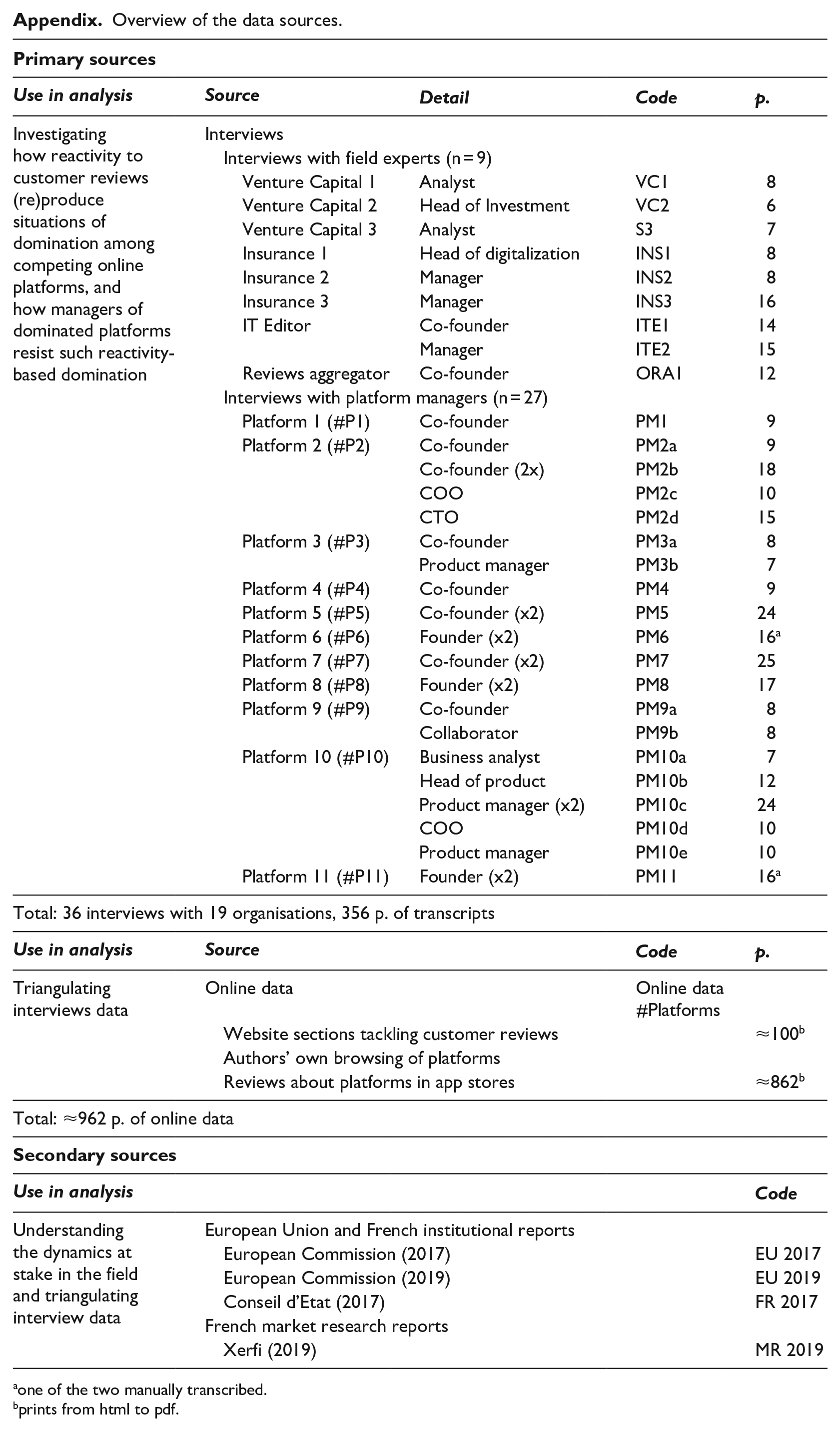
| Primary sources | ||||
|---|---|---|---|---|
| Use in analysis | Source | Detail | Code | p. |
| Investigating how reactivity to customer reviews (re)produce situations of domination among competing online platforms, and how managers of dominated platforms resist such reactivity-based domination | Interviews | |||
| Interviews with field experts (n = 9) | ||||
| Venture Capital 1 | Analyst | VC1 | 8 | |
| Venture Capital 2 | Head of Investment | VC2 | 6 | |
| Venture Capital 3 | Analyst | S3 | 7 | |
| Insurance 1 | Head of digitalization | INS1 | 8 | |
| Insurance 2 | Manager | INS2 | 8 | |
| Insurance 3 | Manager | INS3 | 16 | |
| IT Editor | Co-founder | ITE1 | 14 | |
| Manager | ITE2 | 15 | ||
| Reviews aggregator | Co-founder | ORA1 | 12 | |
| Interviews with platform managers (n = 27) | ||||
| Platform 1 (#P1) | Co-founder | PM1 | 9 | |
| Platform 2 (#P2) | Co-founder | PM2a | 9 | |
| Co-founder (2x) | PM2b | 18 | ||
| COO | PM2c | 10 | ||
| CTO | PM2d | 15 | ||
| Platform 3 (#P3) | Co-founder | PM3a | 8 | |
| Product manager | PM3b | 7 | ||
| Platform 4 (#P4) | Co-founder | PM4 | 9 | |
| Platform 5 (#P5) | Co-founder (x2) | PM5 | 24 | |
| Platform 6 (#P6) | Founder (x2) | PM6 | 16 a | |
| Platform 7 (#P7) | Co-founder (x2) | PM7 | 25 | |
| Platform 8 (#P8) | Founder (x2) | PM8 | 17 | |
| Platform 9 (#P9) | Co-founder | PM9a | 8 | |
| Collaborator | PM9b | 8 | ||
| Platform 10 (#P10) | Business analyst | PM10a | 7 | |
| Head of product | PM10b | 12 | ||
| Product manager (x2) | PM10c | 24 | ||
| COO | PM10d | 10 | ||
| Product manager | PM10e | 10 | ||
| Platform 11 (#P11) | Founder (x2) | PM11 | 16 a | |
| Total: 36 interviews with 19 organisations, 356 p. of transcripts | ||||
| Use in analysis | Source | Code | p. | |
| Triangulating interviews data | Online data | Online data #Platforms | ||
| Website sections tackling customer reviews | ≈100 b | |||
| Authors’ own browsing of platforms | ||||
| Reviews about platforms in app stores | ≈862 b | |||
| Total: ≈962 p. of online data | ||||
| Secondary sources | ||||
| Use in analysis | Source | Code | ||
| Understanding the dynamics at stake in the field and triangulating interview data | European Union and French institutional reports | |||
| European Commission (2017) | EU 2017 | |||
| European Commission (2019) | EU 2019 | |||
| Conseil d’Etat (2017) | FR 2017 | |||
| French market research reports | ||||
| Xerfi (2019) | MR 2019 | |||
one of the two manually transcribed.
prints from html to pdf.
Acknowledgements
We thank the three anonymous reviewers and our senior editor for this manuscript, Janne Tienari, for their helpful feedback and advice. Prior versions of this paper have been presented at research seminars of IREGE at IAE Savoie-Mont-Blanc, of IAE Lille, and of the Department of Management Studies of Aalto School of Business as well as in the track 44 of EGOS 2019 (Valuation, Strategy and Organization): we thank all the participants for their useful comments. We also thank Isabelle Royer for feedback on earlier versions of this paper as well as Mickaël Buffart, Nina Granqvist, Saku Mantere, Inês Peixoto and Mark van der Giessen for their support during the last rounds of revision.
Funding
The author(s) disclosed receipt of the following financial support for the research, authorship, and/or publication of this article: The work of the first author was supported by Academy of Finland [Grant Number 323119].
