




Abstract
Using the concept of regulatory space, this article asks how both the state and non-state actors influence employment regulations particular to the gig-economy. To address this question a mixed method approach is used, including interviews with strategically placed informants involved in policy formation at national and international levels, content analysis of legal cases, parliamentary inquiry transcripts and policy reports. The analysis contributes to an understanding of employment regulation by the state in two ways. First, it reports distinct ‘levers’, which lead to a particular state role of ‘ceding and seizing’ regulatory power. Second, it argues that these levers ultimately serve the accumulation interests of capital over the legitimacy of employment rights for labour. The findings have wider societal implications for issues of equity, justice and employment regulation applicable to the gig-economy.
Introduction
The emergence of new forms of business, such as those advocating greater flexibility and typically described as being part of the gig-economy, has sparked interest in a range of debates about work sociology and the future of employment regulation (Graham et al., 2017). The gig-economy makes use of online platforms to provide various services (such as food delivery, cleaning, IT micro-tasks, etc.) to consumers, by allocating job tasks to a pool of workers, often described as ‘independent contractors’. Utilising digital technologies and online platforms, the gig-economy represents an extension to non-standard forms of employment (NSFE) with greater casualisation and fewer employment protections (Howcroft et al., 2019). Despite knowledge about working conditions in the gig-economy across different jurisdictions (e.g. Bales et al., 2018; Tassinari and Maccarone, 2020; Veen et al., 2020; Wood et al., 2019), understanding how employment standards in the sector are shaped, and by whom, is relatively limited. Focusing on the United Kingdom (UK), this article asks how the state and non-state actors influence the processes affecting employment standards within the sector. The findings contribute to debates about ‘regulatory spaces’ occupied by multiple actors seeking to leverage employment changes particular to the gig-economy.
This article makes two contributions to theory and practice affecting gig-economy employment debates. First, it provides new insights as to how the state effectively ‘cedes’ and ‘seizes’ regulatory power over gig-economy employment standards. Second, it argues that these processes of occupying regulatory spaces by both state and non-state actors predominantly serve the interests of capital over the rights of workers. The evidence has wider implications for those who work under gig-economy arrangements and for trade unions seeking to mobilise and represent such workers.
The article begins by discussing the literature on the role of the state, the concept of regulatory space and its relevance to gig-economy employment debates. After explaining the research methodology, the findings are presented in two parts: first, three distinct levers used by the state are reported, which ‘cede’ power to non-state actors; second, three additional levers of power are identified, whereby non-state actors ‘seize’ opportunities to affect employment conditions in the gig-economy. The discussion argues that the dynamics of ‘ceding and seizing’ regulatory power in the sphere of work and employment tend to serve the interests of the state and business more than workers or unions.
Regulatory space, power and the role of the state
The role of the state has been explored across several streams of literature. Martínez Lucio and MacKenzie (2017: 2984) define the state as a ‘heterogeneous and complex entity’ with broad interests and levels of autonomy governing relationships among divergent actors. Jessop (2013) illustrates the power dynamics of the state in regulating capitalism and formulating accumulation strategies, considering the role of other social actors who seek to shape relations across a territory and/or a culture, while Howell (2016) draws attention to the ‘stickiness’ of the institutions of the state regarding phases of liberalisation over time. Furthermore, Erne (2008: 15) underscores the political intricacies of regulatory decision-making of the state, including transnational processes of the EU, when perceived democratic traditions can be subsumed or transferred to a technocratic (elite) agency, which can sometimes be detached from the representative constituency the state is supposed to protect (e.g. its citizens or workers). The analysis provides a distinct theoretical framing for research to examine employment regulation in newer sectors such as the gig-economy.
First, there are different state agencies involved in standard-setting and the power resources they deploy for legal enforcement, demonstrating a polymorphic character of state power over time and space (Jessop, 2015). Accordingly, a consideration of the sources of legitimacy is required to appreciate changing state (and non-state agency) influence, incorporating the important role played by markets and community actors (Scott, 2017). There are layers of complexity concerning the legitimacy of various state roles in employment regulation, meaning that power resources are not straightforward or uniform, either between separate state institutions or within them. Given the range of state agencies and separate actors that operate with them, it is difficult to describe in its broadest sense a single overarching state project (Martínez Lucio and MacKenzie, 2017). Thus, along with various agencies and actors that interact with the state in making rules, there exist multiple centres of legitimacy and authority outside the walls of state governance (Jessop, 2015). Arguably, the image of a democratic or westernised pluralist tradition of governance remains one of uneven diffusion, or what Jessop (2004: 50) alludes to as an ‘ensemble of socially embedded, socially regularized, and strategically selective institutions, organizations, social forces [. . .] making collectively binding decisions’. When considered in terms of labour market institutions and gig-economy employment rights more specifically, the strategic-relational approach of a polycentric state signals the fragmentation of various tensions: for example, between collective ideas of solidarity and regulation over employment standards and related struggles of resistance and counter-mobilisation (Cant and Woodcock, 2020), shifts toward greater individualism in the management of employment spaces, such as espousing newer managerial techniques in the name of human resource capital, agility or resilience (Koukiadaki et al., 2016), but also power from the judiciary as a distinct agency of the state that occasionally intervenes around worker grievances (Kirk, 2018). These approaches can sometimes disrupt the ideological flow of unconstrained employer unilateralism of a neo-liberal political project of government, albeit inconsistently, as evidenced by conflicting judicial decisions on gig-economy workers (discussed below).
More broadly, the work of Erne (2008), Howell (2016), Jessop (2004, 2013, 2015) – and others – is important in appreciating the complexities that frame multiple facets of the state and how they intersect to shape regulations for work and employment. On the one hand, there is an articulated ‘legitimacy’ of how the state protects citizens (workers), say supporting individual rights about hours of work or health and safety, even if new rights privilege the individual over the collective representation of labour. On the other hand, there is an interest in ‘accumulation’ for businesses to expand and grow, which can mean the state facilitates corporate objectives when shaping employment rights. The state is therefore seen in terms of its ‘coupling and decoupling evolution with a wider set of institutions and social practices’ (Jessop, 2004: 51), which may affect the spaces and processes of work and employment regulation in the gig-economy.
Second, the functional and technical roles of different state and labour market institutions are not straightforward. According to Kahn-Freund (1977), the scope of state legal regulation falls under multiple forms: restrictive laws are areas where the state outlaws certain practices, such as forbidding child labour, or confers positive rights, such as guaranteeing protections to whistle-blowers; the state’s regulative function establishes certain minimum standards to actors’ autonomy, such as working time or minimum wages; and auxiliary legislation enables the support of employment relations’ institutions, such as collective bargaining. These regulatory forms are contested between actors through a deployment of power and resources, particularly in capitalist market economies. Hyman (2008) argues the state has an accumulating function (e.g. facilitating capital expansion and economic growth) as well as a legitimising role (e.g. fostering citizenship and voice). Using this accumulation-legitimation dynamic, O’Sullivan et al. (2017: 652) show how a weakened regulatory state in Ireland can open-up spaces for the derogation of employment standards under pressures for accumulation. Their research finds that regulations protecting those working under zero hours arrangements have ‘been demonstrably ineffective’ (O’Sullivan et al., 2017: 665). Our research focuses on the UK regulatory space specifically, although the methodological approach can be replicated and reproduced to understand other state regimes, especially by considering the state as a social relations actor, internally and externally (Jessop, 2015).
Third, the idea of ‘regulatory space’, first developed by Hancher and Moran (1989), offers analytical capacity to capture the power-centric features of socio-political governance (Inversi et al., 2017). Regulatory space can be defined as ‘the range of regulatory issues subject to public decision [. . .] in any particular national setting, and by analysing that setting in terms of its specific political, legal and cultural attributes’ (Berg et al., 2005: 73). The sources of regulatory influence enacted across gig-economy contexts is a relatively new departure under-explored in much of the extant literature. Specific debates capture issues such as legal contract definition (De Stefano, 2016), working hours and job insecurity (Berg et al., 2018), pay and work inequalities (Wood et al., 2019), and collective organisation and potential union mobilisation (Tassinari and Maccarone, 2020). However, less is known about how the state and other agencies seek to regulate the spaces influencing employment standards (Dundon et al., 2014). Arguably, regulatory space is a conceptual development under-used to examine how trade unions are organising around gig-worker rights. For example, the value of mobilising campaigns to help forge solidarity networks and alliances has emerged in gig-sectors (Cant and Woodcock, 2020): unions have taken direct strike action to help improve pay and conditions (Trappmann et al., 2020), developed new litigation tactics to challenge the bogus self-employment status of gig-workers (Kirk, 2020), and engaged in lobbying and media campaigns exposing poor worker rights to undermine the Deliveroo public share offering (O’Connell, 2021).
Extending the concept of regulatory space to gig-economy contexts, Inversi et al. (2017) outline four interrelated dimensions: law, codetermination, voluntary negotiation and unilateral employer power, operating at international, national, sectoral and/or workplace levels. The dimensions are not separate entities but symbolic of regulatory spaces that exhibit polymorphism. Actors mediate regulatory instruments and processes through different pathways, digital technologies, sources of influence and power resource utilisation (MacKenzie and Martínez Lucio, 2014). Likewise, Erne (2008) distinguishes different strategic choices of state regulatory paths: either democratic opportunities including workers and unions, or technocratic reliance on external expertise to ensure regulatory administration. The democratic–technocratic dichotomy resonates with gig-economy employment conditions when appreciating the range of outside agencies that the state has drawn upon to assist in the formation and/or enforcement of restrictive, standard-setting and auxiliary employment regulations, such as the Taylor Review in the UK (Bales et al., 2018). Such an analytical schema offers a picture of the sources of power and the spaces actors seek to occupy when regulating gig-economy employment spheres.
Analysing the political process through the lens of regulatory theory, commentators have pointed to the rise of the ‘regulatory state’, which, according to Braithwaite (2008), began in the 1980s with the process of reform adapting to globalisation and embracing neo-liberal views. From there, the state has switched from being seen as a monolithic entity, to represent a system of ‘governance at distance’ (Yeung, 2010). The state’s role affects the spaces for other actors and private agencies to contribute (or not) to the re-regulation of employment issues (Osborne and Gaebler, 1992). The change in state role has been uneven and sometimes contradictory. For example, the state has not entirely abandoned its regulatory functions as a protector and facilitator of labour reproduction (Erne, 2008). The state has occasionally had to intervene, either through the establishment of new rights and standards or through enforcement, to protect workers from the ‘fall-out’ from its own policies of labour market decommodification (Rubery, 2011). These interventions open-up spaces of agitation and adjustment for a wide range of actors, the incidence of non-state (soft) law, non-hierarchical control and the effects on the regulatory processes (Jessop, 2004, 2015). Considerations of such developments may be witnessed in the UK government’s decision to commission a review of ‘Modern Working Practices’ in the gig-economy, known as the Taylor Review, named after its chairperson, Matthew Taylor. The Taylor Review (Taylor et al., 2017) represented a form of expert or technocratic regulation, with actors reviewing and recommending on employment rights in the gig-economy. This article looks at the regulatory processes for the gig-economy by asking ‘how do both public and private actors interact to influence employment conditions particular to the gig-economy?’.
Methodology
The complexity of researching employment regulation involves rich and varied methodological traditions: in particular, the distance between the traditional legal approach (mainly based on the review of jurisprudence) and sociological analysis of actor experiences of work relations (based both on qualitative and quantitative empirical data). Empirical research in the field of labour law and regulation is a contested area (Deakin, 2010). However, qualitative inductive approaches to data collection and legal analysis have emerged (Webley, 2010), with the aim of expanding into sociological and political science perspectives to enrich the study of law with external socio-economic institutions and actors (Doherty, 2016).
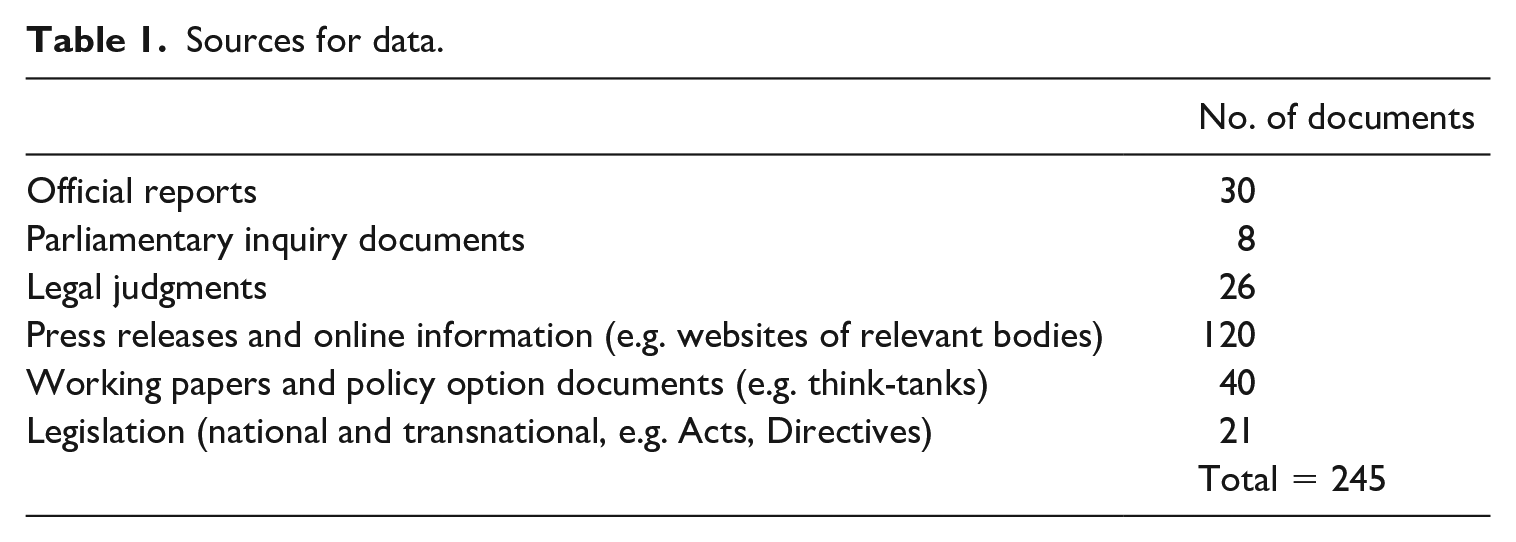
Recognising the complexities of regulatory influences and agencies, this article supports a qualitative mixed-methods approach. Besides the technical analysis of legal and judicial developments, it uses qualitative methods to address regulatory questions, stressing how social experiences are created, socially reproduced and given meaning (Denzin and Lincoln, 2000). First, the data draw on interviews with 18 key informants (three at international level, 15 at national level), selected for direct experience of the decision-making apparatus of the state across national (UK) and transnational (e.g. EU, International Labour Organization (ILO)) levels. Interviewees include officers and representatives of the ILO, EU and UK unions, an employer association representative, the Advisory Conciliation and Arbitration Service (ACAS), policy networks/think-tanks such as the Royal Society of Arts (RSA), the New Economics Foundation (NEF) and New Economics (NE). The interviews are supplemented by observation and further interaction with Deliveroo riders at work. 1 All interviews were transcribed and coded for analysis to identify central themes, helping to understand regulatory dynamics. Second, a content analysis method was employed to identify themes and common points between documentary sources and research interviews (Gioia et al., 2012). This element draws from 245 legal and policy document sources (including press releases, minutes of meetings, government and other reports and legal judgments) to contextualise the regulatory debate (Table 1). Gig-economy platforms/employers refused to participate in the study; however, their perspectives were collected and analysed from parliamentary inquiries and other (e.g. ILO) reports that received direct employer representations.
Sources for data.
Data collected at national level focused on statutory regulations, relevant case law and official reports by bodies and agencies connected with employment regulation in the gig-economy. Data collection at international level focused on transnational actors and institutions that can influence the regulation of employment issues in the gig-economy, particularly the ILO and EU. The levels and type of data collected for the study are summarised in Table 2.
Level and types of data collected.
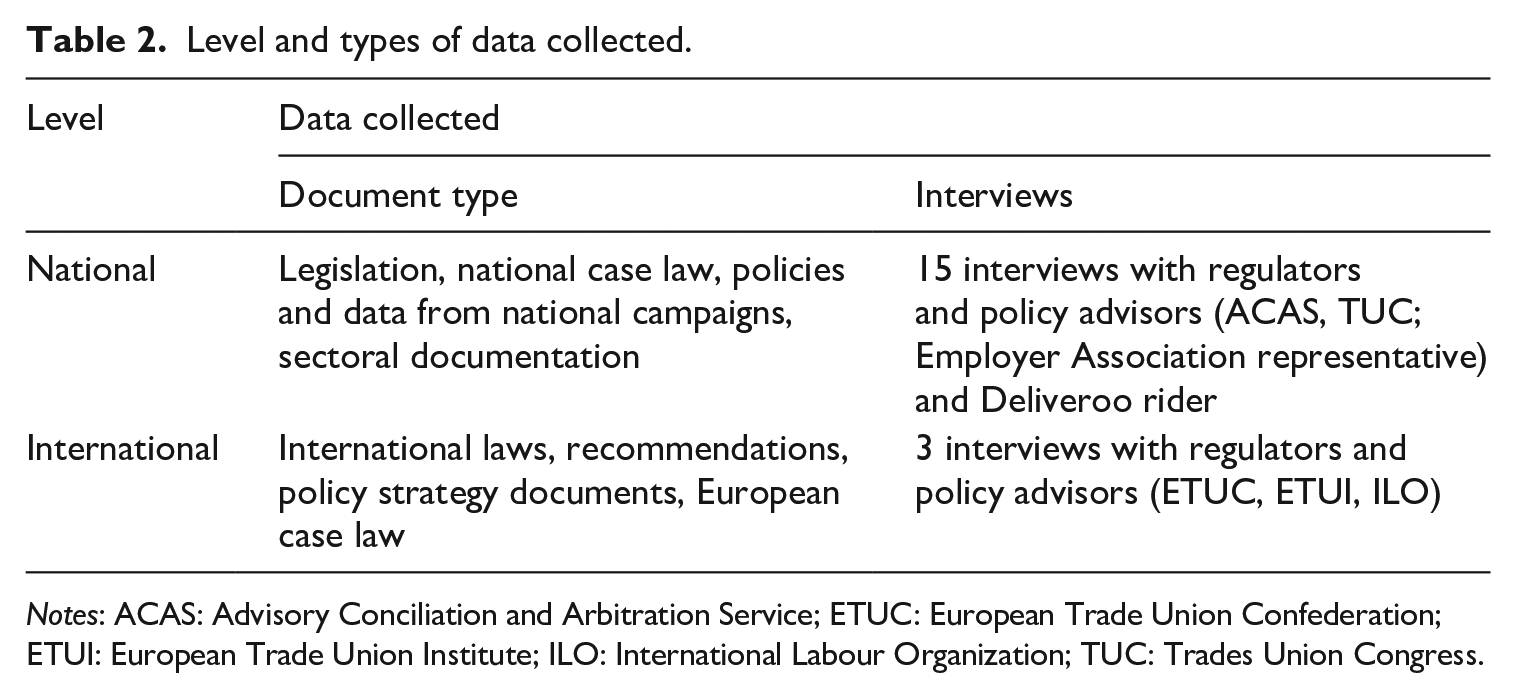
Notes: ACAS: Advisory Conciliation and Arbitration Service; ETUC: European Trade Union Confederation; ETUI: European Trade Union Institute; ILO: International Labour Organization; TUC: Trades Union Congress.
Data were analysed in two stages. First, documentary sources were subjected to a legal and policy content analysis using coding to facilitate thematic analysis (e.g. pay, hours, contract status, etc). Second, the interview data were analysed, adopting the same coding structure as the policy documents to link grey literature with respondent transcripts. Following the method identified by Gioia et al. (2012), the coding for both the documentary content analysis and the interviews followed a step-procedure useful to develop a systematic presentation of a priori employment issues reported for gig-economy workers (e.g. pay, working time, hours, contract status) as well as allowing concepts to emerge from the data. Following the legal analysis and content analysis of both interviews and fieldwork observations, the findings were mapped in terms of multi-level regulatory actors (Inversi et al., 2017). Although few in number, international agency respondents all held senior positions in their organisations, specifically in terms of decision-making and/or policy formation roles, and therefore provided strategic-level information. Ethical approval was obtained according to respective higher education institutional research standards.
Findings: The ceding and seizing of regulatory space in the gig-economy
The role of the state in regulating the gig-economy
Three important regulatory stages are reported: pre-regulatory considerations (stage 1), enactment of standards (stage 2) and enforcement (stage 3). The research found that at each stage the state ‘cedes’ a degree of regulatory influence, mostly to employer and business groups. Each stage thus represents a key ‘lever’ to shape the regulatory spaces that favour the interests of capital accumulation over labour legitimisation.
Stage 1: Preliminary pre-regulatory dynamics
The research examined the workings of the Taylor Review, which incorporated entrepreneurs, business leaders, legal professionals and enforcement agencies. It is symbolic of the ‘auxiliary’ role of the state, noted by Kahn-Freund (1977), and received political support from the Department of Business, Energy and Industrial Strategy (BEIS). However, content analysis shows that the Taylor Review had very limited engagement with unions representing gig-economy workers (e.g. Independent Workers’ Union of Great Britain (IWGB), Unite and GMB), despite their active role organising couriers and promoting solidarity action in the sector. Further scrutiny shows that the Taylor Review engaged more directly and actively with corporate interests, privileging employer access to the space for influence. The content analysis also discovered bias in the composition of the Review, as one of its members had been a Deliveroo investor.
The data point to a distinct ‘ceding’ of important regulatory ground by the state to those employers engaged with the Taylor Review process. For example, the Taylor Review’s recommendations fall short of suggesting any direct regulatory intervention; for instance, its final recommendation advocates ‘responsible corporate governance, good management and strong employment relations within the organisation’, rather than legislation. Nor does it favour collective bargaining or negotiation. Instead, it emphasises that employers and employees should promote a voluntarist ‘best practice’ agenda, without further interrogation of what ‘best practice’ might mean. The UK government’s response largely followed the Taylor Review’s recommendations, refraining from any new substantive legal intervention in gig-economy employment.
The data also suggest significant fragmentation and contestation among related state agencies. The Taylor Review was scrutinised by other state bodies, such as Work and Pensions (WP) and BEIS committees, reporting to various House of Commons fora (e.g. ‘A framework for modern employment’, WP & BEIS, 2017). Significant for national level regulation is the recommendation on the topic of defining employment contract status for gig-workers. The Framework suggests that, to avoid the misuse of contracts for services (where under UK law workers are deemed ‘self-employed’ and lack employment protections), ‘new’ legislation should focus on ‘the importance of control and supervision of workers by a company’. The latter would represent an important change and a partial reclaiming by the state of the regulatory space; however, the Framework’s proposals have not yet been enacted. 2 Arguably, therefore, the ‘preliminary’ regulatory spaces facilitate a state role that underpins corporate (private) accumulation, ahead of specified employment standard-setting.
Stage 2: Enactment of standards
The data identified two ways in which the state shapes the regulatory space by enacting standards: first, excluding the worker voice and other (international) policy actors, and second, adopting ‘soft’ regulatory language.
First, the data evidenced that the legitimacy of worker representative voices, such as the Trades Union Congress (TUC) and European Trade Union Confederation (ETUC), did not substantially shape the processes debating possible future gig-economy regulations, as with the Taylor Review (reported above). Additionally, evidence shows that the British state actively marginalised and/or by-passed forms of social dialogue with legitimate international institutions, such as tripartite discussions at the level of the ILO concerned with working time standards. For example, there was a stark contrast between the preferences of the UK and the desired standards of other transnational actors (e.g. ILO and EU), which tend to favour including worker and employer voices. In this regard, an ETUC respondent reported a priority issue for the trade union movement was ensuring that, if the UK left the EU, ‘employment standards are protected and social and labour rights will not cease to be implemented in the UK’ (ETUC Officer 1). However, content analysis of reports and legal cases shows the British state and its agencies did not acknowledge standards for social dialogue, as promoted as good practice by the ILO. An ILO officer commented: There are certain countries and governments that look more favourably to the ILO and use it for guidance, but others that never do [. . .] I think in the Anglo-Saxon world this is just not on the horizon. (ILO Officer 2)
Second, the research found that policy recommendations originating from the state (and its agencies) increasingly used ‘soft’ regulatory language. At best, this buttressed a voluntarist regulatory space supporting corporate accumulation. At worst, it actively undermined hard legal rights for workers employed in gig-economy jobs. For example, a respondent from the RSA explained how the state’s role meant policy formation was unclear and often vague: So, if we say that the gig-economy should be fair, what does that actually mean? Fairness in what sense? Is it just about guaranteeing workers’ basic rights? So, for instance, should the Working Time Directive apply? Or should they have the opportunity to train and develop? We believe all these things need to be much more specific, and the government need to take a stance. So even if the government was saying: ‘this is what our conception of good work looks like’ that would be a start but for that to be a reality we need to have platforms and civil society on board on that as well.
Stage 3: Enforcement.
Further ways the state shaped the regulatory space were found at the enforcement stage. Here, actors’ perceptions diverged more substantially and illustrated a degree of contested space, between ‘light-touch’ legal preferences by employers, and worker and trade union arguments for mandatory enforcement rights. The IWGB
3
secretary explained: By far the biggest employment rights problem facing low paid workers in the so-called gig-economy is a lack of enforcement of existing law. [. . .] The reason they are not enjoying these rights in practice is because there are essentially no consequences for companies who purposely misclassify them as small businesspeople and simply ignore the rights to which they are legally entitled.
However, the enforcement structure tended to constrain union influence. For example, evidence from the WP report and the BEIS parliamentary inquiry shows that workers have difficulty enforcing their statutory employment rights (BEIS & WP, 2017; WP & BEIS, 2017). These difficulties include over-reliance on individual claimants, legal costs and structural disincentives prohibiting workers from bringing tribunal cases.
Nevertheless, several legal challenges have taken place against gig-economy businesses, suggesting a more fluid and dynamic mobilisation around regulatory spaces among unions. These include Pimlico Plumbers,
4
Citysprint,
5
Addison Lee,
6
Uber
7
and Deliveroo
8
– all cases brought by individual workers, often with union support. Decisions on employment status are highly fact-dependent: in most cases, other than Deliveroo, the court or tribunal recognised the right of individual claimants to be re-classified as ‘limb (b) workers’ under s230(3) Employment Rights Act 1996 (a dependent contractor who provides a service as part of someone else’s business and enjoys some employment rights). Union involvement was fundamental: We made employment tribunal claims against four of the biggest courier companies using the WTR [Working Time Regulations] to claim that they were workers and not independent contractors. (IWGB 2)
However, while the data indicate some union success in claiming the regulatory enforcement space, employers often frustrate decisions by playing a ‘wait and see game’, meaning that companies do not always apply case law outcomes to other workers’ contracts. Instead, employers rely on a hierarchical system of control and ongoing ambiguity about employment status, ceding regulatory space only if challenged. The employer Hermes Parcelnet illustrates this tactical approach: It will be for the individual courier to assert their right through the tribunal. We would wait and see the take-up of that.
9
In the context of this enforcement tension, the Taylor Review emphasised the need for ‘deterrence methods’, suggesting the government take measures to ‘disincentive businesses’ (sic) from misclassifying workers’ contract status by enforcing higher penalties for companies who repeatedly lose legal cases (Taylor et al., 2017: 63). This would theoretically limit the regulatory scope ceded to employers. However, such penalties would depend on legal enforcement, which in a power-based regulatory arena places considerable burdens on individual workers, who generally lack institutional supports. Evidence from content analysis of the WP and BEIS committees is illustrative: We are concerned that this approach still relies on individual workers bearing the risk of litigation in a tribunal system that is not currently providing effective access to justice for all [. . .] victimisation prevents individuals pursuing their rights via the tribunal system. [. . .] there are ‘many vulnerable workers’ who are either unaware of their rights or who are ‘rather frightened of complaining’. (2017: 15)
Together, the three levers of ‘pre-regulatory process dynamics’, the ‘enactment of standards’ and subsequent ‘enforcement’ procedures speak to debates in the sociology of work and legal scholarship concerned with how the state may open-up employment regulatory spaces to other non-state private actors, which then have a ‘ceding’ effect that privileges employers rather than workers or unions.
The role of non-institutional actors in regulating the gig-economy
The research found three additional levers to influence gig-economy employment conditions, whereby non-institutional actors actively ‘seize’ regulatory spaces opened-up by the state. These levers include: the exercise of power in negotiations, lobbying activities and the framing of a discourse of persuasion.
The exercise of power in negotiations
A key issue in regulating for the gig-economy is working time. Content analysis of ILO reports and meetings on this issue show very different positions on regulatory approaches between employer groups and worker representatives. Employers advocate for voluntarist modes of self-regulation and individual negotiations, while employees and trade unions emphasise a strong legal framework of clearly defined rights, with collective bargaining to correct for unequal negotiating power. ILO data also support greater collective bargaining and trade union representation to address issues of working time, such as securing regular employment and a fair scheduling of hours (ILO, 2016).
In recent decades in the UK, the key regulatory space has shifted from national level sectoral agreements towards workplace level dialogue, fragmenting rights and increasing voluntary power for employers. Accordingly, the TUC stressed an increased need for ‘co-ordination between national and workplace trade unions, in order to align interests and strategies’ (TUC Respondent 1). The data point to a partial shift in union aims in the regulatory space. For example, excessive working hours are no longer seen as a key union priority, while issues of precarious work, insecure gig-employment, and minimum and zero hours contracts have become much more significant. The TUC objective is not only to tackle the abuse of zero hours contracts, but to prioritise newer employment issues in the gig-economy, which might be disguised by rules that sustain (bogus) self-employment. The approach connects with the regulatory agenda of other actors, such as the recent ILO strategy for the ‘Future of Work’, which supports important regulatory objectives regarding working time protections. These are, first, to carve out space for substantive rules regarding employees’ sovereignty about working time issues, and second, to sustain guaranteed minimum hours, alongside the classic issues on working time duration (ILO, 2019).
The TUC highlighted that one of the main active spaces concerned the training of union representatives to bargain more effectively on newer issues, including working time and challenging precarious work (TUC Respondent 1). Collective bargaining was reported as having some positive impact for workers in sectors where employers were eager to experiment with gig-type contract status. For example, a national retail union respondent (NatUnion 1) explained how the union negotiated conditions to protect agency and temporary workers from zero hours job insecurity. Furthermore, the data from other unions (Unite, University and College Union (UCU), IWGB) reveal campaigns in higher education to better regulate fixed-term, hourly paid and outsourced workers (e.g. ‘Justice for cleaners’ campaigns). Importantly, the evidence of bargaining capacity signals that employers do not have it all their own way regarding regulatory spaces, at least where unions have an active membership base. However, the extent of union success in the regulatory arena is at best incremental, typically shaped by landmark legal cases that enforce rights, or state intervention to correct injustice arising from its own previous (deregulatory) policy preferences (Rubery, 2011), rather than negotiation.
Lobbying
The active union mobilisation reported above indicates another recurring feature of regulatory space tension: lobbying activities by non-state institutional actors. Trade unions identified challenges and power imbalances when lobbying for policy or regulatory rule changes, reporting a continuous struggle with state or semi-state agencies at different levels. In the context of the Taylor Review, for example, trade unions (specifically the IWGB) were only invited to comment in open meetings and were excluded from formal consultation by the review board. IWGB Respondent 4 explained: There was no official involvement of our Union in any serious way. Our Union offered one-to-one sessions with Taylor or with the panel to discuss our positions on the gig-economy as probably the single biggest institution that could be representative of people working in the gig-economy and that was repeatedly turned down in favour of appearing on a more open panel meeting. They never wanted to consider the position that we had, it was of no interest for them [. . .] if a panel wanted to seriously consider the lived experience of people working in the gig-economy when they made the review and the report’s suggestions to regulating the gig-economy, what they would have done is definitively sit down with at least a couple of unions and definitively the union that is most active in that sector and find out what they have to say. That’s obvious. But I don’t find it surprising.
By contrast, employers attended both open and closed meetings and the Taylor Review report clearly reflects employer lobbying (particularly by Deliveroo) in its recommendations. For instance, Dan Warne (then Managing Director of Deliveroo UK) stated in a parliamentary inquiry at the BEIS Committee: One of the things that we are very happy to see with the Taylor Review is that, speaking with riders and people doing comparable work, it recognises the value of that flexibility and it found that it would be a real loss if for any reason we would try to force that type of work into traditional employment models.
10
The lobbying success of Deliveroo demonstrated little or no openness to engaging in negotiations or discussions with worker representatives and trade unions. Indeed, legal reports and case law show a consistent strategy by the company of opposing trade union recognition and bargaining. However, our findings show that while gig-economy companies and think-tanks lobby for ‘flexibility’, it is not, as they claim, entirely for commercial gain, but rather on the premise that flexibility serves workers’ interests and is something preferred by employees. Employers thus claim to represent the voice of gig-workers. This indicates a further twist in how employers re-craft spaces of regulation using a discourse of alleged worker preferences.
The discourse of persuasion
All non-state actors used language and persuasive narrative to generate regulatory influence. These interventions took three forms: (i) a narrative of expertise, bolstered by research; (ii) a narrative that ‘gig-companies are technical intermediaries and not employers’; and (iii) a narrative that ‘cultural change’ is shaping new flexibility demands for a younger generation. This discourse suggests a shift away from employer obligations and statutory employment rights to the implementation of a ‘choice’ narrative that legitimises an emphasis on personal responsibility of gig-workers. This then bolsters the increasing shift by the state towards ‘soft’ regulatory language, identified above.
First, employers, unions and non-state institutional agencies leverage persuasion from selective research-led reports to influence the regulatory agenda. ILO Officer 1 explained: The Office has really worked hard in recent years to strengthen the empirical basis of our policy-oriented research and that has in fact strengthened the power of our policy suggestions, even when it is just a research report.
Linking policy agenda issues to evidence-based research may pre-empt criticism or reinforce a preferred strategy of a vested interest (e.g. a preference for individual, voluntary rule-making over collective or mandatory regulations, or vice-versa). This helps actors to build credibility for a preferred regulatory approach, supporting attempts to claim the regulatory space. However, the research cited by actors is not always unbiased in methodology or conclusions. For example, employer groups were found to manipulate the language of reports to promote a particular narrative or to censor dissenting opinions. ILO Officer 2 commented: the employers were very effective in silencing the ILO in the use of the ‘precarious work’ terminology: we still have to write things very nuanced and be very careful in how we write because otherwise we get attacked by the employers.
Second, gig-economy companies sought to impact the regulatory space by defining themselves using a language of ‘innovative business models’, underpinning their corporate accumulation role. Companies such as Uber and Deliveroo fiercely deny being ‘employers’, presenting themselves instead as ‘technological intermediaries’. Content analysis of legal cases and reports shows these companies present flexibility as something new that they offer workers, claiming their workers desire and need this rather than a standard employment relationship (SER). Thus, in parliamentary inquiry reports, both Uber and Deliveroo stressed that ‘self-employment contracts with riders and drivers [support] the guarantee for working time flexibility’ (BEIS & WP, 2017).
The data further show how gig-companies present technology and digital innovation as alternative labour arrangements. Particular phrasing distances gig-companies from the SER, thereby claiming a different regulatory space. In Deliveroo, for instance, workers do not work ‘for’ the company but ‘with’ it. The recruitment process is termed ‘on-boarding’ instead of ‘hiring’; riders are asked to refer to the branded clothes as ‘equipment’ and not ‘uniforms’. A fieldwork observation further illustrates the point. When a rider on a delivery job in the street was asked if they worked for Deliveroo, they (jokingly) answered: I don’t work ‘for’ Deliveroo. I work ‘with’ Deliveroo. That’s what I am supposed to answer, isn’t it? (Deliveroo Rider 7)
Third, employers adopt a discourse of ‘cultural change’, claiming to speak particularly to the concerns of younger workers (so-called ‘millennials’). Flexibility and change are represented as millennial demands, rather than corporate objectives. The tone is upbeat and presented by employers as reflecting concern for their workers. In other words, although flexibility gains accrue to the corporate world, the communicative discourse does not always make this clear. For instance, an employer association respondent viewed the flexibility of the gig-economy as something to be emulated by other organisational types. NatEmployerAssoc 1 commented: it’s an all-new way of managing people, but actually people like to be managed that way. They say, ‘I work with Uber because it suits me’ [. . .] and that’s the thing: younger people like more freelance work and stuff like that, and that’s where our businesses are behind [. . .] It is not that zero hours contracts are terrible [. . .] It is not really fair on the younger generation, because actually they are looking for a better work–life balance. (emphases added)
The same employer association respondent indicated approval of the state’s minimalist regulatory role for worker rights: here is where the government is coming in saying, ‘Actually, we get Uber, we get the Uberisation, it is pretty much self-employment, it is pretty much zero-hour contracts, let’s look what is great of it and regulate it and then move forward’. (emphasis added)
In this narrative, a national retail sector employer body signals regulatory virtue by claiming to know what young employees want. It espouses presumed market freedoms and an upbeat de-regulatory regime of so-called ‘Uberisation’, though not itself operating in the gig-economy. It further claims knowledge of the government perspective and suggests it is doing the ‘right thing’ for people in the gig-economy and those workers prefer freelance status. Although strongly contested by unions, this constitutes another lever by which non-state actors seek to seize regulatory spaces and, in so doing, privilege corporate accumulation over universal employment rights.
Discussion
It is useful to consider the context and forces leading to the current socio-political patterns of employment re-regulation (MacKenzie and Martínez Lucio, 2014). The research indicates the uneven polymorphic character (Jessop, 2004, 2015) of state powers, as applied to gig-economy employment standard-setting and (limited) enforcement. Erne’s framework (2008), regarding democratic versus technocratic decision-making approaches, is useful to illustrate variable state regimes, specifically choices that open-up regulatory spaces to non-state actors that result in a ‘ceding effect’, along with active ‘seizing’ policy options, when the state underpins a voluntary (or minimalist light touch) regulatory arrangement. The net effect is for accumulative business interests to have a greater say over the scope of employment regulations in the gig-economy. However, tensions were also found across levels of activity, when looking at the connections between national actors and international regulatory bodies. These tensions offer optimistic signs for union mobilisation and potential revitalisation using variable regulatory spaces, such as lobbying, direct legal challenges, public discourse campaigning targeting specific gig-companies, as well as direct action and active resistance against employers and other agencies seeking to seize these respective spaces.
The dynamics of the state machinery affecting employment regulation must also be considered. While governmental power may privilege private corporate accumulation, the spaces for regulation are not without competing sources of influence from among multiple (elite, or technocratic) labour market actors (Veen et al., 2020). In this regulatory context, the role played by the British state has been central in propping-up ‘light touch’ and ‘explorative’ regulatory approaches for businesses in the gig-economy. The latter is demonstrated by the delegation of key policy development roles to (so-called) external experts, such as the members of the Taylor Review. The state thus effectively ‘cedes’ regulatory choices about the determination of gig-economy worker rights by transferring at least some policy functions to external private intermediary actors, whom the state claims are efficient (technocratic) experts. Consequently, the opportunity for regulatory influence is heavily dominated by employer interests, due to the lack of balanced representation in the newly constructed fora or review groups: for instance, the exclusion of trade union and worker voices from the Taylor Review process.
Further fragmentation at state level is demonstrated by the partial reclamation of the regulatory space by state actors in the enforcement context. The most substantial regulatory intervention to date has derived from judicial intercessions on specific employment issues, such as the Supreme Court ruling that Uber drivers qualify for worker status rather than self-employed independent contractors. 11 The implications are potentially far-reaching. The Uber ruling does not sit in a vacuum but is situated around multiple regulatory forces. The data and analysis presented here demonstrate that a strategy of mobilising workers and union campaigning (e.g. legal challenges, public campaigns, solidary and strike actions) can jostle and re-occupy the spheres of influence where worker rights in gig-economy jobs are shaped. Moreover, the tensions of seizing and ceding have reduced the exclusivity of unfettered employer unilateralism regarding gig-worker conditions, shifting the power dynamic. However, the full impact of judicial decisions that may support workers and union mobilisation is often minimised by employers. For example, gig-economy employers can exploit regulatory uncertainty by operating a ‘wait and see’ strategy. This applies when waiting for individual workers to challenge current arrangements, but also in waiting to see ‘if’ and ‘when’ the state intervenes. The result is the use of bogus contracts and litigation to resist worker and union claims within a regulatory process that thus remains fluid, dynamic and contested. Even the landmark Uber decision falls short of full ‘employee contract status’ and confirms the lesser status of ‘limb (b) worker’. The state’s role continues to be characterised by uneven and complex patterns of regulation: while Uber advances worker status for gig-workers, the Court of Appeal decision in Deliveroo shows how regulatory decisions protect the interests of capital over and above worker and union rights, even in the same sector of the gig-economy, adding to the multiple sources of influence around the seizing and ceding of regulatory employment spaces.
The polymorphic nature of state ‘ceding and seizing’ reveals a nuanced regulatory canvas that is neither pro-worker rights, nor much of a constraining influence restricting employer choice (Jessop, 2015). The consequence is a very particular state role affecting gig-economy employment standards, which confers a greater degree of influence for employers. Although tribunals have sometimes reduced the scope for employer unilateralism (Inversi et al., 2017), the extent of counter-mobilising responses from labour have almost inherently required institutional support for individual workers from well-resourced trade unions. Arguably, without a broader framework of protection for similar precarious work, with employers actively availing of non-compliance strategies (Prassl, 2018), resistance is beyond the resources of individual precarious workers. Hence, the strategic-relational role of a polycentric state signals greater fragmentation and uncertainty for workers and unions, and a degree of power consolidation for employers and non-state agencies interested in gig-economy employment standards. The emphasis on voluntarism has led to significant soft (light-touch) attempts to shape the regulatory context (Dundon et al., 2014). However, as our data show, this includes a further dissemination of a particular discourse and narrative to influence both the regulatory process and the social acceptance of particular ideological perspectives. An example is the use of language by employer bodies to persuade employees of (alleged) advantages of flexibility and self-regulation. Similar ‘soft’ narratives are also evident at state level, through the adoption of ambiguous and imprecise language in the regulatory framework and in policy recommendations; for instance, the emphasis in the Taylor Review on ‘best practices’ and ‘fairness’ for workers, even though its core recommendations maintain temporary and casual employment contract status, with attendant implications for union and worker voices being further marginalised from decision-making.
The extent of voluntarist regulation has further implications for unions organising workers in the gig-economy. Bottom-up or organic union mobilisations, while necessary and novel, are perhaps insufficient given the hegemonic neo-liberal power of competing agencies actively ‘seizing’ the opportunities to influence regulatory spaces for their own (corporate) interest. These issues speak to a public policy discourse about who decides and influences rights, who selects the actors to be active on softer institutional forms of social dialogue (such as the Taylor Review) and how technocratic experts set policy for all workers, when worker agency is often absent in the formation and design of rules. For these reasons, the nation state remains a political actor whose choices must be subjected to critical scrutiny and on-going debate.
Finally, sham employment contracts, now commonly indicative of gig-economy employment, arguably serve as a double-edged sword for businesses reliant on greater flexibility. The prevalence of cases contesting employment status poses risks for businesses and digital platform providers, especially where workers are well-organised to resist. The outcome is that bogus self-employment leaves space for both managerial discretion and worker agency, both capable of leveraging change in narrow workplace spaces: between workers and employers; among workers and their unions; between and within state agencies, each with enforcement powers; and between employers and non-state institutional actors. Gig-economy employment conditions and power dynamics do not exist in a ‘regulatory void’, but rather in a space subject to continuous re-crafting and re-shaping by employers, trade unions and other actors. The processes of ‘ceding and seizing’ regulatory spaces thus remain fluid and contestable. In this regard, analysis of state responses and regulatory strategies is pivotal to comparative studies. While this study focuses on the UK, it is possible to find comparable experiences in other countries, where employers avoid applying workers’ rights and protections in gig-economy contexts (Howell, 2016; Tassinari and Maccarone, 2020), and to develop tools of regulatory space to evaluate the potential utility of union power to mobilise and resist.
Conclusion
The article outlines the ‘contestation’ of regulatory space from the role of the state and other non-state institutional actors affecting gig-economy employment standards. It demonstrates a polymorphic state with diffused power sources in terms of restrictive, regulatory and auxiliary legal functions, as applied to gig-economy employment contexts. The evidence further highlights both the state’s active role in ‘ceding’ regulatory space to other non-state actors, and competitive interventions by others jostling to ‘seize’ the spaces that sustain a self-regulated regime, at least for the UK and probably other liberal regimes. The data add to broader debates about the sociology of work, regulation studies and socio-legal scholarship, depicting nuance to the processes that influence ‘preparatory, enactment and enforcement’ standards particular to the gig-economy. The research also demonstrates how some key non-state actors influence the regulatory spaces from active (voluntary) negotiation, politicised lobbying and via the crafting of narratives and discourses of persuasion. Overall, the research contributes new insights concerning the ways in which both state and non-state actors utilise ‘levers’ of power to influence employment regulations. It concludes that, in practice, these levers of power tend to sustain more dominant employer bodies while weakening worker and union spaces of influence.
Footnotes
Acknowledgements
We thank all the respondents who participated in the research. We would also like to thank the anonymous referees, Editor Eleonore Kofman and Miguel Martinez Lucio for valuable comments and guidance on earlier drafts of the article.
Funding
The authors received no financial support for the research, authorship, and/or publication of this article.
