




Abstract
This article explores how various groups of food delivery gig workers create and maintain distinct strategies to build collective and individual power resources, including institutional, associational, structural and mobility power. Drawing on 35 interviews with food delivery couriers, social media data and observations in a British city, this article provides rich empirical evidence on the power resources of groups of gig workers based on their nationality, dependence on gig work and right to work in the UK. It intersects workers’ labour market position and migrant (documented and undocumented) and national border regimes to understand varying levels of agency and power. In doing so, this article comparatively shows that differentiating inclusion and exclusion dynamics are intrinsically related to the capacity of workers to develop collective and individual power-building strategies that can improve their working lives.
Introduction
This article investigates and maps how different groups of native British and migrant (documented and undocumented) gig workers engaged in platform-based food delivery work in the UK develop strategies to build collective and individual power resources, ultimately seeking improvements in their working conditions (Gumbrell-McCormick and Hyman, 2013; Schmalz et al., 2018; Smith, 2006). Contradictory academic and policy debate highlights how platform companies enable or constrain worker power and agency. While proponents emphasise how the flexible and autonomous nature of platform work empowers workers to determine when and how long they work (Taylor et al., 2017), empirical studies counter this narrative by revealing limitations on workers’ agency, including constraints on formal engagement in collective bargaining and organising (Cini and Goldmann, 2020; Heiland, 2022a; Marà et al., 2023; Mendonça and Kougiannou, 2023; Tassinari and Maccarrone, 2020; Veen et al., 2020).
It is now well established that the experience of working in the platform economy varies depending on the type of platform work and the workers’ level of engagement, nationality and position in the labour market (Mangan et al., 2023; Van Doorn et al., 2023; Veen et al., 2020). This article employs the ‘multiplication of labour’ concept (Mezzadra and Neilson, 2013) to examine how capital can create fragmented workforces. This fragmentation exerts tighter control over workers’ agency and their compliance with the norms dictated by algorithmic management (Altenried, 2021; Mendonça and Kougiannou, 2023). In addition, there is an increasing scholarly focus on migrant gig workers and how their employment and living conditions set them apart from native gig workers. It is argued that this differentiation significantly influences their abilities to participate in and cultivate collective and individual power resources (Altenried, 2021; Cini, 2022; Cini et al., 2021; Heiland, 2022a, 2022b; Van Doorn and Vijay, 2021).
In this article, we intersect the multiplication of labour argument (Mezzadra and Neilson, 2013) with a power-resource approach. This combination allows for a more comprehensive analysis of the complex dynamics influencing gig workers’ ability to interact with and yield results from their power-building strategies. We draw on the power-resource theoretical framework (Gumbrell-McCormick and Hyman, 2013; Schmalz et al., 2018) to analyse gig workers’ capacity to develop collective power. Concurrently, we intersect this framework with Smith’s (2006) conceptualisation of mobility power to examine gig workers’ capacity to build individual power. The study involved participants engaged in platform-based food delivery, each with varying levels of involvement with platform work, different nationalities and diverse positions within the labour market, influenced by factors such as citizenship, visa and right-to-work status. This article addresses the following research question: comparatively, how do various groups of gig workers engage in strategies that accumulate different resource powers, specifically concerning institutional, associational, structural, societal and mobility powers?
This article makes several important theoretical and empirical contributions by intersecting collective and individual power resources to understand the nuanced dynamics of platform work in the food delivery sector. This intersection allows us to understand in more depth the power-building strategies, be they collective or individual, formal or informal, that couriers pursue to improve their working and living conditions. Moving away from the labour process dynamics (Tassinari and Maccarrone, 2020), this article presents a comparative analysis indicating that differentiating inclusion/exclusion dynamics from the labour market, social security and national border regimes are intrinsically related to workers’ capacity to develop power-building strategies. This enables discerning a link between the workplace outcomes and wider politico-economy dynamics (Thompson and Newsome, 2004). In addition, by comparatively analysing collective and individual power resources, this article extends Smith’s (2006) conceptualisation of mobility power to encompass job and geographical mobility as key individual power resources within platform-based food delivery gig work. This article illustrates the interdependence between building collective and individual power resources, showcasing how one influences the other. These contributions are relevant as we apply concepts from traditional workplaces to a rapidly evolving sector with a self-employment model, algorithmic management and a fluid workspace.
Conceptualising the multiplication of native and migrant labour in food delivery work
According to Mezzadra and Neilson (2013), the multiplication of labour is a multifaceted dynamic encompassing intensification, diversification and heterogenisation, which shapes and reshapes working conditions and impacts workers’ experiences. This term is particularly interesting when analysing the fragmented workforce condoned in platform work. Platform companies rely on permissive recruitment strategies and highly flexible, stratified labour markets to create groups of workers with different levels of gig work dependency and access to resource powers. In doing so, platform companies exploit both native and migrant gig workers (documented and undocumented). This multiplication of labour is at the same time evident when native and migrant gig workers are compelled to seek multiple jobs within and outside the gig economy due to the poor work conditions imposed by platform companies (Altenried, 2021; Mendonça et al., 2023).
The creation of fragmented workforces, including native and migrant workers, in platform-based gig work is condoned by platform companies so that they can reliably tap into a wide pool of potential workers. Initially, food delivery gig workers primarily consisted of dedicated native couriers with prior experience and numerous students. However, as income opportunities diminish over time, the workforce increasingly comprises migrant workers, eventually becoming the predominant demographic among couriers (Altenried, 2021). Migrant workers often experience a different set of structural conditions leading to precarity, such as language ability, education, citizenship status and socioeconomic standing, all acting as control mechanisms to nudge people to behave in specific ways (Schaupp, 2022; Walker et al., 2021). Such characteristics and expected behaviours are crucial for the dynamics of inclusion and exclusion in the labour market (Mezzadra and Neilson, 2013). Platform companies can exploit migrant workers’ vulnerability by using systems of algorithmic work control, which makes the instruction of workers possible without relying on individuals being proficient in a specific language or being knowledgeable of the geographical area within which they operate. In addition, platform work can also be particularly appealing to migrant labour because platform companies often deploy permissive technology when enforcing formal requirements such as background and account checks (Mendonça et al., 2023). The ability of food delivery companies to define workers as independent contractors permits effortless access to the labour market and waged labour. Given such permissiveness, migrants view this work more favourably than finding employment elsewhere (Van Doorn et al., 2023). This is particularly so for undocumented migrants as food delivery companies make little effort to check who uses their accounts, giving a new income opportunity to those lacking a visa, work permit, or social security number (Mendonça et al., 2023). For a weekly fee, undocumented couriers can rent account details from formal couriers or engagement brokers to sign in to the platforms and start working. Platform-based waged labour is highly valuable as it provides an income stream to support families and helps pay off debt (Mendonça et al., 2023).
This latter point takes this article to the final factor fundamental to the analysis of capital-labour power relations in platform work, which lies in the recognition that workers are fragmented in how they experience work and thus may develop and resort to different forms of power resources (Heiland, 2022a; Vandaele, 2018; Veen et al., 2020). Fragmented workforces are a significant obstacle to collective power. Some groups of workers often see themselves as separated from other workers in the workplace and ultimately compete with one another (Gumbrell-McCormick and Hyman, 2013). Recent research in the platform economy suggests the active role of platform companies in empowering some workers at the expense of other workers. For instance, platform companies empower and disempower different groups of users by granting access to transactions and fuelling competition (Franke and Pulignano, 2021). In addition, migrant gig workers are more constrained in exercising their collective agency than their native counterparts (Veen et al., 2020). However, there is a scarce understanding of how migrants’ right-to-work status influences their agency and power-building strategies to improve their working and living conditions.
Gig workers are typically classified as independent contractors, creating a space (referred to as a ‘border’ in Mezzadra and Neilson’s (2013) terminology) where individuals find themselves in existential, social and legal limbo. Consequently, they are impeded from fully accessing their employment rights, exercising agency and building power. It is then essential to analyse how the dynamics of the multiplication of labour define and redefine workers’ capacity to build collective and individual power.
Collective and individual power resources in gig platform work
This article considers power relations through the worker perspective using two theoretical frameworks: the power resource approach (PRA) (Gumbrell-McCormick and Hyman, 2013; Schmalz et al., 2018) and mobility power (Smith, 2006). Collective power resources cannot be regarded as a universal and static formula; instead, they must be located within the politico-economic environment where workers are situated (Schmalz et al., 2018). Given the dynamics of the multiplication of labour found in the context of platform-based food delivery (Altenried, 2021; Cini, 2022; Cini et al., 2021; Mezzadra and Neilson, 2013), native and migrant gig workers can tap into or develop different power resources depending on their structural and group characteristics (Heiland, 2022a; Vandaele, 2018). Although PRA is a helpful tool for analysing the resources available to workers, it is somewhat limited in assessing how those resources allow them to achieve their collective and, particularly, individual goals (Nowak, 2018), as it tends to overemphasise worker homogeneity. In other words, PRA assumes work is governed by an overarching employment regulation and that workers are connected to a social welfare state (Schmalz et al., 2018). In the case of platform-based food delivery, this is not necessarily the case given the subcontracted relationship between capital and labour and the overreliance on migrant labour that often is undocumented (Altenried, 2021; Cini, 2022; Cini et al., 2021; Mendonça et al., 2023). Therefore, it is essential to understand how individuals’ circumstances, especially for migrants – both documented and undocumented – involving their citizenship, social networks and work permits, influence their capacity to develop power and ameliorate their life and working conditions (Heiland, 2022b; Schaupp, 2022).
At the national level, research has highlighted the role of inclusive institutions in extending regulatory protections from stronger to weaker groups of workers. Empirical findings suggest that more inclusive institutions reinforce workers’ institutional power and capacity to regulate employment conditions through collective bargaining and political and regulatory leverage (Doellgast et al., 2018). In the platform economy, the employment model based on self-employment status implies that gig workers are usually neither covered by collective bargaining nor entitled to formal union representation (Woodcock and Cant, 2022). Moreover, migrant labour may be institutionally displaced, unfamiliar with the rules and norms of the host country and may not even be eligible due to specific rights due to work/visa status (Heiland, 2022b). For instance, how institutions and regulatory bodies operate in the UK inhibits collective action for migrant workers operating in sectors where informal practices are condoned (Cioce et al., 2022).
Associational power encompasses ‘the various forms of power that result from the formation of collective organisations of workers’ (Wright, 2000: 962) and relates to the ability of organised labour to not only recruit new members but also represent their distinct interests. Associational power depends on the capacity of workers to organise a broad membership base that develops consciousness of their shared interests and is willing to participate in collective actions (Doellgast et al., 2018: 19). In platform work, which is characterised by an individualised and dispersed labour process as well as high turnover rates (Woodcock and Cant, 2022), associational power is deemed to be weaker than in traditional localised workplaces where workers share common areas, and the collective nature of the labour process is more noticeable (Cini, 2022; Cini et al., 2021). In addition, the multiplication of labour in platform-based gig work, characterised by stratified native and migrant labour and with different levels of dependence on gig work, may also hamper sharing common interests (Vandaele, 2018; Woodcock and Cant, 2022). Therefore, associational power will strengthen when workers build an inclusive strategy to defend the interests of distinct groups (Marà et al., 2023).
Although Silver (2003) considers alliances across societal actors an additional associational resource, Schmalz et al. (2018) propose a new distinct form of power for such dynamics. Societal power comes from workers’ capacity to engage the wider community and build a cultural hegemony of worker-friendly ideas and actions with actors beyond the workplace (Schmalz et al., 2018). In this sense, societal power entails deliberately departing from the workplace and opening up the trade union’s social environment as a battlefield (for instance, by tapping into social media and chat groups) (Cini and Goldmann, 2020). The fluid nature of workplace boundaries in gig work often leads workers to interact closely with their social community. These could be rooted in the careful analysis of power structures within the workplace and community, engaging with allies in the community to create networks of solidarity, and efforts to organise their community and increase pressure on the employer. Studies focusing on migrant workers highlight the importance of established social and family networks in host countries, aiding their integration into the local labour market (Alberti, 2014; Vickers et al., 2019). Therefore, workers must present their interests and demands in a way that resonates with the broader public (Schmalz et al., 2018).
By comparison, structural power is defined as the power that results simply from the location of workers within the economic system (Wright, 2000). Two subtypes distinguish this power. On the one hand, workplace bargaining power is accrued to workers due to their location within the production and economy system (Silver, 2003). For instance, workers are more effective in advancing their interests and demands when they use stoppages in specific choke points that halt the production process (Mendonça and Adăscăliței, 2020). On the other hand, marketplace power derives from tight labour markets and when employers struggle to get the necessary labour power to meet business demands. This can be caused by a low level of unemployment, undersupply of skills within a specific geographic area or sector and mobility power (i.e. workers’ capacity to exit the labour market altogether) (Silver, 2003). The precarious, outsourced engagement relationship with the companies and the migrant status, compounded with visa and work permit status, may result in gig workers having minimal capacity to build structural power (Veen et al., 2020).
However, the particular context of platform-based food delivery work calls for a more nuanced approach to power resource analysis. Even though there might be shared politico-economic conditions governing platform food delivery, gig workers might not operate under a uniform employment regulation due to their loosely defined engagement with the employer (Nowak, 2018; Schmalz et al., 2018). Moreover, the heavy reliance on migrant labour significantly influences their capacity to build power, shaped by factors such as citizenship and work status, language proficiency, qualifications and social networks (Altenried, 2021; Mendonça et al., 2023). This article then includes and expands Smith’s (2006) mobility power concept to analyse the capacity of gig workers to draw on different mobility strategies to build power. This approach enables a more fine-grained analysis of the individual characteristics that influence workers’ ability to engage (or not) in power-building strategies, complementing a more thorough contextualised analysis of an ultra-individualised, fragmented and hyper-flexible work environment. Mobility power describes workers’ ability to move between jobs as one element of the labour process distinct from effort (Smith, 2006). In this article, we use mobility power in two interrelated senses: job mobility, representing movement between waged labour roles that sometimes also involves movement between employers, and geographical mobility, which may range in scale from local to international movements (Vickers et al., 2019). The local environment where the labour process is situated is particularly relevant. As Heiland (2022b) shows, using self-employment status to engage workers in food delivery gig work has consequences for labour mobility power. Although freedom of movement between jobs is implied in self-employment (Smith, 2006), this is only true for specific workers with the skills and possibility to change jobs within the labour market. Therefore, high or low job mobility power is influenced by workers’ position in the labour market and whether their skills are highly demanded (Heiland, 2022b). Geographical mobility is also inherent to food delivery gig work. Although the labour process is undertaken in specific localities, couriers can potentially sign in to the platform/app in different localities within a country, albeit their tacit geographical knowledge is potentially hampered. Therefore, for migrant workers, mobility power may be particularly restricted due to their employment options in the labour market being influenced by factors such as citizenship, language, social networks, visas, or work permits (Altenried, 2021). In addition, although most migrant workers are highly overqualified and forced out of their home countries due to politico-economic factors (Bauder, 2006), they may face structural conditions resulting in employment and geographic immobility in their host countries (Schaupp, 2022). Mobility between localities or jobs can facilitate the rearrangement of workers into positions that increase their exploitation through increased control by capital over movement within the labour process. Alternatively, it can improve workers’ power resources to challenge and/or resist companies’ exploitative attempts. Therefore, the decisive question is when mobility occurs, under whose direction and the extent to which the interests of labour or capital shape it (Alberti, 2014: 878).
Methodology and case contextualisation
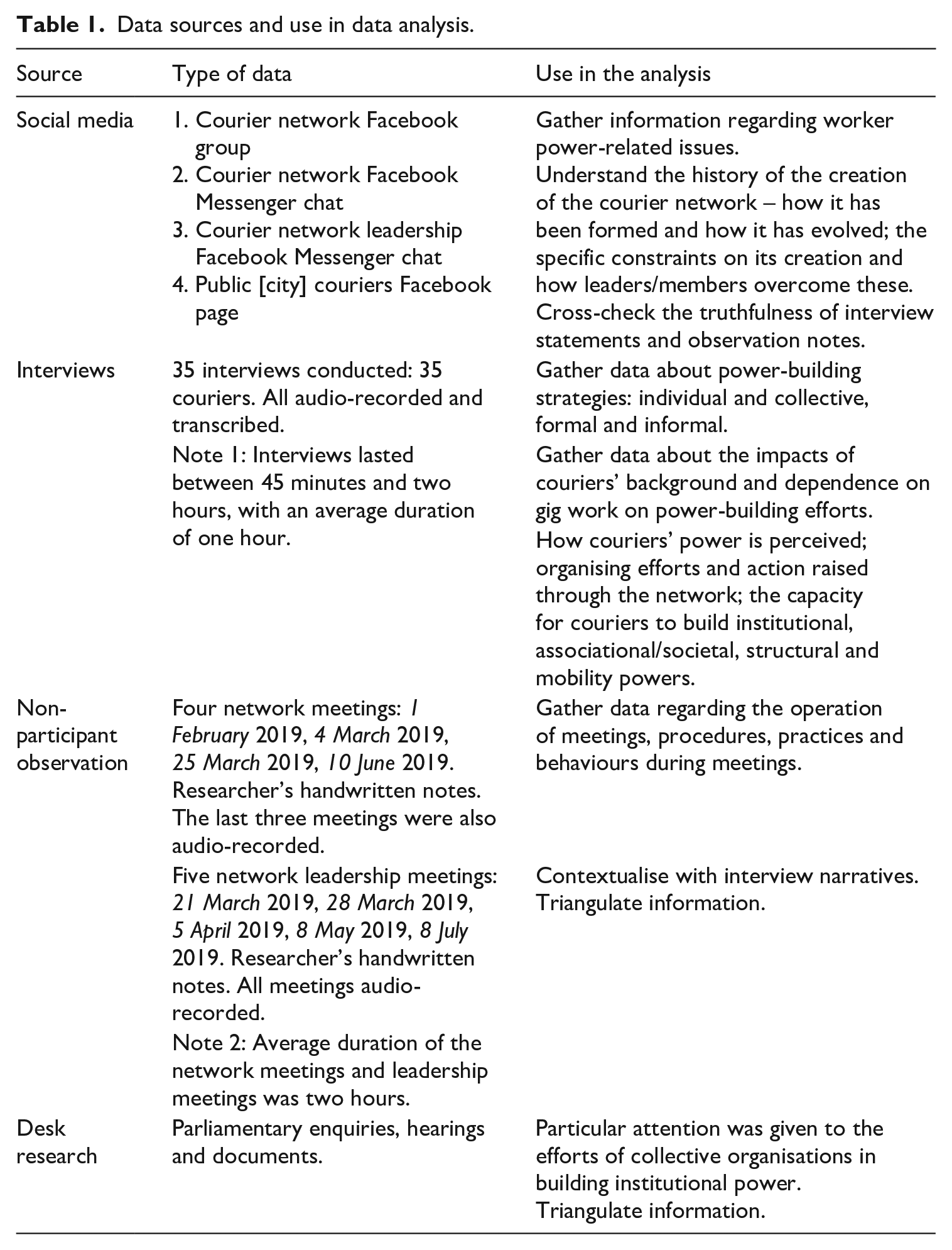
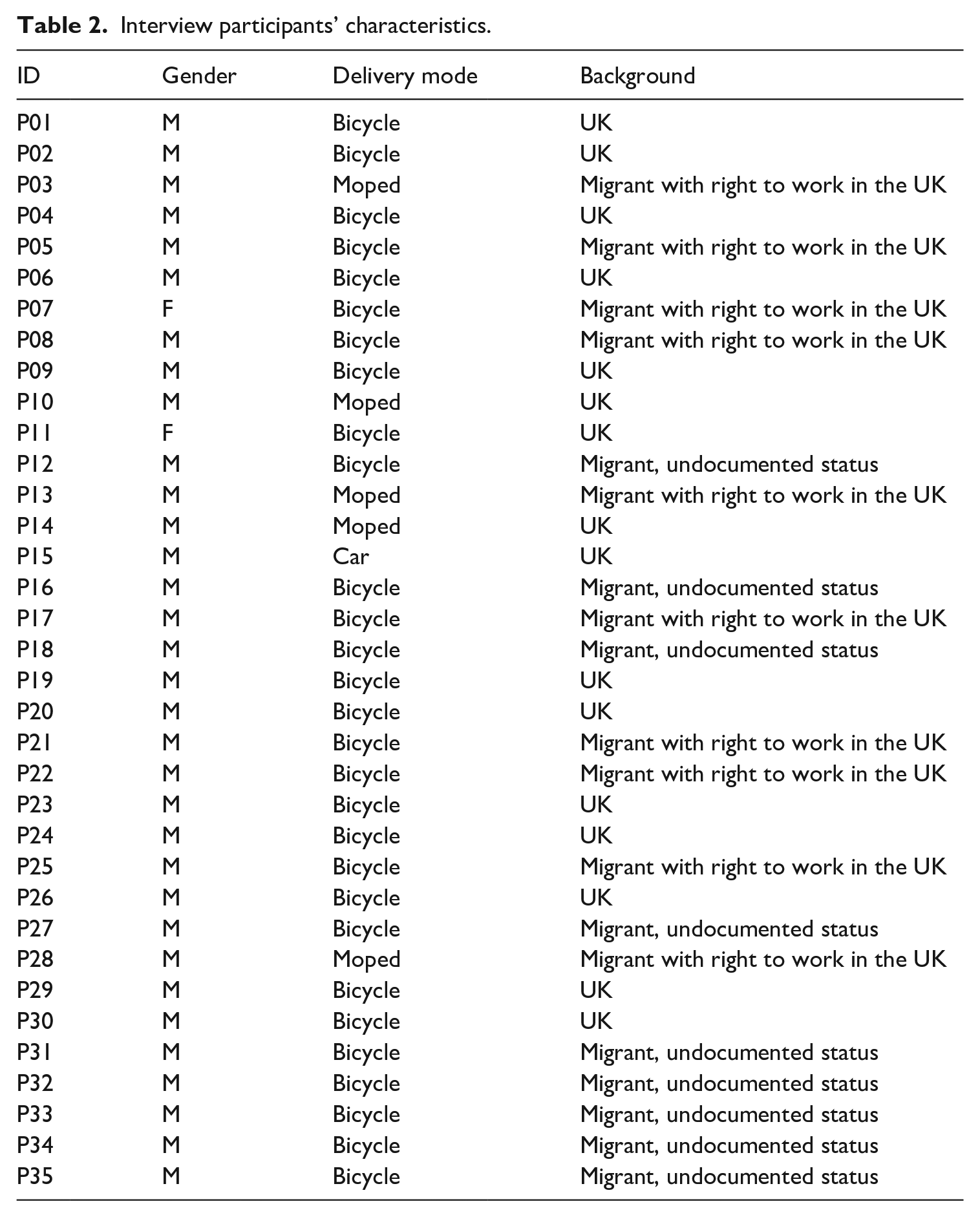
We adopted and triangulated several qualitative methods (in-depth interviews, overt non-participant observation, social media and document analysis), deployed in fieldwork focused on food couriers’ working experiences with platform-enabled food delivery companies in a city in the Midlands between February 2019 and September 2022 (Table 1). The respondents involved in the fieldwork had varied backgrounds and work experience. This is empirically relevant as it enabled the study to explore varied experiences in power resource-building strategies within platform work and whether these differed. Therefore, this study draws on qualitative data from 35 semi-structured interviews with food couriers. Nineteen of the respondents were migrants. Among these participants, nine were undocumented migrants, while the remainder had the right to work in the UK (Table 2).
Data sources and use in data analysis.
Interview participants’ characteristics.
In addition, the study draws data from overt non-participatory observation of four courier network meetings and five courier network leadership meetings, analysis of courier network meetings’ minutes, analysis of couriers’ and the network’s private Facebook group page and messenger chat. Participants were informed about our research and presence, and their consent was obtained. At the first meeting, we explained the purpose of our research and sought consent. This process was also followed for the private social media groups, where we requested access during the initial meeting. Additionally, desk research into parliamentary enquiries, hearings and documents was utilised to understand power-building strategies related to institutional power. The desk research involved collecting and analysing existing parliamentary enquiries and hearings, emphasising formal collective organisations’ efforts to build institutional power for food delivery couriers. All sources were retrieved from reputable sources such as parliamentlive.tv and the Work and Pensions Committee website. Trustworthiness and rigour of data were increased through extended engagement with the participants in the case study, prolonged and varied observation of events, and data triangulation protocols with the four primary sources of data (Lincoln and Guba, 1985).
Semi-structured interviews were used as this enabled us to explore the meaning and experiences of participants captured in their own words (Marshall and Rossman, 2011). The themes of the interviews included experiences of work, the labour process and power-building strategies, either individual or collective, formal or informal. Observations enabled a greater understanding of the case by allowing the covering and annotation of real-time events, the context of these events and the consistency of people’s statements (Yin, 2009). Furthermore, observation bias was mitigated by adopting a ‘complete observer’ approach (Burgess, 1984), in the sense that we chose not to take centre stage (for instance, we were not sitting with the leaders during meetings but chose to sit at the back so that our presence could go unnoticed). With social media (private and public groups), rigour and bias of data collection were addressed by taking into consideration key criteria such as: (1) selecting social media pages and chat groups related to the city where the study was being conducted; (2) only ‘observing’ interactions, without posting questions or our views; and (3) selecting interactions that related to the themes the study was focusing on (Kozinets, 2020). Within this data collection method, there may be a risk of non-response bias, as the people who post on social media can be more opinionated than those who do not, which was mitigated by always considering that we were not dealing with generalised views but only individual opinions (Kozinets, 2020). In this sense, we conducted data triangulation with other data sources, as illustrated in Table 1, to compensate for potential social media non-response bias. All data collection received ethical approval from the authors’ academic institution before commencing.
Purposive sampling was used to select information-rich participants to accommodate an in-depth study (Yin, 2009). The sample was purposively selected to broadly mirror the multi-layered reality typically observed in the gig food delivery sector in the UK (Mendonça et al., 2023). Therefore, in addition to varied engagement with the courier network, this study aimed to recruit participants with different levels of dependence on gig work, nationalities and right-to-work in the UK status (Tables 2 and 3).
Sample details.
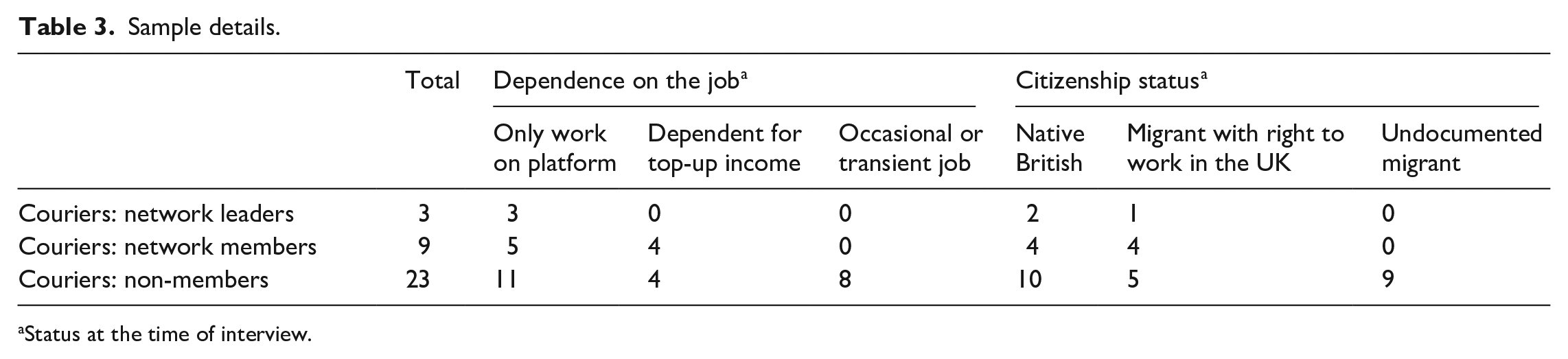
Status at the time of interview.
The analysis process was the same for all types of qualitative data gathered. NVivo (Version 12) was used to code the qualitative data. Open coding was initially used to identify concepts, moving from in vivo (i.e. coding of verbatim statements), to second-order codes based on thematic analysis (Strauss and Corbin, 1990). An abductive approach was followed to develop the themes for this study, allowing the researcher to move between theory and data, each informing the other to answer the project’s research question and add new knowledge (Cunliffe, 2011). Observation notes, interview recordings, minutes of meetings and online chats were vital for informing interviewees’ recollections of events. Interviews and chats complemented observations of meetings and events by giving a rich insight into how workers experienced the labour process, the network and its meetings and what issues were discussed.
Findings
Our findings show dissimilarities in power resources accrued by different groups of gig workers. The main differences refer to three categories of gig workers: (1) gig workers native to the UK or migrants with the right to work and who are dependent on gig work as their main source of income; (2) gig workers native to the UK or migrants with the right to work, who hold a main job and use gig work as top-up income; (3) gig workers who are migrants, do not have the right to work in the UK (undocumented), and as a result are informalised and highly dependent on gig work as the only source of income. The results focus on how these groups develop or use institutional, associational, structural and mobility power.
Institutional power resource
Findings show that the business model of platform companies based on self-employment meant that all groups of couriers experienced an absence of institutional protection and welfare. There were attempts by organised labour movements (such as IWGB – The Independent Workers’ Union of Great Britain, and GMB – General and Municipal Workers’ Union) to build up institutional power, particularly by seeking recognition of worker status and union recognition for food delivery couriers. This involved both native British and formalised migrant couriers. Both groups of couriers were found to actively seek a change in their employment status by turning to more institutionalised forms of power. Although IWGB had won a series of worker status cases (such as at CitySprint), the Deliveroo case was less successful and resulted in a series of appeals to the courts in the UK. As it stands, appeals to recognise Deliveroo couriers as workers have been opposed by the Supreme Court on the grounds of couriers’ freedom to choose a substitute to work in their place (Independent Workers Union of Great Britain v Central Arbitration Committee and another, 2023). Therefore, albeit unsuccessfully, findings show attempts to build up institutional power. For instance, large unions such as GMB have been involved in attempting to build up institutional power. However, respondents have highlighted concerns regarding a lack of representation stemming from the union’s unwillingness to negotiate with employers, especially concerning matters related to compensation.
Findings show that such formal attempts contrasted with the invisibility experienced by those without relevant right-to-work documents. Undocumented migrant couriers overwhelmingly referred to struggling with much more fundamental challenges, such as ‘becoming recognised as a legal person [sic] in this country [UK]’ (Undocumented Courier 33). As long as the Home Office did not recognise their right-to-work status, their institutional power was non-existent. All interviewed undocumented couriers reported that commitments with the Home Office often clashed with their food delivery work, as one undocumented courier commented: ‘It is a case of becoming legal worker or bringing food to the table at the end of the day’ (Undocumented Courier 32). Undocumented couriers also reported that a lack of language skills and familiarity with the bureaucratic procedures hindered getting the right-to-work permit. These constraining factors were consistently linked to feelings of being trapped in platform work to maintain a relatively stable source of income.
Another differentiating area between couriers with the right to work and those who were undocumented relates to health and safety (H&S) support. H&S regulations have acted as institutional leverages for workers to regulate and improve working conditions in other sectors (Mendonça and Adăscăliței, 2020). This pressure, driven by the piece-meal pay structure and increasing intensification, may result in H&S hazards, with couriers engaging in unsafe behaviour such as running red lights and cutting corners. Although formal couriers lack institutional H&S support due to their self-employment status, the platform company started providing free personal accident insurance to all riders globally. However, undocumented couriers could not access any company or alternative private H&S protection since their informal subcontracting status makes them invisible to the platform company and institutions. Invisibility also meant being unable to get any other private workplace insurance since they do not have the right to work in the UK. All undocumented couriers referred to health hazards when involved in accidents, but also the law-related risks: In the position I’m in (informal undocumented courier) you really want to avoid being visible to [the platform company] and to authorities [. . .] if you have an accident is almost like holding a poster with ‘guilty’ on it. Last thing you want is trouble with the police. (Undocumented Courier 35)
Associational and societal power resource
Findings demonstrate formal and informal associational power-building strategies accrued to different groups of food delivery couriers depending on their level of engagement with platform work and their right-to-work status. On the back of the platform company’s initiative to restructure the payment scheme, couriers decided to set up an informal network to defend couriers’ interests collectively. From the data, it is possible to identify that couriers using food delivery work as a main source of income were more involved in setting up the network. Only two couriers within the group that used gig work as an income top-up reported being involved at some point but later having distanced themselves from collective organising and mobilising. The undocumented couriers consistently expressed disinterest in participating in any visible organisational activity out of fear of jeopardising their much-needed income stream.
Couriers more dependent on platform work as a main source of income, who were also network leaders and members, consistently referred to informal strategies to recruit other couriers as new network members. In a context of spatial dispersion and individualised interaction with the app, it became crucial for recruitment that leaders and members engaged with fellow couriers in meeting-up points. Network leaders and couriers commented that they shared concerns about the job and pay structure, but they also used these moments to provide H&S support to new and less experienced couriers: We know some [new riders] are at Five Guys, others at McDonald’s and so on . . . any new rider will be somewhere around here and we make the effort to understand what’s their motivation and level of involvement in [platform work] [. . .] they are always keen to know about some tips and we also talk about safety issues. (Courier Network Member 10)
As the network grew in size and influence, couriers started to strategise more complex plans to harness solidarity around the community, extend outside the workplace and build societal power. This involved engaging with the local council to improve the community life of the city (for instance, lobbying the council to prioritise green modes of transport – e-bikes – within the city centre); with local charities and restaurants by organising and promoting charity initiatives, which involved not working for an evening to distribute donated food to homeless people across the city; as well as with local news outlets to amplify their concerns and interests. In this way, associational power is demonstrated by not being solely a matter of union membership, density or legitimacy but also an outcome of how workers’ actions are shaped by the wider context in which they are embedded (Schmalz et al., 2018).
Throughout the months of fieldwork, the couriers’ network became relatively well-known among couriers across the country. This was the basis for establishing common interests between the different networks and eventually organise coordinated actions (the latter point is further elaborated in the section ‘Structural power resources’): I go to Sheffield, London, Leicester, Bristol [. . .] mostly what I’m looking at is common ground – what are the concerns that we all got? How do we make ourselves heard by [platform companies]? We are stronger together if we share the same interests. Because, so far, it has been very easy for [the platform company] to single us out like ‘that’s a minority of 10% of riders in [city]’. But bringing together networks across the country makes it more difficult for the [company] to overlook us. (Courier Network Leader 2)
Associational power was also accrued to couriers through informal strategies, such as social media group chats and forums. All couriers reported engaging with these forms of interaction to build associational power by disseminating information about organised actions and getting information regarding the platform and labour process updates. All couriers with right-to-work status consistently referred to informal chat groups as key communication channels (in English and bi-lingual, such as Portuguese and Spanish) to gather momentum among the chat group members to organise collective actions, such as wildcat strikes. These actions have become increasingly notorious in many cities in the UK (Woodcock and Cant, 2022), including the city where this research project was conducted.
Informalised and undocumented couriers also used chat groups that other couriers participated in, aiming to be an entry point to the food delivery labour process. Bi-lingual chat groups represented a key source of informal subcontracted labour where informalised undocumented couriers sought to rent formal accounts, identity details from other formal couriers and work-related gear used to improve their H&S standards. All undocumented couriers reported the importance of their community, either in chat groups or family and social networks, to get into waged labour. There was a strong sense among all undocumented couriers that informal associational and societal capacities were strongly linked with the ability to navigate the increasingly hostile migration regime in the UK and to rent different accounts more efficiently, enabling them to work as food delivery couriers and circumvent the platform efforts of identity control.
Structural power resources
Data show that building structural power was more prominent in activities related to workplace bargaining power rather than marketplace bargaining power. The free log-in system implemented by platforms permitted any individual to freely join the food delivery platform, 1 making this recruitment process very fast, flexible and efficient in case of high customer demand, undermining in this way marketplace power.
Data show that strategies to develop workplace bargaining power were undertaken by couriers who were network members and more dependent on platform work as their main source of income. The most significant reported strategy was recognising their strategic position within the meal production and distribution supply chain. By resorting to coalitions and protests involving actors across the supply chain, couriers were able to boost their impact and push for more effective changes in working conditions. For instance, couriers’ network leaders and members (who were mostly dependent on platform work as their main source of income) mentioned creating partnerships with popular restaurants throughout the city: Being conscious and knowing where we stand in the [supply chain], how important we are for this food industry nowadays, is crucial to have our interests recognised. Many restaurants now rely on [food delivery platforms], 50% or more. If that stream stops for one reason or another, then they [restaurants] will be really pissed off. [Food delivery company] does not want that either. (Courier Network Leader 3, Leadership Meeting, 8 July 2019)
Many restaurant owners contacted informally during fieldwork confirmed strikes were ‘harmful’ to their businesses and communicated these concerns to the partner platform company. During strikes and protests, other restaurants showed solidarity with couriers’ actions by actively not accepting (typically for a specific period of the day) any order by food delivery platform companies or by displaying protest flyers to their customers.
The most impactful action related to protests targeting specifically the platform company’s ‘dark kitchens’.
2
This activity involved protesting in front of dark kitchens on high-activity days (such as Saturdays) with posters and megaphones. The message targeted the cooks’ poor working conditions, low pay and unsocial long working hours. The attempt to recruit dark kitchen cooks to join couriers’ protests had a significant impact: These kitchens are a project that they come up with to cut short on some problems they had with restaurant providers. Our protests was like hitting them at their core. (Courier Network Leader 3)
Another workplace bargaining power strategy undertaken by the network was to synchronise actions and protests with those of other networks in different cities in the UK. Network leaders referred to synchronising actions as a strategy that emerged from social media chat groups to provoke the highest impact across the country.
Data show that activity to enhance the structural power of undocumented couriers was absent from interviews and observations. Interviewees reported consistently experiencing limited actions since their informal subcontracting arrangement makes them practically invisible in the labour market. Undocumented couriers do not hold a formal labour marketplace or workplace position, and their status as undocumented workers discourages any visibility entailed by structural power. One undocumented courier refers to this lack of power as being a ‘bystander’ while the action unfolds and refers to their vulnerable status as the main factor in their decision not to take part in collective actions: [I]f I join the strike and do not sign-in into the app, I know I’m contributing to the [collective] protest, but nobody knows that I am joining in since I do not exist as a courier – I work under [account holder’s name]. (Undocumented Courier 35)
Another undocumented courier refers to how the subcontracting rental agreement constrains them from building workplace power: I rent my account weekly; every minute of the day and night counts. If I’m not working, not only I’m not earning any money, but I’m actually paying [for the rented account] to stay at home or join protests. (Undocumented Courier 31)
Mobility power
The observed stratification and multiplication of labour (Mezzadra and Neilson, 2013) condoned by platform companies served to increase some couriers’ mobility power and constrain others. All couriers with the right to work in the UK, including native British and migrants, reported some accrued mobility power. The couriers using platform work to top-up their salary referred to their ability to juggle between multiple jobs and move between cities. Job mobility, or the capacity to quit from platform work at any time, was highly valued by couriers who held a main stable job. An interviewee, employed as a barista, highlights their capacity to easily quit platform work and move to a new job due to the valuable skills held within the local labour market: As a barista, I know if I need extra cash, I can pick up a shift in the café next door. For now, I work as a rider because I like it . . . it’s fun to be on the bike. But I know if I want to leave, I can . . . and probably will [laughs]. (Courier Non-member 22)
Couriers reporting being unable to quit platform work described juggling between apps to maximise their chances of getting more delivery requests. This platform mobility, termed ‘multi-apping’, was vital to enhancing respondents’ control over wages. This strategy nonetheless meant increased work intensity, as one courier suggested: If I really want to reap the benefits from being a [courier], I just turn on two or three apps at the same time [. . .] it’s not for the faint-hearted. At the end of the day, you are knackered, mentally. But this is when you really start taking home some serious [money]. (Courier Non-member 28)
Job mobility was combined with geographical mobility for other couriers, who used platform work as a part-time gig. One courier reported circulating between England and Scotland so that work could follow where they were situated due to family and/or social commitments: I study in [city], where I also work for Sainsbury on [street name] [. . .], but I’m constantly going back and forth to England. When I’m back home for longer than usual I just turn on the app [. . .] I can make some good money – keeps me going. (Courier Non-member 26)
A key distinction between the native and migrant courier populations that influences mobility power is related to the latter’s lack of skill recognition. There were reports from migrant couriers (with the right to work in the UK) finding it difficult to continue the careers they had in their home countries. Some couriers mentioned the complexity of getting recognition for their skills and qualifications gained outside the UK. One courier, a migrant from an overseas country, states: To get my qualification recognised [in the UK] is extremely time-consuming, it becomes extremely expensive with all the trips. But even if I got it [recognised], I think there are still so many barriers . . . or because the degree is not from the UK; or you don’t have experience in the UK; or references. (Courier Non-member 17)
This can be considered a lack of recognition of their mobility power related to the job and social status, resulting from foreclosure of opportunities to move to better quality, better paid jobs.
For undocumented migrant couriers, the struggles to develop mobility power are related to more fundamental issues. As a result of the absence of right-to-work status compounded with having experienced forced migration internationally, all undocumented couriers reported the impossibility of getting recognised waged work in the formal labour market. Nonetheless, interviewees saw participating in informal waged work in food delivery as representing a form of clandestine informal mobility power. Most undocumented informal couriers referred to their ability to build mobility power from a no-work position into getting informal waged work. Being able to rent an account and identity details from formal food delivery account holders was perceived as highly valued by respondents as it brought some financial reward. Unlike formalised couriers, renting multiple apps and engaging in multi-apping (job mobility) was considered too costly.
Albeit actively participating in informal paid work, undocumented informalised couriers are seen as invisible or non-existent in the labour market because they lack right-to-work status. This status had repercussions in the non-recognition of skills and experience gained in their home countries. One undocumented courier expressed their frustration towards the impossibility of having more work and the meaninglessness of working in food delivery: It is really difficult position I’m in, because I used to work back home. I was considered a ‘jack of all trades’, and in here I’m stuck delivering food, which is really frustrating to only do this. (Undocumented Courier 32)
The same interviewee reported being highly involved in community activities and helping newly arrived migrants, which included extremely (emotional) skilled work and long hours. This represents the willingness to accrue mobility power through mobilising labour power into work and activities that carry more meaning. However, because this work was voluntary and unpaid, it did not grant resources that enabled the interviewee to develop enough resources to seek a new job in a different city with more favourable labour market conditions.
Discussion and conclusion
This article provides a novel approach to literature, comparing collective and individual power-building strategies of groups of native British and migrant (documented and undocumented) gig workers in the UK’s platform-based food delivery sector. Three main categories of gig workers are observed and analysed: (1) gig workers native to the UK or migrants with the right to work and who are dependent on gig work as their main source of income; (2) gig workers native to the UK or migrants with the right to work, who hold a main job and use gig work as top-up income; (3) gig workers who are migrants, do not have the right to work in the UK (undocumented), and as a result are informalised and highly dependent on gig work as their only source of income. The precise number of undocumented couriers that work in platform-based food delivery is unknown. However, the Labour Force Survey suggests there are 82,649 couriers in the sector across the UK (Cockett and Willmott, 2023). In addition, studies show that there has been an increase in informal work and employment practices in the UK across most sectors in the past few years (ACCA, 2017). This translates to around 2.5 million workers, equal to 9% of the legitimate private sector working population, generating some £223 billion in GDP annually. Therefore, extrapolating from these sources, as many as 8000 undocumented food delivery couriers could be available for work in the UK. Recent studies on platform work (Mangan et al., 2023; Pulignano et al., 2023) reveal an expanding trend of informalisation in European countries. This shows that informalised work and employment practices are gaining ground, suggesting the emergence of the platform economy as a significant hotbed for these practices.
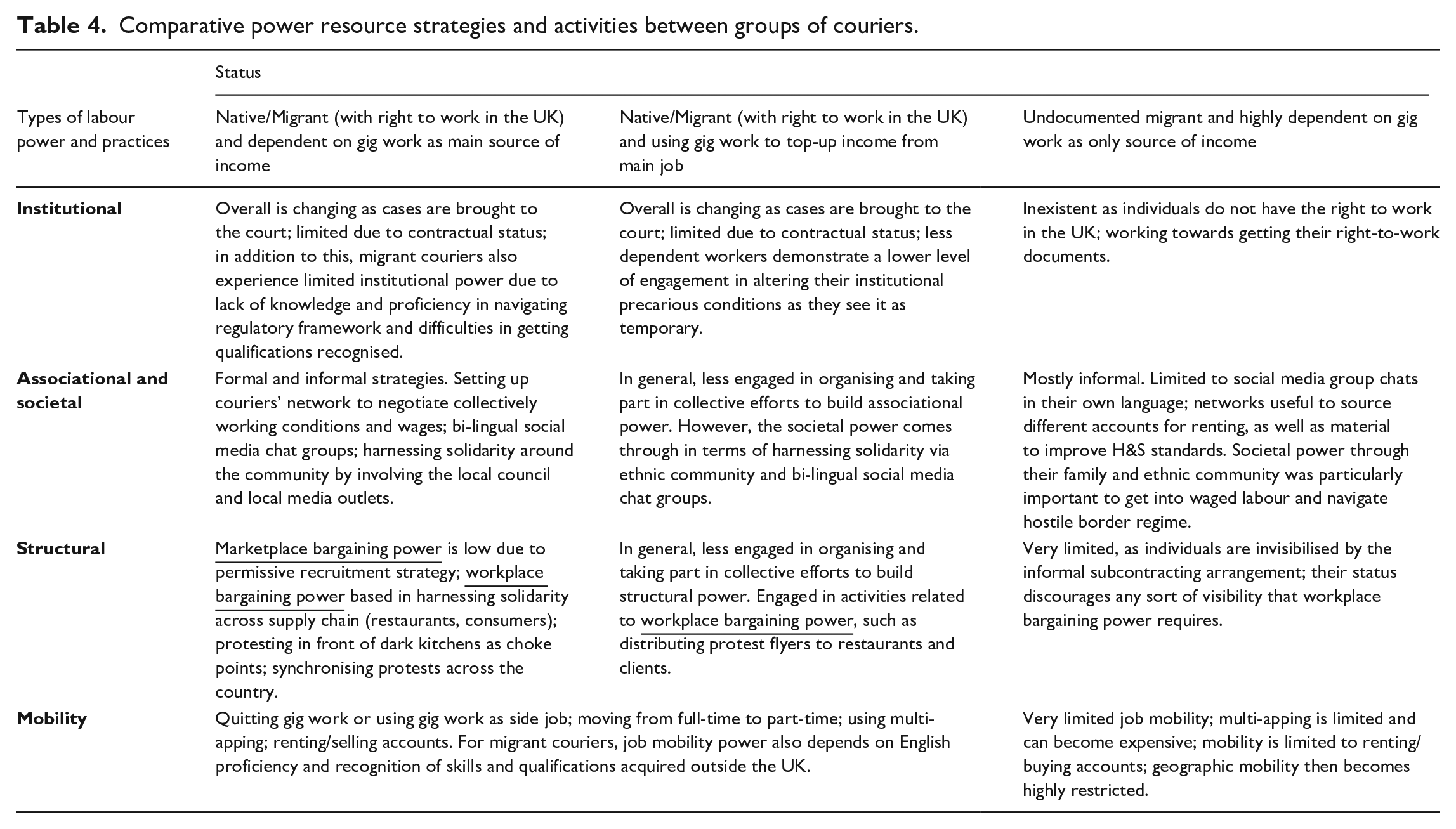
In terms of power resource strategies, this article makes several novel contributions. First, using the concept of multiplication of labour (Mezzadra and Neilson, 2013), this article demonstrates in detail that couriers are not a homogeneous group with similar interests and concerns. Conversely, food delivery gig workers’ embeddedness in a stratified labour market is marked by differential inclusion and exclusion in labour markets, tightly entwined with employment rights and social protection. These dynamics yield both converging and diverging interests among the workers. Second, in contrast to previous research (Cini and Goldmann, 2020; Woodcock and Cant, 2022), this article shows that the capacity to build collective and individual power resources are interlinked and influence one another. Therefore, it is indeed critical for the analysis to intersect power resources with group and individual characteristics such as citizenship, language and work permit status. Moreover, although institutional power is seen as relevant, it is not key in workers setting up power-building strategies. Therefore, workers are able to draw from other power resources to defend their interests, suggesting that union renewal and action needs to go beyond focusing efforts in building institutional power but more importantly on other forms of power. Third, unlike prior studies that draw power and solidarity from specific labour process characteristics (Tassinari and Maccarrone, 2020; Veen et al., 2020), this article intersects the potential to build power resources from traits originating in both the workplace and the wider politico-economic context, such as the progressively hostile border regime and a pro-employer regulatory framework evident in the UK. Table 4 summarises these findings and shows comparative power resource strategies and activities undertaken by the different courier groups. Table 5 shows the available power resources for each of these groups.
Comparative power resource strategies and activities between groups of couriers.
Developed power resources for each studied group.
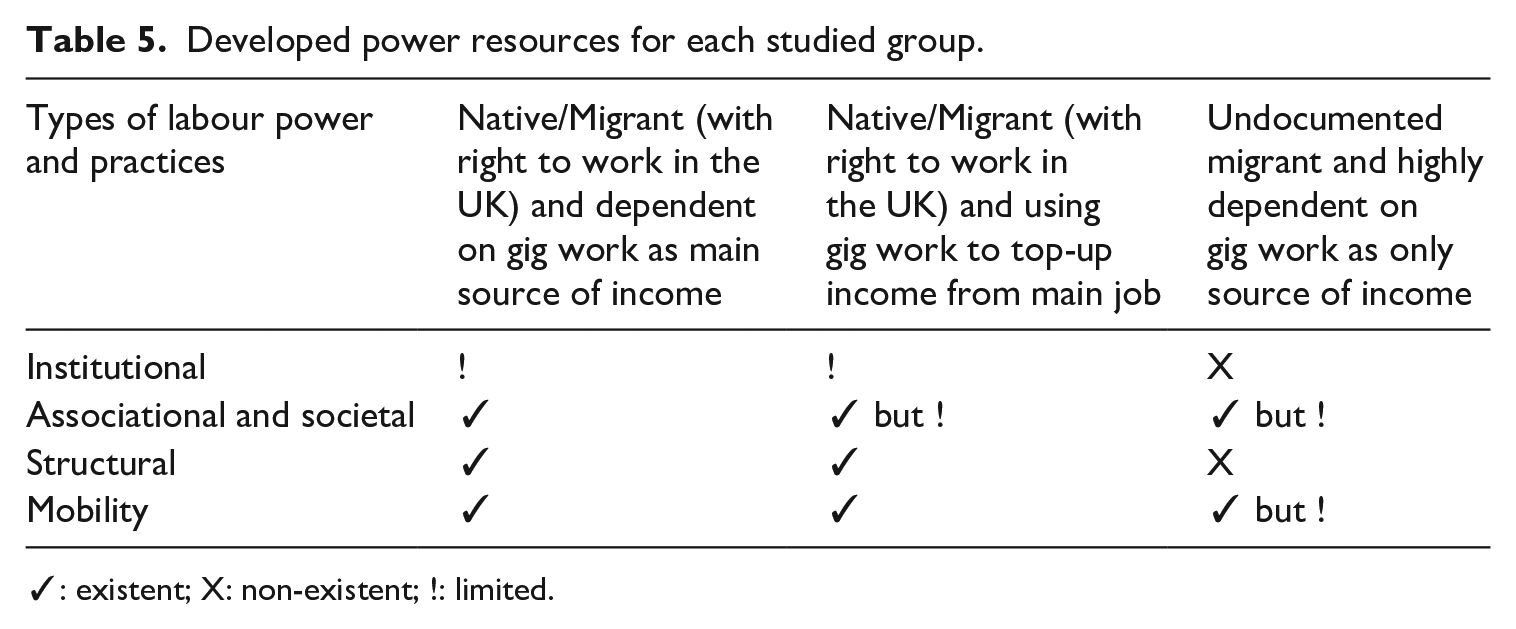
✓: existent; X: non-existent; !: limited.
Adding to Woodcock and Cant (2022), our study shows nuanced results on the notion that institutional power is limited or non-existent for gig workers. Formal gig workers have successfully implemented institutional power-building strategies through collective efforts. Nevertheless, it is important to acknowledge that the efficacy of these strategies depends on the intersection and accumulation of diverse power resources. When gig workers collaborate with formal trade unions like the IWGB and GMB, associational power becomes influential, reinforcing institutional strategies for power-building and supporting the case for worker status.
Moreover, this article demonstrates that strategies to develop institutional power resources are closely linked to migrant and right-to-work status. Undocumented gig workers have no other option but to remain invisible and focus on building their power individually by dedicating time to obtaining their right-to-work status, or through their close networks. While some migrant workers may actively participate in collective organising and mobilising efforts (Altenried, 2021; Heiland, 2022a, 2022b; Van Doorn et al., 2023), our research underscores that certain migrant groups, particularly those with no access to institutional power, primarily rely on other strategies (networks and mobility) to build power due to their invisible status in the labour market. This finding shed a light on how power-building and union renewal strategies can be drawn without necessarily resorting to institutional power.
In this study, we contribute to knowledge by examining associational power compounded with societal power when formalised and legitimised native and migrant gig workers engaged with the broader community, such as charities and restaurants. Findings show that gig workers’ societal power effectively complemented their efforts to legitimise and boost their associational collective demands (Schmalz et al., 2018). Social media was also seen as a crucial tool in running public campaigns against the platforms, sensitising consumers and restaurants, and seeking societal alliances through these media channels. Building on existing research (Cini, 2022; Cini et al., 2021; Marà et al., 2023; Veen et al., 2020; Woodcock and Cant, 2022), this study reveals that the interplay between social media, chat groups and the broader community represents a deliberate departure from the diffused and fluid nature of the platform delivery workplace.
A particularly relevant and novel contribution of this study is that for undocumented migrant gig workers, despite minimal associational efforts, societal power played a crucial role through development of networks. This dynamic strategically opens migrant workers’ social and local environments as arenas of struggle as some of the chat groups were bi-lingual, meaning they sought to be inclusive of varied courier groups (Doellgast et al., 2018). This form of collective power leveraged ethnic community ties of migrant workers by engaging in bilingual social media chat groups and involving family members. These actions were pivotal in (i) navigating the increasingly hostile border environment in the UK, and (ii) connecting with numerous employment brokers, thus enhancing opportunities for accessing waged labour. Contrary to previous research (Tassinari and Maccarrone, 2020), the findings in this study propose that these evolving dynamics are not solely due to the nature of the work, but more to do with the combination of permissive technology and the multiplication of labour, coupled with the dynamics of differential inclusion and exclusion (Mezzadra and Neilson, 2013) fostered by platform companies and condoned by stricter institutions (such as access to right-to-work permits). This includes the open log-in system, where any individual can become a potential courier and the legal framework of self-employment that enables a situation of undocumented couriers to emerge.
For structural power, despite a generally modest marketplace bargaining power, the formal and legitimised gig workers were able to build a significant workplace bargaining power. This study complements previous literature (Mendonça and Kougiannou, 2023) by showing that gig workers within the platform economy can offset a constrained marketplace bargaining power, hindered by a highly precarious employment structure and the companies’ ability to access a large reserve labour force. They achieve this through strategic actions that leverage their privileged position within the production and economic system. The couriers, who were more dependent on gig work, were concerned about taking full advantage of their disruptive potential in the supply chain. Similar to previous studies (Mendonça and Adăscăliței, 2020), this article shows that structural power can be built around organising and planning protests in choke points of the supply chain. Therefore, this study adds to knowledge by showing that despite an insecure employment relationship, loose labour markets and weak institutional power, gig workers in the food delivery sector can successfully develop structural power-building strategies that provide visibility to their actions and harness solidarity from other workplaces across the supply chain. Findings also show that wildcat strikes were a central strategy in building structural power. This finding echoes past studies documenting around 1270 instances of platform worker protests (Bessa et al., 2022). Within this strategy, findings in this article show that synchronising actions across cities was seen as impact-enhancing.
For undocumented migrant workers, structural power was minimal as individuals are invisibilised by the informal subcontracting arrangement of renting accounts. As this informal relationship is inherently feeble, undocumented gig workers experienced hyper-precarious employment with the threat of their account being terminated by the broker or being found out by the platform company. Moreover, since this group of gig workers does not hold formal labour marketplace positions, they perceive their participation in strikes and withdrawal of labour as insignificant. This absence of structural power undermines the workplace bargaining power of formal couriers, easily replaced by informalised workers.
Beyond collective power, this article adds to the literature (Altenried, 2021; Cini and Goldmann, 2020; Heiland, 2022a, 2022b; Van Doorn and Vijay, 2021) by showing the significance of individual mobility power. For the British natives, job mobility in terms of multi-apping, renting accounts and having multiple jobs is compounded by the capacity to move geographically to serve their circumstances. For migrant workers, the lack of recognition of their skills and qualifications means they are usually trapped in low-paid, low-quality jobs such as platform work. Although migrant workers may be overqualified when working in platform food delivery (Bauder, 2006), they face antagonistic structural conditions that encourage employment and geographic immobility in their host countries (Schaupp, 2022).
Similarly, for undocumented workers, the experienced complex dynamic is characterised by a severe lack of mobility power in terms of jobs and geography, resulting in coercive states of immobility. Although gig work is seen as a form of mobility power – from not being active in the labour market to finding waged work – it is primarily shaped and controlled by the platform and coupled with hostile institutional migrant policies, rather than the worker (Alberti, 2014). The dynamics of multiplication of labour and differential inclusion and exclusion, which are condoned and nurtured by platform companies, provide them with a relatively stable and compliant workforce with no alternative but to continue working in food delivery.
In conclusion, this article represents a novel attempt to analyse in a nuanced way the intersection of collective and individual power-building strategies with technology-driven work, hyper-flexible employment regimes, and migration and border regimes. By examining various cohorts of gig workers, we reveal how distinct types of oppression and empowerment impact workers’ strategies for building power in distinctive manners. Understanding the development or constraints of these strategies within one form of oppression, like the platform-driven labour process, becomes incomplete without considering other forms of oppression, such as citizenship status and the right to work. Moreover, when comparing different groups of gig workers, this article shows that labour market characteristics and dynamics exploited by platform companies promote the agency of some workers (legitimate couriers) and undermine the agency of others (undocumented migrant workers) (Franke and Pulignano, 2021). Finally, by expanding Smith’s (2006) mobility power to include geographic mobility, the study reveals insights into how an inherently mobile workforce (such as migrant workers) experiences being trapped in an immobile status, where upwards job and geographic mobility are constrained. This analysis sheds light on broader institutional and regulatory dynamics that impact the agency of platforms, the labour process and workers (Thompson and Newsome, 2004). Future research should leverage this study’s contribution to further understand the organisational and market dynamics deployed by global North platform companies that enable the exploitation of a workforce increasingly originating from the global South.
Footnotes
Acknowledgements
The authors are primarily thankful to all the fieldwork participants and the Editor and referees who provided valuable comments and suggestions for improving this article.
Funding
The authors disclosed receipt of the following financial support for the research, authorship, and/or publication of this article: This research project was partly financially supported by the Royal Society of Edinburgh, project number 2426.
