




Abstract
To accommodate the need for community engagement and place-based approaches in smart city agendas in Africa, we build on the literature on smart cities, southern urbanism and the urban commons to develop a conceptual framework for urban commoning in Africa. We argue that commoning, as an organizing process, establishes institutions for urban commons that account for different urban dwellers’ needs, perspectives and knowledges thereby strengthening inclusion and producing knowledge-intensive smart city development. We explain how the proposed conceptual framework is particularly suited to the African context, as it can mitigate the formal-informal divide and enable marginalized citizens to meaningfully express their right to the city. By enabling citizens’ voice in planning and distributing urban resources, commoning helps redefine local bureaucracies, rendering them more open and inclusive while limiting the enclosure and marketization of cities, which is often a source of contestation in the development of smart cities.
Introduction
Over a quarter of the world’s fastest growing cities are in Africa (United Nations, 2014). Recently estimated at 548 million urban dwellers in 2018 (up from 400 million in 2010), the continent is expected to experience a tripling of its population to around 1.5 billion by 2050, constituting around 22% of the global urban population at that time (United Nations, 2018). Building sustainable African cities is therefore crucial to meeting sustainable development goals (Ferraro, Etzion, & Gehman, 2015; McCormick, Anderberg, Coenen, & Neij, 2013). To address rising demand, Africa has witnessed a scramble for urban real estate to build ‘smart’ cities. These smart urbanism agendas are typically driven by top-down governance by central governments and/or private sector interests (Odendaal, 2018), and are planned as greenfield developments expressing aspirational techno-futurist visions that ignore the prevailing specificities of local context and dynamics (Ratti & Claudel, 2016; Watson, 2015).
Many urbanists and activists have criticized these smart city approaches, warning that Africa’s cities are largely viewed as objects and not agents of these urban transformations (Hollands, 2015; Marvin, Luque-Ayala, & McFarlane, 2016). The voices of everyday Africans are distinct in their absence from the processes of generating and implementing these smart city visions (Parnell & Pieterse, 2014). These critiques extend beyond the African continent, however. A significant segment of the literature on smart cities critiques the overemphasis on technological development while inadequately considering the social dimensions of urban systems (Acuto & Parnell, 2016; Halpern, LeCavalier, Calvillo, & Pietsch, 2013; Soderstrom, Paasche, & Klauser, 2014; Vanolo, 2014). As such, there is a call for organizing cities to become collaborative ecosystems that foster cooperation and coordination between communities, government, businesses, universities and civil society organizations (Appio, Lima, & Paroutis, 2019; Ardito, Ferraris, Messeni Petruzzelli, Bresciani, & Del Giudice, 2019; Kornberger, Meyer, Brandtner, & Höllerer, 2017; Mora, Deakin, & Reid, 2019a; Quélin, Kivleniece, & Lazzarini, 2017). Indeed, the organization of smart cities requires collective, inclusive governance systems that incorporate the voices of the multiple actors living in and creating the city (Arellano-Gault, Demortain, Rouillard, & Thoenig, 2013; Martí, Courpasson, & Barbosa, 2013; Rousseau, Berrone, & Gelabert, 2019).
This defence of diversity raises a question regarding the adequate architecture that would enable urban citizenry’s right to participate in city development. Interestingly, several scholars argue that the urban commons could constitute an efficient organizing model for managing cities and providing citizens with access to essential resources (Huron, 2015; Kornberger & Borch, 2015). The urban commons proposes rethinking the city not only as urban resources that are collectively shared but also as an inherently relational phenomenon that contributes to building sociality between urban dwellers. Scholars and practitioners contend that the establishment of institutions for collective action contributes to enacting citizens’ rights to the city (Harvey, 2012; Parnell & Pieterse, 2010) through bottom-up governance, instead of leaving cities to be managed top-down by governments and the private sector alone (Dellenbaugh, Kip, Bieniok, Müller, & Schwegmann, 2015). In this sense, the urban commons contests the power dynamics of public-private partnerships and the privatization of cities (Courpasson, 2000; Mumby, Thomas, Martí, & Seidl, 2017; Reinecke, 2018).
Drawing on theories of the quadruple helix model for smart cities (Albino, Berardi, & Dangelico, 2015; Ardito et al., 2019; Hollands, 2008; Marvin et al., 2016; McFarlane & Söderström, 2017; Mora et al., 2019a; 2019b), southern urbanism (Parnell & Pieterse, 2014; Roy, 2005; Simone & Abdelghani, 2005; Watson, 2014, 2015) and urban commons (Dellenbaugh et al., 2015; Harvey, 2012; Huron, 2015; Kornberger & Borch, 2015; Pithouse, 2014), we establish a conceptual framework for organizing urban commons in Africa in relation to smart city development agendas. Specifically, we position the urban commons as an inclusive, relational and transparent way to address the grand challenges of inequality, poverty and lack of access/inclusion in African cities (Hamann & April, 2013). To do so, we illustrate our conceptual framework with different examples of commoning, i.e. the process of creating and maintaining commons (Fournier, 2013), which have the potential to mobilize relations for collaboration, co-creation and resistance (Daskalaki, Fotaki, & Sotiropoulou, 2019). We posit that urban commons and commoning can be leveraged to revise post-colonial (Hamann et al., 2020), Weberian-styled bureaucracies (Kiser & Sacks, 2011; Kornberger et al., 2017) for African city management, and foster bottom-up inclusion in collective decision-making.
This article contributes to the theory on urban sustainability in three ways. First, we integrate the theory of the urban commons with the debates on the governance of the smart city. Precisely, we develop a heuristic, interpretive conceptual framework to position the role of commoning in organizing a quadruple helix for collective action and bottom-up participation in smart city development. We further position the role of commoning as being critical in respect of facilitating effective and inclusive knowledge-intensive governance in the adoption of smart city development agendas. Second, we redefine the concept of smart cities for Africa. By critiquing smart city agendas in the African context and their lack of community engagement, we explain how the smart city concept requires significant adaptation to address the local, context-specific challenges faced by African urban citizenries, and argue for an inclusive, in situ, decentralized implementation of the smart city in African urban contexts. This is especially the case where accommodating informal sector dynamics and the lack of access to basic resources such as land, water and energy are concerned. In doing so, we contribute to the call to develop an African perspective on management research (Hamann et al., 2020), while emphasizing the limitations of directly transferring urban policies from the Global North to the Global South. Third, we contribute to extending the concept of urban commons by providing a new understanding of its meaning in the African context. While in the Western world the priorities of urban commons are typically expressed through the right to the city and protestation against commodification and enclosure, in the African context, staggering, multi-dimensional gulfs of inequality characterize the social, economic, physical and spatial urban divide. We propose that accommodating the marginality that prevails in African cities – particularly informality – is critical to commoning for smart cities on the African continent.
Theoretical Background
Africa’s urban transition and the smart city: Dynamics and debates
Dual formal-informal systems typify African cities across multiple sectors and activities, ranging from housing and land ownership to service provision, trade, employment and finance (Peter, 2021; Roy, 2005, 2011). The informal sector in Africa employs 80% of Africa’s current labour force, while contributing around 55% of GDP (African Development Bank, 2013). Urban slums and informal settlements dominate the African urban landscape where fragmented planning and haphazard development impedes efforts to establish bulk infrastructure provisions for energy, transportation, waste, and water and sanitation. Consequently, formal and informal service providers ensure supply to the poor, who suffer from a lack of access to formal infrastructures and service provisions, typically at higher cost. (Peter, 2021; United Nations, 2014). In acknowledgement of this reality, African urban theorists and practitioners have made the case for in situ development approaches where low cost, easy to maintain, contextually relevant, small-scale decentralized solutions (Swilling, 2016; United Nations, 2014) are given preference in the development of slums and informal settlements (Parnell & Pieterse, 2014; Pithouse, 2014).
This coheres with a significant move in the scholarly discourse on African urbanism that has, since the mid-2000s, placed particular emphasis on understanding the strategies, tactics and modalities through which the majority of the African urban citizenry navigate their everyday existence (De Boeck & Plissart, 2005; Simone, 2001; Simone & Abdelghani, 2005). This discourse reveals the myriad innovative ways in which informality and the quotidian play a role in the reproduction of the African city, revealing the creative modes through which marginal – often informal – actors negotiate everyday survival. This speaks directly to the need for urbanisms that respond to local, contextual specificities in African cities by ‘making the invisible visible’ (Odendaal, 2018). These developments in urban studies mirror recent work in organization theory that recognize informality (Bothello, Nason, & Schnyder, 2019) and suggests that ‘scholars take to the street’ (Cnossen, de Vaujany, & Haefliger, 2021) to better understand the difference between what is assumed and what is emergent in real-world contexts.
In the African context, it is clear that the prevailing push to embrace the smart city agenda is predominantly technology-led, top-down, and premised on a double-helix collaboration model (Appio et al., 2019; Marvin et al., 2016; Mora, Deakin, & Reid, 2019b; Ratti & Claudel, 2016; Townsend, 2013; Watson, 2014, 2015). That is, African smart city developments largely adopt a corporate path, being typically marketed as wholly new urban developments that take the form of greenfield satellite cities on the peri-urban outskirts of major urban centres. Watson (2014) critiques these smart city development agendas, referring to them as ‘African urban fantasies’. Indeed, whether one looks to Kigamboni City in Dar es Salaam, Hope City in Ghana, or Tatu City in Kenya, these smart cities redefine the new urban African modernity by embracing visions of hypermodern, glass-towered and sanitized new ‘Singapores’ and ‘Dubais’ (Choplin & Franck, 2010; Watson, 2014, 2015). These city imaginaries in reality avoid the overwhelming ‘messiness’ of existing African cities, proposing instead to develop wholly new cities that avoid the mess, and the people – often the majority – who reside in the ‘mess’, altogether. Of all these planned smart cities, only Kigali in Rwanda (Watson, 2014) and perhaps Cape Town in South Africa constitute smart city development agendas that seek to work within an existing city.
The technological innovations proffered for smart cities are predominantly adapted to the higher income ‘global’ classes and are fundamentally driven by corporate interests where markets determine who can access these solutions and who cannot. In this respect, despite the rhetorical lip service paid to the public good, they are inherently fundamentally skewed towards the interests of the private sector and elites (Halpern et al., 2013; Hollands, 2008; Marvin et al., 2016). By directly transferring planning regimes from the Global North to the Global South (Watson, 2009), the smart urban agendas in the African context are lacking in community engagement and place-based approaches that respond to local contexts (Watson, 2015). We thus posit that the double helix model does not adequately respond to the fundamental urban development challenges of cities in the Global South, where basic infrastructures and service provisions are lacking for the majority urban citizenry.
In urban theory terms, the smart city drive in Africa has largely taken the form of ‘urban entrepreneurialism’ (Hollands, 2008) or ‘speculative urbanism’ (Goldman, 2011), which seek to leverage ‘new alliances between international property capital, national and city politicians and emerging middle classes’ towards the ‘seizure and re-valorization of land’ (Watson, 2014, p. 230). This significantly impacts the poor (in respect of displacement through renewals and evictions) and transforms existing systems of governance by making them more market facing (Pithouse, 2014). Consequently, African cities such as Ouagadougou, Lagos, Addis Ababa and Khartoum (Obeng-Odoom, 2017) are places of protest, where large-scale mobilization of the majority marginalized, informal and poor occurs in contestation to the exclusive, private sector-led urban development plans that exclude them (Watson, 2014).
The governance of existing smart city developments in Africa is also almost exclusively top-down (Watson, 2014), with little to no representation of the marginal poor and the vast informal sector, which typically constitute the majority of the urban citizenry and economies of these cities (Roy, 2005, 2011). Hence the question of what (and who) informs what a ‘smart city’ means in the African context needs to be interrogated further (Greenfield, 2017; Marvin et al., 2016; Mora et al., 2019b). Drawing on the urban citizenry and broader stakeholder networks in inclusive and participatory-based processes of policy and planning (Ratti & Claudel, 2016; Townsend, 2013), holistic pathways are more sensitive to context, mobilize local knowledge and experience, and generate smart solutions through community-led development processes, rather than imposing them from the top down. The governance structure that overcomes the dichotomy between top-down and bottom-up approaches – and vastly differential power relations – presents as a quadruple helix model (Mora et al., 2019a). This model engenders broad collaboration between a wide range of stakeholders (such as communities, civil society, universities, research organizations, businesses and government) in an attempt to be inclusive of all who influence and are affected by smart city development in a particular place (Ardito et al., 2019; Hollands, 2015; Rousseau et al., 2019).
Acknowledging these arguments, we assert that actualizing the smart African city requires a quadruple helix collaborative approach that enables a distributed ‘smart’. In doing so, we redefine the smart city in the African context as one that leverages decentralized solutions for in situ development, as opposed to an enclaved, centralized smart approach that services the wealthy and elites. Moreover, being smart in this context requires inclusivity and acknowledging the heterogeneity of urban actors and sectors. The push for inclusive development is often associated with unwieldy, open-ended participatory processes that can prove difficult, slowing down and encumbering development (Arellano-Gault et al., 2013; Kornberger et al., 2017). Hence, we propose that urban commons contribute to the smart African city by generating commoning processes that draw on the existing interests and knowledge of diverse sectors to make the city accessible to – and inclusive of – its inhabitants (Hamann & April, 2013; Rousseau et al., 2019).
The urban commons
An increasing number of scholars argue that commons theories can inform sustainable city development (Dellenbaugh et al., 2015; Kornberger & Borch, 2015). Broadly defined, the commons are resources that are shared by a community of users who can produce and/or have access to them through specific institutional arrangements (Hess & Ostrom, 2011; Ostrom, 1990; Peredo, Haugh, Hudon, & Meyer, 2020). The governance of commons generally relies on mechanisms of self-organization, where producers and users collectively allocate responsibilities in terms of the production, distribution and consumption of these shared resources (Dobusch, Dobusch, & Müller-Seitz, 2019; Gibson-Graham, Cameron, & Healy, 2016; Meyer, 2020). Traditionally, the commons constitute a paradigm that challenges both the market and the state as the unique social, economic and political systems that efficiently allocate resources (Bollier, 2011).
Interestingly, emerging literature on the urban commons focuses on grassroots modes of organizing that reclaim and take ownership of resources in urban settings (Daskalaki et al., 2019). That is, there is a specific emphasis on the process of commoning in the urban commons literature, rather than simply focusing on urban commons as shared resources. Examples of commons in cities include community gardens that enable citizens to grow their own food (Fournier, 2013), housing cooperatives (Huron, 2015) and social financing which fosters territorial resilience (Meyer, 2020; Meyer & Hudon, 2019; Siqueira, Honig, Mariano, & Moraes, 2020). Yet the potential of urban commons goes beyond these micro-initiatives (Harvey, 2012; Pithouse, 2014), and raises the question of how to move from self-organizing a community garden to collectively managing a whole city. To this end, De Angelis (2007) proposes that three elements are required for creating commons: a community, shared resources and institutional arrangements for sharing those resources within the community. Hence, studying the urban commons requires understanding the collective governance of cities’ spaces (Bresnihan & Byrne, 2015; Dellenbaugh et al., 2015), as well as the values and ideological principles behind collective action (Harvey, 2012; Pithouse, 2014; Reinecke, 2018).
The development of urban commons corresponds to the evolution of the concept of the commons from natural, subtractable common-pool resources (Ostrom, 1990) to human-made resources (Bollier, 2011; Périlleux & Nyssens, 2017). While the urban commons is reproduced through its consumption (Huron, 2017) – as opposed to subtracting from the commons – this reproduction is contingent on the interconnectedness of the city, which in turn emphasizes the vastly more fluid and porous nature of the urban commons (i.e. urban commons are not neatly bounded). Following this new conceptualization, commons organizing evolved from establishing institutional arrangements to prevent overuse and free riding (Ansari, Wijen, & Gray, 2013; Ostrom, 1990) to designing institutions that enable collective action for creating and sharing resources (Aaltonen & Lanzara, 2015; Dobusch et al., 2019; Meyer, 2020). While local common-pool resources are often managed by rural communities that are generally homogeneous in terms of socio-economic conditions, the establishment of human-made resources, and particularly urban commons, is characterized by significant heterogeneity of actors who have different identities, economic capacities and powers (Kornberger & Borch, 2015), encompassing a diversity of public, private and non-profit actors and interests much like global commons (Ansari et al., 2013).
Moreover, the urban commons are not only about the resources that are shared, but also about the atmosphere that emanates for using and sharing the city (Kornberger & Borch, 2015). Every social group has a different claim, use and vision of the city and its infrastructure. Therefore, urban commons invite us to think about inclusion in cities in terms of access to – and use of – resources, as well as in terms of participation in collective governance (Bresnihan & Byrne, 2015), with the two being intertwined. Drawing on the processual perspective on the urban commons, we refer to African urban commons not in the sense of urban space, which is a dominant theme in the literature, but rather as a process of commoning that is key to leveraging ‘acts of being-in-common’ (Huron, 2017) for enhancing inclusivity of the majority poor and/or informal citizenry in African smart city development agendas.
Urban commoning is often motivated by the political objective of reclaiming the city and resisting the enclosure and commodification of the urban space. In these cases, commoning contests the private appropriation and use of the urban space, infrastructures and services (Pithouse, 2014; Peredo et al., 2020). Cities are sites of political struggle and resistance to neoliberalism, as shown by the Occupy movement (Reinecke, 2018). These forms of protest echo what Harvey (2012) calls the ‘right to the city’, i.e. citizens have the right to collectively choose what type of city they want to live in. From this perspective, citizens’ right to the city limits the power of the financial markets and governments to dispossess inhabitants of their lived physical and social spaces. As vehicles of values of resistance (Mumby et al., 2017), collective forms of contestation often oppose the enclosure of spaces through the transfer and dispossession of common land into private hands, turning it into a marketable resource (Pithouse, 2014). This reveals a tension between everyday life and capital accumulation (Huron, 2015), or a fight for the shared and contested urban atmosphere (Kornberger & Borch, 2015). In sum, different powers and interests contest decisions over the use of public space and what type of city to be. This tension is very present in the debates on smart cities, especially in Africa. Considering that African cities are expected to boom in the coming decades, it is crucial to understand how to develop these cities, not solely for capital accumulation, but to respond to the continent-wide challenges of poverty, informality and inequality.
A Conceptual Framework for Commoning for Smart City Development in Africa
Drawing on our critique of the market-based double helix model in the previous section, we build on theories of the quadruple helix model for smart cities, southern urbanism and the urban commons to establish a conceptual framework for commoning for smart city development in Africa. This model proposes that building urban commons – through commoning – offers a vehicle to express the right to the city through promoting, on the one hand, socio-economic rights to access key resources such as housing, energy and water, and, on the other hand, political rights to participate in the city agenda for most (or all) community members. Specifically, we explain how different interest groups can engage in generating the diverse knowledges that are required to create context-specific, innovative, smart solutions. The framework builds on the core constituents of the urban commons (De Angelis, 2007; Dellenbaugh et al., 2015; Huron, 2017), namely a shared resource, a sharing community, and institutions for collective action. Figure 1 presents the conceptual framework.
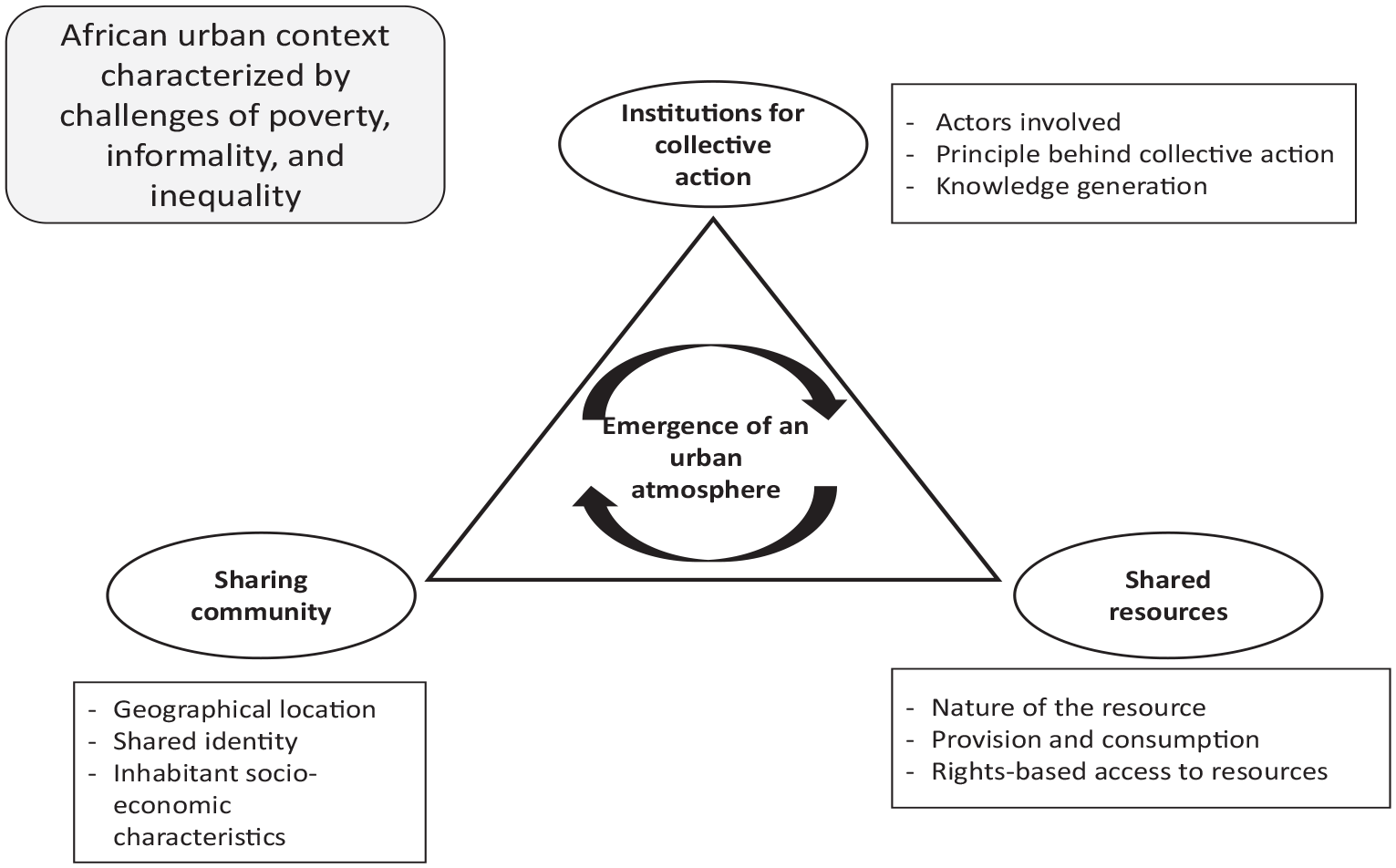
Conceptual framework for urban commons in Africa.
The first component of our framework is the resource that is produced, distributed and shared by urban citizens. African cities face shortcomings in providing access to the basic goods and services that urban dwellers require for individual and collective fulfilment. These resources can be consumed individually, such as water and energy, or shared collectively, such as infrastructure and parks. Access to them is typically characterized by contestation or cooperation and not typically over the biophysical limits of the resource itself. That is, the traditional notion of a resource boundary does not apply in these urban settings since the provision and consumption of these resources is a matter of expanding boundaries in order to provide rights-based access to resources. Indeed, in contexts characterized by high levels of informality, Roy (2005, pp. 150–152) observes that ‘the provision and distribution of infrastructure is not a technical issue but rather a political process’, and that it is a ‘question of who sets the upgrading agenda’. While double helix smart city agendas often restrict and/or condition access to these resources based on market pricing, the organizing processes of commoning promote access to these resources, thereby tackling the existing exclusion and fragmentation of the urban space. Hence, while smart African cities can reproduce and/or exacerbate stark pre-existing inequalities, commoning processes aim to reduce inequalities and poverty with alternative organizing processes through which the provision and consumption of these resources is conditioned. Organizing the sharing of resources is therefore linked to the political process of promoting the right to key resources for the individual and collective development of urban dwellers.
The second component of our framework is the sharing community, which is defined by the geography, shared identities and socio-economic characteristics. Geographical location is key to establishing a sensitivity to place and context that responds to the vast heterogeneity of urban localities in Africa. We argue that urban commoning can potentially reflect the aspirations of the communities and represent the socio-economic, physical and cultural needs and orientations of the local context. Since the urban commons give control to the multiple actors that both constitute and benefit from the city, the sharing community is not fixed, but evolves with its inhabitants and their shared identities. As such, migration and community leadership are key elements affecting communities and their capacity to organize for – and engage in – collective action. It is worth mentioning that a shared identity can emerge as a reaction to the commodification of cities and their related expropriations. Resistance can therefore be consistent with community building, although not necessarily a condition for urban commons. This is particularly important in responding to the socio-economic characteristics of cities on the continent. The diversity of inhabitants’ socio-economic characteristics in the formal and informal sectors are indicative of the heterogeneity of urban communities and need to be embraced in the organizing processes that underpin commoning.
The third component of our framework refers to institutions for collective action. As urban commons are not given but are constructed collectively, establishing and maintaining institutions for building and governing them is critical. The actors involved play a key role in these organizing activities. The principles behind collective action relate to asserting the right to the city, which is about both promoting socio-economic rights to resources that ensure human dignity and supporting the political right to participate in city governance. In doing so, these principles aim to address the tensions in the urban divide by producing an institutional space in which the struggles and conflicts around city developments are negotiated, mitigated and resolved. Due to the complexity of the socio-spatial divide between formal and informal institutions, organizing for city developments directly raises questions regarding what and whose knowledge underpins action in smart urbanism, and to what ends. Building on McFarlane and Söderström’s argument for knowledge-intensive urbanism (2017), we infer that institutions for collective action and urban commoning require the provision and production of knowledge that should be ‘socially distributed’ in order to incorporate three forms of knowledge: ‘lay knowledge’, ‘expert knowledge’ and knowledge generated between the citizenry and experts (McFarlane & Söderström, 2017, p. 14).
The three building blocks of our framework interact in such a way that they enable the emergence of an urban atmosphere, which is a consideration of the urban commons as defined by Kornberger and Borch (2015). We propose that commoning is key to building an atmosphere that enables each social grouping within the urban citizenry to enjoy and reclaim their right to the city, as well as their affective sense of belonging to it (Resch, Hoyer, & Steyaert, 2021). As commoning includes a permanent process of creating and re-creating relationships between individuals and organizations, it emphasizes the need for relationality in the organizing processes, which can be enhanced by adopting the quadruple helix model. Our framework approaches smart city development in this spirit, emphasizing a processual perspective on commoning for an atmosphere of inclusion and diversity. Since urban commons are inherently relational (Kornberger & Borch, 2015), collective organizing and common strategic orientation build an atmosphere that is inclusive of both the formal and informal sectors and proceed with the objective – and in the spirit – of mitigating spatial and socio-economic inequalities. This atmosphere is also critical to the generation of prefigurative urban politics (Reinecke, 2018) and imaginaries from which new innovative possibilities can be envisaged and acted upon in the actualization of more inclusive, just and sustainable smart urbanism agendas.
Methods
Research design and setting
To illustrate the utility and flexibility of the conceptual framework, we selected three urban commons experiments on the African continent: Abahlali baseMjondolo for access to land and housing in Durban, South Africa; iShack for access to energy in Stellenbosch, South Africa; and ASUREP (Associations des Usagers des Réseaux dʹEau Potable) for access to water in Kinshasa, Democratic Republic of Congo (DRC). These cases allow us to compare how the building blocks of our conceptual framework apply differently in a variety of urban contexts and, in turn, how they enable us to generate a better understanding of different forms of collective actions that foster the inclusive smart urbanism agenda on the continent.
We specifically selected these illustrative cases because they display different types of essential resources, geographic communities and collective action patterns. These cases refer to three resources to which access is considered a basic human right for development, namely land/housing, energy and water. The production and distribution of these resources are necessary for urban development, but due to how ownership is structured and severe lack of infrastructure provisions, large inequities prevail in respect of access to these resources (UN, 2014). In addition, the communities are present in different geographic settings as we selected cases located in two African countries (South Africa and DRC) and three cities (Durban, Stellenbosch, Kinshasa) that display significant differences in terms of populations but common patterns of urban inequalities. We also selected cases that reveal different modalities of commoning to produce urban commons. Specifically, they illustrate different forms of institutions for collective action for urbans commons, including patterns of resistance to marginalization and land commodification, coordination of multiple actors from the public, private and nonprofit sector, and self-organization for the governance of natural commons.
Data collection and analysis
To conduct our analysis of the commoning processes, we primarily collected secondary data on the three cases described above. A summary of case study source material is tabulated in Appendix A in the supplementary material provided online. One of the authors, however, has had direct contact with the iShack project, having conducted site visits with student groups over a period of four years spanning 2014 to 2017, and has enjoyed direct access to the founders of the project since its inception. Used with data from the literature (Conway et al., 2019; Kovacic, Smit, Musango, Brent, & Giampietro, 2016; Kovacic et al., 2021; Swilling, 2016), this research experience serves as a rich source of inputs regarding the urban commons established and the collective action happening in this community. Secondary data was also used as a major source of information for the two other cases. We reviewed the scientific and grey literature presenting and analysing Abahlali baseMjondolo. In particular, the work of Pithouse (2006a, 2006b, 2008, 2014) was a key source of information to unpack the logics of collective action. We followed a similar process of data collection for ASUREP and reviewed the scientific and grey literature on the experience (Bédécarrats, Lafuente-Sampietro, Leménager, & Sowa, 2019), in addition to consulting different websites and videos presenting this mode of organizing.
We used our conceptual framework to analyse and interpret these three cases. Our analysis focused on the nature of collective action and organizational processes enabling the creation and management of urban commons. This analysis was organized along the dimensions of the conceptual framework. First, we investigated the characteristics of the sharing communities, and particularly their geographical locations, shared identities and the inhabitants’ socio-economic characteristics. Second, we examined the shared resources by examining the nature of the resource, its provision and consumption, and identifying the human right their access referred to. Third, we studied the institutions for collective action by identifying the actors involved in resource provision and management, the principles behind collective action, and the knowledge generated. Building on this analysis, we then established the urban atmosphere emerging from commons creation and management. This interpretive analysis of the cases enabled us to illustrate the relevance, validity and flexibility of the conceptual framework in understanding collective action for creating and managing urban commons in a diversity of contexts and communities. Additionally, the process of analysing the case studies yielded additional insights from practice that helped refine the framework.
African Urban Commoning in Practice
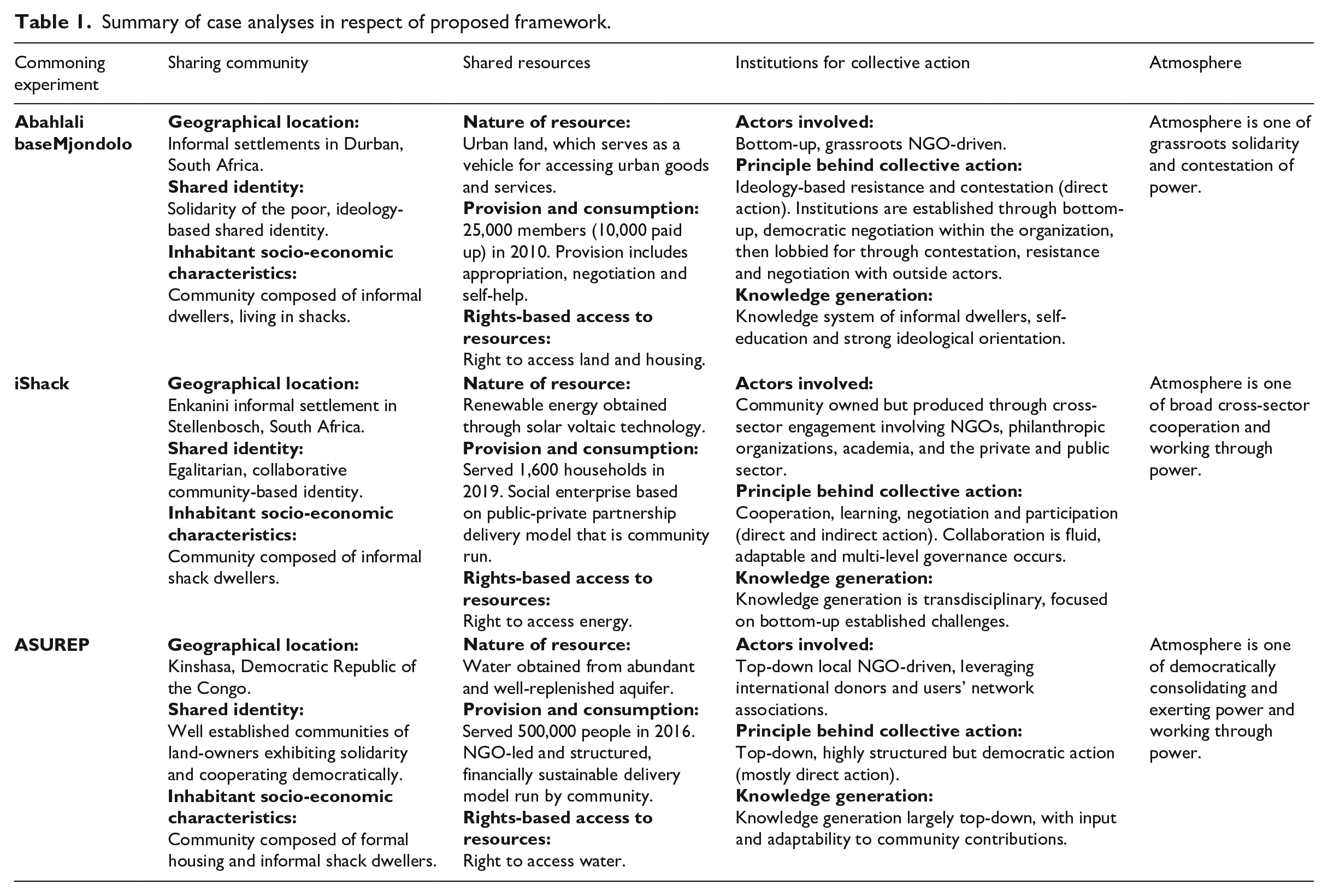
In this section, we examine the three urban commons initiatives in African cities according to the core elements of our framework (Figure 1). Table 1 summarizes our analysis of these cases using the conceptual framework.
Summary of case analyses in respect of proposed framework.
Abahlali baseMjondolo and the protest to access land and housing
Initially started in one informal settlement in Durban, South Africa, Abahlali baseMjondolo (‘the people of the shacks’) is an organization of predominantly informal settlement shack dwellers, who engage in direct action to seize and retain land and urban services, and act against attempts at enclosure, removals and other infringements on shack dwellers. Shared identity is ideological (Gill, 2014), based on the solidarity of the poor within and between shack dwelling communities. As shack dwellers, these communities are typically low income, lack access to resources and service provisions and live predominantly within informal systems. Despite persecution and harassment (De Vos & Webster, 2015), its reach in 2014 constituted 54 branches in Durban, as well as branches in Cape Town and smaller towns. With a membership exceeding 25,000 in 2010 (10,000 paid-up) Abahlali’s commoning has produced nationwide organizing.
The resource shared in this urban commons is land. Insurgency in the form of land seizure is critical, as the seizure of urban land is also about gaining access to urban ‘social goods like schools, libraries, hospitals and sports fields as well as opportunities for livelihoods’ (Pithouse, 2014, p. i35). Services such as electricity, water and sanitation are further appropriated or sought from the state, while self-organized projects to grow food and organize crèches have also been undertaken. In its community and rights-based approach, boundaries are contested, seized and expanded upon through mobilizing insurgency, self-help, protest action, contestation and encroachment. Urban land is the primary resource of concern, despite also serving as a vector through which to access other urban services.
Abahlali baseMjondolo’s commoning is largely grassroots, organizing for bottom-up, direct action that is contestation-oriented (Gibson, 2008; Gill, 2014; Zikode, 2008). The actors involved are mainly shack dwellers, with institutional support from NGOs, academics and legal representatives, but remaining primarily bottom-up in orientation. In Pithouse’s (2006a, 2008) framing of Abahlali’s activities, the principles behind collective action rely on ideology of solidarity among marginal, informal settlement shack dwellers, who engage in insurgency, encroachment, protest and contestation. Yet, despite its autonomous grassroots organizing, Abahlali engages the state on a variety of levels, ranging from protest to legal action and petitioning for public services. Pithouse (2014, p. i42), echoing Harvey (2012), concludes that Abahlali’s experience illustrates ‘that neither commoning, much of it outside the law, nor the state can be ignored’. Abahlali’s knowledge generation is inclusive, value-based and ideological, and self-education plays a role in identity construction, primarily brokering a space for political engagement with its members and supporters.
The atmosphere generated by Abahlali’s commoning constitutes a profound, albeit fraught, expression of the rights of the marginal; one that resonates with global struggles and working-class solidarity building (Gibson, 2008; Gill, 2014). Abahlali literally makes the invisible visible in an urban context characterized by high social, spatial and economic inequality and marginality. That visibility, brokered through ideologically driven direct action, is compelling to shack dwellers whose visibility remains hidden.
iShack and the cross-sector collaboration to access energy
The iShack project is located in the Enkanini (‘taken by force’) informal settlement in Stellenbosch in South Africa. The shared identity of the community is informed by egalitarianism and a collaborative spirit that is outward looking, inviting collaboration with authorities, civil society and academia. It is a low income, informal settlement surrounded by formal settlements and a light industrial area, yet, while enjoying proximity to urban resources and services, lacks direct access to them, particularly to the formal electricity grid. The immediate goal of the iShack project is to establish a viable and sustainable public-private social enterprise that could provide electricity to shack dwellers until they obtain access to the energy grid (typically an eight-year wait), with a longer-term view to expand services more broadly through incremental in situ shack upgrading.
The resource provided by this urban commons is renewable energy. The iShack project served 1600 households in 2019 with a solar energy service pack, including a solar panel, storage battery, LCD television and connections for lighting (3 or 4 per household) and media (television, mobile phones, radios). Each household is subsidized by the local municipality (through a public-private partnership) for operations and maintenance, which accounts for up to 90% of overhead costs. Each household signs up for the service, pays a joining fee and co-pays towards maintenance costs, establishing a transactional relationship between the project and its clients (Conway et al., 2019). While commons boundaries were initially established through the seizure of land, these boundaries are maintained through cooperation with local authorities. Access to the resource is transitionary; decentralized renewable energy provisions are made while awaiting connection to the national grid.
In contrast to Abahlali, iShack’s commoning is broad, multi-institutional and cross-sector, where collectivity is focused on socio-technical innovations that are appropriate for context (Kovacic et al., 2016). In the iShack model, the principles behind collective action are inclusive of all sectors and actors. While the project is in principle completely community-implemented and -driven, it is inclusive of academic, public and private sector motivations and actors (Swilling, 2016). This enables a high degree of adaptivity and innovation (Staggs, Wright, & Jarvis, 2022) that responds closely to the needs and preferences of end-users (Annecke & Hattingh, 2016; Conway et al., 2019). Knowledge is generated by leveraging broad cross-sector engagement but is informed by grassroots priorities and implemented by the community itself. iShack’s commoning is knowledge-intensive rather than ideological, relying on both grassroots and expert knowledge to generate transformative knowledge through transdisciplinary methods. It places emphasis on generating appropriate social, economic and technical knowledge to generate sustainability-oriented in situ solutions within informal settlements until state-led services can be brought to shack dwellers.
The atmosphere produced in iShack’s commoning is one of broad cooperation rather than resistance (albeit not without contestation; see Kovacic et al., 2016), receiving support from researchers at Stellenbosch University (who provide technical implementation support, test new solutions, and regularly train community iShack agents who run the project), catalyst funding support from global agencies, and was ultimately underwritten by the state (Kovacic et al., 2021). Scaling up has been achieved through community-driven, peer-to-peer knowledge exchange and learning between different communities. The iShack model produces a highly relational atmosphere that draws on diverse local and global knowledge flows to broker socio-technical innovation and diverse funding sources.
ASUREP and an NGO-led community-based initiative to access water
With a population exceeding 10.6 million in 2016, Kinshasa is an African megacity that experiences critical deficiencies in guaranteeing a water supply to its residents. In an urban context characterized by a failing state, cronyism and collapsing water infrastructures, well-established communities of landowners sought to meet basic needs by leveraging solidarity and community structures (Bédécarrats et al., 2019). With only 5% of those employed enjoying salaried employment, 18.8% unemployed and 36.8% living under the poverty line (Makabu ma Nkenda, 2014 in Bédécarrats et al., 2019) a mix of formal and informal settlement patterns persists across the city. The characteristics of the sharing community are defined by geography and socio-economic status of being excluded from water provision infrastructure.
The shared resource in this urban commons is water, which is available from an abundant, well-replenished rainfed aquifer: hence the resource is not scarce, it is access to water that is scarce. A local NGO, ADIR (Action pour le Développement des Infrastructures en milieu Rural), which promotes decentralized water systems with the help of international donors, had supplied water to more than 500,000 Kinshasa residents by 2016. Access to water is run by water user network associations (ASUREPs), which constitute the delivery model developed by ADIR. ASUREPs are focused on the financial sustainability of their operations. Tariffs are set at rates that provide full cost recovery. ASUREPs are organized by ADIR, which liaises with the mayors of municipalities to set up user associations that operate independently of the state. Community liaison ensues, first with community leaders and then with the communities – at street level – themselves, where the implementation model is explained (Bédécarrats et al., 2019). The case of ASUREP is more akin to traditional notions of commons as it is concerned with water, a recognizable resource to which basic rights of access are agreed upon.
The institutions for collective action rely on an NGO-led and community run model of implementation that is self-organized receiving no state support. It constitutes a highly structured approach towards community engagement that involves multiple community members in the governance and management of the commons (Bédécarrats et al., 2019). Elections are held to appoint delegates who will make their land available for the infrastructure to be set up, and 45 to 70 delegates are typically elected in each ASUREP for a three-year term, renewable once. A board, which is elected by delegates, typically comprises six to seven members, while three members are elected to the general association. A salaried management unit is set up which is responsible for the day-to-day operations. The principles for collective action rely on a top-down, well-established but flexible institutional framework that can be adapted to a limited degree, with oversight from higher-level governance structures. The commons is, in this manner, coproduced, but only through interactions between communities and the institutions the NGO has put in place. The knowledge generated is mainly technical and organizational with the governance structure provided by the NGO, and some limited flexibility is accommodated in respect of incorporating local knowledge.
The atmosphere produced by this mode of commoning is democratic but appears to be more oriented towards guaranteeing strict accountability and transparency, as though anticipating internal contestation within communities themselves. Notwithstanding, it must be acknowledged that it appears to have been highly successful in autonomously expanding its reach across the city reliably and sustainably. Moreover, ASUREPs function largely without any state involvement, except where cooperation over boundary conditions is necessary to ensure non-competition.
Discussion
It is notable that only the quadruple helix model accommodates the full swathe of different modes of commoning outlined in Table 1, which typically depend on a set of actors that initiate, support and perform collective action in African cities. The modes of commoning may range from bottom-up to top-down to both, but all fundamentally involve knowledge-intensive, cross-sector cooperation (albeit to different extents). The cases all cohere in respect of the need to develop context-specific, local solutions to address the needs of those who are excluded from urban development agendas. Moreover, they are all essentially pragmatic in orientation, drawing on whatever means – ideological, knowledge-based or cross-sector – to actualize material outcomes that are rights-based.
Drawing on these insights, our framework for developing smart urban commons to address the urbanization challenges on the African continent posits that, to bridge the dual formal-informal divide, African cities require that both top-down and bottom-up processes of governance work in cooperation with each other. This necessitates that different agencies and actors work together. Based on our conceptual framework and analysis of the three commoning cases, we establish the following propositions that we discuss in more detail in the following sections:
Proposition 1: A quadruple helix model is key to co-producing an inclusive smart African city.
Proposition 2: Commoning contributes to generating knowledge-intensive smart city developments in the African context.
Proposition 3: The process of pragmatic commoning enables urban dwellers to exert their right to the city.
Proposition 4: The right to the city is composed of both socio-economic rights to access essential resources and political rights to participate in city decision-making.
Towards knowledge-intensive institutions for the smart African city
As revealed in all three case studies, urban commoning enables a move from a technology-intensive to a knowledge-intensive urbanism (McFarlane & Söderström, 2017), and redirects the governance of smart cities from bureaucratic decision-making imposed by the private and public sectors to a collaborative ecosystem that seeks democratic solutions to urban issues. By leveraging collectivity and shared understanding based on multiple knowledge inputs, urban commoning responds to Arellano-Gault and colleagues’ (2013, p. 159) interest in identifying ‘the point of equilibrium where the fragmentation of stakeholders meets the needed coherence of public policies in a given sector’. In this respect, adopting the quadruple helix model enables a range of possibilities for inclusion in support of knowledge generation. Additionally, through knowledge and perspective sharing, marginalized groups that are ‘not organized and without access to sufficient resources to carve their own niche in the governance process’ (Arellano-Gault et al., 2013, pp. 156–157) can be included and share their views and knowledge. This is particularly relevant for informal actors, who are often not included in smart city developments. Hence, commoning enables contestation and resistance within democratic debate, helping prevent local governments from making decisions that can run counter to some communities’ interests and values. At the same time, commoning can enable consensus.
In theorizing urban commoning as knowledge-intensive organizing processes that improve open, inclusive governance for adopting smart urbanism (Kornberger et al., 2017), we institute a prospective move to transition smart city development in Africa towards a post-Weberian turn that is more aligned with aspirations to ensure just and inclusive urban development. Managing the tension between modernized, post-colonial, Weberian-styled African city and local government bureaucracies – which typically serve a fraction of the urban citizenry (Courpasson, 2000) – is key to actualizing a smart urbanism that is contextually appropriate for African contexts. According to Swilling (2016, p. 1), in this context, ‘systems solutions will need to be driven by transformative knowledge co-produced by researchers and social actors who can actively link game-changing dynamics that operate at multiple scales with local-level innovations with potential social impacts’. By informing the knowledge base that is drawn on to guide smart urbanism trajectories, commoning places the ‘public’ at the heart of the ‘bureau’ (Kornberger et al., 2017, p. 183).
To this end, we relocate the role of informality in the African urban context by drawing on Roy’s (2005, p. 148) assertion that urban informality is more of a ‘mode’ than a sector, as it represents ‘an organizing logic, a system of norms that governs the process of urban transformation itself’, and ‘is not a separate sector but rather a series of transactions that connect different economies and spaces to one another’. Hence, building a knowledge-intensive smart city that is deliberately inclusive of informality in its appreciation of the knowledge it brings can contribute to making the invisible visible and engender the collectivity and relationality that is required to co-produce the smart city.
A pragmatic commoning balancing instrumental-rationality and value-rationality
By drawing on Weber (1978) who argues that decision-making must balance between instrumental-rationality and value-rationality, we define pragmatic commoning in the context of smart African urbanism as follows: pragmatic commoning constitutes an organizing process through which instrumental-rational and value-rational outcomes are debated and negotiated, informing urban commons decision-making. Both value-rationality and instrumental-rationality are balanced through a process of inclusive, broad engagement, facilitated by organizing and learning to ensure that the institutions and boundaries of the urban commons, as well as solidarity, resistance and collaboration, are inclusively brokered.
Acknowledging that the ‘commons are not a silver bullet’ (Huron, 2017) and are constrained by how power manifests, we do not proceed from a position of leveraging commons as an instrument that solely contests the state and the market, that is, ‘as a “third way” separate from state and market’ (Huron, 2017, p. 1064). Rather, and as illustrated in the cases analysed, we adopt a pragmatist perspective: one that propositionally embraces the private sector, the state, civil society and academia, and acknowledges commoning in this space of interaction as agonistic and not utopian. In this framing, commoning does not engage with the smart city as being on the brink of something new, but as participating in its actualization or its becoming. That is, actualizing its potential through leveraging cross-sector and local and global relations.
This pragmatist perspective on commoning is particularly important when navigating institution building for an African urban commons that accommodates informality, inequality, poverty and a lack of universal access to infrastructures and service provision. Critically, it enables strategies of contestation and negotiation for inclusion (in the planning process) and appropriation (after implementation) (Jerram, 2015; in Kornberger & Borch, 2015). Both possibilities need to be catered for if the marginal are to become part of the becoming of the city. This represents a pragmatic commoning that manages to be ‘radical’ and ‘transformative’, yet still ‘rendering unto Caesar what is his’ (Jerram, 2015, p. 54). In this conception of commoning, the poor become ‘political actors’ (Appadurai, 2001; in Roy, 2005, p. 151), negotiating the form of urban transition that is most desirable and suitable to their context. They are not so much reclaiming the city (or a ‘lost’ commons within the city) as much as laying claim to it.
Commoning as a process to exert the right to the city
Our conceptual framework contributes to the theory of the commons by examining how commoning is occurring though the collective governance and management of urban resources, while generating relationality and the creation of an atmosphere (Fournier, 2013). It also explains how the right to access resources is distributed through mechanisms of collective governance and the promotion of collaboration (Meyer, 2020). Drawing on Roy’s (2005, p. 155) observations of informality, we argue that working ‘through rather than against institutions of power’ is critical for commoning in the African context. We acknowledge that agonistic engagements (Swilling, Roux, & Guyot, 2010), such as contestation and resistance, are likely to be prominent features of such working through power, as is common in processes involving open participation (Belmondo & Sargis-Roussel, 2022). As shown by Ansari and colleagues (2013), the successful management of commons requires defining institutions and governance systems that are inclusive and agree on a shared understanding of the resource. Yet, as the cases indicate, accessing power in urban Africa – whether from within or outside a community – is a challenging task for informal and marginal urban dwellers, but necessary to gain influence.
The demand for the right to the city from the marginal majority (Harvey, 2012; Lefebvre, 1996; Parnell & Pieterse, 2010) is significantly more pronounced in Africa when compared to that of the urban commons in Western, developed cities. Hence, the urban commons and commoning challenging current institutions of power can be perceived as a form of resistance (Mumby et al., 2017). Adjusting urban governance to redirect public and collective action to give more voice to the people who use the city, live in the city and need the city for living (Huron, 2015; Kornberger & Borch, 2015) can go against some private interests that consider the city as a commodity for profit generation. Hence, central to the conception of the urban commons is addressing the key developmental challenges that the majority of citizens and denizens face, and actualizing the right to the city in material and political terms (Pithouse, 2014).
The tension between the commons, on the one hand, and the public and private sector, on the other hand, is unavoidable. The challenge is to think through ‘commoning and progressive state interventions together and in a manner that could transform both’ (Pithouse, 2014, p. i42). In this respect, our argument to place emphasis on the processes of commoning that produce the urban commons in African cities – within the quadruple helix model of smart city development – provides a framework through which bureaucratic African governments and governance can be made more inclusive, providing a means for citizens to express their right to the city. Hence, building urban commons serves to negate thoughtless commodification that increases the capture of value by capital in ways that are detrimental to the majority or vulnerable urban citizenry. It facilitates a dialogical relationship that defines the city in a more inclusive way for those who are traditionally excluded.
Limitations and future research
There are several limitations to this study. First, this is a conceptual framework that builds on the three literature streams and theories of smart urbanism, southern urbanism and urban commons. While we do illustrate our conceptual framework with concrete examples of commoning in the African context, more research is needed to apply and refine the framework. It could be useful to investigate other commoning processes linked to resources such as food, the internet, waste and transportation. Second, we acknowledge the limitations of generalizing an interpretive framework for a whole continent in which a diversity of historical, cultural, social and economic conditions influence urban developments. Therefore, future research that tests the conceptual framework in a diversity of contexts is required. Third, our examples of commoning mainly focus on the community level, yet cities are anchored in the biophysical world and there are multiple connections between the local, provincial and national levels. Understanding how cities collaborate to share resources such as rivers, which connect to the countryside, is therefore a promising avenue for further research.
Conclusion
By building a dialogue between smart cities and the urban commons in Africa, we redefine what smart city agendas mean in the African context and theorize how commoning can serve the inclusive development and sustainability priorities of the continent in the 21st century. In doing so, we address the call from Kornberger and Borch (2015) to better understand and explore the urban commons with an organizational theory lens. We argue that commoning around the conceptualization and implementation of smart city development is sensitive to the formal-informal divide and deep inequalities that characterize African urbanism. By bridging this divide – particularly by including the knowledge ‘from a different set of experts: the residents of informal settlements’ (Roy, 2005, p. 152) alongside formal knowledge systems – urban commons is a critical necessity for smart city development agendas across the continent. Accordingly, we have developed a conceptual framework that reinterprets what ‘smart’ means and positions it in relation to African urban commons – replete with considerations around institutions, inclusivity, transparency and relationality. Our framework explains how commoning enables citizens to exert the right to the city through promoting socio-economic rights to access key resources, as well as by promoting political rights to participate in city decision-making. In this framing, commoning represents a way of implementing in practice the action strategies developed by Ferraro and colleagues (2015) to practically tackle grand challenges through participatory architecture, multi-vocal inscription and distributed experimentation. By locating commoning at the locus of multi-stakeholder engagements, we bring a new perspective to the governance of urban commons that is specific to African cities. In doing so, we argue that a renewed emphasis on commoning can enable prefigurative politics (Reinecke, 2018) to produce and manage urban commons that influence smart city development in Africa.
Supplemental Material
sj-docx-1-oss-10.1177_01708406221089609 – Supplemental material for Organizing for the Smart African City: Leveraging the urban commons for exerting the right to the city
Supplemental material, sj-docx-1-oss-10.1177_01708406221089609 for Organizing for the Smart African City: Leveraging the urban commons for exerting the right to the city by Camaren Peter and Camille Meyer in Organization Studies
Footnotes
Acknowledgements
We would like to extend our gratitude to Editor Renate Meyer, Guest Editors Luca Mora, Francesco Paolo Appio, Nicolai Foss, David Arellano Gault and Xiaoling Zhang, as well as to the anonymous reviewers for their comments and guidance in shaping the work and help in bringing it to conclusion. We also thank the participants of the 2021 EGOS Colloquium Sub-theme 67: Spaces, Places and Institutions for their comments on earlier versions of this paper. Both authors contributed equally to this publication.
Funding
The author(s) received no financial support for the research, authorship, and/or publication of this article.

Supplemental Material
Supplemental material for this article is available online.
Author biographies
References
Supplementary Material
Please find the following supplemental material available below.
For Open Access articles published under a Creative Commons License, all supplemental material carries the same license as the article it is associated with.
For non-Open Access articles published, all supplemental material carries a non-exclusive license, and permission requests for re-use of supplemental material or any part of supplemental material shall be sent directly to the copyright owner as specified in the copyright notice associated with the article.
