




Abstract
This paper explores how the smart city idea unfolds in the bureaucratic context. Applying a qualitative approach and the Scandinavian stream of translation theory, we investigate the case of cities’ ‘smartification’ in Russia during 2017–2020. Tracking mechanisms and outcomes of translation, we see the encounter of the smart city idea and bureaucracy as context entanglement, with smartocracy as an epilogue. Context entanglement refers to the mutual co-translation of the smart city idea and bureaucracy by means of formal and informal mechanisms, implying that what happens with bureaucracy or the smart city cannot be fully described without considering what happens with the other. Smart city vagueness and complexity appear to be both strengths and weaknesses that can be compensated for by bureaucracy as the smart city assemblage point. Smartocracy appears as a new way to organize cities whereby bureaucracy deals with smart city creatively: it keeps the core of bureaucracy while simultaneously reinforcing it and isolating some complex idea elements for later translation. This approach helps keep bureaucracy as a rational form of city modernization while maintaining smart cities’ promise to improve urban futures.
Introduction
In recent decades, the smart city idea has been moving throughout the world triumphantly from one bureaucracy to another with the promise of sustainable urbanization through co-creation and participatory ideals (Baccarne, Logghe, Schuurman, & De Marez, 2016; Dameri, 2017; Gardner & Hespanhol, 2017; United Nations, 2017). However, in whatever idealistic way the smart city idea may be introduced, bureaucracy, while ‘sanitized’ (Nisar & Masood, 2020, p. 894) in the organizational literature, is hardly ideal in reality (Clegg, Cunha, Munro, Rego, & de Sousa, 2016; Hodson, Martin, Lopez, & Roscigno, 2013). In this respect, although critical examinations of the smart city idea’s promises to include multiple stakeholders and recognize cities’ identities exist (e.g. Argento, Grossi, Jääskeläinen, Servalli, & Suomala, 2020; Grossi, Meijer, & Sargiacomo, 2020; Mora & Deakin, 2019), it remains unclear how this idea unfolds in the bureaucratic context.
An investigation of this context would be interesting, especially one emphasizing the city as not only an exercise of urbanization and technology but also as a set of administrable objects that are visible and manageable through bureaucracy (Kornberger, Meyer, Brandtner, & Höllerer, 2017). Surprisingly, the role of bureaucracy has been kept apart from smart city research even though it is the central element in how smart city implementation begins in practice (Meijer & Bolívar, 2016). One might claim that bureaucracy is an inappropriate setting for the smart city idea due to its rigidity and inability to incorporate smart city complexity (Mora & Deakin, 2019). Some may even argue that the smart city idea could challenge bureaucracy and replace its core of organizing public sector routines (Peter & Meyer, 2023; Gardner & Hespanhol, 2017; United Nations, 2017). Still others may suggest that the smart city idea could be an extension of bureaucracy (Buffat, 2015) or even another utopian reform ideology, which, despite intending to weaken bureaucracy, makes it stronger (Clegg, 2012; Dunleavy, Margetts, Bastow, & Tinkler, 2006; Kornberger et al., 2017; Olsen, 2008). Hence, considering such uncertainties, is the smart city idea a new chance for bureaucracy to recover from its ‘historical failure’ (Byrkjeflot & du Gay, 2012, p. 89), or will it serve to illuminate bureaucracy’s dark sides (Clegg et al., 2016; Hodson et al., 2013)?
In light of this knowledge gap, the purpose of this paper is to explore bureaucracy’s encounter with the smart city idea. In particular, we ask, how does the smart city idea unfold in the bureaucratic context? To investigate this phenomenon, we combine the interdisciplinary literature on smart cities (e.g. Grossi et al., 2020; Mora, Bolici, & Deakin, 2017; Mora & Deakin, 2019) with theoretical insights on bureaucracy (e.g. Arellano-Gault, Demortain, Rouillard, & Thoenig, 2013; Clegg et al., 2016; Hodson et al., 2013; Kornberger et al., 2017). Theoretically, we apply the Scandinavian stream of translation theory (Czarniawska & Joerges, 1996; Gond & Boxenbaum, 2013; Nielsen, Mathiassen, & Newell, 2014; Røvik, 2016; Sahlin & Wedlin, 2008), which, as a theoretical lens, provides a surprising view of the encounter of the smart city idea and bureaucracy compared to previous literature streams. Apart from the principles of rationality, rule of law, hierarchy, expert knowledge and closeness (Kornberger et al., 2017), we also consider ‘less-formalized, nasty and brutish’ everyday bureaucracy (Hodson et al., 2013, p. 260) and how it plays out.
Empirically, this paper explores the development of smart city initiatives in Russia during 2017–2020. The Russian context provides the possibility to track how bureaucracy’s encounter with the smart city idea begins as a vivid illustration of not only Weberian principles but also everyday bureaucracy (Hodson et al., 2013). Drawing on semi-structured interviews with government actors, interventionist observations, and documentary analysis, we reveal translation mechanisms and outcomes for the smart city idea and bureaucracy across government tiers.
Our findings contribute to the current debate on smart cities, specifically focusing on the role of bureaucracy, which seems to be overlooked in the current literature (e.g. Clegg et al., 2016; Grossi et al., 2020; Kornberger et al., 2017; Mora et al., 2017). We reject the message from the literature regarding smart cities and bureaucracy being repellent forces in city organizing due to their potentially conflicting elements (Gardner & Hespanhol, 2017; Mora & Deakin, 2019; United Nations, 2017). We claim that whatever pathway a smart city initiative may pursue, there is no way for a smart city to escape bureaucracy. The fate of the former inevitably depends on the fate of the latter. This concerns both the process of their encounter that we conceptualize as context entanglement and its epilogue that we name smartocracy. 1 While context entanglement refers to the mutual co-translation of the smart city idea and bureaucracy, smartocracy evolves as the undivided outcome from this entanglement for city organizing. Context entanglement shows that the complexity of the smart city idea cannot rest on mere formal translation mechanisms but instead illuminates their constant interaction with informal mechanisms, which are usually kept in the shadows of bureaucracy (Kornberger et al., 2017). This, in turn, reveals the potential of bureaucracy to become a translating machine instead of merely an ‘implementing machine’ (Mintzberg, 1979) dealing with complex ideas such as smart city in a special way. This implies compromising smart city elements and revealing bureaucracy’s weaknesses. The latter concerns the ability of bureaucracy to rebuild itself and organize around smart city complexity, which is reflexive and creative and becomes an indispensable part of smartocracy as a new way of city organizing. When it comes to practical considerations, we address the inherent feature of bureaucracy to expand in response to external challenges, such as smart city promises to revise traditional (bureaucratic) city organizing. Thus, our study suggests that such expansion is sometimes the only way for bureaucracy to succeed in translating complex ideas.
Theoretical Orientation
The smart city idea
The smart city idea has gained momentum over the last decade to address the goal of urban sustainability and revise traditional forms of city administration (Peter & Meyer, 2023; Mora & Deakin, 2019). The idea promises ‘initiatives or approaches that effectively leverage digitalization to boost citizen well-being and deliver more efficient, sustainable, and inclusive urban services and environments as part of a collaborative, multi-stakeholder process’ (OECD, 2018, p. 1). With such promises, the smart city idea has become a trend with many optimistic connotations among politicians and academics that could potentially lead to very different outcomes.
The literature suggests two major development paths for the smart city idea: the technocentric path and humancentric path (Aleksandrov, Dybtsyna, Grossi, & Bourmistrov, 2022; Grossi et al., 2020; Mora et al., 2017). The technocentric perspective holds technology as the key to resolving city problems (Meijer & Bolívar, 2016; Mora et al., 2017). This unifying view inspires strong beliefs in one-size-fits-all approaches, ready-to-use technological fixes, and supply-push solutions (Mora & Deakin, 2019). According to the humancentric perspective, a city is a polis in which citizens and other stakeholders are not only the objects of decision-making but also active subjects in smart city construction (Aleksandrov et al., 2022; Grossi et al., 2020). While the former considers citizens as consumers, with technocratic managers improving cities for them (Valdez, Cook, & Potter, 2018), the latter is oriented towards public value and understands city governance mechanisms as collaborative in nature (Peter & Meyer, 2023; Gil-Garcia, Zhang, & Puron-Cid, 2016). By these means, the smart city idea suggests revising and reinventing the traditional bureaucratic form of city administration (Caragliu, del Bo, & Nijkamp, 2011) in favour of open, inclusive and collaborative environments (Mora & Deakin, 2019).
Despite the smart city idea’s normative and optimistic connotations for reinventing traditional bureaucratic city administration, a growing body of literature reveals the smart city idea to be vogue but also vague. 2 For example, Meijer and Bolívar (2016) stressed that the smart city idea has neither definition nor unified principles, thus leading to complexity that results in dynamic interpretations. In this regard, smart city implementation can end up with utopian visions, which bring neoliberal values, technocratic dominance, and privatization of city development (e.g. Aleksandrov et al., 2022; Grossi & Pianezzi, 2017; Valdez et al., 2018). Therefore, research demonstrates the mismatch between the smart city idea’s promises for city practices and results in practice. However, surprisingly few studies address the underlying processes of how city actors deal with the vagueness of the smart city idea. In particular, scant smart city research explores bureaucracy as a central part of city administration (Elliott & McCrone, 1982; Kornberger et al., 2017), which the smart city idea claims to revise.
The existing literature connecting the smart city idea and bureaucracy assumes that tensions may arise during smart city implementation because the actors, ideologies and infrastructures of bureaucracy are not always as flexible and malleable as those in generic and rhetorical policy documents (Shelton, Zook, & Wiig, 2014). Similarly, the smart city idea has been criticized for its complexity, which scarcely fits the capacities of cities as part of the public administration domain (Argento et al., 2020; Mora & Deakin, 2019). Although the latter raises the question of bureaucracy’s place in a smart city, this important topic seems to have evaded detailed investigation of whether smart city complexity is really so complex for bureaucracy in practice (Mora & Deakin, 2019). Thus, it becomes intriguing to explore what happens when the smart city idea of integrating technology and collaborative environments meets bureaucracy and how this happens.
Bureaucracy as a context for the smart city idea
There is a growing discussion on how bureaucratic organizations adapt their internal dynamics to operate under increased digitalization, transparency and interaction within collaborative environments. Critical literature often portrays bureaucracy as outdated (Florian, 2018). Indeed, key dimensions of Weberian-style bureaucracy, such as rational thinking, hierarchy, ethics of office, value of law, dehumanization, etc., are believed to reduce bureaucracy’s innovative capacity (e.g. Clegg, 2012). As for bureaucracy in cities, offices and routines at lower organizational levels act to support the internal legitimacy of higher-level actors. Further, legalistic routines imply permission-based actions rather than restriction-based behaviour, leading bureaucrats to do only what is written in their instructions (Elliott & McCrone, 1982).
At the same time, bureaucracy has survived certain ideological struggles (e.g. Clegg, 2012; Olsen, 2008), including new forms of public service delivery (Arellano-Gault et al., 2013; Dunleavy et al., 2006). While (Weberian) bureaucracy tackles the complexity of post-industrial cities as service centres encompassing increasingly divergent social issues (Mora & Deakin, 2019), it still has strong merits and may outperform post-bureaucratic organizations with regard to organizational memory and learning from experience (e.g. Clegg, 2012; Olsen, 2008). Accordingly, the smart city idea can be viewed as a new ideological and practical ‘struggle’ that bureaucracy has to deal with. A particular outcome of this encounter is intriguing and depends on how certain characteristics of bureaucracy play out: while some characteristics may help address the smart city idea’s complexity, others can easily expose bureaucracy’s shortcomings.
There are certain benefits of bureaucracy that could potentially facilitate the local-level legitimacy of a new idea (Tracey, Dalpiaz, & Phillips, 2018). Bureaucracy is ‘a functional necessity in coordinating complex action and ideas’ (Olsen, 2008, p. 14), with rule- and file-based expert knowledge (Hull, 2012; Olsen, 2008) likely being an advantage when it comes to processing from the top. Bureaucracy reduces complexity and chaos as it provides shared understanding and routines for problem-solving and orienting people for joint action, efficiency and growth even in dynamic environments (e.g. du Gay, 2008; Florian, 2018; Olsen, 2008). The bureaucratic context can thus potentially neutralize legitimacy pressures around the translation of the smart city idea, consequently making the process less resource demanding (Tracey et al., 2018).
On the other hand, while bureaucracy can be creative in translating complex ideas into administrable objects, bureaucratic realities may be more nuanced when bureaucracy meets the smart city idea on a daily basis. This nuance corresponds to what Kornberger and colleagues (2017) referred to as the shadow culture, which makes bureaucracy ‘leave behind its familiar legal base for action’ (p. 189). Thus, the smart city idea requires more human competence and agent capabilities from everyday bureaucracy than technology alone (Buffat, 2015; Hodson et al., 2013). Recognizing these aspects, we view the critique of bureaucracy’s encounter with technology ‘not a result of the failings of bureaucracy, but rather reflecting its inherent nature’ (Hodson et al., 2013, p. 273). However, whether bureaucrats demonstrate the necessary competences and skills when they ‘turn a blind eye’ to humancentric smart city (Grossi et al., 2020; Mora et al., 2017) remains to be seen.
As an implementing machine (Mintzberg, 1979), bureaucracy can typically neutralize complex ideas for its needs (Kornberger et al., 2017). While files and documents can control and organize the translation of an idea without burden (Hull, 2012), some elements of the smart city idea may require creativity when translating human judgements and emotions (Buffat, 2015). In this respect, how the implementing machine’s arsenal may serve in translating the smart city idea – either neutralizing it or surrendering to it – is unclear. Therefore, we assume that the smart city idea may somehow trigger the bureaucratic implementing machine to become a translating machine.
Translation theory perspective: The smart city idea in the bureaucratic context
While there is no single theory of translation (see Spyridonidis, Currie, Heusinkveld, Strauss, & Sturdy, 2014; Wæraas & Nielsen, 2016 for an overview), in this paper, we rely on the Scandinavian stream of translation theory and its recent developments (e.g. Czarniawska & Joerges, 1996; Gond & Boxenbaum, 2013; Nielsen et al., 2014; Piekkari, Tietze, & Koskinen, 2020; Røvik, 2016; Sahlin & Wedlin, 2008; Waldorff & Madsen, 2022) to understand how the smart city idea is translated in the context of bureaucracy.
Originally, Scandinavian institutionalism portrayed translation as the circulation of ideas and practices intertwined in a highly interactive process that follows various routes, transforming and turning ideas into local arrangements (Sahlin-Andersson & Engwall, 2002). We apply translation theory as an analytical lens to investigate how the smart city idea unfolds across bureaucracy, changing from an abstract idea into enacted city practices. In particular, translation theory unpacks the taken-for-granted assumptions of the smart city idea’s ‘flow’ across city administrations by questioning its ‘translatability’ in an organizational context (Røvik, 2016). Hence, from this perspective, the smart city idea is less about its content and promises and more about what particular actors do with its complexity in practice, which is ‘not so much in context but made by the context’ (Spyridonidis et al., 2014, p. 244). In this sense, translation theory enables a broader understanding of how bureaucracy tackles this new idea (translation mechanisms) and what the consequences are for both the initial idea and bureaucracy itself (translation outcomes).
When it comes to translation mechanisms, the theory suggests looking at idea translation as an editing process – that is, as intentional and/or unintentional reformulation by key actors that changes the focus, content and meaning of an idea (Sahlin & Wedlin, 2008). However, more recent studies propose looking at idea translation as a more general idea-contextualization process (e.g. Gond & Boxenbaum, 2013; Waldorff & Madsen, 2022). These views suggest that the translation process is more about multidirectional sub-processes (Nielsen, Mathiassen, & Newell, 2022) whereby both an idea and the organizational context are intertwined within a complex system (Nielsen et al., 2014). Thus, to understand how bureaucracy translates the smart city idea, one should search for specific translation patterns in the organizational context representing bureaucracy (Wæres & Sataøen, 2014).
In examining these patterns, Røvik (2016) claims that organizations may mobilize different sets of translation rules that facilitate idea contextualization in multiple ways, such as copying, addition, omission and alternation. In this vein, when bureaucracy encounters the smart city idea, we expect that, as quite complex and not easily translatable, the smart city idea becomes a part of articulating and combining different interpretations. Some elements are emphasized, while others are sent to the background (Nielsen et al., 2014) or ultimately ‘lost in translation’ (Jensen, Sandström, & Helin, 2009). One may assume that such contextualization happens due to the existence of formal translation rules that facilitate idea contextualization in more detail (Røvik, 2016) and how they apply in particular contexts (Wæraas & Sataøen, 2014) with regard to more informal social interactions (Vossen & van Gestel, 2019; Waldorff, 2013). While the former relate to what we expect from bureaucracy as an implementing machine (Mintzberg, 1979), the latter refer to certain translation competences (Wæraas & Nielsen, 2016; Nielsen et al., 2014) when contextualizing alien ideas within bureaucracy. These informal aspects and interactions are part of bureaucracy’s shadow culture and can ‘only exist in parallel to the official administrative practice[s]’ (Kornberger et al., 2017, p. 189). Still, while emphasized in previous literature, they have only briefly been examined as translation mechanisms so far.
As for translation outcomes, the literature suggests that translation goes beyond mere heterogeneity or homogeneity within the organizational field (e.g. Wæraas & Nielsen, 2016; Wæras & Sataøen, 2014). Instead, the fate of translation is not so much about how an idea changes in a context but more about the context itself (Claus, Greenwood, & Mgoo, 2020; Spyridonidis et al., 2014; Tracey et al., 2018). Bureaucracy may represent an interesting context in which a potential outcome of translation is not quite apparent. In particular, bureaucracy can be protective (e.g. Kornberger et al., 2017) or creative (e.g. Buffat, 2015) in the idea-contextualization process, thereby leading to open outcomes. One explanation for this can relate to a duality of change – not only does an idea change through translation but the context this idea is adapted to changes as well (Gond & Boxenbaum, 2013; Nielsen et al., 2014). However, we do not know how this duality of idea-context change unfolds in particular cases (Gond & Boxenbaum, 2013). Therefore, translation theory is a novel way to examine the encounter of the smart city idea and bureaucracy, revealing surprising processes and outcomes of translation compared to the previous literatures on the smart city and bureaucracy.
Data Collection
Our study builds on the triangulation of several data sources collected during 2017–2020. All data was collected in the Russian language by three co-authors, who then translated main quotes, key notes and data summaries into English. The combination of several data sources provided a rich understanding of the phenomenon – namely, the encounter of the smart city idea and bureaucracy in Russia.
First, we collected available textual and visual information on smart city initiatives, including websites, scientific publications, government documents and newspaper articles. As a result, we unveiled a strong ‘official’ story of smart city development through a more focused documentary analysis on smart city initiatives across government levels, including key texts on ‘smart city projects’, ‘pilot cities’, and the so-called ‘smart city standard’. This data constituted an essential element for understanding smart city development and supporting our interview and interventionist data. In addition, documents were important as they generally play a key role in how bureaucracy translates ideas (Hull, 2012).
The second batch of data was derived from one of the co-authors, an interventionist researcher who was engaged in a working group on smart city implementation in one municipality on a pro bono basis for an 18-month period during 2018–2019. The working group included municipal and regional bureaucrats tasked to be at the forefront of smart city development in the region. The researcher was engaged in sharing academic knowledge on the smart city idea, drafting conceptual documents for the local smart city strategy, and having consequent discussions with regional authorities preparing documents for official approval. The researcher played the role of expert and ‘team member’ and was thus able to ‘feel’ the complexity of problems and the indeterminacy of solutions exercised by public authorities (Jönsson & Lukka, 2006). This helped us theorize by being grounded in both data and action to understand what actually matters for everyday bureaucracy (Hodson et al., 2013). The co-author documented the chronology of events, saving meeting summaries, emails and social media correspondence. This intervention also allowed us to acquire various data, such as internally distributed materials, audio recordings, unstructured notes and insights from participation in 14 meetings, public managers’ Telegram and WhatsApp group chats, and webinars.
Finally, during 2019–2020, one co-author conducted 11 semi-structured interviews with bureaucrats responsible for smart city projects at the federal ministry, regional and local levels (Appendix 1). Interviewees were selected through a combination of the snowball approach and a search for key actors involved in smart city initiatives. Interviews included general themes regarding when, why and how smart city appeared and progressed over recent years, the main actors involved and challenges faced. Themes also changed depending on the government tier the interviewees represented. Interviews lasted around 50 minutes on average, with note taking and tape recording depending on respondents’ permission. Interviews were the main source of our data, resulting in 130,762 words of transcribed text. Documents and data from the intervention supported the interview data, together generating a comprehensive set of raw data for analysis.
Data Analysis
This paper draws on abduction as the interactive interpretative process of moving back and forth between theoretical concepts and empirics (Mantere & Ketokivi, 2013), forming disciplined imagination during data collection, analysis and theorizing (Alvesson & Kärreman, 2007; Sætre & Van de Ven, 2021). This approach enabled more interpretative rigour, as is increasingly being demanded in management studies (see Mees-Buss, Welch, & Piekkari, 2022). However, to improve our procedural rigour, our data analysis was also inspired by Gioia, Corley and Hamilton (2013) as we developed and structured our data using their corresponding terminology (first-order categories, second-order themes and aggregated dimensions). We combined the use of the NVivo software with manual data coding to enable creativity in our search for relationships between theoretical concepts and empirical details.
First, we read the interview transcripts, documents and observation notes and listened to recordings (both separately and jointly) to create an in-depth feeling for the data between co-authors before conducting coding. As part of manual coding, each of the co-authors read the transcripts and performed initial open coding independently. Further, we organized NVivo coding sessions and transferred our independent open coding into jointly developed codes. This procedure facilitated sufficient agreement in our collective interpretation process. We also wrote a memo for each session, in which we kept track of disagreements and decisions, along with reflections on the phenomena and the literature. Here, we tried to follow the advice of moving between ‘knowing and not knowing’ the literature (Gioia et al., 2013, p. 21), and we eventually ended up with 103 open codes. After several rounds of reading, seeking similarities and differences, thematic grouping and revising, we reduced this initial set to 23 codes, which formed our first-order categories. While these 23 codes were based on ‘empirical voices’ (Gioia et al., 2013, p. 21), imprinted theoretical starting points and our prior understanding of the phenomena also influenced their formation (Mees-Buss et al., 2022). In particular, we ended up with thematic groupings of main concepts raised when the encounter and translation began.
Further, we organized our first-order categories into second-order themes, formulating a larger narrative of ‘What is going on here?’ theoretically (Gioia et al., 2013, p. 20) when looking at the encounter of bureaucracy and the smart city idea. This creative and reflexive process allowed us to be open to discoveries – that is, nascent concepts that did not appear in the literature (Gioia et al., 2013). Instead of engaging in naive induction and aggregating empirical voices into theoretical constructs, we put them into dialogue (Mantere & Ketokivi, 2013) with translation theory vocabulary and the literatures on the smart city idea and bureaucracy. For example, in searching for a larger theoretical narrative within the second-order themes, we discovered sequential translation phases and ‘formal’ and ‘informal’ sides of them. These findings challenged our prior understanding of translation (e.g. translation rules) and stimulated our search for alternative explanations in the literature, for more open constructs of translation processes, and for formal and informal mechanisms (Kornberger et al., 2017; Røvik, 2016; Vossen & van Gestel, 2019; Waldorff, 2013). Altogether, we formed our collective data interpretation based on existing literature as well as on earlier unavailable ‘hunches’ (Sætre & Van de Ven, 2021). Hence, the overarching theoretical dimensions of ‘context entanglement’ and ‘smartocracy’ appeared during one of the meetings (see Appendix 2). In the ’Empirical findings’ section, we demonstrate the most intriguing ‘zoomed in’ elements using representative quotes, terms and metaphors.
Research Setting
To address the theoretical conundrum of the interplay between bureaucracy and the smart city idea, we present the Russian case of ‘smartification’ during 2017–2020. Contemporary Russia has a ubiquitous centralized bureaucracy that is rigid and advanced but does not fall into an ideal Weberian categorization due to its Soviet heritage (Pollitt, 2008). In particular, while Russian bureaucracy features traditional hierarchy, rule of law, expert knowledge and restriction-based behaviour, a number of state-modernization agendas (e.g. new public management) were adapted to ‘old bureaucratic tricks and methods’, showing ‘the need for bureaucracy in Russian society’ rather than its elimination (Barkov, Markeeva, & Gavrilenko, 2018, p. 223). Thus, the Russian case is interesting both empirically and theoretically as an example of bureaucracy that has faced many new ideas and adapted (to) them.
Concerning Russian cities, bureaucracy plays a central role, inflating cities with bureaucratic operational processes via the Russian state hierarchy of ‘offices’ and related resource allocation (Barkov et al., 2018). This hierarchy, in turn, applies principles of fiscal federalism across federal, regional and local government levels (Aleksandrov, Khodachek, & Bourmistrov, 2021), with each level having specific responsibilities for public service delivery and associated spending mandates that imply fiscal autonomy and coordination between levels. During recent years, many of these principles have been implemented by the federal government as so-called ‘national projects’ that have prescribed the modernization of public services at different levels of government. In particular, two national projects were essential for the urban agenda: (1) the Comfort Urban Environment National Project (CUE) aimed at improving urban environments and infrastructure across the country; and (2) the Digital Economy aimed at automating bureaucratic processes and digitizing public services. These two projects created a legal framework to design and implement city modernization initiatives, introducing an associated vocabulary, guidelines and project classification.
In regard to the smart city agenda, the idea received strong political attention in 2017. This attention included individual support from top federal politicians and the general political connotation of the smart city as ‘some kind of bright, new story’ (I11) promising the revision of ‘traditional city organizing’ (I4). Accordingly, several dozen municipalities were assigned to the top smart city political initiative with its underlying goal to ‘make the majority of Russian cities smart by 2024’ (Minstroi, 2018). The point when bureaucracy ultimately encountered the smart city idea happened in 2018 (Ministry Decree #38) when previous generic and rhetorical political connotations of the smart city idea formally moved to the bureaucratic domain, meaning that federal, regional and local governments had to deal with the smart city idea in practice.
Empirical Findings
Our findings fell into two main sections that unpack the encounter of the smart city idea and bureaucracy via a web of emerging themes (see Appendix 2) rooted in mechanisms and outcomes of translation across different government levels. For the translation mechanisms, we appealed to empirically driven patterns of translation (Røvik, 2016; Wæres & Sataøen, 2014) being open to their formal and informal sides (Kornberger et al., 2017; Røvik, 2016; Vossen & van Gestel, 2019; Waldorff, 2013). This approach led to a two-dimensional understanding of the translation mechanisms and included (1) three sequential translation phases for bureaucracy within the studied period (i.e. ‘comprehending’, ‘filing’ and ‘standardizing’) and (2) formal and informal sides of translation by bureaucracy throughout all three phases. For the translation outcomes, we built our understanding of the consequences of the encounter between bureaucracy and the smart city idea after three years through a set of three emerging themes: ‘bureaucratic core remained’, ‘bureaucracy rebuilt’ and ‘malfunctions of smart city translation by bureaucracy’.
Translation mechanisms
Phase 1: Comprehending
In this phase, the first official reference to smart cities appeared at the federal level. Federal bureaucrats started the process of ‘groping for the smart city idea’ (I9) when the ministry introduced a smart city workgroup with the declared purpose of establishing a ‘comprehensive and systematic approach to smart cities’ (Ministry Decree #38). The aim was to understand ‘what the smart city idea is and how to do it’ (I5).
In our analysis, we traced ‘various modalities’ and ‘ingredients’ (I4) that bureaucracy saw on ‘the smart city plate’ (I3). Both federal- and local-level bureaucrats stressed the diversity of the smart city idea as there was ‘something’ about ‘technology’, ‘digitalization’ and ‘infrastructure’, along with ‘safety’, ‘effectiveness’ and minor things about ‘citizens’. In addition, many respondents treated the smart city idea as ‘nothing newer than an efficiency increase’ (I5) that could ‘avoid inefficient management decisions’ (I10). Others viewed the smart city idea as ‘another opportunity for federal money to come’ (I8) or just another ‘federal daydreamers’ privet 3 to be responded to with some actions’ (I9). Thus, the recognition of the smart city idea was strongly embedded in what bureaucracy had already got used to from previous initiatives and what we called the formal side of comprehending.
In this regard, many respondents associated the smart city idea with existing bureaucratic sectoral agendas, reflecting on it in a similar way as the CUE agenda (referring to infrastructure and technology) and the Digital Economy agenda (referring to digitalization). The CUE project appealed to the federal ‘dream’ of smart cities as ‘a comfortable story . . . with engineering networks, roads, streets, houses and public spaces’ (I4). The Digital Economy agenda, on the other hand, promoted ‘digitalizing everything possible in all spheres’ (I11). In terms of the funding and hierarchy of national projects, this project-based thinking suggested that smart cities would ‘formally go into the structure’ (I5) of line items and sub-programmes in federal-, regional- and local-level budgets, along with established public-private partnership mechanisms. Hence, bureaucracy had ‘big opportunities, big budgets and . . . centralized systems that we can quickly digitize to get some kind of effect’ (I11), creating ‘action algorithms’ (I3).
However, there were doubts as to whether bureaucracy clearly saw the smart city idea as a whole and whether existing bureaucratic algorithms were enough to handle it. Bureaucrats understood the technical and formal sides of the smart city idea well but not the essence of it: It seems like you sold us the bus [smart city], but we have neither a driver nor instructions on how to drive it. . . .We are lucky owners of the bus! But we cannot drive it! It is impossible! You need people and knowledge to do this. (I9)
Thus, the ambiguity of the smart city idea puzzled bureaucracy as bureaucrats suddenly had to relay a top-down political message that was essentially difficult to understand: ‘Just what is a smart city? There is no manual’ (I10).
Interestingly, in response to this puzzle, we observed what we called the informal side of comprehending, which meant the bureaucrats had to mobilize action and initiatives that they were not used to and required their ‘being open and realizing that we are not experts’ (I7) – something bureaucrats generally cannot afford within formal procedures.
Indeed, to grasp the complexity of the smart city idea, bureaucrats acknowledged the need for new competences. Some mentioned the need for a ‘team’ and an ‘update of the system that has been unchanged for decades’ (I9). Others called for new creative skills to ‘catch the idea’ (I4). Even federal bureaucrats needed smart city experience as they ‘were not ready to take charge of smart cities’ (I9).
Moreover, realizing the need for external knowledge, the ministry working group opened the ‘door’ for feedback, knowledge and experience both internally (regions and local governments) and externally (companies and international experience). Thus, it was about ‘registering best practices, best experiences . . . and everything which might be relevant’ (I5) into ‘[bureaucracy’s] arsenal’ (I3) to move from comprehending the smart city idea to placing it into files – that is, filing the smart city idea.
Phase 2: Filing
After comprehending, ‘filing’ was the next translation mechanism, whereby the ministry working group moved the smart city idea from abstract discussions into a formalized algorithm of smart city content, actions, functionality and legalization in 2018.
Unsurprisingly, the formal side of filing was tightly linked to the hierarchy of national projects, thereby legitimizing the smart cities’ importance for national priorities. For example, the working group approved a detailed roadmap (areas, goals, tasks and action plan) for 2018–2024, which accommodated CUE priorities but, more importantly, ‘put citizens at the centre’ (I7): ‘Activities within CUE must comply with the principles of smart city development . . . the city that is convenient, safe and informative for people’ (Minstroi, 2018). By focusing on such humancentric rhetoric, the roadmap ensured five key areas for smart city implementation: a human dimension, urban infrastructure, utility management and urban planning, a comfortable and safe urban environment, and economic efficiency. Further, the smart city project charter was created as ‘a vector for urban digital innovations . . . to make cities comfortable, attractive for life’ (Minstroi, 2018). The charter was aligned with the roadmap but with a more detailed agenda to secure goals, performance indicators, participants, an implementation plan, and funding possibility linked to CUE.
Despite the humancentric rhetoric around the smart city idea placed in existing ‘files’, bureaucrats were still puzzled. In contrast to the comprehending phase, the issue was now more about ‘what the human dimension looks like’ (I7) as a ‘file’ at the local level: ‘You must understand what you own, understand how to regulate it, what you can unify and simplify’ (I5). As a result, creating a humancentric core was still seen as a formality for the sake of digitalization rather than for citizens’ engagement: ‘feedback, appeals, interactive maps . . . so all this participation stuff’ (I6) in which ‘citizens will involve themselves’ (I9).
Interestingly, we found several examples of the informal side of the filing phase, which partly addressed this ongoing puzzle and existed in parallel to the formal side. First, we observed what we called informal signals within bureaucracy, such as ‘promises of additional federal funding’ (I4). The expectation of funding was a mechanism for inscribing cities into the federal smart city agenda, but no official documents were evident, only ‘informal conversations’ (I9), ‘internal rumours’ and ‘non-official protocols’ (I4). In a similar way, we observed taken-for-granted ‘informal punishment’ if a municipality did not meet key performance indicators. Municipalities shared the perception that the federal level would cut funding not only in relation to smart cities but also for CUE and Digital Economy, although there was no official mention of this. However, municipalities felt the ‘need to be ready so that when the official decree comes, we are not punished’ (I11).
Another emerging aspect of the informal side of filing was related to bureaucracy obtaining knowledge and experience. In particular, this process was like ‘a gateway’ (I5) that bureaucrats were opening up and closing down when necessary, leaving the filing decisions black-boxed. An illustrative example is a smart city pilot initiative with the rhetoric of hearing ‘the voice of regions and cities’ via ‘testing and forming common solutions for cities’ demands’ (I5). In total, 18 cities became pilots in the initiative with expansion to 24 cities by mid-2018. However, the pilot cities were like ‘narrow groups of comrades’ (I5) that were financially supported but also controlled by the top with an element of secrecy surrounding the ‘never published’ (I4) list of pilot cities.
Finally, we observed an emergent bureaucratic discussion of a sort of shadow culture at the local level, with some respondents reflecting on the importance of ‘smart team formation’ (I3) for ‘realizing what to link to what’ (I9) and ‘dealing with a bureaucratic wave [of change] on the ground, simplifying, expertizing, counselling or [even] cutting corners’ (I8). This shadow side of filing was also evident in pilot cities’ communication as ‘immediate discussions and prompt decisions’ (I9) with the federal level were possible via private Telegram and WhatsApp chats.
Phase 3: Standardizing
The last phase of bureaucracy’s translation work entailed what we called ‘standardizing’, which included the formation of a final common vision for cities in response to the complexity surrounding the smart city idea on the ground. The official culmination of this phase occurred in March 2019, when the ministry approved a ‘smart city standard’. The standard covered activities in eight areas: urban management, ‘smart’ utilities, innovations for the urban environment, ‘smart’ urban transport, intelligent public and environmental safety systems, communications network infrastructure, tourism, and service.
Our emerging themes revealed formal and informal sides of standardizing that interacted and rarely separated (i.e. occurred in parallel). The most recognizable aspect of the formal side was seeing the standard as a formalized ‘assemblage point’ (I11) for bureaucracy, which created a clearer algorithm for local-level bureaucrats to follow. In that sense, respondents referred to the standard in a variety of ways: as a ‘unified mentality for bureaucratic levels’ (I8), a ‘synchronization mechanism’ (I9) and even the Soviet past perception of Gost 4 (I7). Thus, while the standard was voluntary with some freedom since municipalities possess a certain degree of autonomy from direct formal orders from the federal and regional levels, it became a control mechanism.
However, a somewhat more nuanced perception was also evident in how the standard was open, flexible and welcomed interpretations from local bureaucracy through the informal side of standardizing. Particularly, some more flexible elements of the standard and its voluntary nature opened up space for what we called smart city ‘emotion/human-side’ aspects to be considered in practice. Some respondents noted that the standard became a ‘driver’ (I6) for emphasizing the importance of ‘emotional sensory’ (I3) and people-centred services as elements of ‘care’ and ‘feeling the city, which cannot be rationalized’ (I3). Others claimed, ‘We cannot digitize everything’ (I9) as this is ‘something about irrationality and the human side of formal things’ (I8). Finally, the standard helped local bureaucrats turn towards ordinary citizens’ needs – ‘to speak from the point of the ordinary man’ (I10), searching for enthusiastic team members, or even bureaucratic ‘freaks’ (I6) with tacit knowledge and ‘intuition . . . not digits’ (I3).
Still, despite the emergence of this ‘emotion/human-side’ perspective, it was barely observable in the federal-level agenda or the standard itself. The standard set a list of activities to be implemented but failed to give guidelines on how they should be implemented, creating implementation uncertainty for the humancentric part of the smart city idea. As many respondents revealed, it opened the door for CUE domination such that the logic surrounding citizens’ involvement remained the same: ‘with citizens to participate somehow in something’ (I7). As a result, some respondents criticized the standard as it brought local bureaucrats to the battlefield: ‘There is a battle, not only for the technical side but also for the organizational and human one’ (meeting notes 04/2019). In that sense, small cities could become ‘victims’ or ‘hostages’ (I3) of the standard. For example, the funding issue created a vicious circle: a particular level of smartness confers reputation; then, a city is part of the system and receives more (federal) funds, but this might not happen for (poor) small cities.
In this way, the standard created a to-do list but did not specify detailed requirements for smart city systems on the ground. It answered the question of ‘what’ instead of ‘how’, creating a ‘smart’ but standard conceptualization. Still, for local bureaucrats, this was enough to begin working on in practice, as the next section reveals.
Outcomes of translation
The enforcement of the standard can be seen as a kind of success by the ministry since many cities joined the project and began implementing the standard. Importantly, the bureaucratic core remained as municipalities did everything so that ‘activities are sufficiently closed and tied to the goal of the project itself’ (meeting notes 03/2020) in terms of bureaucratic adherence to ‘rulemaking processes’ (I11) and ensuring accountability. As mentioned in several interviews, ‘We are smart because we got around it all’ (I2). Namely, We allegedly did everything required to minimize the risks of non-compliance. Everything required by the standard is [already] there! . . . That is, according to the ministry guidelines, we have fulfilled the standard. (I10)
Hence, we observed that ‘many regions have simply transferred the smart city story into more bureaucratic logic’ (I11), making some believe that ‘the smart city idea has not changed anything, at least for now’ (I9).
At the same time, despite bureaucracy managing to preserve its bureaucratic logic in smart city implementation, ‘the bureaucratic machine [was] . . . slightly rebuilt’ (I11). We found several elements showing bureaucracy rebuilding to enable smart city practices at different levels.
First, the enforced mandatory activities of the standard were difficult for municipalities to implement, apply and account for, creating a lot of paperwork. The ministry established ‘a whole table of indicators in accordance with the standard’ (I10) and a regular document flow to keep an eye on how the cities fulfilled the planned digitalization. The documents’ volume was so significant that municipalities could ‘get drowned in paper’ (I11): We are simply trying to implement what we have in this roadmap, so that we are not taken off the money. And with this city’s digital twin [smart city element prescribed by the standard], we are not making a smart city; we are making a performance. (I4)
Thus, ironically, a digital twin of each city had been replaced by a paper twin, making the smart city idea mainly play out on paper: ‘[Municipalities] just buy a video stream and don’t even watch it. They only do it if something happens [on paper]’ (I4), and ‘if it does not fit, then rewrite it’ (I11).
The paper twins facilitated transparency by means of papers and reports and made it much easier for the federal level to monitor cities. Notably, this top-down transparency also contributed to ‘enhanced visibility between cities and regions’ (meeting notes 04/2019) and led to the formation of collective responsibility between them as another element of bureaucracy rebuilding. Since federal-level bureaucracy did not have the financial resources to motivate cities towards smartification, they established a formal ‘bundle’ between smart city performance and subsidies for CUE: ‘How to get everyone to do smart cities? If you have not fulfilled what is mandatory for this period, you will not receive a CUE subsidy either at all, or they [the ministry] will cut some part off’ (I4). Essentially, if a city did not comply with the required ‘digitalization rates’, the whole region was punished. Thus, this enforced collective responsibility linked regions and municipalities.
The final element of bureaucracy rebuilding involved acknowledgement of some difficult parts of the smart city idea that required more time and space for translation. In particular, the ministry demanded the establishment of centres of competence – regional-level government-funded nongovernment organizations – as a condition for subsidies. These centres were to deal with everything that could not be easily translated and required new competences: ‘The smart city idea requires a system that makes a person better: not only the external [citizens] but also those within the system. Bureaucracy is not such a system; rather, it is the opposite’ (I9). Hence, bureaucrats finally understood ‘that such people are needed. . . . If you understand but your subordinates do not . . . you will not get a [smart city] story!’ (I4).
Thus, bureaucracy was unable to translate the humancentric elements of the smart city idea, which we referred to as malfunctions of translation by bureaucracy. First, we observed unintended effects of the standard. Because the standard suddenly became coercive for cities (through the CUE bundling and collective responsibility), instead of the smart city idea ultimately improving cities, it resulted in a required minimum and the prevailing technocratic dimension of the standard: ‘If you want something beyond it, it is up to you. We have the standard, and we follow it in a standard way’ (I9).
Another translation malfunction entailed what we called the lag of bureaucratic orgware. Orgware, in our case, stands for established mandatory documentation that must be in place for bureaucratic acts. Without it, any smart initiative may end up being ‘a deadweight’ (I6). At the same time, orgware requires so much extra effort from bureaucracy that it often does not deliver and lags behind: The platform [i.e. Active Citizen, an element prescribed by the standard] will not work for you if you do not adopt the appropriate legal act [a resolution or a decree] at the regional level, where the terms for the consideration of citizens will be clearly spelled out. (meeting notes 03/2020)
Finally, there was a leadership void, which served as a salient malfunction since it created frustration among bureaucrats for ‘slowing down the pace of activity’ (meeting notes 12/2019). Even though the standard enabled bureaucracy to concentrate resources and do something significant, an actor was needed who could reconstruct the deconstructed dimensions of the smart city idea: ‘So far, nobody, the ministry included, has managed to become such an assemblage point [for the smart city idea]’ (I11). In other words, the smart city project needed to be implemented within ‘vertical logic – either the governor or the prime minister . . . has enough influence on the others and can push the [smart city] story in the right direction’ (I11). Otherwise, in the hands of bureaucracy, the smart city idea risks being partly lost in translation. Thus, the answer to the question of how smart it is to be formally smart in the bureaucratic context depends on who is being asked.
Discussion
This paper reports on a qualitative study of the encounter of bureaucracy and the smart city idea as a topic that has remained under-examined despite its importance. Considering previous studies, one may expect two general plots. The first is that bureaucracy, as an implementing machine (Mintzberg, 1979), would ‘surrender’ to the smart city idea and become its servant for humancentric and sustainable urban futures (Peter & Meyer, 2023; Gardner & Hespanhol, 2017; Mora & Deakin, 2019; United Nations, 2017). The second assumes that bureaucracy would be protective and ‘keep up’ with the smart city idea via neutralization and extension by strengthening itself (Clegg, 2012; Dunleavy et al., 2006; Kornberger et al., 2017; Olsen, 2008). However, we argue a third way – context entanglement – with an exciting epilogue – smartocracy (Figure 1).
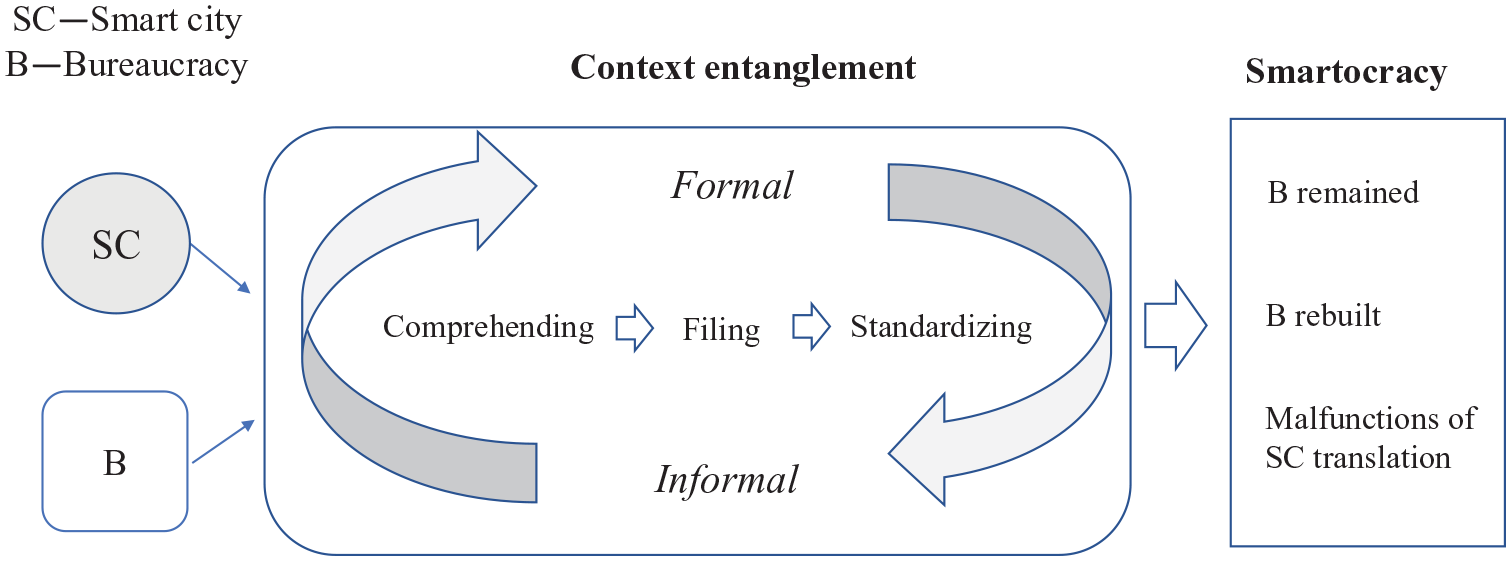
The encounter between the smart city idea and bureaucracy from a translation theory perspective.
Context entanglement
Having observed a dynamic relationship between the smart city idea and bureaucracy, we propose context entanglement as a new concept to describe this dynamic as a set of translation mechanisms. ‘Entanglement’ is borrowed from physics (Schrödinger, 1935) and refers to how, even at large distances, the state of one or the other entangled particles cannot be described independently of the state of the other particle, making them inseparable. In other words, to understand the encounter between the smart city idea and bureaucracy, we cannot treat them as two separate units of analysis such that what happens with bureaucracy or the smart city idea cannot be fully described without considering the other. This point was partly addressed via the duality of idea-context change (Gond & Boxenbaum, 2013) and idea-context interaction (Claus et al., 2020; Nielsen et al., 2014; Spyridonidis et al., 2014; Tracey et al., 2018). We reveal two aspects of context entanglement in the case of the smart city idea’s encounter with bureaucracy appealing to empirical investigations of translation patterns (Wæres & Sataøen, 2014).
First, neither the smart city idea nor bureaucracy remained unchanged but constantly transformed. In a way, the idea and the translation context were co-translated, partly changing the initial meaning of both during the three different phases of translation – namely, comprehending, filing and standardizing. We observed how the smart city idea was translated from political connotations of revising traditional city organizing (Mora et al., 2017; Mora & Deakin, 2019; OECD, 2018) and abstract discussions (Meijer & Bolívar, 2016) into everyday bureaucratic rulemaking for cities (Elliott & McCrone, 1982). In particular, during the comprehending phase, as a concept with an unlimited number of urban opportunities through technology and a collaborative approach (Peter & Meyer, 2023; Grossi et al., 2020; Mora & Deakin, 2019), the smart city idea was primarily interpreted as nothing more than existing bureaucratic agendas. The known elements of these agendas were further unpacked during the filing phase, in which technocentric elements of the idea were easily built into national projects, budgets and corresponding reporting procedures. Finally, during the standardizing phase, the smart city idea unfolded as many standard ingredients that could be copied and implemented in a fast and legitimacy-based way through bureaucratic resources, power and competence (Tracey et al., 2018).
In its turn, bureaucracy’s role as an implementing machine (Mintzberg, 1979) failed to deal with smart city complexity such that certain characteristics of bureaucracy often played out controversially. As revealed, bureaucrats simultaneously had a clear understanding of what the smart city idea could be but came to realize that the formally expressed smart city intentions required more from bureaucracy in the traditional sense (Clegg, 2012; Kornberger et al., 2017). While assuming to have resources and competence to organize idea translation without burdens (Graeber, 2015) and legitimacy pressures (Tracey et al., 2018), bureaucracy also realized the need for human competence and agent capabilities (Buffat, 2015) when turning towards the humancentric elements of the smart city idea. Moreover, while being open to learning about the smart city idea, bureaucracy also faced the challenge of being open within itself (Hodson et al., 2013) as it sporadically opened up and closed down for knowledge and experience exchange between government tiers.
Hence, the smart city idea and the bureaucratic context were not uniform and thus called for different translation mechanisms at different entanglement points. In this respect, following certain rules of translation (e.g. Røvik, 2016) became challenging in the case we explored since both the smart city idea and the bureaucracy context were in motion and constantly interacted during the translation process. While some of the smart city idea elements seemed to be understood well enough to be copied, others required certain omissions (e.g. formalized humancentric aspects), additions (e.g. the smart city standard) and even alterations of both the idea and the context. Thus, we claim that more attention should be placed on how formal bureaucratic features (Clegg, 2012) play out in more informal social interactions (Vossen & van Gestel, 2019; Waldorff, 2013; Waldorff & Madsen, 2022), bringing us to the second aspect of context entanglement in practice.
We observed that the dynamic co-translation of the idea and the context happened by means of formal and informal mechanisms. Besides existing in parallel (Kornberger et al., 2017), these mechanisms constantly interplayed, enabling context entanglement and evolving more or less in sync with each other through all phases of translation. While formal mechanisms should be tough, structured and based on rules (Elliott & McCrone, 1982), bureaucracy also mobilized initiatives as a part of the shadow culture (Kornberger et al., 2017). For example, to capture the humancentric elements of the smart city idea during the comprehending and filing phases, bureaucracy opened (but still controlled) doors to new knowledge and best practices beyond formal prescriptions. Similarly, while the smart city idea gained a formal core within existing bureaucratic procedures, the shadow culture and informal signals flourished, simplifying, ‘expertizing’, counselling and even ‘cutting corners’ of formal initiatives. Last, during the standardizing phase, while the creation of the standard facilitated unification and control, it was still voluntary and allowed some freedom, which opened up informal aspects to unfold. Therefore, the smart city idea provoked battles around everyday bureaucracy’s (in)ability to generate necessary resources (Buffat, 2015; Clegg et al., 2016; Hodson et al., 2013), emphasizing the essential role of informal mechanisms.
Smartocracy
The translation literature stresses that not only does an idea change during translation but so does the context (Claus et al., 2020; Spyridonidis et al., 2014; Tracey et al., 2018). Tracing the smart city idea within the Russian bureaucratic context, we demonstrate that after three years of context entanglement of bureaucracy and the smart city idea, smartocracy appeared as a new way of city organizing (Mora et al., 2017; Mora & Deakin, 2019). We show three features of smartocracy that reflect the consequences of the encounter of the smart city idea and bureaucracy.
First, in line with the previous literature on revisiting bureaucracy in contemporary organizations (Arellano-Gault et al., 2013; Clegg, 2012; Kornberger et al., 2017; Olsen, 2008), we claim that many things about bureaucracy remained after the smart city idea was introduced as they were functional necessities (Florian, 2018) for city organizing. This resulted in the smart city idea being reduced to the limits of the bureaucratic logic of rulemaking and accountability (Clegg, 2012). In that sense, our study illustrates what is always expected from the implementing machine (Mintzberg, 1979) – the neutralization and narrowing of ideas to a set of procedures, laws, degrees and administrable objects (Kornberger et al., 2017). This ‘inherent nature’ of bureaucracy (Hodson et al., 2013) becomes a possible explanation for why smart cities often become overly technocentric and lose their humancentric features (Grossi et al., 2020; Mora & Deakin, 2019; Mora et al., 2020).
However, as the second feature, this inherent nature was also slightly rebuilt. As our findings show, bureaucracy not only survived (Olsen, 2008) but successfully constructed new hierarchical links between levels of government via formal and informal translation mechanisms. By these means, instead of replacing city bureaucracy (Gardner & Hespanhol, 2017; Mora & Deakin, 2019; United Nations, 2017), the smart city idea paradoxically made hierarchy and control even stronger (Elliott & McCrone, 1982). Instead of real smart cities, bureaucracy established the smart cities on paper as this is what bureaucrats are used to doing (Barkov et al., 2018; Hull, 2012; Olsen, 2008). Interestingly, this also provided flexibility as it was enough to keep the rhetoric of the smart city idea afloat, stressing the essence of bureaucracy for forming better urban futures and still keeping almost everything under control. Thus, bureaucracy not only reinforced itself (Byrkjeflot & du Gay, 2012) but also became creative (Buffat, 2015; Kornberger et al., 2017) in finding a way to keep similar or even stronger controls, not in spite of the smart city idea but because of it.
Finally, smartocracy demonstrated several malfunctions in everyday bureaucracy (Nisar & Masood, 2020). These malfunctions unveil how the smart city idea is less about algorithmic implementation and more about dealing with human aspects on a daily basis (Hodson et al., 2013). As revealed, bureaucratic structures create new types of links within bureaucracy that make it formally connected but mentally separated. For example, bureaucratic templates (i.e. the standard) can limit the smart city idea when adherence does not produce rewards. In our case, such linkage made local bureaucrats’ motivation dissolve when the smart city idea became a bureaucratic burden, and municipalities started to doubt whether it was actually smart to become officially smart. Accordingly, it is not important which government body is responsible for smart city implementation in the hierarchy but that this body has enough political power to keep the smart city idea flowing. Otherwise, when bureaucracy compromises the smart city idea complexity, there is the risk of trying to put its humancentric elements into existing files even though new files are actually needed. As we revealed, such file creation and corresponding documentation or absence thereof are other malfunctions, which can freeze any open smart city initiative and close bureaucracy from within (Clegg, 2012).
Interestingly, in our case, such malfunctions with regard to the smart city idea complexity were still not ignored as a part of bureaucracy’s rebuilding. As we observed, bureaucracy segregated the humancentric aspects of smart city in new structures (centres of competence) that became a buffer where bureaucracy reserved the unclear parts of the smart city idea for later translation, keeping the humancentric aspects close to it albeit isolated. Therefore, bureaucracy is now probably not as it wanted to be and, similarly, smart city is not how political connotations wanted it to be (Baccarne et al., 2016; Dameri, 2017; Gardner & Hespanhol, 2017; United Nations, 2017). Instead, we observed that under context entanglement, both culminated into smartocracy as a way to organize cities when bureaucracy did not surrender to the smart city idea but rather found ways to benefit from it. As we illustrated, when facing the smart city idea complexity, bureaucracy has the capacity to be self-reflective and intelligent, forming compromises and new values while keeping the image of a rational tool for city modernity (Nisar & Masood, 2020). Bureaucracy is also ‘smart’ in making promises of a better future via a new idea, keeping unknown and unfixed smart city components for later translation. By these means, bureaucracy is innovative as it develops skills to face the unknown and is therefore capable of handling new complex issues.
Conclusion
Our study redefines our understanding of the role of bureaucracy in smart city organizing, showing how the smart city idea unfolded in the bureaucratic context in Russia. We show that the smart city idea was much less about revising city administration by integrating technology and a humancentric approach (Baccarne et al., 2016; Peter & Meyer, 2023; Dameri, 2017; Grossi et al., 2020) and more about organizing its complexity in everyday bureaucracy (Nisar & Masood, 2020). The smart city idea appeared complex but also elastic, dynamic and adjustable, creating a rationale to welcome the technocentric capacity of the smart city idea (Grossi et al., 2020). This capacity can apparently be complementary to bureaucracy (Dunleavy et al., 2006) but can also lead to smart cities mainly on paper and freeze the humancentric aspects of the idea. Thus, our study makes the following contributions.
First, with regard to the current debate on smart cities (e.g. Peter & Meyer, 2023; Grossi et al., 2020; Mora & Deakin, 2019; Mora et al. 2017), whatever smart city pathways are evident in terms of changing city organizing, their fate inevitably depends on how bureaucracy will play out on the ground. In particular, we show that smart city translation in practice can be unpacked as context entanglement of the smart city idea and bureaucracy. While smart city and bureaucracy are separate, antagonistic and incompatible in the literature (Gardner & Hespanhol, 2017; Mora & Deakin, 2019), we show that they are interdependent – namely, smart cities’ complexity (Mora et al., 2017) appear to be both its strength and weakness that can be compensated for by bureaucracy as the smart city assemblage point. This explains how the smart city idea was downsized from humancentric connotations to technocentric routines (Grossi et al., 2020; Mora et al., 2020). Thus, however humancentric the initial smart city idea is, more attention should be placed on whether and how formal and informal bureaucratic features complement each other.
Second, our study contributes to understanding bureaucracy’s place in city organizing. Instead of replacing bureaucracy (Peter & Meyer, 2023; Gardner & Hespanhol, 2017; Mora & Deakin, 2019; United Nations, 2017), the smart city idea can reinforce it (Byrkjeflot & du Gay, 2012), keeping similar or even stronger controls on city organizing but also being creative and self-reflexive (Buffat, 2015; Kornberger et al., 2017). Furthermore, smart cities can provide the chance to recover from the failed past of bureaucracy (Byrkjeflot & du Gay, 2012) by maintaining the promise of smart cities to improve urban futures and keeping bureaucracy as a rational tool for city modernization (Nisar & Masood, 2020). Hence, for bureaucracy, facing new ideas is not only about extending and strengthening itself, which is a main concern of contemporary organizational studies (e.g. Clegg, 2012; Dunleavy et al., 2006; Kornberger et al., 2017; Olsen, 2008), but also about realizing and addressing its weaknesses.
Regarding practical contributions, one of the cornerstones of smart city development for practitioners is bureaucracy’s readiness to incorporate external ideas (Kornberger et al., 2017). Our study shows that while bureaucracy can be open to the smart city idea when necessary, the openness of bureaucracy within itself can be a more significant issue (Hodson et al., 2013). This issue, in turn, can lead to technocentric smart cities’ dominance, thereby isolating some complex idea elements, such as citizen involvement. Therefore, if policymakers delegate smart city implementation to bureaucracy, they will face the interdependence of smart city and bureaucracy, thereby compromising the humancentric elements of the smart city idea. To keep the humancentric aspects afloat, practising bureaucrats must not miss the right moment to create new files as mandatory documentation for any bureaucratic acts. Such expansion is sometimes the only way for bureaucracy to succeed in translating complex ideas.
Along with the implications presented above, this paper has several limitations. First, despite seeking theoretical generalization, further research can discover more empirical examples and various actors’ roles besides those of bureaucrats. Second, our study covers the first three years of smart cities’ development in Russia, while future studies can follow context entanglement over time, tracing multidirectional idea travelling (Nielsen et al., 2022). Third, we encourage alternative interpretations of the encounter of the smart city idea and bureaucracy via alternative theories, such as sensemaking (see Brown, Colville, & Pye, 2015, for a review), which can be more sensitive to the reflexive and creative processes of other actors beyond bureaucrats. Finally, future studies can further explore the human dimensions in the dehumanized domain of bureaucracy, including bureaucrats’ tensions, emotions and sensitivity towards the smart city idea. Whether these dimensions can become glimmers of hope for cities’ organizing depends on the smart city competences to be developed (if any).
Footnotes
Appendix
Interviews.
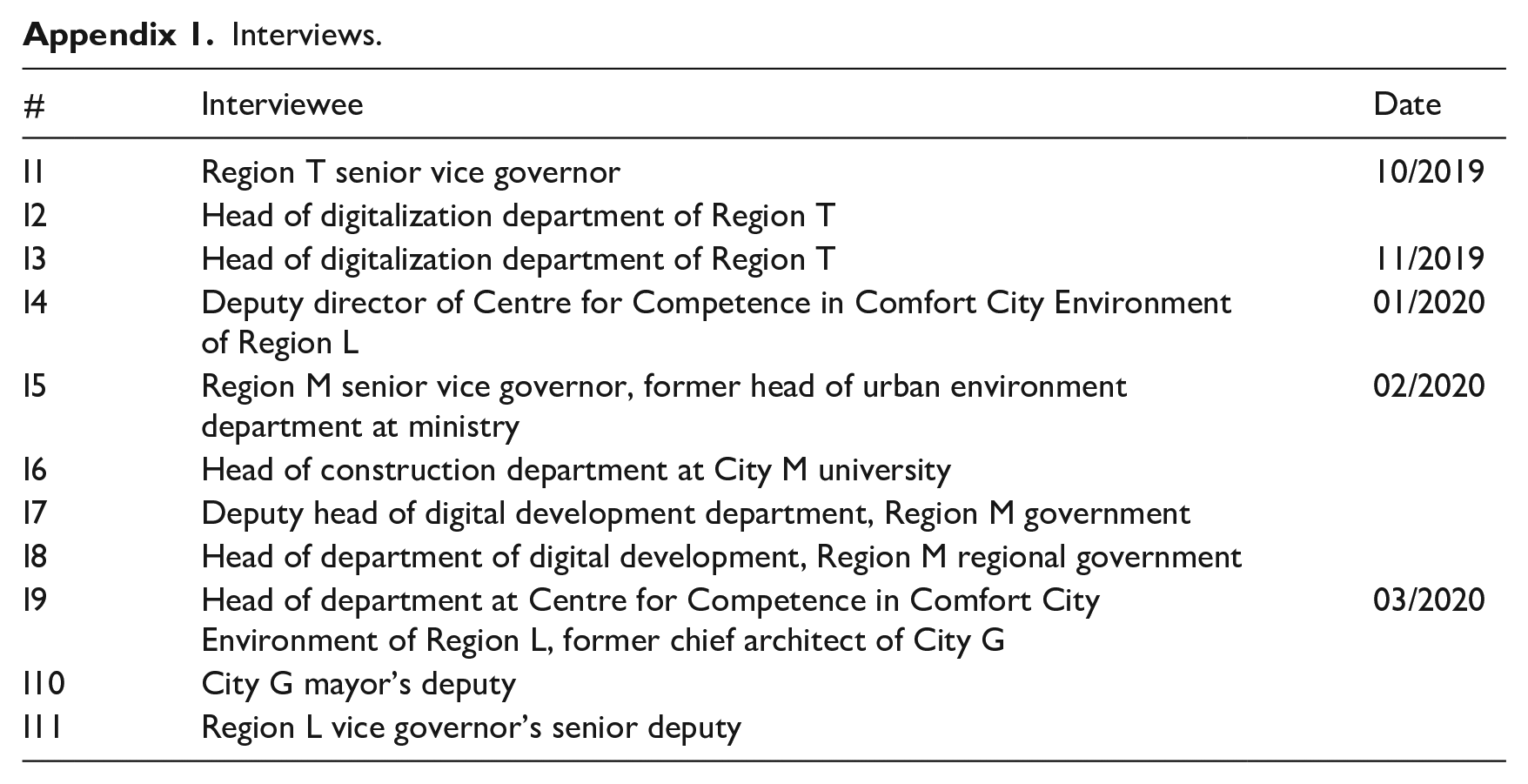
| # | Interviewee | Date |
|---|---|---|
| I1 | Region T senior vice governor | 10/2019 |
| I2 | Head of digitalization department of Region T | |
| I3 | Head of digitalization department of Region T | 11/2019 |
| I4 | Deputy director of Centre for Competence in Comfort City Environment of Region L | 01/2020 |
| I5 | Region M senior vice governor, former head of urban environment department at ministry | 02/2020 |
| I6 | Head of construction department at City M university | |
| I7 | Deputy head of digital development department, Region M government | |
| I8 | Head of department of digital development, Region M regional government | |
| I9 | Head of department at Centre for Competence in Comfort City Environment of Region L, former chief architect of City G | 03/2020 |
| I10 | City G mayor’s deputy | |
| I11 | Region L vice governor’s senior deputy |
Acknowledgements
We would like to thank Renate Meyer, editor-in-chief of Organization Studies, and Luca Mora and the other guest editors of this special issue for their dedicated guidance and thoughtful suggestions, which helped us solidify our arguments and strengthen our contributions. We are also immensely grateful to the three anonymous reviewers for directing us and helping us to frame our initial ideas to the point where they became meaningful for the audience of the journal. Moreover, we greatly appreciate the feedback on early versions of the manuscript from Daniela Argento, associate professor in management control and accounting at Kristianstad University (Sweden).
Funding
The author(s) disclosed receipt of the following financial support for the research, authorship, and/or publication of this article. We would like to thank the Research Council of Norway for the following funding support: Project ‘EduSmart: Education and Knowledge Development for Smart City Governance and Performance Management in the High North’ (grant #309532, INTPART programme); Project ‘SMARTNORTH: Sustainable Development and Management by Participatory Governance Practices in the High North’ (grant #288250, NORRUS Pluss programme).
