




Abstract

Chevalier Q Jackson is recognized as the father of American Broncho-Esophagology and as an astounding innovator in techniques and equipment for the removal of aerodigestive foreign bodies. Throughout his career he maintained a close collaborative relationship with several equipment manufacturers, but especially with the George P Pilling and Son Company of Philadelphia. Their 1932 catalog 1 includes 36 pages of Jackson bronchoscopes, esophagoscopes, laryngoscopes, suctions, illuminators, mouth gags, and a huge array of specialized forceps for removal of specific foreign bodies—with the caution: “In the following pages we have not attempted a complete presentation of all the Bronchoscopic equipment. . .”
How did he get all those amazing instruments? The short answer is, “he made them.” After completing medical school under the tutelage of the pioneering Philadelphia laryngologist Jacob DaSilva Solis-Cohen, he sailed to London to advance his skills. Jackson spent several months observing the famed laryngologist Morell Mackenzie, a master of mirror laryngoscopy. While Jackson admired Mackenzie’s clinical skills, he was not impressed by Mackenzie’s “impractical” mirror illuminated esophagoscope. 2
Returning to his native Pittsburgh, he chose to specialize in laryngology at a time when specialization was discouraged. Lacking necessary surgical instruments, he created rough models “in my little shop in the cellar,” perhaps with the assistance of a machinist friend, Andrew Lascher. 3 He used his meager income to pay for construction of “the instruments, specially designed to overcome the particular problem in a particular case.” 4 In the early 1890s Jackson worked with instrument manufacturers in New York, but subsequently formed a relationship with the Feick Brothers in Pittsburgh, who became his preferred instrument makers. 5 At the suggestion of a colleague, Max Einhorn, Jackson created a distally illuminated esophagoscope using an electrified light carrier—originally designed for use in a cystoscope. The carrier was fitted with the newly developed “Mignon” light bulb at its distal end and was powered by a battery at the endoscopist’s feet. Separate channels for the light carrier and for suction completed his prototype instrument.6,7 Jackson’s early bronchoscopes followed Killian’s design, using a straight brass tube with “bell-mouth extremities” and distal “perforations in the sides for admission of air from shut off bronchi.” The light carrier rode in a separate channel, except in the smallest versions. Early models included an obturator to aid with insertion (See Figure 1). 8
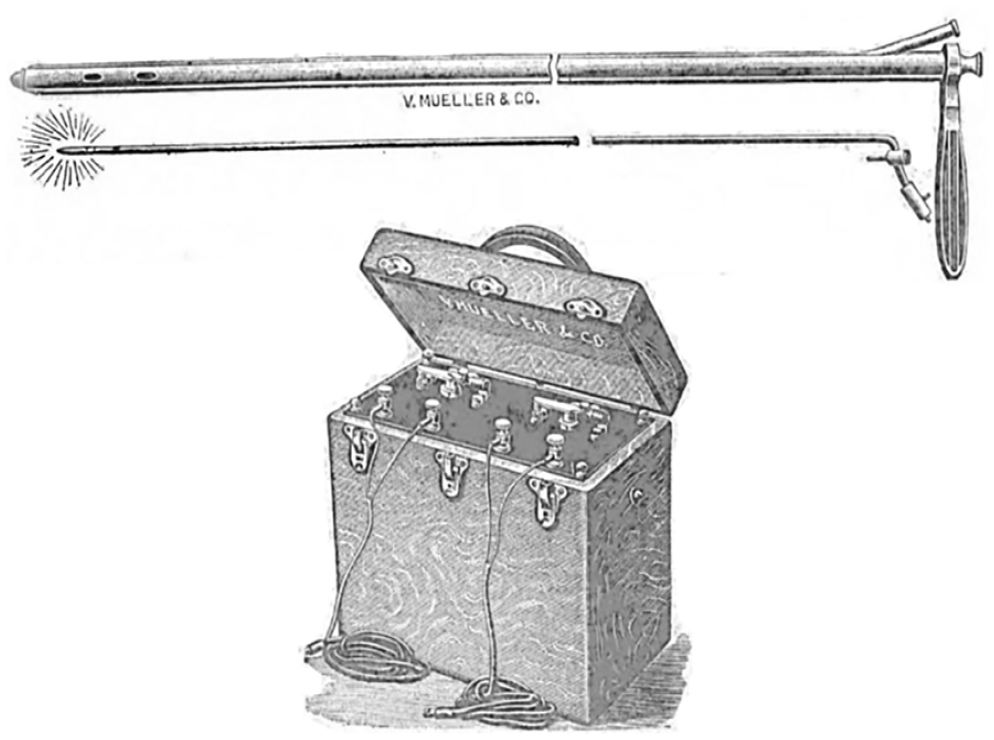
Jackson bronchoscope and battery from 1916 V Mueller catalog. Similar in design to Killian’s with the addition of side perforations and a Mignon light bulb carrier for distal illumination. 9
In 1916, Jackson and his family relocated from Pittsburgh to Philadelphia as he assumed his new position on the faculty of Jefferson Medical College. Shortly thereafter, he purchased Sunrise Mill, a farm in Schwenksville in rural Montgomery County, Pennsylvania. The farmhouse and nearby grist and saw mill on the Swamp Creek became his refuge from the “noise, dirt, smoke and noxious fumes” of Philadelphia. The mill itself became his laboratory and workshop for the creation of new surgical instruments. Jackson rebuilt the mill’s dam and used its millrace and turbine to drive an electrical generator that provided illumination to the farmhouse and power to Jackson’s workshop tools until commercial electricity arrived a decade later.
His metal shop included a lathe for working brass bronchoscope tubes, a drill press, and a powered finishing wheel (Figures 2 and 3). The prototypes he created were finished and later mass produced by the Pilling Company and the V Mueller Company of Chicago. 9
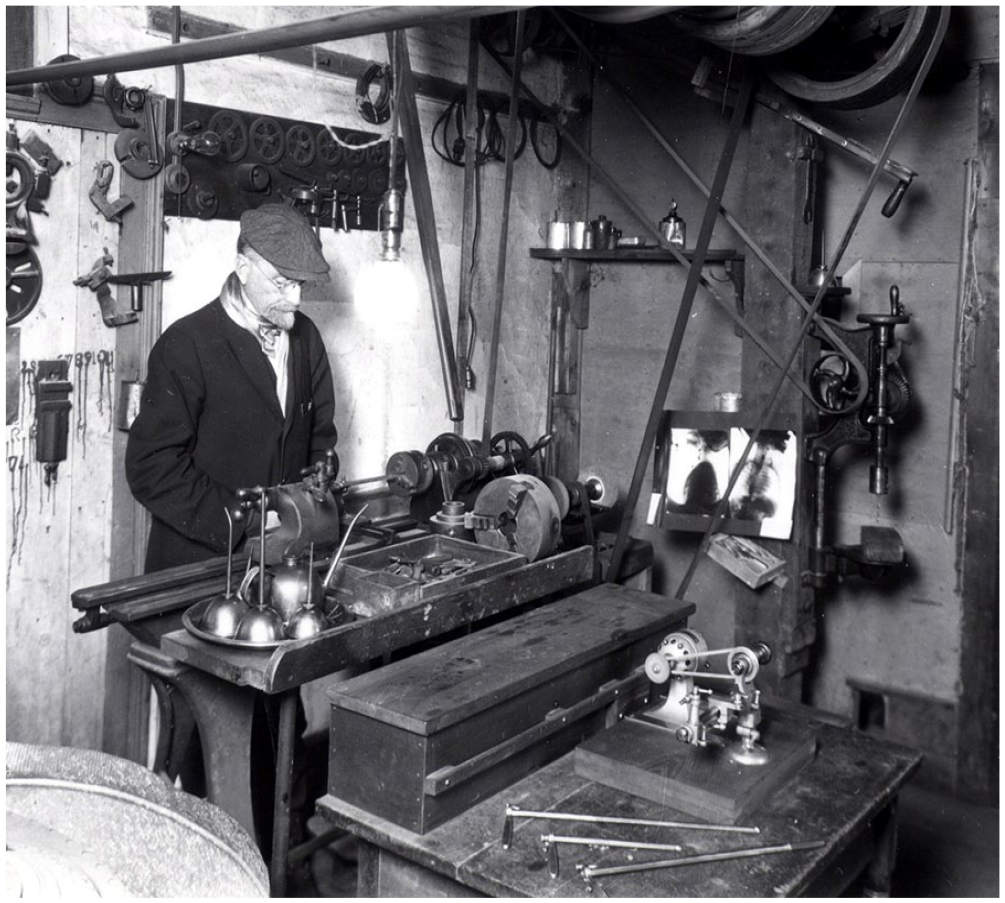
Chevalier Jackson in his Sunrise Mill machine shop. A brass bronchoscope tube is clamped in the lathe and several incomplete prototypes lie on the table.
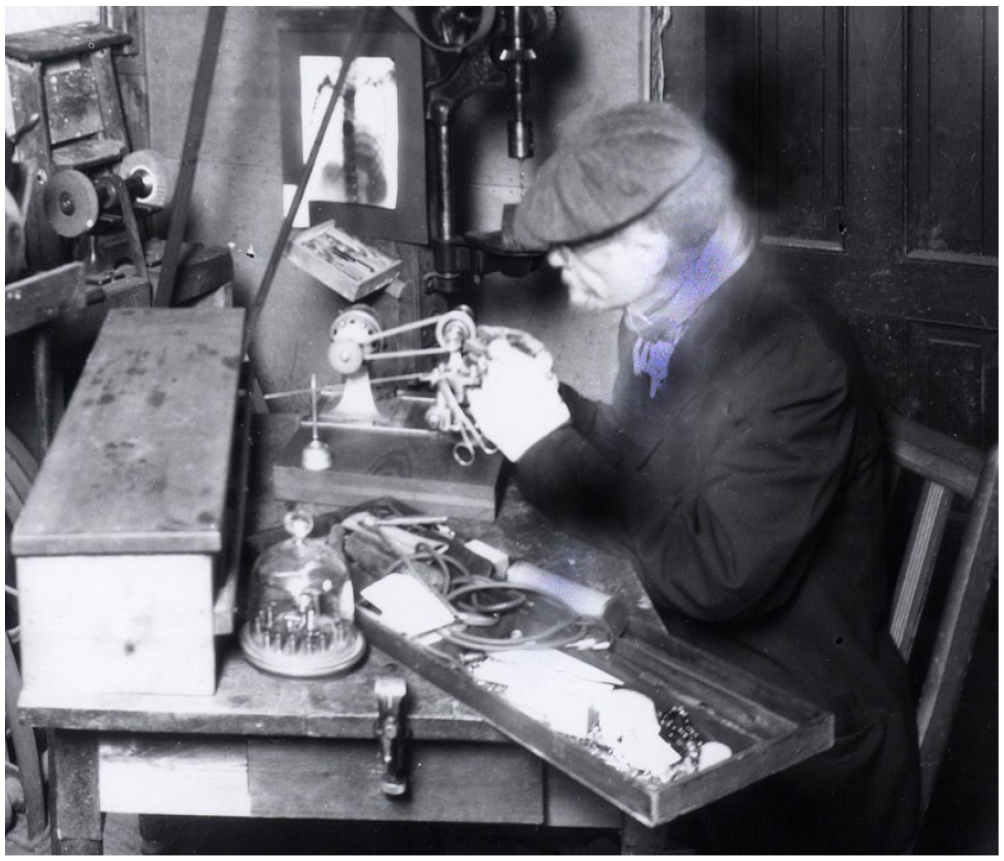
Jackson at the finishing wheel with bronchoscopic forceps.
Jackson’s workshop also served as an outlet for his other creative talents. He designed and built a wooden boat with a battery-powered electric motor to cruise about the mill pond. With hand woodworking tools he assembled the writing chair where he spent long hours logging foreign body cases and composing his autobiography (Figure 4).
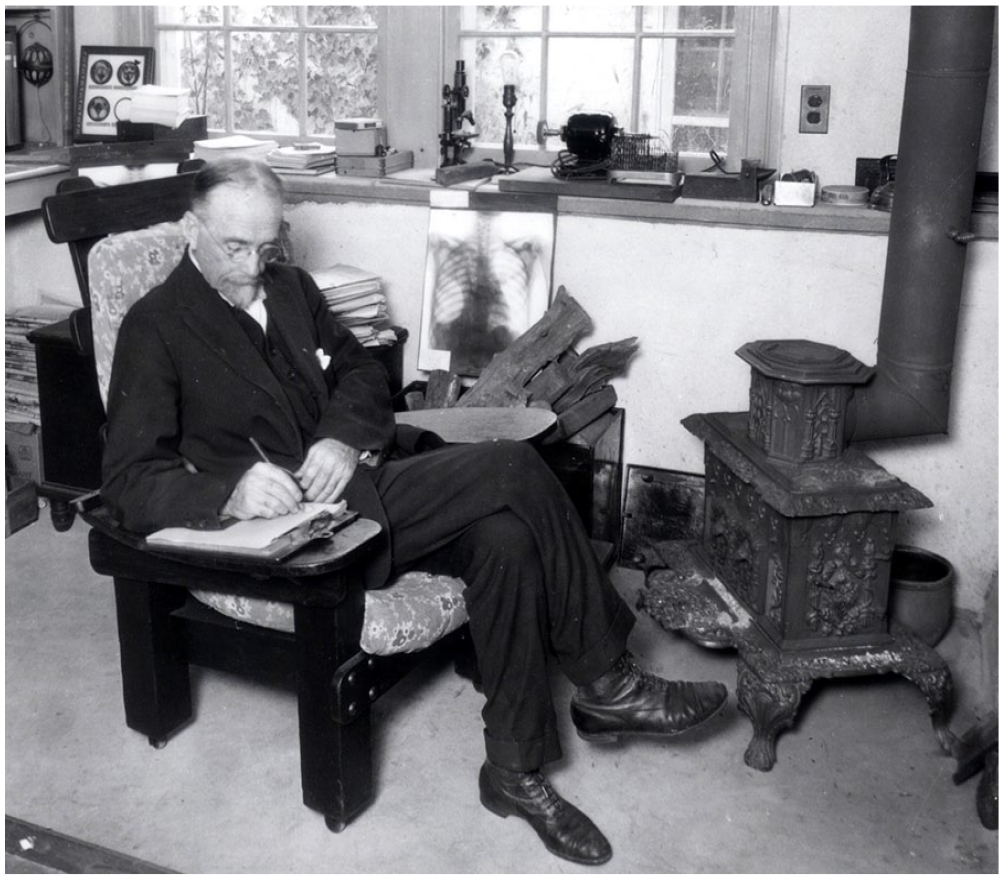
Jackson logging cases in his writing chair, a chest radiograph in the background.
Footnotes
Declaration of Conflicting Interests
The author declared no potential conflicts of interest with respect to the research, authorship, and/or publication of this article.
Funding
The author received no financial support for the research, authorship, and/or publication of this article.
