




Abstract
By the middle of the 1800s, the gross and microscopic anatomy of the ear had been studied in great detail and the major infectious disorders of the temporal bone were well described. Still, the ability to diagnose middle ear disease was in its infancy. Anton Freiherr von Troltsch described the state of otoscopy in 1870 as follows (Figure 1):
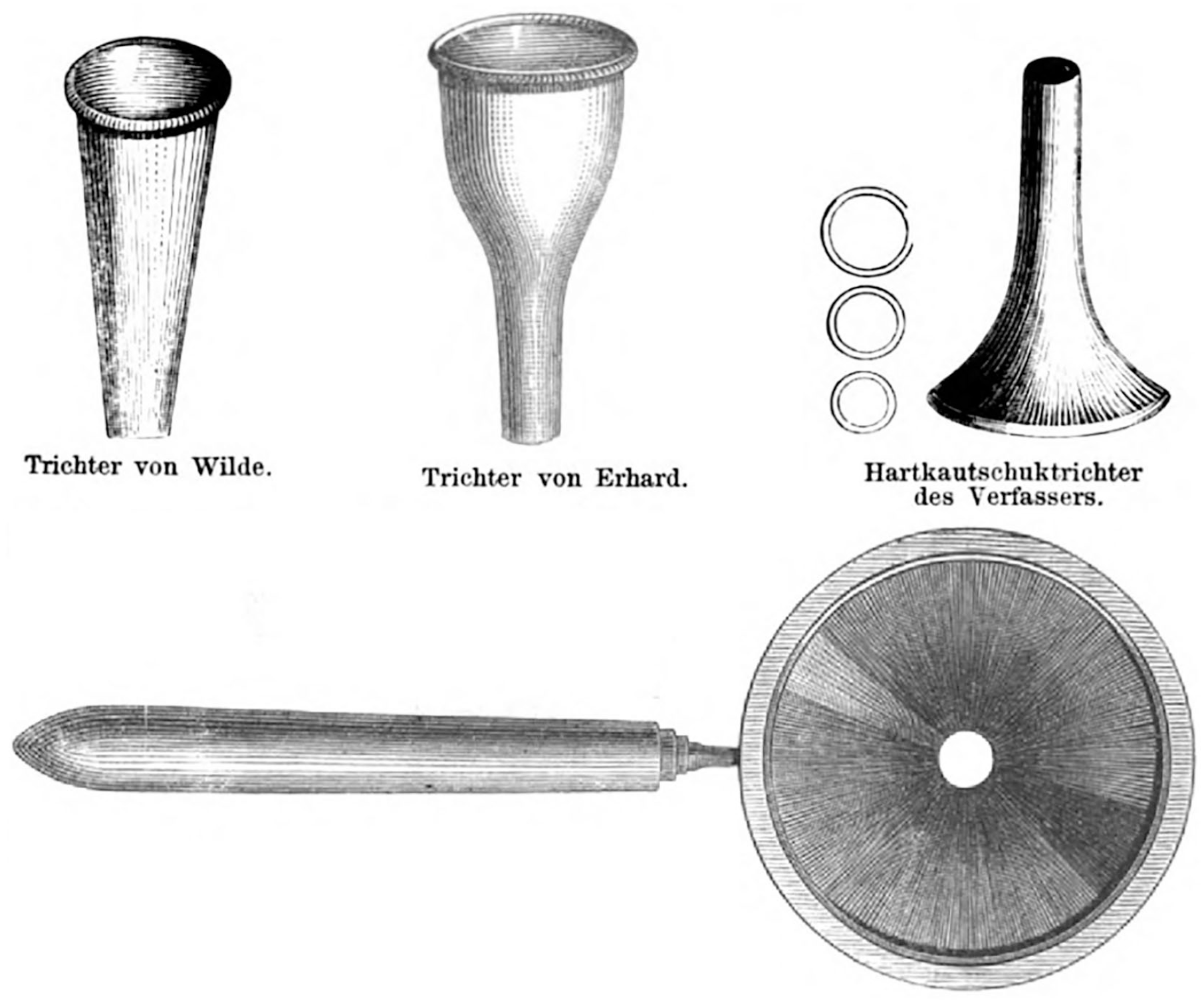
Top, Wilde, Erhart, and Politzer ear specula. Bottom, a concave reflective mirror with a central aperture and lens (modified from Politzer). 3
In no other form of disease are the history and the subjective symptoms of so little value for the correct diagnosis of any special case as in diseases of the ear, and the objective examination of the parts accordingly of such preponderating value. . ..Generally the (external auditory) meatus is too narrow to allow the deeper parts, and especially the membrane, to be sufficiently illuminated. By introducing a funnel-shaped tube called the ear speculum into the meatus, and while the latter is made straight by traction (backwards and upwards) on the auricle, at the same time throwing daylight by means of a concave mirror on to the deeper parts (the ear is visualized). 1
Von Troltsch was not the first to describe the ear speculum, nor the concave mirror for illumination (Friedrich Hofmann, a medical officer in Burgsteinfurt, Westphalia, Germany, is credited with this invention), 2 but his use of natural light to visualized the tympanic membrane allowed him and others to describe middle ear disease in exquisite detail. 3 With these tools, von Troltsch accurately described myringitis, acute otitis media with perforation, traumatic tympanic perforation, and temporal bone fractures.
The limitations of reflected sunlight or gaslight for examination of the eardrum were obvious. The invention of the carbon filament electric light bulb by Edison in 1879 changed all of this. Within a decade, the light bulb had been miniaturized and incorporated into surgical instruments. Maximilian Carl-Friedrich Nitze, a urologist of Vienna, was eager to develop an illuminated cystoscope. He encouraged Josef Leiter, 4 the genius Austro-Hungarian instrument maker, to build a carbon filament, electro-deflector “panelectroscope” which was patented in 1887. It was designed to illuminate any tube including both the cystoscope and gastroscope. By 1888, Leiter had applied for a US patent for an electrically lighted laryngoscope. The patent application included attachments for an otoscope speculum and a pneumatic otoscope using a modification of Siegel’s device (Figure 2). 5
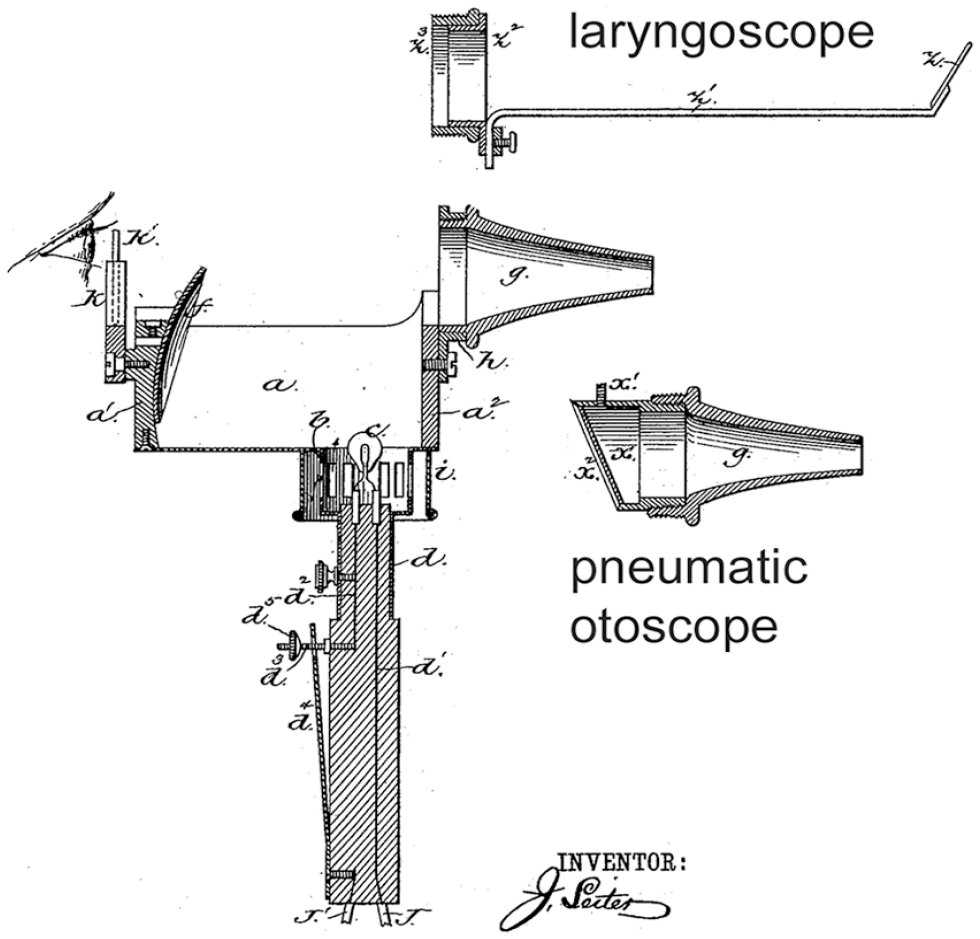
Josef Leiter’s panelectroscope with laryngoscope, otoscope, and pneumatic otoscope attachments (modified from US patent 376,601).
By the turn of the 20th century, a flurry of electrified otoscope designs had been constructed. Peter T Geyerman of Brewster, Minnesota devised a compact closed otoscope in 1904 (Figure 3A). 6 In 1910, Henry L De Zeng of Philadelphia constructed a pneumatic otoscope powered by dry cell batteries. His “auriscope” is hard to distinguish from popular otoscope designs used today (Figure 3B). 7
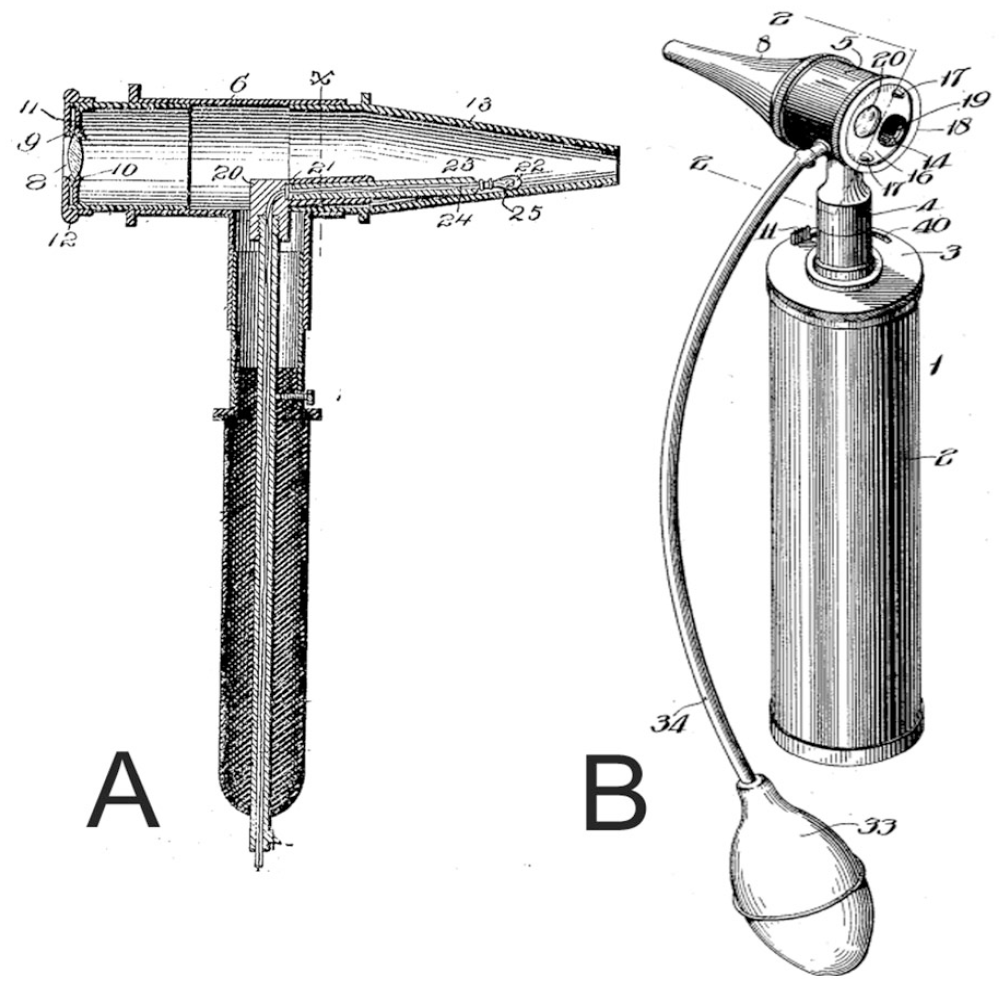
(A) Geyerman’s otoscope. (B) De Zeng’s auriscope (modified from US patents 765,887 and 1,588,791).
In 1915, Dr. Francis Welch, MD of New York received a patent for a hand-held, direct-illuminating ophthalmoscope. Collaborating William Noah Allyn, an engineer who had formerly worked with De Zeng, they started the Welch Allyn Company in a small factory space in Auburn NY. Their new ophthalmoscope and a battery-powered otoscope were displayed at the 1920 American Medical Association meeting in Chicago to great acclaim. William Allyn went on to receive patents for a detachable ophthalmoscope-otoscope handle, folding intubating laryngoscope and, an illuminated sigmoidoscope.
Footnotes
Declaration of Conflicting Interests
The author declared no potential conflicts of interest with respect to the research, authorship, and/or publication of this article.
Funding
The author received no financial support for the research, authorship, and/or publication of this article.
Level of Evidence
5 – expert opinion
