




Abstract
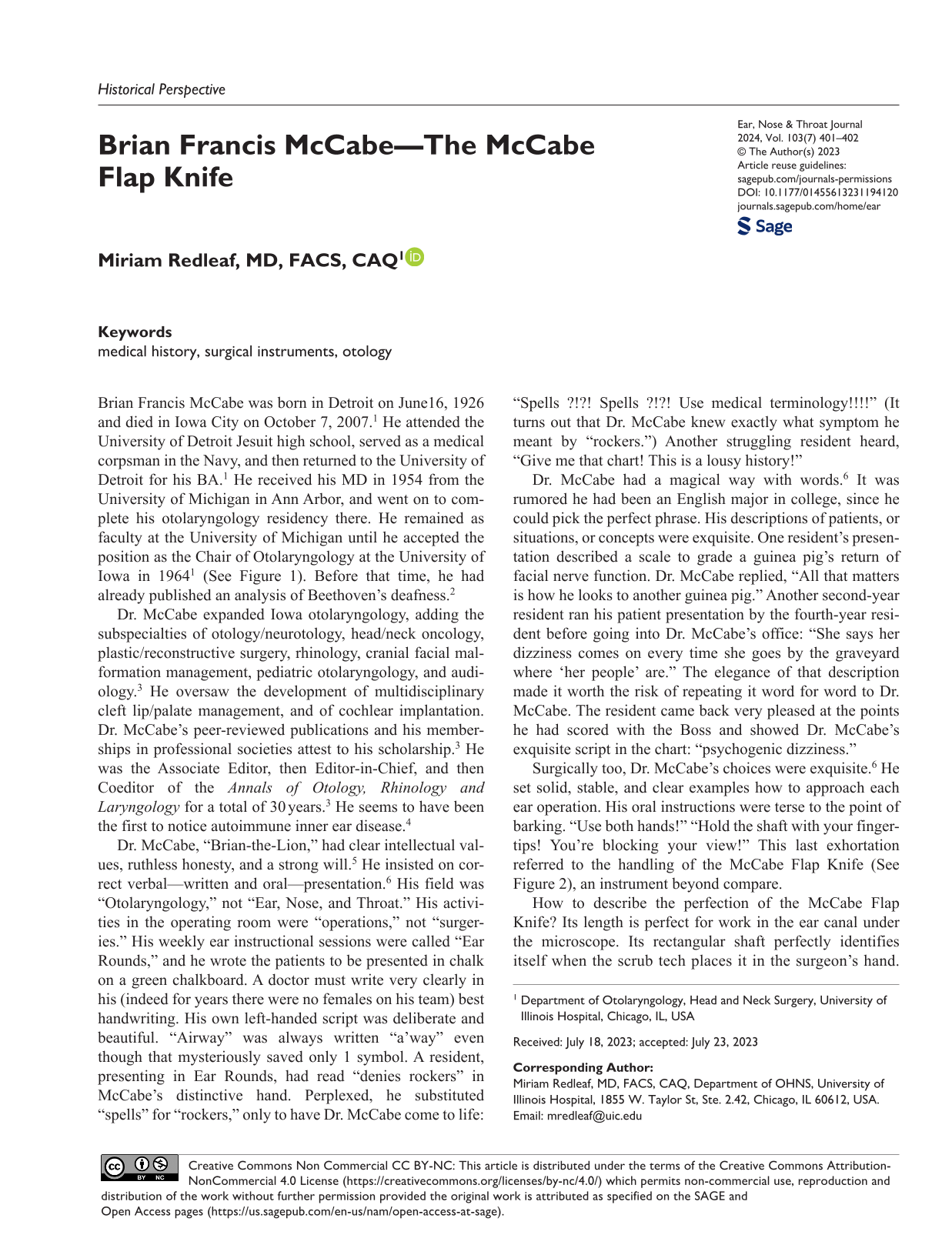
Brian Francis McCabe was born in Detroit on June16, 1926 and died in Iowa City on October 7, 2007. 1 He attended the University of Detroit Jesuit high school, served as a medical corpsman in the Navy, and then returned to the University of Detroit for his BA. 1 He received his MD in 1954 from the University of Michigan in Ann Arbor, and went on to complete his otolaryngology residency there. He remained as faculty at the University of Michigan until he accepted the position as the Chair of Otolaryngology at the University of Iowa in 1964 1 (See Figure 1). Before that time, he had already published an analysis of Beethoven’s deafness. 2
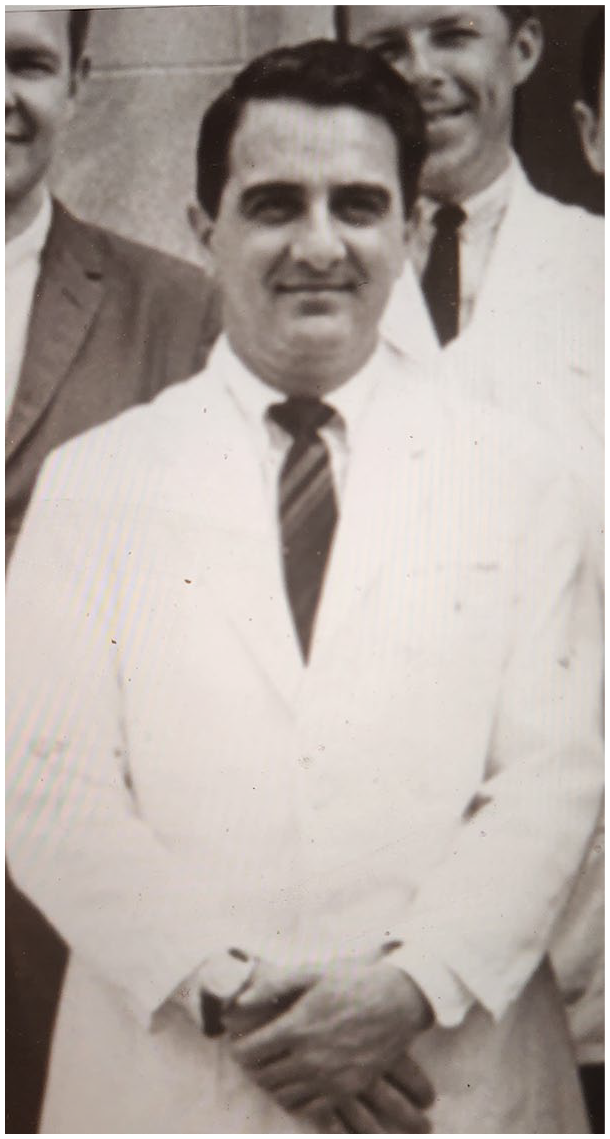
Brian F. McCabe.
Dr. McCabe expanded Iowa otolaryngology, adding the subspecialties of otology/neurotology, head/neck oncology, plastic/reconstructive surgery, rhinology, cranial facial malformation management, pediatric otolaryngology, and audiology. 3 He oversaw the development of multidisciplinary cleft lip/palate management, and of cochlear implantation. Dr. McCabe’s peer-reviewed publications and his memberships in professional societies attest to his scholarship. 3 He was the Associate Editor, then Editor-in-Chief, and then Coeditor of the Annals of Otology, Rhinology and Laryngology for a total of 30 years. 3 He seems to have been the first to notice autoimmune inner ear disease. 4
Dr. McCabe, “Brian-the-Lion,” had clear intellectual values, ruthless honesty, and a strong will. 5 He insisted on correct verbal—written and oral—presentation. 6 His field was “Otolaryngology,” not “Ear, Nose, and Throat.” His activities in the operating room were “operations,” not “surgeries.” His weekly ear instructional sessions were called “Ear Rounds,” and he wrote the patients to be presented in chalk on a green chalkboard. A doctor must write very clearly in his (indeed for years there were no females on his team) best handwriting. His own left-handed script was deliberate and beautiful. “Airway” was always written “a’way” even though that mysteriously saved only 1 symbol. A resident, presenting in Ear Rounds, had read “denies rockers” in McCabe’s distinctive hand. Perplexed, he substituted “spells” for “rockers,” only to have Dr. McCabe come to life: “Spells ?!?! Spells ?!?! Use medical terminology!!!!” (It turns out that Dr. McCabe knew exactly what symptom he meant by “rockers.”) Another struggling resident heard, “Give me that chart! This is a lousy history!”
Dr. McCabe had a magical way with words. 6 It was rumored he had been an English major in college, since he could pick the perfect phrase. His descriptions of patients, or situations, or concepts were exquisite. One resident’s presentation described a scale to grade a guinea pig’s return of facial nerve function. Dr. McCabe replied, “All that matters is how he looks to another guinea pig.” Another second-year resident ran his patient presentation by the fourth-year resident before going into Dr. McCabe’s office: “She says her dizziness comes on every time she goes by the graveyard where ‘her people’ are.” The elegance of that description made it worth the risk of repeating it word for word to Dr. McCabe. The resident came back very pleased at the points he had scored with the Boss and showed Dr. McCabe’s exquisite script in the chart: “psychogenic dizziness.”
Surgically too, Dr. McCabe’s choices were exquisite. 6 He set solid, stable, and clear examples how to approach each ear operation. His oral instructions were terse to the point of barking. “Use both hands!” “Hold the shaft with your fingertips! You’re blocking your view!” This last exhortation referred to the handling of the McCabe Flap Knife (See Figure 2), an instrument beyond compare.
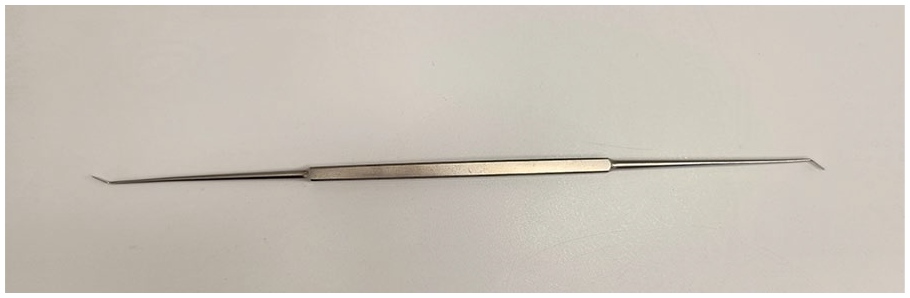
McCabe Flap Knife—7¼ inches long, more and less angled blades.
How to describe the perfection of the McCabe Flap Knife? Its length is perfect for work in the ear canal under the microscope. Its rectangular shaft perfectly identifies itself when the scrub tech places it in the surgeon’s hand. The 2 blades are angled perfectly for access to varying locations in the canal and middle ear. The length of the blade—4 mm—is almost canonical in its utility: How many flap knives long should the flap be? How big is the perforation? How long should the prosthesis be? No instrument can unzip an annulus from its sulcus like a McCabe. For some, the McCabe Flap Knife is the most beloved of instruments.
Dr. McCabe was brilliant and gruff and eloquent and should better be remembered as “Brian-the-Lionhearted.” His death, 16 years ago now, seems just a wisp away.
Footnotes
Declaration of Conflicting Interests
The author declared no potential conflicts of interest with respect to the research, authorship, and/or publication of this article.
Funding
The author received no financial support for the research, authorship, and/or publication of this article.
Level of Evidence
5 - expert opinion
