




Abstract
Water in coal reservoirs serves as both the driving force of reservoir fluid and the resistance to coalbed methane (CBM) migration. However, the impact and control mechanism of water saturation on CBM development in the field have not been revealed yet. The evolution of reservoir dynamics and gas production rate under various initial water saturation conditions is simulated based on the COMSOL multiphysics numerical simulation software. The simulation results show that the reduction of initial water saturation can significantly enhance the effective permeability of the reservoir gas phase, which can be increased by up to 4764%. This increases the rate of gas production, which is the main mechanism for controlling production by water saturation in the reservoir. For high water saturation reservoirs, the positive effect of inter-well interference should be reasonably utilized, and high well network density should be used to rapidly increase gas-effective permeability. For low water saturation reservoirs, the negative effect of inter-well interference should be avoided, and low well network density should be used to increase the control of single well reserves.
Keywords
Introduction
The water saturation of coal reservoirs is an important factor in the development of coalbed methane (CBM), which largely determines the flow and dynamic relative permeability of fluids in reservoirs. In coal reservoirs, formation water stores elastic potential energy (Zhao et al., 2022a), which drives the migration of reservoir fluids. Meanwhile, because gas and water share the flow channels in the reservoir, the formation of water also acts as a resistance to the migration of CBM (Bear, 1975). The saturation of reservoir water controls the migration and production of CBM (Akhondzadeh et al., 2018).
In the early stage of CBM exploration and development, it is generally recognized in the academic and engineering communities that the water in coal reservoirs is saturated (Chen et al., 2018). Only a few coal reservoirs (Dry Horseshoe Canon CBM Play) show low water saturation or are completely anhydrous, and good development results are achieved under low-permeability conditions (Clarkson, 2009; Xu et al., 2015b). It is also believed that most CBM reservoirs are undersaturated, meaning that the actual gas content is lower than the theoretical adsorption content under reservoir pressure (Xu et al., 2014). As a result, fluid flow in reservoirs begins with single-phase water flow, and as reservoir pressure decreases and reaches the critical desorption pressure, CBM begins to desorb and enter a two-phase gas water flow stage (Gerami et al., 2008). Therefore, in numerical simulations of CBM reservoir development, the water saturation degree is usually set to 100% (Tim, 2012). In recent years, with the exploration and development of deep and low-rank CBM, the free gas in coal reservoirs has gradually been discovered and recognized by the engineering community and academia (Chen et al., 2021). Water saturation in deep and low-rank coal reservoirs is often considered to be <1 (Sun et al., 2018), which challenges the previous assumption that coal reservoirs are always saturated with water (Guo and Kantzas, 2009).
Current research on the impact of water saturation in coal reservoirs on CBM development mainly involves its impact on coal matrix adsorption capacity and reservoir permeability, and they are all based on microscopic experimental studies (Xu et al., 2015a). Experimental studies are necessary for the study of microscopic mechanisms (Li et al., 2023a, 2023b). Regarding adsorption capacity, scholars generally believe that water inhibits CBM adsorption (Gao et al., 2018), and Joubert et al. (1973) and Joubert et al. (1974) suggested that the inhibitory effect disappears when the water saturation is higher than the equilibrium water saturation. Regarding reservoir permeability, Yin et al. (2011) pointed out that the lower the water saturation, the higher the effective methane permeability through experimental research. Liu et al. (2020a, 2020b) studied the evolution of CBM seepage velocity with effective stress in samples with different water saturation. These experimental-scale studies reveal the role of water saturation in controlling the single-factor physical mechanism during CBM production (Meng et al., 2018). This provides a theoretical basis for field studies. However, at the field scale, water and gas production from CBM wells is influenced by a combination of factors. With the development of CBM, the negative effect of effective stress (Zhang et al., 2023a) and the positive effect of matrix shrinkage (Xu et al., 2014) jointly control the absolute permeability of the reservoir, and the change of absolute permeability causes the change of effective permeability (Liu et al., 2023; Zhang et al., 2023b). Meanwhile, during the development process, the reservoir pressure keeps decreasing and the reservoir pressure is different at different locations from the wellbore (Zong et al., 2023). This results in different water saturation at different locations, which ultimately affects gas production. Currently, at the field scale, the comprehensive impact and control mechanism of water saturation in coal reservoirs on gas water production from CBM wells have not been fully studied (Liu et al., 2020a, 2020b; Tang et al., 2017; Thararoop et al., 2012; Xu et al., 2012).
This study constructs a multiphysics coupling numerical model for CBM reservoir development using COMSOL software, simulating the evolution of reservoir and gas production rates under various reservoir water saturation conditions. From the perspective of driving force for fluid flow and resistance for CBM migration, this study explores the control mechanism of reservoir water saturation on CBM production and provides corresponding development recommendations for reservoirs with different water saturation.
Multi-field coupling numerical simulation of development
Geological model
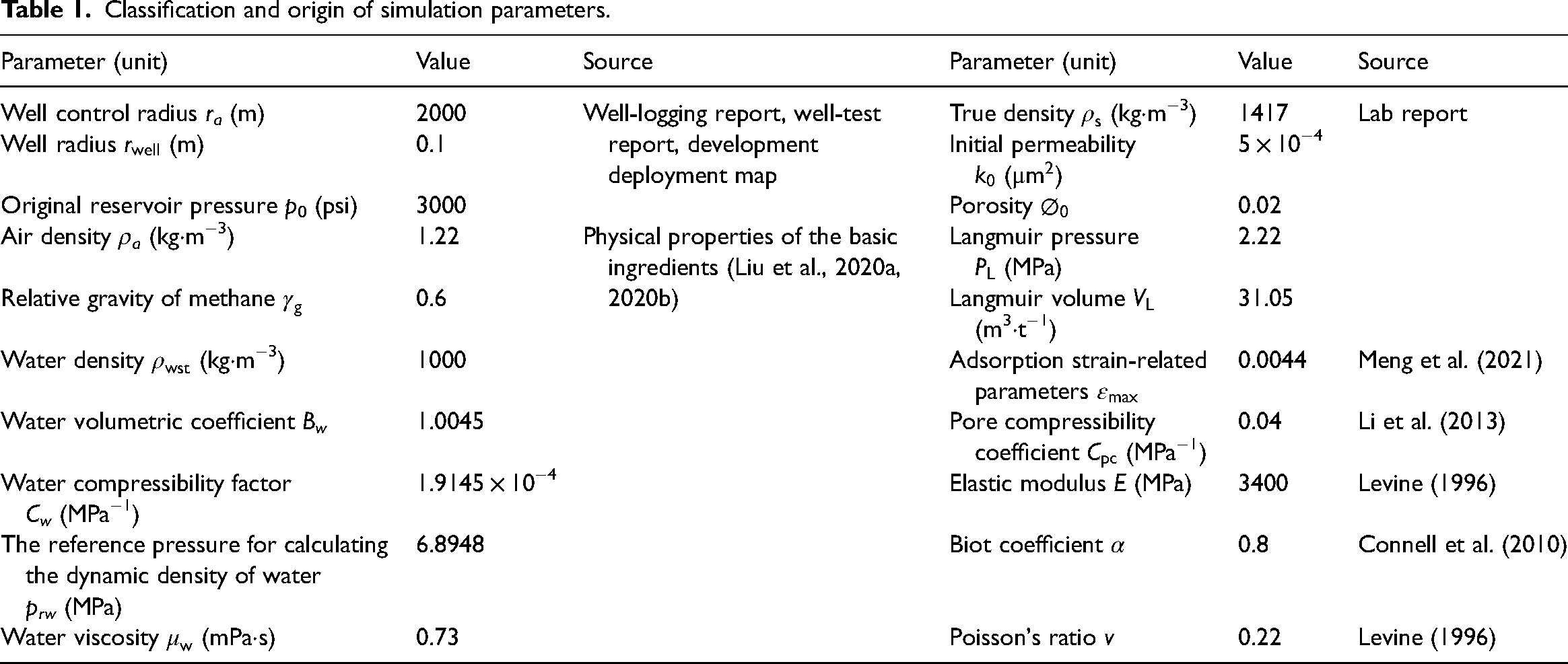
In this study, the geological model is constructed based on the coal reservoirs in the X-1 Block. The geological parameters can be divided into four categories (Table 1): (a) Based on on-site reports (such as well logging reports and well test reports), development design parameters were evaluated, including well radius, well control radius, and original reservoir pressure. (b) Basic coal properties, such as true density, initial permeability, and porosity, were obtained through experimental data of X-1 coal samples. (c) The physical properties of some basic components, such as water, air, and methane, including density and viscosity under standard conditions. (d) The mechanical properties of coal, including elastic modulus, Poisson's ratio, and adsorption strain-related parameters, were obtained from the literature.
Classification and origin of simulation parameters.
Geometric model
This study is based on the multiphysics coupling software COMSOL and uses the finite-element method for numerical simulation. CBM development is simplified into a two-dimensional model, with a production well radius of 0.1 m and a well control radius of 2000 m. The reservoir thickness can be set in the two-dimensional model (referring to the thickness of the No. 8 coal seam in X-1 Block, the model is set to 5 m). In this case, the gas and water flow rates of the coal reservoir at different depths are the same, and the thickness is only used to calculate the final production data. The reservoir pressure in the X-1 Block is about 20 MPa, the initial formation pressure is 3000 psi, and the simulated burial depth of the coal seam is 2100 m. Considering symmetry, only one-quarter of the control field was simulated (Figure 1). Due to the strong nonlinearity of the mathematical model of CBM development and difficulty in convergence, an extremely fine linear triangular unit grid (a total of 13,339) was used.
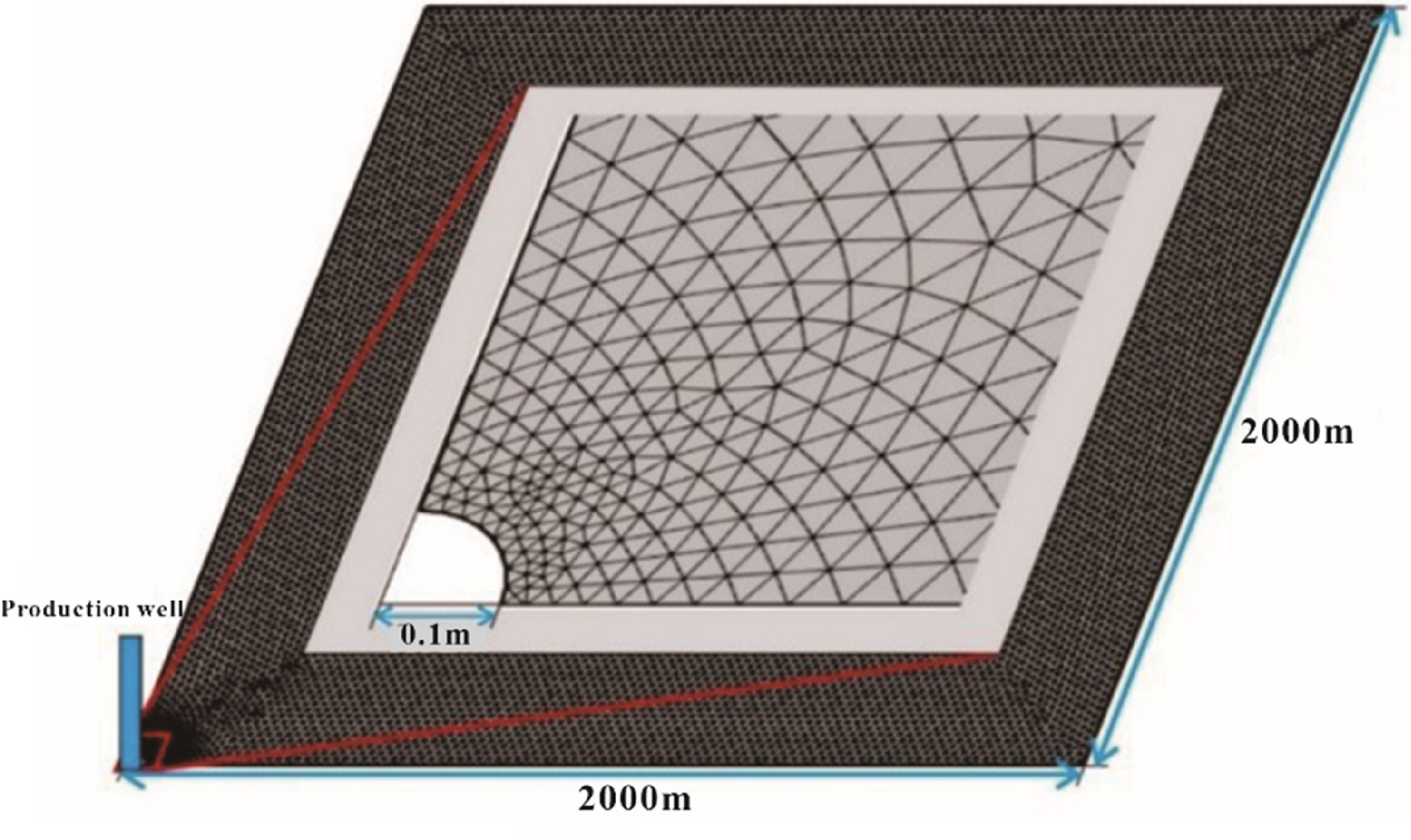
Numerical simulation of a geometric model of well control field (a quarter).
Mathematical model
This study couples the Darcy flow model, the porous media transfer model, and the geological mechanics model (Figure 2) to construct a mathematical model for CBM development. The detailed modeling process can be found in the author's previously published article (Zhao et al., 2022a). The specific mathematical models utilized in this study are improved in the geological mechanics and porous media transfer modules.
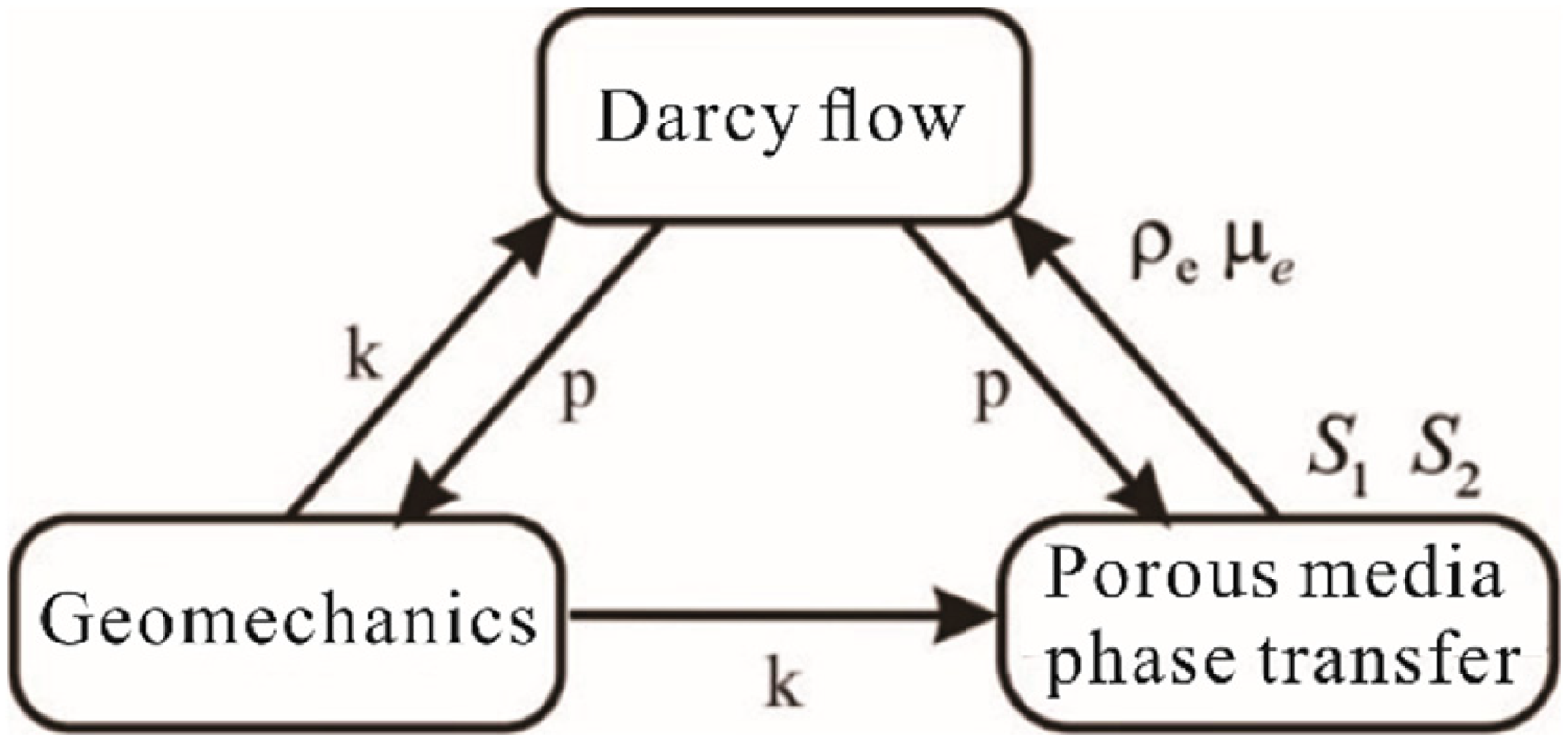
Coupling diagram of numerical simulation of coalbed methane (CBM) development.
In the flow model, the material conservation equation is equation (1) when single-phase fluid flows in porous media and there is no source or sink (Zhao et al., 2022a).
In the porous media phase transfer model, when there are two or more phases of fluid in a porous medium, there is a mass conservation relationship for each phase (Zhao et al., 2022a).
The diffusion of methane is assumed to be instantaneous. Therefore, the source term can be considered as the derivative of the mass of desorbed gas with respect to time (Zhao et al., 2022b):
The isothermal adsorption process of methane can be described by the Langmuir-like equation (4) (Zhao et al., 2022b).
In the geological mechanics model, most of the absolute permeability evolution models are derived based on the porous media compression equation without considering adsorption effects, which does not adequately describe the characterization of matrix shrinkage effects (Zhao et al., 2015). This study uses an absolute permeability evolution model that considers the dual effects of matrix shrinkage in coal reservoirs to characterize the impact of geological mechanics during the development process (Xu et al., 2015b; Yuster, 1951; Zhang et al., 2020). This model is derived based on the compressibility equation of adsorptive porous media and can more accurately characterize the influence of matrix shrinkage on permeability evolution (Zhao et al., 2022a, 2022b).
In the phase transfer model, the gas water infiltration law cannot be effectively characterized by capillary tube theory in low permeability coal reservoirs. Therefore, this study adopts a plate relative permeability model based on the gas–water interface mechanism to describe the flow law of gas–water two-phase flow (equations (6) to (9)) (Zhao et al., 2021).



When the water saturation 


Control effect of water saturation for reservoir exploitation
The pore and fracture networks within coal reservoirs can either contain water or be completely dry. However, when hydraulic fracturing is used for well completion in the development of CBM reservoirs, a large amount of water-based fracturing fluid enters the reservoir (Pan et al., 2022; Tang et al., 2016; Yan et al., 2020; Zheng et al., 2012). Although the water will go through back-draining after the completion of fracturing, there will still be bound water that can’t be discharged (Liu et al., 2014). Therefore, in CBM reservoirs being developed, the range of water saturation can vary from bound water saturation to 1. This paper sets the initial water saturation values to be 1.0 (the gas saturation is actually set to 0.001 so that the gas permeability is not 0), 0.8, 0.6 for free water, and 0.37 for bound water, representing different types of saturated reservoirs. According to the experimental study of coal samples, the bound water saturation in this area is 0.37. Additionally, the well control radius is set to 2000 m, simulating the production of gas and water from an unlimited reservoir.
Simulation results show that different types of saturated reservoirs exhibit significant differences in gas and water production rates (Figure 3). High water-saturation reservoirs are characterized by low gas production and high water production rates, while low water-saturation reservoirs are characterized by high gas production and low water production rates (Ihsan et al., 2013). After 1000 days of development, the gas production rate from a reservoir with an initial water saturation of 1.0 is only 85 m3/day, whereas that from a bound water saturation reservoir can reach up to 5625 m3/day. For water production rates, the reservoir with an initial water saturation of 1.0 has a production rate of 2.8 m3/day, while the reservoir with an initial water saturation of 0.6 has a production rate of <0.1 m3/day. In the X-1 Block, the production characteristics of deep CBM wells are typically characterized by high gas production and low water production rates, with gas production rates of 5000 m3/day and water production rates of 0.1 m3/day. Therefore, numerical simulation research shows that the X-1 Block conforms to the dynamic characteristics of low water saturation CBM development.
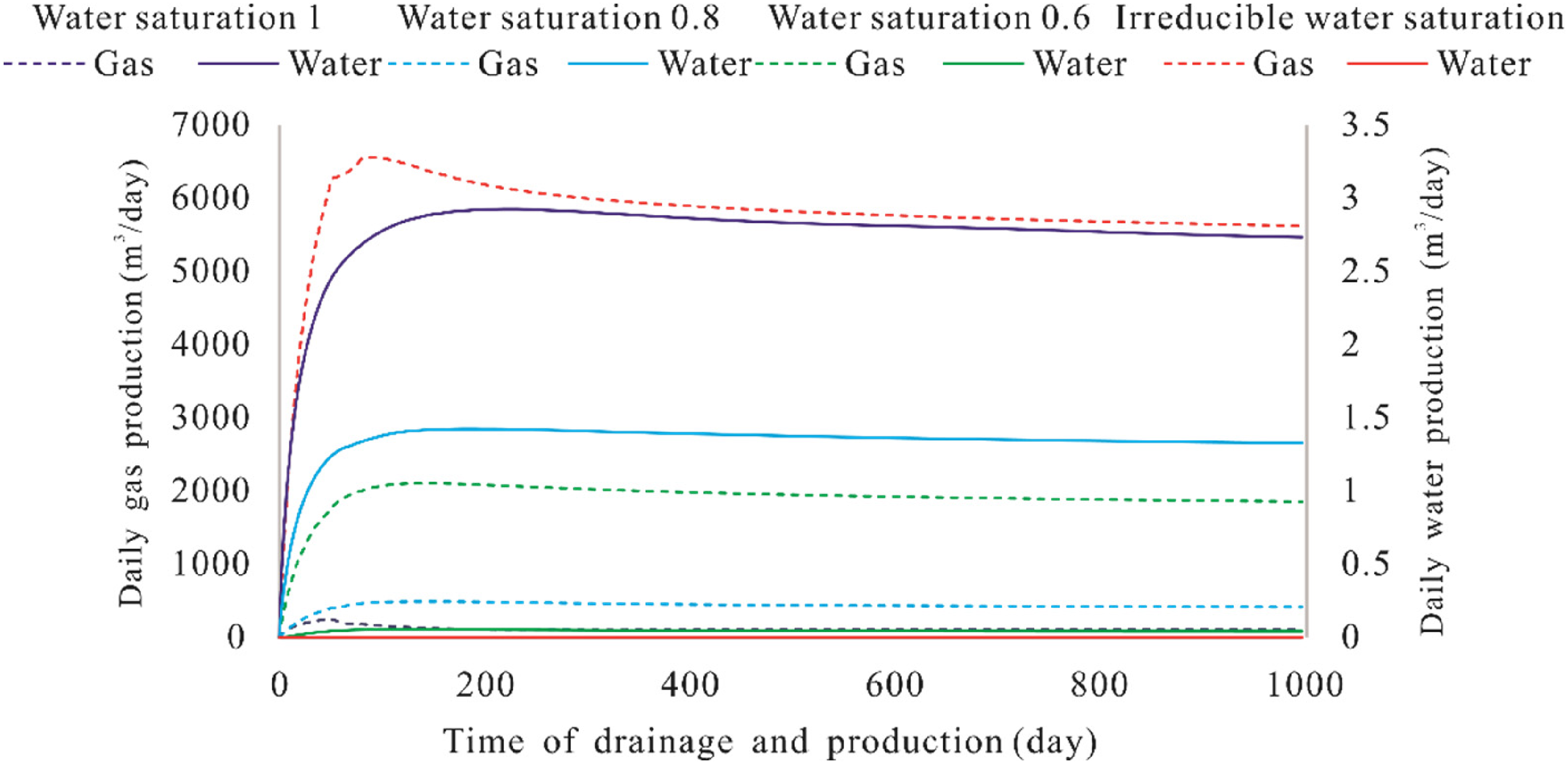
Production of gas and water from coalbed methane (CBM) reservoirs with different water saturation during development.
This paper provides a detailed comparative analysis of pressure distribution, pressure gradient, water saturation, and gas-effective permeability evolution of CBM reservoirs with different water saturation during development. In terms of pressure distribution (Figure 4), numerical simulation results show that water saturation does not have a significant influence, with the bottom-hole pressure of a reservoir with bound water saturation being only 19% lower than that of a water-saturated reservoir after 1000 days of production (Table 2). A pressure gradient is also only slightly affected by water saturation, only 3% (Figure 5 and Table 2).
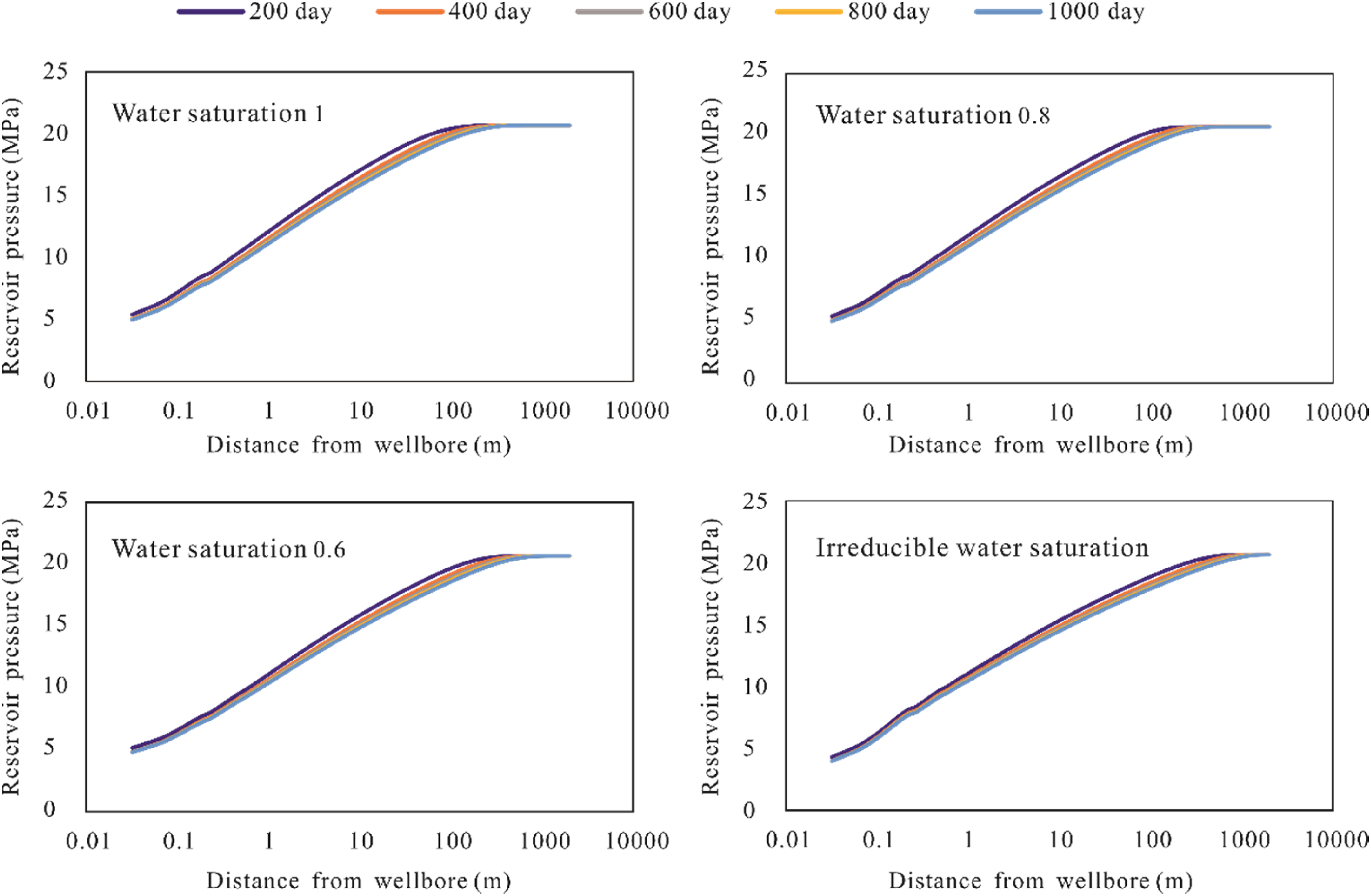
Evolution of reservoir pressure for coalbed methane (CBM) reservoirs with different water saturation during development.
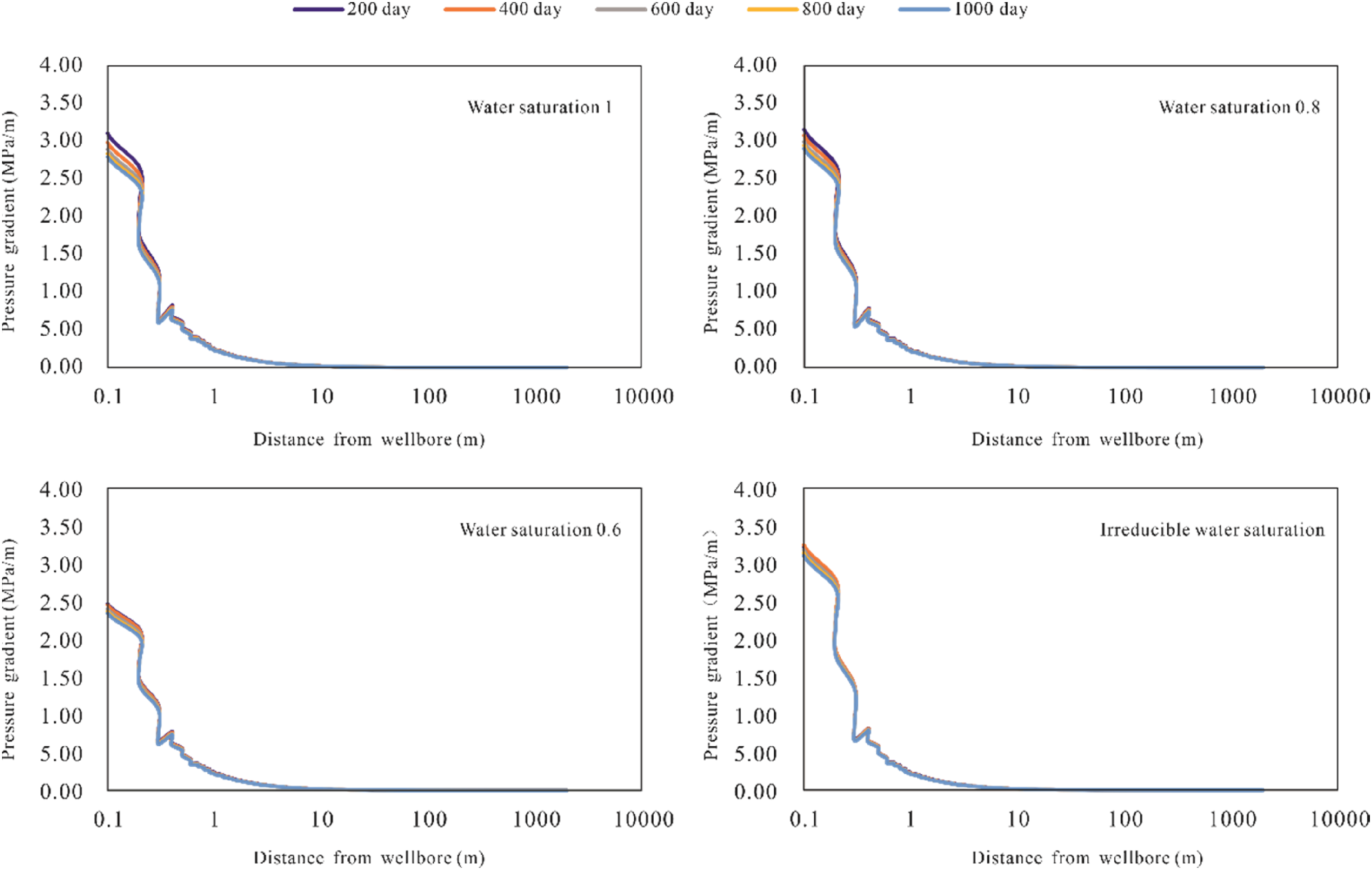
Evolution of pressure gradient for coalbed methane (CBM) reservoirs with different water saturation during development.
Bottom-hole production performance of reservoirs with different water saturation after 1000 days of development.
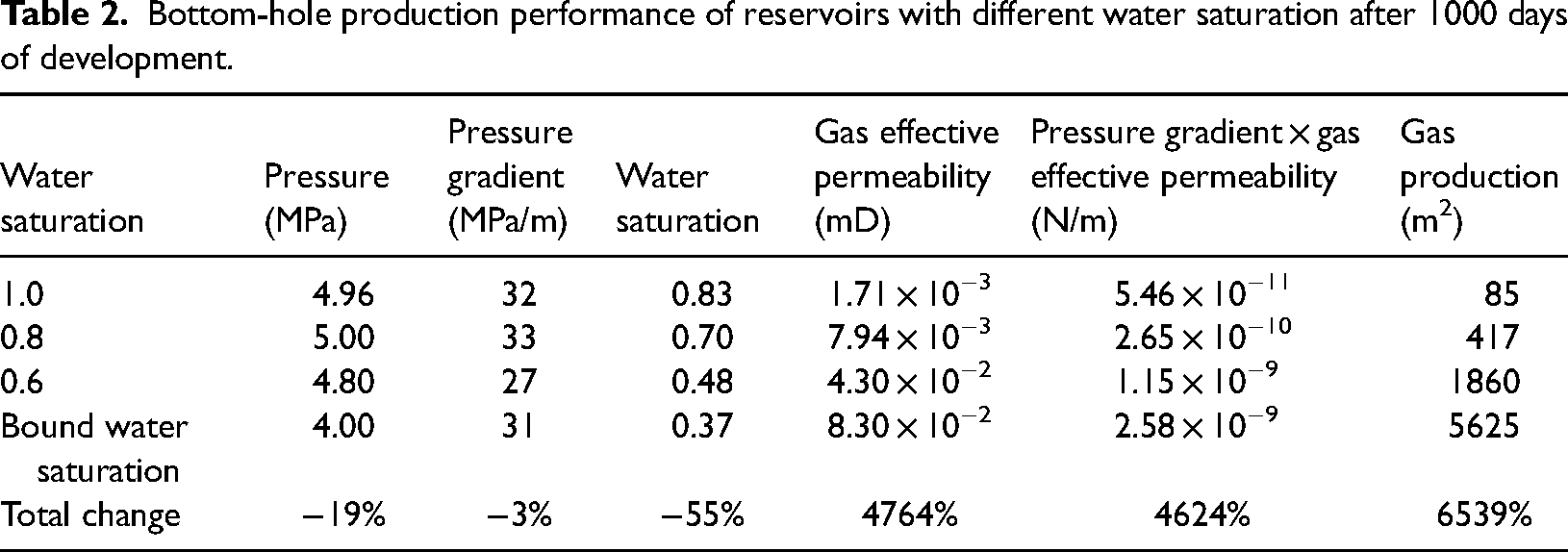
The water content of CBM reservoirs plays an important role in the evolution of reservoir water saturation. The higher the water saturation of the reservoir, the more water needs to be produced, and the higher the lowest achievable saturation limit (Figure 6) (Xu et al., 2015b; Zhang et al., 2020). After 1000 days of production, the bottom-hole water saturation of different water-saturated CBM reservoirs shows obvious step-like characteristics. The initial water-saturated reservoir saturation decreases to 0.83, but it is still much larger than the bound water saturation, with a 55% difference in proportion (Table 2).
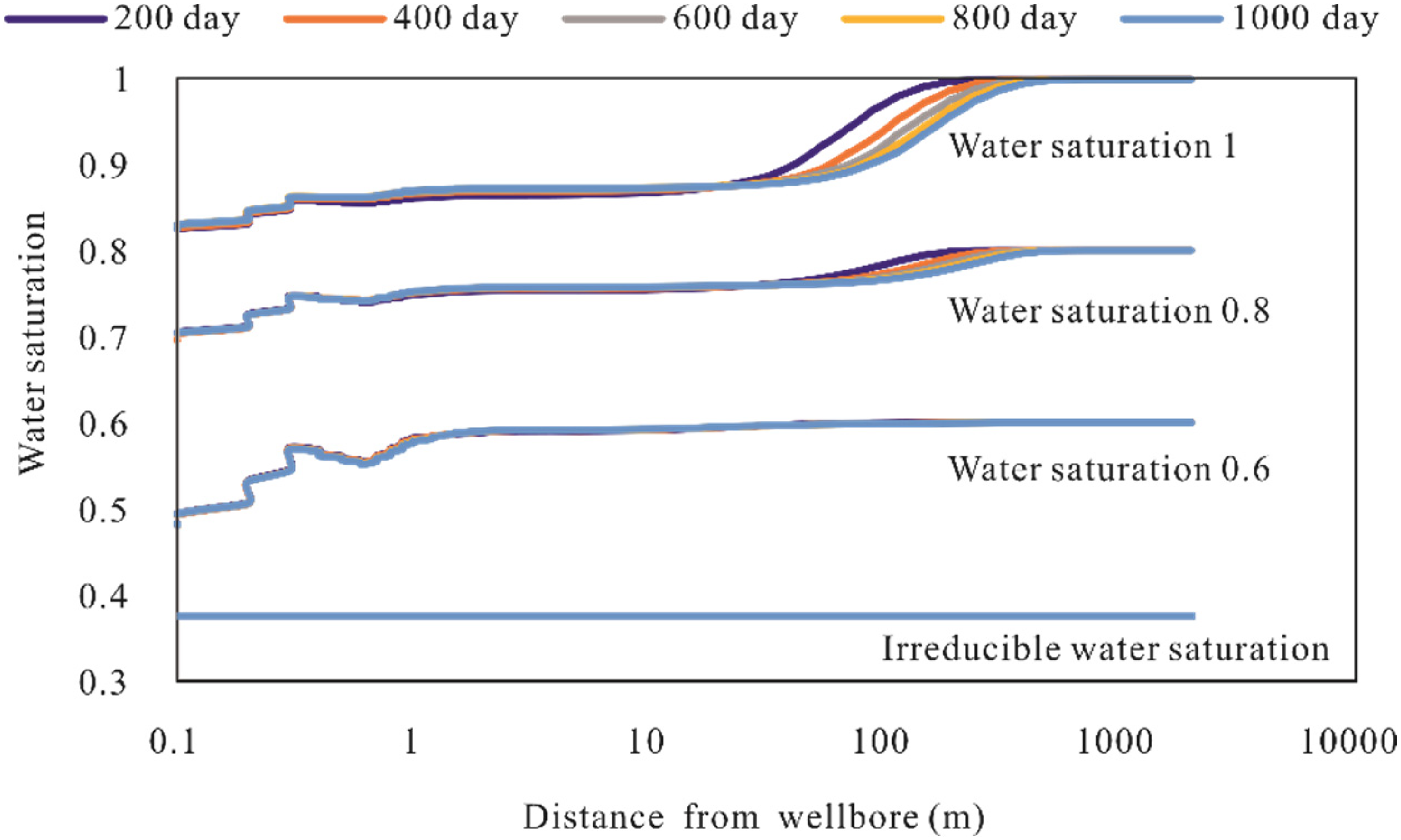
Evolution of water saturation in coalbed methane (CBM) reservoirs with different water saturation.
The difference in water saturation evolution has an important influence on the gas effective permeability of the gas phase. Numerical simulation results demonstrate that the evolution of gas-effective permeability in CBM reservoirs with different water saturation shows more obvious step-like characteristics (Figure 7). As the space occupied by reservoir water decreases, the number of channels available for gas phase flow increases. Additionally, the smaller the water content is, the smaller the dragging effect of water on the gas phase is. These two factors magnify the difference in water saturation evolution in the evolution of gas effective permeability by several orders of magnitude. After 1000 days of production, the gas effective permeability in the bottom reservoir of CBM reservoirs with bound water reached 4764% of the reservoir with water saturation of 1.
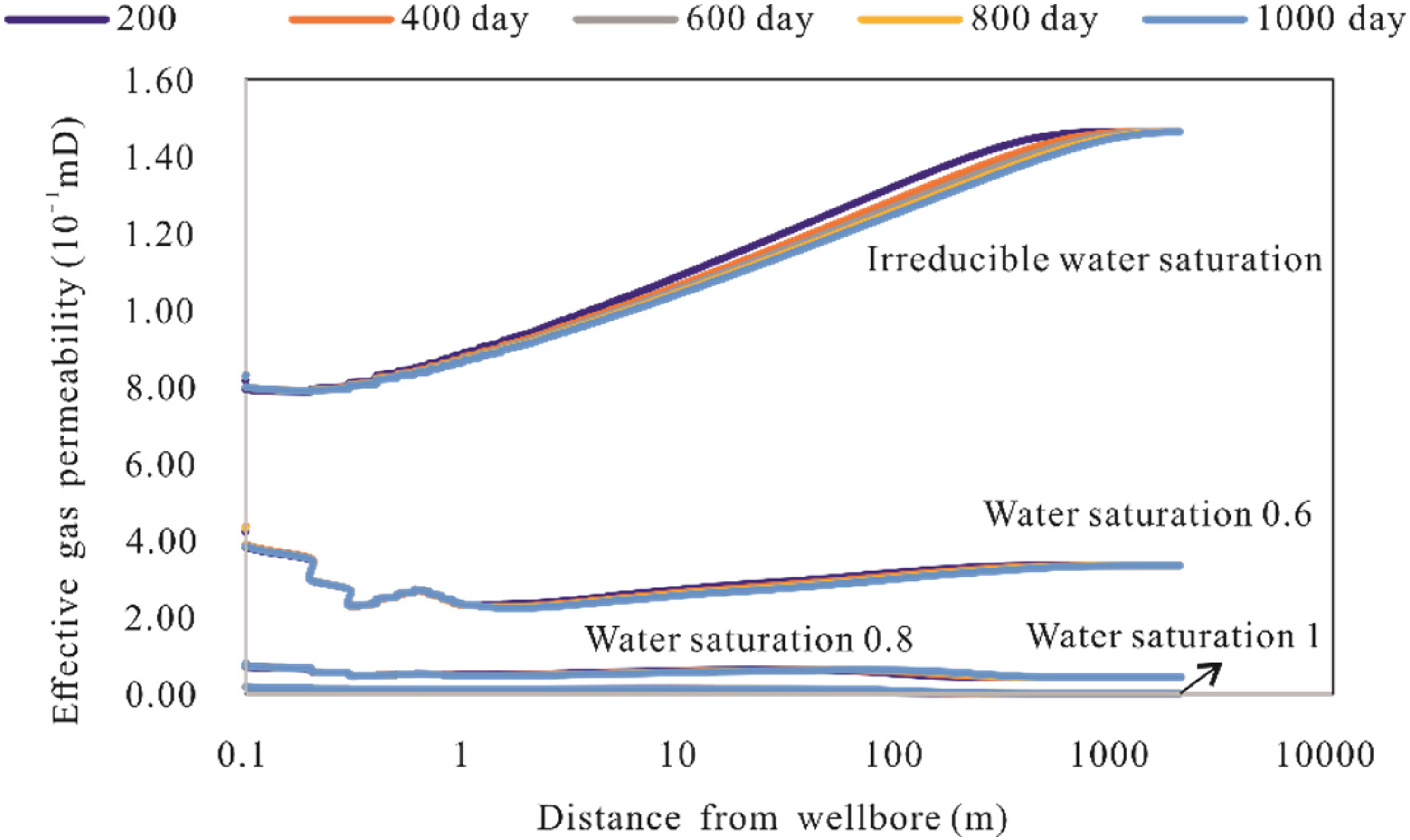
Evolution of gas effective permeability in coalbed methane (CBM) reservoirs with different water saturation.
According to Darcy's law, the product of gas effective permeability in the bottom reservoir and pressure gradient is directly proportional to the gas production rate of the production well. The difference in initial water saturation of the reservoir affects the effective permeability of the gas phase in the bottom-hole reservoir up to 48 times, whereas it affects the pressure gradient by only 3%. Therefore, the impact of reservoir water saturation on the gas–water production in CBM reservoirs is mainly reflected in the evolution of water saturation and gas-phase effective permeability.
Adaptability analysis of well density to various reservoir water saturation
Gas production under different well densities
In this study, a well control radius of 100 m was set, and the gas production characteristics of CBM reservoirs with different water saturation were compared with those of a well control radius of 2000 m to investigate the impact of well network density on the development of different water saturation reservoirs. Numerical simulation results show that for high water saturation reservoirs (reservoirs with water saturation of 1 and 0.8), the gas production increases with the development after increasing the well network density, and the well interference caused by well network densification has a good production increasing effect. However, for low water saturation reservoirs (reservoirs with water saturation of 0.6 and under bound water conditions), increasing the well network density does not increase the maximum gas production, but rather, it decreases rapidly after reaching the production peak, and the increase in well network densification greatly reduces the single well production. Therefore, the well interference effect caused by high well network density is only applicable to the development of high-water saturation CBM reservoirs, not to low-water saturation CBM reservoirs (Figure 8).
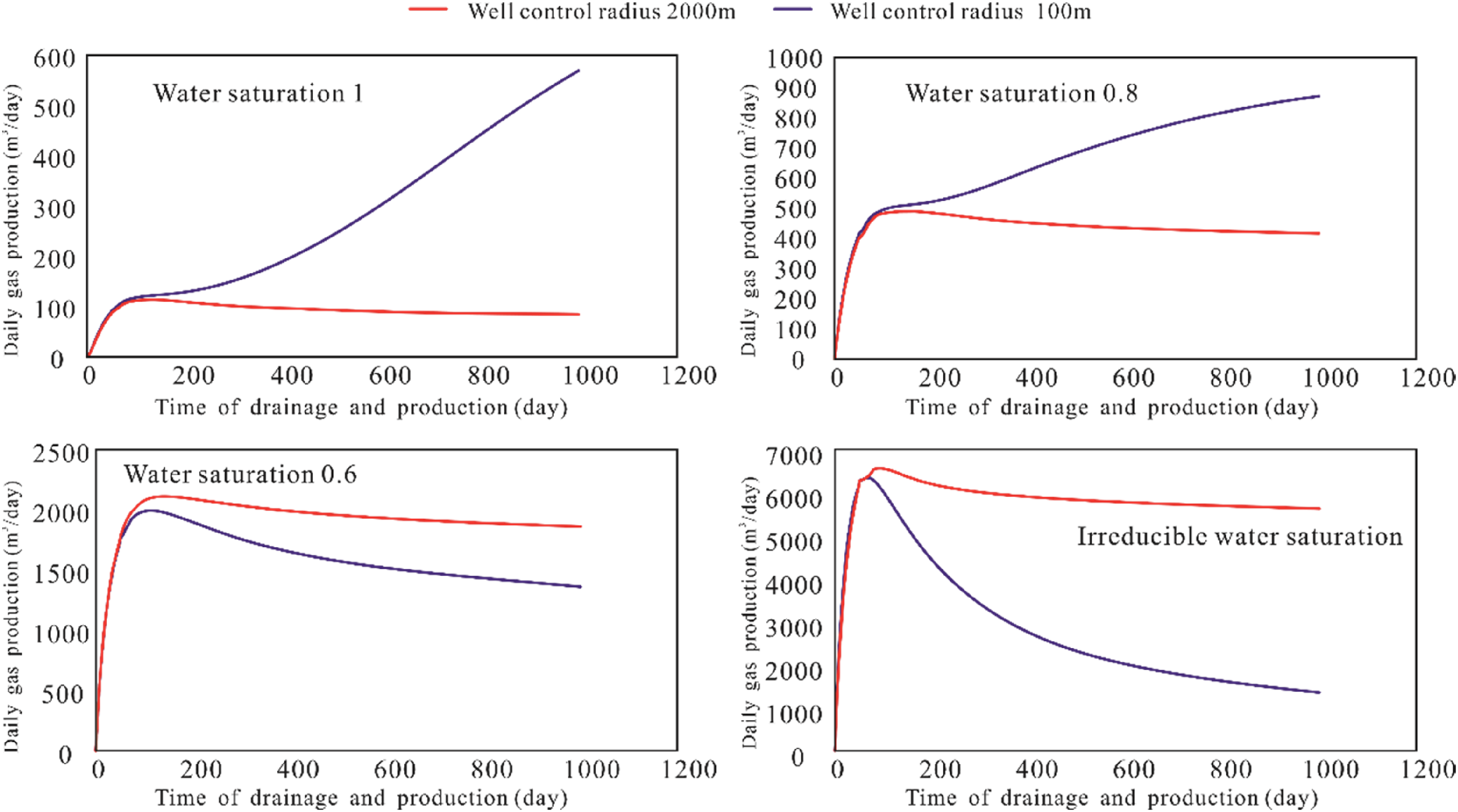
The effect of well control field on gas production in coal reservoirs with different water saturation.
Control mechanism of well density on gas production in reservoirs with various water saturation
The evolution laws of pressure distribution, pressure gradient, water saturation, and gas-phase effective permeability in different water-bearing reservoirs are analyzed in detail after increasing the well-network density, and compared with the simulation results of the low-well-network density. The control mechanism of wellbore density on the production of gas-bearing reservoirs with different water saturation is explored from two perspectives: the migration force of CBM (reservoir pressure gradient) and the permeability of CBM in the reservoir (gas effective permeability)
Numerical simulations show that under high wellbore density conditions, the reservoir pressure drops significantly after 1000 days of development, which is significantly different from the pressure evolution under low wellbore density. Under high wellbore density conditions, at 100 m from the wellbore, the reservoir pressure does not drop significantly due to continuous replenishment by distant formation water. The maximum decrease is about 3 MPa, and there is no significant difference in the variations of reservoirs with different water saturation.
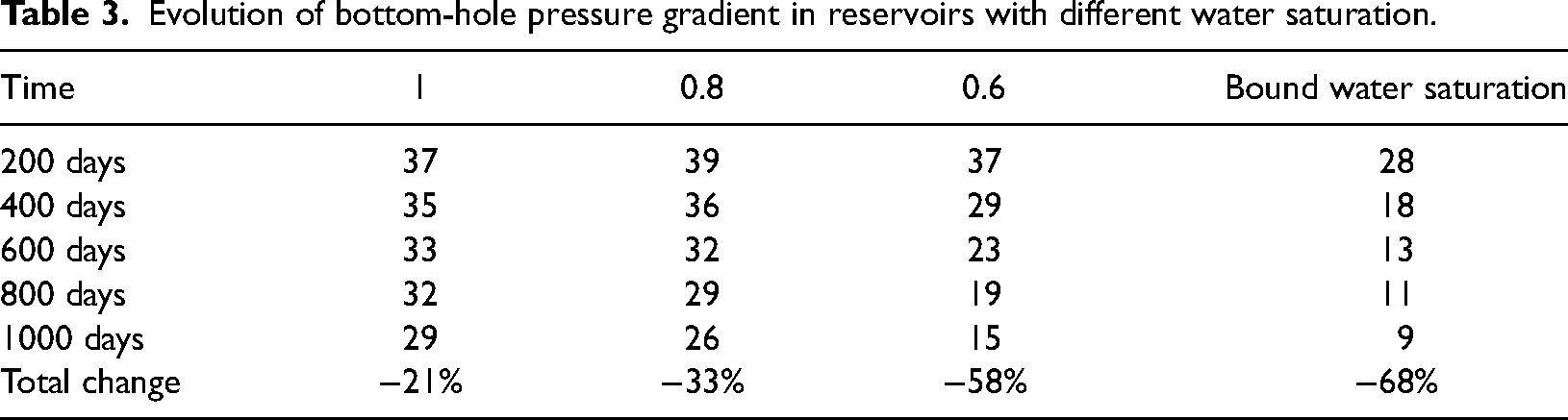
Under high wellbore density conditions, as the initial water saturation of the reservoir increases, the pressure drop decreases. When the reservoir is initially in the state of bound water, the pressure drop can reach 13 MPa, while when the reservoir is saturated with water, the pressure drop of the reservoir decreases, and the drop is 5 MPa (Figure 9). This is because the water saturation of the reservoir to some extent reflects the size of the elastic potential energy of the fluid in the reservoir, and the lower the water saturation of the reservoir, the lower the energy of the fluid in the reservoir, and the attenuation of the transportation energy is more obvious. In terms of the evolution of the bottom-hole pressure gradient, after 1000 days of development, the pressure gradient of bound water reservoir decays by 68%, while the bottom-hole pressure gradient of saturated water reservoirs decays by only 21% (Figure 10 and Table 3).
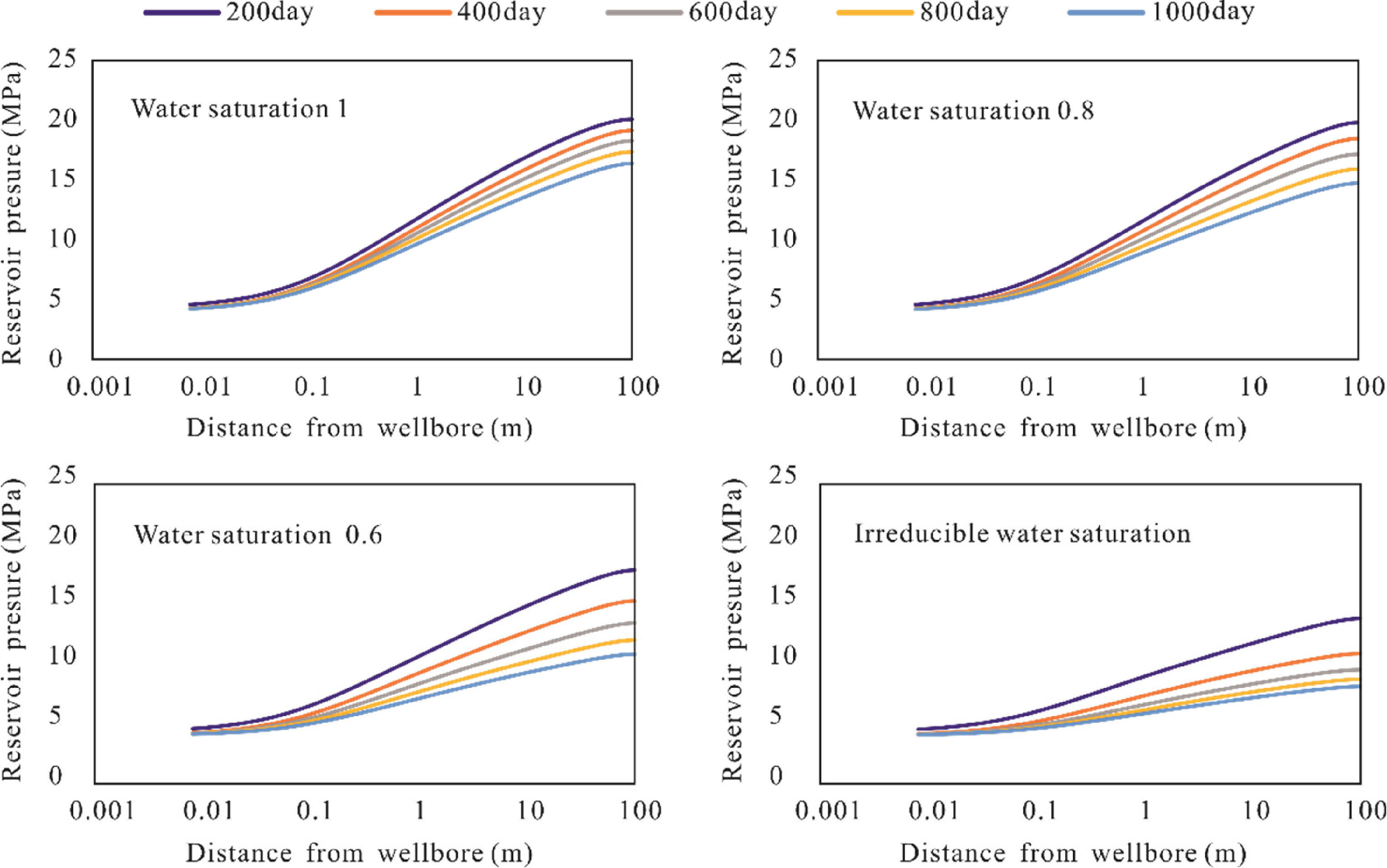
Evolution of pressure distribution in reservoirs with different water saturation.
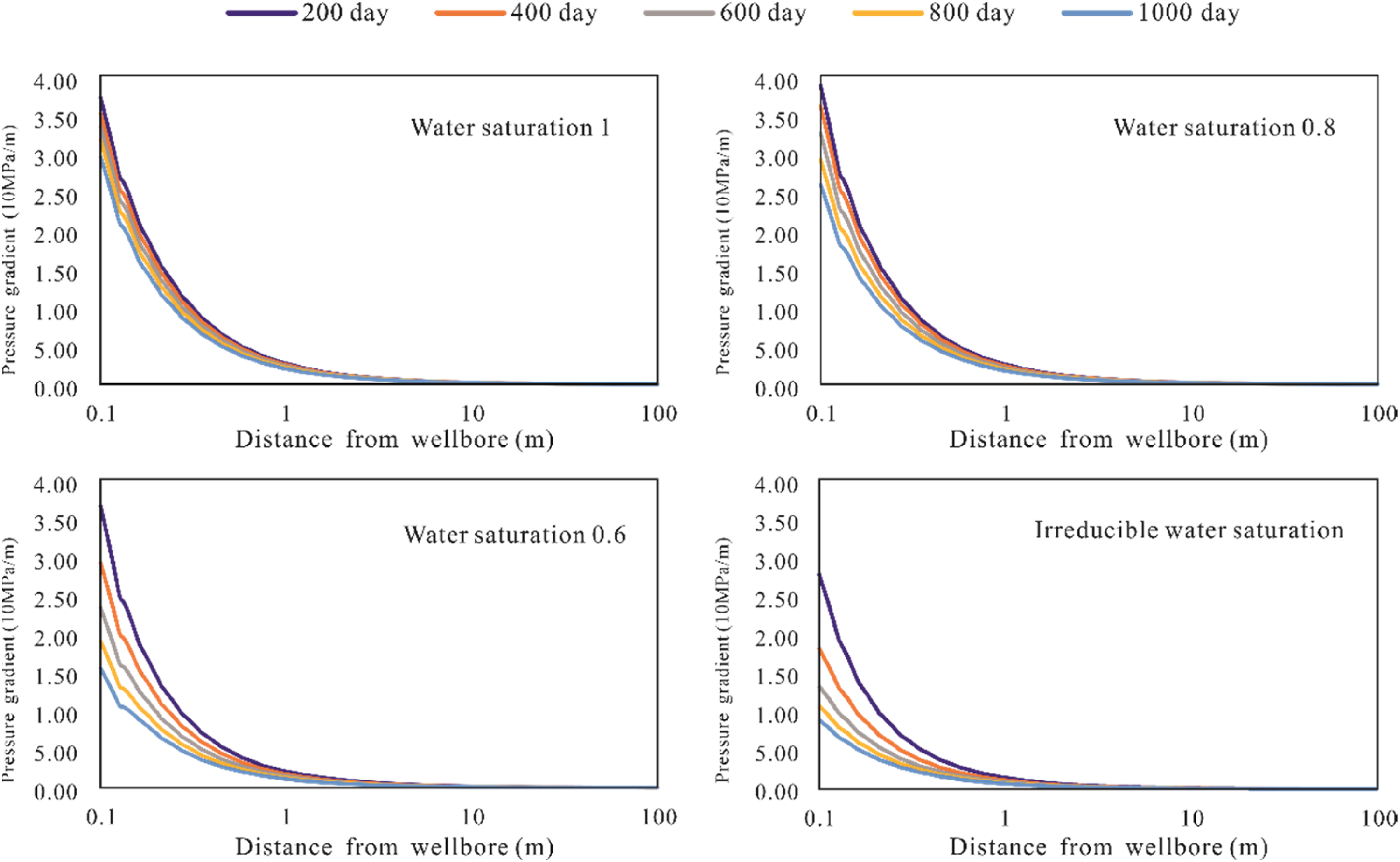
Evolution of pressure gradient in reservoirs with different water saturation.
Evolution of bottom-hole pressure gradient in reservoirs with different water saturation.
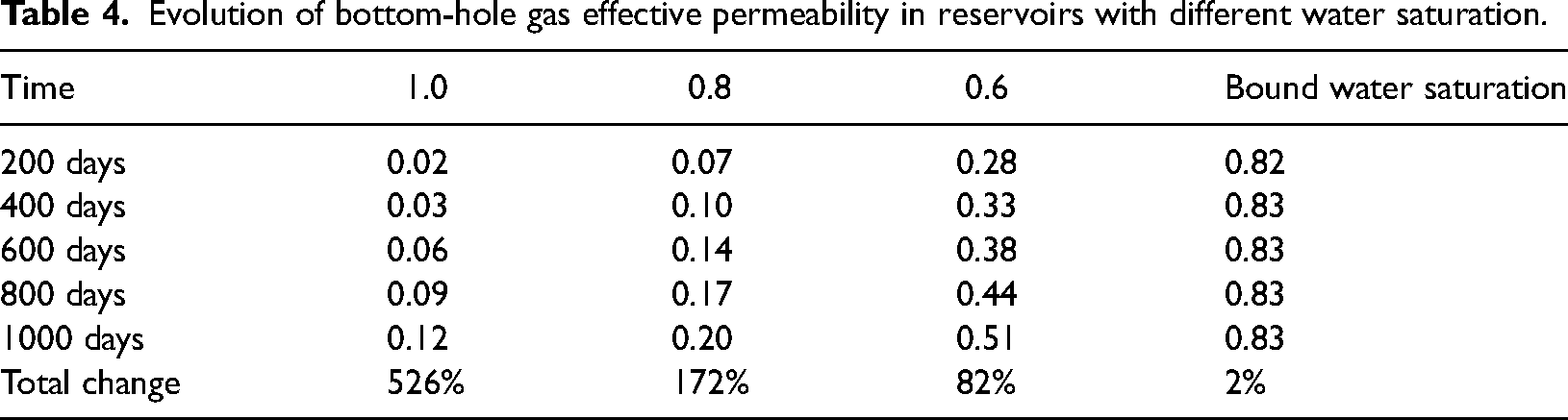
Under the condition of high well network density, as the initial water saturation of the reservoir increases, the decrease of reservoir water saturation significantly increases (Figure 11). When the reservoir is initially saturated with water, the reservoir water saturation decreases from 1 to 0.65 during the process of development, with a decrease of 0.35. Conversely, when the initial water saturation of the reservoir is low, especially when it is under the condition of bound water, the saturation does not change at all. The difference in saturation decrease rate causes variations in the increase of gas effective permeability in reservoirs with different water saturation (Figure 12). A high decrease rate in saturation leads to a great increase in gas-effective permeability. When the reservoir is initially saturated with water, the bottom-hole gas effective permeability increases by 526% during the development process, while in a reservoir of bound water condition, it only undergoes a slight increase of 2%, which is due to the evolution of absolute permeability (Table 4).
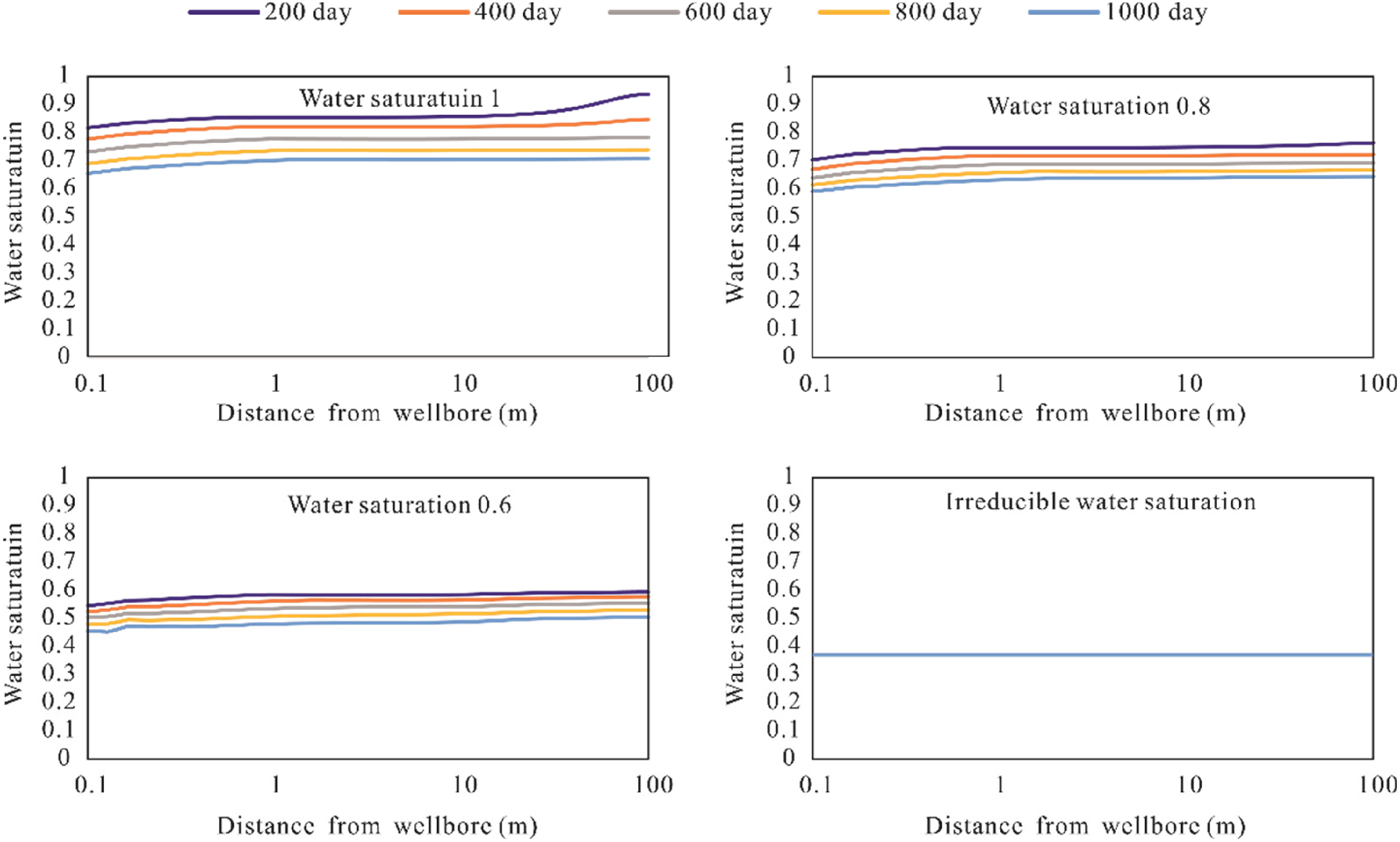
Evolution of water saturation in reservoirs with different water saturation.
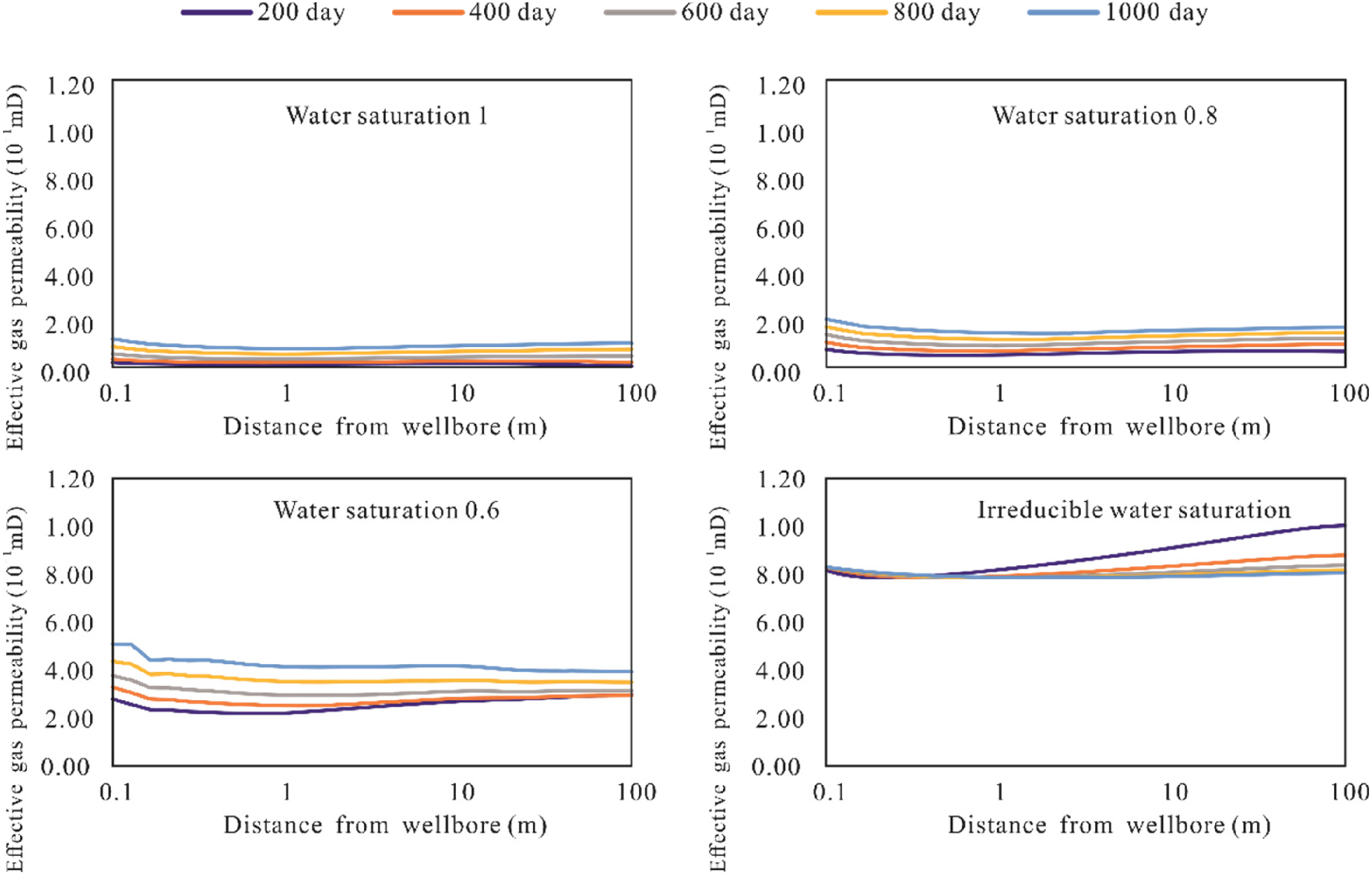
Evolution of gas effective permeability in reservoirs with different water saturation.
Evolution of bottom-hole gas effective permeability in reservoirs with different water saturation.
In summary, the high well density results in a wider range of water saturation variation and a significant increase in gas phase effective permeability in high water saturation reservoirs. The gas phase's effective permeability can increase up to 526% when the reservoir is initially saturated with water. Moreover, due to the higher fluid elastic potential in high water saturation reservoirs, the decay of flow kinetic energy is slower, with only a 21% decrease in saturation level when the reservoir is initially saturated with water. The slow decay of kinetic energy and rapid increase in gas phase effective permeability result in the gas production of high water-bearing reservoirs increasing during development, so high well network density is required for development. In low water saturation reservoirs with high well density, the increase in gas phase effective permeability is limited, with a minimum increase of 2%. The fluid kinetic energy decay is significant, with a maximum decay of 68%. The rapid decay of kinetic energy and slow increase in gas phase effective permeability cause the gas production rate in low water saturation reservoirs to peak and then continuously decline. Interwell interference often has a negative effect, and therefore, low well density should be used to increase single well control of reserves.
Conclusions
Based on an absolute permeability evolution model that considers the dual impact of matrix shrinkage and a relative permeability model that considers gas–water interface interaction, a multiphysics coupling numerical model for CBM development that fully considers the permeability evolution characteristics of adsorptive low permeability coal reservoirs was constructed.
High-water saturation reservoirs show the characteristics of low gas production and high-water production, while low-water saturation reservoirs show high gas production and low water production. The simulation results show that the decrease in reservoir water saturation greatly enhances the gas phase effective permeability of the reservoir, which can be increased by up to 4764%, significantly increasing the gas production rate up to 6539%. This is the main mechanism by which reservoir water saturation controls production.
For high water saturation reservoirs, high well density should be used for development to make use of the positive effects of well interference, which can quickly increase the effective gas phase permeability by 526%. For low water saturation reservoirs, low well density should be used to increase the control reserves of individual wells and avoid the negative effects of well interference, such as a −68% drop in the bottom-hole pressure gradient.
Footnotes
Declaration of conflicting interests
The authors declared no potential conflicts of interest with respect to the research, authorship, and/or publication of this article.
Funding
The authors disclosed receipt of the following financial support for the research, authorship, and/or publication of this article: This work was supported by the National Natural Science Foundation Project, China (grant number 42172188).
