




Abstract
The development of abandoned coal mine gas has multiple advantages in terms of safety, economy, environment, and society. Due to previous excavations, the gas distribution is heterogeneous, thereby hindering well location optimization. In this study, considering the Shenbei abandoned coal mine as an example, the authors developed a workflow for well location optimization through simulation. The workflow includes: (1) the setup of an initial reservoir simulation model with the preliminary well location designed by experience; (2) the optimization of the well location based on the flowline distribution, and it is preferred that the well connect a large number of flowlines; (3) the simulation based on the optimized well location, and (4) repetition of the steps until the optimized well locations are determined. Moreover, the role of fracturing is also examined through simulation scenarios. The simulation results show that the locations of the two originally designed wells (1# and 4#) should be optimized due to the relatively low gas production without fracturing. The two wells are optimized according to the flow streamlines, demonstrating performance improvement. Moreover, the simulation results also show that there is no need to optimize the well 4# location if the fracturing technology is applied. An additional well is suggested based on the flow streamline analysis and gas production performance simulation. The main conclusions drawn from this study are as follows. (1) Five optimized well locations are determined for the Shenbei abandoned coal mine, and they should be located within the “O” ring, a high permeability region nearby the previous excavation zone; (2) Fracturing is an effective method for stimulating gas production; however, the extent of fracturing varies from well to well; (3) The workflow applied in this study is effective for the well location optimization in abandoned coal mines.
Introduction
Abandoned mine gas refers to the existing methane resources in the residual coal seams, surrounding rocks, or underground spaces in the coal mines that are closed based on specific procedures due to the depletion of coal resources, failure to satisfy the safety production requirements, or other industrial technology policies (Karacan et al., 2011). The gas is extracted in active coal mines through either an underground or a surface borehole (Wang et al., 2017), while for the gas drainage in the abandoned coal mines, generally surface wells are exclusively used. The effectiveness of the gas drainage from abandoned coal mines relies significantly on the well location, well density, and hydraulic fracturing.
Owing to energy conversion and environmental protection, an increasing number of coal mines in China are shut down. In these abandoned coal mines, there are still few gas resources having significant developmental and utilizable value (Cui et al., 2020). Furthermore, the gas in the abandoned coal mines also causes various environmental, safety, and economic problems that has attracted wide attention because of its evident toxicity (Palchik, 2012; Shi et al., 2016). Therefore, it is urgent to conduct a research on the relevant theory and technical methods of gas drainage in the abandoned coal mines, such that the potential multiple advantages offered by the abandoned mine gas are adequately exploit.
The abandoned coal mine is strongly heterogeneous and can be subdivided into different regions, vertically and horizontally (see Figure 1). In the vertical direction, the abandoned coal mine reservoir is classified into the caving zone, fracture zone, bending subsidence zone, and the above rock formation from the bottom to the rock layers upward. In the horizontal direction, it can be divided into a re-compaction zone, an “O” ring fracture zone, a lateral fractured zone, and an intact unmined zone, from the center to the outside of the gob (Hu et al., 2018; Qian and Xu, 1998). The gas storage and transport behaviors are particularly different among different regions.
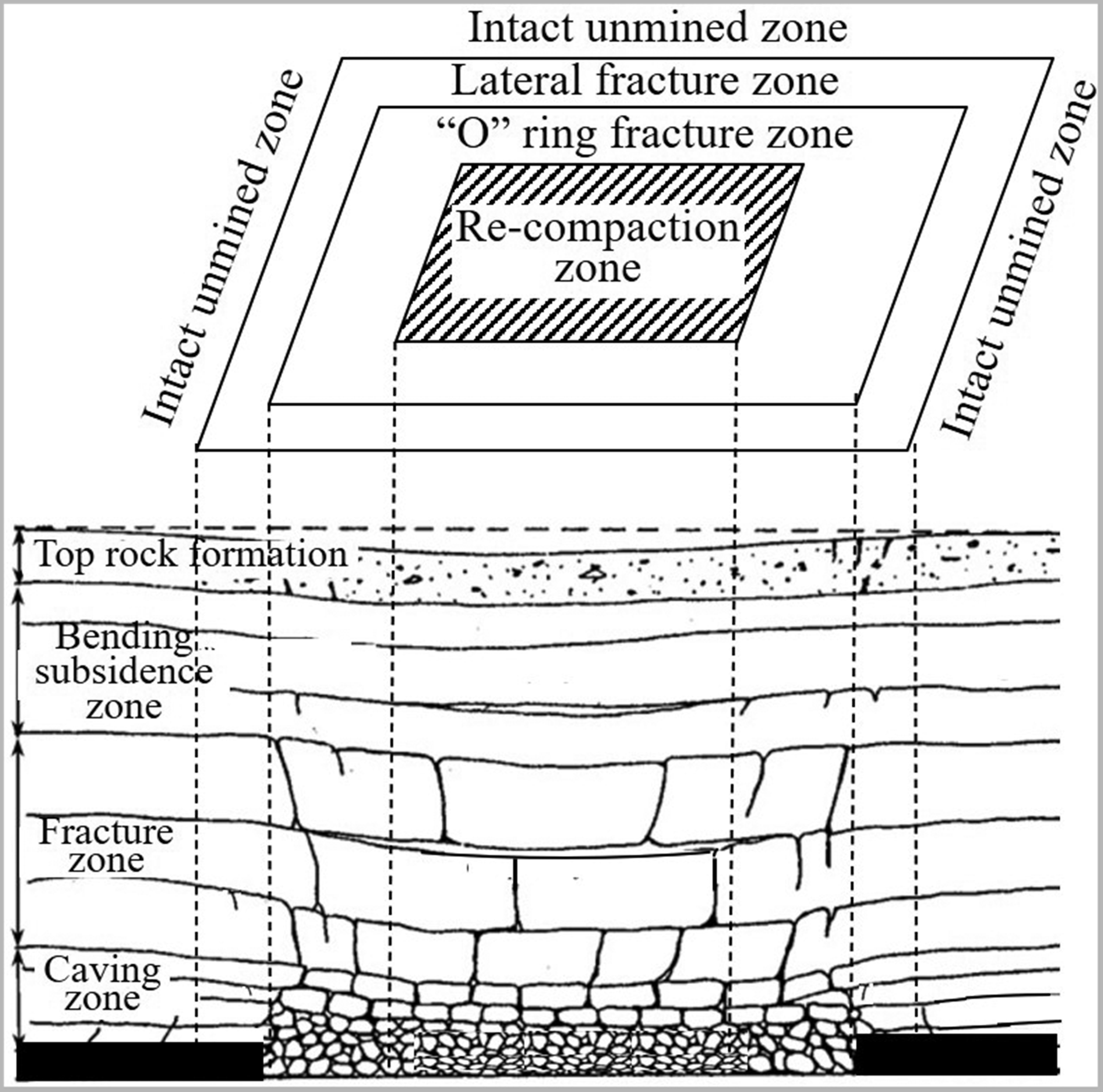
Schematic diagram of the horizontal and vertical zones in abandoned coal mine reservoir.
The abandoned coal mine gas mainly includes free gas and adsorbed gas in the coal pillar and remaining coal seam, adjacent undeveloped coal seam, and surrounding rocks. The gas content distribution is more heterogeneous in an abandoned coal mine reservoir than in the coalbed methane reservoir. The free gas is mainly distributed in the fracture region because a major volume of the gas has already been desorbed due to the previous mining activity. Adsorbed gas mainly remains in the unmined region. Moreover, the permeability in the different regions of the abandoned coal mine reservoir varies significantly. The “O” ring fractured region generally has a higher permeability than other regions (Zhang et al., 2016).
Although several simulation studies have been conducted on gas transport in coal mines (Fan et al., 2017; Guo et al., 2012), the focus has been mainly on the gas extraction from roadways or the working face during the mining process in a local area. In particular, the simulation of gas drainage from a large-scale abandoned coal mine by surface drilling is lacking. In the Shenbei abandoned coal mine, multiple goafs coexist along with few unmined areas. Conversely, the gas content and permeability varies significantly throughout the reservoir. Thus, a large-scale reservoir simulation model should be established to appropriately select the optimal well locations for the gas drainage in the abandoned coal mines in Shenbei.
In this study, a large-scale reservoir simulation model is established, considering the strong heterogeneity of gas content and permeability. The model is solved using the COMSOL finite element software, and the gas drainage well location is accordingly determined and optimized. The outcome of this study will contribute to improving the methodology for well location optimization in strongly heterogeneous and large-scale reservoirs.
Flow characteristics of abandoned coal mine
The complex structure of an abandoned coal mine is illustrated in Figure 1. The gas content and permeability distribution are highly heterogeneous in the complex reservoir. The gas pressure in the goaf is significantly reduced during the mining process. After abandoning it, the in-situ gas tends to migrate to the low-pressure areas (Tauziede et al., 2001). In case there is a relatively dense cap-rock, a high-concentration gas-rich area is generated at the top of the fracture zone (Feng et al., 2016; Li et al., 2018). After the well is closed for a period, the goaf and the central area of the overlying caving zone and fracture zone are gradually compacted. However, the reservoir outside the central area forms an “O” ring zone with high porosity and permeability and a few developed fractures. Therefore, the reservoir outside the central area also has high-concentration gas-rich areas. Moreover, the pressure difference is maintained due to a number of geological reasons (Shi et al., 2016).
In recent decades, the pore-fracture dual media model has been increasingly accepted and widely used by several scholars (Thararoop et al., 2012). Coal is a dual-porosity medium consisting of pores, fractures, and matrix. There is abundant adsorbed gas in the matrix that flows in the reservoir via diffusion and can be expressed by the pseudo-steady-state equation. In the small fractures in the reservoir, the gas flows in the linear seepage mode (Gilman and Beckie, 2000).
Mathematical model of gas flow in abandoned mines
Basic equations
During the negative pressure drainage of an abandoned mine gas, the free gas flows into the wellbore through fractures, and the gas pressure in the fracture network decreases. Subsequently, the adsorbed gas in the matrix begins to desorb. The desorbed gas, thereafter, enters into the fracture system at a low pressure, flows into the bottom of the well, and is pumped to the surface through the wellbore. The gas desorbs and diffuses into the matrix. The gas flow in the fractures satisfies Darcy's law. The gas adsorption capacity can be described based on the Langmuir isotherm adsorption model. Therefore, the coupling flow model of the gas matrix and the natural fracture can be established. The governing equations are as follows:
The pseudo-steady state flow is adopted for the seepage flow in the matrix, and the equation is (Chen et al., 2012) as follows

where,
The adsorption gas content was characterized by the Langmuir isotherm adsorption equation, and therefore the equivalent gas volume in natural fractures ( 2. The law of conservation of gas mass is adopted in the natural fractures, and the mass conservation equation is as follows


where,
According to the gas equation of state (EOS), the gas density is related to the gas pressure

The gas mass exchange volume qd is calculated using the following equation

Initial and boundary conditions
The model established in this study describes the general mechanism of fluid movement under the condition of negative pressure pumping in surface drilling. For an unsteady flow, the initial condition is as follows

The Dirichlet boundary condition, specifying the value of the function at the boundary, is used. In this study, the boundary pressure is applied at the boundary (constant bottom hole pressure in the simulation), and the equation is as follows

Numerical simulation of gas drainage in abandoned mines
Numerical simulation methods
In this study, the finite element software COMSOL Multiphysics is selected to simulate the gas drainage process of an abandoned mine with a dual-porosity media.
The basic simulation concept is to construct and assign the 3 D geological geometry model of the abandoned mine reservoir by studying the resource distribution, coal seam thickness, gas content, and working face layout, while considering the effect of land subsidence and surface water accumulation. Subsequently, the appropriate combination of the physical fields is to be selected to simulate the change in the adsorbed gas content in the number and location of wells designed in the original plan after pumping for a period. After analyzing the three-dimensional (3 D) flow field distribution of the reservoir and comparing the change in the gas production after the change in the well position, the well location is optimized. Based on the steps above, the optimization of gas drainage well location in the abandoned mines is finally completed.
Simulation example and result analysis
Model establishment and parameter setting
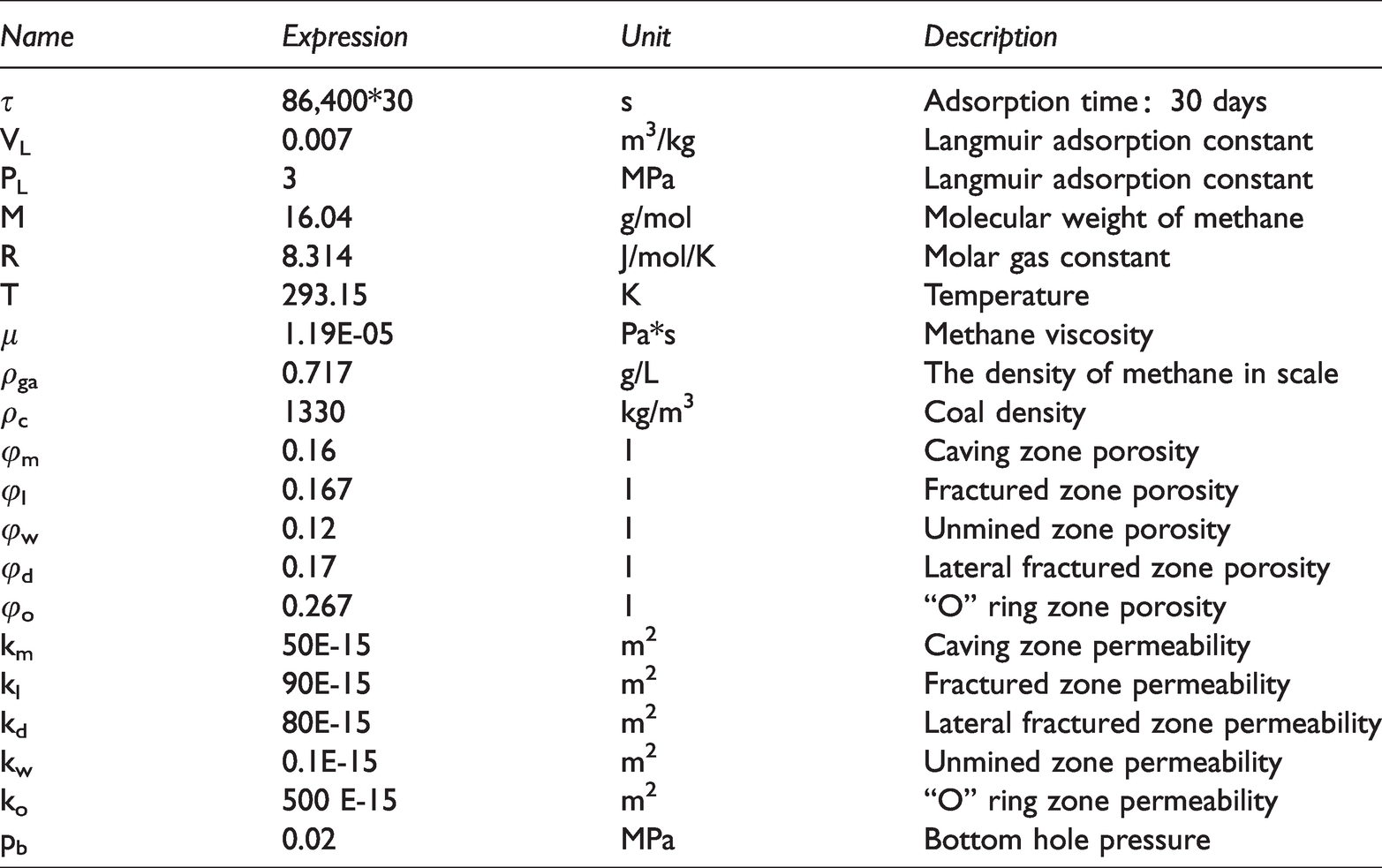
This numerical simulation considers a mine in the Shenbei coalfield as the research prototype. The geometric model and grid of the numerical simulation are generated based on analyzing the geological report estimating coalbed methane resources after mining and working face layout (Figure 2(a)). The geometrical model considers both the distribution of gob and the fractured zones adjacent to the gob area. To create complex geometries, the various build-in geometric shapes and modeling tools (such as parametric surface from interpolation of known elevation points and Boolean operation) in COMSOL are applied. The geometric model is meshed and the grid model is shown in Figure 2(b). The initial distribution of gas content is obtained from the geological report and is presented in Figure 2(c). The geological parameters of the abandoned coal mines are presented in Table 1. The different zones, as discussed in Section “Flow characteristics of abandoned coal mine”, are considered in the geometric model. Parameters and settings of the geometric model are shown in Table 2.
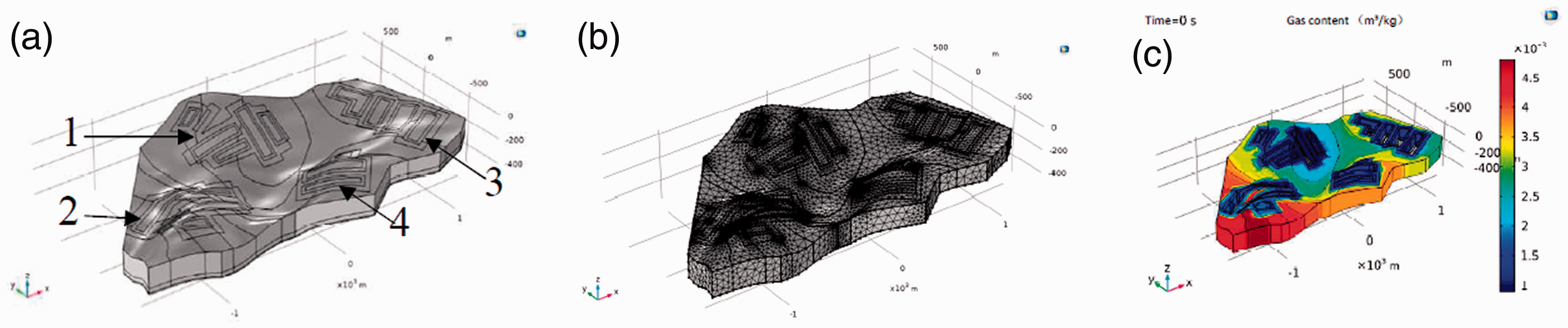
Abandoned mine reservoir geometry/grid model and initial gas distribution. (a) Geometry model, (b) grid model and (c) initial gas content.
Geological parameters of the abandoned coal mines.

Parameters used in the simulation.
To extract the residual coalbed methane in-situ, surface gas drainage holes are designed by experience. In the original development plan, four boreholes with the numbers 1#, 2#, 3#, and 4#, are determined (Figure 3). The main tasks of the simulation model are determining whether the locations of the four wells are suitable for gas extraction, whether the wells need to be fractured, and whether more wells should be drilled.
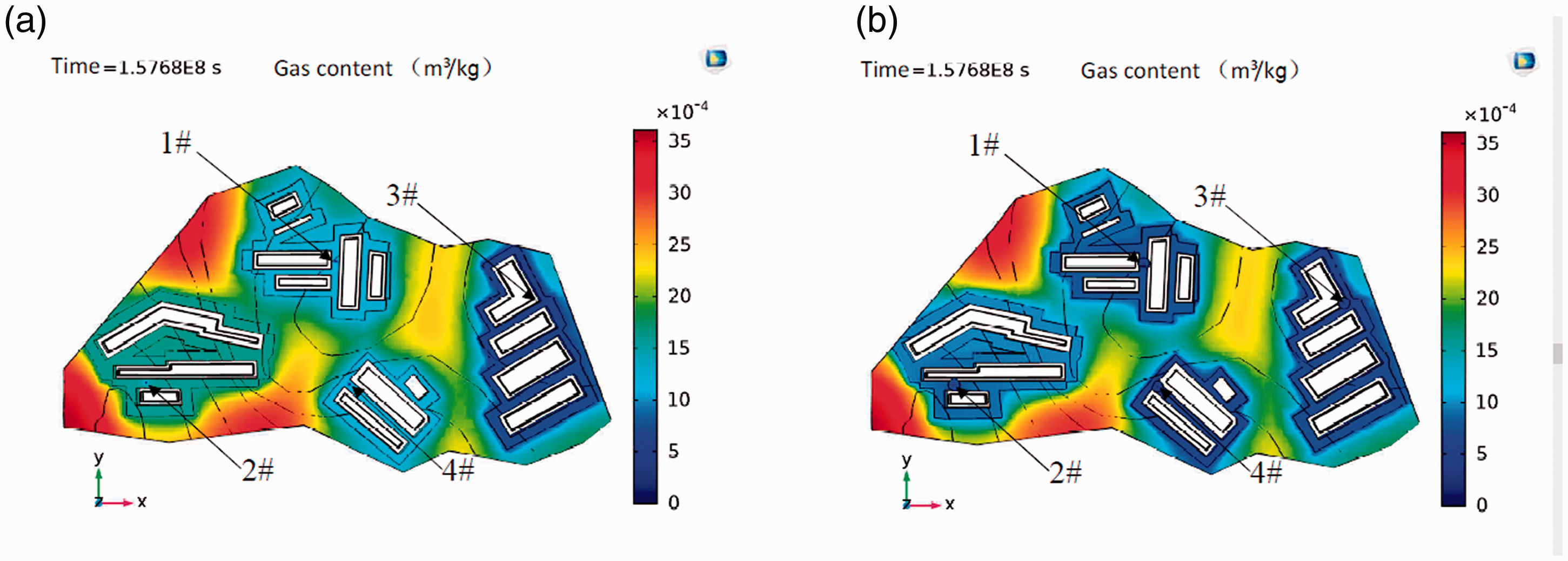
Distribution of adsorbed gas content after five years with and without fracturing. (a) Not fractured and (b) fractured.
Numerical simulation of gas drainage based on the originally designed four wells
Figure 3 is a comparative diagram of the adsorbed gas distribution, extracted after five years with (high fractured zone permeability) and without fracturing of the abandoned mine. As seen in the figure, after fracturing, the adsorbed gas content in the overall reservoir decreases significantly, and the goaf and its surrounding rocks show appropriate connectivity (Figure 3).
The gas production performance can be obtained through the surface integral of the gas velocity around and at the bottom of the well. Figure 4 shows the gas production variation rate of the four wells, with and without fracturing. The gas production from well 1# and 4# are low without fracturing, while the gas production rates for the other two wells, particularly, well 2#, are satisfied. After five years of extraction, the gas content close to the wells decreases significantly. However, abundant gas remains far away from the wells.
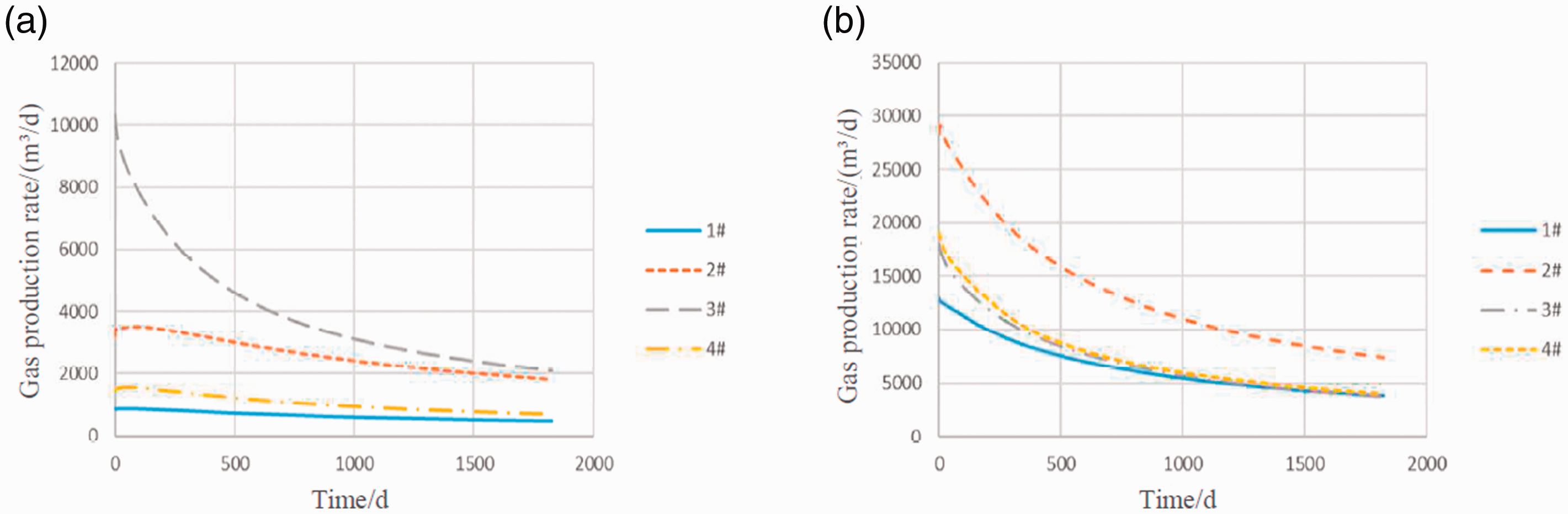
Gas production curve over five years, with and without fracturing. (a) Not fractured and (b) fractured.
3D flow field analysis
The flow behavior within the entire field is investigated by drawing the streamline diagram of the gas drainage reservoir without fracturing (Figure 5). The 3 D flow path can be vividly observed from the streamline diagram. The results show that the flow lines have been connected throughout the entire field, indicating that a transient flow region has been reached. The flow streamlines are highly complex due to the strong heterogeneity in the gas content and permeability distribution. The left and right areas exhibit a high density of the flow streamlines, while the central area exhibits a low density of flow streamlines. This is consistent with the production rates in Section “Numerical simulation of gas drainage based on the originally designed four wells”
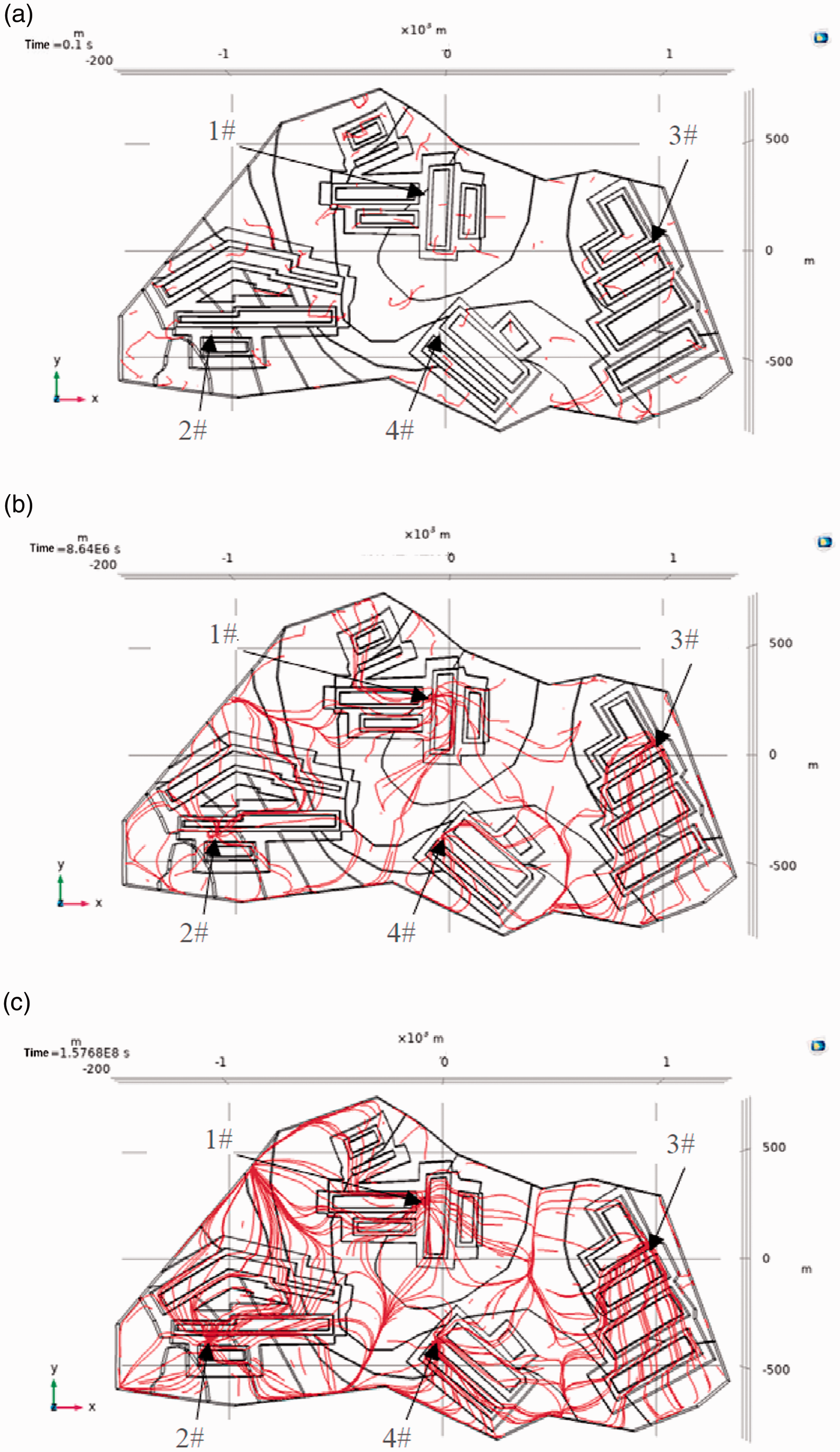
Flow streamline distribution at different times (without fracturing). (a) t = 0.1 s, (b) t = 100 days and (c) t = 5 years.
Optimization of the well locations in the original design
Due to the low production of well #1 and #4, the locations of the two wells are adjusted according to the 3 D flow field analysis results (see Figure 6).
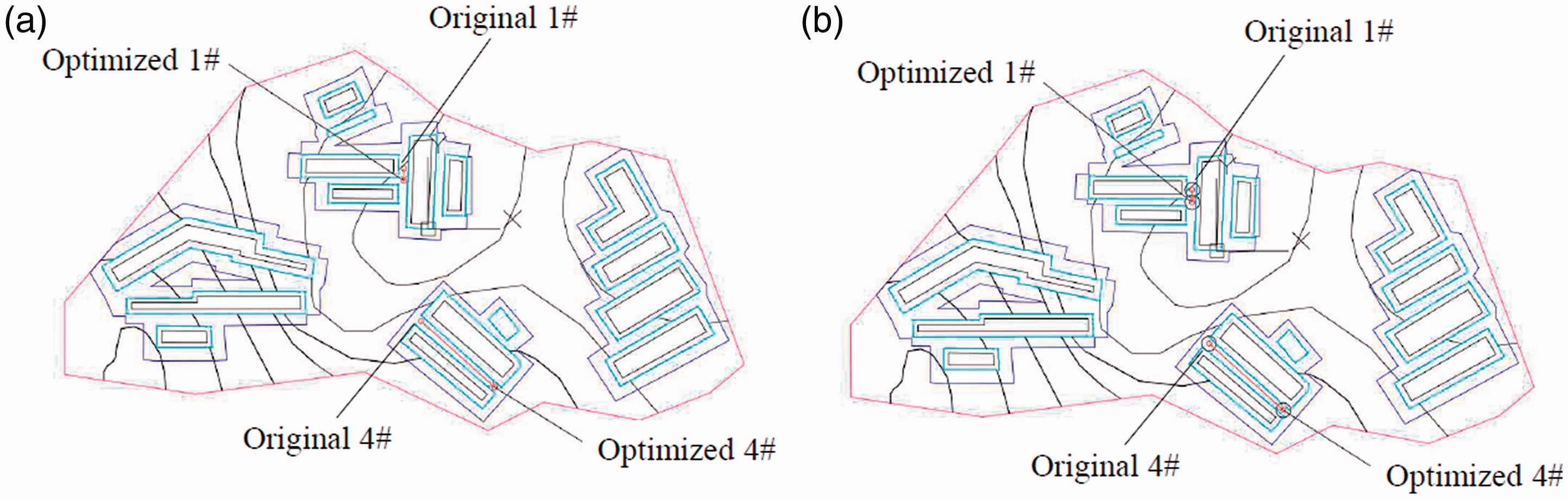
Graphs of well locations and fracturing ranges of the four wells after optimization. (a) Not fractured and (b) fracutred (30 m).
After reviewing the flow streamlines in Figure 5, it is noticed that the high-density flow streamlines are located southwest of well 1#. Therefore, well 1# moves further south to optimized 1# location. Figure 7 presents a comparison chart of the gas production rate over five years after the well location is optimized, before and after fracturing. The results illustrate that the gas production rate has been significantly enhanced by changing the well location without fracturing (Figure 7(a) and (c)). This verifies that the proposed analysis based on the flow stream effectively optimizes the well location. The results also illustrate that the fracturing indeed contributes to the increment in the production rate as expected. The reason is that a larger goaf area could be connected after fracturing. The optimized location for well 1# can still achieve a higher production after fracturing (Figure 7(b)). However, the optimized location for well 4# becomes less preferred after fracturing (Figure 7(d)), which implies that there is no need to optimize the location of well 4#, if the fracturing technology is applied.
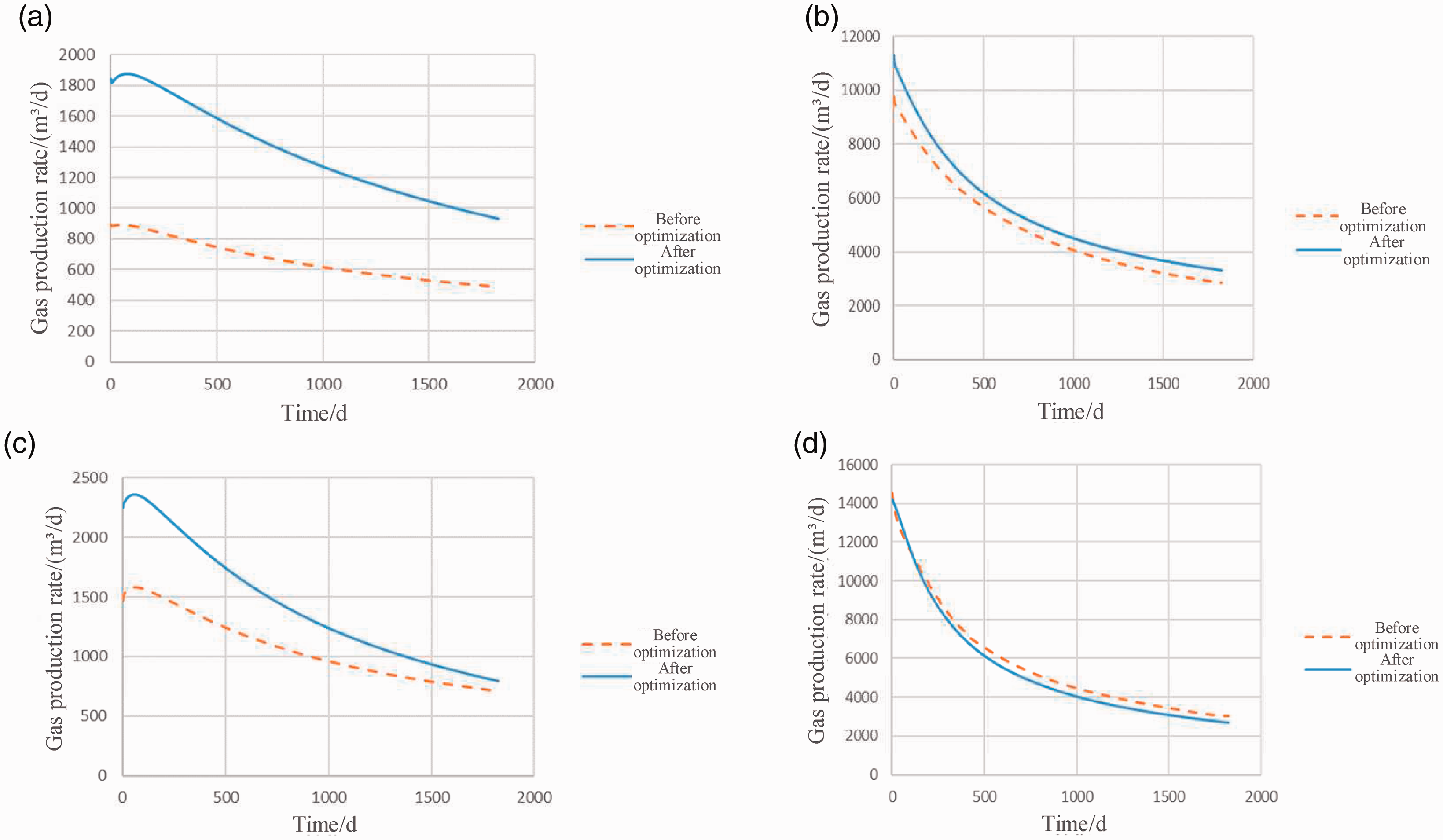
Gas production curves for the original and optimized well 1# and 4# with and without fracturing. (a) Well 1# optimization without fracturing, (b) Well 1# optimization with fracturing, (c) Well 4# optimization without fracturing, and (d) Well 4# optimization with fracturing.
Gas drainage simulation based on two infill wells
To study whether the abandoned mine requires newly drilled wells or not, the gas drainage simulation of the abandoned mine is conducted to observe the production change of the new wells, according to the distribution of goaf and flow field distribution. Two new wells, including the added well 1# and added well 2# are added according to the goaf distribution, and the layout of the optimized well location (only well 1#) has been optimized for this case.
Figure 8 shows a comparison without and with fracturing radius of 30 m of the adsorbed gas content distribution after five years of gas extraction. Comparing with Figure 3, it can be observed that the gas content has been significantly decreased with the addition of wells, particularly in the region adjacent to the added well 1#. After adding the two new wells, the cumulative gas production in the fifth year increases by 33% without fracturing and 17% with fracturing.
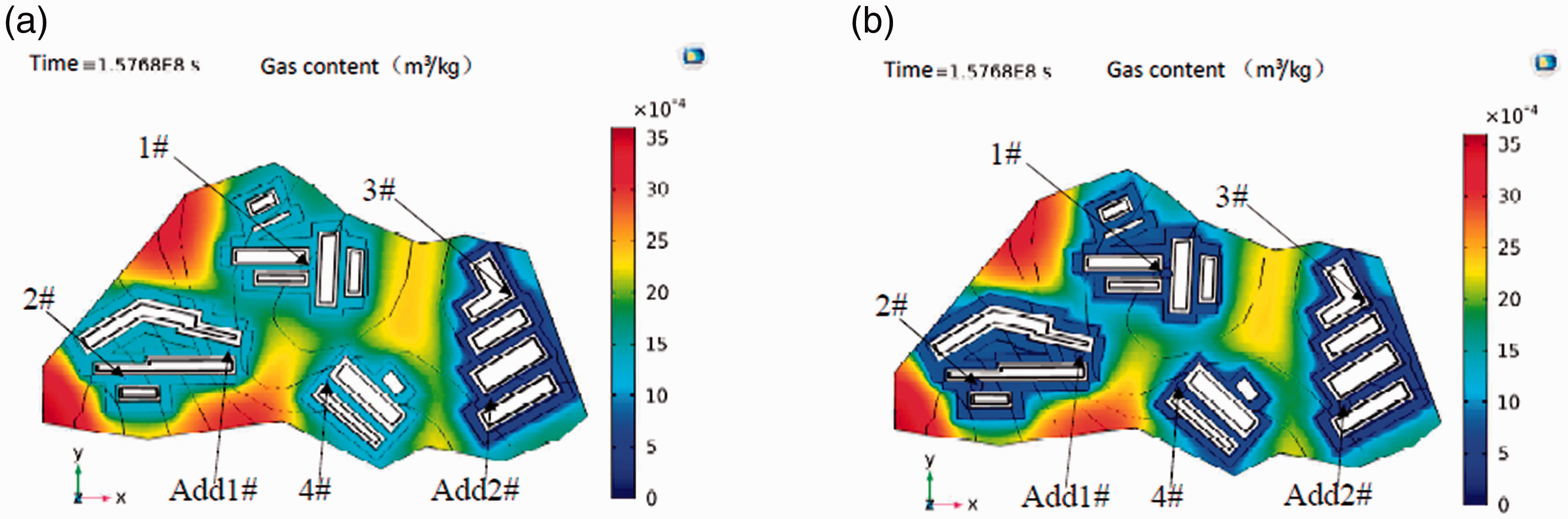
Distribution of adsorbed gas content over five years, before and after fracturing. (a) Not fractured for adding wells and (b) fratured for adding wells.
The gas production curves for all the six wells are shown in Figure 9. The results show that the gas production rate is low for both the added wells without fracturing. Therefore, it is necessary to fracture the well when added. In addition, the gas production rate for the added well 1# is higher than that for the added well 2#, which is consistent with the results shown in Figure 8. The gas production performance comparisons before and after adding the new well in the left and right gob regions are presented in Figure 10. The results illustrate that the cumulative production rate in the fifth year is high when a new well is added, particularly for the added well 1#, without fracturing (increased by 41%). More gas can be extracted through well 2# and the added well 1#, after fracturing.
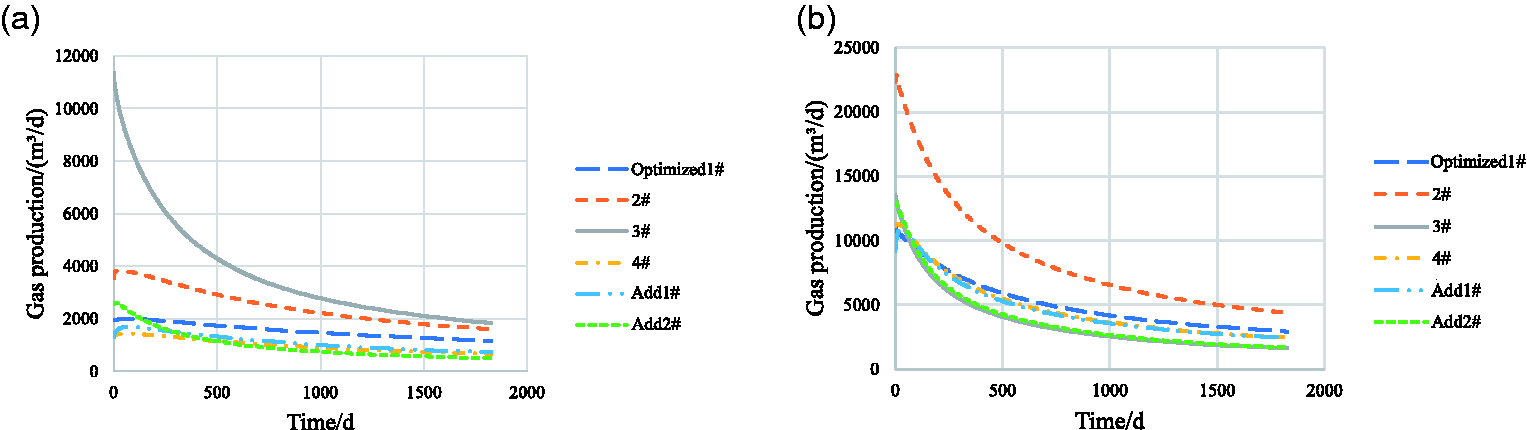
Gas production curves before and after fracturing. (a) Not fractured and (b) fracutred.
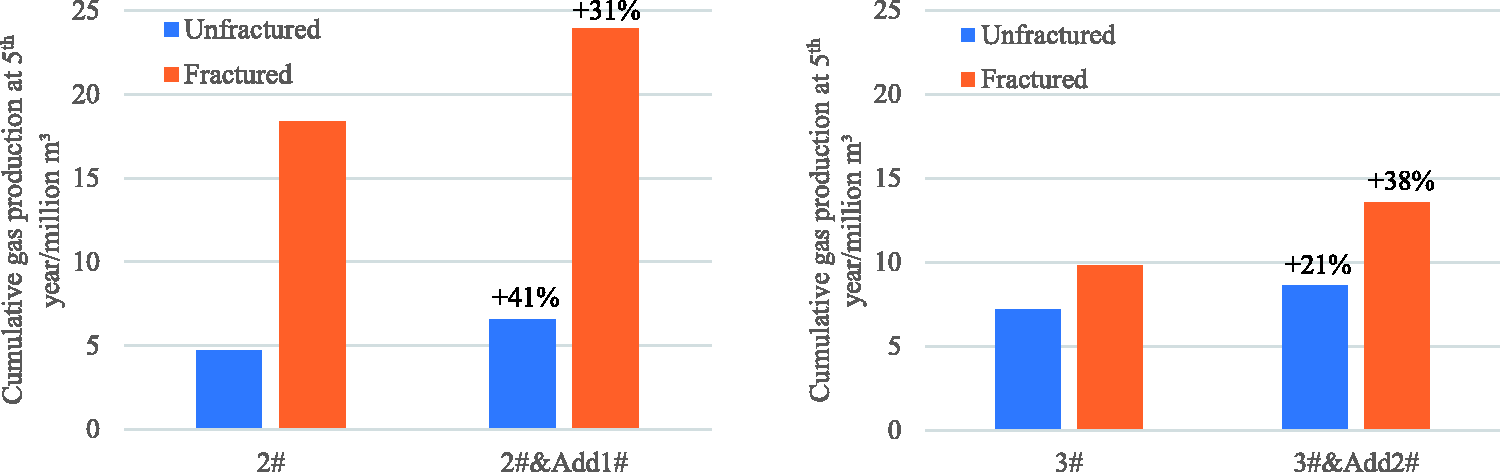
Gas production performance comparison before and after adding new wells.
Discussion
Due to the effect of natural fractures and artificial excavation, the heterogeneity of abandoned coal mine reservoirs with respect to the gas content and permeability is stronger than those of the conventional coalbed methane reservoirs. Simultaneously, the occurrence state of gas in each area and the migration rule under the pumping state are also more complex, hindering the optimization of well positions. Based on the simulation analysis of gas drainage in a certain mine, this study proposes a simulation workflow for the optimization of the gas production well location in the abandoned coal mines, including the following steps:
Establishing of a 3-D geological model and distribution of reservoir properties; Performing a simulation using the original well location data; Evaluating the flowline of the simulation results and optimizing the well location; Repeating Steps (2) and (3) until the optimized well location is obtained.
Conclusions
A coupled dual-porosity simulation model has been established for an abandoned coal mine in Shenbei to optimize the well location. The following conclusions are drawn based on the simulation results:
Five optimized well locations, including optimized 1#, 2#, 3#, 4#, and the added well 1#, are determined through several simulation scenarios. The optimized well should be within the “O” ring. The flowlines facilitate the optimization of the well location, and it is preferred that it connect various flowlines. Fracturing is an effective method to stimulate gas production; however, the extent of fracturing varies from well to well. A decision should be made based on the tradeoff between the simulation prediction and gas price. The workflow applied in this study can be used to optimize the well locations in abandoned coal mines that are expected to be strongly heterogeneous, owing to the initial and subsequent mining activities.
Footnotes
Declaration of conflicting interests
The author(s) declared no potential conflicts of interest with respect to the research, authorship, and/or publication of this article.
Funding
The author(s) disclosed the following financial support for the research, authorship, and publication of this article: This research was funded by the Natural Science Foundation of Hebei Province (Grant nos. D2019508167; D2019508160); National Major Research and Development Projects (2017YFC0804108); and National Natural Science Foundation (Grant no. 51774136).
