




Abstract
The viscous resistance caused by the relative motion of plunger and pump barrel is an important factor in the dynamic analysis of the drainage and production mechanism during coalbed methane exploitation. Existing studies mostly focus on deep well (1000–3000 m) large-displacement pump (usually 80–300 m3/d), and the interstitial medium is mainly crude oil. Regression fitting is mainly carried out based on empirical formula or experimental simulation method, without considering the characteristics of shallower coalbed gas well (400–800 m) small-displacement pump (<10 m3/d). The variation of the clearance between plunger and barrel and the variation of viscous resistance between plunger and barrel are not revealed. Based on the Navier-Stokes equation and Newton's internal friction law, a mathematical model of the annular viscous resistance between the plunger and the pump barrel is established, and an analytical method is used to describe the influence of stroke times, annular clearance, and differential pressure between the upper and lower plungers on the viscous resistance. The results show that the plunger stroke is directly proportional to the variation range of viscous resistance, and low stroke is beneficial to reduce the viscous resistance. The effect of differential pressure between upper and lower plunger of rod pump on viscous resistance of small displacement coalbed gas well is significantly greater than that of plunger running speed. The annular clearance is directly proportional to the differential pressure between the upper and lower parts of the plunger, the inertia force of the plunger, and the shear force of the moving fluid. The annular viscous resistance model between plunger and pump barrel is helpful to improve the calculation accuracy of suspending point load of coalbed gas well pumping unit, analyze the working condition of coalbed gas drainage gas production process, and provide basis for the optimization design of coalbed gas well rod pump clearance.
Introduction
Rod-pump drainage equipment is widely used in coalbed methane drainage gas production (Liang, 2017; Liu et al., 2017; Zhou, 2016), and its structure is transplanted from the oil field's pumping unit-pumping rod-pumping pump (hereinafter referred to as three-pumping system). The design of the rod pump in the three-pumping system is based on the large displacement pump (usually 80–300 m3/d) with oil as the drainage medium (Guo, 2018; Han, 2018; Wang et al., 2015), while the rod pump in the coalbed gas well belongs to the small displacement pump (usually 1–10 m3/d) with formation water as the drainage medium (Qu et al., 2016; Xu et al., 2009). Hard transplanting of drainage and mining equipment lacks objective judgment basis and matching rationality (Gao, 2018; Gong et al., 2019; Zhang, 2017). The design of small displacement rod pump based on the characteristics matching of coalbed gas well drainage medium has become an urgent problem in the field of unconventional oil and gas drainage.
In the rod pump, the annular gap between the plunger and the pump barrel is filled with well fluid, and the viscous resistance of the fluid in the annular gap will produce large energy loss when the plunger and the pump barrel move relative to each other. Therefore, the viscous resistance of the annular gap between the plunger and the pump barrel is an important factor that must be considered in the structural design of the rod pump. At present, most studies have analyzed the friction between the plunger and the pump barrel of the pumping pump, which is mainly calculated according to the empirical formula model and the experimental fitting method. However, the analysis of friction is based on the fact that the medium in the gap is a thick liquid such as crude oil (Chen and Sun, 2013; Ham et al., 2005; Ren and Hui, 2018), which cannot be applied to the coalbed gas well rod pump with small displacement and water as the medium, and the pump barrel and the plunger are not in direct contact. It is more reasonable to study the viscous resistance of fluid in the clearance between pump barrel and plunger. Therefore, it is necessary to establish a mathematical model of the viscous resistance between the plunger and the barrel gap and analyze its influence factors, so as to realize the optimization of the gap size and provide a theoretical basis for the optimization of the key size of the rod pump.
Research status quo and existing problems
At present, the research on the annular gap between the plunger and the pump barrel mainly focuses on the calculation of clearance friction (Wang, 2019; Yang et al., 2022; Zhang et al., 2020) and clearance leakage (Liu et al., 2021; Ndenguma et al., 2017; Tamm and Stoffel, 2002; Wang et al., 2002, 2019). Zhao Hongmin studied the friction calculation between the plunger and the pump barrel (Zhao, 1993), and thought that the friction between the plunger and the pump barrel (or bushing) of the oil pump was mainly caused by the hydraulic clamping force. Zhu (2004) tested the liquid output of 70 mm oil pump when the stroke is 3 m, the stroke times is 3, 6, 9 min−1, and the polymer solution concentration is 0, 100, 200, 400, 600, 800, and 1000 gm/L through experiment, and then regressed and fitted the relation curve of resistance, stroke, and stroke-times of oil pump under different polymer concentrations to obtain the calculation formula of plunger-barrel friction force. Zhu et al. (2009), based on the dimensional analysis method, consider that the downward resistance of the plunger is proportional to the flow. Yang (2016) simulated the flow conditions of fluid in the oil pumping pump when the clearance fluid was power law fluid and 32 groups of plungers were concentric and eccentric respectively with CFD software, and obtained the friction value of plunger under two experimental conditions, and derived the calculation formula of friction force.
The clearance between the rod pump barrel and the plunger is filled with liquid. Considering that there is no direct contact between the pump barrel and the plunger, it is considered that the motion resistance of the plunger is not friction, but the motion of the plunger causes the fluid between the plunger surface and the pump barrel to form a velocity gradient and the resulting viscous resistance. The geometric model of the relative motion of the plunger and the pump barrel is complex. For the convenience of the reader, the simplified physical model is shown in Figure 1.
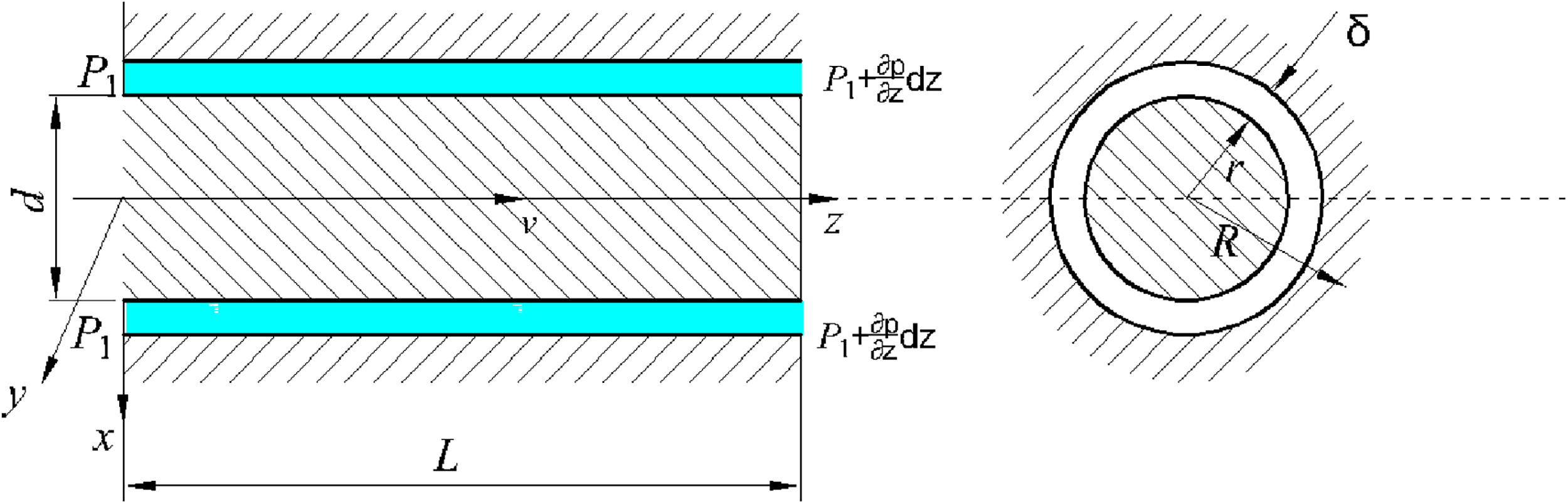
Physical model of plunger and barrel annular gap.
The existing studies mostly focus on the large displacement pump (>80 m3/d) of the deep well (1000–3000 m). The regression fitting is mainly based on the empirical formula or the method of experimental simulation. The characteristics of the small displacement pump (<10 m3/d) of the shallow coalbed gas well (400–800 m) are not considered, and the change characteristics of the small displacement rod pump plunger and the pump barrel clearance viscous resistance of the water medium are not revealed. Based on the analysis of clearance friction force of plunger pump (Shen and Lu, 2014; Zanoun et al., 2021) and clearance water flow characteristics (Fan and Feng, 2011; Li, 2016; Pullela, n.d.; Zhang et al., 2021) and combined with the drainage and production characteristics of coalbed gas well (Hu et al., 2019; Wan, 1988; Zhang, 2000), this paper establishes the viscous resistance model of annular clearance flow of rod pump in coalbed gas well and reveals the change rule of viscous resistance, which is of great significance for improving the calculation accuracy of suspended point load of pumping unit and providing theoretical basis for the optimal design of rod pump in coalbed gas well (Bellary et al., 2018; He et al., 2015; Ułanowicz, 2014).
Establishment of viscous resistance model for annular gap flow
Through the motion analysis between the plunger and the pump barrel of the rod pump in coalbed gas well, the viscous resistance between the plunger and the pump barrel is composed of three parts: the fluid force caused by the differential pressure between the upper and lower parts of the plunger, the shear force generated by the gap viscous fluid driven by the motion of the plunger and the inertia force generated by the motion state of the fluid driven by the change of the plunger speed.
As shown in Figure 2, the viscous force model of the clearance between the plunger and the pump barrel of the rod pump for coalbed gas well is established. Taking the liquid between plunger and barrel of rod pump as the research object, the coordinate system is established. The center of the barrel bottom is the origin of the coordinate, the axial and vertical directions are z-axis, and the horizontal and right directions are positive x-axis. Take dx and dz annular micro-elements for analysis. According to the Navier-Stokes equation, the force on the fluid can be divided into inertial force, pressure, viscous force, and other volume forces (gravity, etc.). These forces can be shown as drag or “dynamic force” under different flow fields. Combined with the second law of Newton, it can be obtained that:

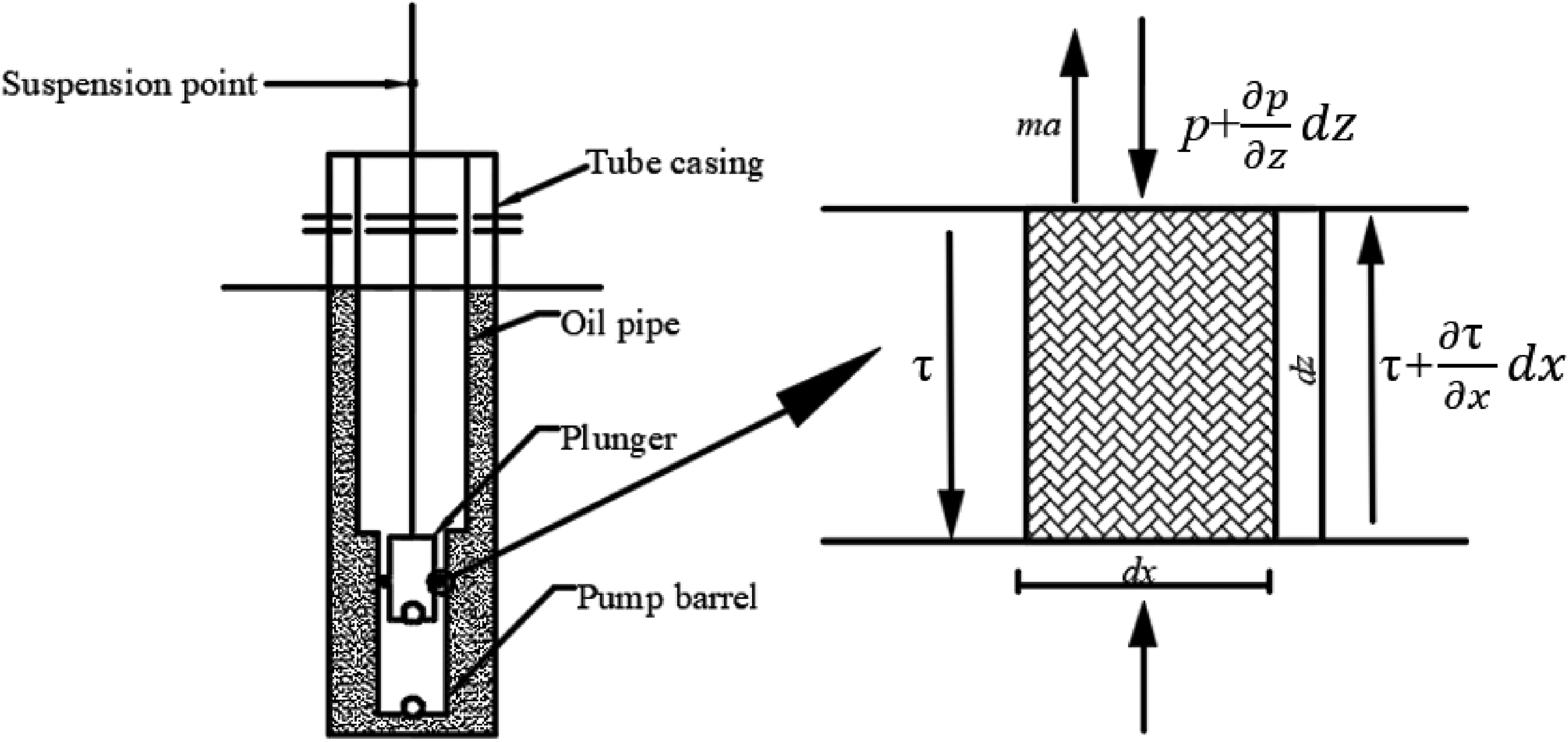
Plunger and pump barrel annular gap flow viscous resistance model.
Where, m is the mass of the micro-element, kg; a is the acceleration of the micro-element motion; m/s2; f is the mass force of the micro-element, N; P is the pressure on the plunger, N; τ is the tangential stress on the surface of the micro-element in the z-axis direction, N.
Where, dx, dz tend to be close to zero, so ignore the micro-element mass force, and calculate the fluid viscous resistance caused by plunger movement, inertia force and differential pressure between upper and lower plungers, respectively.
Viscous resistance caused by plunger movement
Considering the influence of plunger motion speed on the motion state of clearance fluid, when the differential pressure is equal to zero, the viscous resistance on the inner surface and outer surface of micro-element is equal and opposite in direction:

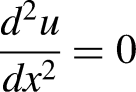

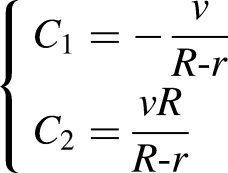
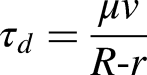
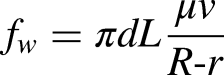
When the motion of plunger is simple harmonic motion, the running speed of plunger can be expressed as:
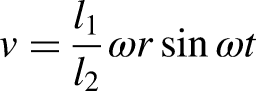

Viscous resistance caused by inertial force
Considering the influence of the inertia force generated by the change of plunger speed on the motion state of gap fluid, the balance equation of fluid inertia force and viscous resistance is established:

Simplify the above formula to obtain:
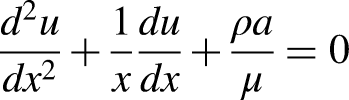
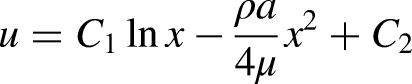
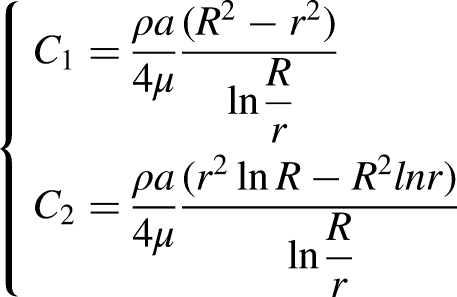
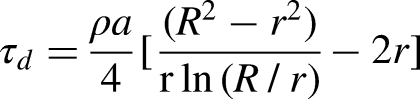

The pumping unit drives the pumping rod and plunger to perform simple harmonic motion through the rotation of crank. The acceleration a can be expressed as:

By substituting Equation (3) into Equation (2), the viscous resistance caused by inertial force is:

Viscous resistance due to plunger differential pressure
Considering the influence of the pressure on the upper and lower surfaces of the plunger on the motion state of the gap fluid, the viscous resistance balance equation generated by the pressure difference between the upper and lower surfaces of the gap fluid is established:

According to
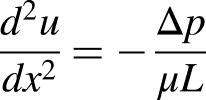
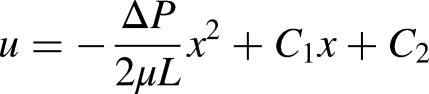
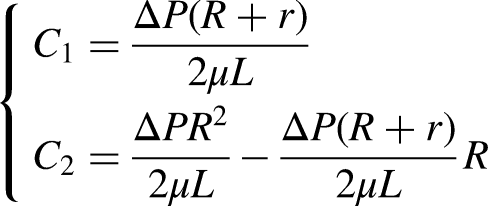
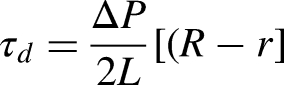

To sum up, the viscous resistance between the plunger and barrel of the coalbed gas well rod pump is:

From the viscous resistance between the plunger and the pump barrel, it can be seen that the viscous resistance between the plunger and the pump barrel is affected by the plunger running speed, acceleration, differential pressure between the upper and lower parts, clearance and the viscosity of the well fluid. It is necessary to analyze the above factors to provide theoretical basis for the optimization of the annular clearance and the design of the rod pump.
Analysis of factors influencing viscous resistance between rod pump plunger and pump barrel in coal-bed gas well
Taking the 38 type rod pump driven by CYJ5-2.5-26B pumping unit as an example, the viscous resistance between plunger and pump barrel and its influence factors are analyzed. Main parameters and data of the selected pumping unit: the crank rotation radius is 1.495 m, the front arm of the traveling beam is 3.28 m, the rear arm of the traveling beam is 2.82 m, the stroke is 1.85 m, and the stroke is 3min−1. Rod pump plunger diameter 38 mm, plunger length 1.2 m.
Influence of shear force and inertia force generated by plunger movement
The operating state of the plunger is described by the operating speed and acceleration of the plunger. The inertia force generated by the change of plunger speed has an impact on the viscous resistance of clearance fluid. The stroke of plunger in the operation of pumping unit determines the crank angular velocity, and then determines the running speed and acceleration of plunger.
The running speed and acceleration of the plunger change in a triangular function curve with time. Assuming that the pressure difference and annular clearance are a constant, the viscous resistance caused by the pressure difference is a fixed value. By substituting the parameters of CYJ5-2.5-26B pumping unit into Equation (6), the variation of the viscous resistance of the plunger and the pump barrel with time under different impulses is shown in Figure 3.
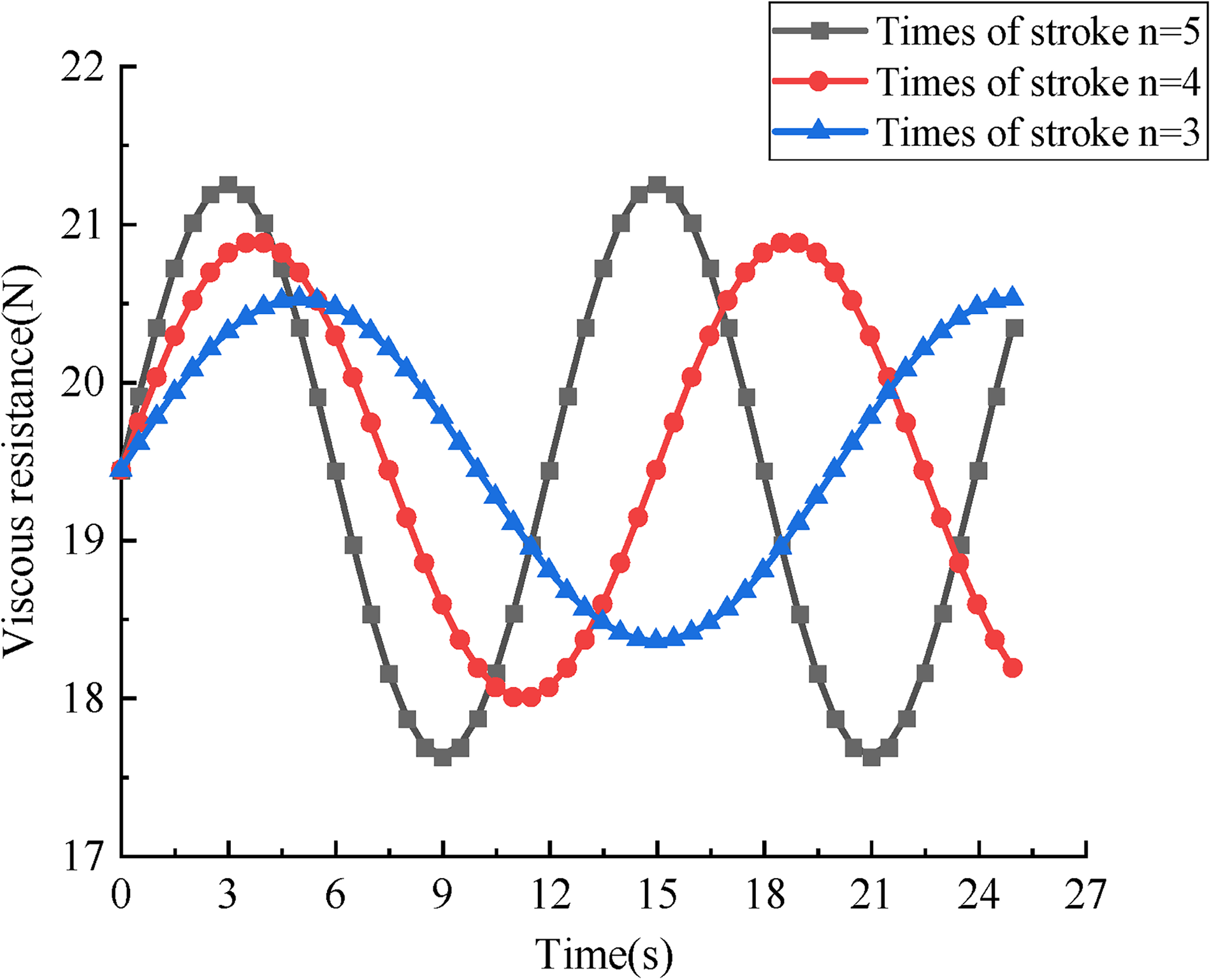
Variation of viscous resistance with plunger stroke.
It can be seen from Figure 3 that the viscous resistance changes periodically and sinusoidally with the plunger speed. With the increase of stroke, the variation range of viscous resistance between plunger and pump cylinder increases. When the stroke is 3 min−1, the viscous resistance varies from 18.4 to 20.4 N with time. When the impulse is 5 min−1, the viscous resistance varies from 17.6 to 21.4 N with time. This is because the running speed and acceleration of the plunger increase with the increase of the stroke, thus increasing the shear force and inertia force between the plunger surface and the well fluid, and increasing the viscous resistance of the plunger.
Therefore, the rod pump of coalbed gas well working under low impulse is conducive to reducing the change of viscous resistance. At the same time, reducing the impulse of coalbed gas well can also effectively reduce the impact of variable load.
Influence of differential pressure generated by upper and lower pressure of plunger
Take the stroke and clearance as fixed values, the motion state of plunger remains unchanged, the viscous resistance caused by corresponding inertia force and shear force is fixed, and only the pressure difference between upper and lower plunger causes the change of viscous resistance term. The variation of fluid viscous resistance with differential pressure between upper and lower plunger is shown in Figure 4.
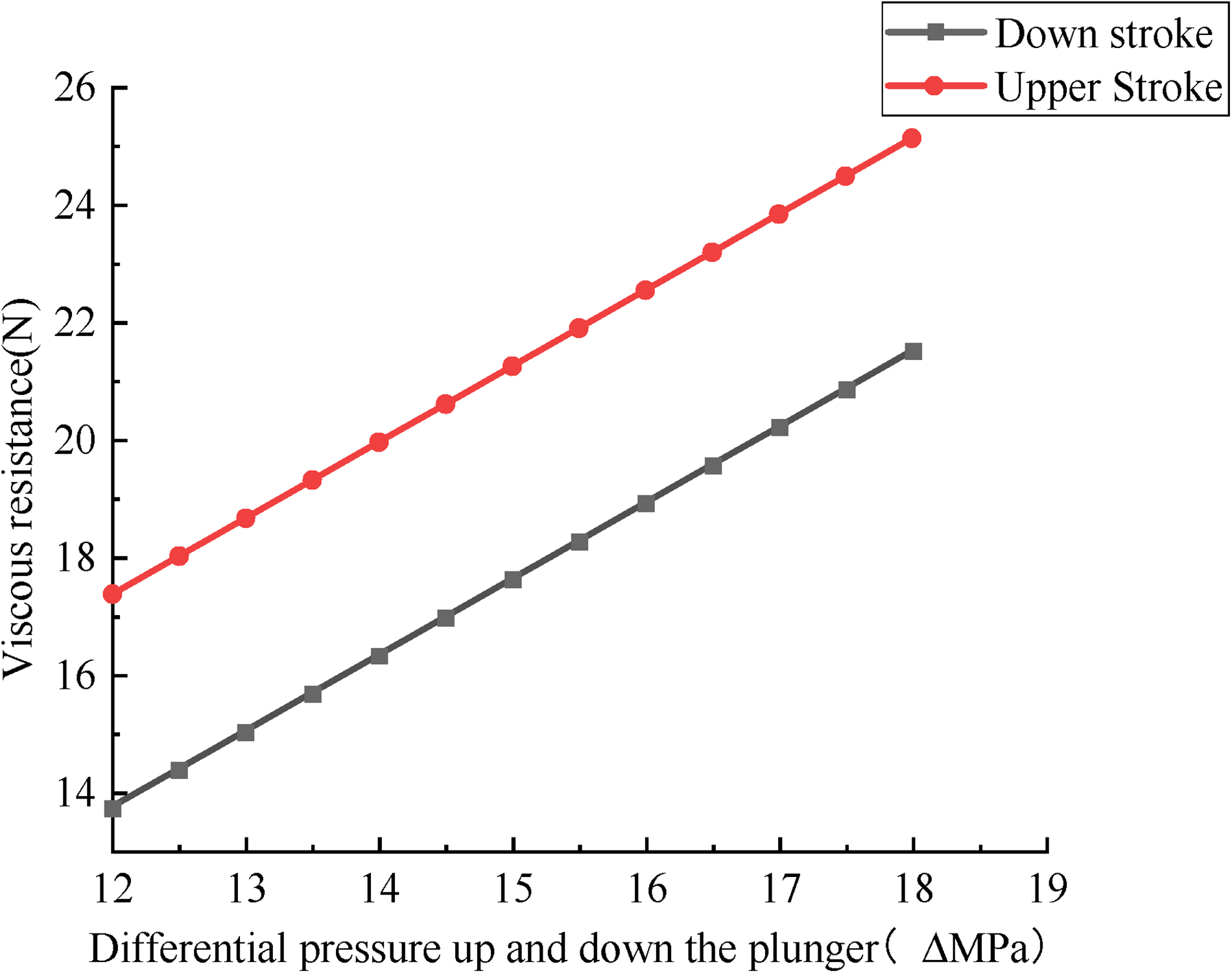
Influence of differential pressure on viscous resistance between plunger and pump barrel.
From Figure 4, it can be seen that at a certain time point, the viscous resistance increases with the increase of the differential pressure between the upper and lower plungers; under the same differential pressure, the viscous resistance of the plunger at the upper stroke is 4.2 N greater than that at the lower stroke. This is because when the oil pump is working, the pressure at the upper end of the plunger is always higher than the pressure at the lower end of the plunger. The difference between the upper and lower pressure causes the liquid in the annular gap to flow to the lower end of the plunger, causing the viscous resistance between the liquids to be upward.
Therefore, the fluid force caused by the differential pressure between the upper and lower stroke plungers is in the same direction as the fluid shear force generated by the plunger motion, while the lower stroke is opposite. The rod pump of coalbed gas well can reduce the viscous resistance when working under the low pressure difference, and the viscous resistance of the upper stroke is always greater than the viscous resistance of the lower stroke.
Influence of annular clearance size between plunger and pump barrel
In accordance with the oil and gas industry standard of the People's Republic of China SY-T 5059-2009 Standard for Combination Pump and Tubular Pumping Pump, the fit clearance of the plunger and bushing pair of the pumping pump is 15–90 μm (Wan, 1988). Keep the pressure difference unchanged, the viscous resistance caused by the pressure difference is also a fixed value. At the same time, under different impulses, the viscous resistance between the plunger and the pump barrel changes with the gap, as shown in Figure 5.
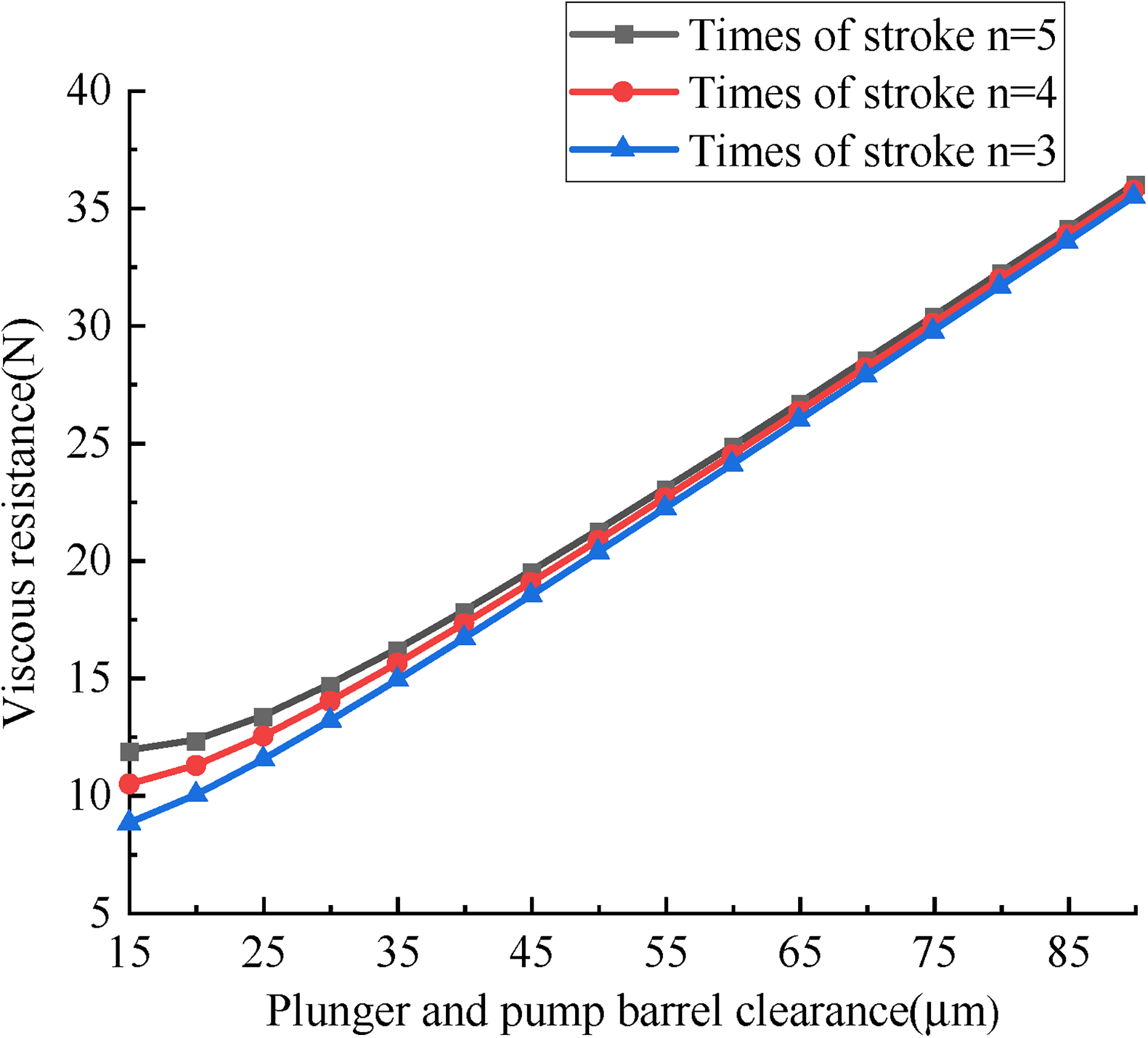
Influence of clearance between plunger and pump barrel on viscous resistance.
It can be seen from Figure 5 that the viscous resistance between the plunger and the pump barrel increases with the increase of the annular clearance. The smaller the clearance between the plunger and the pump barrel, the more significant is the impact of the stroke. This indicates that if a large-gap pump is selected in coalbed gas wells, increasing the stroke has little impact on the viscous resistance between the pump barrel and the plunger. That is to say, large-gap drainage pump is conducive to changing the stroke according to different displacement.
The relationship between the differential pressure, inertia force and shear force of the plunger, and the clearance between the plunger and the barrel is analyzed. The viscous resistance of the clearance between the plunger and the barrel is composed of three parts. The first part is the viscous resistance caused by the shear force generated by the fluid in the clearance caused by the motion of the plunger. The second part is the viscous resistance caused by the fluid force caused by the differential pressure between the upper and lower parts of the plunger. The third part is the viscous resistance caused by the inertia force caused by the fluid movement state change driven by the piston movement state change.
The first part of viscous resistance decreases with the increase of clearance. The second and third viscous resistances increase with the increase of clearance, and the specific change curve is shown in Figure 6.
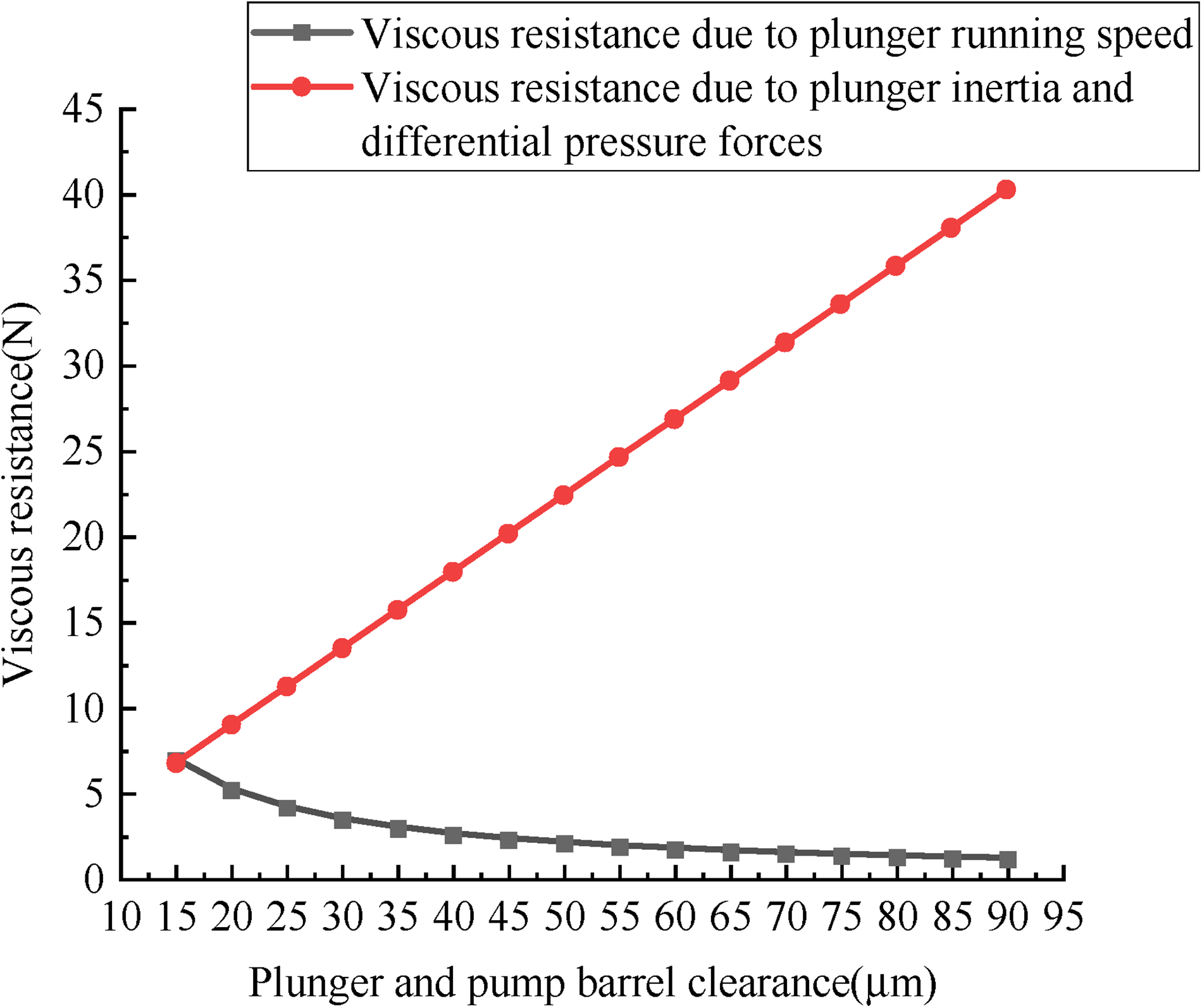
Influence of plunger motion, plunger inertia force, and differential pressure on viscous resistance under different clearances.
For coalbed gas well with small displacement, the effect of differential pressure between upper and lower plunger of rod pump on viscous resistance is larger than that of plunger running speed. Therefore, it is concluded that the clearance between the plunger and the pump barrel of coalbed gas well with small displacement is directly proportional to the viscous resistance under the combined action of the differential pressure between the upper and lower plunger, the inertia force of the plunger, and the fluid shear force.
Influence of viscosity of well fluid
The viscosity range of the coalbed gas well fluid is 6–10 mPa·s. The viscous resistance between the plunger and the pump barrel varies with the viscosity of the well fluid, as shown in Figure 7.
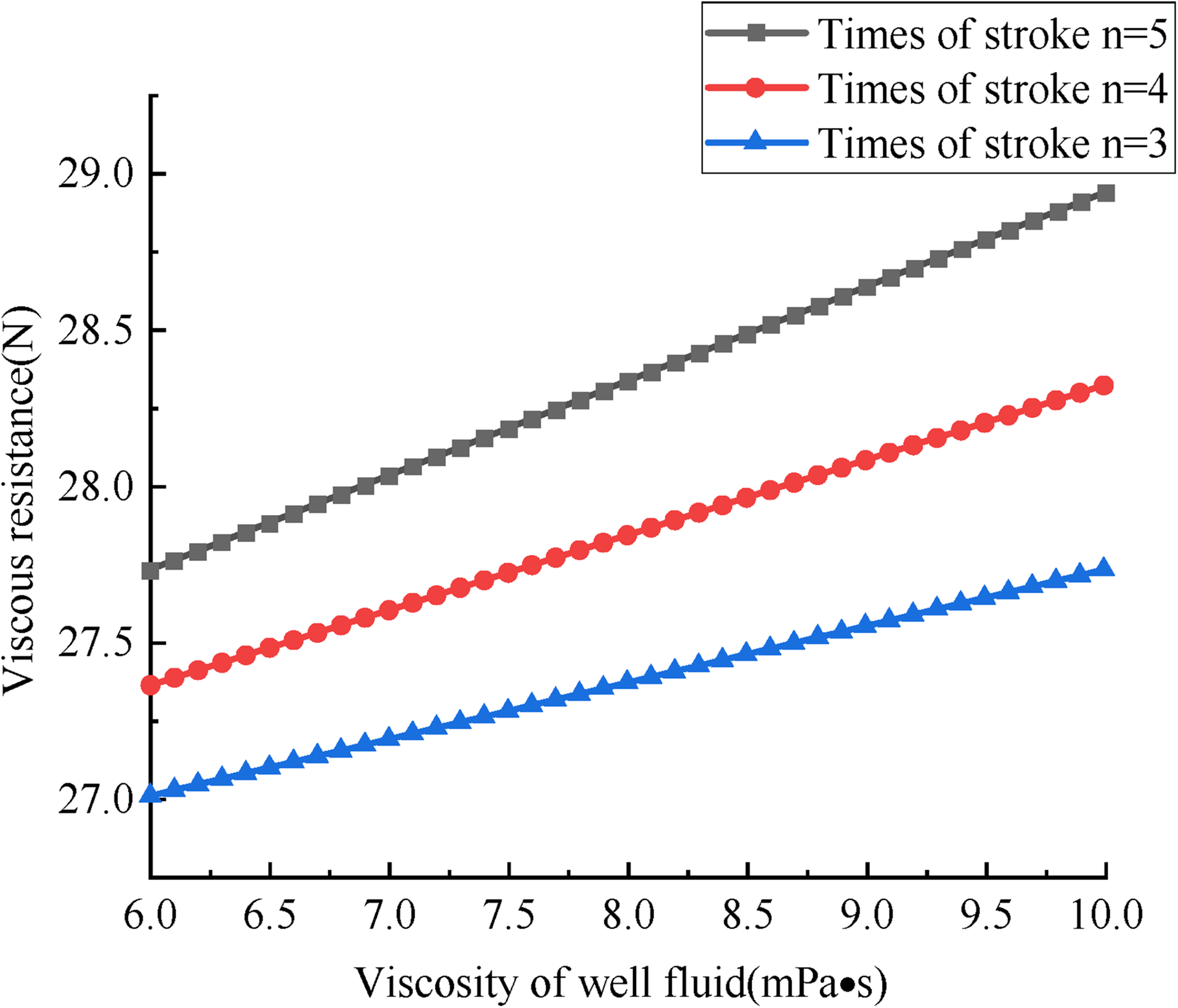
Influence of viscosity of well fluid on viscous resistance between plunger and pump barrel.
The curve shows that the viscous resistance increases with the increase of well fluid viscosity. The higher the running speed of plunger, the more obvious the effect of well fluid viscosity on viscous resistance. This conclusion can be verified by the effect of the viscosity of the well fluid on the viscous resistance through the up and down movement of the plunger.
When the pressure difference between upper and lower parts of plunger, annular gap and impulse other than the viscosity of well fluid is fixed value, the viscous resistance of interstitial fluid is only related to the viscosity of well fluid, and the plunger is subject to less viscous resistance under the condition of low viscosity of well fluid, which is more suitable for coalbed gas drainage and production.
Discussion
It can be seen from the physical model in Figure 1 that there is no direct contact between the plunger and the pump barrel, and there is no hydraulic clamping force. Therefore, there is no friction resistance between the plunger and the pump barrel. The resistance is due to the movement of the middle plunger relative to the pump jack barrel, which causes the change of the clearance velocity gradient along the pump barrel section, resulting in viscous resistance. According to the analysis of the influencing factors in the fourth part, it can be concluded that under the conditions of low impact rate, low well fluid viscosity, I-level sealing of the plunger pump barrel (liner), and low pressure difference between the upper and lower plunger, the viscous resistance caused by the annular clearance fluid caused by the relative movement of the plunger is the smallest, which hinders the movement of the plunger.
Conclusion
The viscous resistance between the plunger and the pump barrel of the coalbed gas well rod pump is affected by the plunger operating state, the differential pressure between the upper and lower plunger, the viscosity of the well fluid and the annular gap. The running speed of the plunger is directly proportional to the viscous resistance, and the plunger stroke is directly proportional to the change amplitude of the viscous resistance. Low stroke is conducive to reducing the viscous resistance. The clearance between the plunger and the pump barrel is directly proportional to the differential pressure between the upper and lower parts of the plunger. The differential pressure between the upper and lower parts of the plunger is directly proportional to the viscous resistance suffered by the plunger and the viscous resistance is always upward.
The effect of differential pressure between upper and lower plunger of rod pump on viscous resistance of small displacement coalbed gas well is significantly greater than that of plunger running speed. Therefore, the clearance between the plunger and the pump barrel of coalbed gas well with small displacement is directly proportional to the viscous resistance under the combined action of the differential pressure between the upper and lower parts of the plunger, the inertia force of the plunger, and the shear force of the moving fluid.
Expectation
Based on the Navier-Stokes equation and Newton's internal friction law, the viscous resistance between the plunger and the pump barrel of coalbed gas well is considered as caused by differential pressure force, inertia force, and shear force, which provides a theoretical basis for analyzing and describing the law of annular gap flow field. The research draws a conclusion that the change rule of the viscous resistance in the process of plunger drainage can provide a basis for the design, system optimization, and the formulation of drainage system of low submergence small displacement drainage pump in shallow coalbed gas well.
Footnotes
Acknowledgments
This work was supported by CNOOC's “14th Five-Year Plan” major science and technology project “Key Technology for Onshore Unconventional Gas Exploration and Development,” National Science and Technology Major Project (2016ZX05066004), (2017ZX05064004), and Shandong Provincial Natural Science Foundation (ZR2020MD038).
Declaration of conflicting interests
The author(s) declared no potential conflicts of interest with respect to the research, authorship, and/or publication of this article.
Funding
The author(s) disclosed receipt of the following financial support for the research, authorship, and/or publication of this article: This work was supported by the Natural Science Foundation of Shandong Province, National Science and Technology Major Project (grant numbers ZR2020MD038, 2016ZX05066004, 2017ZX05064004).
