




Abstract
Coal and gas outbursts mostly occur during mining at geostructural belts. Pre-drainage coalbed methane using hydraulic fracturing is one of the methods to prevent outbursts. However, the coal in geostructural belts is to be soft and crushed with special mechanical properties and pore structure. To explore the feasibility of hydraulic fracturing in geostructural belts, a field investigation on enhanced coalbed methane using hydraulic fracturing with vertical well was conducted at the Yangquan Coalfield, China. This case puts forward a method for the location selection of vertical well in geostructural belts. In addition, a triple-control technology for hydraulic fracturing, which is characterized by pressure control, flow control and sand ratio control of fracturing fluid, is presented. The results show that the average gas production and maximum gas drainage capacity of the test well were 5.67 and 12.88 times than those of the regular well, respectively, achieving good drainage effects.
Introduction
In recent years, with the increase in the depth of coal seam mining, gas emission from the working face has increased dramatically, with some shallow non-salient coal seams having gradually developed into prominent coal seams, resulting in the frequent occurrence of coal mine gas disasters (especially coal and gas outbursts). The coal and gas outbursts have become the major natural disasters that challenge coal mine safety (Yuan, 2016). According to statistics, the secondary disasters caused by coal and gas outbursts account for more than 80% of the major coal mine accidents that have occurred (Hu et al., 2009a, 2009b). Therefore, China has been one of the countries suffering from a serious coal and gas outburst problem (Hu et al., 2009a, 2009b, 2012, 2015). Studies have shown that the actual outbursts area accounted for only 10 to 20% of the total areas of coal seam (He and Chen, 2009). According to the existing statistics of coal and gas outburst accidents, an overwhelming majority of coal and gas outburst incidents occur in the geostructural zone (Cao et al., 2001; Farmer and Pooley, 1967; Shepherd et al., 1981). Therefore, it is vital to effectively eliminate the danger of outburst in the coal seams within the geostructural zone.
XJ Mine in Yangquan is a typical coal mine with coal and gas outbursts in China. The main features of the mine are the folds, with the geostructural distribution characterized by the synchronous development of faults and collapses. Due to the influence of these complex geostructures, coal and gas outburst disasters in XJ Mine are serious, with gas overrun and mine power phenomenon often occurring during coal tunnel excavation. For example, the North-9 roadway in seam #3 of XJ Mine is located near the syncline axis, with four faults and some small collapse columns in the periphery, as shown in Figure 1. Although long-bore holes are used for the gas pre-drainage in this area, its drainage effect is not good, resulting in the gas overrun and dynamic phenomenon occurring frequently during the tunneling process in mines, seriously affecting mine safety and tunneling progress.
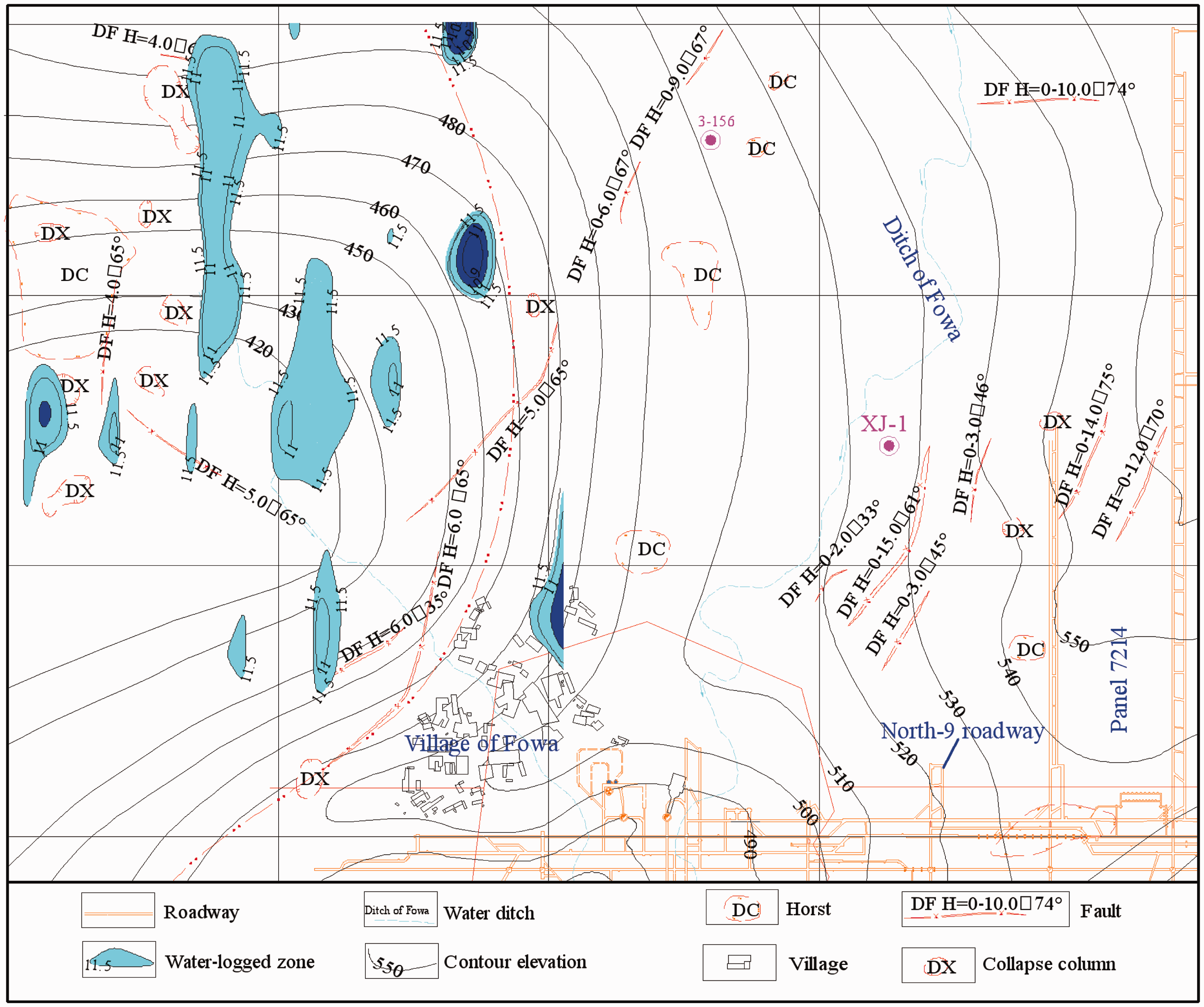
The study area.
For the prevention and control of coal and gas outburst disasters in the geostructural zone with a single-layer outburst coal seam, most of the wells are drilled with directional long holes in the downhole for gas drainage. However, the North-9 roadway of seam #3 of XJ Mine in Yangquan mining area is located in the geostructural belt, with the coal body structure showing typical structural coal characteristics. The stress concentration in the coal seam and gas sealing conditions are good, while the firmness of coal is poor, making the underground long borehole for gas drainage collapsible. The gas drainage effect is also poor. At present, the main solution to this problem is to strengthen and enhance the outburst seam to improve the gas drainage results of the coal seam. In recent years, the ground vertical well with hydraulic fracturing technology, as a kind of improving permeability technology, has been widely applied to the development of coalbed methane, achieving good results in some non-geostructural zones (Aziz et al., 2013; Guo et al., 2012; Huang et al., 2011; Huang and Li, 2015; Keshavarz et al., 2016; Ren et al., 2017; Saghafi, 2014; Yuan et al., 2012). This offers a new technical approach to enhance the gas drainage in coal seams in the geostructural belts.
However, the geostructural coal, which has special mechanical properties and pore structure, differs greatly from the primary coal seam. Whether the vertical well with hydraulic fracturing technology can still effectively increase the gas permeability of the outburst coal seam in the geostructure, maintaining them for a long time, remains to be further explored and tested. This issue is also the key to determining whether the hydraulic fracturing technology can be successful in gas drainage from the geostructure. Therefore, this paper considers XJ Mine in the Yangquan mining area as an example. Based on the occurrence characteristics of coalbed methane in this area, an experimental study was carried out on gas drainage using hydraulic fracturing with vertical well in the outburst coal seam, with the effect of hydraulic fracturing of vertical wells in the geostructural belts and coal seam gas drainage being examined. The relevant experience of this case can provide a new technical reference for enhanced the gas drainage of coal seam with the similar mining conditions.
Study site
Regional geological backgrounds
The coal-bearing strata of XJ Mine are the Upper Carboniferous Taiyuan Formation and the Lower Permian Shanxi Formation, with the coal seams being #3, #6, #8A, #8B, #9, #12, #13, #15A and #15B. Among them, the occurrence of coal seam #3 is shown in Table 1.
The occurrence of coal seam in the test area.

The study site of gas drainage using hydraulic fracturing is located in the vicinity of the North-9 roadway near coal seam #3 of XJ Mine, which is located at the axis of the north syncline of the Danshan-Fowa (the dip angle of the two wings strata being 3°–11°). There are four relatively short reversed faults nearby (the longest reversed fault throw is 15 m, while the rest are 2–3 m), as shown in Figure 1.
Occurrence of coal and gas
Coal seam #3 has a higher degree of metamorphism, with the fracture of coal being more developed. Moreover, it is rich in coalbed methane. The gas occurrence of coal seam #3 is shown in Table 2.
Parameters of coal seam #3 in the test area.

Implementation of hydraulic fracturing
The location selection of ground vertical well
The 3D seismic prospecting data of XJ Mine show that the small inter-layer faults in coal seam #3 are developed relatively well, with the general trend being more developed from westward to eastward. In addition, the faults are relatively more developed in the fold wing relative to the shaft. The last portion is developed much more than the other portions. Although the fault structure of coal seam #3 is small, the combined structure of these small faults is an important condition for the partial enrichment of gas. It can influence the gas occurrence, as well as outbursts in coal seam #3. However, the test area was located near the axis of the north syncline of the Danshan-Fowa, with four reverse faults developing around it, along with the complex geostructural (as shown in Figure 1). On the one hand, these reverse faults are mainly controlled by the north syncline of Danshan-Fowa, which makes the coalification degree of the coal seam relatively high, with a large amount of gas generated during the formation process, resulting in a high level of gas content in the coal seam. On the other hand, these reverse faults belong to the compressive-torsional faults, with a certain sealing effect on the coal seam gas. The effect of these faults will cause the coal seam structure in this area to be broken, which is favorable for the gas migration and accumulation in coal seams, making it prone to outburst. It can be seen that the coal seam in the test area is a typical structural coal, rich in gas, which makes the geostructural belt a gas-enriched area.
According to the influence of faults on the outbursts and occurrence of gas in coal seams, at a larger distance from the test area, the gas occurrence of coal seams was mainly controlled by the buried depth of the coal seam and the north syncline structure of Danshan-Fowa. However, near the test area, the gas occurrence in coal seams was mainly controlled by these faults. Thus, these reverse faults have a pressure relief effect on the nearby coal seam, while increasing its permeability. It can be seen that the coal seam near the four reverse faults in the test area is not only a gas enrichment area, but also a high permeability area. Therefore, this experiment comprehensively considers the coal seam gas occurrence law, geostructural distribution, and ground topography of the area. The fractured vertical well in the geostructural belt in the experimental area was located at a minimum distance of 70 m from the fault (the XJ-1 well is shown in Figure 1). The ground vertical well fracturing technology was used to fracture and enhance the permeability of the coal seam near the vertical well, to form a high permeability area near the coal seam of the vertical well. The fault structure was used to relieve the pressure and increase the permeability of the coal seam near the fault, so that the area near the vertical wells in the high permeability zone can communicate with the coal seam gas enrichment zone generated by the fault structure (as shown in Figure 2). This led to an increase in the effective gas drainage range of the ground fracturing vertical well, while improving the gas drainage results of the ground fracturing vertical well, in order to eliminate the outburst risk in the coal seam to the extent possible.
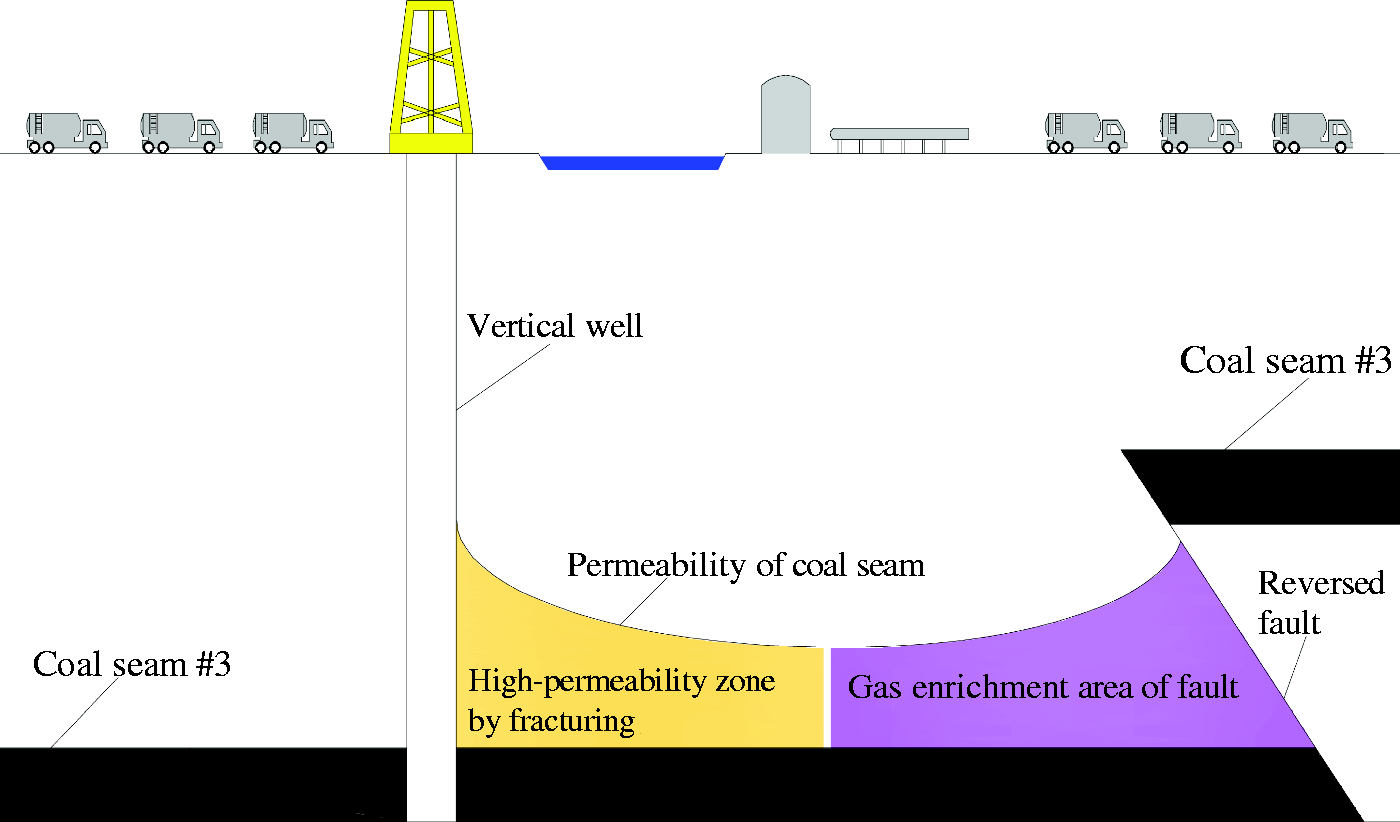
Well site selection method for fracturing in the study area.
The hydraulic fracturing effect
Fracturing design
The fracturing design was conducted on basis of XJ-1 drilling, well logging, path data (as shown in Table 3), gas desorption and rock mechanics experiments. Through the fracturing of XJ-1 well, the state of stress concentration in the area will be changed, achieving the purpose of eliminating outburst. This significantly improves the diversion of the coal seam gas flow to improve the seepage flow characteristics of the target coal seam near the well, thus improving the output of the well (Keshavarz et al., 2016).
The basic parameters of XJ-1 well.

There are significant differences between the reservoir characteristics of the coal seam and the ordinary oil and gas reservoirs. Sandstone is to be pore structure, with a porosity of approximately 10%. Coal has a natural multi-fracture system, with a porosity of approximately 2% only. Moreover, the pore connectivity is very poor, with no gas and water seepage ability. The main function of hydraulic sand fracturing in coal seam is to press and support more cracks, so that the cracks in the coal seam can be effectively connected, providing fissure channel for pressure conduction and the flow of gas and water to achieve methane desorption and output from the coal seam (Keshavarz et al., 2016; Saghafi, 2014).
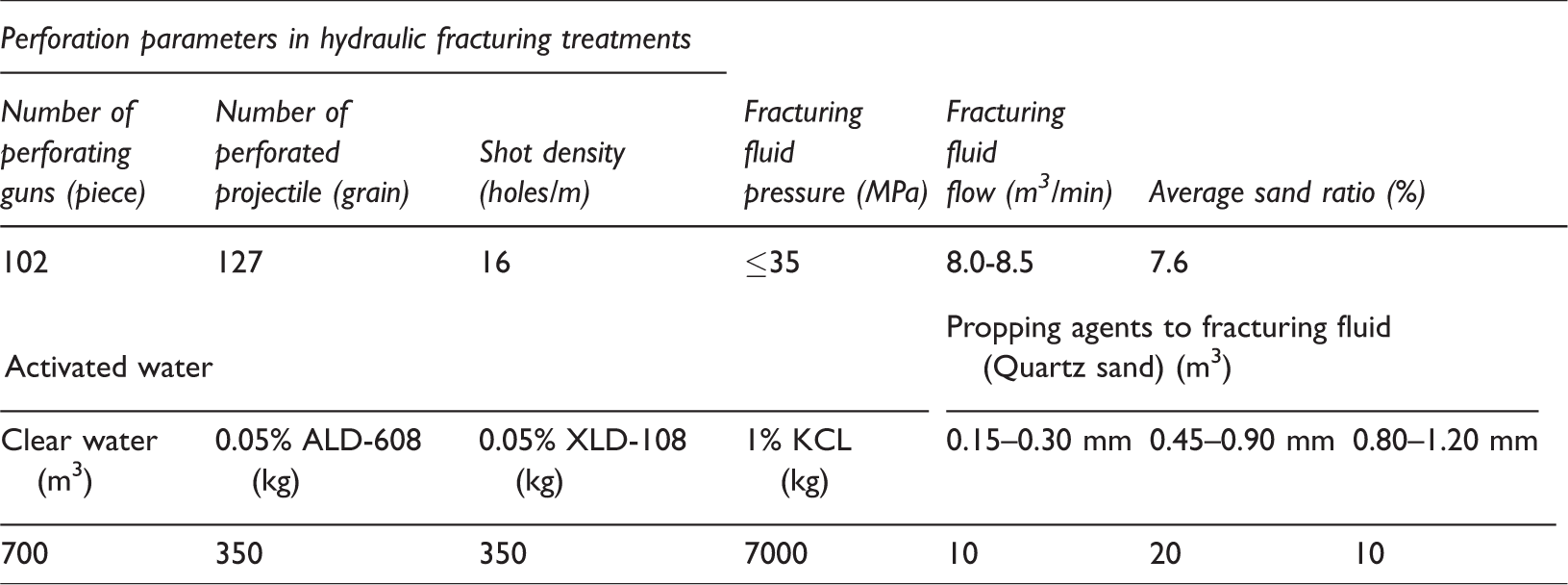
Therefore, the characteristics of the high in-situ stress and developed cleats of coal seam in the geostructural belts of XJ Mine are discussed. We have suggested the “triple-control” technology of hydraulic fracturing of vertical well, with high oil pressure, stable flow, and low sand ratio (as shown in Figure 3). The technical parameters of fracturing in XJ-1 well are shown in Table 4 and Figure 4.
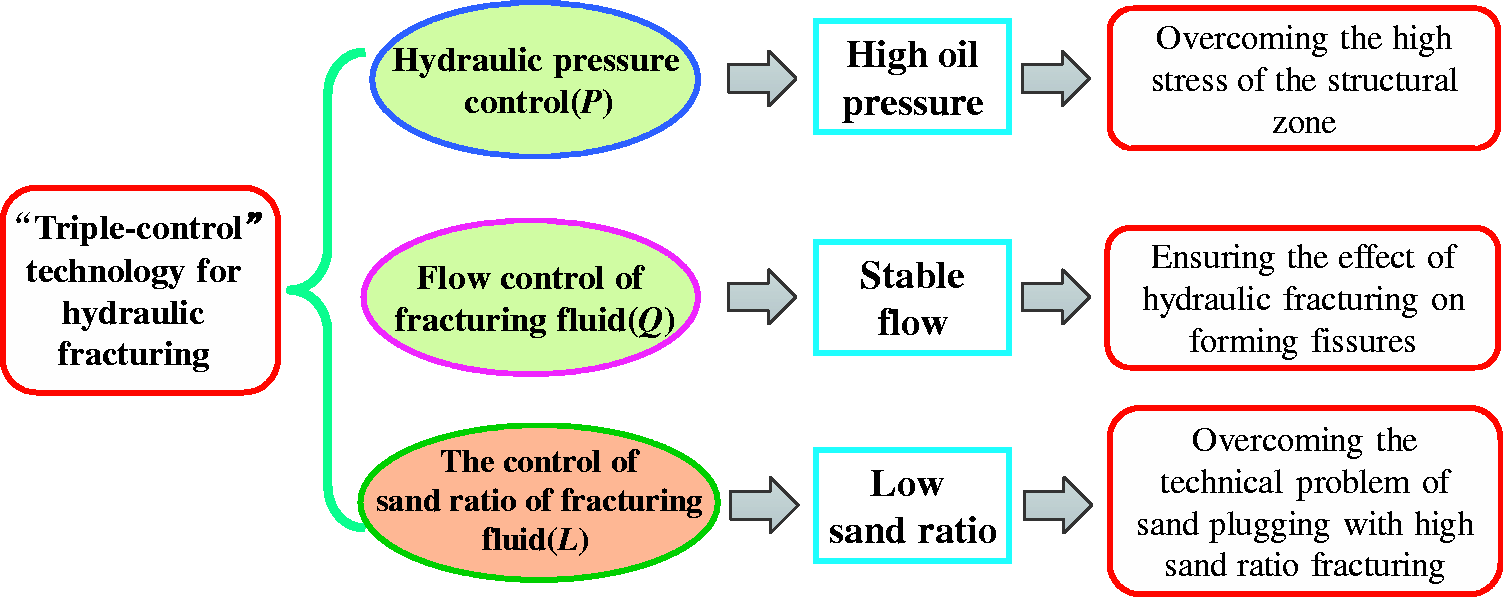
“Triple-control” technology for hydraulic fracturing.
Technical parameters of fracturing in XJ-1 well.
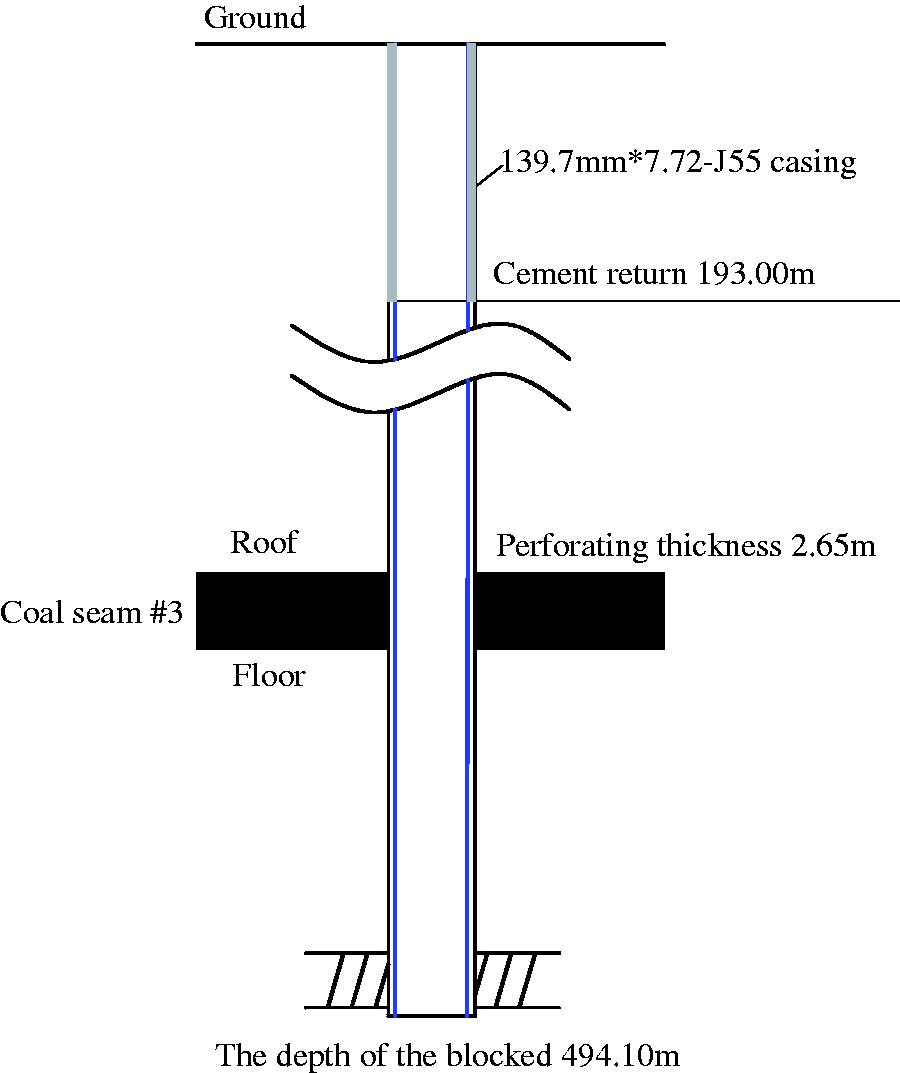
XJ-1 well fracturing pipe diagram.
Hydraulic pressure control (P)
The curves of oil pressure (as shown in Figure 5) indicate that, compared with the regular coalbed methane well 3–156, the XJ-1 well has a higher cracking pressure of up to 26.22 MPa. However, it takes a longer time (62 min) after the pump was stopped, for the cracks in XJ-1 well to close, while it takes 30 min in the 3–156 well, which indicates that the length of fracture penetration in the XJ-1 fractured well is much longer. In addition, it can be seen that the final value of the oil pressure in the XJ-1 well is 10 MPa, which is larger than the final value of the oil pressure in the 3–156 well. This is because the XJ-1 well is located near the thrust fault. This structure led to the stress concentration and the cracking pressure was greater.
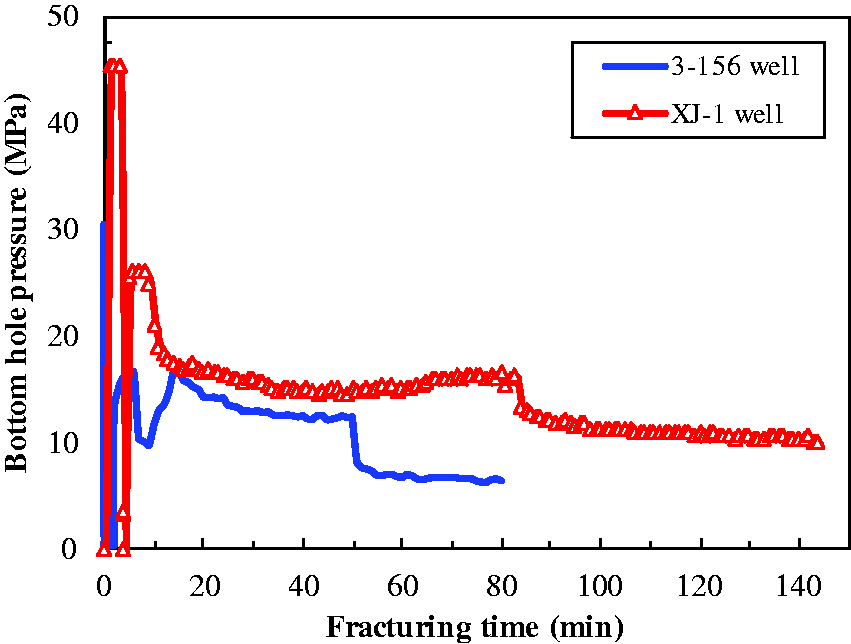
The change of the bottom hole pressure.
Flow control of fracturing fluid (Q)
The curve of the flow of the fracturing fluid (as shown in Figure 6) show that the flow of the fracturing fluid in the XJ-1 well is relatively stable at about 8 m3/min, while the flow of the fracturing fluid in the conventional coalbed methane 3–156 well fluctuates.
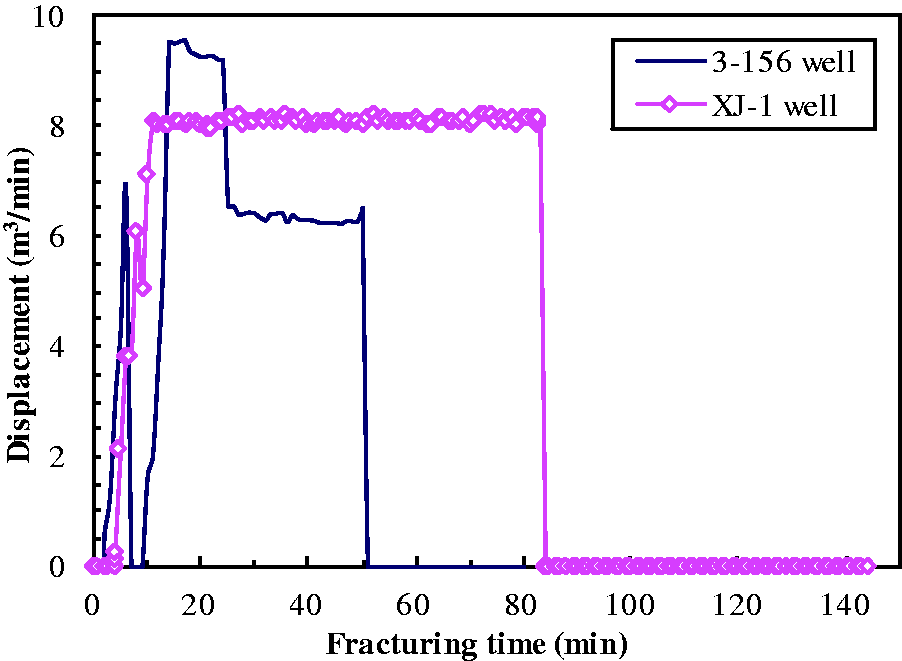
The displacement of the fracturing fluid.
In addition, it can be seen from Figure 7 that the total amount of fracturing fluid Q in XJ-1 well is 620.36 m3, which is nearly two times than that of 3–156 well. It indicates that the length of fracture penetration in XJ-1 well is more, with better effect of fracturing.
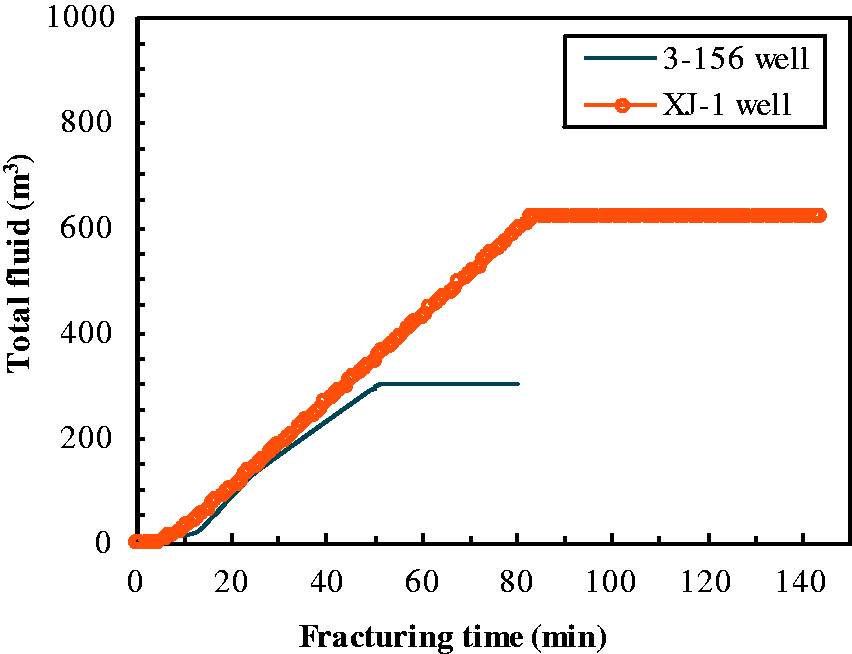
The total fluid of fracturing.
Control of the sand ratio of fracturing fluid (L)
The sand ratio of the fracturing fluid in XJ-1 well and 3–156 well is indicated in Figure 8. As shown in this figure, the sand ratio of fracturing fluid in 3–156 well reaches a maximum of 34%, while that in the fracturing XJ-1 well reaches 15%, which is approximately 50% of that in reference 3–156 well.
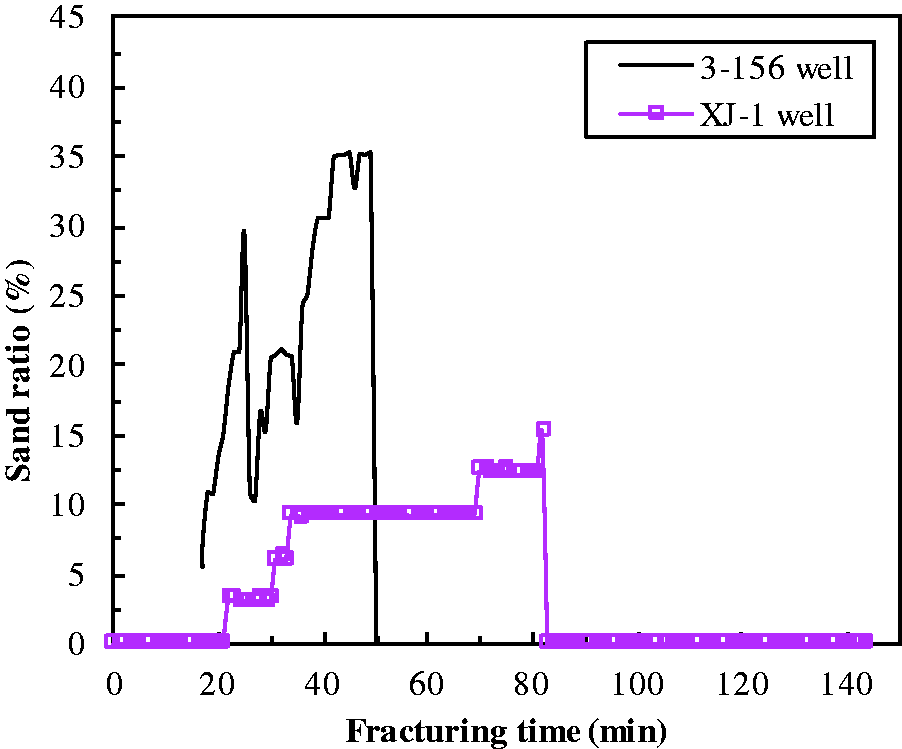
The curve of the sand ratio of fracturing fluid.
Length of the half wing fracture
Based on the principle that the initiation and extension of hydraulic fracturing and the filtration of the stratum are related to construction pressure, the relationship between the pumping flow and pumping time is obtained as follows (Xu et al., 2011).


In this equation, Cf represents the pore volume compressibility; P* represents the fitting pressure, MPa.
Through the transformation of equation (1), the length of the half wing fracture can be obtained as follows.

In this equation, Qf*tp is equal to the total amount of fracturing fluid Q. Thus, the relationship between the length of the half wing fracture and the total amount of fracturing fluid Q is obtained as follows.

The fracturing construction parameters of XJ-1 well are shown in Table 5. The comprehensive filtration coefficient C = 0.0263 m/min1/2, and the length of the half wing fracture LP=156.8 m can be obtained by substituting the parameters from Table 5 into equation (4).
Parameters for calculating the length of half-wing fracture in XJ-1 well.

Gas drainage results
Implementation of gas drainage
After hydraulic fracturing in the XJ-1 well, when the pressure inside the pipe reduced to a reasonable range, the surface drainage equipment was installed to begin the drainage by a combination of the traditional pumping unit and the suction pump. The gas drainage equipment is shown in Figure 9.
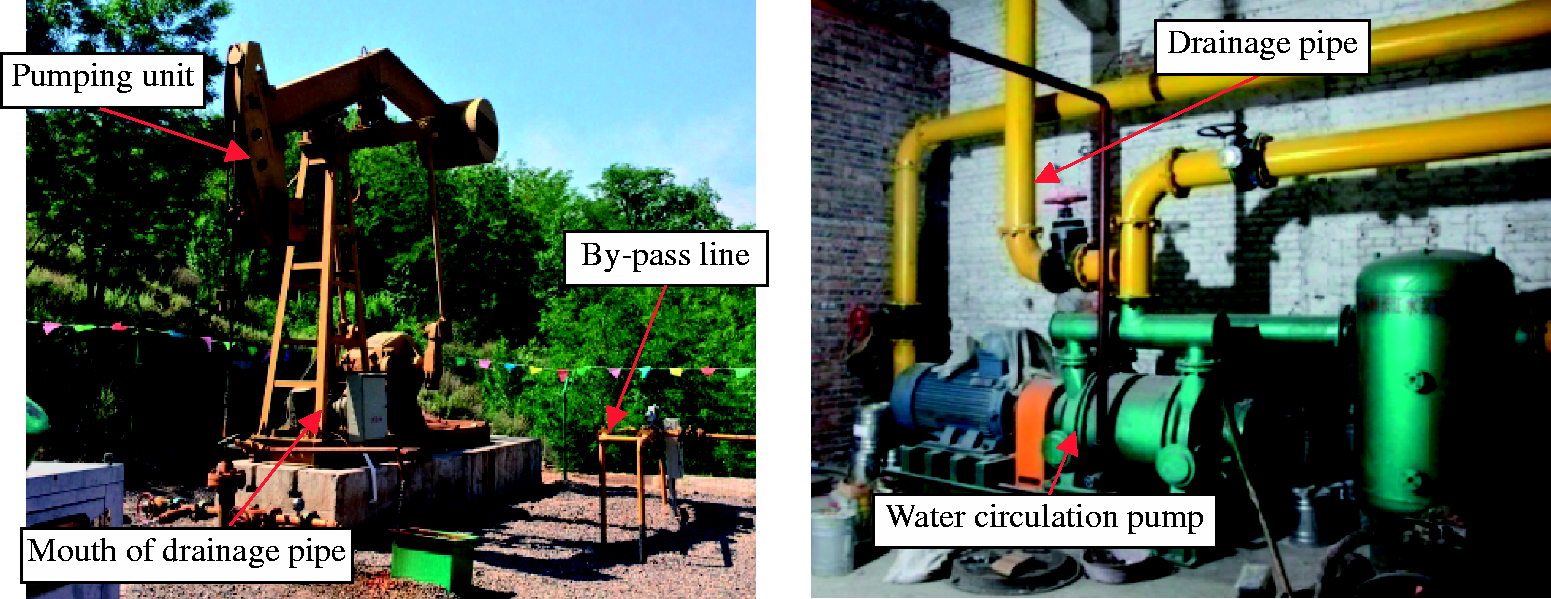
Gas drainage equipment.
Drainage results
Daily gas output
The change curve of the daily gas output and casing pressure is shown in Figure 10. It can be seen that the depth of the initial drainage level was 30 m. When the liquid level reached a depth of 385 m after the initial stage of reduction in the drainage liquid level for 22 days, the gas production began to enter a critical period, followed by the appearance of casing pressure. Subsequently, XJ-1 well began to produce gas. The initial gas concentration was approximately 97%, with a daily gas output of approximately 1000 m3. In addition, the gas production of XJ-1 well increases with the increasing casing pressure. On the 298th day of the drainage operation, the cumulative gas output was 276,000 m3. While the gas concentration was maintained at 97%, the maximum daily gas output reached 4707 m3/day.
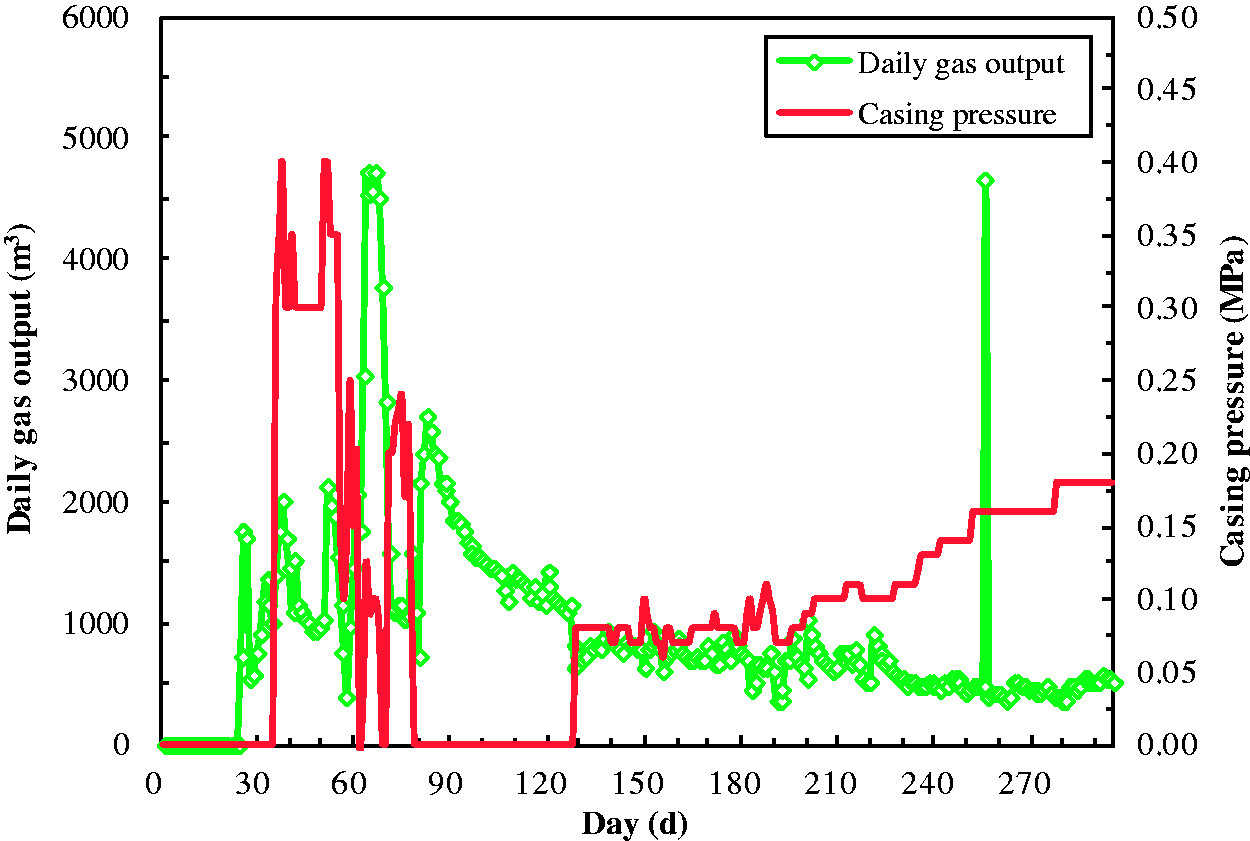
The change of the daily gas output in XJ-1 well.
On days from 40th to 45th of gas production, the dynamic fluid level in XJ-1 well dropped to coal seam #3. The ground water-circulating pump was turned on at that time, for carrying out the experiment on drainage in the ground fracturing well through ground pumping station. The results show that the maximum level that the gas drainage reached was 4707 m3/day during the test period, with an average of 4602 m3/day, which was 3.5 times than the output with the pumping unit. Moreover, the gas drainage concentration was 97.7%.
Dynamic liquid level
The change curve of dynamic liquid level and casing pressure during the production period in fracturing XJ-1 well is shown in Figure 11. It can be seen from the Figure that with the prolongation of drainage, the depth of the dynamic liquid level increased, stabilizing eventually. Based on the curve of daily gas output in Figure 10, the depth of the dynamic liquid level of XJ-1 well in XJ Mine should be maintained at 460 m.
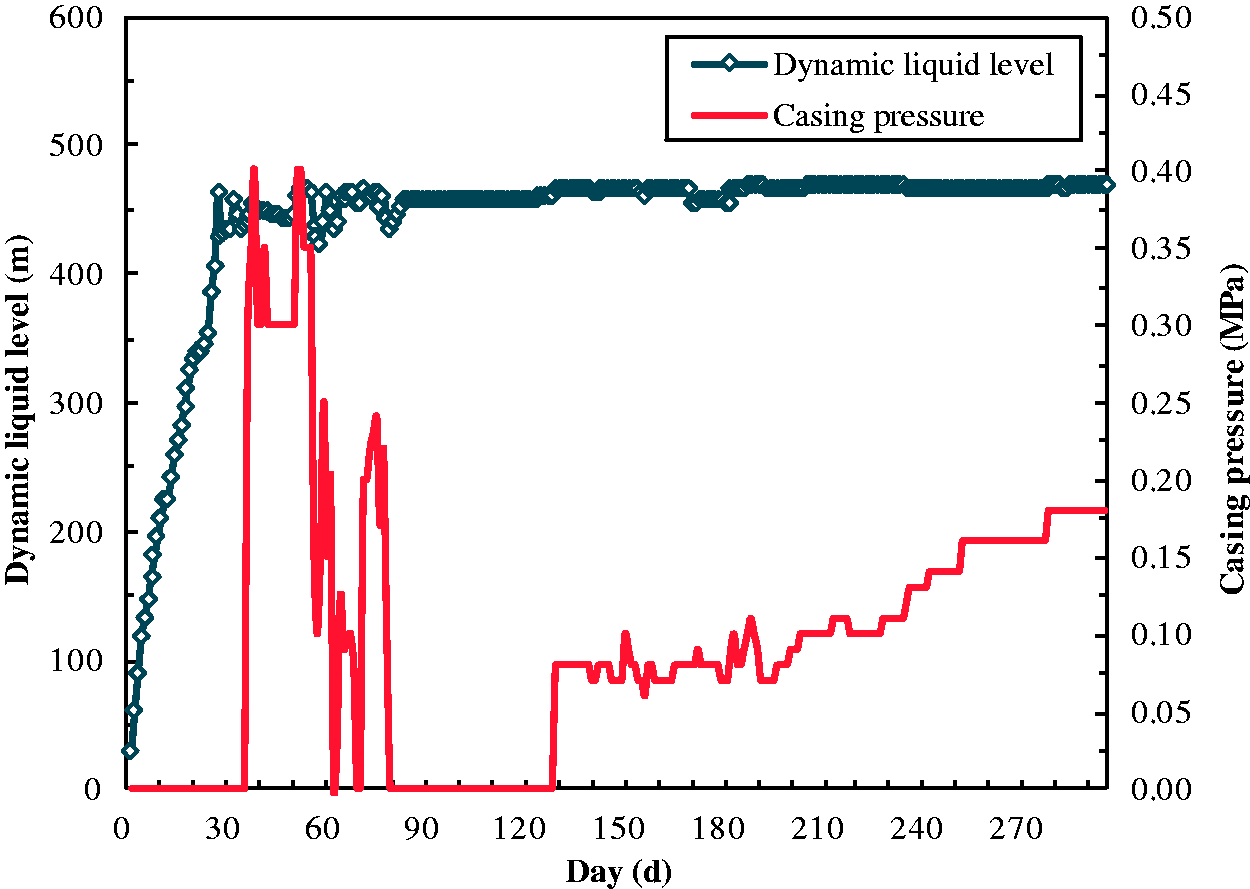
The change of the depth of dynamic liquid level.
Stroke frequency
The change curve of the stroke frequency and casing pressure during the production period in XJ-1 well is shown in Figure 12. It can be seen from the Figure that the changing trend of stroke frequency in the fracturing XJ-1 well is inverse to that of the casing pressure in XJ Mine. According to the curve of the daily gas output in Figure 10, the reasonable stroke frequency of fracturing XJ-1 well should be maintained at 0.5 n/min.
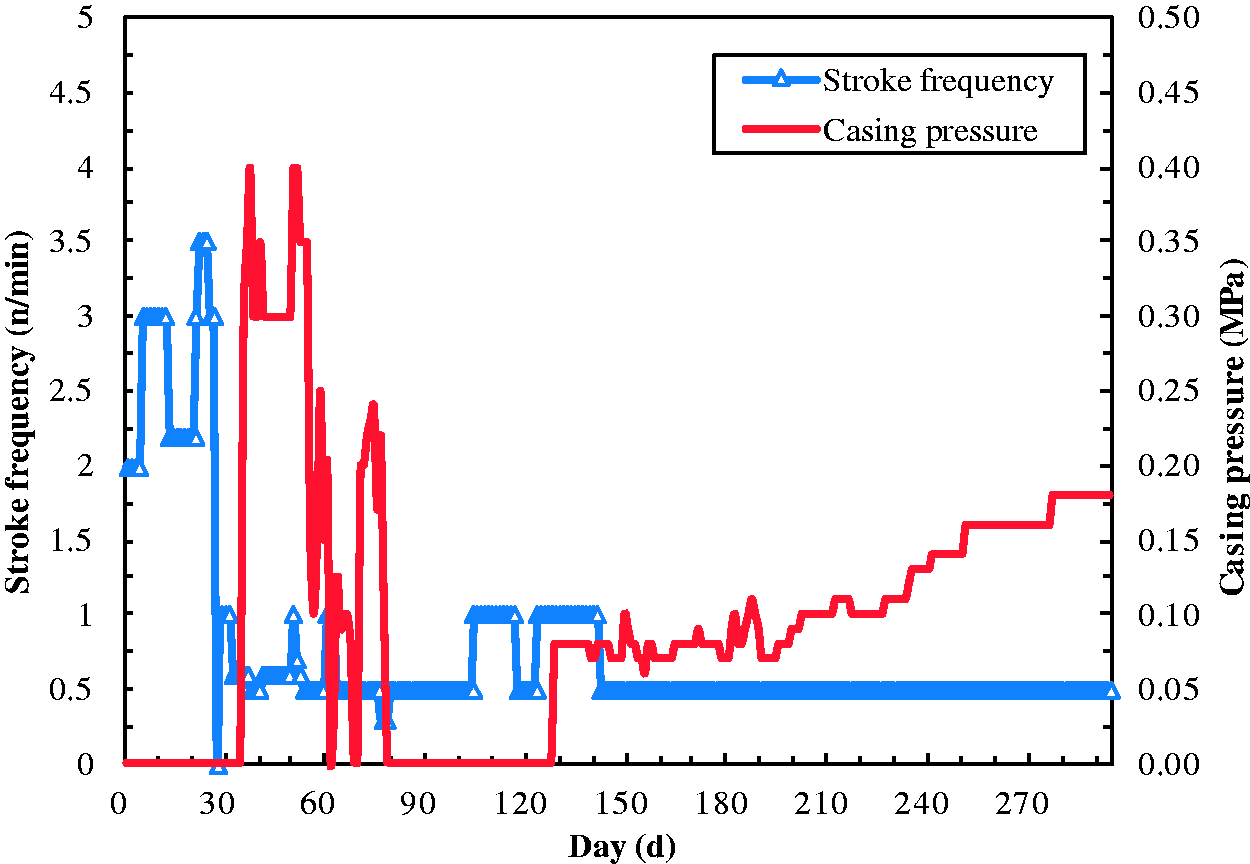
The change curve of the stroke frequency in XJ-1 well.
Daily water yield
The change curve of the daily water yield and casing pressure is shown in Figure 13. From the figure, it can be seen that the daily water yield of fracturing XJ-1 well decreases with the increase in casing pressure. Moreover, the trend of the daily water yield is inverse to that of casing pressure. It means that the daily water yield decreased while the casing pressure increased.
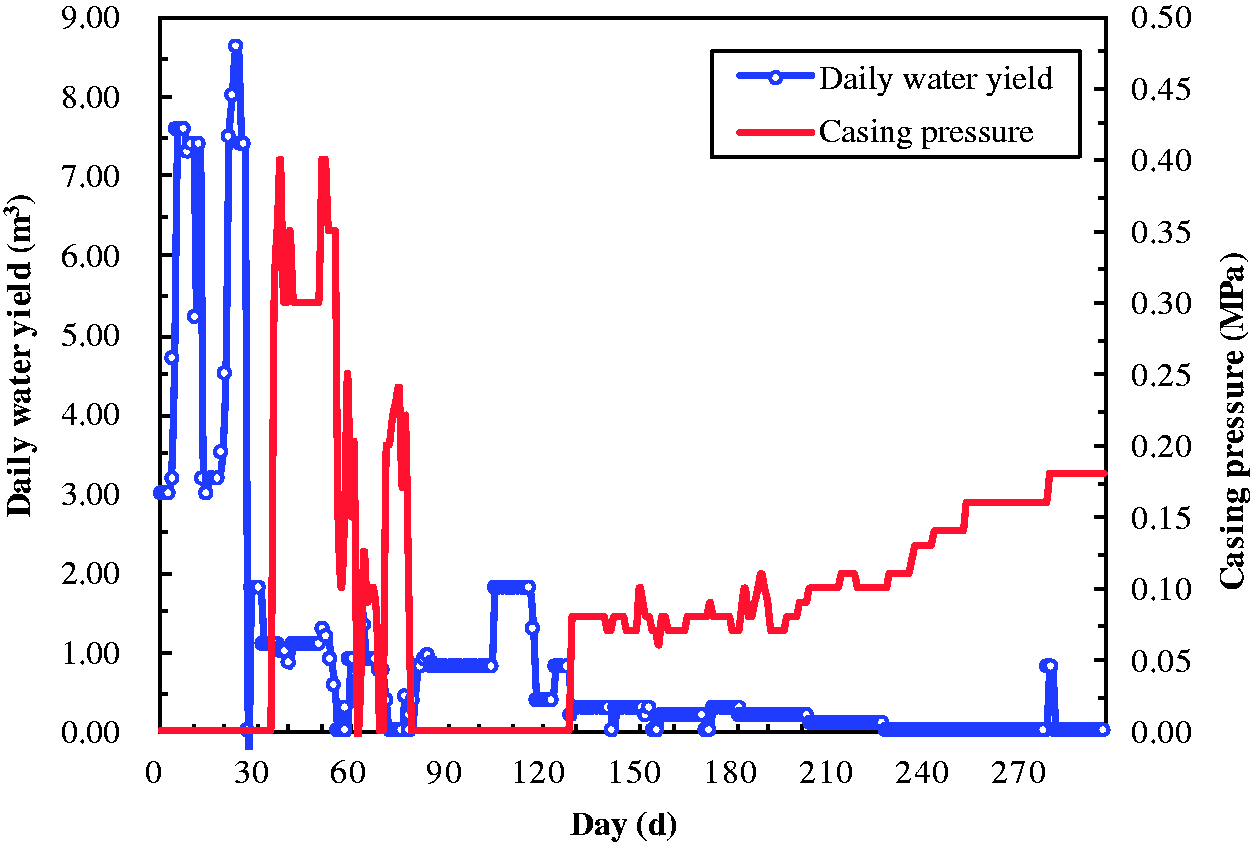
The change of the daily water yield in XJ-1 well.
Analysis on eliminating outburst risk of coal seam
It can be seen from the analysis above that the length of the half wing fracture in XJ-1 well is 156.8 m, while the coal reserves within the range of the fracture are approximately 286.2 kt. The exponentially function fitting the cumulative output of gas and the period length of drainage in XJ-1 well (as shown in Figure 14) is as follows.

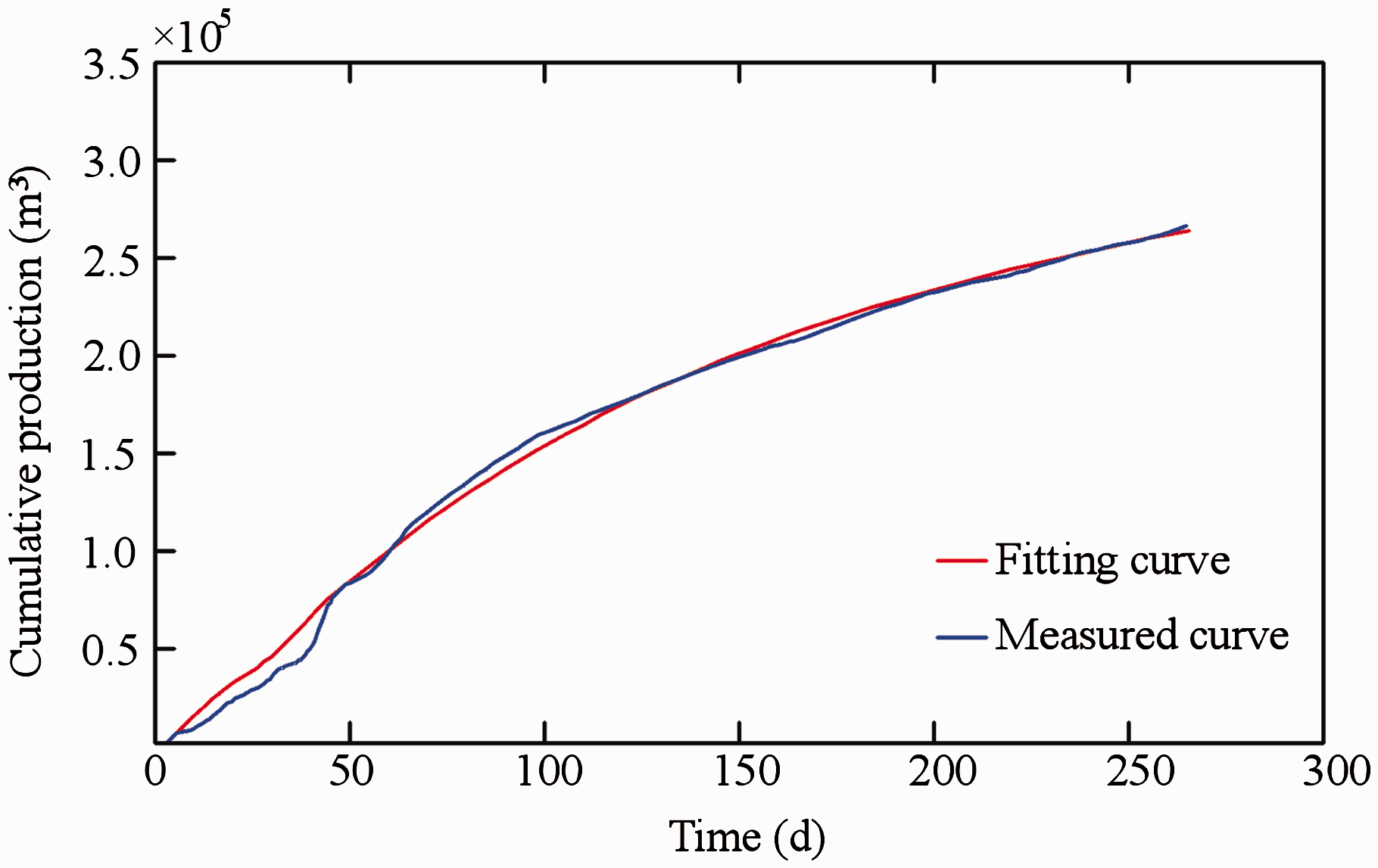
The forecast of gas output in XJ-1 well.
According to equation (5), on the 1976th day of the drainage, the cumulative output of the gas would reach 1,227,899 m3. Then, the content of gas will drop to less than 8 m3/t, eliminating the outburst risk of coal seam.
Comparison with the regular CBM well
XJ-1 well is located in the fault structure region that is controlled by the north syncline of the Danshan-Fowa, with the geostructural belts creating conditions favorable for the reservoir of coal seam gas. The main purpose of this ground vertical fracturing well in the geostructural belts gas drainage experiment was to determine the influences of the fault structural belts that is controlled by the north syncline of the Danshan-Fowa on the ground gas drainage. The gas drainage data for 3–156 well shows the law of influence of the geostructural belts on drilling ground fracturing well gas drainage.
3–156 well (the roof to floor depth of coal seam #3 was 531.85–534.45 m, while the roof to floor depth of coal seam #15 was 657.65–665.05 m, and the bottom depth of the pump was 667.18 m) was a regular CBM well. This coalbed methane well drained 59,042 m3 of gas in 363 days, with an average drainage rate of 163 m3/day. The maximum daily gas production reached 368 m3/day on the 53th day after the initial gas production.
Based on the gas drainage results of XJ-1 and 3–156 (as shown in Table 6), it was found that, in case coal seam #15 was not fractured, XJ-1 well drained an average of 923.07 m3/day of gas, which was 5.67 times than that of the 3–156 well. XJ-1 well drained a maximum of 4707 m3/day of gas, which was 12.88 times than that of 3–156 well. Thus, it can be seen that, a ground fracturing well in a sealed thrusting fault belts, controlled by an inclined geostructural, can achieve a better gas drainage results.
Comparison on gas drainage results of XJ-1 well and 3–156 well.

Conclusions
This case has studied the actual situation of outburst accidents in the Yangquan mining area, usually occurring at the geostructural regions, to solve the problem of coal and gas outbursts during excavation of the coal tunnels. Ground well with hydraulic fracturing was constructed at the geostructural belts.
On the basis of the influence of geostructure on coal seam gas occurrence and outbursts, combined with the geostructure distribution of the coal seam #3 in the test area, the fundamental reason for the frequent gas overrun and outburst accidents along the North-9 roadway in coal seam #3 of XJ Mine during the tunnels excavation was revealed, while suggesting a method for the selection of the ground vertical well location along the geostructural belts in coal seam #3 of XJ Mine.
The “triple-control” technology for hydraulic fracturing, namely, the high pressure, stable flow, and low sand ratio technologies, for ground vertical well with hydro-fractures can overcome the technical problem of sand plugging in the geostructural belts. The effect of forming fissures on improving the permeability of coal seam and maintaining the coalbed methane well for a long-term efficient drainage was confirmed. This technology provides a technical reference for coal seam gas drainage with similar geological conditions.
Reasonable process parameters of ground fracturing vertical well gas drainage technique at the geostructural belts of outburst-prone coal seam in XJ Mine were obtained. Compared with 3–156 well, which was the conventional coalbed methane well, the initiation pressure of fracturing XJ-1 well was higher, while it took longer for the fracture to close after the termination of pumping. The effect of coal seam fracturing was significant in improving coal seam permeability. Constructing ground fracturing well in a sealed thrusting fault structural belt, controlled by an inclined structure, can achieve improved gas drainage.
Footnotes
Declaration of conflicting interests
The author(s) declared no potential conflicts of interest with respect to the research, authorship, and/or publication of this article.
Funding
The author(s) disclosed receipt of the following financial support for the research, authorship, and/or publication of this article: This work was supported by the National Natural Science Foundation of China (grant no. 51774279), Fundamental Research Funds for the Central Universities (grant no. 2015XKMS093), and a Project Funded by the Priority Academic Program Development of Jiangsu Higher Education Institutions (grant no. SZBF2011–6-B35).