




Abstract
The primary problem needed to be solved in mining close coal seams is to understand quantitatively the floor failure depth of the upper coal seam. In this study, according to the mining and geological conditions of close coal seams (#10 and #11 coal seams) in the Second Mining Zone of Caocun Coal Mine, the mechanical model of floor failure of the upper coal seam was built. Calculation results show that the advanced abutment pressure caused by the mining of the upper coal seam, resulted in the floor failure depth with a maximum of 26.1 m, which is 2.8 times of the distance between two coal seams. On this basis, the mechanical model of the remaining protective coal pillar was established and the stress distribution status under the remaining protective coal pillar in the 10# coal seam was then theoretically analysed. Analysis results show that stress distribution under the remaining protective coal pillar was significantly heterogeneous. It was also determined that the interior staggering distance should be at least 4.6 m to arrange the gateways of the #209 island coalface in the lower coal seam. Taken into account a certain safety coefficient (1.6–1.7), as well as reducing the loss of coal resources, the reasonable interior staggering distance was finally determined as 7.5 m. Finally, a novel method using radon was initially proposed to detect the floor failure depth of the upper coal seam in mining close coal seams, which could overcome deficiencies of current research methods.
Keywords
Introduction
Coal has a share of more than 90% in the fossil fuel resources of China, and this trend will not change significantly in the short term (Michieka, 2014). As for the most resource-exhausted mines, due to various historical reasons and limitations of mining technical conditions, the single thick coal seam with superior occurrence conditions inside the mines is usually preferentially mined (Kumar et al., 2015). On the other hand, the mining of CCSs with relatively complex geological conditions is normally postponed for a long time. In most mines, after continuing a large-scale and high-intensity mining for several years, reserves of mineable coal seams with high quality get exhausted. This causes gradually a tense situation of subsequent production (Liu et al., 2017; Zhang et al., 2013). Therefore, the issues on mining CCSs have to be reconsidered in many mines in order to extend the service life of mines (Tan et al., 2010; Xiong et al., 2015). This would enhance the recovery ratio of coal resources and ensure the sustainable development of aged mines.
Currently, large proportion of CCSs in minable coal resources does exist in many mining areas, China (Wang et al., 2013; Wu et al., 2008; Yan et al., 2009; Yan et al., 2015), e.g. Huainan, Huaibei, Datun, Gujiao, Pingdingshan, Shuicheng, Xinwen, Handan, Kailuan, Jinglong, Xishan, Huozhou, Datong, Baoji, Shuangyashan, Fuxin, Binchang, Urumchi and some more. In most of the above-mentioned mining areas, there are more than two or even up to 10 or 30 mineable coal seams. Generally, as for the mining of multiple coal seams, when the distance between the upper coal seam (UCS) and lower coal seam (LCS) is large, e.g. the distance is greater than 30–40 m, the mining of the UCS affects the mining of the LCS to a little. The behaviour of mine pressure during practical production is basically the same with that of regular mining of single coal seam (Hu and Wu, 2013; Khanal et al., 2016; Ren et al., 2014; Singh and Singh, 1999). However, when the distance between the UCS and LCS gradually decreases, mining of the UCS and LCS affects more and more on each other. Especially when the distance between the UCS and LCS is small, then these coal seams can be considered as CCSs, and the mining of the UCS will cause different levels of damages to the roof of the LCS, which is the floor of the UCS (Nasedkina et al., 2008; Tan et al., 2010). Also, stress can easily concentrate in the remaining protective coal pillar (RPCP) after the mining of the UCS (Singh et al., 2002; Zhang et al., 2014). The concentrated stress then will transfer to the deep rocks, causing a significant change in structures and stress environment in the roof of the LCS (Berk et al., 2016; Chanda, 1989; Guo et al., 2012). It thus creates huge difficulties in gateways arrangement and support of the LCS (Gao et al., 2016; Wang et al., 2014).
Recently, the problems in mining CCSs have gradually attracted many researchers in the mining industry. However, most relevant studies of mining CCSs still depend on empirically qualitative judgments (Khare et al., 2006; Porathur et al., 2014). Theoretically quantitative calculation and practical engineering detection of the FFD of UCS during CCSs mining are still lacking. Currently, two types of methods to exploit CCSs are available (Ghabraie et al., 2017; Heasley and Akinkugbe, 2005; Kong et al., 2014; Maleki et al., 1986; Sun et al., 2014; Xie et al., 2014). The first method is based on the traditional descending mining of the single coal seam. After the mining of the UCS, gateways of the LCS will be arranged after the roof caving been stable. This method does not account effects of the FFD of UCS and the stress concentration in RPCP. Due to this, causing unreasonable gateways arrangement of the LCS, a strong behaviour of mine pressure and significant difficulty in later stage maintenance of gateways prevail. The second method is the coordinated mining of the UCS and LCS, i.e. both the UCS and LCS will be mined at the same time with a certain interior staggering distance (ISD). The benefit of this method is able to avoid time-effect influences of the floor failure of the UCS in the mining of LCS as much as possible. However, it is significantly difficult to organize and realize the coordinated mining during a practical production process.
Therefore, the primary problem needed to be settled in mining CCSs is to quantitatively understand the FFD of UCS. According to the mining and geological conditions between #10 and #11 coal seams in the Second Mining Zone (SMZ) of Caocun Coal Mine (CCM), the mechanical model of floor failure of UCS was built in this study, and the FFD of #10 coal seam was theoretically calculated. Then, the features of stress distributions under the RPCP of UCS were theoretically analysed using the elastic mechanics. Based on this, the reasonable ISD of gateways arrangement of the #11 coal seam also had been determined. Finally, a novel method using radon was initially proposed to detect the FFD of UCS during CCSs mining. This novel method thus helps to overcome the deficiencies of current traditional methods. Research results can provide a theoretical basis for reasonably arranging gateways of the LCS.
Mining and geological conditions
The CCM locates at about 7 km southeast of Huozhou City, Shanxi Province, China. Its terrestrial coordinates are 111°44'–111°48' East longitudes, 36°31–36°31' North latitudes. It has a strike length from east to west ranging from 2.1–5.3 m, a dip width from south to north ranging from 2.5–3.5 m, and an area of about 13.77 km2. The area has a surface of strongly dissected loess hilly landform and alternately consists of ditches and beams from east to west. The relative altitude difference between the zenith located in the north with an elevation of +783 m and the nadir located in the southeast with an elevation of +606 m is 177 m.
The main minable coal seams in the SMZ of CCM from top to bottom are stated as follows: the #2, #9, #10 and #11 coal seams. Figure 1 shows the generalized column of the SMZ. Currently, the #2, #9 and #10 coal seams have been completely mined out, and the mining of the #11 coal seam is still in process.
The #10 coal seam has a thickness ranging from 1.85–8.06 m with an average value of 4.43 m, a dip angle ranging from 2–10° and an average value of 6°. The coal seam floor has significantly varied lithology and consists of the dominant medium and fine sandstones and some sandy mudstone or black mudstone. The #11 coal seam has a thickness ranging from 1.6–1.7 m with an average value of 1.65 m, a dip angle ranging from 3–12° and an average value of 7.5°. The immediate roof consists of mudstone, with a thickness ranging from 1.0–1.6 m and an average value of 1.3 m. The main roof consists of fine sandstone which is mainly the quartz, with a thickness ranging from 3.4–4.2 m and an average value of 3.8 m. The generalized column of the SMZ.
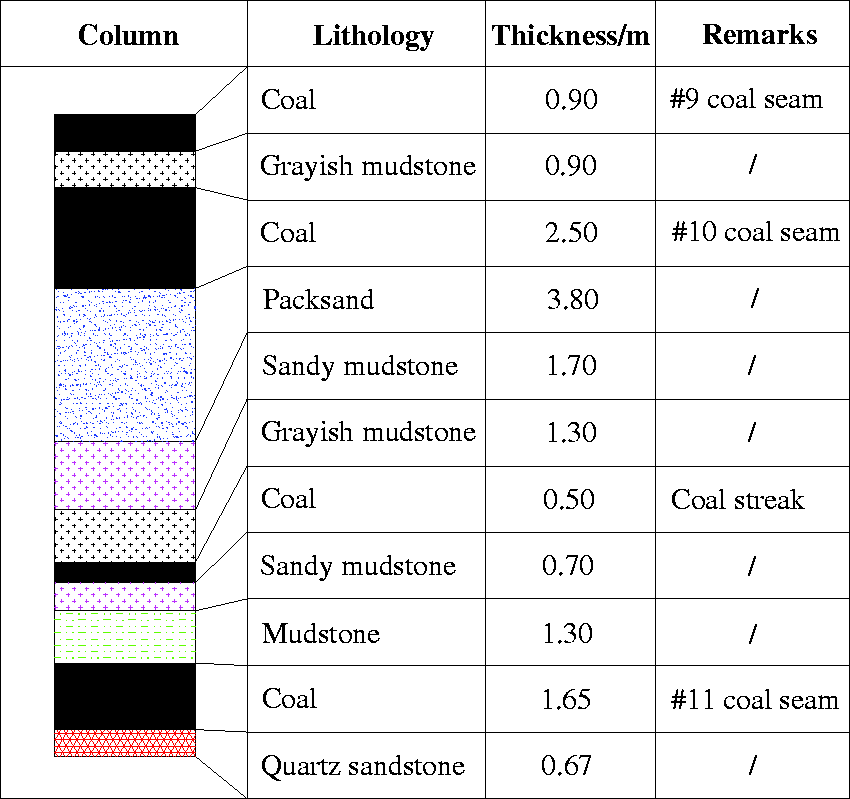
The #10 and #11 coal seams in the SMZ has a vertical distance ranging from 8.4–10.2 m and an average value of 9.3 m, and thus are characterized as ultra-close coal seams. The #10 coal seam in the SMZ has been mined out, and the width of RPCP is 18 m. In the #11 coal seam of the SMZ, there is only the #209 coalface that hasn’t been mined yet, which becomes a typical island coalface and causes worse mining conditions for gateways arrangement and support.
Calculation of the FFD during UCS mining
Establishment of the mechanical model of floor failure
The fully caving method was adopted to deal with the goaf roof of the #10 coal seam. After the roof caving being stable, where will form a stress-relaxed area. Therefore, the primary problem needed to be settled in subsequent production of CCM is to select an appropriate location to arrange the gateways of the remaining #209 island coalface. According to the positional relationship of the #10 and #11 coal seams, the mechanical model of floor failure (Figure 2) was established after simplifying its occurrence conditions. Figure 2 shows that when the coalface advances forward, the floor failure of UCS occurs within the certain range, and the point F is the deepest failure point. When the abutment pressure of the floor continuously moving forward, failure points will form an approximate parallel line FG, which is the failure line. In the meantime, under the advanced abutment pressure, the floor strata will become fragmental after the failure, which makes that the relation between the coal wall and the floor is similar with that of the building base and the foundation.
The mechanical model of floor failure.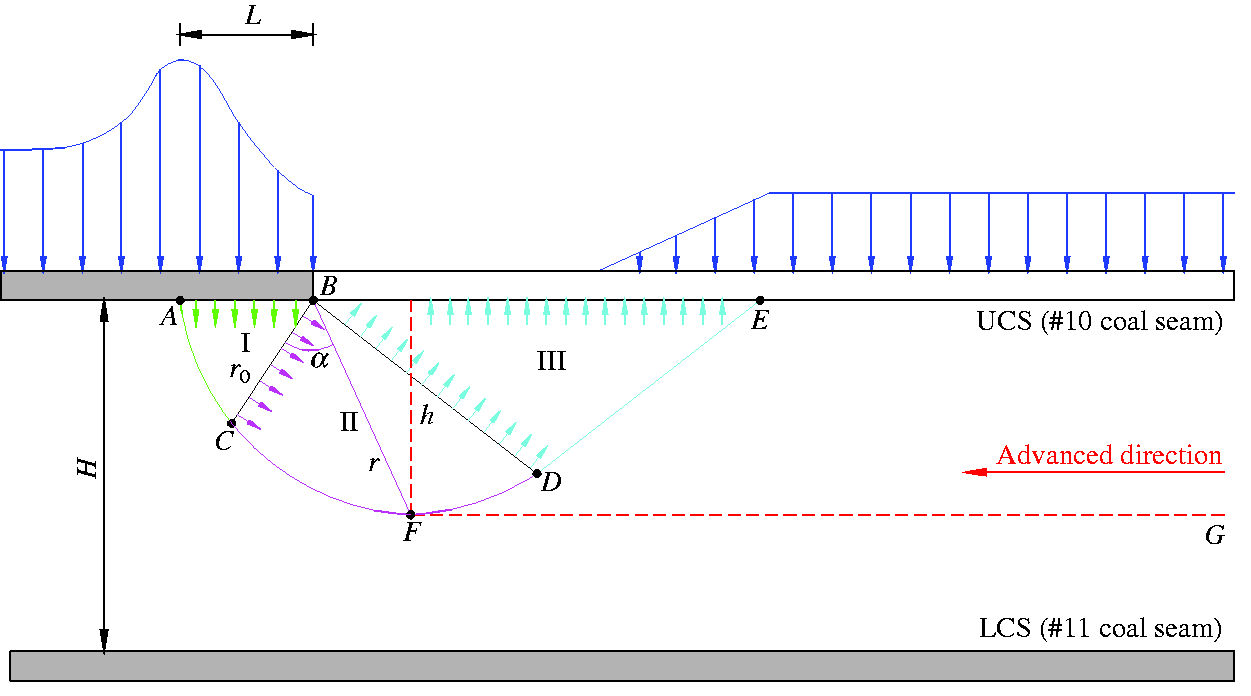
Calculation of the FFD
According to the calculation method of elastic foundation in soil mechanics (Zhao et al., 2000), as well as the mine pressure theory of coalface overburden (Jayanthu et al., 2001; Peng, 2015; Yu et al., 2012), the FFD caused by mining the #10 coal seam of CCM can be divided into the following three regions:
The active limit region (Region І) The transition region (Region ІІ)

The curve CD is the logarithmic spiral with the point B as the origin and the spiral equation is as follows
The passive limit region (Region ІІІ)


The abutment pressure accounts primarily for the floor failure of the #10 coal seam. Figure 2 shows that

Given that

If we suppose dh/dα equals zero, the maximum FFD will be obtained.

The maximum FFD can be calculated using the following equation

According to the experimental data of the #10 coal seam in CCM (Xu et al., 2017), the maximum advanced abutment pressure located at about 12 m ahead of the coalface. Therefore, the value of L can be determined as 12 m. The internal friction angle ϕ ranging from 33.5 to 38.9° can be determined as 36°. Then

Calculation result shows that the maximum FFD caused by the mining of #10 coal seam has entered into the #11 coal seam. After mining of the #10 coal seam, the stress-relaxed area occurs within the certain scope of the goaf. Then, the interior staggering type can be qualitatively determined to arrange the gateways of the #209 island coalface in the #11 coal seam.
Features of stress distributions under the RPCP
After mining of the #10 coal seam in the SMZ, stresses at different levels will concentrate in the RPCP with 18 m width, and then transfer to the lower strata. It will directly affect the gateways arrangement of the #209 island coalface in the #11 coal seam. Due to the relative hard roof of the #10 coal seam, hanging roof at different levels will occur on both sides of the RPCP. Therefore, the weight of the goaf’s overlying strata will be transferred to the RPCP through plates or beams (Mandal et al., 2008).
The total load on the RPCP is

The uniform load on the RPCP is

Given that S is 18 m, W is 160 m, D is 215 m, d is 5 m, δ is 35°, and γ is 1.32 × 10⁴ N/m3, according to the specific mining and geological conditions of the #10 coal seam in the SMZ of CCM, it can be calculated and obtained from the equation (9) that

Simplifying the coal-rock mass as the heterogeneous elastic media, the mechanical model of the RPCP (Figure 3) can be established. According to elastic mechanics theory (Li and Guan, 2006; Poulsen, 2010; Suchowerska et al., 2013), stress components of uniform loads at any point (θ, r) in the infinite plane of plates can be expressed in polar coordinates as follows
The mechanical model of the RPCP. (a) The model under concentrated loads. (b) The model under uniform loads.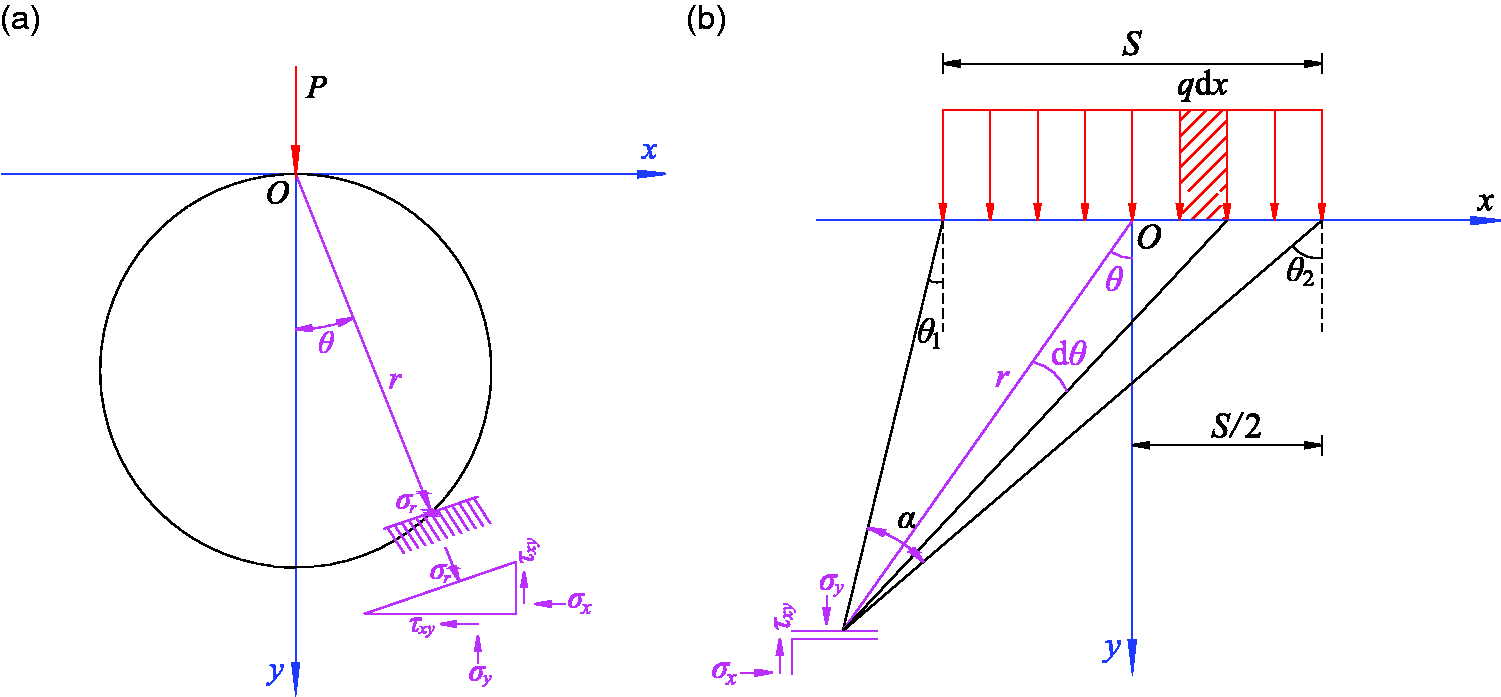



Equations (10) to (12) can be transformed from polar coordinates to rectangular coordinates as follows



Integrating and then correcting equations (13) to (15), stresses at any point in the floor of the RPCP under uniform loads can be obtained and expressed as follows



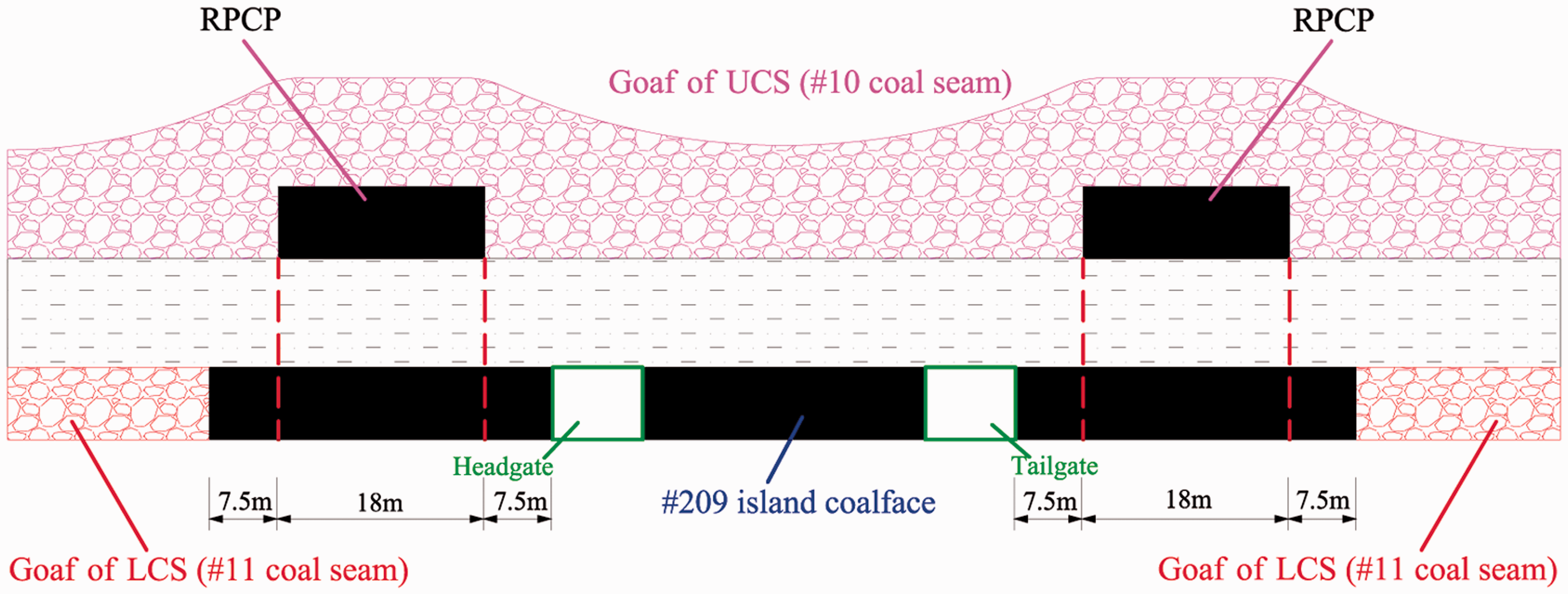
Substituting the width (18 m) of the RPCP in the #10 coal seam into equations (16) to (18), distributions of shearing stresses, horizontal stresses and vertical stresses at various floor depths of the RPCP under uniform loads can be calculated (Figure 4). Figure 4 shows that all the above three types of stresses distribute heterogeneously, decay and disperse with the increasing horizontal distance to the RPCP. However, their transferring laws are different. When the depth increases, the peak values and ranges of shearing stresses and horizontal stresses are affected to a little and kept at about in-situ stress values. However, as for vertical stresses, when the depth increases, the ranges increase, while the peak values gradually decrease and the number of peak values changes from one to two. At the depths of 8 and 10 m, the maxima of vertical stresses appear at locations with the distance to the centreline of the RPCP of 12.8 and 14.1 m, respectively, which indicates that the stress-relaxed area exists at locations where the distance to edges of the RPCP is larger than 3.8–5.1 m. The average vertical distance between the #10 and #11 coal seams in CCM is 9.3 m, locating at 8–10 m below the RPCP. Consequently, it can be initially determined that the stress-relaxed area exists at locations where the distance to edges of the RPCP is larger than 4.6 m through calculation using the approximate average values. It indicates that the ISD to arrange the gateways of the #209 island coalface in the #11 coal seam should be larger than 4.6 m. Taken into account a certain safety coefficient (1.6–1.7), as well as reducing the loss of coal resources, the reasonable ISD for the gateways of the #209 island coalface was finally determined as 7.5 m (Figure 5).
Features of stress distributions at various floor depths of the RPCP. (a) shearing stress, (b) horizontal stresses, (c) vertical stresses. RPCP: remaining protective coal pillar. Gateways arrangement of #209 island coalface.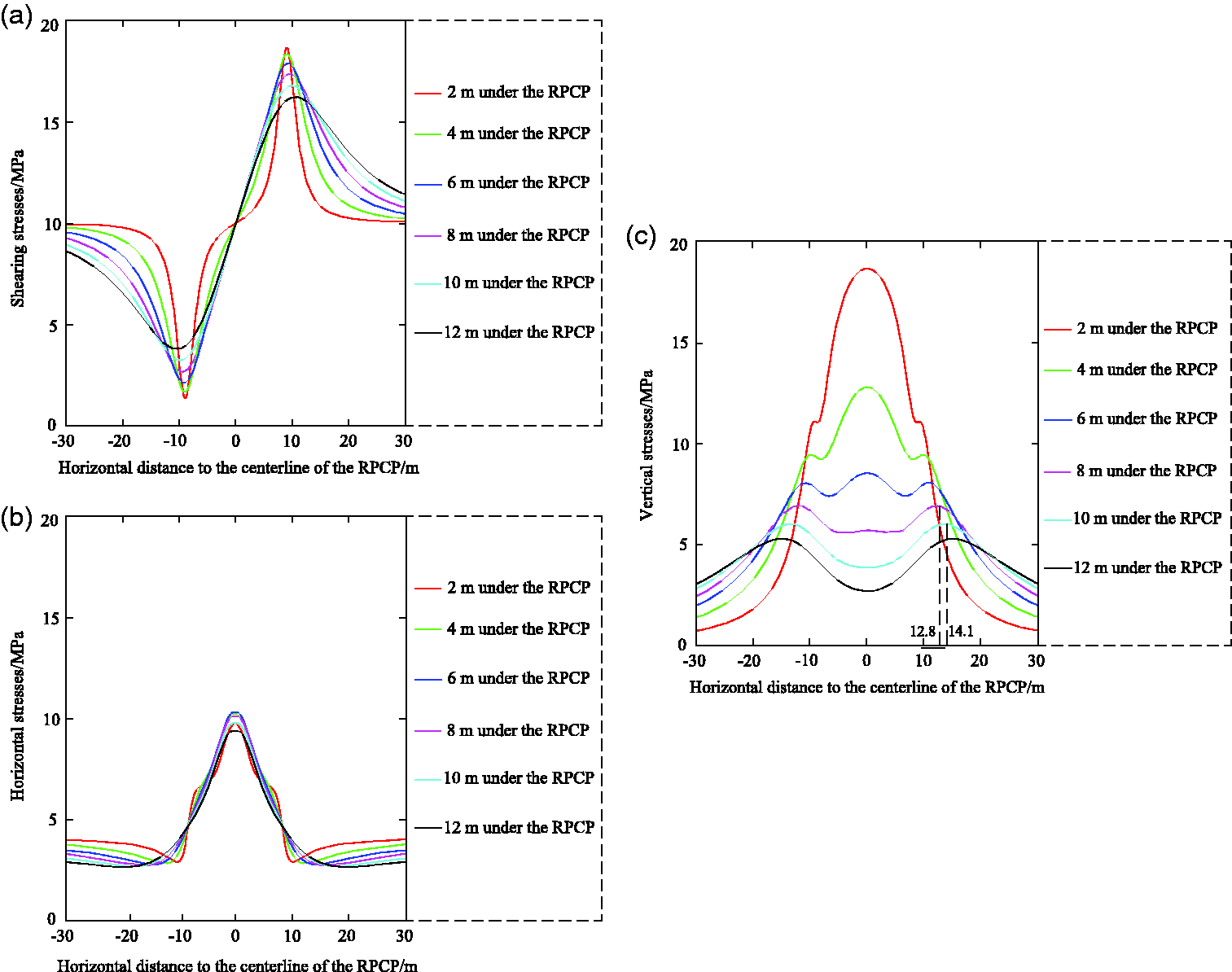
Discussion
Currently, research methods about the FFD of the UCS during CCSs mining mainly include theoretical calculations, numerical simulations and field measurements (Yao et al., 2011; Yin et al., 2016; Zhu et al., 2014). As for theoretical calculations, there are certain deviations between the final results and the practical situations due to simplifications of relevant specific mining and geological conditions during calculating. As for numerical simulations, it is difficult to accurately reflect the actual situations on site since it is hard to select accurate parameters during establishing numerical models. As for field measurements, existing detecting methods are easily limited by mining conditions, which cannot guarantee the accuracy and validity of detection results and seriously affect the safe and efficient mining of CCSs.
Radon (222Rn) is a radioactive inert gas that can be come into contact with human beings, has a half-life period of 3.82 days, has strong migration ability under natural conditions and widely exists in coal seams, rocks, soils and water in nature. Principles of proposing the method using radon to detect the FFD of the UCS during CCSs mining are as follows (Sun et al., 2016; Zhang et al., 2016). First, radon can be detected even at a very low concentration due to its radioactivity. Second, radon holds the physical and chemical properties of an inert gas, i.e. it can migrate and accumulate into microcracks or micropores. Therefore, a novel method using radon (Figure 6) was initially proposed, which overcomes deficiencies of current research methods. This novel method is not limited by specific mining conditions but has small engineering installation, low cost, strong operability, high efficiency, practicability and popularization. Data acquisition through this method is also easy. However, it should be pointed out that this novel method has not been verified by on-site engineering yet. Therefore, the feasibility of this method should be verified through more subsequent engineering practices, and then be further improved and optimized.
Schematic diagram of the radon detection method.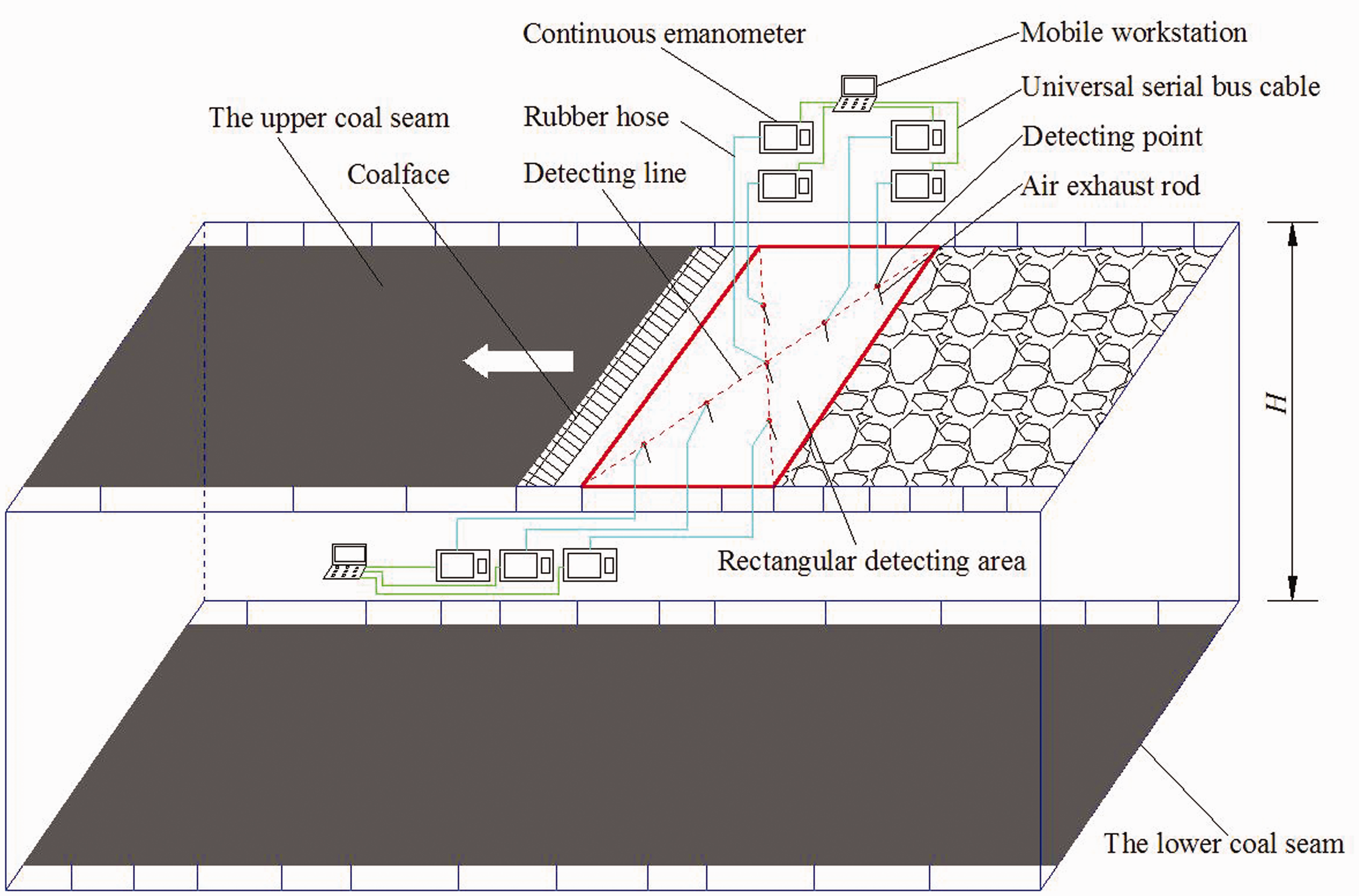
Procedures for operating the radon detection method on site are stated as follows:
According to the vertical distance H between the UCS and LCS, as well as the inclined length of the coalface in the UCS, determine the rectangular area to detect the FFD of the UCS during CCSs mining. During the mining of the UCS, arrange two detecting lines in advance along diagonal lines inside the already determined rectangular detecting area, and then arrange detecting points on each line with a certain interval (50–60 cm) separately. At each detecting point, make a drilling hole with a diameter of 5 cm and a certain depth (50 cm) vertically into the floor strata of the UCS, seal the air exhaust rod of the continuous emanometer (KJD-2000R, Xstar Company, Chengdu, China) inside the drilling hole and connect the air exhaust rod to the continuous emanometer using the rubber hose with a diameter of 5 mm. Turn on all continuous emanometers and begin the detecting work. Detect each point for three hours, and transmit detecting results to the mobile workstation (Thinkpad P71, Lenovo Company, Beijing, China) using universal serial bus (USB) cables to plot the variation curves of radon concentration. After finishing detecting all points inside the rectangular detecting area, according to the variation features of radon concentration, as well as the mining and geological conditions, the evolution characteristics of the mining-induced fractures in the floor strata of the UCS could be analysed. On this basis, the FFD of the UCS during CCSs mining can be further obtained through inversion.
Conclusions
Mechanical calculation results of floor failure show that the advanced abutment pressure caused by the mining of the #10 coal seam in CCM resulted in the FFD with a maximum of 26.1 m, which is 2.8 times of the distance between the #10 and #11 coal seams. After mining of the #10 coal seam, the stress-relaxed area occurs within the certain scope of the goaf. The interior staggering type can be qualitatively determined in order to arrange reasonably the two gateways of the #209 island coalface in the #11 coal seam. Calculation results of the RPCP show that the floor of the RPCP in the #10 coal seam under uniform loads from the roof, distributions of shearing stresses, horizontal stresses and vertical stresses at various depths are heterogeneous. When the depth increases, the peak values and ranges of shearing stresses and horizontal stresses are affected to a little and kept at about in-situ stress values. However, as for vertical stresses, when the depth increases, the ranges increase, while the peak values gradually decrease and the number of peak values changes from one to two. On this basis, It is further determined that the ISD to arrange the gateways of the #209 island coalface in the #11 coal seam should be larger than 4.6 m. Taken into account a certain safety coefficient (1.6–1.7), as well as reducing the loss of coal resources, the reasonable ISD was finally determined as 7.5 m. A novel method using radon was initially proposed to detect the FFD of the UCS in mining CCSs, which overcomes deficiencies of current research methods. The radon detection method is not limited by specific mining conditions but has small engineering installation, low cost, strong operability, high efficiency, practicability and popularization, and its data acquisition is easy. However, it should be pointed out that this method should be verified in the feasibility by more subsequent engineering practices, and then be further improved and optimized.
Footnotes
Acknowledgements
We wish to thank the CCM for supporting to conduct this important study, as well as Mengtang Xu from Guizhou Institute of Technology, China, for the assistance of field data collection. Special thanks are given to Mapletrans Company in Wuhan, China, for its professional English editing service. The authors are also grateful to the editor and two anonymous reviewers for their constructive comments and helpful suggestions.
Declaration of conflicting interests
The author(s) declared no potential conflicts of interest with respect to the research, authorship and/or publication of this article.
Funding
The author(s) disclosed receipt of the following financial support for the research, authorship and/or publication of this article: This work was financially supported by the National Natural Science Foundation of China (Nos. 51404254 and 41601500), the National Basic Research Program of China (No. 2015CB251600), the Scientific Research Foundation of State Key Laboratory of Coal Mine Disaster Dynamics and Control (No. 2011DA105287-FW201602), the Jiangsu Qing Lan Project (No. 2016-15) and the Foundation Research Project of Jiangsu Province (Nos. BK20150051 and BK20140186).