




Abstract
In order to obtain lower coal seam mining of roof breaking characteristic and the law of mine pressure appearance in the close distance coal seams, this paper takes working face 6101 of a mine as the engineering background, and studies the roof breaking characteristics and pressure law in close distance coal seam through theoretical analysis, numerical simulation and engineering verification, which provides the basis for roof control in lower coal seam mining. The results show that the maximum failure depth of 4# coal seam mining on floor is 8.28 m. The lower coal seam mining roof forms a “loose-block” structure, and the main roof fracture step distance is 44.61 m. The UDEC simulation shows that the initial weighting intensity of 6# coal seam is large, and the first weighting distance step is about 40 m. The hydraulic support with the highest working resistance should be chosen based on the roof pressure analysis, and the weighting is frequent. The hydraulic support with higher working resistance should be selected through the analysis of roof pressure, some control measures should be taken to strengthen the organization and management, and prevent the occurrence of roof disasters. The roof is effectively controlled through engineering verification. The study further recognizes the laws of mining pressure appearance in lower coal seam of close distance coal seam, and provides experience for similar mine mining.
Keywords
Introduction
Close distance coal seams exist in all major mining areas and are widely distributed in China. When the layer spacing is close, downward mining is often used for the mining of close-distance coal seam. The bottom plate after upper layer coal mining is the roof of lower coal seam. After the upper coal seam mining, the strength and stress distribution of the roof in the lower coal seam mining area changes, and the roof effective control is the key to the lower coal seam mining, so it is very important to study the roof breaking characteristics in the close distance coal seam.
Some scholars have studied the problems arising from close-distance coal seam mining (Cheng et al.; Ning et al. 2020; Yang et al. 2022). The bearing structure characteristics of overlying strata in the overlying goaf in short-distance coal seams mining are the main factors inducing roof dynamic disasters. The bearing structure and stability characteristics of overburden strata in shallow-buried interval mined-out area of Yushenfu mine in northern Shanxi province are studied (Zhang and Wang 2021). In view of the occurrence conditions and mining technology of 11# coal seam in Pingshuo mine, the initial caving step distance of the main roof in the first working face of 11# coal seam is analyzed by using the mechanical model of the main roof supported rock beam, and the method of using deep hole pre-splitting blasting in the roof to weaken in the cutting eyes of the working face is proposed. (Jiang et al., 2014). In view of the complex conditions of extremely close repeated mining broken roof, firstly, the support strength is analyzed. A new type of two-column shield hydraulic support is developed. The adaptability of the support is analyzed from many aspects through engineering practice, and the application effect of the support is verified (Si 2019). In order to solve the problem of roadway stability and instability in repeated mining of near-distance coal seam group, the mechanism and control technology of roadway surrounding rock instability were studied in repeated mining of near-distance coal seam group. The restoration plan of long bolt + high strength anchor cable + U steel + grouting is proposed to reduce the risk of roadway instability (Xiong et al. 2021). In order to discuss the distribution law of stress field under goaf under the way of pillar - less roof plate cutting and retaining roadway mining, the following Shanmao Coal Mine are taken as engineering background. The stress field distribution of GERRCP and traditional residual columns is studied by combining theoretical analysis and numerical simulation (Liu et al. 2019).
At present, there are many studies on the erosion rock structure and migration law of single coal seam mining. The layer spacing is narrow due to the impact of layer spacing in the process of close distance coal seam mining. The effect law of roof deformation and failure of the lower coal seam is still insufficient after the upper coal seam mining is accomplished, and more research is needed. The key to safe and effective lower coal seam mining is studying the roof fracture characteristics and pressure law. Therefore, this paper takes working face 6101 as the engineering background, mainly studies the roof fracture characteristics and law of mining pressure appearance in the mining of lower coal seam, which provides certain reference significance for the downward mining of close distance coal seams.
Engineering background
The average thickness of the 6# coal seam is 3.6 m, and the average dip angle of the coal seam is 5°, according to the mining of working face 6101 at a coal mine. Working face 6101 is close to 4# coal seam and most of them have been mined. The average thickness of 4# coal seam is 3.6 m. The interval between 4# coal seam and 6# coal seam is 6.36 m ∼ 8.60 m. The average interval between 4# coal seam and 6# coal seam is 7.9 m. According to the definition of close distance coal seam in China's coal mine safety regulations, the mining of 4# coal seam and 6# coal seam belongs to close distance coal seam mining. All caving method is used to control the roof after 4# coal seam mining. The geological histograms of 4# and 6# coal seams are shown in Figure 1.
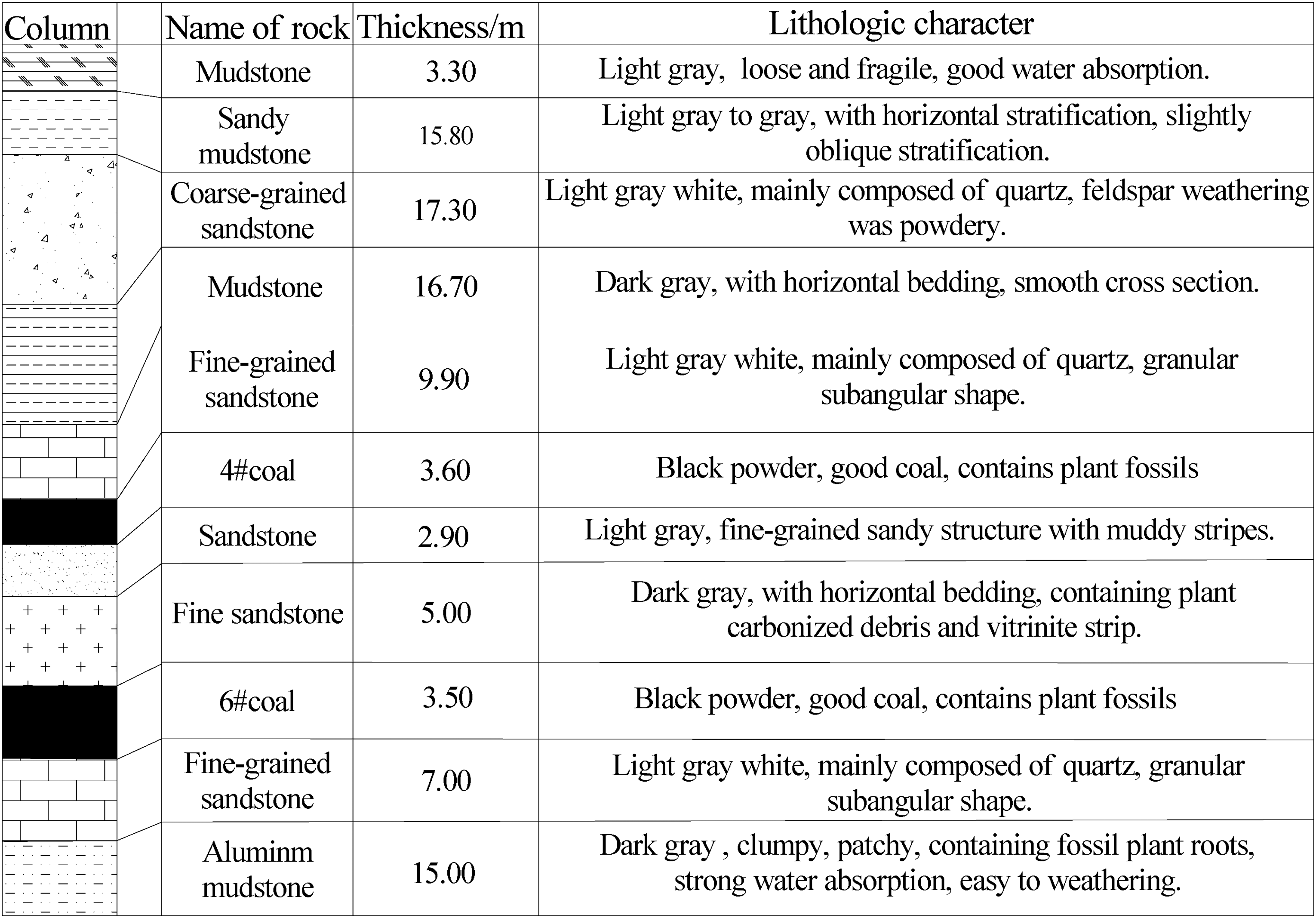
Geological column diagram of 4# coal seam and 6# coal seam.
Roof failure characteristics of lower seam mining
The stress of the floor is redistributed after 4# coal seam mining, resulting in cracks in the rock mass of the floor and even damaged. The mining of 4# coal seam directly affects the roof fracture characteristics in the mining process of 6# coal seam. Therefore, it is of great significance to understand the damage depth of the floor after the mining of 4# coal seam, which is of great significance to the roof state of the working face in 6# coal seam and the reasonable support method (Chen et al., 2020; Lu et al., 2021; Nandi et al., 2021; Zhang et al., 2020a; Zhu and Tu, 2017). According to the failure slip line theory of floor rock mass after coal seam mining, the failure slip line field of floor of 4# coal seam is shown in Figure 2.
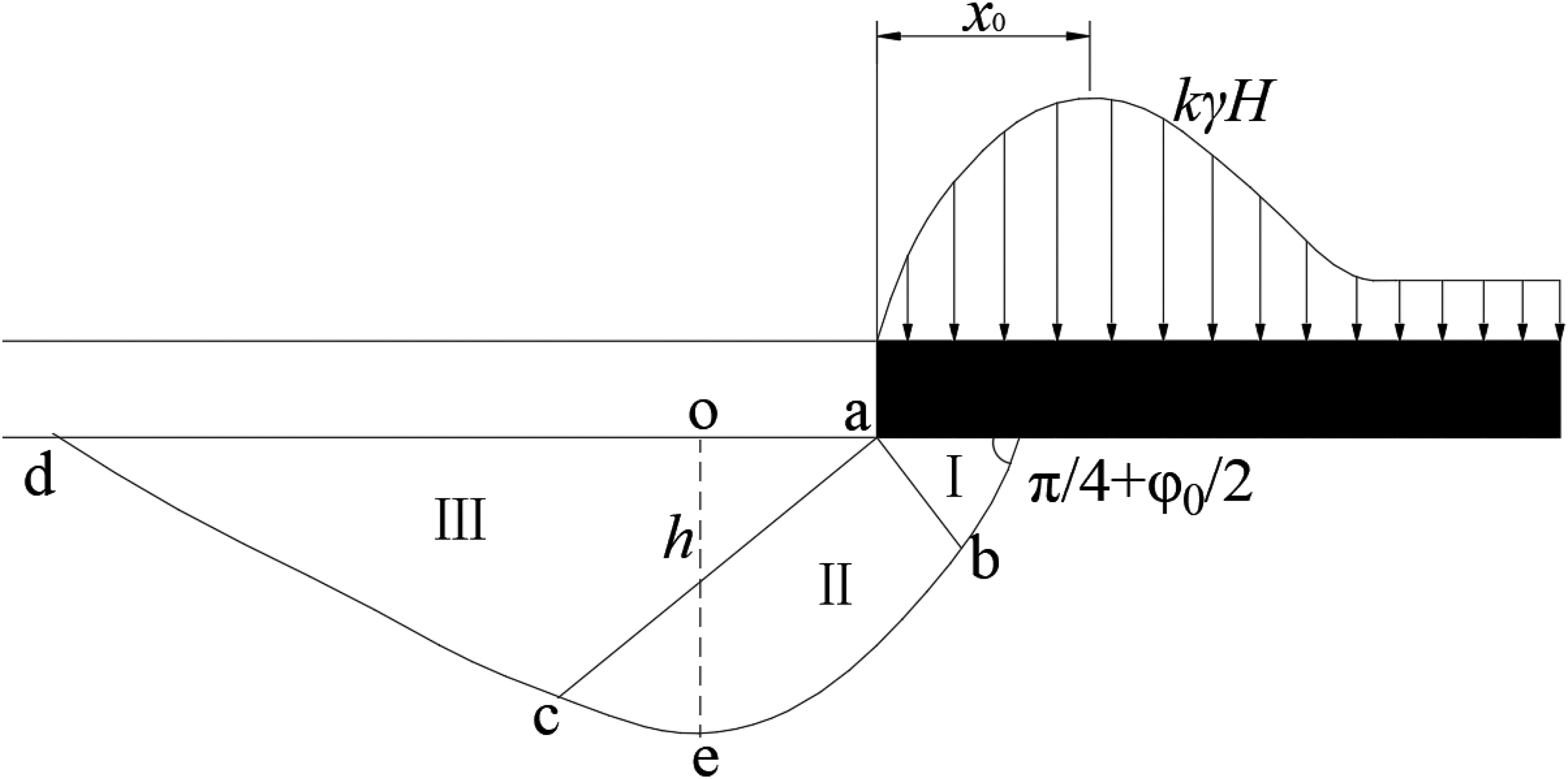
Sliding line field of floor failure. Remarks: I-active limit region; II-transition zone; III-Passive Limit Zone.
Then the maximum failure depth h of floor rock mass after coal seam mining in working face is:


According to the physical and mechanical parameters test of roof surrounding rock in working face 6101 and the actual geological and engineering mining conditions, the slip line field theory is adopted to obtain that the maximum failure depth of floor after mining in 4# coal seam working face is 8.28 m, and the distance between 4# coal seam and the lower 6# coal seam is 6.36–8.60 m. Therefore, when 6# coal seam is mined under 4# coal seam working face, the roof of 6# coal seam is affected by 4# coal seam mining, and its roof can be regarded as a block structure with fully developed joints and fissures, which is prone to roof fall accidents. Therefore, it is necessary to study the roof fracture characteristics of lower coal seam mining, so as to carry out timely and effective support in the process of lower coal seam mining to prevent the occurrence of roof surrounding rock instability accidents.
Fracture characteristics of lower coal seam roof
Roof breaking structure in lower coal seam mining
Due to the narrow coal seam spacing and the influence of upper coal seam mining, the immediate roof collapses and fills the goaf, and the main roof breaks to form a “masonry beam” structure when the lower coal seam of the close distance coal seams is mined. Since the roof is managed by the caving method, the upper part of the roof is the loose gangue falling from the goaf of the upper coal seam working face, which can be regarded as a loose structure. The roof's surrounding rock is shattered, and the damaged main roof can be considered a block construction. The gangue in the lower coal seam's goaf is classified as a granular structure (Kong et al. 2021; Zhang and Wang 2021; Li et al. 2022a,b; Wang et al. 2022; Wu et al. 2022). According to the structural characteristics of the roof strata under the close distance coal seams, it can be abstracted as a “loose-block-loose” structural model, as shown in Figure 3:
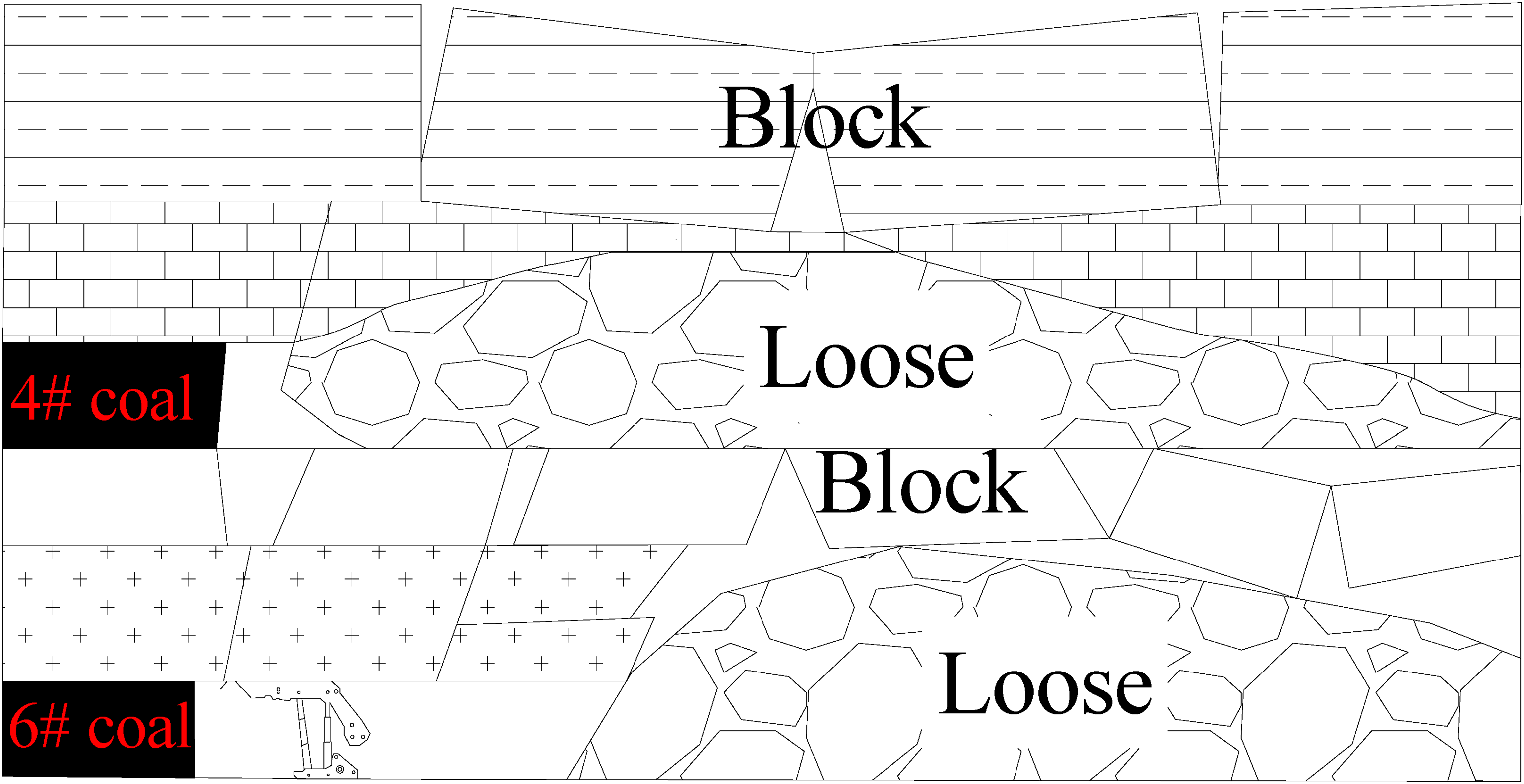
Broken roof structure of lower coal seam mining.
Lower coal seam roof caving step distance
The main roof fractured rock block formed hinged structure after 4# coal seam mining, resulting in the roof filling at the boundary is not real, and the load on the roof of the interval rock is uneven. Block A in compaction state has high load, which is called stress recovery zone. Block B near the boundary is in the stress reduction zone (Xue et al.; Zhang et al. 2014; Huang et al. 2018; Suo et al. 2021). As shown in Figure 4, q1 is the load of goaf gangue under block A, and q2 is the load of block B and goaf gangue, q1 < q2.
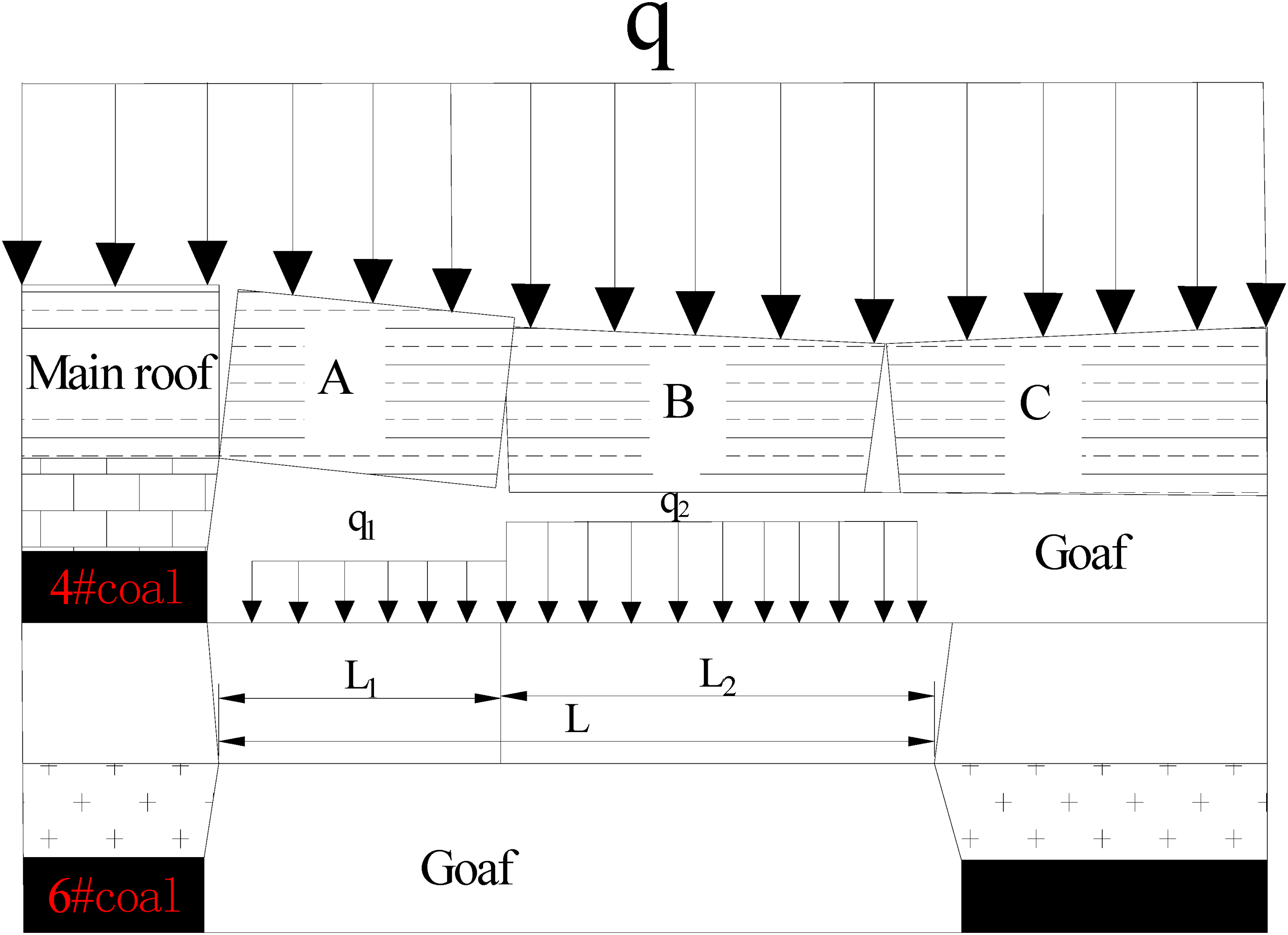
Mechanical model of main roof of 6# coal seam.
According to the tensile failure criterion(Huang et al. 2018), the ultimate span of rock beam is:

Due to the effect of uneven load on the interval rock, it can be concluded that:

According to the above analysis, it can be concluded that the first ultimate caving step of the main roof is 44.61 m in the mining of 6# coal seam.
Numerical simulation study on underground pressure law of lower coal seam
The Mohr-Coulomb model in UDEC software is used to establish a numerical model of working face 6101 in a coal mine based on the geological conditions and mining technology. The Mohr-Coulomb model defines the failure of materials by shear yield, and the yield stress is only related to the maximum and minimum principal stresses, which is suitable for underground excavation of mining engineering. Therefore, the material constitutive relation selected in the simulation scheme is Mohr-Coulomb model to simulate the influence of 4# coal seam mining on 6# coal seam and roof fracture characteristics (Gao et al. 2014; Ma et al. 2018; Zhang et al. 2020b).
Establishment of initial model
In the model, the strike of coal seam is X axis, and the vertical direction of lead is Y axis. The length of the calculation model is 200 m, and the height is 100 m. The thickness of 4# coal seam is 3.6 m, and the thickness of 6# coal seam is 3.5 m. The mining depth of the working face is 300 m, and the vertical stress of 9 MPa is applied. The transition zone of 40 m is reserved on both sides of the boundary of the model in order to reduce the boundary effect. The left and right boundaries of the model limit horizontal displacement, and the lower boundary limit vertical displacement. The two sides are fixed boundary conditions, and the rate is zero. The bottom is also a fixed boundary, the velocity is zero, and the gravity acceleration is 9.8 m/s2. The relationship between the initial model and lithology is shown in Figure 5:
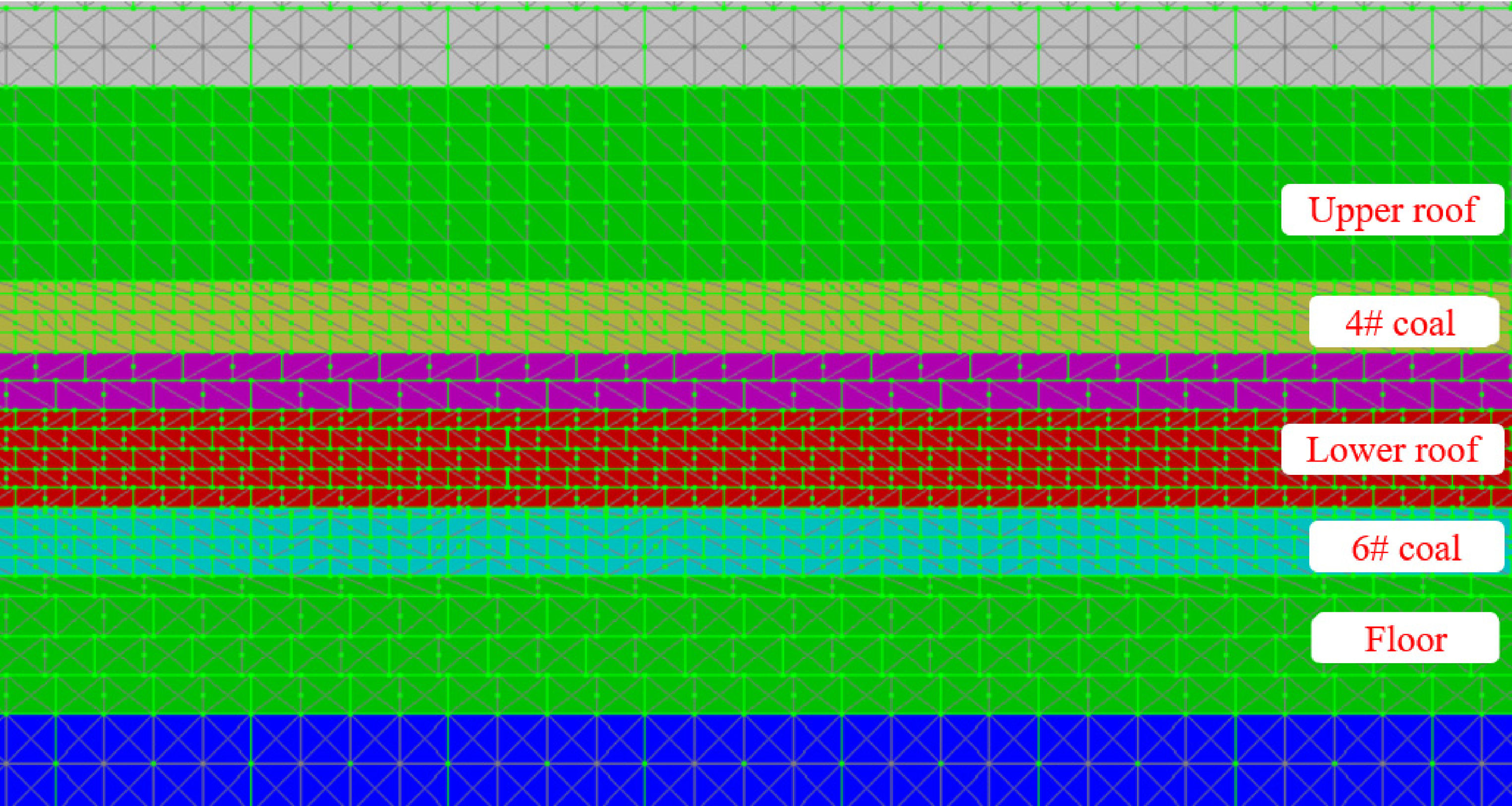
Relationship between initial model and lithology.
Floor fissure field and plastic zone development during upper coal seam mining
Figure 6 depicts the fracture development of the rock and floor following 4# coal seam mining. The floor cracks are concentrated on both sides of the goaf following the mining of the 4# coal seam, and the crack growth is visible. The maximum depth of the floor crack growth is 8 meters, which is greater than the roof thickness of the lower coal seam, posing a threat to lower coal seam mining. As a result, roof caving on both sides of the mining operation should be considered in the lower coal seam mining process.
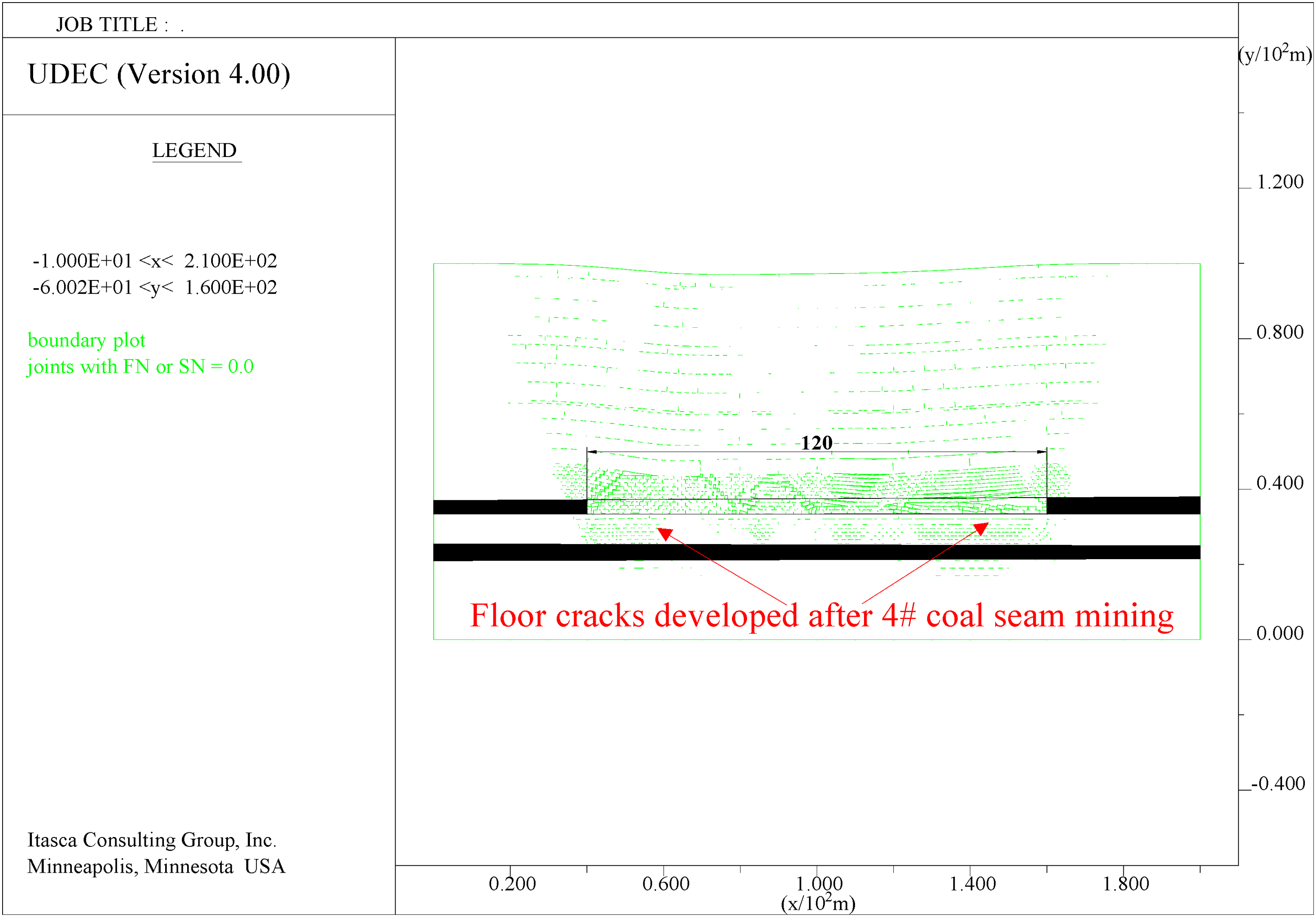
Floor crack development after 4 # coal seam mining.
This part mainly analyzes the relationship between the plastic-stress regional distribution of the floor rock mass in 4# coal seam mining and the advancing length of the working face. Some representative cases are taken out from the simulation calculation, which are 40 m, 60 m, 80 m and 120 m, respectively, as shown in Figure 7.
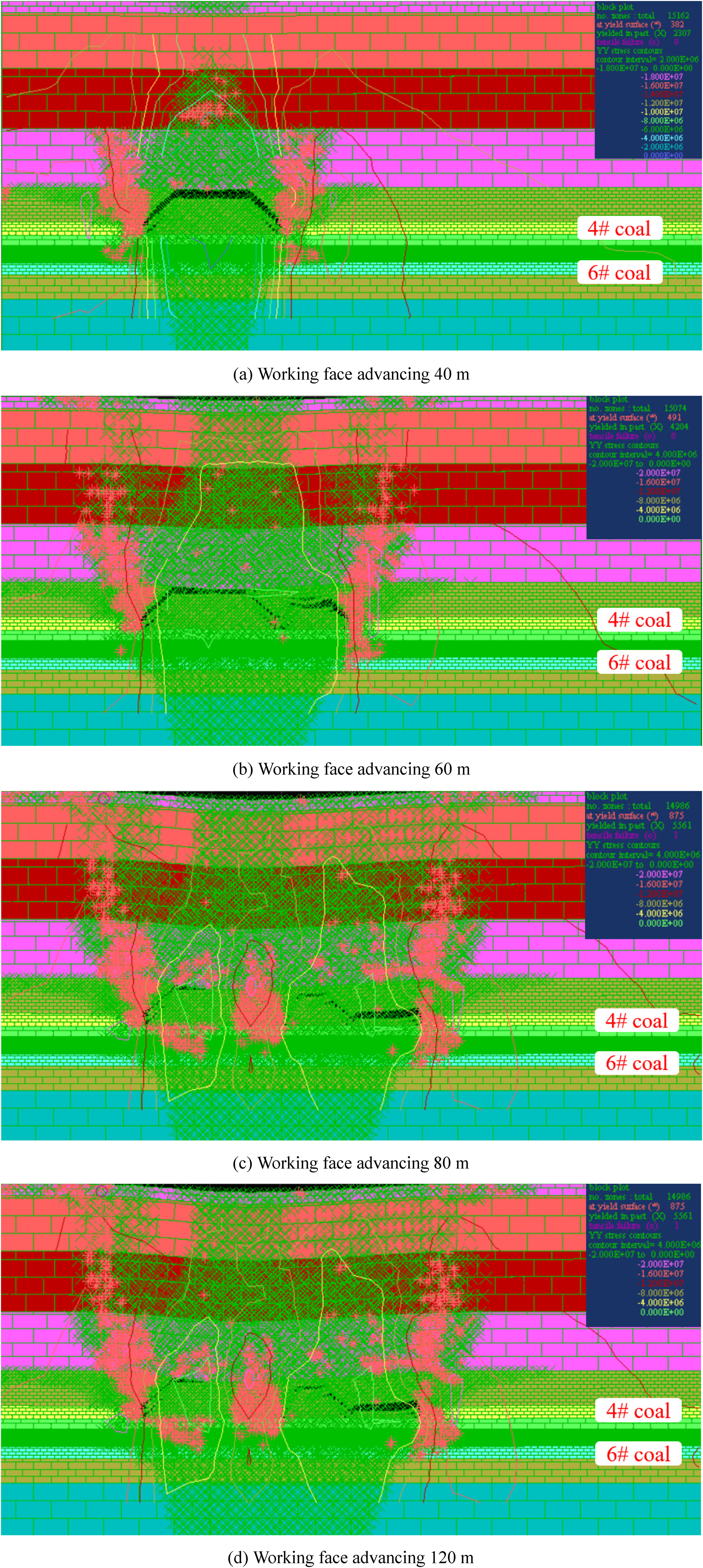
Plastic zone development and stress evolution at different propelling distances. (a) Working face advancing 40 m. (b) Working face advancing 60 m. (c) Working face advancing 80 m. (d) Working face advancing 120 m.
When the working face advances 40 m, the plastic zones on both sides of the roof are destroyed more, and the plastic damage on both sides of the coal seam is serious, and the cracks begin to develop to the roof and floor. When the working face advances 60 m, the floor failure depth extends downward, and the roof span increases, resulting in plastic failure at the center of the roof. When the working face advances 80 m, the failure range of the working face floor continues to increase, but the depth is no longer increased, and the plastic failure is still at both ends and the middle position of the working face. When the working face advances 120 m, the damage depth of the working face floor no longer continues to increase, basically stabilized.
The roof of the 6# coal seam is located in the failure zone of the 4# coal seam mining floor, and its roof has been damaged, since the interlayer spacing between 4# coal and 6# coal is 7.9 m, which exceeds the maximum depth of fracture development. As a result, in the lower coal seam mining process, it is vital to pay attention to roof support in order to avoid roof leaks from interfering with normal working face mining.
Roof breaking characteristics in lower coal seam mining process
Figure 8 shows the roof fracture structure of working face under different advancing distances. When the working face advances to 20 m, the roof of 6# coal seam is stable.
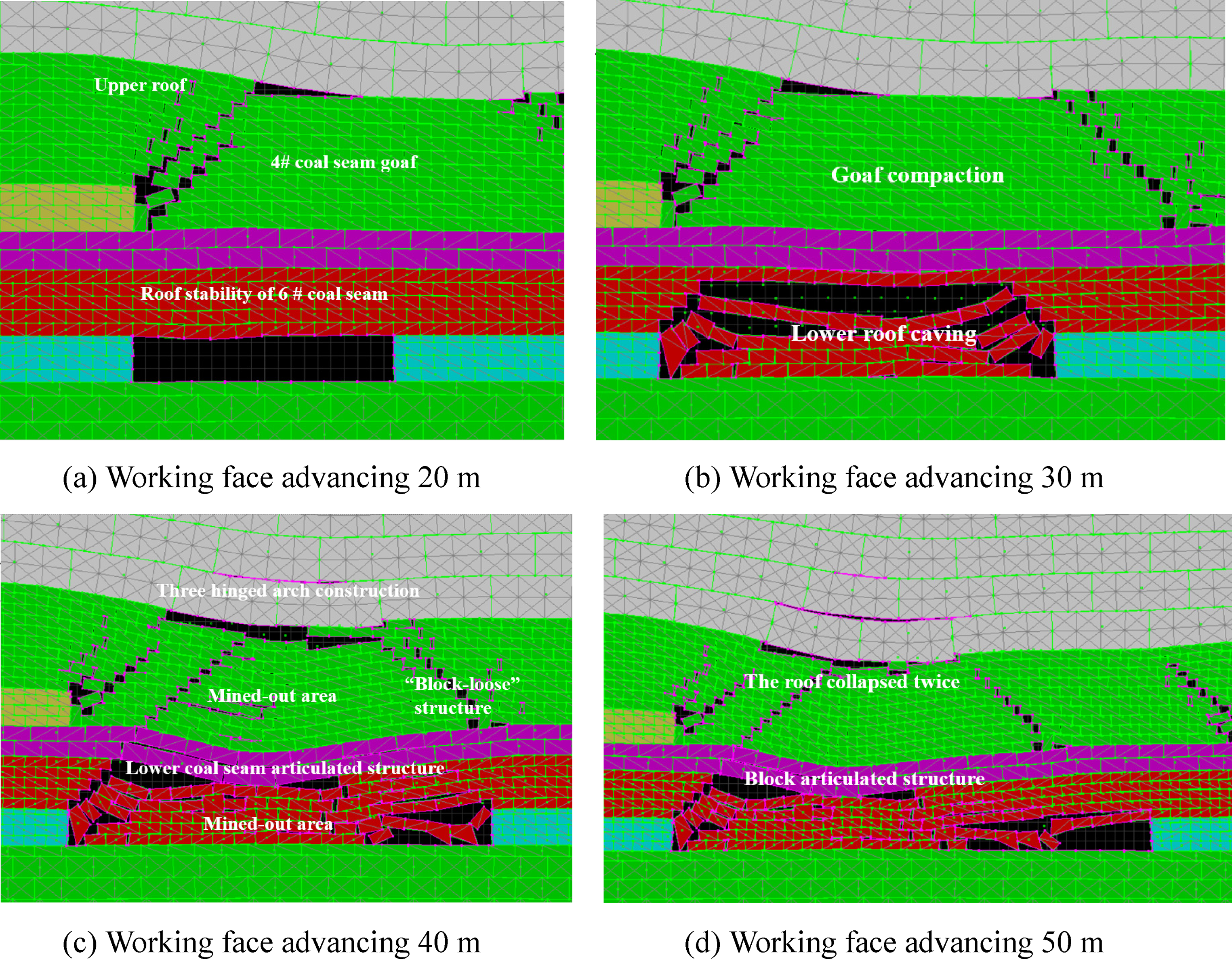
Roof breaking structure of working face under different advancing distance. (a) Working face advancing 20 m. (b) Working face advancing 30 m. (c) Working face advancing 40 m. (d) Working face advancing 50 m.
When the working face reaches 30 m, the immediate roof collapses for the first time, and the initial collapse step distance of the immediate roof is between 20 m and 30 m. When the working face reaches 40 m, the roof falls in a big area, the main roof seems to be a hinged structure, the upper goaf begins to sink, and the first weighing happens.
When the working face advances to 50 m, the upper coal seam's goaf bends and sinks, and the lower coal seam forms a hinged block structure that is prone to instability, resulting in the downward filling of the gangue in the upper coal seam's goaf, which leads to a change in the upper coal seam's roof structure and secondary roof caving, severely affecting lower coal seam mining. The roof caving creates a dynamic and static stress that renders the surrounding rock of the lower coal seam's working face and the mining highway unstable, resulting in roof deformation and instability and the breakdown of normal production.
Therefore, it is necessary to strengthen the cooperation between the hydraulic support system and other supporting methods in the mining process of the lower coal seam, adopt certain supporting measures, and strengthen the organization and management, so as to make the occurrence of roof disasters in the production process and improve the production efficiency.
Development and stress variation of plastic zone in lower coal seam mining
(Figure 9).
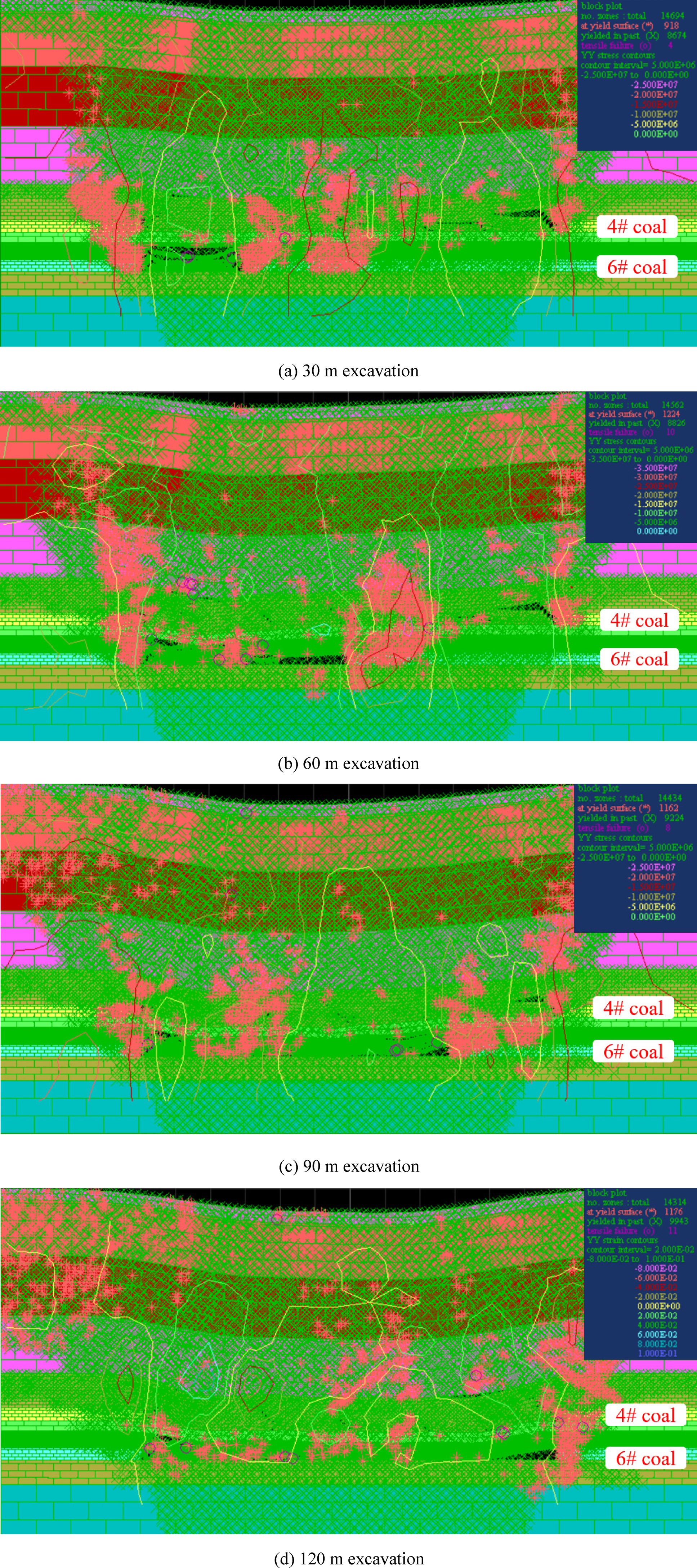
Development and stress change of plastic zone in mining of lower coal seam. (a) 30 m excavation. (b) 60 m excavation. (c) 90 m excavation. (d) 120 m excavation.
The immediate roof falls, the main roof deforms, and the plastic failure region is concentrated at both ends of the working face as the working face 6101 moves 30 meters. When the working face advances 60 meters, the deformation and failure zone is mostly focused at both ends of the working face and in the middle of the goaf, and the main roof is clearly sinking due to the immediate roof damage. At the same time, the area in the middle of the goaf has the most subsidence. The red region lessens as the working face moves 90 meters, but it remains concentrated at both ends of the working face, the damage area spreads upward, and the roof subsidence grows dramatically.
The stress of the surrounding rock of the working face changes as a result of coal seam mining, and stress concentration emerges at the front of the coal wall at both ends and in the back of the goaf. As the fully mechanized working face advances, the stress concentration phenomena becomes more apparent and tends to ease in a specific way, and the stress concentration position gradually spreads to both portions of the coal and rock mass. At the site of goaf, the caving rock mass is gradually compressed and bears the weight of a portion of the above rock mass, resulting in some stress variation.
Roof subsidence of lower coal seam mining
The roof subsidence of 6# coal seam mining is seen in Figure 10. There is no visible bending subsidence on the main roof when the advancing length of the working face is less than 20 m. The subsidence is greatly exacerbated when the advancing length is 30 m, and the roof of the lower coal seam is first collapsed. When the working face advances 40 m, the roof subsidence grows again, reaching its maximum subsidence, the roof first weighting, and then remaining stable; the change in roof subsidence is extremely slight, the periodic roof weighting is frequent, and the greatest subsidence happens twice. The highest subsidence is 3.55 m when the advancing length is 30 m and 55 m.
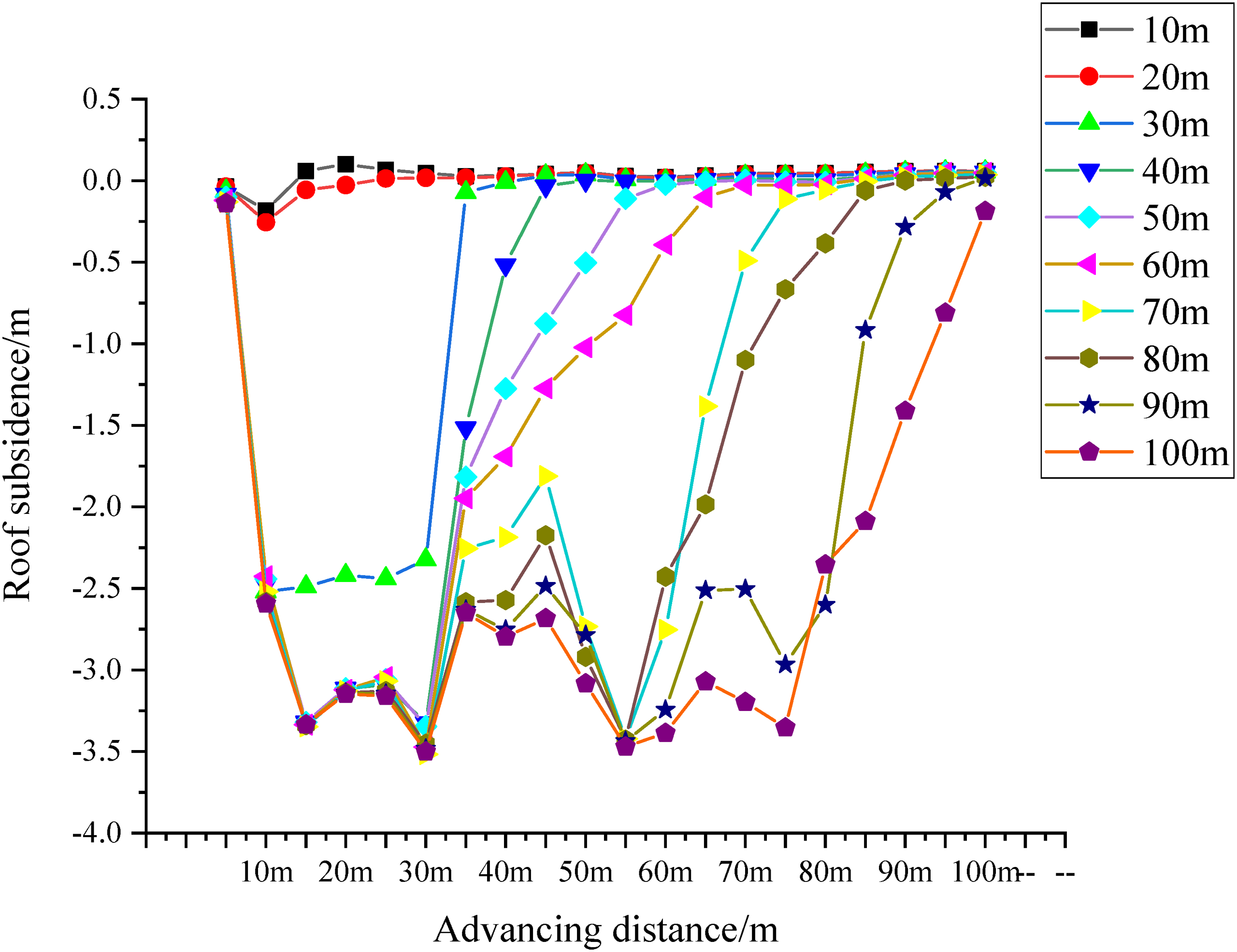
Roof subsidence of lower coal seam mining.
Change of roof pressure in lower coal seam mining
Figure 11 shows that while the process of repeated mining progresses, the roof pressure also gradually increases at the beginning, tends to be stable, and finally gradually decreases. The initial weighing happens, the strength is larger, and the periodic weighting step distance is shorter. Therefore, it is necessary to pay special attention to the mining process of the lower coal seam in the close-distance coal seams. When the working face first weighting, it is easy to cause the rapid increase of pressure and strong dynamic pressure phenomenon. The collaboration between the hydraulic support system and other supporting methods is reinforced during the 6# coal seam mining process, and some preventative measures are taken to avoid roof accidents.
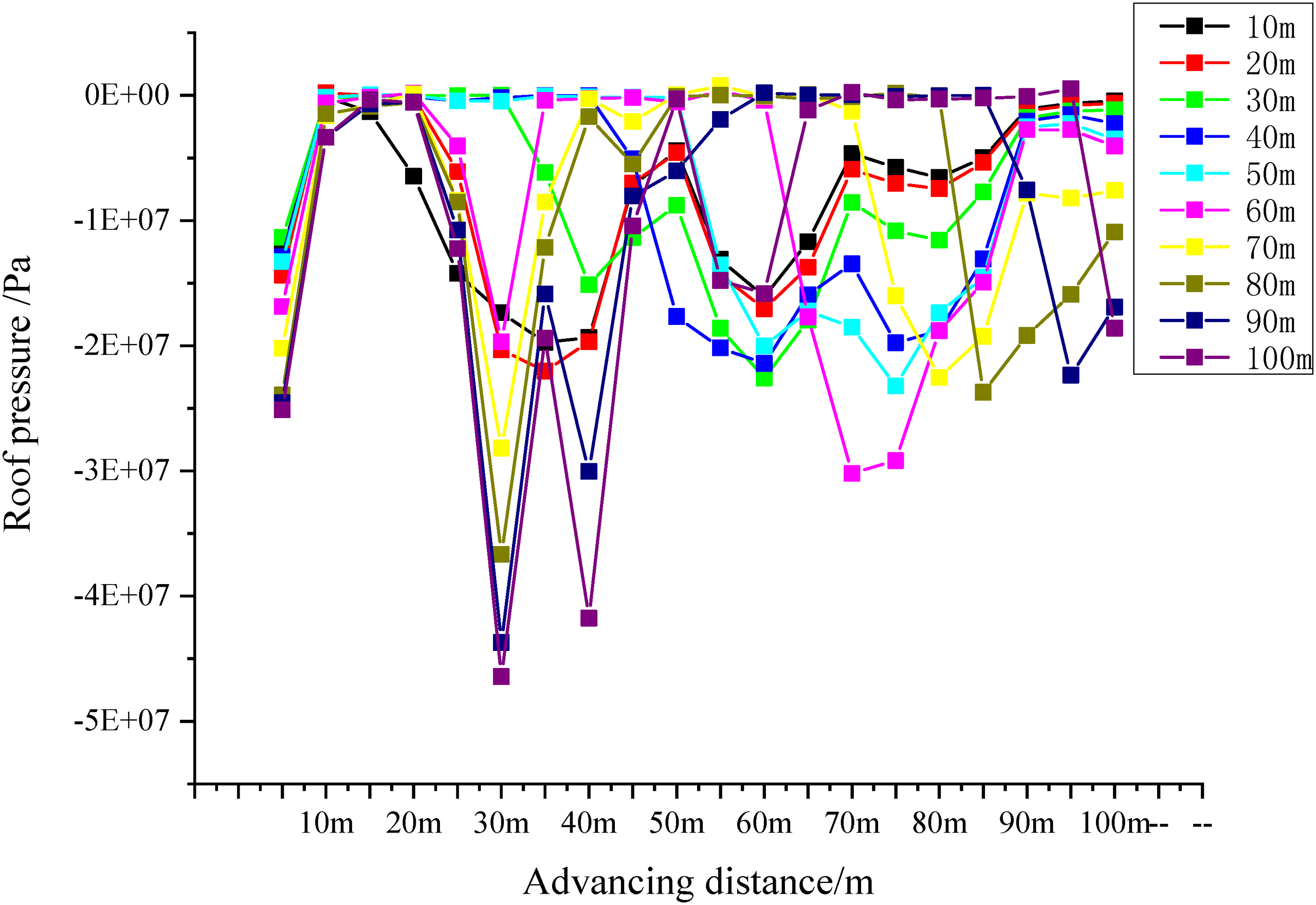
Roof pressure changes in lower seam mining.
Engineering test analysis of strata behavior law
Through the above analysis, it can be seen that the roof of the lower coal seam collapsed seriously in the mining process, and the working face came under frequent pressure, which led to the roof breaking and instability, thus damaging the hydraulic support and seriously affecting the normal production of the working face. Therefore, in the process of support selection, the hydraulic support with high working resistance is selected, with a rated working resistance of 6000kN.
The mean value of the front and rear columns of the support is utilized for analysis, and four groups of hydraulic support are chosen for on-line monitoring of operating resistance. Figure 12 shows the measured findings of the hydraulic support's working resistance as a function of the working face's advancing distance. Table 1 shows the peak working resistance of hydraulic support and its corresponding advancing distance.
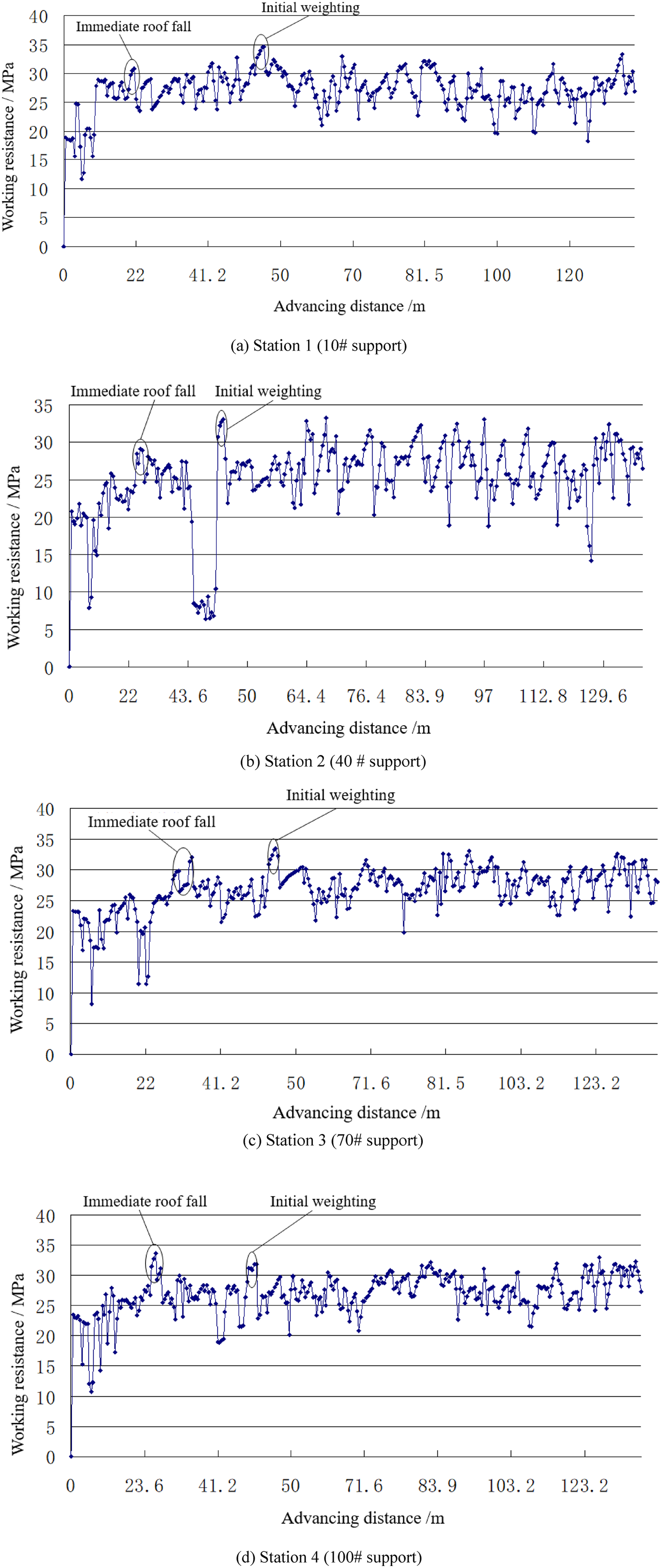
The measured results of hydraulic support working resistance with advancing distance of working face. (a) Station 1 (10# support). (b) Station 2 (40 # support). (c) Station 3 (70# support). (d) Station 4 (100# support).
Peak working resistance of hydraulic support and corresponding advancing distance.
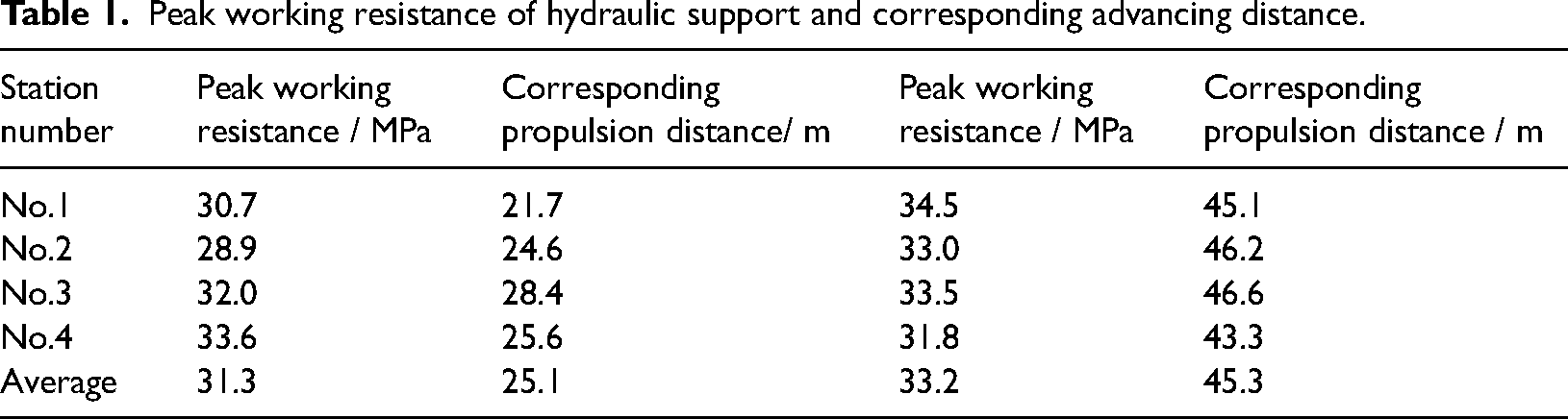
The initial collapse of the immediate roof in the mining operation of the 6# coal seam is approximately 25 m, and the initial collapse of the main roof is around 45 m, which is practically identical to the theoretical calculation and numerical simulation findings. To improve the control and management of the roof during the working face pressure, the appropriate support measures are used. No accidents involving roof disasters or poor hydraulic support occur throughout the mining operation on working face 6101.
Conclusions
Through theoretical calculation, the floor failure depth of 4# coal seam mining is around 8.2 m, while the roof of 6# coal seam mining develops a “block-loose” structure. The roof weighing step distance is 44.61 m in lower coal seam mining.
The maximum depth of floor crack growth after 4# coal seam mining is 8.0 m, according to numerical simulation study, which is compatible with the theoretical portion and has influenced the mining of 6# coal seam. In the process of 6# coal seam mining, the initial caving step distance of the immediate roof is between 20 m and 30 m. The initial weighing happens when the working face advances to 40 m, the strength is high, and the first weighting distance step is roughly 40 m. As a result, in the mining process of the lower coal seam, it is required to improve the cooperation of hydraulic support systems and other supporting techniques, as well as to adopt certain auxiliary measures to ensure the safe production of the working face.
Through the monitoring of the working conditions of the field support, the initial collapse of the direct roof is about 25 m, and the initial collapse of the main roof is about 45 m, which verifies the theoretical calculation and numerical simulation results. The corresponding supporting measures are taken to strengthen roof control and management during the weighting period of working face. There is no roof disaster accident and the working condition of hydraulic support is good during the mining process of working face 6101.
Footnotes
Acknowledgements
We gratefully acknowledge the financial support of this research comes from the National Natural Science Foundation of China (grant nos. 51964036)
Data availability statement
All data, models, and code generated or used during the study appear in the submitted article.
Declaration of conflicting interests
The author(s) declared no potential conflicts of interest with respect to the research, authorship, and/or publication of this article.
Funding
The financial support of this research comes from the National Natural Science Foundation of China, (grant number. 51964036).
